98
The utility of discourse parsing features
for predicting argumentation structure
Freya Hewett, Roshan Prakash Rane, Nina Harlacher, Manfred Stede
University of Potsdam, Germany
{hewett,rane,harlacher,[email protected]}
Abstract
Research on argumentation mining from text has frequently discussed relationships to dis-course parsing, but few empirical results are available so far. One corpus that has been annotated in parallel for argumentation struc-ture and for discourse strucstruc-ture (RST, SDRT) are the ‘argumentative microtexts’ (Peldszus and Stede, 2016a). While results on perus-ing the gold RST annotations for predictperus-ing argumentation have been published (Peldszus and Stede,2016b), the step to automatic dis-course parsing has not yet been taken. In this paper, we run various discourse parsers (RST, PDTB) on the corpus, compare their results to the gold annotations (for RST) and then assess the contribution of automatically-derived dis-course features for argumentation parsing. Af-ter reproducing the state-of-the-art Evidence Graph model from Afantenos et al. (2018) for the microtexts, we find that PDTB features can indeed improve its performance.
1 Introduction
The argumentative structure of texts, as captured, for instance, by schemata fromPeldszus and Stede
(2013) or Stab and Gurevych (2014), is repre-sented by tree structures that suggest a certain sim-ilarity to accounts of discourse structure, such as in Rhetorical Structure Theory (Mann and Thomp-son, 1988) or Segmented Discourse Representa-tion Theory (Asher and Lascarides,2003). These approaches aim at accounting for thecoherenceof texts, which is clearly related – though not identi-cal – to the structure of complex arguments. This is not a new observation (Habernal and Gurevych,
2017), but we are not aware of many empirically-grounded studies of the correspondences between the two realms. A corpus that facilitates such experiments is the ‘argumentative microtext cor-pus’ (Peldszus and Stede, 2016a), as it offers an-notation not only for argumentation but also for
discourse structure in terms of RST and SDRT. While there is evidence that RST trees can “in principle” be helpful for parsing the argumenta-tion (based on the gold annotaargumenta-tions; seePeldszus and Stede, 2016b), we are not aware of experi-ments which try to verify such effects with au-tomatic parsers. Our work aims to bridge this gap. We use common parsers for RST and for Shallow Discourse Parsing (specifically the Penn Discourse Treebank, henceforth PDTB), run them on the microtexts, and first compare the RST out-put to the gold annotations, in order to assess the prospects of the idea. Having selected the most promising parsers, we then compute a set of fea-tures from their output and add them to a state-of-the-art implementation of argumentation parsing on the microtexts (Afantenos et al., 2018). The results indicate that the parsed PDTB features do in fact improve the accuracy of the argumentation annotation.
Section2discusses related work, and Section3
describes the corpus and the discourse parsers we used. Initial analyses of parser results are given in Section4, and the experiments on predicting argu-mentation structure are reported in Section5. The paper closes with some conclusions in Section6.
2 Related work
for detecting argument components and relations between them. Stab and Gurevych (2014) com-pile a list of 55 discourse markers which indicate argumentative discourse and use these as features to detect the argumentative role in German essays. Eckle-Kohler et al. (2015) instead look at Ger-man news items which are annotated with the ar-gumentative roles ‘claim’ and ‘premise’ (with var-ious sub-categories). They found that both single discourse markers and semantic groups of such markers occurred in significant correlation with claims or premises. Turning specifically to RST, Green (2010) proposes the ArgRST annotation scheme, which represents both argumentation and discourse analysis in the same structure.Inter alia, she finds parallels between the RST relation ‘evi-dence’ and the premise and claim of an argument. Finally, Peldszus and Stede (2016b) present a qualitative study on the mapping from manual RST annotations to argumentation structure and also conduct experiments using a new feature set which is based exclusively on the gold RST anno-tation (of the ‘microtext’ corpus; see Section 3.1). These features include the position of the segment in the text, whether a segment has incoming or out-going edges, and the type of RST relation between segments, amongst others. They showed that es-pecially two subtasks of argumentation structure parsing in the microtexts (finding the central claim and the attachment point of segments) can clearly benefit from these features. Our project is a con-tinuation of that study, as we essentially replicate the model, but use automatically parsed RST trees instead of the gold annotations, in order to assess a “real world” scenario.
3 Data and parsers
3.1 Argumentative microtexts
Part 1 of the microtexts corpus (Peldszus and Stede, 2016a) is a freely available1 parallel cor-pus of 112 short texts with 576 argumentative seg-ments. They were originally written in German and have been professionally translated to En-glish, preserving the segmentation where possible. The texts have been collected in a controlled text generation experiment using a short instruction. All texts have been annotated with argumentation structure according to the scheme ofPeldszus and Stede (2013), i.e., trees with one claim and sup-port/attack relations between the segments.
Fur-1http://angcl.ling.uni-potsdam.de/resources/argmicro.html
thermore, various other layers of annotation have been produced, including RST trees (Stede et al.,
2016). Later,Musi et al.(2018) conducted a study comparing the RST trees to annotations of argu-mentation schemes.
3.2 Argumentation parsing
Various researchers have used slightly different approaches to automatically parse the argumen-tation structure in the microtexts. Peldszus and Stede(2015) decompose the problem into the four subtasks of finding the central claim (cc) segment, and for each other segment its role (ro: propo-nent or oppopropo-nent), its function (fu: support, re-but, undercut), and the segment it attaches to (at). They use a minimum spanning tree (MST) de-coder on a so-called ‘evidence graph’ that com-bines the probabilities computed for the four sub-tasks.Stab and Gurevych(2016) achieved slightly better results for some subtasks using Integer Lin-ear Programming. Potash et al.(2017) use a bidi-rectional LSTM encoder and achieve competitive results on the microtexts, but they solve only part of the problem (no support/attack distinction). Fi-nally, Afantenos et al. (2018) compare ILP and MST by training a classifier for each subtask (cc, ro, fu, at) and use this combined distribution as in-put to the decoders. Their best model is a replica-tion of the evidence graph model with MST decod-ing fromPeldszus and Stede(2015) with some ad-ditional features, including discourse connectives for English. As this is this the model with best re-sults for the complete problem, we will replicate it for our experiments.
3.3 Discourse parsing: first observations
We parsed a subset of the corpus with various parsers (Ji and Eisenstein, 2014;Feng and Hirst,
2014; Lin et al., 2014; Biran and McKeown,
2015), and after a manual analysis of the results, chose the systems of Feng and Hirst (2014) and
Lin et al. (2014). These were used “out of the box”, without having been trained on our data, to produce the automatic RST- and PDTB-parses for our study in a domain-independent way.
seg-ment (for an explanation, see Section 4.1 below) in 50% of the graphs, and that 26 RST edges – out of 40 – corresponded to ARG edges. In these cases the relation labels were also coherent. For instance, the ARG relationundercutmatched with the RST relation concession and antithesis, sup-port corresponded with RST edges explanation andcause.
Likewise, for the 10 texts we checked the out-put of the PDTB parser and observed that again, the boundaries did not match in most cases. There were very few argumentation pairs that matched to the ARG edges, and the parser in general did not pick up on many relations, in particular implicit relations.
Due to the segment boundary mismatches we observed, we decided to use common pre-segmented text, taken from the gold-annotated corpus, as input to the parsers for all the follow-ing experiments. While this is in line with prac-tices in related research, it has to be noted as a cer-tain simplification of the “real world” scenario, as discourse- and argumentation parsing are not quite used out of the box anymore.
4 Quantitative analysis of parser output
In the next step, we turned to the full corpus of 112 texts. For quantitatively comparing our automatically-parsed texts to the gold-standard ar-gumentative annotations of the microtexts, we first converted the tree structures to a dependency for-mat, adapting the techniques described in Stede et al. (2016). These include converting multi-nuclear RST relations such asjoint orcontrast to nested binary relations by combining the sources of the relations. In a similar vein, join nodes in the ARG trees were converted to ajoint edge between the two relevant segments, and under-cut edges which target a relation between two edges were converted to target the source of the attacked relation. The PDTB parser output in-cluded relation predictions both within and across our pre-determined segments; for the purposes of this comparison we only considered the inter-segmental relations.
4.1 Central claims
The “most nuclear” (MN) segment in the RST structure can be identified by tracing down from the root node to the nucleus at each level, until reaching the lowest level (Marcu,2000). We
inter-preted this for our RST trees by defining the MN as the segment or group with no parent. If it is a group, the RST tree can have more than one MN. If the ARG CC matches any of these MNs then it counts as match. There were a total of 67 matches, which represents about 60% of the corpus. The corresponding figure for gold RST and ARG from (Peldszus and Stede,2016b) is 85%. Considering there are 5 segments in each text on average, we see the automatic result as a quite promising score.
4.2 Common undirected edges
reb join sup und link exa NONE elaboration 22 23 88 6 4 3 115
same-unit 2 0 1 0 0 0 8
joint 2 13 1 1 10 0 32
contrast 7 2 3 28 0 0 19
temporal 0 0 0 0 0 0 1
evaluation 3 0 3 0 0 0 7
summary 0 0 0 0 0 0 1
explanation 1 1 8 1 0 1 7
cause 0 3 8 1 1 0 3
topic-comment 0 0 0 0 0 0 1 background 0 9 14 0 0 0 7 attribution 0 4 0 0 0 0 3
condition 0 14 0 0 0 0 0
enablement 0 1 1 0 0 0 0
manner-means 0 1 1 0 0 0 0
comparison 0 0 2 0 0 0 0
[image:3.595.308.525.235.392.2]NONE 65 10 114 23 6 4 0
Table 1: Co-occurrence matrix of the RST (rows) and ARG (columns) relations of the matching edges in the converted annotations
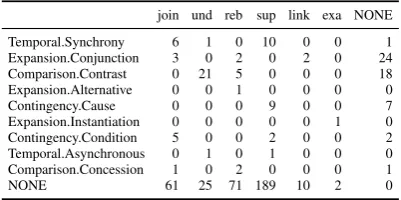
join und reb sup link exa NONE Temporal.Synchrony 6 1 0 10 0 0 1 Expansion.Conjunction 3 0 2 0 2 0 24 Comparison.Contrast 0 21 5 0 0 0 18 Expansion.Alternative 0 0 1 0 0 0 0 Contingency.Cause 0 0 0 9 0 0 7 Expansion.Instantiation 0 0 0 0 0 1 0 Contingency.Condition 5 0 0 2 0 0 2 Temporal.Asynchronous 0 1 0 1 0 0 0 Comparison.Concession 1 0 2 0 0 0 1 NONE 61 25 71 189 10 2 0
Table 2: Co-occurrence matrix of the PDTB (rows) and ARG (columns) relations of the matching edges in the converted annotations
RST & ARG: Although a large amount of edges in one annotation had no corresponding edge in the other annotation, there are some simi-larities. Contrastmaps toundercut28 times, and elaborationis frequently mapped tojoin,support, which seems plausible, andrebuttalwhich seems less so.
[image:3.595.316.517.459.559.2]annotation. Comparison.Contrastmaps to under-cut21 times andTemporal.Synchronyoften maps tojoin, both of which seem to be a suitable map-ping.
4.3 RST gold vs. parser
Besides comparing RST parses to argumentative structures, we were also interested in evaluating the RST parser on the microtexts, i.e., on their gold RST trees. To this end, we converted the gold an-notations to a comparable format, which involved converting the ‘span’ relations (which were not present in the parser’s output), adjusting the seg-ment IDs so that they were in ascending order, and converting the more fine-grained relations to the smaller set used by the parser (using the taxonomy inDas and Taboada,2014). We adapted the met-rics to evaluate the parser output from those pro-posed byJoty et al.(2015); our results are given in Table3.
Span Nuclearity Relation
[image:4.595.319.520.165.235.2]F1 0.338 0.264 0.115
Table 3: RST parser evaluation, with the categories used byJoty et al.(2015) and others.
5 Prediction experiments and results
Finally, we address the task of predicting the ARG structure with the help of discourse parser output. We extended the system ofAfantenos et al.(2018) and started from the feature set used byPeldszus and Stede(2016b); our own new features, listed in Table4, will be referred to as ‘RST+’ and ‘PDTB’ respectively. The task now is to assess their con-tribution in comparison to the ‘Default’ and ‘RST’ features from Peldszus and Stede(2016b) and to the best performing lexical, syntactic, semantic and discourse features used by Afantenos et al.
(2018). In Table 5, which shows our results, the latter are labelled as ‘2018’.
We experimented with different combinations of the features on two different settings of the model: the simple relation set (support and at-tack); and the more fine-grained full relation set (support, example, join, link, undercut and rebut-tal). We used the same train-test splits as in Peld-szus and Stede (2015), which involved 10 itera-tions of 5-fold cross validation. The results for the full relation set were marginally better than those for the simple relations, aside from thefu
classi-PDTB parser output
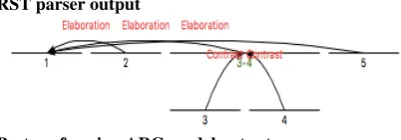
1:[Intelligence services must urgently be regulated more tightly by parliament;] 2:[this should be clear to everyone after the disclosures of Edward Snowden.] 3:[Granted, those concern primarily the British and American intelligence services,]Comparison.Contrast 4:[but the German services evidently do collaborate with them closely.] 5:[Their tools, data and expertise have been used to keep us under surveillance for a long time.]
RST parser output
Best performing ARG model output
[2, 1, ‘join’], [3, 1, ‘rebut’], [4, 3, ‘undercut’], [5, 1, ‘support’]
Gold ARG annotation
[2, 1, ‘support’], [3, 2, ‘undercut’], [4, 3, ‘undercut’], [5, 4, ‘support’]
Figure 1: Parser and model output for microtext b005. The numbers refer to the segments. RST tree created using RSTTool (O’Donnell,2000).
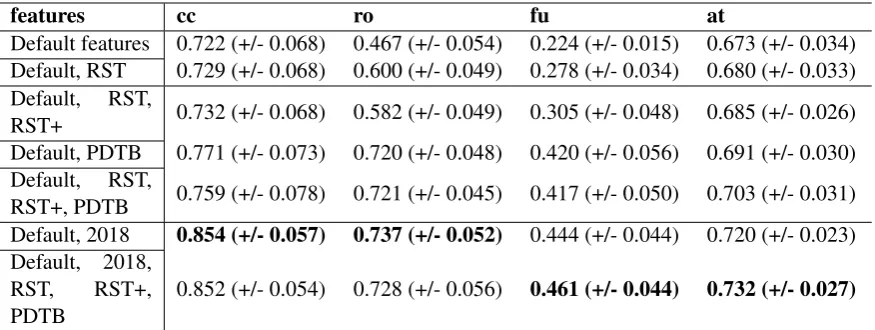
fier whose highest score, 0.750, was achieved with the combination of all features for the simple rela-tions. Even though the statistical analysis of the PDTB output at first did not seem promising, the PDTB features did improve all classifiers’ perfor-mances. The model’s performance was best for the majority of classifiers with the features employed by Afantenos et al. (2018) in collaboration with our features for both settings. In particular, our model achieved promising improvements on the attachment and function classifiers.
For illustration, Figure 1 shows the various analyses for one text from the corpus.
6 Discussion and conclusion
Feature description Classifier Tag Absolute & relative no. of all children/parents and
grandchil-dren/grandparents of segment fu, ro RST+
Relative no. of grandchildren/grandparents before & after the segment fu, ro RST+
Absolute & relative distance to parent and direction at RST+
Whether the segment is involved in a multi-nuclear relation at RST+
Whether segment has any PDTB connections to neighbouring segments cc, fu, ro, at PDTB
Count of incoming & outgoing PDTB connectives cc, fu, ro PDTB
Level one and two of the PDTB semantic relation cc, fu, ro, at PDTB
[image:5.595.81.519.235.400.2]Raw text of PDTB connective cc, fu, ro, at PDTB
Table 4: Feature descriptions.
features cc ro fu at
Default features 0.722 (+/- 0.068) 0.467 (+/- 0.054) 0.224 (+/- 0.015) 0.673 (+/- 0.034) Default, RST 0.729 (+/- 0.068) 0.600 (+/- 0.049) 0.278 (+/- 0.034) 0.680 (+/- 0.033) Default, RST,
RST+ 0.732 (+/- 0.068) 0.582 (+/- 0.049) 0.305 (+/- 0.048) 0.685 (+/- 0.026) Default, PDTB 0.771 (+/- 0.073) 0.720 (+/- 0.048) 0.420 (+/- 0.056) 0.691 (+/- 0.030) Default, RST,
RST+, PDTB 0.759 (+/- 0.078) 0.721 (+/- 0.045) 0.417 (+/- 0.050) 0.703 (+/- 0.031) Default, 2018 0.854 (+/- 0.057) 0.737 (+/- 0.052) 0.444 (+/- 0.044) 0.720 (+/- 0.023) Default, 2018,
RST, RST+,
PDTB
0.852 (+/- 0.054) 0.728 (+/- 0.056) 0.461 (+/- 0.044) 0.732 (+/- 0.027)
Table 5: Results for the full relation set with complex setting: macro-averaged F1 score, variance in parentheses, maximum is in bold for each classifier
that the PDTB parser only identified a relatively small amount of relations, and these did not map very well to the ARG annotation, the PDTB fea-tures still improved the results more than the RST features did (compare lines 2 and 4 to line 1 in Ta-ble5). Combining both feature sets led to further improvements (lines 5, 7). We thus conclude that discourse parser features, and specifically PDTB features, add valuable information in particular for the classification of the function and attachment subtasks of ARG parsing, and could therefore be further explored and applied to other argumenta-tive corpora.
Future work in this line of research includes a qualitative error analysis of the parsers’ contri-butions to ARG parsing, and an ablation test for identifying the impact of the individual RST and PDTB features. Furthermore, recently a second part of the microtext corpus has been released (see website in footnote 1), which is larger than part 1 and would also warrant similar experiments. This would also be a test for the potential influence of
the translation step (German to English) in creat-ing part 1.
Acknowledgments
We thank the anonymous reviewers for their help-ful comments on the earlier version of the paper.
References
Stergos Afantenos, Andreas Peldszus, and Manfred Stede. 2018. Comparing decoding mechanisms for parsing argumentative structures. Argument and Computation, 9(3):177–192.
Nicholas Asher and Alex Lascarides. 2003. Logics of Conversation. Cambridge University Press, Cam-bridge.
Or Biran and Kathleen McKeown. 2015. Pdtb dis-course parsing as a tagging task: The two taggers approach. InProceedings of the 16th Annual Meet-ing of the Special Interest Group on Discourse and Dialogue (SIGDIAL 2015), pages 96–104.
and back: Relations and differences. Lecture Notes in Computer Science (Computational Logic in Multi-Agent Systems), 8143:1–17.
Debopam Das and Maite Taboada. 2014. RST Sig-nalling Corpus Annotation Manual. Simon Fraser University.
Judith Eckle-Kohler, Roland Kluge, and Iryna Gurevych. 2015. On the role of discourse markers for discriminating claims and premises in argumen-tative discourse. In Proceedings of the 2015 Con-ference on Empirical Methods in Natural Language Processing (EMNLP), pages 2236–2242.
Vanessa Wei Feng and Graeme Hirst. 2014. A linear-time bottom-up discourse parser with constraints and post-editing. In Proceedings of the 52nd An-nual Meeting of the Association for Computational Linguistics, pages 511–521.
Nancy Green. 2010. Representation of argumentation in text with rhetorical structure theory. Argumenta-tion, 24(2):181–196.
Ivan Habernal and Iryna Gurevych. 2017. Argumenta-tion mining in user-generated web discourse. Com-putational Linguistics, 43(1):125–179.
Yangfeng Ji and Jacob Eisenstein. 2014. Represen-tation learning for text-level discourse parsing. In Proceedings of the 52nd Annual Meeting of the As-sociation for Computational Linguistics, pages 13– 24.
Shafiq Joty, Giuseppe Carenini, and Raymond T. Ng. 2015. Codra: A novel discriminative framework for rhetorical analysis. Computational Linguistics, 41(3):385–435.
Ziheng Lin, Hwee Tou Nh, and Min-Yen Kan. 2014. A pdtb-styled end-to-end discourse parser. Natural Language Engineering, 20:151–184.
William Mann and Sandra Thompson. 1988. Rhetori-cal structure theory: Towards a functional theory of text organization. TEXT, 8:243–281.
Daniel Marcu. 2000. The theory and practice of dis-course parsing and summarization. MIT Press, Cambridge/MA.
Elena Musi, Tariq Alhindi, Manfred Stede, Leonard Kriese, Smaranda Muresan, and Andrea Rocci. 2018. A multi-layer annotated corpus of argumen-tative text: From argument schemes to discourse relations. InProceedings of the 11h International Conference on Language Resources and Evaluation (LREC’18), Miyazaki, Japan.
Michael O’Donnell. 2000. Rsttool 2.4 a markup tool for rhetorical structure theory. InProceedings of the International Natural Language Generation Confer-ence (INLG’2000), pages 253–256.
Andreas Peldszus and Manfred Stede. 2013. From ar-gument diagrams to arar-gumentation mining in texts. International Journal of Cognitive Informatics and Natural Intelligence, 7(1):1–31.
Andreas Peldszus and Manfred Stede. 2015. Joint pre-diction in mst-style discourse parsing for argumen-tation mining. InProceedings of the 2015 Confer-ence on Empirical Methods in Natural Language Processing (EMNLP), pages 938–948.
Andreas Peldszus and Manfred Stede. 2016a. An an-notated corpus of argumentative microtexts. In Ar-gumentation and Reasoned Action - Proceedings of the 1st European Conference on Argumentation 2, pages 801–816.
Andreas Peldszus and Manfred Stede. 2016b. Rhetor-ical structure and argumentation structure in mono-logue text. In Proceedings of the Third Workshop on Argument Mining (ArgMining2016), pages 103– 112.
Peter Potash, Alexey Romanov, and Anna Rumshisky. 2017. Heres my point: Joint pointer architecture for argument mining. InProceedings of the 2017 Con-ference on Empirical Methods in Natural Language Processing (EMNLP), pages 1364–1373.
Christian Stab and Iryna Gurevych. 2014. Identify-ing argumentative discourse structures in persuasive essays. InProceedings of the 2014 Conference on Empirical Methods in Natural Language Processing (EMNLP), pages 46–56.
Christian Stab and Iryna Gurevych. 2016. Parsing ar-gumentation structures in persuasive essays. Com-putational Linguistics, 43(3):619–660.
Manfred Stede, Stergos Afantenos, Andreas Peldszus, Nicholas Asher, and Jrmy Perret. 2016. Parallel dis-course annotations on a corpus of short texts. In Pro-ceedings of the Ninth International Conference on Language Resources and Evaluation (LREC), pages 1051–1058.