133
Relevant and Informative Response Generation
using Pointwise Mutual Information
Junya Takayama† and Yuki Arase†‡
†Graduate School of Information Science and Technology, Osaka University ‡Artificial Intelligence Research Center (AIRC), AIST
{takayama.junya, arase}@ist.osaka-u.ac.jp
Abstract
A sequence-to-sequence model tends to gen-erate generic responses with little information for input utterances. To solve this problem, we propose a neural model that generates relevant and informative responses. Our model has simple architecture to enable easy application to existing neural dialogue models. Specifi-cally, using positive pointwise mutual infor-mation, it first identifies keywords that fre-quently co-occur in responses given an utter-ance. Then, the model encourages the de-coder to use the keywords for response gener-ation. Experiment results demonstrate that our model successfully diversifies responses rela-tive to previous models.
1 Introduction
Neural networks are common approaches to build-ing chat-bots. Vinyals and Le (2015) have pro-posed a neural dialogue model using sequence-to-sequence (Seq2Seq) networks (Sutskever et al.,
2014) and achieved fluent response generation. Because a Seq2Seq model uses a word-by-word loss function at the time of training, any words outside the reference are penalized equally. Con-sequently, the Seq2Seq model tends to generate generic responses that consist of frequent words, such as “Yes” and “I don’t know.” This is a central concern in neural dialogue generation. To tackle this problem,Li et al.(2016) proposed a model for considering mutual dependency between an utter-ance and response modeled by maximum mutual information (MMI). However, their model disre-garded the aspect of informativeness of responses, which is also important for user experience of chat-bots.
To solve this problem, we propose a response generation model that outputs diverse words while preserving relevance in response to the input ut-terance. In our model, Positive Pointwise Mutual
Information (PPMI) identifies keywords from a large-scale conversational corpus that are likely to appear in the response to an input utterance. Then, the model modifies the loss function in a Seq2Seq model to reward responses using the identified keywords. In order to calculate the loss function using the words output by the decoder, we need to sample words from the probability distribution of the output layer. Hence, we apply the Gumbel-Softmax trick (Jang et al.,2017) as a differentiable pseudo-sampling method.
Experiments using a Japanese dialogue corpus crawled from Twitter and OpenSubtitles revealed that the proposed model outperformed (Li et al.,
2016) for all automatic evaluation metrics for cor-respondence to references and diversity in outputs.
2 Related Work
The generic response problem has been actively studied. Yao et al. (2016) and Nakamura et al.
(2019) proposed models that constrain decoders to directly suppress generation of frequent words.
Yao et al. (2016) diversified the response by a loss function in which words with high inverse document frequency values are preferred. Naka-mura et al. (2019) proposed a loss function that adds weights based on the inverse of the word fre-quency. Xing et al. (2017) proposed a model us-ing topic words extracted from utterances. Their model ensembles words predicted using the topic words and the words predicted by the decoder.
All of the methods described above only fo-cus on the amount of a information in a response. Therefore, generated responses tend to lack rele-vance to input utterances. MMI-bidi (Li et al.,
Encoder Decoder
Utterance Reply
PPMI Matrix Keyword
Handler
Backward
1 − 𝜆
𝜆
1 − 𝛼
[image:2.595.78.286.57.306.2]𝛼 MLP
Figure 1: Outline of the proposed model
responseRas follows:
PMI(Q, R) = (1−λ) logP(R|Q) +λlogP(Q|R).
(1) Here, both P(R|Q) and P(Q|R) are computed by independent Seq2Seq models. Specifically, the N-best candidate responses generated by the for-mer model are re-ranked by Equation (1). MMI-bidi exhibited a strong performance for diversi-fying responses while preserving relevance to an input utterance. However, its effects depend on the diversities of the N-best candidate responses. If these responses are diverse, MMI-bidi can im-prove futher.
3 Proposed Model
Figure1shows the outline of the proposed model. It first identifies keywords that strongly co-occur between utterances and their responses in a train-ing corpus ustrain-ing PPMI (section3.1). The decoder then uses Gumbel-Softmax to sample words in the output layer (section 3.3). Finally, it computes the proportion of output words matching the key-words, and add weights to the loss function (sec-tion3.4).
3.1 Keywords Retrieval Based on Positive Pointwise Mutual Information
The keyword handler retrieves words that are likely to appear in the response to a certain input
utterance based on PPMI, calculated in advance from an entire training corpus. Let PQ(x) and PR(x) be probabilities that the word x will
ap-pear in a certain utterance and response sentences, respectively. Also, letP(x, y) be the probability that the words xandy exist in the utterance and response sentence pair. PPMI is calculated as fol-lows:
PPMI(x, y) = max
(
log2 P(x, y)
PQ(x)·PR(y) ,0
) .
The pair ofxandyand its PPMI score are saved in the PPMI Matrix in Figure 1. At the time of response generation, the keyword handler looks up the PPMI Matrix. Let the word set of a cer-tain utterance sentence beQ = {q1, q2, . . . , qL},
and the vocabulary in the decoder be VR = {vR1, vR2, . . . , vRN}. The keyword-score of a
wordvRn ∈VRis defined as follows:
∑
q∈Q
PPMI (q, vRn).
Keyword-scores are calculated for all words inVR.
Then top-kwords are set as keywordsVPredused
in the loss function.
3.2 Decoding Response Sentences using Retrieved Keywords
The decoder first receives a vector vf consisting of keyword-scores for all words in the vocabulary, and non-linearly transforms vf through a
multi-layer perceptron (MLP). This vector is concate-nated with the output of the encoder, and then set to the initial state of the decoder. By doing so, we expect that the decoder considers the keyword-scores. In order to directly boost the probability to output the keywords, we add weightedvf to the decoder output vectorπi at each time stepi. The final decoder output˜πi is represented by the fol-lowing equation:
˜
πi = (1−λi)·πi+λi·vf.
λi balances the effects of the decoder output and vf.λiis calculated as follows based on the current
intermediate statehi of the decoder:
λi =σ
(
Wgatehi+bgate
) ,
3.3 Pseudo-sampling of Generated Words using Gumbel-Softmax
In order to determine whether the decoder gen-erated words in VPred, it is necessary to sample
words generated by the decoder. However, sam-pling based on argmax, which is generally used at the decoder, disallows back propagation because of its discrete nature. Jang et al. (2017) pro-posed Gumbel-Softmax which performs pseudo sampling from the probability distribution to al-low back propagation. Gumbel-Softmax performs the following calculations for a probability distri-butionπ (corresponding to the output layer in the decoder) forkclasses:
yi =
exp((log(πi) +gi)/τ)
∑k
j=1exp((log(πj) +gj)/τ) .
Here, τ is a hyperparameter called temperature. Smallertaumakes the vector closer to one-hot but the dispersion of the gradient becomes larger.giis
obtained by the following calculation using uni-form distributionui∼Uniform(0,1):
gi =−log(−log(ui)).
In the proposed model, Gumbel-Softmax is ap-plied to the final decoder output vectorπ˜at each time stepias in Equation (2). Then, we obtain the differentiable pseudo-bag-of-words vectorB.
B= T
∑
i=1
GumbelSoftmax(˜πi). (2)
3.4 Loss function
We design a loss functionlvwhich value decreases
as words contained inVPred are generated. Thus,
the decoder outputs more words that strongly co-occur with the input utterance. Specifically, when t(bn)is the word corresponding to then-th index
inB,lv is defined as follows.
lv =− N
∑
n=0
f(bn, VPred),
f(bn, VPred) =
{
min(bn,1) (t(bn)∈VPred),
0 (otherwise). (3) We use min(bn,1) in Equation (3) to avoid
adding a reward when a keyword is generated mul-tiple times. This aims to suppress the decoder out-puts the same word many times.
Finally, the loss functionLis defined as a liner interpolation oflCEof the cross-entropy error and
thelv:
L= (1−α)·lCE +α·lv.
αis a hyperparameter that balances the degree of rewards based on the keywords.
4 Experiments
We empirically evaluate how our model avoids generic responses to generate relevant and infor-mative responses.
4.1 Datasets
We used two datasets, OpenSubtitles (English) and Twitter (Japanese). The details of each dataset are as follows.
OpenSubtitles OpenSubtitles (Tiedemann,
2009) is a large scale open-domain corpus composed of movie subtitles.
Like Vinyal et al. (Vinyals and Le, 2015) and Li et al (Li et al., 2016), we assumed that each line of the subtitles represents an independent utterance, and constructed a single-turn dialogue corpus by regarding two consecutive utterances as an utterance-response pair. We randomly sampled2 mil-lion utterance-response pairs. All sentences were tokenized using the Punkt Sentence To-kenizer of nltk1.
Twitter We crawled conversations in Japanese Twitter using “@” mention as a clue. A single-turn dialogue corpus was constructed by regarding a tweet and its reply as an utterance-response pair. The dataset consists of about1.3million utterance-response pairs. All sentences were tokenized by MeCab2.
In both datasets, 10k utterance-response pairs were separated as validation data, another 10k were separated as test data, and the rest were used as training data.
4.2 Comparison Methods
We compared our model to previous models. The baseline is the standard Seq2Seq (Seq2Seq). We also compared to MMI-bidi (Seq2Seq + MMI)
1
https://www.nltk.org/
BLEU NIST dist-1 dist-2 ent-4 length repetition Proposed + MMI 1.577 0.872 0.050 0.187 8.536 8.064 1.551
Proposed 1.569 0.837 0.044 0.148 7.327 7.520 1.377
Seq2Seq + MMI 1.373 0.739 0.009 0.032 5.600 7.566 1.223
Seq2Seq 1.374 0.687 0.005 0.015 4.070 8.025 1.095
[image:4.595.103.495.183.268.2]Reference 100.000 16.498 0.086 0.482 10.647 7.671 1.000
Table 1: Results on the OpenSubtitle corpus (English)
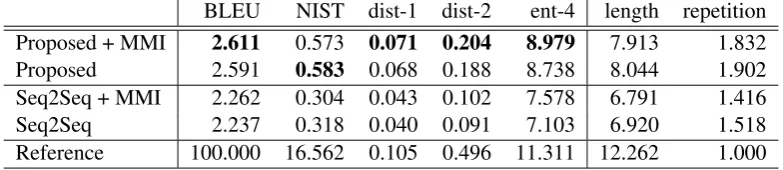
BLEU NIST dist-1 dist-2 ent-4 length repetition Proposed + MMI 2.611 0.573 0.071 0.204 8.979 7.913 1.832
Proposed 2.591 0.583 0.068 0.188 8.738 8.044 1.902
Seq2Seq + MMI 2.262 0.304 0.043 0.102 7.578 6.791 1.416
Seq2Seq 2.237 0.318 0.040 0.091 7.103 6.920 1.518
Reference 100.000 16.562 0.105 0.496 11.311 12.262 1.000
Table 2: Results on the Twitter corpus (Japanese)
because it is the most relevant method for diver-sifying responses. In addition, we combined our model with MMI-bidi (Proposed + MMI) to see whether it contributes to diversification of the N-best candidates.
4.3 Evaluation Metrics
We employed several automatic evaluation met-rics. BLEU and NIST measure the validity of generated sentences in comparison with refer-ences. BLEU (Papineni et al.,2002) measures the correspondence betweenn-grams in generated re-sponses and those in reference sentences. Follow-ingPapineni et al.(2002), we used the average of BLEU scores from1-gram to4-gram in the experi-ment. NIST (Doddington,2002) also measures the correspondence between generated responses and reference sentences. Unlike BLEU, NIST places lower weights on frequentn-grams,i.e., NIST re-gards content words as more important than func-tion words. In the experiment, we used the average of NIST from1-gram to5-gram.
In addition, distandent measure the diversity of generated responses. Dist (Li et al., 2016) is defined as the number of distinctn-grams in gen-erated responses divided by the total number of generated tokens. On the other hand, ent (Zhang et al.,2018) considers the frequency ofn-grams in generated responses:
ent =−∑ 1 wF(w)
∑
w∈X
F(w) log∑F(w) wF(w)
,
where X is a set of n -grams output by the
sys-tem, and F(w) computes the frequency of each n-gram.
In this paper, we focus on automatic evaluation. Human evaluation is our future work.
4.4 Parameter Settings
For all models, we implemented the encoder and decoder of each model using1-layer GRUs. The dimension of the GRU was set to 512. How-ever, only the decoder of the proposed model used
1024-dimensional GRU. This is because the ini-tial state of the decoder is the concatenation of the keyword-score vector and the output from the en-coder (512-dimension for each). Both the encoder and decoder had a word embedding layer of 256
dimensions.
The vocabulary consisted of words that ap-peared more than 15 times in the training data. Words that occured less than 15 times were re-placed with the “<unk>” token. The vocabulary size was41.5k for the Twitter model and20.9k for the OpenSubtitles model.
4.5 Results and Error Analysis
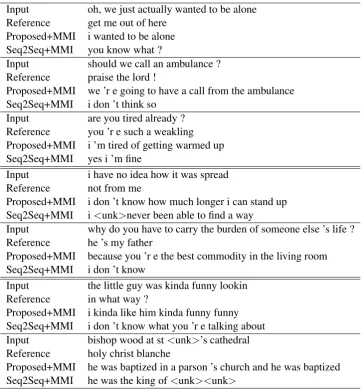
gener-Input oh, we just actually wanted to be alone Reference get me out of here
Proposed+MMI i wanted to be alone Seq2Seq+MMI you know what ?
Input should we call an ambulance ? Reference praise the lord !
Proposed+MMI we ’r e going to have a call from the ambulance Seq2Seq+MMI i don ’t think so
Input are you tired already ? Reference you ’r e such a weakling Proposed+MMI i ’m tired of getting warmed up Seq2Seq+MMI yes i ’m fine
Input i have no idea how it was spread Reference not from me
Proposed+MMI i don ’t know how much longer i can stand up Seq2Seq+MMI i<unk>never been able to find a way
Input why do you have to carry the burden of someone else ’s life ? Reference he ’s my father
Proposed+MMI because you ’r e the best commodity in the living room Seq2Seq+MMI i don ’t know
Input the little guy was kinda funny lookin Reference in what way ?
Proposed+MMI i kinda like him kinda funny funny Seq2Seq+MMI i don ’t know what you ’r e talking about Input bishop wood at st<unk>’s cathedral Reference holy christ blanche
[image:5.595.118.483.60.453.2]Proposed+MMI he was baptized in a parson ’s church and he was baptized Seq2Seq+MMI he was the king of<unk><unk>
Table 3: Example responses generated by the proposed model and (Li et al.,2016)
ates diverse responses, which effectively improves the N-best candidates reranked by MMI-bidi. It is notable that improvements on NIST, which ap-preciates less frequent n-grams, support this idea the proposed model improves the informativeness of responses. The improvement is larger on the Twitter dataset, where the proposed method (Pro-posed) achieved NIST score 0.265 points higher than Seq2Seq even though MMI-bidi is inferior to Seq2Seq.
The example responses generated by Pro-posed+MMI and Seq2Seq+MMI using OpenSub-titles are shown in Table 3. The examples from the top to the third rows show that the proposed model generates more content words relevant to the con-tent words in the utterance. On the other hand, Seq2Seq+MMI ended up generating fewer infor-mative responses using generic words. The fourth and fifth examples show that the proposed model generated responses with little relevance to the
in-put, although they were more informative than the responses generated by Seq2Seq+MMI.
The last two examples show a drawback of the proposed model,i.e., which is over-generation of the same word. For quantitative evaluation, we computed the repetition rate (Le et al., 2017) on the test data, which measures the meaningless rep-etition of words. The reprep-etition rate is defined as:
repetition rate = 1
N N
∑
i=1
1 +r(eyi) 1 +r(Yi) ,
whereeyi is thei-th generated sentence in the test
data,Yiis its reference, andN is the total number
of test sentences. The functionr(·)measures the repetition as the difference between the number of words and that of unique words in a sentence:
r(X) = len(X)−len(set(X)),
re-moves duplicate items inX. The average lengths of generated responses and repetition rates are shown on the right sides of Tables1 and2. The results show that the proposed models (Proposed and Proposed+MMI) tend to generate longer re-sponses than Seq2Seq, but their repetition rates are also higher. This may be caused by time-invariant keyword-scores, despite the fact that the decoder output changes over time. In the future, we will update the keyword-score vector to avoid repeti-tion in responses.
5 Conclusion
Aiming at generating diverse responses while pre-serving relevance to the input, we proposed a model that identifies keywords using PPMI and promoted their generation in the decoder. Eval-uation results using English and Japanese conver-sational corpora show that in comparison with (Li et al.,2016), the proposed model achieved better performance in terms of correspondence to refer-ences and diversity of output. On the other hand, we found that the proposed model has a tendency of over-generation.
As future work, we will conduct human eval-uation and qualitative analysis. We will also in-vestigate the effects of the hyper-parameterα on overall performance. We also plan to develop a mechanism for suppressing over-generation.
Acknowledgments
This project is funded by Microsoft Research Asia, Microsoft Japan Co., Ltd., and JSPS KAK-ENHI Grant Number JP18K11435.
References
George Doddington. 2002. Automatic Evaluation of Machine Translation Quality Using N-gram Co-Occurrence Statistics. InProceedings of the second international conference on Human Language Tech-nology Research (HLT 2002).
Eric Jang, Shixiang Gu, and Ben Poole. 2017. Cat-egorical Reparametarization with Gumbel-Softmax. InProceedings of The 5th International Conference on Learning Representations (ICLR 2017).
An Nguyen Le, Ander Martinez, Akifumi Yoshimoto, and Yuji Matsumoto. 2017. Improving Sequence to Sequence Neural Machine Translation by Utiliz-ing Syntactic Dependency Information. In Proceed-ings of the The 8th International Joint Conference on Natural Language Processing (IJCNLP 2017), pages 21–29.
Jiwei Li, Michel Galley, Chris Brockett, Jianfeng Gao, and Bill Dolan. 2016. A Diversity-Promoting Ob-jective Function for Neural Conversation Models. In Proceedings of The 15th Annual Conference of the North American Chapter of the Association for Computational Linguistics: Human Language Tech-nologies (NAACL-HLT 2016), pages 110–119.
Ryo Nakamura, Katsuhito Sudoh, Koichiro Yoshino, and Satoshi Nakamura. 2019. Another Diversity-Promoting Objective Function for Neural Dialogue
Generation. In Proceedings of The Second AAAI
Workshop on Reasoning and Learning for Human-Machine Dialogues (DEEP-DIAL).
Kishore Papineni, Salim Roukos, Todd Ward, and Wei-Jing Zhu. 2002. BLEU: A Method for Automatic Evaluation of Machine Translation. InProceedings of the 40th Annual Meeting of the Association for Computational Linguistics (ACL 2002), pages 311– 318.
Ilya Sutskever, Oriol Vinyals, and Quoc V Le. 2014. Sequence to sequence learning with neural net-works. InProceedings of The Twenty-eighth Con-ference on Neural Information Processing Systems (NeurIPS 2014), pages 3104–3112.
J¨org Tiedemann. 2009. News from opus-A collection of multilingual parallel corpora with tools and in-terfaces 1 Index of Subjects and Terms 13 vi News from OPUS-A Collection of Multilingual Parallel Corpora with Tools and Interfaces. Recent advances in natural language processing, 5:237–248.
Oriol Vinyals and Quoc V Le. 2015. A Neural Conver-sational Model. In Proceedings of the 32nd Inter-national Conference on Machine Learning (ICML 2015).
Chen Xing, Wei Chung Wu, Yu Ping Wu, Jie Liu, Yalou Huang, Ming Zhou, and Wei-Ying Ma. 2017. Topic Aware Neural Response Generation. InProceedings of the Thirty-First AAAI Conference on Artificial In-telligence (AAAI 2017).
Kaisheng Yao, Baolin Peng, Geoffrey Zweig, and Kam-Fai Wong. 2016. An Attentional Neural
Con-versation Model with Improved Specificity. arXiv
preprint arXiv:1606.01292.