71
Cross-lingual morphological inflection with explicit alignment
Çağrı Çöltekin
University of Tübingen Department of Linguistics
Abstract
This paper describes two related systems for cross-lingual morphological inflection for SIGMORPHON 2019 Shared Task participa-tion. Both sets of results submitted to the shared task for evaluation are obtained using a simple approach of predicting transducer ac-tions based on initial alignments on the training set, where cross-lingual transfer is limited to only using the high-resource language data as additional training set. The performance of the system does not reach the performance of the top two systems in the competition. However, we show that results can be improved with fur-ther tuning. We also present furfur-ther analyses showing that the cross-lingual gain is rather modest.
1 Introduction
Morphological inflection generation is the task of generating a word based on its lemma and mor-phological features. For example, given the Ger-man lemma aufgeben ‘to give up’ and the mor-phological tags {V.PTCP, PST}, the task is to predict the inflected form aufgegeben (morpho-logical tags are described in McCarthy et al.,
2019; Kirov et al., 2018). Traditionally, finite-state methods (Koskenniemi, 1985) are used for morphological generation (and analysis). Since such systems typically require man-months of ex-pert work, and difficult to maintain and adapt to changes in the language, data driven approaches to inflection generation have recently become popu-lar (Durrett and DeNero,2013;Nicolai et al.,2015;
Ahlberg et al.,2015;Faruqui et al.,2016). The task is further popularized by the past three SIGMOR-PHON morphological (re)inflection shared tasks (Cotterell et al.,2016,2017,2018). The primary focus of the task tackled in this paper, the task 1 of the present SIGMORPHON shared task ( Mc-Carthy et al., 2019), is the cross-lingual transfer
learning of the inflection generation.
The dominant approach to morphological inflection has been sequence-to-sequence neu-ral networks with attention (e.g., Kann and Schütze, 2016; Makarov et al., 2017; Makarov and Clematide, 2018). Furthermore, there seems to be a shift from soft attention models towards models with monotonic attention (Ahlberg et al.,
2015; Makarov and Clematide, 2018; Wu and Cotterell, 2019), which indicate that the predic-tions of the decoder benefit most from a (short) window in the output. Although we do not use an encoder-decoder architecture, the simple systems presented here are similar to hard-monotonic attention models in the sense that they predict the transduction actions based on a window on the input and output. The method presented here is much simpler, however. The predictions are not conditioned on any hidden (continuous or discrete) state or variable.
A particular reason of interest for data-driven approaches to morphological inflection genera-tion is to avoid the considerable amount of expert time required for building rule-based finite-state systems. This is particularly important for low-resource languages, where experts, and maybe even native speakers, are hard to come by. As past SIGMORPHON shared tasks demonstrated, however, satisfactory results in the morphologi-cal inflection task requires relatively large amount of data. The low-resource settings in earlier SIG-MORPHON shared tasks often resulted in much worse accuracy compared to the high-resource settings. A potential solution to this problem, the focus of the current inflection shared task, is cross-lingual or transfer learning, which has been demonstrated to be useful a number of lan-guage processing tasks (e.g., Yarowsky et al.,
2001;Faruqui and Kumar, 2015;Johnson et al.,
learn-ing, the data or resources that exist for a related language are leveraged to improve the learning in low-resource setting. The method we use for cross-lingual learning is rather simple. We only use the (related) high-resource language as addi-tional training data.
2 The method
The inflection systems in this study operate by predicting a number of transduction actions based on current position in the lemma, morphological tags, and the output produced so far. The general idea is similar to transition-based parsers (Yamada and Matsumoto, 2003;Nivre et al.,2004) where the aim is to predict the parsing action in a given state of the parser. The similar ideas were used in the past for morphological inflection generation as well. The system presented here is most simi-lar to the baseline system of SIGMORPHON 2016 shared task (Cotterell et al.,2016), and also shares many aspects of the inflection generation systems that follow an align-and-transduce strategy in the earlier SIGMORPHON shared tasks (e.g.,Alegria and Etxeberria,2016;Nicolai et al.,2016;Liu and Mao,2016). Our current models do not make use of any hidden representations, such as the parser state in transition based parsing, or hidden repre-sentations learned in a recurrent neural network.
2.1 Alignment
During training, we need to determine the gold-standard transduction actions, which requires aligning the lemmas and word forms. Better se-quence alignment is one of the concerns for the similar inflection systems cited above, as well as the sequence-to-sequence models that operate with hard monotonic attention. Better alignments are also a common concern and studied exten-sively in other areas of computational linguistics such as dialectometry (Wieling et al.,2009;Prokić,
2010) and historical linguistics (List,2012;Jäger,
2013). Standard alignment algorithms that use equal penalties for edit operations often fail to cap-ture the similarities and differences between char-acters (or phonetic segments). As a result, often a weighted method is used such that similar char-acters in one of the sequences are more likely to be aligned with the similar characters in the other. The weights are most often learned from the data using an unsupervised method. The data-driven weights are found to be more effective than
manu-e r i m e k - - - - -e r i y e c e k l e r
e r i m - - e k - - -e r i y e c e k l e r
- - a u f g e b e n a u f g e g e b e n
[image:2.595.306.528.64.254.2]a u f - - g e b e n a u f g e g e b e n
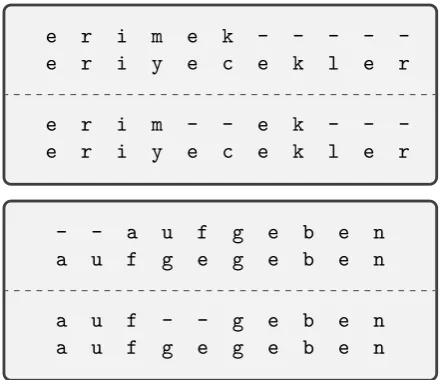
Figure 1: Example alignments of two lemma–form pairs from Turkish (top) and German (bottom). In each box, upper part shows the alignment based on longest common substring, while lower part shows minimum edit distance solution.
ally assigned weights based on linguistic knowl-edge/intuitions (Sofroniev and Çöltekin, 2018). We tried a few of these more informed weighted alignment methods. However, in preliminary ex-periments, a simple alignment mechanism based on longest common substring (LCS) worked best. Hence, in all the experiments reported here, align-ments are performed first by finding the longest common substring of lemma and the word from, and aligning the two strings such that the LCS is aligned correctly. The rest of the characters are aligned disregarding whether they match or not. The method introduces gaps only at the beginning and end of the sequences. If there are two match-ing substrmatch-ings of equal length, we pick the first se-quence.
Lemma (input) Form (output) Action
s s copy
c c copy
h h copy
r r copy
e i replace(i)
i e replace(e)
b b copy
e e copy
n s replace(s)
# t insert(t)
# # copy
Table 1: The sequence of actions mapping the German lemmaschreiben‘to write’ to its second person singular past formschriebst.
limited number prefixes to precede ‘infixed’ ma-terial, the LCS solution still provides reasonably regular patterns to predict.
2.2 Transduction actions
The inflection systems use four character-to-character transduction actions:
copy copies the current character of the lemma to the word form, and advances to the next char-acter on the lemma
replace(c) inserts the charactercto the word form, and advances to the next character on the lemma
insert(c) inserts the charactercto the word form, without advancing the current lemma pointer
delete deletes the current character of the lemma, and advances to the next character on the lemma
All actions are character-to-character operations based on one-to-one alignments, and each action is represented individually, i.e., we do not compress consecutive actions of the same type to a single complex action. Table1 demonstrates the series of transductions for an example lemma–word form pair. Both lemmas and words are appended with a special end-of-sequence symbol (indicated with ‘#’ in Table1). The decoding stops when any of the actions predict the end-of-sequence symbol.
2.3 Classifiers
Given the gold standard action sequences extracted from a training set as described above, we can use any multi-class classification method for predict-ing the next action. We experimented both with traditional linear classifiers, in particular SVMs, and feed-forward neural network classifiers. Re-gardless of the classification method, however, the features are based on the morphological tags, char-acters within a local window around the current lemma character, and the last few (predicted) char-acters of the word form. During training we use the gold-data for extracting features from the word forms.
Since the linear methods cannot represent non-linear combinations of the features, we use the fol-lowing feature (combinations).
• The current lemma character.
• The varying-length, overlapping n-grams to the left and right of the current lemma charac-ter. For example, at the fourth step in Table1, with current lemma characterr, and assum-ing a window size of three, we includeh,ch, andschas n-grams before the current point, ande,ei, andeibas n-grams after the cur-rent point.
• The varying-length, overlapping n-grams of the last part of the output already predicted. For the same position, this would amount to n-gramsh,ch, andsch.
• Morphological tags, including a special tag indicating the language, and all binary com-bination of tags. For example, with input tags{V, PST, S}we also include{V-PST, V-S, PST-S}as additional tag features.
• Cross product of all tag features with the other features.
All features for the linear classifiers are com-bined as a single sparse feature vector. The fea-tures are weighted using TF-IDF, but no pruning or any other feature selection step is employed.
However, they also increase the feature set size, resulting in an increases in the time it takes to tune the classifiers. The choice above was a compro-mise between accuracy and demands on computa-tion (which may be an important factor when tun-ing models for100language pairs).
Intuitively, and also shown in similar tasks ear-lier, the neural models here have an expected ad-vantage as they can learn useful combinations of arbitrary features automatically. The features for the neural classifier used in this study are based on the same set of characters and the tags, but without explicit combinations of the features.
For both type classifiers, a straightforward op-tion is to train a single multi-class classifier is pre-dicting all possible actions (including the compos-ite actions such asreplace(i)). Alternatively, one can first predict one of the four action types, and then predict the parameter of the action if the ac-tion isreplaceorinsert. For the linear classifier, this means training three separate classifiers, and applying two of them in correct order at predic-tion time. For the neural model, a similar approach is used. The model first predicts the action, and then the parameter of the action, for which action is also given as an additional predictor. The different parts of the network are trained jointly, and share some of the weights which may provide additional benefits. We experimented with both approaches. Initial experiments produced mixed results, one or the other option performing better in different data sets. The results presented here are based on the two-level classifiers, chosen somewhat arbitrarily. At prediction time we decode the sequence greedily, choosing the single-best action according to the model at each step. However, both systems can produce multiple outputs with minor modifi-cation to the decoding algorithm.
2.4 Cross lingual transfer
The main focus of the present task is cross-lingual transfer. Although we entertained a few ideas, including the use of cross-lingual character em-beddings and translation of transition sequences, the approach used at the end was straightforward inclusion of the high-resource language data in training the models. During cross-lingual training, however, we include an additional hyperparame-ter that dehyperparame-termines the weight training instances belonging to the source language. This way the model also learns ‘how much to learn from the source language’ during tuning.
Since a sizable number of language pairs do not use the same writing system, a learner relying on categorical character inputs cannot learn from the source language data. Even when the script used by both languages are the same, there are often differences in the writing traditions that make the transfer difficult. Without success from our pre-liminary experiments with cross-lingual character embeddings, we used the inputs as is, only experi-menting with transliteration of the source language input to the target language input for a limited set of language pairs.
Performing the correct, or useful, translitera-tions for this task seems difficult. There are no standard transliteration methods defined for most language pairs in the data. The standard translit-eration methods for some languages exists, where the standard typically defines how to transliterate a language written with a non-Latin script to some version of the Latin script. However, the stan-dard methods are often designed for easy read-ing/phonetization by English speakers. Even in cases of target languages that use a version of the Latin script, there are significant differences to hinder cross-lingual learning considerably. As a result, we report below some of the experiments with transliterations between Latin and Cyrillic scripts for only eight language pairs (all Turkic lan-guages) to demonstrate the potential gains that can be obtained with transliteration. The translitera-tion method followsÇöltekin and Barnes(2019). The method does not follow any transliteration standards (e.g., one set by ISO), but tries to max-imize the similarities of the writing traditions in these particular languages.
3 Experimental setup
3.1 Data and preprocessing
dif-ferent pairs. Most source languages have 10 000 training instances, with a few exceptions (notably Uzbek with only 1 060 word forms). The num-ber of training instances for all target languages is100, with a single exception of Telugu with61 word forms. Development set sizes vary more be-tween50,100and1 000word forms. The number of unique lemmas and tag combinations also vary among different training and development sets.
The relation of language pairs also differ. Most pairs have shared ancestry, ranging from very close (e.g., Turkish–Azeri) to rather far modern relatives (e.g., Russian–Portuguese), or histori-cal relatives (e.g., Polish–Old Church Slavonic). There are also a few pairs where the relation is rather through geographical contact (e.g., Italian– Maltese). As noted above, one obstacle for cross-lingual learning is the different writing systems used in these languages. The data set includes11 different scripts, and 30of language pairs do not use the same script. It should be noted, however, that the use of common script does not necessar-ily solve all the problems regarding mapping char-acter sequences across languages reliably. Even when they use the same script, e.g., Latin or Cyril-lic, the differences adopted in the writing tradition of each languages may still introduce difficulties.
To overcome the differences in scripts, we transliterated source language data in eight pairs (Bashkir–Azeri, Bashkir–Crimean-Tatar, Bashkir–Tatar, Bashkir–Turkmen, Turkish– Kazakh, Turkish–Khakas, Uzbek–Kazakh, and Uzbek–Khakas) into the script used by the target language. The transliteration method used tries to maximize the similarity of the transliterations with the writing system of the target language.
3.2 Classifier tuning
For both classifiers we performed a random search through the hyperparameter space, which included the weight of the source language instances. Hence, both classifiers are tuned to make use of the source language based on their usefulness. The other common parameter for both the linear and the neural classifier included window size, which de-termines the number of characters to the left and right of the current lemma position, the number of characters from the end of the word form predicted so far. For linear models the only other hyperpa-rameter we tune is the regularization constant.
For the neural model we fixed the architecture after some initial experimentation, where the
ac-tion classifier had two hidden layers of100units with ReLU activation, followed by a softmax clas-sifier. The part of the network that predict the pa-rameter ofinsertandreplaceactions had one layer with ReLU activation followed by a softmax clas-sifier. The input to the parameter classifier was the output of the hidden layer of the activity classifier, as well as the activity prediction. We used early stopping, stopping when the mean edit distance on the development set did not improve. We use only a single-best system, without any weight averag-ing or ensemblaverag-ing.
Both models are tuned on the training sets of tar-get language, and both source and tartar-get combi-nation with a parameter controlling the weight of the source language instances. Random search for transfer model includes the best model parameters tuned on mono-lingual low-resource setting with a source weight parameter set to0. Hence, the trans-fer models for each language pair does at
All linear models were implemented in scikit-learn Python library (Pedregosa et al.,2011) using liblinear back end (Fan et al., 2008). The neural model was implemented with Tensorflow (Abadi et al.,2015) using Keras API (Chollet et al.,2015).
4 Results
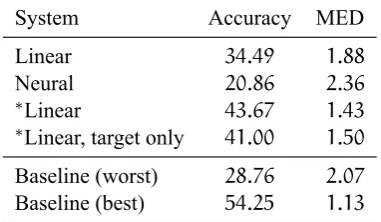
The official results obtained by our linear and neu-ral model alongside the best and worst baseline results published by the organizers presented in Table 2. The organizers offer a large number of baseline results. We only present the best (unpub-lished transformer model) and the worst (‘untuned’ monotonic alignment model). The best system in the competition (CMU-03) achieves an accuracy of58.79and mean edit distance of1.52.
Besides the official results, we also present re-sults obtained after the competition in Table2. The row labeled ‘∗Linear’ presents the results obtained with the same linear classifier after fixing a bug in feature extraction and further tuning. The row marked as ‘target only’, presents results that are obtained using only the target language, without any attempt of cross-lingual learning. Both scores are obtained using the official evaluation script on the test data released after the end of the evaluation period.
0 10 20 30 40 50 60 70 80 90 adyghe–kabardian albanian–breton arabic–classical-syriac arabic–maltese arabic–turkmen armenian–kabardian asturian–occitan bashkir–azeri bashkir–crimean-tatar bashkir–kazakh bashkir–khakas bashkir–tatar bashkir–turkmen basque–kashubian belarusian–old-irish bengali–greek bulgarian–old-church-slavonic czech–kashubian czech–latin danish–middle-high-german danish–middle-low-german danish–north-frisian danish–west-frisian danish–yiddish dutch–middle-high-german dutch–middle-low-german dutch–north-frisian dutch–west-frisian dutch–yiddish english–murrinhpatha english–north-frisian english–west-frisian estonian–ingrian estonian–karelian estonian–livonian estonian–votic finnish–ingrian finnish–karelian finnish–livonian finnish–votic french–occitan german–middle-high-german german–middle-low-german german–yiddish greek–bengali hebrew–classical-syriac hebrew–maltese hindi–bengali hungarian–ingrian hungarian–karelian hungarian–livonian hungarian–votic irish–breton irish–cornish irish–old-irish irish–scottish-gaelic italian–friulian italian–ladin italian–maltese italian–neapolitan kannada–telugu kurmanji–sorani latin–czech latvian–lithuanian latvian–scottish-gaelic persian–azeri persian–pashto polish–kashubian polish–old-church-slavonic portuguese–russian romanian–latin russian–old-church-slavonic russian–portuguese sanskrit–bengali sanskrit–pashto slovak–kashubian slovene–old-saxon sorani–irish spanish–friulian spanish–occitan swahili–quechua turkish–azeri turkish–crimean-tatar turkish–kazakh turkish–khakas turkish–tatar turkish–turkmen urdu–bengali urdu–old-english uzbek–azeri uzbek–crimean-tatar uzbek–kazakh uzbek–khakas uzbek–tatar uzbek–turkmen welsh–breton welsh–cornish welsh–old-irish welsh–scottish-gaelic zulu–swahili 96 22 91 18 60 79 43 34 68 74 72 61 70 46 6 23.5 35 42 8.4 66 28 28 42 67 66 32 28 38 68 34 28 36 32 58 33 27 36 54 30 34 42 66 28 67 40 88 18 44 26 48 32 27 21 18 6 44 55 46 16 73 78 12.8 35.8 17.8 40 33 40 62 35 37.7 8.1 33 54.5 45 40 48 17.6 32.3 55 46 20.8 61 71 62 68 66 86 36 16.6 37 64 64 68 65 70 24 18 6 40 33 78 22 88 18 60 78 43 30 59 64 60 61 58 42 6 23.5 35 42 8.4 66 28 27 35 67 66 32 27 35 68 34 27 36 26 50 32 27 30 50 30 27 42 66 28 67 40 88 18 43 26 48 32 27 21 18 6 38 55 46 16 73 78 10.1 35.8 17.8 40 30 40 48 35 37.7 8.1 33 51 43 40 44 17.6 32.3 55 46 19.7 28 59 62 64 61 60 36 16.6 30 61 64 64 64 62 23 18 6 40 25 accuracy transfer no transfer
System Accuracy MED
Linear 34.49 1.88
Neural 20.86 2.36
∗Linear 43.67 1.43
∗Linear, target only 41.00 1.50
[image:7.595.86.277.64.175.2]Baseline (worst) 28.76 2.07 Baseline (best) 54.25 1.13
Table 2: Overall results obtained by our systems in comparison to the official state-of-the-art baseline (Wu and Cotterell,2019). The scores are word-form accu-racy and mean edit distance (MED) averaged over all 100language pairs. The rows marked with asterisk in-dicate post-evaluation scores obtained using the linear predictor, after fixing a bug and further tuning.
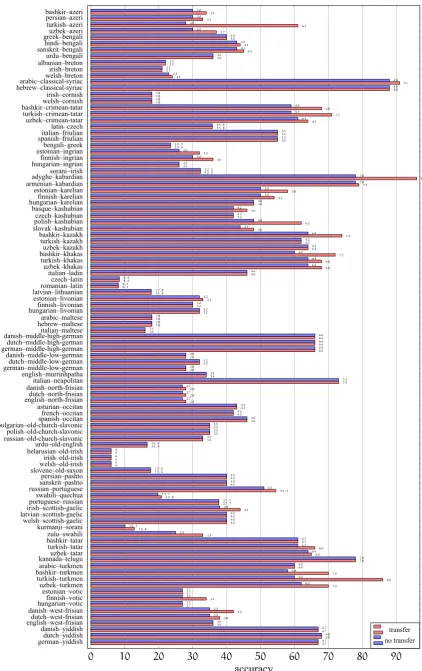
performing systems, the post-evaluation fixes and tuning results in a dramatic increase in the perfor-mance of the linear model. The more interesting result, however, is the small difference between the transfer learning results and the ‘target only’ results. We present the target-only and transfer ac-curacy scores for each language pair in Figure2. In general, the gains from cross-lingual learning are modest. There is no improvement at all for59of the language pairs. As expected, this includes all 30pairs with writing system mismatch, excluding some of the language pairs for which we translit-erated the source data. The effect of transliteration is rather modest as well, yielding an improvement between4to12percentage points of accuracy for four of the eight language pairs where it was used. The effect of the transliteration to the overall score is a0.29%increase in accuracy. Not surprisingly, the highest increases due to cross-lingual learn-ing are obtained when source and target languages are closely related. The highest increase is ob-tained from Turkish to Azeri with33%, followed by Turkish–Turkmen and Adyghe–Kabardian with 26%and18%respectively.
5 Summary and outlook
We presented a simple inflection system based on predicting transduction actions. Of the predictors we tried, the linear predictor performs reasonably well. Although its performance is lower than the top performing systems in the shared task, the sys-tem is far from being well-tuned, and as demon-strated above simple improvements may have a major effects on the performance. Furthermore,
the linear predictor has the advantage of requir-ing relatively less computational resources, which may be advantageous in some cases. One further advantage is the ease of analyses of linear learn-ers. What the linear model learns is often much simpler to understand and interpret, and although the need for crafting feature combinations is one of its weaknesses, it may also provide further in-sight through more interpretable ablation studies. Our neural predictor did not perform as well as the linear predictor. This, however, is by no means a conclusive result. If tuned well, neural networks should in fact work well in this task because of their capability of learning arbitrary combinations of their inputs.
On the cross-lingual side of the problem, the improvements we get are rather modest. In fact, there is a only small overall improvement due to cross-lingual learning over learning only from low-resource target language. Since our relatively simple system can get up to 40% accuracy by learning only from the small target language train-ing sets, there is also a good chance that more suc-cessful systems are also relying more on the target language data rather than benefiting from trans-fer learning. Some of the reasons for low suc-cess is probably the make up of the data. Not all language pairs are close enough to facilitate the transfer learning. However, there are many possi-ble directions for exploiting the cross-lingual sig-nal better. The simple method used in this study can be improved in many ways. Although our ini-tial experiments were not successful. We believe cross-lingual character embeddings, and ’translat-ing’ transduction actions from source language to target language may be potential ways to get a bet-ter cross-lingual input.
Acknowledgments
Some of the experiments reported here were run on a Titan Xp donated by the NVIDIA Corporation.
References
Tal-war, Paul Tucker, Vincent Vanhoucke, Vijay Vasude-van, Fernanda Viégas, Oriol Vinyals, Pete Warden, Martin Wattenberg, Martin Wicke, Yuan Yu, and Xi-aoqiang Zheng. 2015.TensorFlow: Large-scale ma-chine learning on heterogeneous systems. Software available from tensorflow.org.
Malin Ahlberg, Markus Forsberg, and Mans Hulden. 2015. Paradigm classification in supervised learn-ing of morphology. In Proceedings of the 2015 Conference of the North American Chapter of the Association for Computational Linguistics: Human Language Technologies, pages 1024–1029, Denver, Colorado. Association for Computational Linguis-tics.
Iñaki Alegria and Izaskun Etxeberria. 2016. EHU at the SIGMORPHON 2016 shared task. a simple pro-posal: Grapheme-to-phoneme for inflection. In Pro-ceedings of the 14th SIGMORPHON Workshop on Computational Research in Phonetics, Phonology, and Morphology, pages 27–30, Berlin, Germany. Association for Computational Linguistics.
Jeremy Barnes, Roman Klinger, and Sabine Schulte im Walde. 2018. Bilingual sentiment embeddings: Joint projection of sentiment across languages. In Proceedings of the 56th Annual Meeting of the As-sociation for Comutational Linguistics (Volume 1: Long Papers), pages 2483–2493.
François Chollet et al. 2015. Keras. https:// github.com/fchollet/keras.
Çağrı Çöltekin and Jeremy Barnes. 2019. Neural and linear pipeline approaches to cross-lingual morpho-logical analysis. InProceedings of the Sixth Work-shop on NLP for Similar Languages, Varieties and Dialects, pages 153–164, TOBEFILLED-Ann Ar-bor, Michigan. Association for Computational Lin-guistics.
Ryan Cotterell, Christo Kirov, John Sylak-Glassman, Géraldine Walther, Ekaterina Vylomova, Arya D. McCarthy, Katharina Kann, Sebastian Mielke, Gar-rett Nicolai, Miikka Silfverberg, David Yarowsky, Jason Eisner, and Mans Hulden. 2018.The CoNLL– SIGMORPHON 2018 shared task: Universal mor-phological reinflection. In Proceedings of the CoNLL SIGMORPHON 2018 Shared Task: Univer-sal Morphological Reinflection, pages 1–27. Associ-ation for ComputAssoci-ational Linguistics.
Ryan Cotterell, Christo Kirov, John Sylak-Glassman, Géraldine Walther, Ekaterina Vylomova, Patrick Xia, Manaal Faruqui, Sandra Kübler, David Yarowsky, Jason Eisner, and Mans Hulden. 2017. CoNLL-SIGMORPHON 2017 shared task: Univer-sal morphological reinflection in 52 languages. In Proceedings of the CoNLL SIGMORPHON 2017 Shared Task: Universal Morphological Reinflec-tion, pages 1–30. Association for Computational Linguistics.
Ryan Cotterell, Christo Kirov, John Sylak-Glassman, David Yarowsky, Jason Eisner, and Mans Hulden.
2016. The SIGMORPHON 2016 shared Task— Morphological reinflection. InProceedings of the 14th SIGMORPHON Workshop on Computational Research in Phonetics, Phonology, and Morphol-ogy, pages 10–22, Berlin, Germany. Association for Computational Linguistics.
Greg Durrett and John DeNero. 2013. Supervised learning of complete morphological paradigms. In Proceedings of the 2013 Conference of the North American Chapter of the Association for Computa-tional Linguistics: Human Language Technologies, pages 1185–1195, Atlanta, Georgia. Association for Computational Linguistics.
Rong-En Fan, Kai-Wei Chang, Cho-Jui Hsieh, Xiang-Rui Wang, and Chih-Jen Lin. 2008. LIBLINEAR: A library for large linear classification. Journal of Machine Learning Research, 9:1871–1874.
Manaal Faruqui and Shankar. Kumar. 2015. Multi-lingual open relation extraction using cross-Multi-lingual projection. InProceedings of the 2016 Conference of the North American Chapter of the Association for Computational Linguistics: Human Language Technologies, Proceedings of the 2018 Conference of the North American Chapter of the Association for Computational Linguistics: Human Language Technologies, Volume 2 (Short Papers), pages 1351– 1356.
Manaal Faruqui, Yulia Tsvetkov, Graham Neubig, and Chris Dyer. 2016. Morphological inflection genera-tion using character sequence to sequence learning. InProceedings of the 2016 Conference of the North American Chapter of the Association for Computa-tional Linguistics: Human Language Technologies, pages 634–643, San Diego, California. Association for Computational Linguistics.
Melvin Johnson, Mike Schuster, Quoc V. Le, Maxim Krikun, Yonghui Wu, Zhifeng Chen, Nikhil Thorat, Fernanda Viégas, Martin Wattenberg, Greg Corrado, Macduff Hughes, and Jeffrey Dean. 2017. Google’s multilingual neural machine translation system: En-abling zero-shot translation.Transactions of the As-sociation for Computational Linguistics, 5:339–351.
Gerhard Jäger. 2013. Phylogenetic Inference from Word Lists Using Weighted Alignment with Empiri-cally Determined Weights.Language Dynamics and Change, 3(2):245–291.
Katharina Kann and Hinrich Schütze. 2016. MED: The LMU system for the SIGMORPHON 2016 shared task on morphological reinflection. InProceedings of the 14th SIGMORPHON Workshop on Computa-tional Research in Phonetics, Phonology, and Mor-phology, pages 62–70, Berlin, Germany. Associa-tion for ComputaAssocia-tional Linguistics.
Xia, Manaal Faruqui, Sebastian J. Mielke, Arya Mc-Carthy, Sandra Kübler, David Yarowsky, Jason Eis-ner, and Mans Hulden. 2018. UniMorph 2.0: Uni-versal Morphology. In Proceedings of the 11th Language Resources and Evaluation Conference, Miyazaki, Japan. European Language Resource As-sociation.
Kimmo Koskenniemi. 1985. Compilation of automata from morphological two-level rules. InPapers from the Fifth Scandinavian Conference of Computational Linguistics, page 143–149.
Johann-Mattis List. 2012. SCA: Phonetic Alignment based on sound classes. New Directions in Logic, Language and Computation, pages 32–51.
Ling Liu and Lingshuang Jack Mao. 2016. Morpho-logical reinflection with conditional random fields and unsupervised features. InProceedings of the 14th SIGMORPHON Workshop on Computational Research in Phonetics, Phonology, and Morphol-ogy, pages 36–40, Berlin, Germany. Association for Computational Linguistics.
Peter Makarov and Simon Clematide. 2018. UZH at CoNLL–SIGMORPHON 2018 shared task on uni-versal morphological reinflection. In Proceedings of the CoNLL–SIGMORPHON 2018 Shared Task: Universal Morphological Reinflection, pages 69–75, Brussels. Association for Computational Linguis-tics.
Peter Makarov, Tatiana Ruzsics, and Simon Clematide. 2017. Align and copy: UZH at SIGMORPHON 2017 shared task for morphological reinflection. In Proceedings of the CoNLL SIGMORPHON 2017 Shared Task: Universal Morphological Reinflection, pages 49–57, Vancouver. Association for Computa-tional Linguistics.
Arya D. McCarthy, Ekaterina Vylomova, Shijie Wu, Chaitanya Malaviya, Lawrence Wolf-Sonkin, Gar-rett Nicolai, Christo Kirov, Miikka Silfverberg, Se-bastian Mielke, Jeffrey Heinz, Ryan Cotterell, and Mans Hulden. 2019. The SIGMORPHON 2019 shared task: Crosslinguality and context in morphol-ogy. In Proceedings of the 16th SIGMORPHON Workshop on Computational Research in Phonetics, Phonology, and Morphology, Florence, Italy. Asso-ciation for Computational Linguistics.
Garrett Nicolai, Colin Cherry, and Grzegorz Kondrak. 2015. Inflection generation as discriminative string transduction. InProceedings of the 2015 Conference of the North American Chapter of the Association for Computational Linguistics: Human Language Tech-nologies, pages 922–931, Denver, Colorado. Asso-ciation for Computational Linguistics.
Garrett Nicolai, Bradley Hauer, Adam St Arnaud, and Grzegorz Kondrak. 2016. Morphological reinflec-tion via discriminative string transducreinflec-tion. In Pro-ceedings of the 14th SIGMORPHON Workshop on Computational Research in Phonetics, Phonology,
and Morphology, pages 31–35, Berlin, Germany. Association for Computational Linguistics.
Joakim Nivre, Johan Hall, and Jens Nilsson. 2004. Memory-based dependency parsing. In Proceed-ings of the 8th Conference on Computational Nat-ural Language Learning (CoNLL), pages 49–56.
F. Pedregosa, G. Varoquaux, A. Gramfort, V. Michel, B. Thirion, O. Grisel, M. Blondel, P. Prettenhofer, R. Weiss, V. Dubourg, J. Vanderplas, A. Passos, D. Cournapeau, M. Brucher, M. Perrot, and E. Duch-esnay. 2011. Scikit-learn: Machine learning in Python. Journal of Machine Learning Research, 12:2825–2830.
Jelena Prokić. 2010.Families and resemblances. Ph.D. thesis, University of Groningen.
Pavel Sofroniev and Çağrı Çöltekin. 2018. Phonetic vector representations for sound sequence align-ment. In Proceedings of the Fifteenth Workshop on Computational Research in Phonetics, Phonol-ogy, and Morphology, pages 111–116, Brussels, Bel-gium. Association for Computational Linguistics.
Martijn Wieling, Jelena Prokić, and John Nerbonne. 2009. Evaluating the pairwise string alignment of pronunciations. In Proceedings of the EACL 2009 workshop on language technology and resources for cultural heritage, social sciences, humanities, and education, pages 26–34.
Shijie Wu and Ryan Cotterell. 2019. Exact hard monotonic attention for character-level transduction. arXiv preprint arXiv:1905.06319v1.
Hiroyasu Yamada and Yuji Matsumoto. 2003. Statis-tical dependency analysis with support vector ma-chines. In Proceedings of 8th international work-shop on parsing technologies (IWPT), pages 195– 206.