47
Whitepaper on NEWS 2018 Shared Task on Machine Transliteration
Nancy Chen†, Xiangyu Duan‡, Min Zhang‡, Rafael E. Banchsη, Haizhou Li? †Singapore University of Technology and Design, Singapore
‡Soochow University, China 215006
ηNanyang Technological University, Singapore
?National University of Singapore, Singapore
Abstract
Transliteration is defined as the phonetic translation of names across languages. Transliteration of Named Entities (NEs) is a necessary subtask in many applica-tions, such as machine translation, cor-pus alignment, cross-language IR, infor-mation extraction and automatic lexicon acquisition. All such systems call for high-performance transliteration, which is the focus of the shared task in NEWS 2018.
1 Task Description
The objective of the Shared Task on Named En-tity Transliteration at NEWS 2018 is to promote machine transliteration research by providing a common benchmarking platform for the research community to evaluate state-of-the-art approaches to this problem. The task is to develop machine transliteration and/or back-transliteration systems in one or more of the provided language pairs.
For each language pair, training and develop-ment data sets containing source and target name pairs are released for participating teams to train their systems. At the evaluation time, test sets of source names only will be released, on which participants are expected to produce a ranked list of transliteration and/or back-transliteration can-didates in the target language. The results will be automatically evaluated by using the same metrics used in previous editions of the shared task.
This year’s shared task focuses mainly on “stan-dard” submissions, i.e. output results from sys-tems that have been trained only with the data pro-vided by the shared task organizing team. This will ensure that all results for the same task are comparable across the different systems. Partici-pants may submit several “standard” runs for each of the task they participate in. Those participants interested in submitting “non-standard” runs, i.e.
output results from systems that use additional data during the training phase, still will be able to do so. However such runs will be evaluated and reported separately.
2 Important Dates
Train/Development data release 12 March 2018
Test data release 07 May 2018
Results Submission Due 14 May 2018
Task (short) Papers Due 21 May 2018
Acceptance Notification 28 May 2018
Camera-Ready Deadline 04 June 2018
Workshop Date 20 July 2018
3 Participation
1. Registration (12 March 2018). Prospec-tive participants are to register through the NEWS 2018 website by requesting the datasets from 12 March onwards.
2. Train/Development Data (12 March 2018). Registered participants are to obtain train and development data from the shared task regis-tration form and/or the designated copyright owners of databases. All registered partici-pants are required to participate in the evalu-ation of at least one language pair, submit the results, prepare a short paper and attend the workshop at ACL 2018.
processed this year. According to this, par-ticipants are required to use only the train-ing and development data provided within the shared task to train their systems.
Participants can submit several runs for each individual language pair at the competition site. However, the total number of submis-sions per language pair will be limited to a maximum of 3 submissions per day, with a total maximum of 15 submissions during the whole period of the competition. From all submissions done to each individual lan-guage pair, each participant must select one to be posted on the leaderboard. Results on the leaderboard (by the last day of the shared task on 14 May 2018) will constitute the final official results of the shared task.
Each submission must be saved in a file named ”results.xml” and submitted into the system in a ”.zip” compressed file format. Each ”results.xml” file can contain up to 10 output candidates in a ranked list for each corresponding input entry in the test file (re-fer to Appendix B for more details on file for-mating and naming conventions).
Those participants interested in submitting “non-standard” runs, i.e. transliteration re-sults from systems that use additional data during the training phase, still will be able to do so. However such runs will be evalu-ated and reported separately (please contact the organizers).
4. Results (14 May 2018). Leaderboard results, as on 14 May 2018, will be considered the official evaluation results of the NEWS 2018 shared task. These results will be published on the workshop website and proceedings.
Note that only the scores (evaluation metrics) of the participating systems on each language pair will be published, and no explicit refer-ence to the participating teams will be pro-vided. Furthermore, all participants should agree on not to reveal identities of other par-ticipants in any of their publications unless permission from the other respective partici-pants is granted. By default, all participartici-pants remain anonymous in published results. Par-ticipating teams are allowed to reveal only their own identity in their publications.
5. Shared Task Short Papers (21 May 2018). Each participant is required to submit a 4-page system paper (short paper) describing their system, the used approach, submissions and results. Peer reviews will be conducted to improve paper quality and readability and make sure the authors’ ideas and methods can be understood by the workshop participants.
We are aiming at accepting all system papers, and selected ones will be presented orally in the workshop. All participants are required to register and attend the workshop to present their work. All paper submission and reviews will be managed electronically through https: //www.softconf.com/acl2018/NEWS/.
4 Language Pairs
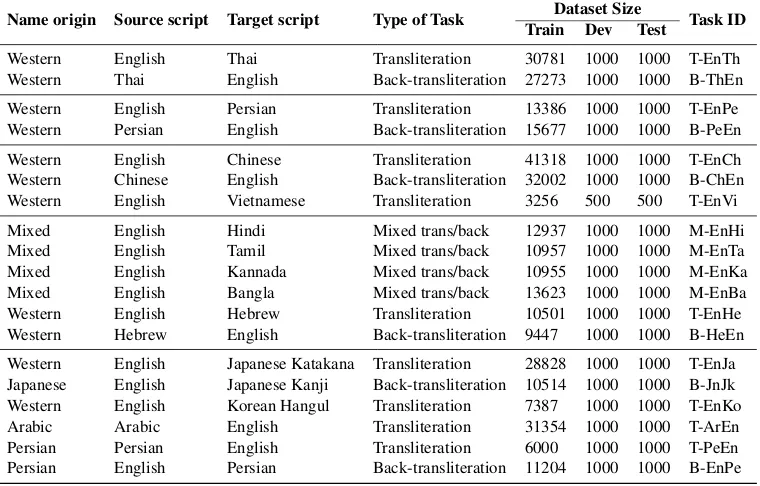
The different evaluation tasks within the NEWS 2018 shared task focus on transliteration and/or back-transliteration of personal and place names from a source language into a target language as summarized in Table 1. This year, the shared task offers 19 evaluation tasks, including 9 translitera-tion tasks, 6 back-transliteratranslitera-tion tasks and 4 hybrid tasks. NEWS 2018 will release training, devel-opment and testing data for each of the language pairs. Within the 19 evaluation tasks, NEWS 2018 includes the 14 tasks that were evaluated in the previous year editions. In such cases, the training and development datasets are augmented versions of the previous year ones. New test dataset will be used in NEWS 2018 evaluations.
The names given in the training sets for Thai (T-EnTh & B-ThEn), Persian (T-EnPe & B-PeEn), Chinese (T-EnCh & B-ChEn), Hebrew (T-EnHe & B-HeEn), Vietnamese EnVi), Japanese (T-EnJa) and Korean (T-EnKo) are Western names and their respective transliterations.
Name origin Source script Target script Type of Task Dataset Size Task ID Train Dev Test
[image:3.595.110.490.66.309.2]Western English Thai Transliteration 30781 1000 1000 T-EnTh Western Thai English Back-transliteration 27273 1000 1000 B-ThEn Western English Persian Transliteration 13386 1000 1000 T-EnPe Western Persian English Back-transliteration 15677 1000 1000 B-PeEn Western English Chinese Transliteration 41318 1000 1000 T-EnCh Western Chinese English Back-transliteration 32002 1000 1000 B-ChEn Western English Vietnamese Transliteration 3256 500 500 T-EnVi Mixed English Hindi Mixed trans/back 12937 1000 1000 M-EnHi Mixed English Tamil Mixed trans/back 10957 1000 1000 M-EnTa Mixed English Kannada Mixed trans/back 10955 1000 1000 M-EnKa Mixed English Bangla Mixed trans/back 13623 1000 1000 M-EnBa Western English Hebrew Transliteration 10501 1000 1000 T-EnHe Western Hebrew English Back-transliteration 9447 1000 1000 B-HeEn Western English Japanese Katakana Transliteration 28828 1000 1000 T-EnJa Japanese English Japanese Kanji Back-transliteration 10514 1000 1000 B-JnJk Western English Korean Hangul Transliteration 7387 1000 1000 T-EnKo Arabic Arabic English Transliteration 31354 1000 1000 T-ArEn Persian Persian English Transliteration 6000 1000 1000 T-PeEn Persian English Persian Back-transliteration 11204 1000 1000 B-EnPe
Table 1: Source and target languages for the shared task on transliteration.
5 Standard Datasets
Training Data (Parallel)
Paired names between source and target lan-guages; size 3K – 41K.
Training data is used for training a basic transliteration system.
Development Data (Parallel)
Paired names between source and target lan-guages; size 1K (500 for T-EnVi).
Development data is in addition to the train-ing data, which is used for fine-tuntrain-ing the system parameters, in case of need. Partici-pants are allowed to use it as part of the train-ing data for their final submissions.
Testing Data
Source names only; size 1K (500 for T-EnVi). This is a held-out set, which will be used for evaluating the quality of the transliterations.
Participants will need to obtain licenses from the respective copyright owners of the different datasets and/or agree to the terms and conditions of use that are given on the downloading web-site (Li et al., 2004; MSRI, 2010; CJKI, 2010). NEWS 2018 will provide the contact details for each dataset group.
The data would be provided in Unicode UTF-8 encoding, in XML format. The results are ex-pected to be submitted in UTF-8 encoding also in
XML format. The required XML format details are available in the Appendix A.
Note that name pairs are distributed as-is, as provided by the respective creators. While the datasets are mostly manually checked, there may be still inconsistencies (that is, non-standard us-age, region-specific usus-age, errors, etc.) or incom-pleteness (that is, not all right variations may be covered). The participants are allowed to use any method of their preference to further clean up the data provided:
• For any participant conducting a manual clean up, we appeal that such data be pro-vided back to the organizers for redistribution to all the participating groups in that language pair. Such sharing benefits all participants!
• If automatic clean up were used, such clean up will be considered part of the system im-plementation, and hence it is not required to be shared with all participants.
6 Evaluation Metrics
As in previous editions of the shared task, the qual-ity of the submitted results will be evaluated by us-ing the followus-ing 4 metrics. Each individual name result might include up to 10 output candidates in a ranked list.
Since a given source name may have multiple correct target transliterations, all these alternatives are treated equally in the evaluation. That is, any of these alternatives are considered as a correct transliteration, and the first correct transliteration in the ranked list is accepted as a correct hit.
The following notation is further assumed: N : Total number of names (source
words) in the test set.
ni : Number of reference transliterations fori-th name in the test set (ni≥1). ri,j : j-th reference transliteration for i-th
name in the test set.
ci,k : k-th candidate transliteration (system output) for i-th name in the test set (1≤k≤10).
Ki : Number of candidate transliterations produced by a transliteration system.
1. Word Accuracy in Top-1 (ACC) Also known as Word Error Rate. It measures correct-ness of the first transliteration candidate in the can-didate list produced by a transliteration system. ACC = 1means that all top candidates are cor-rect transliterations i.e. they match one of the ref-erences, andACC = 0means that none of the top candidates are correct.
ACC= 1 N
N X
i=1
1if∃ri,j : ri,j =ci,1;
0otherwise
(1)
2. Fuzziness in Top-1 (Mean F-score) The mean F-score measures how different, on average, the top transliteration candidate is from its closest reference. F-score for each source word is a func-tion of Precision and Recall and equals 1 when the top candidate matches one of the references, and 0 when there are no common characters between the candidate and any of the references.
Precision and Recall are calculated based on the length of the Longest Common Subsequence be-tween a candidate and a reference:
LCS(c, r) = 1
2(|c|+|r| −ED(c, r)) (2)
whereEDis the edit distance and|x|is the length of x. For example, the longest common subse-quence between “abcd” and “afcde” is “acd” and its length is 3. The best matching reference, that is, the reference for which the edit distance has the minimum value, is taken for calculation. If the best matching reference is given by
ri,m= arg min
j (ED(ci,1, ri,j)) (3)
then Recall, Precision and F-score for i-th word are calculated as follows:
Ri =
LCS(ci,1, ri,m) |ri,m|
(4)
Pi =
LCS(ci,1, ri,m)
|ci,1|
(5)
Fi = 2Ri×Pi
Ri+Pi (6)
• The length is computed in distinct Unicode characters.
• No distinction is made among different char-acter types of a language (e.g. vowel vs. con-sonants vs. combining diereses etc.)
3. Mean Reciprocal Rank (MRR) Measures traditional MRRfor any right answerproduced by the system, from among the candidates. 1/M RR tells approximately the average rank of the correct transliteration. MRR closer to 1 implies that the correct answer is mostly produced close to the top of the n-best lists.
RRi =
minj 1j if∃ri,j, ci,k :ri,j =ci,k; 0otherwise
(7)
M RR= 1 N
N X
i=1
RRi (8)
4. MAPref Measures tightly the precision in the n-best candidates fori-th source name, for which reference transliterations are available. If all of the references are produced, then the MAP is 1. Let’s denote the number of correct candidates for the i-th source word in k-best list as num(i, k). MAPref is then given by
7 Paper Format
Paper submissions to NEWS 2018 should follow the ACL 2018 paper submission policy, includ-ing paper format, blind review policy and title and author conventions. Full papers (research papers) must be in two-column format without exceeding eight (8) pages of content plus two (2) extra pages for references and short papers (research and shared task papers) must also be in two-column format without exceeding four (4) pages content plus two (2) extra pages for references. Submis-sion must conform to the official ACL 2018 style guidelines. For details, please refer to the ACL 2018 website: http://acl2018.org/call-for-papers/.
8 Contact Us
If you have any questions about the share task and the datasets, please contact any of the workshop organizers. Contact information is available at the NEWS 2018 website http://workshop.colips.org/ news2018/contact.html
References
[CJKI2010] CJK Institute. 2010. http://www.cjk.org/.
[Li et al.2004] Haizhou Li, Min Zhang, and Jian Su. 2004. A joint source-channel model for machine transliteration. InProc. 42nd ACL Annual Meeting, pages 159–166, Barcelona, Spain.
[MSRI2010] MSRI. 2010. Microsoft Research India. http://research.microsoft.com/india.
[AILab2018] Artificial Intelligence Laboratory (AILab) 2018. Ho Chi Minh City University of Science (VNU-HCMUS). https://www.ailab.hcmus.edu.vn/
[Cao et al.2010] Nam X. Cao, Nhut M. Pham, Quan H. Vu. 2010. Comparative analysis of transliteration techniques based on statistical machine translation and joint-sequence model. InProc. Symposium on
Information and Comunication Technology, pages
59–63, ACM.
A Appendix: Data Formats
• File Naming Conventions: NEWS18 Z-XXYY trn.xml NEWS18 Z-XXYY dev.xml
– Z: Type of task (T: transliteration, B: back-transliteration, M: mixed)
– XX: Source Language
– YY: Target Language
• File formats:
All data will be made available in XML for-mats as illustrated in Figure 1.
• Data Encoding Formats:
The data will be in Unicode UTF-8 encod-ing files without byte-order mark, and in the XML format specified.
B Appendix: Submission of Results
• File Naming Conventions:
Each submission must be saved in a file named ”results.xml” and submitted into the NEWS 2018 CodaLab competition in a ”.zip” compressed file. Each ”results.xml” file can contain up to 10 output candidates in a ranked list for each corresponding input entry in the test file.
• File formats:
All data will be provided in XML formats as illustrated in Figure 2.
• Data Encoding Formats:
<?xml version = "1.0" encoding = "UTF-8"?>
<TransliterationCorpus CorpusFormat = "UTF-8" CorpusID = "[task_id]"
CorpusSize = "[total_number_of_names_in_file]" CorpusType = "[Training|Development]"
NameSource = "[name_origin]" SourceLang = "[source_language]" TargetLang = "[target_language]">
<Name ID="1">
<SourceName>[source_name_1]</SourceName>
<TargetName ID="1">[target_name_1_1]</TargetName> <TargetName ID="2">[target_name_1_2]</TargetName> ...
<TargetName ID="n">[target_name_1_n]</TargetName> </Name>
<Name ID="2">
<SourceName>[source_name_2]</SourceName>
<TargetName ID="1">[target_name_2_1]</TargetName> <TargetName ID="2">[target_name_2_2]</TargetName> ...
<TargetName ID="k">[target_name_2_k]</TargetName> </Name>
...
<!-- rest of the names to follow --> ...
</TransliterationCorpus>
<?xml version="1.0" encoding="UTF-8"?>
<TransliterationTaskResults
SourceLang = "[source_language]" TargetLang = "[target_language]" GroupID = "[your_institution_name]" RunID = "[your_submission_number]" RunType = "Standard"
Comments = "[your_comments_here]" TaskID = "[task_id]">
<Name ID="1">
<SourceName>[test_name_1]</SourceName>
<TargetName ID="1">[your_system_result_1_1]</TargetName> <TargetName ID="2">[your_system_result_1_2]</TargetName> ...
<TargetName ID="10">[your_system_result_1_10]</TargetName> </Name>
<Name ID="2">
<SourceName>[test_name_2]</SourceName>
<TargetName ID="1">[your_system_result_2_1]</TargetName> <TargetName ID="2">[your_system_result_2_2]</TargetName> ...
<TargetName ID="10">[your_system_result_2_10]</TargetName> </Name>
...
<!-- All names in test corpus to follow --> ...
</TransliterationTaskResults>