Proceedings of the 56th Annual Meeting of the Association for Computational Linguistics-System Demonstrations, pages 31–36
31
Y
EDDA: A Lightweight Collaborative Text Span Annotation Tool
Jie Yang, Yue Zhang, Linwei Li, Xingxuan Li
Singapore University of Technology and Design
{jie yang, linwei li, xingxuan li}@mymail.sutd.edu.sg yue [email protected]
Abstract
In this paper, we introduce YEDDA, a lightweight but efficient and comprehen-sive open-source tool for text span an-notation. YEDDA provides a systematic solution for text span annotation, rang-ing from collaborative user annotation to administrator evaluation and analysis. It overcomes the low efficiency of traditional text annotation tools by annotating entities through both command line and shortcut keys, which are configurable with custom labels. YEDDA also gives intelligent rec-ommendations by learning the up-to-date annotated text. An administrator client is developed to evaluate annotation qual-ity of multiple annotators and generate de-tailed comparison report for each annota-tor pair. Experiments show that the pro-posed system can reduce the annotation time by half compared with existing anno-tation tools. And the annoanno-tation time can be further compressed by 16.47% through intelligent recommendation.
1 Introduction
Natural Language Processing (NLP) systems rely on large-scale training data (Marcus et al.,1993) for supervised training. However, manual anno-tation can be time-consuming and expensive. De-spite detailed annotation standards and rules, inter-annotator disagreement is inevitable because of human mistakes, language phenomena which are not covered by the annotation rules and the ambi-guity of language itself (Plank et al.,2014).
Existing annotation tools (Cunningham et al.,
2002; Morton and LaCivita, 2003; Chen and
Styler, 2013; Druskat et al., 2014) mainly focus on providing a visual interface for user annotation
Admin Toolkits Annotator
Interface
Annotator 1
Annotator 2
Annotator n
Raw Text
Annotated Text
Multi-Annotation Analysis Results
Detailed Pairwise Annotation Report Feedback
[image:1.595.311.522.224.361.2]Administrator
Figure 1: Framework of YEDDA.
process but rarely consider the post-annotation quality analysis, which is necessary due to the inter-annotator disagreement. In addition to the annotation quality, efficiency is also critical in large-scale annotation task, while being relatively less addressed in existing annotation tools (Ogren,
2006;Stenetorp et al.,2012). Besides, many tools (Ogren, 2006; Chen and Styler, 2013) require a complex system configuration on either local de-vice or server, which is not friendly to new users.
To address the challenges above, we propose YEDDA1 , a lightweight and efficient annotation
tool for text span annotation. A snapshot is shown in Figure 2. Here text span boundaries are se-lected and assigned with a label, which can be use-ful for Named Entity Recognition (NER) (Tjong
Kim Sang and De Meulder, 2003), word
seg-mentation (Sproat and Emerson, 2003), chunk-ing (Tjong Kim Sang and Buchholz, 2000) ,etc. To keep annotation efficient and accurate, YEDDA
provides systematic solutions across the whole notation process, which includes the shortcut an-notation, batch annotation with a command line, intelligent recommendation, format exporting and
1Code is available at https://github.com/
Tool Operating System ConsistencySelf Command LineAnnotation System
Recommendation Analysis Size Language MacOS Linux Win
WordFreak √ √ √ √ × √ × 1.1M Java
GATE √ √ √ √ × √ × 544M Java
Knowtator √ √ √ × × × √ 1.5M Java
Stanford √ √ √ √ × × × 88k Java
Atomic √ √ √ √ × × × 5.8M Java
WebAnno √ √ √ × × √ √ 13.2M Java
Anafora √ √ × × × × × 1.7M Python
BRAT √ √ × × × √ × 31.1M Python
[image:2.595.74.525.62.189.2]YEDDA √ √ √ √ √ √ √ 80k Python
Table 1: Annotation Tool Comparison .
administrator evaluation/analysis.
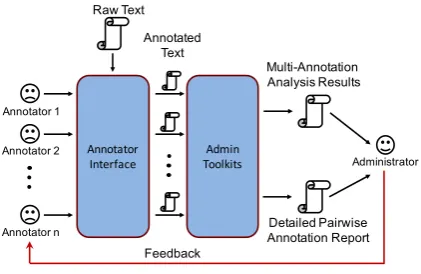
Figure 1 shows the general framework of YEDDA. It offers annotators with a simple and efficient Graphical User Interface (GUI) to anno-tate raw text. For the administrator, it provides two useful toolkits to evaluate multi-annotated text and generate detailed comparison report for annotator pair. YEDDAhas the advantages of being:
• Convenient: it is lightweight with an intuitive interface and does not rely on specific operating systems or pre-installed packages.
• Efficient: it supports both shortcut and com-mand line annotation models to accelerate the an-notating process.
• Intelligent: it offers user with real-time system suggestions to avoid duplicated annotation. • Comprehensive: it integrates useful toolkits to give the statistical index of analyzing multi-user annotation results and generate detailed content comparison for annotation pairs.
This paper is organized as follows: Section 2 gives an overview of previous text annotation tools and the comparison with ours. Section 3 describes the architecture of YEDDAand its detail functions. Section 4 shows the efficiency comparison results of different annotation tools. Finally, Section 5 concludes this paper and give the future plans.
2 Related Work
There exists a range of text span annotation tools which focus on different aspects of the annota-tion process. Stanford manual annotaannota-tion tool2 is a lightweight tool but does not support re-sult analysis and system recommendation. Know-tator (Ogren, 2006) is a general-task annotation tool which links to a biomedical onto ontology to
2http://nlp.stanford.edu/software/
stanford-manual-annotation-tool-2004-05-16. tar.gz
help identify named entities and relations. It sup-ports quality control during the annotation process by integrating simple inter-annotator evaluation, while it cannot figure out the detailed disagreed labels. WordFreak (Morton and LaCivita, 2003) adds a system recommendation function and inte-grates active learning to rank the unannotated sen-tences based on the recommend confidence, while the post-annotation analysis is not supported.
Web-based annotation tools have been devel-oped to build operating system independent an-notation environments. GATE3 (Bontcheva et al.,
2013) includes a web-based with collaborative an-notation framework which allows users to work collaboratively by annotating online with shared text storage. BRAT (Stenetorp et al., 2012) is another web-based tool, which has been widely used in recent years, it provides powerful an-notation functions and rich visualization ability, while it does not integrate the result analysis func-tion. Anafora (Chen and Styler,2013) and Atomic
(Druskat et al., 2014) are also web-based and
lightweight annotation tools, while they don’t sup-port the automatic annotation and quality analysis either. WebAnno (Yimam et al.,2013;de Castilho
et al., 2016) supports both the automatic
annota-tion suggesannota-tion and annotaannota-tion quality monitor-ing such as inter-annotator agreement measure-ment, data curation, and progress monitoring. It compares the annotation disagreements only for each sentence and shows the comparison within the interface, while our system can generate a de-tailed disagreement report in .pdf file through the whole annotated content. Besides, those web-based annotation tools need to build a server through complex configurations and some of the servers cannot be deployed on Windows systems.
3G
Figure 2: Annotator Interface.
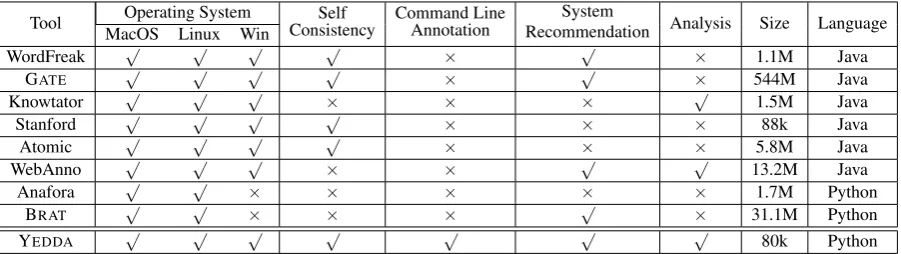
The differences between YEDDA and related work are summarised in Table 14. Here “Self Consistency” represents whether the tool works independently or it relies on pre-installed pack-ages. Compared to these tools, YEDDA provides
a lighter but more systematic choice with more flexibility, efficiency and less dependence on sys-tem environment for text span annotation. Be-sides, YEDDA offers administrator useful toolkits for evaluating the annotation quality and analyze the detailed disagreements within annotators.
3 YEDDA
YEDDA is developed based on standard Python GUI library Tkinter5, and hence needs only Python installation as a prerequisite and is com-patible with all Operating System (OS) platforms with Python installation. It offers two user-friendly interfaces for annotators and administra-tor, respectively, which are introduced in detail in Section3.1and Section3.2, respectively.
3.1 Annotator Client
The client is designed to accelerate the annotation process as much as possible. It supports short-cut annotation to reduce the user operation time. Command line annotation is designed to annotate multi-span in batch. In addition, the client pro-vides system recommendations to lessen the work-load of duplicated span annotation.
4
For web-based tools, we list their server-side dependency on operating systems.
5https://docs.python.org/2/library/
tkinter.html
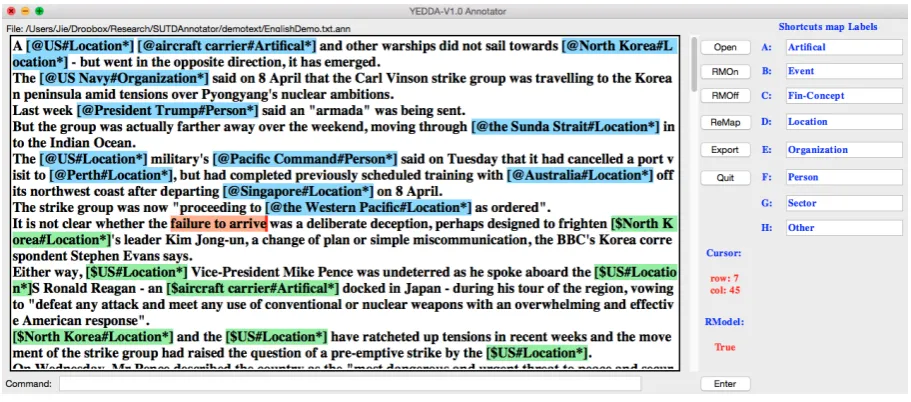
Figure2shows the interface of annotator client on an English entity annotation file. The interface consists of 5 parts. The working area in the up-left which shows the texts with different colors (blue: annotated entities, green: recommended entities and orange: selected text span). The entry at the bottom is the command line which accepts anno-tation command. There are several control buttons in the middle of the interface, which are used to set annotation model. The status area is below the control buttons, it shows the cursor position and the status of recommending model. The right side shows the shortcut map, where shortcut key “a” or “A” means annotating the text span with “Arti-ficial” type and the same for other shortcut keys. The shortcut map can be configured easily6. De-tails are introduced as follows.
3.1.1 Shortcut Key Annotation
YEDDA provides the function of annotating text
span by selecting using mouse and press shortcut key to map the selection into a specific label. It is a common annotation process in many annota-tion tools (Stenetorp et al.,2012;Bontcheva et al.,
2013). It binds each label with one custom short-cut key, this is shown in the “Shortshort-cuts map La-bels” part of Figure 2. The annotator needs only two steps to annotate one text span, i.e. “select and press”. The annotated file updates simultaneously with each key pressing process.
6Type the corresponding labels into the entries following
Figure 3: Administrator Interface.
3.1.2 Command Line Annotation
YEDDA also support the command line annota-tion funcannota-tion (see the command entry in the bot-tom of Figure 2) which can execute multi-span annotation at once. The system will parse the command automatically and convert the command into multi-span annotation instructions and exe-cute in batch. It is quite efficient for the tasks of character-based languages (such as Chinese and Japanese) with high entity density. The command follows a simple rule which is“n1 +key1 +n2 + key2 +n3 +key3 +...00, where ‘n1, n2, n3’ are the length of the entities and ‘key1, key2, key3’ is the corresponding shortcut key. For example, command “2A3D2B” represents annotating fol-lowing 2 characters as label ‘A’ (mapped into a specific label name), the following 3 characters as label ‘D’ and 2 characters further as label ‘B’.
3.1.3 System Recommendation
It has been shown that using pre-annotated text and manual correction increases the annotation ef-ficiency in many annotation tasks (Meurs et al.,
2011;Stenetorp et al., 2012). YEDDA offers an-notators with system recommendation based on the existing annotation history. The current rec-ommendation system incrementally collects anno-tated text spans from sentences that have been la-beled, thus gaining a dynamically growing lexi-con. Using the lexicon, the system automatically annotates sentences that are currently being anno-tated by leveraging the forward maximum match-ing algorithm. The automatically suggested text spans and their types are returned with colors in the user interface, as shown in green in Figure2. Annotators can use the shortcut to confirm, cor-rect or veto the suggestions. The recommending system keeps online updating during the whole an-notation process, which learns the up-to-date and in-domain annotation information. The recom-mending system is designed as “pluggable” which ensures that the recommending algorithm can be easily extended into other sequence labeling
mod-Figure 4: Multiple annotators F1-score matrix.
els, such as Conditional Random Field (CRF)7
(Lafferty et al., 2001). The recommendation can
be controlled through two buttons “RMOn” and “RMOff”, which enables and disables the recom-mending function, respectively.
3.1.4 Annotation Modification
It is inevitable that the annotator or the recom-mending system gives incorrect annotations or suggestions. Based on our annotation experience, we found that the time cost of annotation correc-tion cannot be neglected. Therefore, YEDDA pro-vides several efficient modification actions to re-vise the annotation:
• Action withdraw: annotators can cancel their previous action and let system return to the last status by press the shortcut keyCtrl+z.
• Span label modification: if the selected span has the correct boundary but receives an incorrect label, annotator only needs to put the cursor inside the span (or select the span) and press the shortcut key of the right label to correct label.
• Label deletion: similar to the label modifica-tion, the annotator can put the cursor inside the span and press shortcut keyqto remove the anno-tated (recommended) label.
3.1.5 Export Annotated Text
As the annotated file is saved in .ann format, YEDDA provides the “Export” function which exports the annotated text as standard format (ended with .anns). Each line includes one word/character and its label, sentences are sepa-rated by an empty line. The exported label can be chosen in either BIO or BIOES format (Ratinov and Roth,2009).
3.2 Administrator Toolkits
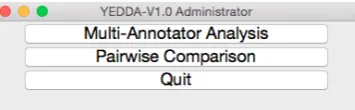
For the administrator, it is important and neces-sary to evaluate the quality of annotated files and analyze the detailed disagreements of different an-notators. Shown in Figure3, YEDDA provides a
7Those sequence labeling models work well on big
[image:4.595.93.271.62.117.2]Annotation Comparison Report
SUTDNLP Group
Singapore University of Technology and Design
1 Overall Statistics
File1color: Blue;Dir: ~/demotext/EnglishUserA.txt.ann File2color: Red;Dir: ~/demotext/EnglishUserB.txt.ann
Table 1.Statistics for two annotations, assume File1 as gold standard
P/R/F (%) Entity Boundary Artifical 74.36/50.0/59.79 – Event Nan/0.0/Nan – Fin-Concept 57.36/68.07/62.26 – Location 50.0/100.0/66.67 – Organization 66.67/82.93/73.91 – Other 57.14/44.44/50.0 – Person 91.3/67.74/77.78 – Sector 56.52/76.47/65.0 –
Overall 61.96/66.36/64.08 72.05/77.16/74.52
2 Detail Content Comparison
Blue : only annotated in File1. Red : only annotated in File2. Green : annotated in both files.
But the group was actually farther away over the weekend, moving through the Sunda Strait into the Indian Ocean .
The US military’s Pacific Command said on Tuesday that it had cancelled a port visit to Perth , but had completed previously scheduled training with
[image:5.595.71.293.58.422.2]Australia off its northwest coast after departing Singapore on 8 April. The strike group was now ”proceeding to the Western Pacific as ordered”. It is not clear whether the failure to arrive was a deliberate deception, per-haps designed to frighten North Korea’s leader Kim Jong-un , a change of plan
Figure 5: Detailed report for annotator pair.
simple interface with several toolkits for adminis-trator monitoring the annotation process.
3.2.1 Multi-Annotator Analysis
To evaluate and monitor the annotation quality of different annotators, our Multi-Annotator Analy-sis (MAA) toolkit imports all the annotated files and gives the analysis results in a matrix. As shown in Figure4, the matrix gives the F1-scores in full level (consider both boundary and label ac-curacy) and boundary level (ignore the label cor-rectness, only care about the boundary accuracy) of all annotator pairs.
3.2.2 Pairwise Annotators Comparison
If an administrator wants to look into the de-tailed disagreement of annotators, it is quite con-venient by using the Pairwise Annotators Com-parison (PAC). PAC loads two annotated files and generates a specific comparison report file8for the two annotators. As shown in Figure5, the report
8The report is generated in.texformat and can be
com-plied into.pdffile.
10 20 30 40 50 60 70 80 90 100 Sentence Number
0 1000 2000 3000 4000
Time (s)
[image:5.595.304.522.65.220.2]Stanford BRAT GATE WebAnno YEDDA YEDDA+R
Figure 6: Speed comparison.
is mainly in two parts:
• Overall statistics: it shows the specific preci-sion, recall and F1-score9of two files in all labels. It also gives the three accuracy indexes on overall full level and boundary level in the end.
• Content comparison: this function gives the detailed comparison of two annotated files in whole content. It highlights the annotated parts of two annotators and assigns different colors for the agreed and disagreed span.
4 Experiments
Here we compare the efficiency of our system with four widely used annotation tools. We extract 100 sentences from CoNLL 2003 English NER
(Tjong Kim Sang and De Meulder, 2003)
train-ing data, with each sentence containtrain-ing at least 4 entities. Two undergraduate students without any experience on those tools are invited to annotate those sentences10. Their average annotation time is shown in Figure6, where “YEDDA+R” suggests annotation using YEDDA with the help of system recommendation. The inter-annotator agreements for those tools are closed, which around 96.1% F1-score. As we can see from the figure, our YEDDA
system can greatly reduce the annotation time. With the help of system recommendation, the an-notation time can be further reduced. We notice that “YEDDA+R” has larger advantage with the
in-creasing numbers of annotated sentences, this is because the system recommendation gives better
9Notice that we assume “File1” as a gold standard. This
only affects the order of precision and recall, while the F1-score keeps same if we choose the other file as gold standard.
10We ask the students to annotate those sentences several
suggestions when it learns larger annotated sen-tences. The “YEDDA+R” gives 16.47% time re-duction in annotating 100 sentences11.
5 Conclusion and Future Work
We have presented a lightweight but systematic annotation tool, YEDDA, for annotating the enti-ties in text and analyzing the annotation results ef-ficiently. In order to reduce the workload of an-notators, we are going to integrate active learn-ing strategy in our system recommendation part in the future. A supervised sequence labeling model (such as CRF) is trained based on the annotated text, then unannotated sentences with less confi-dence (predicted by this model) are reordered in the front to ensure annotators only annotate the most confusing sentences.
6 Acknowledgements
We thank Yanxia Qin, Hongmin Wang, Shaolei Wang, Jiangming Liu, Yuze Gao, Ye Yuan, Lu Cao, Yumin Zhou and other members of SUTDNLP group for their trials and feedbacks. Yue Zhang is the corresponding author. Jie is sup-ported by the YEDDA grant 52YD1314.
References
Kalina Bontcheva, Hamish Cunningham, Ian Roberts, Angus Roberts, Valentin Tablan, Niraj Aswani, and Genevieve Gorrell. 2013. Gate teamware: a web-based, collaborative text annotation framework.
Language Resources and Evaluation 47(4):1007– 1029.
Wei-Te Chen and Will Styler. 2013. Anafora: a web-based general purpose annotation tool. InNAACL. volume 2013, page 14.
Hamish Cunningham, Diana Maynard, Kalina Bontcheva, and Valentin Tablan. 2002. Gate: an architecture for development of robust hlt applications. InACL. pages 168–175.
Richard Eckart de Castilho, Eva Mujdricza-Maydt, Seid Muhie Yimam, Silvana Hartmann, Iryna Gurevych, Anette Frank, and Chris Biemann. 2016. A web-based tool for the integrated annotation of se-mantic and syntactic structures. In Proceedings of the Workshop on LT4DH. pages 76–84.
Stephan Druskat, Lennart Bierkandt, Volker Gast, Christoph Rzymski, and Florian Zipser. 2014.
11The speed improvement by recommendation depends on
the density of text spans. We suggest enabling the recom-mendation model in the task whose text contains dense and recurring text spans.
Atomic: An open-source software platform for multi-level corpus annotation. In Proceedings of the 12th Konferenz zur Verarbeitung nat¨urlicher Sprache.
John Lafferty, Andrew McCallum, and Fernando CN Pereira. 2001. Conditional random fields: Prob-abilistic models for segmenting and labeling se-quence data. InICML. volume 951, pages 282–289.
Mitchell P Marcus, Mary Ann Marcinkiewicz, and Beatrice Santorini. 1993. Building a large annotated corpus of english: The penn treebank. Computa-tional linguistics19(2):313–330.
Marie-Jean Meurs, Caitlin Murphy, Nona Naderi, Ingo Morgenstern, Carolina Cantu, Shary Semarjit, Greg Butler, Justin Powlowski, Adrian Tsang, and Ren´e Witte. 2011. Towards evaluating the impact of se-mantic support for curating the fungus scientific lit-erature. WS2page 34.
Thomas Morton and Jeremy LaCivita. 2003. Word-freak: an open tool for linguistic annotation. In
NAACL: Demo. pages 17–18.
Philip V Ogren. 2006. Knowtator: a prot´eg´e plug-in for annotated corpus construction. In NAACL: Demo. Association for Computational Linguistics, pages 273–275.
Barbara Plank, Dirk Hovy, and Anders Søgaard. 2014. Linguistically debatable or just plain wrong? In
ACL. volume 2, pages 507–511.
Lev Ratinov and Dan Roth. 2009. Design challenges and misconceptions in named entity recognition. In
CoNLL. pages 147–155.
Richard Sproat and Thomas Emerson. 2003. The first international chinese word segmentation bake-off. In Proceedings of the SIGHAN workshop on CLP. pages 133–143.
Pontus Stenetorp, Sampo Pyysalo, Goran Topi´c, Tomoko Ohta, Sophia Ananiadou, and Jun’ichi Tsu-jii. 2012. Brat: a web-based tool for nlp-assisted text annotation. InEACL: Demo. pages 102–107.
Erik F Tjong Kim Sang and Sabine Buchholz. 2000. Introduction to the conll-2000 shared task: Chunk-ing. InProceedings of the 2nd workshop on Learn-ing language in logic and the 4th conference on Computational natural language learning-Volume 7. pages 127–132.
Erik F Tjong Kim Sang and Fien De Meulder. 2003. Introduction to the conll-2003 shared task: Language-independent named entity recognition. In
HLT-NAACL. Association for Computational Lin-guistics, pages 142–147.