Utilization of Trimethylolpropane Based Hyperbranched
Poly (Amine-Ester) as New Polymeric Admixture
Amal Amin Ibrahim1, Ahmed El-Sayed Abdel-Magied2, Mohamed Sayed Selim1, Magdy Mohamed Hussein Ayoub1
1Polymers and Pigments Department, National Research Center, Dokki, Giza, Egypt 2Organic Chemistry Department, Menoufiya University, Shebin El-Kom, Egypt
Email: [email protected]
Received February 10,2012; revised March 12, 2012; accepted March 27, 2012
ABSTRACT
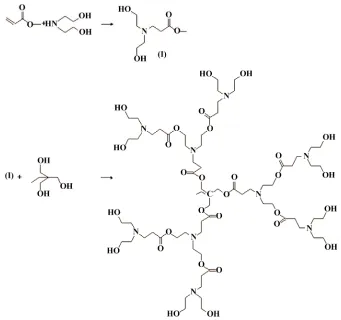
Hyperbranched poly (amine-ester) (HBPAE)was synthesized via pseudo-one-step process between trimethylolpropane as a core molecule and N, N-diethylol-3-amine methylpropionate as the AB2 branched monomer. The prepared polymer
was analyzed by IR, GPC, 1H-NMR and thermal analysis (TGA and DSC). The performance of the polymer in cement
was tested by measuring the effect of 1, 3 and 5 wt% of HBPAE solutions on the properties of Ordinary Portland Ce-ment. Water of consistency, setting times, bulk density, apparent porosity, compressive strength and combined water content of the polymer/cement pastes were studied. The results showed that water of consistency and apparent porosity decreased while setting times, compressive strength, combined water and bulk density increased with the polymer addi-tion.
Keywords: Hyperbranched Polymers; Poly (Amine-Ester); Ordinary Portland Cement; Compressive Strength
1. Introduction
Dendrimers [1] and hyperbranched polymers [2-4], are attracted considerable attention from both industry and academia because of their remarkable vital properties such as reduction of melt and solution viscosity, high solubility, high functionalities due to large number of reactive end-groups within a molecule, approximately spherical molecular shape and the absence of chain en-tanglement. [5-7] However, dendrimers are prepared via step-wise reactions which require several purification processes although they have well controlled structures. [8,9] On contrary, hyperbranched polymers are easily prepared counterparts in one-step reactions, and typically have the branches randomly distributed though the polymers which make them attractive alternatives to dendrimers to some extent for many applications. [10,11] Several hyperbranched polymers in different chemical architectures are prepared now by well-known mecha-nisms such as polyesters, polyamides, polyacrylates, polysiloxysilanes, and others. [12,13] Hyperbranched polymers are potentially used as additives especially when high mechanical strength is required for a certain application [14], functional cross-linkers, rheology modi-fiers, drug and gene delivery, electroactive and photo-chemical molecular devices, conductive materials as well as components in adhesives, advanced and structured
hydrogels for biomedical applications and building blocks of functional materials. Also, polyesteramides hyper-branched polymers were used successfully by our re-search group in the building industry as cement admix-tures as new application for them [15].
Thereby, hyperbranched polymers acted as water re-ducing agents which interacted with the surface of ce-ment particles, involving dispersion and decreasing their natural tendency to coagulate in aqueous systems. As a result, highly flowable mortars and concretes were ob-tained which showed increased workability at constant lower water/cement ratios [16].
Generally, there are four different polymeric chemical admixtures such as modified ligno sulfonated polymers (LS), naphthalene formaldehyde sulfonated polymers (N), melamine formaldehyde sulfonated polymers (S), and polycarboxylate derivates (CE). [17,18] Water-soluble polymers such as sulfonated phenolic resin (SPF) and sulfonated acetone formaldehyde (SAF) have also been used successfully in this area. [19] Polymer/cement paste is normally made by mixing either a monomer or poly-mer in dispersion, powdery, or liquid form with cement and subsequently curing it.
hyperbranched polymer was involved as a new polymeric admixture in the cement pastes.
2. Experimental
2.1. Materials
1, 1, 1-Trimethylolpropane, diethanolamine, methyl-acrylate and p-toluene sulphonic acid were provided by Sigma- Aldrich. The OPC with blain surface area of 3300 cm2/g
was delivered from El-masria Cement Company, Egypt. The chemical composition of OPC is shown in Table 1.
2.2. Instrumentation
The prepared polymer was characterized using different techniques such as Infrared spectra (IR), gel permeation chromatography (GPC), nuclear magnetic resonance (1H-
NMR), thermal gravimetric analyses (TGA) and differ-ential scanning calorimetry (DSC). IR spectra were re-corded by JASCO in the range of 4000 - 400 cm–1. The
number-average molecular weight (Mn) and the polydis-persity index (Mw Mn) of the polymer were measured by GPC via GPC-1100 Agilent technologies by using polystyrene (PS) as standard and N, N-dimethylformamide (DMF) as eluent with flow rate 1 ml/min. 1H-NMR
spec-trum was obtained by Varian Mercury spectrometer at 300 MHz, using tetramethylsilane (TMS) as internal standard and DMSO-d6 as the main solvent. TGA was
carried out by using TGA-50 shimadzu instrument till 400˚C with heating rate 10 K·min–1. DSC was measured
via differential scanning calorimeter DSC-60 shimadzu from –20˚C to 80˚C with scanning rate of 20 K min-1
under nitrogen atmosphere. Vicat apparatus was used to measure the standard water of consistency (or w/c ratio) as well as the setting times (initial and final) of the ce-ment pastes. [15,16,20,21] Bulk density (B.D) and ap-parent porosity (A.P.) of the hardened cement pastes were calculated from Equations (1) and (2), respectively: [20].
[image:2.595.127.468.329.649.2]Scheme 1. Synthesis of hyperbranched poly (amine-ester).
Table 1. Chemical composition of the OPC cement, wt%.
Materials Oxides L.O.I SiO2 Al2O3 Fe2O3 CaO MgO Na2O K2O SO3
OPC 2.64 20.12 5.25 3.38 63.13 1.53 0.55 0.3 2.54
3
1 1 2
B.D. g cm W W W 1 (1)
1 3
1 2
A.P. % W W W W 100 (2)
where W1, W2, W3 = saturated, suspended and dr
The poly (amine-ester) as shown
16]
trations,
(3) W1= Weight before ignition, W2 = ig
th loss.
3. Results & Discussion
tri-methylolpropane as iethylol-3-amine methyl-y weights.
Compressive strength measurements [18] of the cement pastes were carried out by using hydraulic testing ma-chine of the Type LPM 600 M1 SEIDNER (Germany). The chemically-combined water content at each time in-terval was determined on the basis of ignition loss [15,16] where the chemically combined water is defined as that portion present in interlayer spaces, or more firmly non- evaporable water. [22]
2.3. Synthesis of Hyperbranched Poly (Amine-Ester)
prepared hyperbranched
in Scheme 1 was prepared as mentioned elsewhere in the
literature [23] where it had trimethylolpropane as a core and N, N-diethylol-3-amine methylpropionate as the AB2
branched monomer. N, N-diethylol-3-amine methylpropi-onate (I) was prepared via Michael addition of methyl acrylate and diethanolamine in methanol through vaccum distillation. Faint yellow oily liquid (I) was obtained. Subsequently, 0.1 mol of 1, 1, 1-trimethylolpropane, 0.3 mol of (I) and 0.5 wt% of p-toluene sulphonic acid as catalyst were stirred at 120˚C. The unreacted residuals were removed by vaccum distillation.
2.4. Preparation of Cement Mixes [15,
Three polymer solutions with different concen
1%, 3%, and 5%, were prepared. The upper limit of the added hyperbranched polymer to the solid mass of ce-ment was 1.667% and to the used solution of mixing is 5%. Each polymer solution was mixed separately with Ordinary Portland Cement, to study the effect of polymer addition on the properties of cement in the resulting polymer/cement pastes with respect to the blank-cement samples. Water of consistency and setting time meas-urements were carried out on both of blank and polymer/ cement samples by adding water or polymer solutions gradually to cement and tested with Vicat apparatus. Cu-bic samples of blank and polymer/cement admixtures were made and immersed in water basin for different time periods (1, 3, 7, 28 days) then they were subjected to compressive strength measurements by using the hy-draulic press machine. Chemically combined water can be calculated from the following equation.
1 2 100
n
W W W
nited weight where e combined water (Wn) is considered as the ignition
Hyperbranched polymer (HBPAE)was synthesized via pseudo-one-step process between
a core molecule and N, N-d
propionate as the AB2 branched monomer (Scheme 1).
[23] HBPAE was characterized by GPC, IR, 1H-NMR,
TGA and DSC. GPC recorded the number-average mo-lecular weight (Mn) and the polydispersity index (Mw Mn) for HBPAE as 3695 g/mol and 2.65, respec-tively. IR spectrum of the prepared polymer revealed that, the two bands at 2 9 cm–1 and 2941 cm–1 were due to
C ching and the band at 1729 cm–1 represented
the α-unsaturated carbonyl of the ester group. The broad absorption band at 3398 cm–1 was assigned to hydroxyl
groups which were H-bonded and those bands at 1064 cm–1, 1112 cm–1 and 1265 cm–1 were attributed to C–O
and C–N stretches. 1H-NMR spectrum of HBPAE
showed as in (Figure 1) distinguished signals of
chemi-cal shifts at 1.39 ppm which were associated with the methyl protons and those from 2 - 2.28 ppm, 2.5 - 3.2 ppm were assigned to (CH3CH2-) and ( CH3 CH2 CR3).
Other signals at 3.3 ppm, 3.4 - 3.6 ppm and 3.6 - 3.8 were ascribed to (-N (CH2CH2OH)2), (-N (CH2CH2OH)2,
and (OCOCH2CH2NR2). Signals at 4.1 - 4.3 ppm, 4.4
ppm and 4.6 ppm were assigned to (R’R2CCH2-OCO),
(-OCOCH2CH2) and the proton of hydroxyl group
(-CH2CH2OH). TGA of HBPAE as shown in (Figure 2)
[image:3.595.316.530.432.726.2]87 –H stret
Figure 1. 1HNMR of HBPAE.
exhibited relative thermal stability till 193.6˚C where the weight loss was just 5%. The weight loss reached 10% at 254.5˚C, however, TG curve of the hyperbranched poly (amine-ester) descended when the temperature reached the range of 290˚C - 390˚C. That might be due to the decomposition of amine and ester bonds in the hyper-branched poly amine-ester. DSC measurements recorded Tg value as 22.83˚C. The previous data confirmed the
expected structure of the resulting polymer with hydroxyl, ester, and amine groups.
Hyperbranched HBPAE polymer was involved in ce-ment as good application for the hyperbranched polymers in construction materials. On that way, different concen-trations of polym to obtain
increasing the polymer content up
al and final) measurements of OPC premixed with 1%, 3% and 5% of H
Setting time (min) er were added to the OPC
satile polymer/cement pastes. Several measures were per-formed for that purpose on the resulting polymer/cement pastes such as water of consistency, setting times, bulk density, apparent porosity, compressive strength and com-bined water content of the polymer/cement pastes.
The results of water of consistency as well as setting times (initial and final) of the OPC cement pastes pre-mixed with variable concentrations of HBPAE are dem-onstrated in Table 2. Generally, the water of consistency
gradually decreased with
[image:4.595.58.537.496.599.2]to 5%. Using polymer concentration of (5%), the wa-ter of consistency decreased from 30% to 24.32% for OPC. The water of consistency was highly reduced by 4.33% - 5.68% for OPC, when compared with that of the blank. So, it can be concluded that this polymer acted as water reducers. [23] Although the polymer lowered the water of consistency, it increased the setting times (initial
Table 2. Water of consistency and setting times (initi
and final). As shown in Table2, the initial and final
set-ting times increased from 120 to 155 minutes and 230 to 280 minutes with increasing HBPAE concentration. That meant HBPAE behaved as a retarder. The reduction in water of consistency and the elongation of setting times at the same time were attributed to the adsorption of the highly polar polymer molecules on the cement particles and hence, the subsequent formation of a polymer film. An electrostatic repulsion between the negatively charged cement particles formed, which reduced the interparticle attraction between the cement particles and then, pre-vented flocculation or agglomeration for them. That par-tial or full encapsulation of cement hydrates by the polymer molecules retarded the hydration process. So, the used polymer acted as a water reducing admixture and also as a setting-retarder.
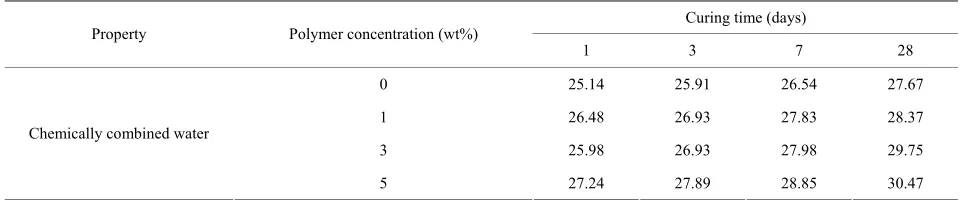
Chemically-combined water contents of OPC cement pastes premixed with 1%, 3% and 5% of HBPAE are shown in Table 3 as a function of polymer concentration.
The combined water contents of all cement pastes gener-ally increased with curing time. That was mainly attrib-uted to the gradual and continuous formation of the hy-dration products resulting from the hyhy-dration of the main phases of cement, particularly C3S and β-C2S. The
com-bined water contents increased with polymer concentra-tion. The higher values of combined water contents by incorporation of small amounts of polymer with OPC were largely due to the dispersion effect of the polymer to the cement grains, which in turn prevented their ag-gregation and thus improved the hydration process.
BPAE.
Polymer (wt%) Water of consistency (%)
Initial set Final set
0 30.00 120 230
1 28.00
3 25.67
5 24.33
130 250
150 270
[image:4.595.57.537.636.736.2]155 280
Table 3. Combined water content measurements of OPC pas 8 days.
tes and those premixed with 1%, 3% and 5% of HBPAE up to 2
Curing time (days) Property Polymer concentration (wt%)
1 3 7 28
0 25.14 25.91 26.54 27.67
1 26.93 27.83 28.37
3 2 26.93 27.98 29.75
Chemically mbined water
5 2 27.89 28.85 30.47
26.48
5.98 co
Table 4. Bulk density and apparent por f OPC cement pastes premi 1%, 3% and 5% HBPA to 28 days.
Curing time (days)
osity o xed with E up
Property Polymer concentration (wt%)
1 3 7 28
0 1.5527 1.6032 1.6311 1.6833
1 1.6124 1.7456 1.8227
1.6742 1.7938 1.8102 1.864
5 1.6562 1.8173 1.8387 1.8791
0 18.75 18.35 16.78 16.45
1 18.29 17.82 16.5 16.31
3 18.34 17.76 16.09 16.
%
5 18.46 17.6 16.02 15.
1.7701
3 Bulk density
gm/m3
04 Apparent porosity
[image:5.595.70.526.298.396.2]78
Table 5. Compressive strength measurements of OPC pastes and those premixed with 1%, 3% and 5% of HBPAE up to 28 days.
ring time (d
Cu ays)
Property Polymer concentration (wt%)
1 3 7 28
0 20.4 25.6 30.5 36
1
3 23.1 9
Compressive strength (MPa)
5 22.9
20.6 32.1 36.3 42.5
37.4 44.1 49.2
39.1 46.5 51.7
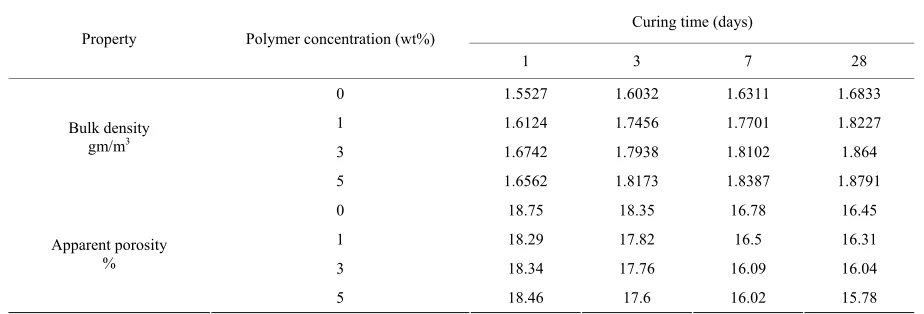
The bulk density and apparent porosity of OPC cement pastes and those premixed with 1%, 3% and % HBPAE
nt porosity decreased. That was attributed to the continual deposition of the formed hydration products in the pore stru the hardened
the apparent porosity decreased and hence the bulk den-sity enhanced. Moreover, the bulk denden-sity was further improved with increasing the polymer concentration. The highe PAE might be at ibuted to the improvement in the hydration process and subse-quently the increase in the hydration products ompared
ith that of the blank samples.
by increasing the polymer concentration when compared
wit of th k samp all cur riods, ex t the firs hours o ation. T havior
stages and also to the decrease of the apparent porosity which was resulted f ease of the hydration products. [24] Furtherm rsing effect of the hyperb hed poly ers/cement astes im d the worka of such es. Therefore, an enha ment of the com ve stren h was obt d [25].
4. Conclusion
The h ranched (amine AE) reduced
of hydration. Therefore, th
Vol. 38, No. 7, 1999, pp. 884-905. 5
are shown in Table 4. The bulk density of all cement
mixes increased gradually with curing time while the appare
was due to some extent to both of the high activation effect of the hyperbranched poly (amine-ester) at later
cture of cement pastes. Thus,
r density values with HB tr
c w
The compressive strength of OPC cement pastes pre-mixed with 1%, 3% and 5% HBPAE was measured as a function of curing time as illustrated in Table 5. The
compressive strength of the hardened cement pastes gen-erally increased with curing time. That was mainly at-tributed to the continual formation of the hydration products which deposited into the pores of the cement pastes. Thereby, the apparent porosity decreased gradu-ally and the compactness increased. Hence, the bulk den-sity increased by time of hydration. As a result, the pressive strength improved and enhanced. Higher com-pressive strength values were obtained for OPC cement
the water of consistency for OPC cement pastes compar-ing to the blank. Also, HBPAE activated the cement phases and improved the rate
h those cept a
e blan t 24
les at f hydr
ing pe hat be
rom further incr ore, the dispe
ranc m p prove
bility past nce
pressi gt aine
yperb poly -ester) (HBP
is class of hyperbranched polymers can be used as wa-ter-reducing agent or cement admixtures. Also, the com-bined water contents and compressive strength were im-proved and enhanced by using HBPAE at all curing ages of hydration particularly at later stages.
REFERENCES
doi:10.1002/pola.10824
[2] J. M. J. Fréchet, M. Henmi, I. Gitsov, S. Aoshima, M. Leduc and R.B. Grubbs, “Self-Condensing Vinyl Polym-erization: An Approach to Dendritic Materials,” Science, Vol. 269, No. 5227, 1995, pp. 1080-1084.
[3] P. Bharathi and J. S. J. Moore, “Solid-Support Hyper- branched Polymerization: Evidence for Self-Limited Grow- th,” Journal of the American Chemical Society, Vol. 119, No. 14, 1997, pp. 3391 3392. doi:10.1021/ja9632062 [4] H. Magnusson, E. Malmström and A. Hult, “Structure
Buildup in Hyperbranched Polymers from 2,2-Bis(Hy-droxymethyl) Propionic Acid,” Macromolecules, Vol. 33, No. 8, 2000, pp. 3099-3104.
[5] C. Gao and D. Yan, “‘A2 + CBn’ Approach to Hyper-mers with Alternating Ureido and Urethan
olecules, Vol. 36, No. 3, 2003, pp. 613-branched Poly
Units,” Macrom o
620.
[6] M. Jikei and M. Kakimoto, “Hyperbranched Polymers: A Promising New Class of Materials,” Progress in Polymer Science, Vol. 26, No. 8, 2001, pp. 1233-1285.
doi:10.1016/S0079-6700(01)00018-1
[7] K. Fang, Z. Xu, X. Jiang, X. Zhang and S. Fu, “Prepara-tion and Characteriza“Prepara-tion of Hyperbranched Polyestera-mides,” Polymer Bulletin, Vol. 60, No. 4, 2008, pp. 533- 543.
[8] D. A. Tomalia and J. M. J. Fréchet, “Discovery of Den-drimers and Dendritic Polymers: A Brief Historical Per-spective,” Journ Part A: Polymer Chemistry, Vol. 40, No. 16, 2002, pp. 2al of Polymer Science 719-2728. doi:10.1002/pola.10301
[9] V. Martinez, S. Mecking, T. Tassaing, M. Besnard. S. Moisan. F. Cansell and C. Aymonier, “Dendritic Core- Shell Macromolecules Soluble in Supercritical Carbon Dioxide,” Macromolecules, Vol. 39, No. 12, 2006, pp. 3978-3979. doi:10.1021/ma0607315
[10] B. Liu, A. Kazlauciunas, J. T. Guthrie and S. Perrier, “One-Pot Hyperbranched Polymer Synthesis Mediated by Reversible Addition Fragmentation Chain Transfer (RAFT) Polymerization,” Macromolecules, Vol. 38, No. 6, 2005, pp. 2131-2136. doi:10.1021/ma048035x
[11] D. Konkolewicz, O. Thorn-Seshold and A. Gray-Weale, “Models for Randomly Hyperbranched Polymers: Theory and Simulation,” Journal of Chemical Physics, Vol. 129, No. 5, 2008, Article ID: 054901. doi:10.1063/1.2939242 [12] T. Sato, N. Sato, M. Seno and T. Hirano, “Initiator-
Fragment Incorporation Radical Polymerization of Divi-nylbenzene in the Presence of Glyoxylic Oxime Ether: Formation of Soluble Hyperbranched,” Journal of Poly- mer Science Part A: Polymer Chemistry, Vol. 41, No. 19, 2003, pp. 3038-3047. doi:10.1002/pola.10824
[13] Y. H. Kim, “Hyperbranched Polymers 10 Years After,”
Journal of Polymer Science Part A: Polymer Chemistry, Vol. 36, No. 11, 1998, pp. 1685-1698.
doi:10.1002/(SICI)1099-0518(199808)36:11<1685::AID-POLA1>3.3.CO;2-4
[14] H. Ihre, M. Johansson, E. Malmström, A. Hult and G. R. Newkome, “Advances in Dendritic Macromole JAI Press, London, 1996. cules,”
.33484
[15] A. Amin, S. Morsi, H. H. M. Darweesh and M. M. H. Ayoub, “Effect of Phthalic Anhydride-Based Hyper-Branched Polyesteramide on Cement Characteristics,”
Journal of Applied Polymer Science, Vol. 120, No. 5, 2011, pp. 3054-3064. doi:10.1002/app
[16] A. Amin, S. Morsi, H. H. M. Darweesh and M. M. H. Ayoub, “Modification of Cement with Succinic Anhy-Dride-Based Hyperbranched Polyesteramide,” Journal of Applied Polymer Science, Vol. 124, No. 2, 2011, pp. 309- 320. doi:10.1002/app.35156
[17] F. Kreppelt, M. Weibel, D. Zampini and M. Romer, “Influence of Solution Chemistry on the Hydration of Polished Clinker Surfaces—A Study of Different Types of Polycarboxylic Acid-Based Admixtures,” Cement Con- crete Research, Vol. 32, No. 2, 2002, pp. 187-198. doi:10.1016/S0008-8846(01)00654-8
[18] A. K. Yamad, T. Takahashi, S. Hanehara and A. M. Ma-tsuhis, “Effects of the Chemical Structure on the Proper-ties of Polycarboxylate-Type Superplasticizer,” Cement Concrete Research, Vol. 30, No. 2, 2000, pp. 197-207.
mconres.2004.01.012
[19] M. Pei, Y. Yang, X. Zhang, J. Zhang and J. Dong, “Syn-thesis and the Effect of Water-Soluble Sulphonated Ace-tone-Formaldhyde Resin on the Properties of Concrete,”
Cement Concrete Research, Vol. 34, No. 8, 2004, pp. 1417- 1420. doi:10.1016/j.ce
. H. M. Darweesh, [20] STM C 187-98, “Standard Test Method for Normal
con-sistency of Hydraulic Cement,” 1998.
[21] STM C 170-90, “Standard Test Method for Compressive Strength of Dimension Stone,” 1993.
[22] P. C. Hewlett., “Lea’s Chemistry of Cement and Con-crete;” 4th Edition, John Wiley & Sons Inc., New York, 1998.
[23] J. Zhang, Y. Zheng, P. Yu, S. Mo and R. Wang, “Synthe-sis of functionalized cArbon Nanotubes by Hyper-branched Poly (Amine-Ester) with Liquid Like Behavior at Room Temperature,” Polymer, Vol. 50, No. 13, 2009, pp. 2953-2957.
[24] T. A. Misev, R. A. T. M. Van Benthem and T. J. G. Zwartkruis, “Calculating Techniques for Formulating and Modifying Hyperbranched Polycondensates,” Bulletin of the Chemists and Technologists of Macedonia, Vol. 17, No. 2, 1998, pp. 77-88.
[25] H. M. M. Ayoub, H. E. Nasr and H