PROSO MILLET SEED PHYSIOLOGICAL AND SANITARY QUALITY WITH PIG SLURRY
1
Dionei Schmidt Muraro,
1Stela Maris Kulczynski,
1
Department of Agronomic and Environmental Sciences, Federal University of Santa Maria Frederico
Westph
2
Department of Forestry, Federal University of Santa Maria Frederico Westphalen, Rio
ARTICLE INFO ABSTRACT
The pig slurry composting has been recommended as an alternative to reduce the volume and pollution potential of liquid pig manure.The pig slurry composting application can influence the physiological and sanitary quality of proso millet
with environmental conditions. The objective was to evaluate the effect of pig slurry composting in physiological and sanitary quality of proso millet crop seeds produced under field conditions.The research was conducted in
randomized block experimental design was used with four replications and five treatmentsconsisted of: a) control without fertilization; and doses of pig slurry compost: b) 4.0 Mg ha
12.0 Mg ha
expressed by accelerated aging, seedling emergence in the field and germination. The PSC doses provided greater weight of thousand seeds, the doses b
PSC doses did not influence the electrical conductivity, first count, cold test in soil. Sanity of proso millet seed is not influenced by the PSC doses.
Copyright©2016, Dionei Schmidt Muraro et al.This
unrestricted use, distribution, and reproduction in any medium, provided the original work is properly cited.
INTRODUCTION
Proso millet (Panicum miliaceum L.) is one of the oldest grasses domesticated by man (Kalinova and Moudry, 2006); most of the operation is designed to feed captive birds (Abrantes et al., 2010). It is also used as a substrate for malting beers (Zarnkow et al., 2010), and a potential alternative to its use is the production of ethanol fuel (Rose and Santra, 2013). Currently proso millet is quite culti
Eastern Europe, Russia, China, India and North America, for food and feed (Karam et al., 2004). In Brazil proso millet is still little cultivated and reduced economic expression when compared to traditional crops. However, in recent years has aroused interest in some regions.
*Corresponding author:Alieze Nascimento da Silva
Department of Agronomic and Environmental Sciences, Federal University of Santa Maria Frederico Westphalen, Rio Grande do Sul, Brazil.
ISSN: 0975-833X
International Journal of Current Research
Vol.
Article History:
Received 14th June, 2016 Received in revised form 18th July, 2016
Accepted 19th August, 2016
Published online 20th September,2016
Key words:
Organic waste, Fertilization, Germination, Vigor.
Citation: Dionei Schmidt Muraro, Alieze Nascimento da Silva, Claudir José Basso, Stela Maris Kulczynski, Andressa Calderan, Vanessa Graciela
Kirsch, and Vanessa alba da Silva.2016. “Proso millet seed physiological and sanitary quality with pig slurry composting dose
Current Research, 8, (09), 37607-37612.
RESEARCH ARTICLE
PROSO MILLET SEED PHYSIOLOGICAL AND SANITARY QUALITY WITH PIG SLURRY
COMPOSTING DOSES
Dionei Schmidt Muraro,
*,1Alieze Nascimento da Silva,
1Claudir José Basso,
Stela Maris Kulczynski,
1Andressa Calderan,
1Vanessa Graciela Kirsch,
and
2Vanessa alba da Silva
Department of Agronomic and Environmental Sciences, Federal University of Santa Maria Frederico
Westphalen, Rio Grande do Sul, Brazil
Department of Forestry, Federal University of Santa Maria Frederico Westphalen, Rio
ABSTRACT
The pig slurry composting has been recommended as an alternative to reduce the volume and pollution potential of liquid pig manure.The pig slurry composting application can influence the physiological and sanitary quality of proso millet(Panicum miliaceum
with environmental conditions. The objective was to evaluate the effect of pig slurry composting in physiological and sanitary quality of proso millet crop seeds produced under field conditions.The research was conducted in southern Brazil under a no-tillage system in a Rhodic Hapludox. A randomized block experimental design was used with four replications and five treatmentsconsisted of: a) control without fertilization; and doses of pig slurry compost: b) 4.0 Mg ha
12.0 Mg ha-1.The application of PSC doses positively affects the vigor of proso millet seeds expressed by accelerated aging, seedling emergence in the field and germination. The PSC doses provided greater weight of thousand seeds, the doses being 8 and 12 Mg ha
PSC doses did not influence the electrical conductivity, first count, cold test in soil. Sanity of proso millet seed is not influenced by the PSC doses.
This is an open access article distributed under the Creative Commons Att use, distribution, and reproduction in any medium, provided the original work is properly cited.
is one of the oldest grasses domesticated by man (Kalinova and Moudry, 2006); to feed captive birds 2010). It is also used as a substrate for 2010), and a potential alternative to its use is the production of ethanol fuel (Rose and Santra, 2013). Currently proso millet is quite cultivated in Eastern Europe, Russia, China, India and North America, for 2004). In Brazil proso millet is still little cultivated and reduced economic expression when compared to traditional crops. However, in recent years has
Alieze Nascimento da Silva,
Department of Agronomic and Environmental Sciences, Federal University of Santa Maria Frederico Westphalen, Rio Grande do Sul,
Proso millet has been used as kind of soil cover in crop rotation under no-tillage due of its advantages to the system (Silva et al., 2013). Advantages like low cost, abundant formation speed of straw and grain production, short cycle (Lu
et al., 2009), can be grown in almost all year, provided there is
enough moisture in the soil and there is no risk of frost (Zancanella et al., 2006). With increasing proso millet economic interest, so does the demand for quality seeds. Seed quality is characterized by genetic
physiological is of fundamental importance in the production process of any plant species, to influence the development and crop quality. There are several factors that affect the quality of proso millet seeds, among them, the fert
a key factor in terms of quality seeds (Imolesi
since proper nutrition of plants influences the formation of the embryo and the reserve tissue (endosperm), with a significant effect on the vigor (Sá, 1994).
nutrients can affect to plant growth, productivity and the quality of the grain (Didonet, 1994). With respect to the proso International Journal of Current Research
Vol. 8, Issue, 09, pp.37607-37612, September, 2016
INTERNATIONAL
Nascimento da Silva, Claudir José Basso, Stela Maris Kulczynski, Andressa Calderan, Vanessa Graciela Proso millet seed physiological and sanitary quality with pig slurry composting dose
PROSO MILLET SEED PHYSIOLOGICAL AND SANITARY QUALITY WITH PIG SLURRY
Claudir José Basso,
Vanessa Graciela Kirsch,
Department of Agronomic and Environmental Sciences, Federal University of Santa Maria Frederico
Department of Forestry, Federal University of Santa Maria Frederico Westphalen, Rio Grande do Sul, Brazil
The pig slurry composting has been recommended as an alternative to reduce the volume and pollution potential of liquid pig manure.The pig slurry composting application can influence the Panicum miliaceum L.) seeds and their effects vary with environmental conditions. The objective was to evaluate the effect of pig slurry composting in physiological and sanitary quality of proso millet crop seeds produced under field conditions.The tillage system in a Rhodic Hapludox. A randomized block experimental design was used with four replications and five treatmentsconsisted of: a) control without fertilization; and doses of pig slurry compost: b) 4.0 Mg ha-1 c) 8.0 Mg ha-1; d)
.The application of PSC doses positively affects the vigor of proso millet seeds expressed by accelerated aging, seedling emergence in the field and germination. The PSC doses eing 8 and 12 Mg ha-1 the greatest results. The PSC doses did not influence the electrical conductivity, first count, cold test in soil. Sanity of proso
an open access article distributed under the Creative Commons Attribution License, which permits
millet has been used as kind of soil cover in crop tillage due of its advantages to the system 2013). Advantages like low cost, abundant formation speed of straw and grain production, short cycle (Lu grown in almost all year, provided there is enough moisture in the soil and there is no risk of frost With increasing proso millet economic interest, so does the demand for quality seeds. Seed quality is characterized by genetic, physical, sanitary and physiological is of fundamental importance in the production process of any plant species, to influence the development and crop quality. There are several factors that affect the quality of proso millet seeds, among them, the fertilization is considered a key factor in terms of quality seeds (Imolesi et al., 2001), since proper nutrition of plants influences the formation of the embryo and the reserve tissue (endosperm), with a significant effect on the vigor (Sá, 1994). Therefore, the application of nutrients can affect to plant growth, productivity and the quality of the grain (Didonet, 1994). With respect to the proso
INTERNATIONAL JOURNAL OF CURRENT RESEARCH
millet crop, few studies have been developed with organic nutrition, especially when it comes to seed production. Although pig slurry is one of organic waste with the highest potential as fertilizer, especially in southern Brazil, little is known concerning the quantities to be used, which allow obtaining satisfactory yields in production and improvement in the quality of seeds (Toledo et al., 2009). The creation system used by most pig producers is the total confinement of animals, causing a large concentration of waste in liquid form in small areas. Successive applications of pig slurry in the same area leading to environmental problems, especially the gaseous
emissions of ammonia (NH3), nitrous oxide (N2O) (Gonzatto
et al., 2013; Aita et al., 2014) and groundwater contamination
by nitrate (NO3-) (Zaman and Blennerhassett, 2010). Pig
slurry composting (PSC) has been recommended as an alternative to reduce the pollution potential of the pig slurry. In this process, the pig slurry is mixed substrates with high C / N ratio, such as wood shavings and sawdust (Fukumoto et al., 2011). Based on the above, this study aimed to evaluate the effect of pig slurry composting doses in physiological and sanitary quality of millet seeds cv. AL Tibagi produced under field conditions.
MATERIAL AND METHODS
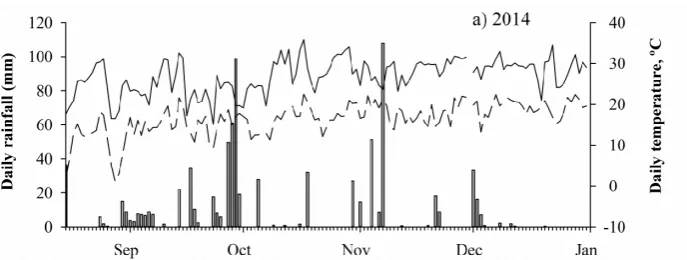
The study was conducted in the experimental area of the Universidade Federal de Santa Maria, in Frederico Westphalen (27º23'S, 53º25'W and altitude of 566 m), Rio Grande do Sul State, Brazil, in 2014. The local climate is humid subtropical (CFA), according to the Köppen classification (Moreno, 1961). Meteorological data for the maximum and minimum air temperatures and daily precipitation were collected from an automatic weather station located 500 m from the experiment site, being electronically recorded in one minute intervals, with values integrated for daily data (Figure 1). The soil is classified as Rhodic Hapludox, or the soil is classified as Latossolo vermelhodistróficotípico in the Brazilian System of
Soil Classification (Embrapa 2013). During the
implementation of the experiment, soil samples were collected from the 0-20 cm depth layer, at the beginning of the
experiment. pH em H2O (1:1) 5.0; SMP index 5.4; clay 700 g
kg-1; organic matter 3.0 g kg-1; P-mehlich 6.9 mg dm-3;
potassium 219 mg.dm-3; calcium 3.1 cmolcdm-3; magnesium
2.4 cmolcdm-3; H + Al 6.1 cmolcdm-3; Al 0.5 cmolcdm-3;
CTC 12.2 cmolcdm-3; and a percentage of CTC with bases and
Al of 49.8 and 7.6%, respectively. Six months before the experiment, lime was applied to the soil in order to raise the pH to 6.0 (CQFS-RS/SC 2004). A randomized blocks design, with four replications and five treatments, where each plot had an area of 4.0 m x 3.6 m (14.4 m²), was used. The treatments consisted of a control without fertilization and PSC doses (4.0
Mg ha-1, 8.0 Mg ha-1 and 12.0 Mg ha-1). The experiment was
conducted under a no-tillage system. A culture succession of proso millet/soybean (Glycine max) was implemented. After the soybean harvest, the area remained in a fallow period of three months. The area was subjected to one application of
glyphosate (3.0 L ha-1) for experimental setup. The proso
millet seeding process was held manually August 22 (2014), using the AL Tibagi cultivar, spaced 0.45 m between rows and
with a density of 120 seeds m-1. The emergence of proso millet
occurred about 10 days after seeding, for both years. The
cycles of the experiments were 83 days. A compost sample was collected and sent to a laboratory for analysis (Tedesco
et al., 1995). The chemical composition and amount of
nutrients added to each administered dose is shown in Table 1.
The PSC doses were manually applied to the crop in each year, immediately after the proso millet seeding. For the mineral fertilizer, a manual process was also used (CQFS-RS/SC
2004). The N was applied as urea (100 kg ha-1 of N), P2O5 in
the form of single superphosphate (60 kg ha-1 of P2O5) and
K2O in the form of potassium chloride (40 kg ha-1). The
following characteristics were evaluated in the proso millet culture: a) Hundred seed weight (HSW): held from the weighing of eight repetitions of 100 seeds taken from the main sample (Brasil, 2009); b) Germination (GT)- eight replicates of 50 seeds per treatment were arranged in rolls of paper, moistened with distilled water corresponding to 2.5 times the weight of the dry paper. The rolls were stored in sealed plastic bags and kept in a B.O.D. incubator at 25 °C for 9 days. The evaluation was conducted at five and nine days after sowing; the percentage of normal seedlings was measured;c) First count (FC) - performed together with the germination test; the number of normal seedlings was assessed on the 5th day after the start of the test. The results were expressed as percentage of normal seedlings; d) Accelerated aging (AA) - four replicates of 50 seeds of each treatment were laid out in a single layer on a screen inside gerboxes, avoiding contact with 40 mL of distilled water placed at the bottom. The gerboxes were sealed and kept inside an oven at 42 °C for 72 hours. Immediately after the end of the aging period, each replicate was placed in paper towel rolls, and exposed to the same conditions described for the germination test, but the percentage of normal seedlings was assessed at five days after sowing (Brasil, 2009).e) Electrical conductivity (EC) - conducted through the center-of-mass system with four replicates of 50 seeds per treatment. The seeds were accurately weighed to two decimal places after the decimal point, and then placed in 200 mL plastic cups filled with 75 mL distilled water, and kept in an incubator at a constant temperature of 25 °C. After 24 hours of soaking, electrical conductivity was measured in the soaking solution, using a digital conductivity
meter whose results were expressed in μS. cm-1.g-1
(Krzyzanowski et al., 1999);f) Cold test without soil: It used the method described by Krzyzanowski et al., (1999) adapted for millet culture.
placed in gerboxes containing three sheets of paper germitest previously dampened with deionized water and incubated in a growth chamber for seven days at a temperature of 25 ° C (± 2) under 12 hours photoperiod. After this incubation period the seeds were examined individually under stereoscopic microscope and / or optical microscope, by computing the fungi incidence percentage. The identification was based on its morphological characteristics and with the aid of specific literature. The results were submitted to analysis of variance and when significant for the variables, the averages were compared by Tukey test 5.0% probability. For these analyzes, we used the statistical program Assistat 7.7 beta.
RESULTS AND DISCUSSION
The results in Table 2 show that the pig slurry composting doses significantly influenced the variables: germination (GT), accelerated aging (AA), hundred seed weight (HSW), seedling emergence in field (SEF). However, the variables first count germination (FC), electrical conductivity (EC) and cold test without soil (CTS) were not significant (Table 2). In the crop cycle, 680 mm of precipitation were recorded during the experiment (Figure 1). During the cultivation period, the proso millet crop suffered two drought intervals, with a 12-days period in full bloom that occurred 42 days after emergence (Figure 1). Thus, water availability during the second year of cultivation may have been a limiting factor to the crop development (Moreno et al. 2014). The values of percentage of germination (GT), expressed by the percentage of normal seedlings showed significant differences depending on the pig slurry composting doses (Table 2).
The application of doses of 4, 8 and 12 Mg ha-1 PSC did not
differ, however, increased germination percentage values compared to the control. These results show that the organic matter (pig slurry composting) by itself was able to provide increase in germination of seeds of proso millet. The large mineral nitrogen present content in the PSC can also significantly influence germination. These data support Passarin et al. (2016) studying the application of pig slurry in soybean had significant response in the percentage of soybean seed germination, seed germination was equal to 86% at the
dose of 100 m3 ha-1. Oliveira et al., (2000) and Diniz (1995)
studied the seed germination percentage in the bean crop had higher percentage of germination when the plants were fertilized with liquid cattle manure. Already Alves (1999) found no effect of manure on germination of bean seeds. Abrantes et al. (2010) studied nitrogen in top-dressing in proso millet cultivation no significant differences depending on nitrogen application in the percentage of millet germination.
Silva et al., (2004), working with different levels of nitrogen in the quality of two cultivars of millet seeds also did not observe significant differences in germination. The no influence of nitrogen fertilization on germination was also observed in other crops such as oats (Nakagawa et al., 2000; Kolchinski and Schuch, 2004). Also in grass ramirez, Mecelis et al. (1991) found no relationship between the nutritional aspect and the physiological seed quality (germination). As for the first count was no significant response. The vigor tests have been using instruments increasingly routine for the seed industry to determine their physiological quality due to its high sensitivity to give answers, however, in this study showed no significant difference, perhaps the drought may have interfered in answer.
Crusciol et al. (2003) work with nitrogen fertilization on bean crop and Schuch et al. (1999) in oat, which to assess the effect of nitrogen on seed vigor found that the percentage of seedlings in the first count was lower when performed nitrogen fertilization. Already Silva et al. (2001) evaluated doses and nitrogen application times and Nakagawa et al. (2000) evaluated N rates in coverage, both with oat seeds, consisted no effect on the vigor. According to Nakagawa (1994) samples that have higher percentage of normal seedlings in the first count are the most vigorous, although it was significant for this work. These results were contrary to work Farinelli et al. (2006) in bean seeds, which found that the nitrogen fertilization promoted increases in seed vigor quadratically. The Brazilian Ministry of Agriculture to establish the grass seed and forage legumes standards through Ordinance No. 381/98, the standard germination is 40% for millet (Panicum
miliaceum L.) (Brasil, 1998).
For proso millet the lowest value found was 64.1% with the application of PSC (Table 2), and this value shows that germination is above the standard set for other species of the same genus. The PSC doses significantly interfere with the
weight of a thousand seeds. The doses 8 and 12 Mg ha-1 had
the highest thousand seed weight. The weight of thousand higher seeds with the PSC doses may be the increased availability of nutrients and organic matter in the surface layer, as compared to control (Derpsch et al., 1991; Santos and Tomm, 2003). Result contrary to that found by Abrantes et al. (2010) did not affect the mass thousand millet seeds to the study of nitrogen.
According to Table 2, it is observed that the physiological quality of millet seeds analyzed by the accelerated aging test
showed a significant difference. A dose of 4 Mg ha-1 presented
the highest percentage of accelerated aging, followed by doses
[image:3.595.121.482.457.532.2]12 Mg ha-1, and the lowest values are observer to the doses of
Table 1. Chemical characteristics and (C), nitrogen (N), phosphorus (P), potassium (K), calcium (Ca), magnesium (Mg) and N inorganic contents existing in each PSC dose
Dose PCS C N P K Ca Mg N inorganic1 pH C: N
--- g kg -1 ---
Mg ha-1 199 34.8 14.7 34.6 36.8 13.5 15.7 6.8 5.72
--- kg ha-1 added---
4.0 796 139.2 58.8 138.4 147.2 5.4 62.8 - -
8 1592 278.4 117.6 276.8 294.4 10.8 125.6 - -
12 2388 417.6 176.4 415.2 441.6 16.2 188.4 - -
1 N inorcanic, N-NH
8 Mg ha -1 and 0 Mg ha-1. and Vieira et al. (1995) evaluating the physiological quality of wheat seeds found that the dose of
120 kg ha-1 of nitrogen in a single application in wheat crop
provided the highest germination in the accelerated aging of seeds obtained.
The electrical conductivity was not influenced by pig slurry composting doses. The three doses did not differ from the control. A possible explanation for the lack of response may be low temperatures occurred during the experiment. Dias et al., 1996 found that the electrical conductivity test is not effective for evaluating the deterioration of soybean seeds stored under low temperature conditions (10 ° C). Moreover, although the electrical conductivity test to provide reproducible results between laboratories, some factors may affect the results, such as genotype, seed development stage at harvest, changes in the structure and seed composition during development, size seed, temperature and soaking period and initial moisture content (Vieira et al., 2002). The result of the cold test without soilindicated no statistical difference between treatments (Table 2). The combination of low temperatures and excess water in the soil can cause direct effects seed, reducing the
emergence speed, favoring the development of pathogenic microorganisms, therefore, the seeds resistant to these unfavorable conditions are more vigorous (Cicero and Vieira, 1994). Doses of compost pig slurry influenced seedling emergence in the field.
In this sense, probably the benefits provided by the addition of organic matter (PCS), allowed proso millet culture express greater seedling emergence in the field. In assessing the sanitary quality of the seeds, it was found the presence of various pathogens. Regarding the sanitary quality of millet seeds, quantification of the incidence of pathogenic fungi was detected: Alternariaspp, Aspergillusspp, Cladosporiumspp,
Bipolarisspp, Epicocumspp, Fusariumspp, Penicilliumspp, Phomaspp (Table 3). Among the fungi only detected the
fungus Alternariaspp presents statistical differences for the different treatments. Introducing higher incidence in treatment
at a dose of 8 Mg ha-1.The PSC has a large amount of nitrogen,
[image:4.595.119.474.156.219.2]the more recent the largest composting mineral N content in the ammonium form. According to Marschner (1995), high concentrations of nitrogen reduce the production of phenolic compounds, which have a fungistatic and lignification of the Table 2. Thousand seed weight (TSW), First count (FC), Germination (GT), Cold test without soil, Electrical conductivity (EC),
Accelerated aging (AA), Seedling emergence in field (SEF), on the application of pig slurry composting doses
Treatments PMS (g) G (%) PCG (%) EA (%) CE (uS cm g-1) TF (%) EC (%)
Control 4.14 b 59.7 ab 71 a 68 b 54 a 80 a 55 b
4 Mg ha-1 4.41 ab 68.3 a 72 a 92 a 52 a 82 a 65 a
8 Mg ha-1 4.57 a 65.4 a 68 a 63 b 58 a 76 a 61 a
12 Mg ha-1 4.62 a 64.1 a 67 a 72 ab 55 a 77 a 62 a
Cv (%) 15.3 12.2 11.2 10.8 15 8 4.5
[image:4.595.169.426.265.377.2]*Means followed by the same letter in the column do not differ by Tukey test at 5% probability.
Table 3. Percentages of proso millet seeds contaminated with fungi by applying pig slurry composting doses
Treatments Alternaria Aspergilus Cladosporium Bipolaris
Control 14.50 ab 0.75 a 6.25 a 0.50 a
4 Mg ha-1 13.50 ab 2.50 a 4.75 a 0.25 a
8 Mg ha-1 21.50 a 1.00 a 4.75 a 0.75 a
12 Mg ha-1 15.00 ab 0.50 a 8.00 a 0.25 a
Cv (%) 12.2 11.2 10.8 15
Treatments Epicocum Fusarium Penicilium Phoma
Control 0.75 a 1.75 a 6.50 a 0.50 a
4 Mg ha-1 2.25 a 1.50 a 12.75 a 0.25 a
8 Mg ha-1 2.50 a 0.50 a 16.50 a 1.50 a
12 Mg ha-1 1.50 a 4.00 a 12.75 a 0.75 a
Cv (%) 17.2 15.1 8.9 11.4
* Means followed by the same letter in the column do not differ by Tukey test at 5% probability.
[image:4.595.127.471.398.528.2]leaves, reducing the resistance to mandatory pathogens, and showing no action on those that are optional. The infection by fungal diseases is favored by nitrogen, as this increases the concentration of amino acids and amides in the apoplast and the cells of the mesophyll, substances that have greater influence than the sugars in the germination and development of conidia. The nutritional aspects of plant have an indirect effect on the incidence of pathogens in seeds, since one of the ways of contamination of the seeds is in the field. Thus plants growing in soils with nutritional stress are more susceptible to pathogens than plants growing in soil with balanced fertility. The use of plant pathogens of free seeds for crop establishment is of utmost importance, and, cultural practices, including the management of fertilization, can influence the contamination / infection of seeds obtained (Marschner, 1995).
Conclusion
The application of PSC doses positively affects the vigor of proso millet crops seeds expressed by accelerated aging, seedling emergence in the field and germination. The PSC doses provided greater weight of thousand seeds, the doses being 8 and 12 Mg ha-1 the greatest results. The PSC doses did not influence the electrical conductivity, first count, cold test in soil. Sanity of proso millet seed is not influenced by the PSC doses.
REFERENCES
Abrantes, F. L., Kulczynski, S. M., Soratto, R. P., Barbosa, M. M. M. 2010. Nitrogênio em cobertura e qualidade fisiológica e sanitária de sementes de painço (Panicum miliaceum L.). Rev. bras. sementes. 32:106-115.
Aita, C.; Gonzatto, R.; Miola, E.C.C.; Santos, D.B.; Rochette, P.; Angers, D.A.; Chantigny, M.H.; Pujol, S.B.; Giacomini, D.A.; Giacomini, S.J. 2014.Injection of dicyandiamide-treated pig slurry reduced ammonia volatilization without enhancing soil nitrous oxide emissions from no-till corn in Southern Brazil. J Environ Qual. 43:789-800.
Alves, E.U. 1999.Produção e qualidade de sementes de feijão-vagem em função de doses e fontes de matéria orgânica. 1999. Dissertação (Mestrado em Produção Vegetal) – Universidade Federal da Paraíba, Areia. 109f.
Brasil - ministério da agricultura e da reforma agrária. 2009. Regras para análise de sementes. Brasília: Secretaria de Defesa Agropecuária. Brasília: Mapa/ACS, 399p.
Brasil. Portaria nº 381, de 05 de Agosto de 1998. Diário Oficial da União, Brasília, DF, 06 ago. 1998, Seção 1, p.43. Cicero, S.M.; Vieira, R.D. Teste de frio. In: Vieira, R.D.;
Carvalho, N.M. Testes de vigor em sementes. Jaboticabal: FUNEP, 1994, p.151-164.
Crusciol, L. C.A.C.; Lima, E.D.; Andreotti, M.; Nakagawa, J.; Lemos, L.B.; Marubayashi, O.M. 2003. Efeito do nitrogênio sobre a qualidade fisiológica, produtividade e
características de sementes de feijão. Rev. bras.
sementes.25:108-115.
Comissão de química e fertilidade de solo (CQFS RS/SC). 2004. Manual de adubação e calagem para os Estados do Rio Grande do Sul e Santa Catarina. 10. ed. Porto Alegre: SociedadeBrasileira de Ciência do Solo.
Dias,D.C.F.S and Marcos filho, J. 1996. Testes de condutividade elétrica para avaliação do vigor de sementes de soja (Glycinemax (L.) Merrill). Sci. agric. [online]. 53:31-42.
Didonet, A.D. Revisão sobre aspectos fisiológicos envolvendo qualidade e teor protéico do grão de trigo. In: Sá, M.E.; Buzzetti, S. 1994. Importância da adubação na qualidade dos produtos agrícolas. São Paulo: Ícone, cap.15: 249-255. Diniz, I.A. Cultivo de feijão guandu (Cajanuscajan) em solo
salinizado tratado com matéria orgânica e drenagem. 1995.
Dissertação (Mestrado em Produção Vegetal) –
Universidade Federal da Paraíba, Areia. 50f
Derpsch, R.,Roth, C. H.,Sidiras, N.; Kopke, U., Krause, R.,Blanken, J. 1991. Importância da rotação de culturas. In: Controle da erosão no Paraná, Brasil: sistemas de cobertura do solo, plantio direto e preparo conservacionista do solo. Eshborn: GTZ/IAPAR. p.147-164.
Empresa Brasileira De Pesquisa Agropecuária (Embrapa). 2013. Centro Nacional de Pesquisa de Solos. Sistema brasileiro de classificação de solos. 3. ed. Rio de Janeiro: Embrapa.
Farinelli, R.; Lemos, L.B.; Cavariani, C.; Nakagawa, J. 2006. Produtividade e qualidade fisiológica desementes de feijão em função de sistemas de manejo de solo e adubação nitrogenada. Rev. bras. sementes. 28:102-109.
Ferreira, D. F. Análises estatísticas por meio do SISVAR para Windows versão 4.0. In: Reunião Anual da região brasileira da Sociedade Internacional de Biometria, 45, 2000, São Carlos, SP.
Fukumoto, Y.; Suzuki, K.; Kuroda, K.; Waki, M; Yasuda, T. 2011.Effects of struvite formation and nitratation promotion on nitrogenous emissions such as NH3, N2O and NO during swine manure composting. Bioresour. Technol. 102:1474.
Gonzatto, R.; Miola, E.C.C.; Doneda, A.; Pujol, S.B.; Aita, C.; Giacomini, S.J. 2013. Volatilização de amônia e emissão de óxido nitroso após aplicação de dejetos líquidos de
suínos em solo cultivado com milho. Ciência
Rural.43:1590-1596.
Imolesi, A.S.; Von pinho, E.V.R.; Pinho, R.G.V.; Vieira, M.G.G.C.; Corrêa, R.S.B. 2001. Influência da adubação nitrogenada na qualidade fisiológica das sementes de milho. Ciênc. agrotec. 25: 1119-1126.
Karam, D.; Westra, P.; Nissen, S. J.; Ward, S. M.; Figueiredo, J. E. F. 2004. Genetic diversity amongproso millet (Panicum miliaceum) biotypes assessed by aflp technique. Planta Daninha, 22: 167-174.
Kalinova, J.; Moudry, J. 2006.Content and quality of protein in proso millet (Panicum miliaceum L.) varieties.Plant Foods for Human Nutrition.61:45-49.
Kolchinski, E.M.; Schuch, L.O.B. 2004.Relação entre a adubação nitrogenada e a qualidade de grãos e de sementes em aveia branca. Ciência Rural. 34: 379-383.
Krzyzanowski, F.C.; Vieira, R.D.; França-neto, J.B. (Ed.). 1999.Vigor de sementes: conceitos e testes. Londrina: Abrates. 218p.
Marschner, H. Mineral nutrition of higher plants.2.ed. San Diego: Academic Press, 1995, 889p.
Mecelis, N.R.; Schammass, E.A.; Dias, L.M.G.S. 1991.Efeitos de adubação nitrogenada sobre a germinação de sementes de Capim Ramirez. Rev. bras. sementes. 13: 53-57. Moreno, J.A. Clima do Rio Grande do Sul. Secretaria da
Agricultura, Porto Alegre, 1961.
Moreno, L.S.B., Pedreira, C. G. S., Boote, K. J.,Alvessa, R. R.. 2014. Base Temperature Determination of Tropical Panicum spp. Grasses and Its Effects on Degree-Day-Based Models.Agricultural and Forest Meteorology, Amsterdam, 186:26-33.
Nakagawa, J. Teste de vigor baseados na avaliação de plântulas. 1994. In: Vieira, R.D.; Carvalho, N.M. Testes de vigor em sementes. Jaboticabal: FUNEP, p.49-86.
Nakagawa, J.;Cavariani, C.; Machado, J.R. 2000. Adubação nitrogenada no perfilhamento da aveia-preta em duas condições de fertilidade do solo. Pesquisa Agropecuária Brasileira, 35: 1071-1080.
Passarin, O. M., Sampaio, S. C., Rosa, D. M., Reis, R. R., Correa, M. M. 2016. Soybean nutritional status and seed physiological quality with swine wastewater. Rev. bras. eng. agríc. ambient. 20:16-21.
Sá, M.E. Importância da adubação na qualidade de semente. In: Sá, M.E.; Buzzeti, S. (Ed.). Importância da adubação na qualidade dos produtos agrícolas. São Paulo: Ícone, 1994. p.65-98.
Santos, H.P. dos; Tomm, G.O. 2003. Disponibilidade de nutrientes e teor de matéria orgânica em função de sistemas de cultivo e de manejo de solo. Ciência Rural, Santa Maria, 33:477-486.
Silva, T.R.B.; Soratto, R.P.; Lima, E.V.; Tavares, C.A. 2004. Adubação nitrogenada em cultivares de painço: qualidade fisiológica, N total e proteína nas sementes. Cultura Agronômica, 13: 69-79.
Silva, R.H.; Zucareli, C.; Nakagawa, J.; Silva, R.A.; Cavariani, C. 2001. Doses e épocas de aplicação do nitrogênio na produção e qualidade de sementes de aveia-preta. Revista Brasileira de Sementes, 23:51-55.
Schuch, L.O.B.; Nedel, J.L.; Maia, M.S.; Assis, F.N. 1999. Vigor de sementes e adubação nitrogenada em aveia-preta (Avena strigosa Schreb). Revista Brasileira de Sementes, 21:127-134.
Silva, L. M., Crusciol, C. A. C., Viegas, P. R. A., Pedrotti. A. 2013. Comprimento radicular e nutrição de cultivares de painço em resposta à calagem. Científica, Jaboticabal, 41: 64–72.
Oliveira, A.P.; Alves, E.U.; Bruno, R.L.A.B.; Bruno, G.B. 2000. Produção e qualidade de sementes de feijão-caupi (Vignaunguiculata (L.) Walp.) cultivado com esterco bovino e adubo mineral. Revista Brasileira de Sementes, Brasília, 22: 102-108.
Rose, D.J. &Santra, D.K. Proso millet (Panicum miliaceum L.) fermentation for fuel ethanol production. Industrial Crops and Products, Amsterdam, v. 43, n.1, p. 602-605, 2013. Toledo, M.Z.; Fonseca, N.R.; Cesar, M.L.; Soratto, R.P.;
Cavariani, C.; Crusciol, C.A.C. 2009. Qualidade fisiológica e armazenamento de sementes de feijão em função da aplicação tardia de nitrogênio em cobertura.Pesquisa Agropecuária Tropical, 39: 124-133.
Vieira, R.D.; Fornasieri filho, D.; Minohara, L.; Bergamaschi, M.C.M. 1995. Efeito de doses e épocas de aplicação de nitrogênio em cobertura na produção e na qualidade fisiológica de sementes de trigo. Científica. 23: 257-264. Vieira, R.D.; Penariol, A.L., Perecin, D.; Panobianco, M.
2002. Condutividade elétrica e teor de água inicial das sementes de soja. Pesquisa Agropecuária Brasileira. 37: 1333-1338.
Zancanella, E.F.; Bonati, J.L.; Martucci, L.M.V. 2006. Novos
cultivares de painço. Disponível em:<www.cati.sp.
gov.br/novacati/tecnologias/painco/novos_cultivares.htm>. Acessoem: 20 mar. 2016.
Zarnkow, M. et al. 2010.Impact of proso millet (Panicum miliaceum L.) varieties on malting quality.Journal of the American Chemical Society. 68: 152-159.
Zaman, M., Blennerhassett,J.D., 2010. Effects of the different rates of urease and nitri-fication inhibitors on gaseous emissions of ammonia and nitrous oxide, nitrate leaching and pasture production from urine patches in an intensive grazed pasture system. Agric. Ecosyst. Environ. 136: 236– 246.