DOI: 10.4236/cc.2018.64006 Oct. 22, 2018 71 Computational Chemistry
Phenolic Systems with Different
Intermolecular Rotations
Ibrahim Ali, Shruti Sharma, Bipul Bezbaruah
*Department of Applied Sciences, Gauhati University, Guwahati, India
Abstract
Aromatic systems like phenol, diphenol, cyano benzene, chloro benzene, ani-line etc shows effective π-π stacking interactions, long range van der Waals forces; ion-π interactions etc. and these forces of interactions play an crucial role in the stability of stacked π-dimeric system. On the other hand, sub-stituents and conformational change in the stacked dimmers of aromatic sys-tem may also change the stability of different stacked dimers. In this current study, stacked phenolic dimmers (both phenol and diphenol) have been taken for investigation of the stacking π-π interaction. But, the stacking interactions are also greatly affected by the conformational change with internal rotation (i.e. dihedral angle, φ) between the stacked dimers. It is generally accepted that larger basis sets are required for the highly accurate calculation of inter-action energies for any stacked aromatic models. But, it has recently been re-ported that M062X/6-311++G(d,p) basis set is effectively better than that of B3LYP/6-311++G(d,p) for determining the interaction energies for any kind of long range interaction in aromatic systems. Therefore, all the calculations were carried out by using M062X/6-311++G(d,p) basis set. However, in most of the cases the calculated π-π stacking interaction energies show almost same result for both DFT and ab initio methods.
Keywords
Phenolic System, π-π Stacking, B3LYP, M062X
1. Introduction
Non covalent interactions in phenolic dimers refer π-π staking interaction, How to cite this paper: Ali, I., Sharma, S.
and Bezbaruah, B. (2018) Quantum Me-chanical Study on the π-π Stacking Interac-tion and Change in ConformaInterac-tion of Phe-nolic Systems with Different Intermolecu-lar Rotations. Computational Chemistry, 6, 71-86.
https://doi.org/10.4236/cc.2018.64006
Received: July 26, 2018 Accepted: October 19, 2018 Published: October 22, 2018
Copyright © 2018 by authors and Scientific Research Publishing Inc. This work is licensed under the Creative Commons Attribution International License (CC BY 4.0).
DOI: 10.4236/cc.2018.64006 72 Computational Chemistry
which is basically an attractive interactive force between the aromatic rings. Just like an electrostatic interaction, where a region of negative charge interacts with a positive charge, the electron rich π-system can interact with a metal (cationic or neutral) or an anion with π-system [1][2][3]. This interaction is very useful in self-organisation and stabilization of aromatic molecules or any other π-systems [4] [5] [6]. However, phenolic systems are frequently associated by intermolecular H-bonding. The importance of the π-π stacking interaction has been repeatedly stressed in many fields of chemistry and structural biology [7] [8][9]. The best known example is the stacking interaction between Nucleic acid (AT and GC base pairs) in DNA/RNA chains, where H-bonds between the base pairs are responsible for the stability and conformational arrangement of nucleic acid chain [10][11][12][13]. Computational and Theoretical techniques such as ab initio or DFT methods are widely used for the calculation of non-covalent in-teractions [14][15]. Although, the gas phase calculations play a major role for determining the π-π stacking interactions but the solvent effect or polarity might change the stability of such stacked molecular systems [16][17][18][19][20].
In this current research work, we have performed a comprehensive study on the π-π stacking interaction energy of phenolic systems by using DFT methods. During the last few years, there has been a significant progress in the method of calculating interaction energies in many aromatic complexes [21] [22]. It has been observed that in some cases the stacking stabilization energies computed by DFT method with extended basis sets is over estimated especially for stacked structures [23][24][25]. Phenol is one of the simplest aromatic systems and it can directly interact with each other through π-π stacking to form dimer, trimer, etc. as similar to water molecules. It is very complicated to calculate the π-π stacking interaction more precisely for the sterically hindered phenols and other phenolic systems with bulky groups [26].
sys-DOI: 10.4236/cc.2018.64006 73 Computational Chemistry
2.1. Computational and Theoretical Method
Density functional Method (DFT) of calculation found to be very effective for studying non-bonded long range interactions in aromatic system. Nowadays, these methods have become an important tool for calculating all kinds of π-π stacking interaction. The Gaussian09 program has been widely used for DFT method to calculate the interaction energies of the molecular systems. The use of DFT is known for the applicability in medium and large molecular system. It is limited in system where dispersion part is considered as the dominant part and in that case the calculated interaction energy values are always under estimated. On the other hand, if a reasonably larger basic set is used then these method of calculations account well for determining the interaction energies as well as the electronic correlation energy of the molecules in the gas phase. The commonly used B3LYP method fails to predict dispersion energy, therefore in such cases inclusion of dispersion energy is very difficult for a large system. All the electron correlation energies for phenol and diphenol system have been calculated by DFT level of theory. All the geometrics of the studied molecules were optimized by using M062X/6-311++G(d,p), basic sets. All single point calculation were carried out by using M062X, B3LYP with 6-311++G(d,p) basis set. But, the minimized stacked structures were obtained by M062X method which shows the most favoured geometry. All the calculations were performed with the Gaussian 09 software Package and the visualization was done by GaussView5.0 [30].
The interaction energy for the stacked geometry can directly be calculated by the following equation:
st us
Interaction energies E= − ×2 E
Here, Est = energy of stacked model, Eus = energy of unstacked model.
2.2. Construction of Models
sepa-DOI: 10.4236/cc.2018.64006 74 Computational Chemistry
rated at a fixed vertical separation of 3.6 Å, which is found to be the most fa-voured separation between two phenol rings. The −OH group of the phenol ring also plays an important role in the stability of stacking interaction in the stacked phenolic dimers. Therefore, during the construction of stacked models, −OH group of the two phenol rings may be placed either in same or opposite direc-tion. Here, we have constructed the stacked models to study the stacking inter-actions of following phenolic systems:
3. Result and Discussion
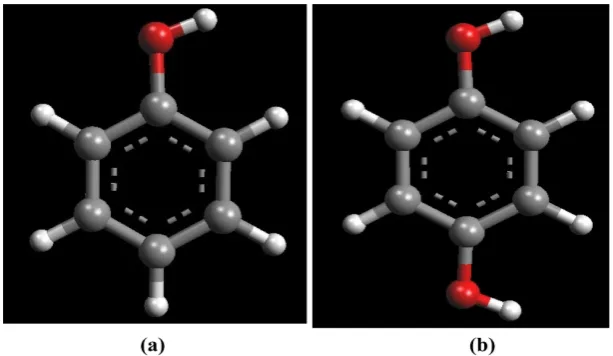
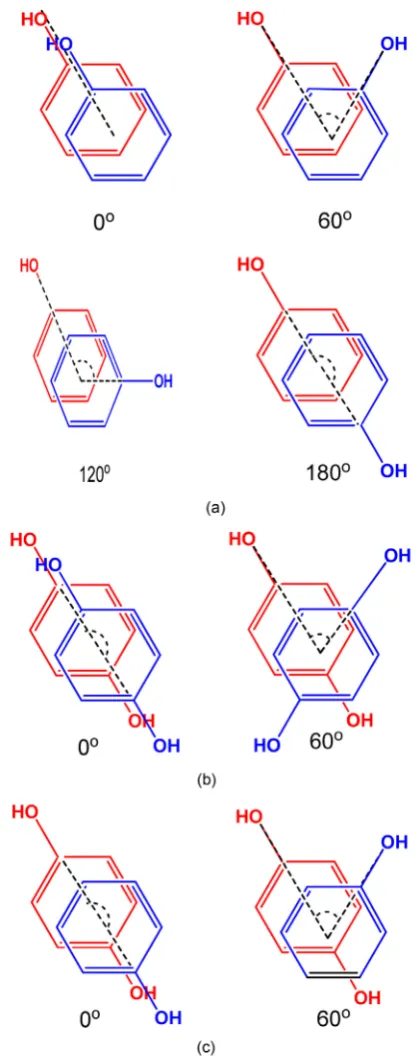
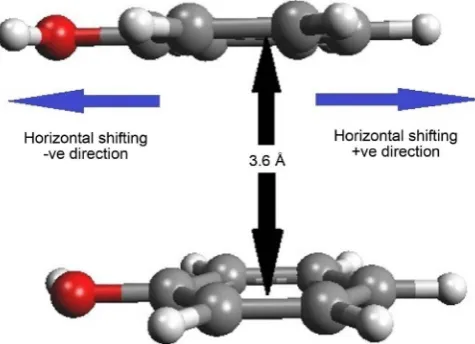
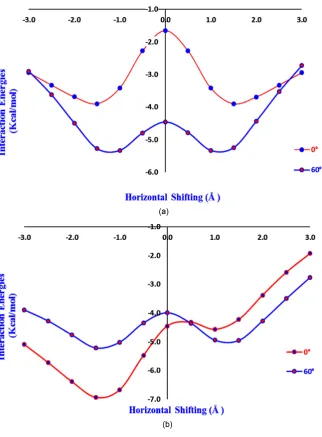
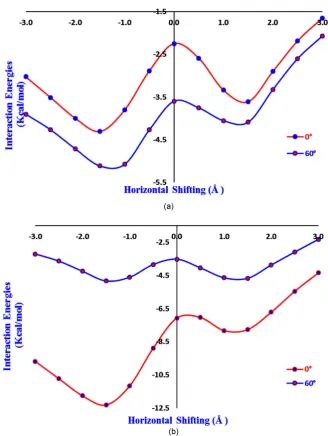
[image:4.595.220.527.524.702.2]In this investigation, the π-π stacking interactions of phenolic dimers such as Phenol-Phenol, Diphenol-Diphenol and Phenol-Diphenol, have been studied for different conformations in gas phase. All the phenolic systems were optimized by using DFT method with M062X/6-311++G(d,p) basis set (Figure 1). All the conformations for stacked phenolic systems were prepared with different dihe-dral angles such as 0˚, 60˚, 120˚ and 180˚ (Figure 2). But, for phenol-diphenol and diphenol-diphenol stacked models 0˚ is equivalent to 180˚ and 60˚ is equiv-alent to 120˚, therefore we prepared models only for 0˚ and 60˚ dihedral angles. Phenolic stacked models with dihedral angle 0˚ was considered as the eclipsed conformation, which was prepared by placing one phenol ring parallely over the other ring with an internal separation of 3.6 Å (Figure 3). On the other hand, dihedral angles 60˚, 120˚ and 180˚, were considered as staggered conformation. During the construction of stacked phenol-phenol model, one phenol ring has been horizontally shifting along X, Y or Z-axis (from positive to negative end), keeping the other ring at constant position. This process was carried out to get the most favored minimized stacked model with minimum repulsion as well as the highly repulsive stacked model. In this case, the horizontal shifting for the stacked model was investigated along X-axis from −3 to +3 Å. Similarly, all the staggered conformations for the stacked models of phenol-phenol stacking sys-tems were also prepared with dihedral angles 60˚, 120˚ and 180˚ respectively.
DOI: 10.4236/cc.2018.64006 75 Computational Chemistry
Figure 2. (a) Pictorial diagrams showing different
dihe-dral angles of phenol-phenol stacking. (b) Pictorial dia-grams showing different dihedral angles of diphe-nol-diphenol stacking. (c) Pictorial diagrams showing different dihedral angles of phenol-diphenol stacking.
DOI: 10.4236/cc.2018.64006 76 Computational Chemistry
Figure 3. Figure depicting the intermolecular separation and
hori-zontal shifting between two stacked monomers.
M062X/6-311++G(d,p) basis set, but M062X is more reliable to calculate stack-ing interaction energy values as it gives more negative values. Durstack-ing the con-struction of stacked phenol-phenol model, one phenol ring has been horizontal-ly shifting along X, Y or Z-axis (from positive to negative end), keeping the other ring at constant position. This process was carried out to get the most favored minimized stacked model with minimum repulsion as well as the highly repul-sive stacked model. In this case, the horizontal shifting for the stacked model was investigated along X-axis from −3 to +3 Å. Similarly, all the staggered con-formations for the stacked models of phenol-phenol stacking systems were also prepared with dihedral angles 60˚, 120˚ and 180˚ respectively. Same procedure was carried out to construct the stacked models for Diphenol-Diphenol and Phenol-Diphenol stacking. We have carried out all computation calculations by DFT method using B3LPY/6-311++G(d,p) and M062X/6-311++G(d,p) basis set, but M062X is more reliable to calculate stacking interaction energy values as it gives more negative values.
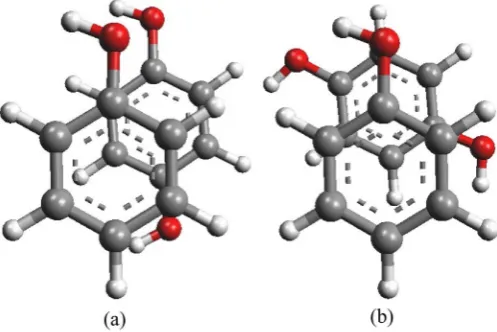
The direction of −OH group of the phenolic ring in a stacked model always makes a significant impact on the overall stability of any stacked phenolic sys-tem. The −OH groups of a phenolic stacked model, with two phenolic rings may be either facing in same direction or opposite direction as shown in Figure 4. To investigate the accurate and effective stacking interaction in phenolic dimers, we have also carefully investigated the direction of −OH group of the two phenolic ring within a staked model. The change in direction of −OH group of a phenol ring in a stacked phenolic dimer also observes in stacking interaction energies, phenol-phenol stacking interaction becomes more favoured when −OH group of two phenol rings are facing opposite to each other.
DOI: 10.4236/cc.2018.64006 77 Computational Chemistry
Figure 4. Stacked models for (a) Phenol-Phenol stacking with
−OH group facing the same side and (b) Phenol-Phenol stacking with −OH group facing away from each other.
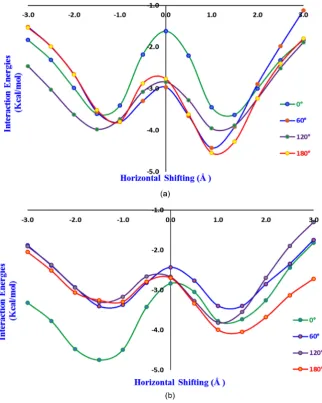
Figure 5. (a) Plot of interaction energies (MP2 single point) versus stacking positions (Å)
[image:7.595.213.536.268.672.2]DOI: 10.4236/cc.2018.64006 78 Computational Chemistry
Figure 6. (a) Plot of interaction energies (MP2 single point) versus stacking positions (Å)
for different conformations of diphenol where the −OH groups are facing the same side. (b) Plot of interaction energies (MP2 single point) versus stacking positions (Å) for dif-ferent conformations of diphenol where the −OH groups are facing the opposite sides.
DOI: 10.4236/cc.2018.64006 79 Computational Chemistry
Figure 7. (a) Plot of interaction energies (MP2 single point) versus stacking positions (Å)
for different conformations of phenol-diphenol where the −OH groups are facing the same side. (b) Plot of interaction energies (MP2 single point) versus stacking positions (Å) for different conformations of phenol-diphenol where the −OH groups are facing the opposite sides.
DOI: 10.4236/cc.2018.64006 80 Computational Chemistry
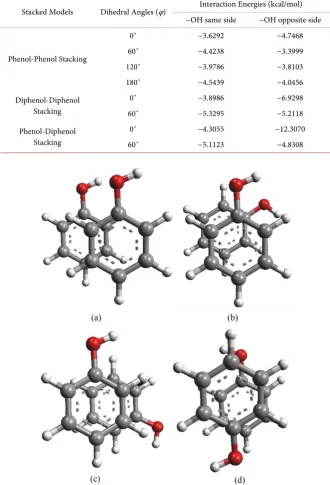
Table 1. Stacking interaction energies (kcal/mol) for minimized phenolic stacked models.
(M062X/6-311++G(d,p)).
Stacked Models Dihedral Angles (φ) Interaction Energies (kcal/mol) −OH same side −OH opposite side
Phenol-Phenol Stacking
0˚ −3.6292 −4.7468
60˚ −4.4238 −3.3999 120˚ −3.9786 −3.8103 180˚ −4.5439 −4.0456 Diphenol-Diphenol
Stacking
0˚ −3.8986 −6.9298
60˚ −5.3295 −5.2118 Phenol-Diphenol
Stacking
0˚ −4.3055 −12.3070 60˚ −5.1123 −4.8308
Figure 8. Minimized stable stacked models of Phenol-Phenol dimer
with −OH groups of the phenol ring facing the same side in gas phase; (a) 0˚ (b) 60˚ (c) 120˚ (d) 180˚.
DOI: 10.4236/cc.2018.64006 81 Computational Chemistry
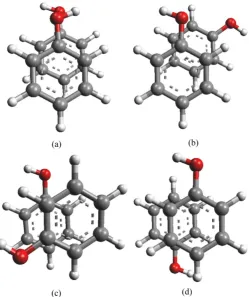
Figure 9. Minimized stable stacked models of Phenol-Phenol dimer
with −OH groups of the phenol ring facing away from each other in gas phase; (a) 0˚ (b) 60˚ (c) 120˚ (d) 180˚.
DOI: 10.4236/cc.2018.64006 82 Computational Chemistry
Figure 10. Minimized stable stacked models of Diphenol-Diphenol
[image:12.595.253.494.292.456.2]dimer with −OH groups of the diphenol ring facing the same side in gas phase; (a) 0˚, (b) 60˚.
Figure 11. Minimized stable stacked models of Diphenol-Diphenol
dimer with −OH groups of the diphenol ring facing away from each other in gas phase; (a) 0˚, (b) 60˚.
Figure 12. Minimized stable stacked models of Phenol-Diphenol
[image:12.595.249.498.516.682.2]DOI: 10.4236/cc.2018.64006 83 Computational Chemistry
Figure 13. Minimized stable stacked models of Phenol-Diphenol
[image:13.595.208.538.325.528.2]dimer with −OH groups of the Phenol-diphenol ring facing away from each other in gas phase; (a) 0˚, (b) 60˚.
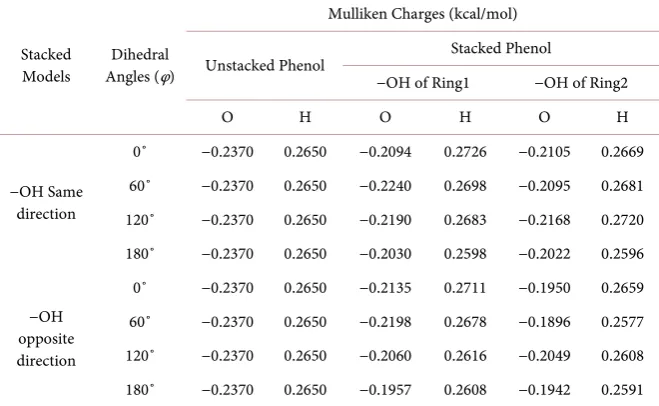
Table 2. Computed mulliken charges forminimized phenol-phenol stacked models for
different dihedral angles with −OH groups are same and opposite direction (M062X/6-311++G(d,p) POP = NPA).
Stacked
Models Angles (φ) Dihedral
Mulliken Charges (kcal/mol)
Unstacked Phenol Stacked Phenol
−OH of Ring1 −OH of Ring2
O H O H O H
−OH Same direction
0˚ −0.2370 0.2650 −0.2094 0.2726 −0.2105 0.2669 60˚ −0.2370 0.2650 −0.2240 0.2698 −0.2095 0.2681 120˚ −0.2370 0.2650 −0.2190 0.2683 −0.2168 0.2720 180˚ −0.2370 0.2650 −0.2030 0.2598 −0.2022 0.2596
−OH opposite direction
0˚ −0.2370 0.2650 −0.2135 0.2711 −0.1950 0.2659 60˚ −0.2370 0.2650 −0.2198 0.2678 −0.1896 0.2577 120˚ −0.2370 0.2650 −0.2060 0.2616 −0.2049 0.2608 180˚ −0.2370 0.2650 −0.1957 0.2608 −0.1942 0.2591
Table 3. Computed mulliken charges for minimized diphenol-diphenol stacked models
for different dihedral angles with −OH groups are same and opposite direction (M062X/6-311++G(d,p) POP = NPA).
Stacked
Models Angles (φ) Dihedral
Mulliken Charges of Stacked Diphenol −OH of Ring1 −OH of Ring2
O H O H O H O H
−OH same direction
0˚ −0.2113 0.2632 −0.2094 0.2661 −0.2010 0.2635 −0.2302 0.2665 60˚ −0.2236 0.2686 −0.2194 0.2690 −0.2281 0.2722 −0.2307 0.2671 −OH
opposite direction
0˚ −0.2269 0.2749 −0.2175 0.2720 −0.2178 0.2722 −0.2266 0.2748
60˚ −0.2289 0.2674 −0.2035 0.2611 −0.2272 0.2701 −0.2168 0.2690
[image:13.595.210.538.595.710.2]DOI: 10.4236/cc.2018.64006 84 Computational Chemistry
Table 4. Computed mulliken charges for minimized phenol-diphenol stacked models for
different dihedral angles with −OH groups are same and opposite direction (M062X/6-311++G(d,p) POP = NPA).
Stacked Models
Dihedral Angles
(φ)
Mulliken Charges of Stacked Phenol-Diphenol system −OH of Ring of
phenol −OH of Ring of diphenol
O H O H O H
−OH same direction
0˚ −0.1971 0.2646 −0.2310 0.2668 −0.2173 0.2635 60˚ −0.1850 0.2603 −0.2305 0.2689 −0.2125 0.2629 −OH
opposite direction
0˚ −0.2049 0.2724 −0.2267 0.2736 −0.2178 0.2638 60˚ −0.2187 0.2719 −0.2273 0.2655 −0.2061 0.2584
*MC for unstacked diphenol: O = −0.2494, H = 0.2640 and Phenol O = −0.2370, H = 0.2650.
4. Conclusion
From the above investigations, it has been observed that the phenolic systems are well stacked within themselves. But, the intermolecular rotation and direc-tion of −OH groups of the phenolic systems play an important role in the stabil-ity of the stacked models. We can conclude that when the −OH groups of the stacked models are facing same direction then 180˚ or 60˚ conformations gets more stabilized. Whereas, when the −OH groups are facing opposite to one an-other then the eclipsed conformation with 0˚ dihedral angle gives more stable stacked model.
Acknowledgements
Authors are highly grateful to the AICTE-TEQIP-3 fund and Ministry of Human Resource Development (MHRD), New Delhi, for providing research assistance.
Conflicts of Interest
The authors declare no conflicts of interest regarding the publication of this pa-per.
References
[1] Kool, E.T., Morales, J.C. and Guckian, K.M. (2000) Mimicking the Structure and Function of DNA: Insights into DNA Stability and Replication. Angewandte Che-mie,39, 900-1009.
https://doi.org/10.1002/(SICI)1521-3773(20000317)39:6<990::AID-ANIE990>3.0.C O;2-0
[2] Hunter, C.A., Lawson, K.R., Perkins, J. and Urch, C.J. (2001) Aromatic Interactions. Journal of the Chemical Society, Perkin Transactions 2,5,651-669.
https://doi.org/10.1039/b008495f
[3] Waters, M.L. (2002) Aromatic Interactions in Model Systems. Current Opinion in Chemical Biology,6, 736-741. https://doi.org/10.1016/S1367-5931(02)00359-9
DOI: 10.4236/cc.2018.64006 85 Computational Chemistry
Construction. Angewandte Chemie, 36, 248-251.
https://doi.org/10.1002/anie.199702481
[7] Suzuki, M., Amano, N., kakinuma, J. and Tateno, M. (1997) Use of a 3D Structure Data Base for Understanding Sequence-Dependent Conformational Aspects of DNA. Journal of Molecular Biology, 274, 421-435.
https://doi.org/10.1006/jmbi.1997.1406
[8] Mathews, D.H, Sabina, J., Zuker, M. and Turner, D.H. (1999) Expanded Sequence Dependence of Thermodynamic Parameters Improves Prediction of RNA Secon-dary Structure. Journal of Molecular Biology, 288, 911-970.
https://doi.org/10.1006/jmbi.1999.2700
[9] Bommarito, S., Peyret, N. and Santa Lucia Jr., J. (2000) Thermodynamic Parameters for DNA Sequences with Dangling Ends. Nucleic Acids Research, 28, 1929-1934.
https://doi.org/10.1093/nar/28.9.1929
[10] Di Fenza, A., Heine, A., Koert, U. and Klebe, G. (2007) Understanding Binding Se-lectivity toward Trypsin and Factor Xa: The Role of Aromatic Interactions. ChemMedChem, 2, 297-308.https://doi.org/10.1002/cmdc.200600185
[11] Georgia, B.M., Marc, G. and Anthony, K.R. (1998) π-Stacking Interactions: ALIVE AND WELL IN PROTEINS. Journal of Biological Chemistry, 273, 15458-15463.
https://doi.org/10.1074/jbc.273.25.15458
[12] Sal-Man, N., Gerber, D., Bloch, I. and Slai, Y. (2007) Specificity in Transmembrane Helix-Helix Interactions Mediated by Aromatic Residues. Journal of Biological Chemistry, 282, 19753-19761. https://doi.org/10.1074/jbc.M610368200
[13] Cozzi, F., Ponzini, F., Annunziata, R., Cinquini, M. and Siegel, J.S. (1995) Polar In-teraction between Stacked π Systems in Flourinated 1,8-Diarylnapthalenes: Imor-tance of Quardruple Moments in Molecular Recognition. Angewandte Chemie, 34, 1019-1020. https://doi.org/10.1002/anie.199510191
[14] Mark, J.R. and Marcey, L.W. (2002) Unexpected Substituent Effects in Offset π−π Stacked Interactions in Water. Journal of the American Chemical Society, 124, 1860-1862.https://doi.org/10.1021/ja016508z
[15] Zhao, Y. and Truhlar, D. G. (2005) Benchmark Databases for Nonbonded Interac-tions and Their Use to Test Density Functional Theory. Journal of Chemical Theory and Computation, 1, 415-432.https://doi.org/10.1021/ct049851d
[16] Yi, M. and Scheiner, S. (1996) Proton Transfer in the [Phenol-NH3] + System: An
Experimental and Ab initio Study. Chemical Physics Letters, 262, 567. https://doi.org/10.1016/S0009-2614(96)01135-9
[17] Brutschy, B. (1992) Ion-Molecule Reactions within Molecular Clusters. Chemical Reviews, 92, 1567-1587.https://doi.org/10.1021/cr00015a005
DOI: 10.4236/cc.2018.64006 86 Computational Chemistry
Transfer in Phenol Ammonia Complex Cation. The Journal of Chemical Physics, 101, 974.https://doi.org/10.1063/1.467752
[19] Lipert, R.J. and Colson, S.D. (1988) Study of Phenol-Water Complexes Using Fre-quency- and Time-Resolved Pump-Probe Photoionization. The Journal of Chemical Physics, 89, 4579-4585.https://doi.org/10.1063/1.454798
[20] Lipert, R.J. and Colson, S.D. (1989) Deuterium Isotope Effects on S1 Radiationless Decay in Phenol and on Intermolecular Vibrations in the Phenol-Water Complex. Journal of Physical Chemistry, 93, 135-139.https://doi.org/10.1021/j100338a030
[21] Korenaga, T., Shoji, T., Onoue, K. and Sakai, T. (2009) Demonstration of the Exis-tence of Intermolecular Lone Pair ⋯π Interaction between Alcoholic Oxygen and the C6F5 Group in Organic Solvent. Chemical Communications, 4678-4680.
https://doi.org/10.1039/b908752d
[22] Alkorta, I., Rozas, I. and Elguero, J. (1997) An Attractive Interaction between the p-Cloud of C6F6 and Electron-Donor Atoms. Journal of Organic Chemistry, 62,
4687-4691.https://doi.org/10.1021/jo970125v
[23] Sinnokrot, M.O., Valeev, E.F. and Sherrill, C.D. (2002) Estimates of the Ab Initio Limit for π-π Interactions: The Benzene Dimer. Journal of American Chemical So-ciety, 124, 10887-10893.https://doi.org/10.1021/ja025896h
[24] Sinnokrot, M.O. and Sherill, C.D. (2004) Highly Accurate Coupled Cluster Potential Energy Curves for the Benzene Dimer: Sandwich, T-Shaped, and Parallel-Displaced Configurations. Journal of Physical Chemistry A, 108, 10200-10207.
https://doi.org/10.1021/jp0469517
[25] Parthasarathi, R., Subramanian, V. and Sathyamurthy, N. (2005) Hydrogen Bond-ing in Phenol, Water, and Phenol-Water Clusters. Journal of Physical Chemistry A, 109, 843-850.https://doi.org/10.1021/jp046499r
[26] Monteiro, C.J.P., Pereira, M.M., Azenha, M.E. Burrows, H.D., Serpa, C., Arnaut, L.G., Tapia, M.J., Sarakha, M.P., Chung, W.W. and Navaratnam, S. (2005) A Com-parative Study of Water Soluble 5,10,15,20-tetrakis(2,6-dichloro-3-sulfophenyl) Porphyrin and Its Metal Complexes as Efficient Sensitizers for Photodegradation of Phenols. Photochemical & Photobiological Sciences, 4, 617-624.
https://doi.org/10.1039/b507597a
[27] Muller-Dethlefs, K. and Hobza, P. (2000) Noncovalent Interactions: A Challenge for Experiment and Theory. Chemical Reviews, 100, 143-168.
https://doi.org/10.1021/cr9900331
[28] Skotheim, T.A., Reynolds, J.R. and Elsenbaumer, R.L. (1997) Hand Book of Con-ducting Polymer. 2nd Edition, Marcel Dekker, New York.
[29] Nalwa, H.S. (1997) Hand Book of Organic Conductive Molecules and Polymer Vol. 1-4. Wiley, New York.