IMPLEMENTING
Saim Ahmad, *Kaushal Mundada
Department of Computer Engineering Sinhgad Institute of Tech and Science, SavitribaiPhule Pune University
ARTICLE INFO ABSTRACT
The science implementation with computer use of automation automation not generalise voice commands. including understand methodology
Copyright©2016, Saim Ahmad et al. This is an open access article distributed under the Creative Commons Att distribution, and reproduction in any medium, provided the original work is properly cited.
INTRODUCTION
For describing previous work, we will present the earlier progress dichotomised into control of devices in home and voice processing. The earliest record of remote controlling devices goes back to 1898; a patent issued to Nikola Tesla for remote controlling of vessels and vehicles. Gradually, with the proliferation of micro controllers in the late nineteenth century, the reach of the so-called smart devices was widened. This was a major reason for the emergence of Internet
in turn was a major boost to the commercialisation of home automation systems. In regards to the speech recognition, much of the pioneering progress happened through Bell labs and DARPA funding. A variety of different statistical models and methods like hidden Markov models, n-gram, log linear models among others tackle problems in speech processing
and Martin, 2000). For a systematic review of the stages in natural language treatment, refer (Michael Collins
project is proposed to support two types of voice inputs commands and queries that control the devices in the home. Commands take the form of an imperative statement where the user specifies an action. For instance, commands could be any one of these, “Turn off the lights in the hall” or “Switch off the lights when
*Corresponding author: Kaushal Mundada,
Department of Computer Engineering Sinhgad Institute of Tech and Science, SavitribaiPhule Pune University
ISSN: 0975-833X
Article History:
Received 23rd March, 2016
Received in revised form 29th April, 2016
Accepted 26th May, 2016
Published online 15th June,2016
Key words:
NLTK, NLP, Parsing, Home Automation.
Citation: Saim Ahmad, Kaushal Mundada, KunalPhaltane
Journal of Current Research, 8, (06), 32456-32460.
RESEARCH ARTICLE
IMPLEMENTING VOICE INTERACTIVE HOME AUTOMATION
Kaushal Mundada, KunalPhaltane and NiharRanjan
Department of Computer Engineering Sinhgad Institute of Tech and Science, SavitribaiPhule Pune University
ABSTRACT
science of home automation took roots in the late eighteen implementation were realised not until early twentieth century.
computer applications is a relatively old idea initiated by Bells voice in controlling elements in the home has not been extensively automation systems that respond to voice, but these systems automation systems identify only a fixed close set of pre-specified generalise well for speech commands that are not included in
commands. The project undertaken by us attempts to push including natural voice interactivity within the home automation system. understand a command even if it is presented in one of its paraphrases. methodology we plan to undertake and the progress we have made
is an open access article distributed under the Creative Commons Attribution License, which distribution, and reproduction in any medium, provided the original work is properly cited.
For describing previous work, we will present the earlier into control of devices in home and voice processing. The earliest record of remote controlling devices goes back to 1898; a patent issued to Nikola Tesla for remote controlling of vessels and vehicles. Gradually, with the rs in the late nineteenth century, called smart devices was widened. This was a major reason for the emergence of Internet-of-Things which in turn was a major boost to the commercialisation of home speech recognition, much of the pioneering progress happened through Bell labs and DARPA funding. A variety of different statistical models and gram, log linear models among others tackle problems in speech processing (Jurafsky . For a systematic review of the stages in Michael Collins, 1999). The project is proposed to support two types of voice inputs- commands and queries that control the devices in the home. Commands take the form of an imperative statement where the user specifies an action. For instance, commands could be any “Turn off the lights in the hall” or “Switch off the
Department of Computer Engineering Sinhgad Institute of Tech and
my father leaves”. Queries, on the oth
enquire about aspects related to home. A few examples of queries would be, “Where in the house can I find my mom?”, “Where is dad?”, “Where is my friend?”, “How many people are there in the guest room?”, “How many rooms are unoccupied?” Note that the queries and command do not conform to a strict format. These are all supported commands and the system can handle these input cases and respond to them as required.
System architecture
This section will proceed to explain mention the functionalities of The high level architectural view Figure 2. A mobile application the user to interact with the system. used for two reasons- firstly, to user and secondly, to track the mobile. We will proceed to the looking at data flow within architecture. We begin with the the system using mobile phone system performing the desired will be sufficient for understanding The user speaks a wake up receptive system in the phone. the command or query into the
Available online at http://www.journalcra.com
International Journal of Current Research Vol. 8, Issue, 06, pp.32456-32460, June, 2016
INTERNATIONAL
KunalPhaltane and NiharRanjan, 2016. “Implementing voice interactive
z
AUTOMATION
NiharRanjan
Department of Computer Engineering Sinhgad Institute of Tech and Science, SavitribaiPhule Pune University
eighteen hundreds. However, the practical Voice interaction to communicate Bells labs in as early as 1930’s. The extensively explored. There exist home systems have a limitation. These home specified voice commands. Such systems do in the pre-specified set of identified the frontier of home automation by system. In other words, the aim is to paraphrases. The report outlines the made so far.
ribution License, which permits unrestricted use,
my father leaves”. Queries, on the other hand, are used to enquire about aspects related to home. A few examples of queries would be, “Where in the house can I find my mom?”, “Where is dad?”, “Where is my friend?”, “How many people are there in the guest room?”, “How many rooms are ” Note that the queries and command do not conform to a strict format. These are all supported commands and the system can handle these input cases and respond to
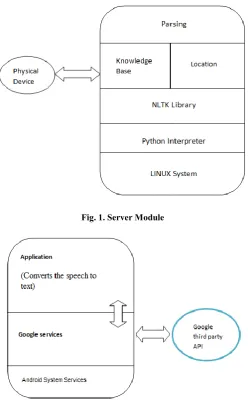
explain the system overview and the components in some detail. view can be illustrated using the application is the first point of contact for system. The user’s mobile phone is to accept speech sample from the location of the user carrying the the discussion of the system by within different components of the the stage of user interacting with phone and end our discussion with the desired action. A simple walkthrough understanding the high level working. up phrase to activate the voice Once activated, the user speaks the microphone. This voice sample
INTERNATIONAL JOURNAL OF CURRENT RESEARCH
is converted to text using third party API’s. The is then passed on to the central language processing further processing. The language processing three important tasks namely tokenization, parsing. Once parsing is complete, we apply to understand the informal query or command. we look up the knowledge base that contains the home users. The knowledge base stores current locations which are updated on real-the mareal-thematics and structure of real-the informal their corresponding machine understandable have created a format that is completely structured representation of the command makes understandable. The structured representation JSON object with nested elements that specify to be performed. In a typical working scenario, text is parsed first. From the parse tree generated, action word is extracted by traversing the examining a node for the VB (Verb base) tag.
Fig. 1. Server Module
Fig 2. Client Module
Once the verb base form is found, we take that tag giving us a word that is the main verb The word is passed to the module that semantically similar words of that verb. Using
32457 Saim Ahmad et al. Implementing voice interactive home automation
The converted text processing module for processing unit performs POS tagging and hand written rules command. After that task, information about the home owner’s -time basis. As for informal commands and understandable commands, we completely structured. This makes it machine representation is a typical specify what action is scenario, the incoming generated, the main the parse tree and tag.
take that leaf node of verb in the sentence. that emits all the Using all the emitted
responses from the word net, corresponds to a predefined action parse tree is referred again to main verb acts. Using a similar written rules, the object is extracted module also examines if the specified in the informal command. one of the elements in the JSON perform that action.
Proposed Methodology
The mobile application which is house members’ mobile phone of interaction with the system. query/command verbally by pressing mobile application is using Google to text and once the speech is received to server side over the network sending the query, the user also and once the string is sent, a string is sent. At the server side, for the string and once it receives important details out of it. It first that query and that is easily done forward the textual string to the disambiguation module classifies The type of the string can either A command is an imperative statement to perform a certain action whereas asks for particular information An example of a command would the lights in the evening". On the query would be, "How many When we talk about query, it can usage query or location query. considered as a command. Query question or a WH-question Example for this can be like ‘How ‘Where can I find my father’. The sentence and builds a parse building the parse tree, the determined that is, the person whose determined. It must be noted that always in the normalised form. “Kunal” in the case of “Where be an indirect reference in the the latter case, the relationships family members must be elicited maintained in the system. Once sentence is extracted, the knowledge real time location of the person Now, talking about the commands many things like “Turn off the or “Turn off the fan at 6 p.m.” The are done again by parsing the tree and analysing certain parameters be performed” i.e. turn on/off assess is “on what action need to fan/light. The third tuple will user and if not specified then
Saim Ahmad et al. Implementing voice interactive home automation
the module checks if the word action verb. If it does, then the extract the object on which the similar process and a set of hand extracted from the parse tree. The time to perform the action is command. If it is specified, then the JSON object is the time specified to
is installed at user end i.e. in all phone and that will be the first point system. The user will fire his pressing the speech button. The Google API to convert the speech received in text format, it is sent network for further processing. While also needs to send his ID to server a message is displayed that the side, it continuously keeps listening receives one, it extracts all the first looks for the user who fired done by user ID. Later the system the disambiguation module, the classifies the type of the textual string.
either be a command or a query. statement that instructs the house whereas a query is a question that information or a statistic about the house. would be a sentence like, "Turn off the other hand, an example of a people are there in the house". can be classified it either as room And all the other things can be Query always starts with the
fifth tuple will be room id and then user id i.e. these action need to be performed and user person firing these commands. And the last condition tuple i.e. “perform action when I So at last the respond is generated by the sys tuples and accordingly the action is performed.
Once the entire tuple is generated, it is analysed and then sent to the microcontroller. Once the tuples are received by micro controller it will analyse the tuple and will take them as input for arduino program. There will be simple program which will control all the hardware and the required action will be performed as per the tuple generation. Once the
performed a message will be sent back to processing unit and from there back to the user’s mobile displayi
that the required operation has been performed.
Implementation
The programming language used for the project is python as majority of the work is performed using NLTK library for which support is available in python. The knowledge bas built in a MySQL relational database. In the knowledge base, information about home owners like the location of each members of the home, the room assigned to them and their familial relations are stored. The location tracking is performed using Bluetooth triangulation. For detailed information on how to perform refer (AdwaitRatnaparkhi, 1997
information is updated on a real time basis with a python script that runs after every 20 seconds. For POS tagging we are using the Viterbi method (NidhiAdhvaryu and PremBalani
This is the tagger is available in the nltk tagger package. For parsing, we are using a PCFG based parser that uses CKY algorithm. The rules of the PCFG are learned from the Penn
32458 International Journal of Current Research,
i.e. in which room user id will be the last tuple will be the I leave the room”. system with all the performed.
Once the entire tuple is generated, it is analysed and then sent to the microcontroller. Once the tuples are received by micro-controller it will analyse the tuple and will take them as input
will be simple program which will control all the hardware and the required action will be Once the action is performed a message will be sent back to processing unit and from there back to the user’s mobile displaying the message that the required operation has been performed.
The programming language used for the project is python as majority of the work is performed using NLTK library for which support is available in python. The knowledge base is built in a MySQL relational database. In the knowledge base, information about home owners like the location of each members of the home, the room assigned to them and their familial relations are stored. The location tracking is performed ooth triangulation. For detailed information on how 1997). This location information is updated on a real time basis with a python script that runs after every 20 seconds. For POS tagging we are using PremBalani, 2015). This is the tagger is available in the nltk tagger package. For parsing, we are using a PCFG based parser that uses CKY algorithm. The rules of the PCFG are learned from the Penn
tree bank. The algorithm for th (Michael Collins, 1999)
Fig.3. Parse
So far, implementing half of the project is complete. Concretely, the first point of interaction of user with this system that is mobile application with both manual and voice interaction facility, partial knowledge base and the query processing module is complete. What remains to be implemented is the command processing unit which takes in an informal command and performs the corresponding action. The query processing sub-mod
module is completely implemented. It can answer questions like, “How many people are there in the hall”, “Where can I find my father”, “Where is my mother”, “Do you know where is my daughter” and so on. For training the parse
that we used was the question tree bank and the parser that we used was “stat_parser”
(Emil Emelio, 2014). Once the trained parser was ready, we tested the parser functionality and visualised the parsed sentences to analyse them. After analyses, the hand written
International Journal of Current Research, Vol. 08, Issue, 06, pp.32456-32460, June, 2016
tree bank. The algorithm for the CYK parsing is shown below.
Parse Tree
So far, implementing half of the project is complete. Concretely, the first point of interaction of user with this system that is mobile application with both manual and voice interaction facility, partial knowledge base and the query processing module is complete. What remains to be implemented is the command processing unit which takes in an informal command and performs the corresponding action.
module in the language processing module is completely implemented. It can answer questions like, “How many people are there in the hall”, “Where can I find my father”, “Where is my mother”, “Do you know where is my daughter” and so on. For training the parser, the corpus that we used was the question tree bank (Cutting et al., 1992) and the parser that we used was “stat_parser” implemented by . Once the trained parser was ready, we tested the parser functionality and visualised the parsed entences to analyse them. After analyses, the hand written
rules were specified based on patterns analysed through the parsed sentences.
Fig.4. Processing Pipeline
Once the object is extracted, we analyse if entry for that object in the knowledge base. direct entry in the knowledge base, we look information the query is asking for. If the lacks a direct entry for the extracted object, object is specified as a possessive proposition noun phrase. For instance, in the sentence, mom”, the object is “my mom”. This object direct entry in the knowledge base for “my few more steps are required to extract a proper an entry in the knowledge base exists. To that relations are maintained in a separated values is parsed to extract the name of the person in the sentence and then the required info is knowledge base. After that information is fetched, command or query proper actions are performed. above in an example like “where is my daughter?” is identified by its mobile Bluetooth mac address system looks up in relation table to find who the speaker is. After identification of the daughter, tracking module comes into picture. This Bluetooth triangulation technique to get the the person. The main step here is to calculate Signal Strength Indicator (RSSI) value of the is used to get a correlation to the distance between receiver in a network.
The picture above is a demonstration triangulation where three Bluetooth modules AP) are placed in a room and then by using the the actual coordinates of the tracking simplicity sake, only one device is considered. being tracked is connected to three Access Points
32459 Saim Ahmad et al. Implementing
rules were specified based on patterns analysed through the
if there is a direct base. If there exists a look up whatever the knowledge base it implies that the proposition attached to a sentence, “Where is my does not contain a “my mom”. Hence, a proper noun for which that end, all familial values file. The csv file in the object part of fetched from the fetched, as per the performed. Like stated daughter?” The speaker address and then the who the daughter of daughter, the location This module uses the exact location of calculate the Received the Bluetooth. This between sender and
demonstration of Bluetooth modules (Access Point i.e. the formula we get device (D). For onsidered. The device Points (AP) whose
positions are known in the XY Access Point (AP) and the device principle of motion and least square these methods we estimate the as the system gets the location location is sent back to the represented either via text notification
Fig.5. Bluetooth
The algorithms used for extracting subject are briefly outlined as follows.
Algo Extract Noun Phrase (Tree t) 1. Length := number of children nodes 2. If Length <= 0 then, return None
3. If Length > 0 and node name = “NP”then, return the t. 4. Recursively call Extract Noun Phrase with right child of
tree.
Algo Extract Object (Tree t)-
1. Length := number of children nodes 2. If Length <= 0 then, return None
3. If Length > 0 and node label = “NP”or “ return the t.
4. Recursively call Extract Noun Phrase with right child of tree.
Algo Extract Subject(Tree t)-
1. Length := number of children nodes 2. If Length > 2 then, perform steps 3
3. If left child of tree has a label “NNS”return the leaves of that tree
4. Return None
RESULTS AND DISCUSSION
After the methodologies, the next to understand the test cases where of our project.
Test Case 1-Location based queries.
In this case, the indoor location actual output is matched against
Saim Ahmad et al. Implementing voice interactive home automation
XY plane. The distance between an device being tracked is based on the square statistical method. Using location of the person. As soon location of the person in query, that the user. This location can be notification or via voice notification.
Bluetooth Triangulation
extracting the noun phrase, object and follows.
(Tree t)- Length := number of children nodes If Length <= 0 then, return None
Length > 0 and node name = “NP”then, return the t. Recursively call Extract Noun Phrase with right child of
Length := number of children nodes If Length <= 0 then, return None
If Length > 0 and node label = “NP”or “VP”or “PP”then,
Recursively call Extract Noun Phrase with right child of
Length := number of children nodes If Length > 2 then, perform steps 3
If left child of tree has a label “NNS”return the leaves of
DISCUSSION
next important thing to be done is where we can understand the result
queries.
queries that follow are partitioned into two- ones that produce the accurate result and the ones that do not. The inaccurate queries and commands are listed at the end. Note that the second category is not a finite set because all the queries that could theoretically produce inaccurate results may not necessarily be relevant and grammatically correct queries.
The list of queries about location that produce the correct output is-
“Where is Anup?”,”Where is mom?”, “Where is my mum?”, “Where can I find my dad?”, “Do you know where is Kaushal?”
Test Case 2- Room usage based queries:
This type of query is the one that enquires about the room usage statistics. The queries of such type start with “How”. Similar to the previous case, the test results are divided into the ones that are successful and the ones that do not yield the accurate results. The inaccurate queries are given at the end of the test cases.
The list of queries about location that produce the correct output is-
“How many people are there in my room?”, “How many rooms are in use?”, “How many people are there in mums room?”
“How many rooms are empty?”,” How many people are there in the house?”
Test case 3- Commands that control the lights and fans-
In this case, different command is fired by the user mainly to control the functionality of the appliances which includes the light and the fan. As written above, here also two different test results are generated i.e. the successful and unsuccessful results.
The list of queries about location that produce the correct output is-
“Turn on/off the lights”, “Turn off the lights at 6:00 pm”, ”Turn off the fan I leave the room”
Future Scope-
Talking about the future scope our system, firstly we will be overcoming the main constraint of our project i.e. throughout the project; we’re assigning unique identity to a person by associating that person to his/her mobile phones. This puts an unusual constraint in interacting with the system and has to carry the mobile phones throughout the house. To eliminate this constraint, new forms of interacting to system can be explored such as smart watch. Secondly, the thing which will be considered for future scope will be replacing the method driven approach by supervised machine learning algorithm. For this purpose two different methods are planned to be used. First, an artificial neural that would be trained on supervised data. The labeled data on which the neural network will be trained would be a two tuple system consisting of informal
speech command and corresponding machine understandable instruction. Second, would be Naïve Bayes classification algorithm where the system will classify an informal statement into categories based on different parameters.
Conclusion
In conclusion, the system is designed to improve the standard of living in home. We’re mainly looking to make the home a cognizant entity that understands human language and performs the required action appropriately. A potentially direct application of such a system will be as an aid for elderly and physically challenged persons. The system will be a convenient way to use and control the home automation elements for elderly persons and physically challenged people.
REFERENCES
AdwaitRatnaparkhi, 1998. “A Maximum Entropy Model for Part-Of-Speech Tagging” in the University of Pennsylvania Agarwal Himashu, AmniAnirudh, 2006. “Part of Speech Tagging and Chunking with Conditional Random Fields” in the proceedings of NLPAI Contest.
Antony P.J, Santhanu P Mohan, Soman K.P, 2010. ”SVM Based Part of Speech Tagger for Malayalam”, IEEE International Conference on Recent Trends in Information, Telecommunication and Computing, pp. 339-341.
Brants, TnT 2000. A statistical part-of-speech tagger. In Proc. of the 6th Applied NLP Conference, pp. 224-231.
Cutting, J. Kupiec, J. Pederson and P. Sibun, 1992. A practical partof-speech tagger. In Proc. of the 3rd Conference on Applied NLP, pp. 133-140.
D Jurafsky, 2000 JH Martin, Speech and Language Processing. Dinesh Kumar, Gurpreet Singh Josan, 2010. ”Part of Speech Taggers for Morphologically Rich Indian Languages: A Survey”, International Journal of Computer Applications,
Volume 6–No.5, pp. 1-9
Manish Shrivastava and Pushpak Bhattacharyya, 2008. Hindi POS Tagger Using Naive Stemming: Harnessing Morphological Information Without Extensive Linguistic Knowledge, International Conference on NLP (ICON08), Pune, India.
Michael Collins, 1999. “Head-Driven Statistical Models for Natural Language Parsing”
NidhiAdhvaryu, PremBalani, 2014. “Survey: Part-Of-Speech Tagging in NLP, International Journal of Research in
Advent Technology,” (E-ISSN: 2321-9637)
PVS Avinesh, G Karthik, 2006. ”Part-Of-Speech Tagging and Chunking using Conditional Random Fields and Transformation Based Learning” in the proceedings of NLPAI Contest.
Roni Rosenfeld, 2000. Two decades of statistical language modeling: where do we go from here?
Stanley F. Chen, Joshua Goodman, 1996. An Empirical Study of Smoothing Techniques for Language Modeling. Proceedings of the 34th Annual Meeting of the ACL. Sumam Mary Idicula and Peter S David, 2007. A
Morphological processor for Malayalam Language, South Asia Research, SAGE Publications.