TO DOCUMENT THE OCCURRENCE AND PATTERN OF REDO PROCEDURES AFTER ABDOMINAL
SURGERIES, IN ELECTIVE AND EMERGENCY SETUP
*,1
Dr. Akshat Sudhanshu,
2Dr.
1
P.G Resident
2Senior Resident,
3Assistant Surgeon,
4
Senior Resident, Department of Surgery, Mmmch, Kumarhatti, Solan,
ARTICLE INFO ABSTRACT
India Abdominal surgeries are the most common procedure performed in general surgical practice. In emergency settings surgeries for intestinal obstruction, intestinal perforation(s), acute
common whereas hepato
for routine abdominal surgeries. All these procedures are prone to complications and may require redo surgery after them.
Aims and objectives
1. To document the occurrence and pattern of redo procedures after abdominal surgeries, in elective and emergency setup.
2. To determine the spectrum of co
procedure and their impact on the outcome i
3. To suggest plan(s) of management for future reference in light of findings and conclusions drawn from the present study.
Material and methods
Governm
Graduate Department of Surgery, GMC Jammu requiring re early post
Results
earliest to minimise the resultant morbidity and mortality. In the era of modern critical care settings intensive post operative care and monitoring should improve t
Copyright©2017, Dr. Akshat Sudhanshu et al.This
unrestricted use, distribution, and reproduction in any medium, provided the original work is properly cited.
INTRODUCTION
Abdominal surgeries that have to be redone following the index surgery in an emergency situation are called urgent redo laparotomies (Unalp HR, Kamer E, Kar H,
term “re-laparotomy” refers to operations performed within 60 days in association with the initial surgery. Re
be of various types such as: (Girgor'ev SG, Petrov VA and Grigor'eva TS, 2003).
Planned/urgent Early/late Radical/palliative
*Corresponding author: Dr. Akshat Sudhanshu
P.G Resident, Department of surgery, GMC Jammu, J&K, India
ISSN: 0975-833X
Article History:
Received 27th June, 2017
Received in revised form
08th July, 2017
Accepted 19th August, 2017
Published online 30th September, 2017
Citation: Dr. Akshat Sudhanshu, Dr. Naveed Anjum Qureshi, Dr. Surinder Singh Sodhi and
and pattern of redo procedures after abdominal surgeries, in elective and emergency setup
Key words:
Carbon content, Tannery weaste, Sewage sludge.
RESEARCH ARTICLE
TO DOCUMENT THE OCCURRENCE AND PATTERN OF REDO PROCEDURES AFTER ABDOMINAL
SURGERIES, IN ELECTIVE AND EMERGENCY SETUP
Dr. Naveed Anjum Qureshi,
3Dr. Surinder Singh Sodhi
4Dr. Ankush Kaul
P.G Resident, Department of surgery, GMC Jammu, J&K, India
Senior Resident, Department of surgery, GMC Jammu, J&K, India
Assistant Surgeon, Department of Nephrology, GMC Jammu, J&K.
Department of Surgery, Mmmch, Kumarhatti, Solan,
ABSTRACT
Abdominal surgeries are the most common procedure performed in general surgical practice. In emergency settings surgeries for intestinal obstruction, intestinal perforation(s), acute
common whereas hepato-biliary, pancreatic diseases and gut malignancies are common indications for routine abdominal surgeries. All these procedures are prone to complications and may require redo surgery after them.
Aims and objectives
o document the occurrence and pattern of redo procedures after abdominal surgeries, in elective and emergency setup.
To determine the spectrum of co-morbid factors and post-operative complications leading to redo procedure and their impact on the outcome in terms of morbidity and mortality.
To suggest plan(s) of management for future reference in light of findings and conclusions drawn from the present study.
Material and methods: This study was conducted in the Post Graduate Department of Surgery, Government Medical College, Jammu. All the patients undergoing abdominal surgeries in Post Graduate Department of Surgery, GMC Jammu requiring re-exploration during the same admission or early post-operative period (six weeks) were included in the study.
Results and conclusions: It is suggested that redo surgeries should be planned and executed at the earliest to minimise the resultant morbidity and mortality. In the era of modern critical care settings intensive post operative care and monitoring should improve the outcome following these procedures.
This is an open access article distributed under the Creative Commons Att use, distribution, and reproduction in any medium, provided the original work is properly cited.
Abdominal surgeries that have to be redone following the in an emergency situation are called urgent redo Unalp HR, Kamer E, Kar H, et al., 2006). The laparotomy” refers to operations performed within 60 tion with the initial surgery. Re-laparotomy can be of various types such as: (Girgor'ev SG, Petrov VA and
Sudhanshu
surgery, GMC Jammu, J&K, India
All these procedures may be preceded by a diagnostic laparoscopy/open laparotomy. These redo laparotomies are usually because of complications of the index operations like biliary peritonitis, fecal fistula, burst abdomen
leaks. Because of increased morbidity and mortality associated with these operations, they are often called final choice operations (Ching SS, Muralikrishnan VP and Whiteley GS, 2003).
Aims and Objectives
To document the occurrence and pat
procedures after abdominal surgeries, in elective and emergency setup.
To determine the spectrum of co
post-operative complications leading to redo procedure and their impact on the outcome in terms of morbidity and mortality.
International Journal of Current Research
Vol. 9, Issue, 09, pp.58186-58191, September, 2017
, Dr. Naveed Anjum Qureshi, Dr. Surinder Singh Sodhi and Dr. Ankush Kaul,
redo procedures after abdominal surgeries, in elective and emergency setup”, International Journal of Current Research
TO DOCUMENT THE OCCURRENCE AND PATTERN OF REDO PROCEDURES AFTER ABDOMINAL
SURGERIES, IN ELECTIVE AND EMERGENCY SETUP
Surinder Singh Sodhi and
J&K, India
J&K, India
J&K. India
Department of Surgery, Mmmch, Kumarhatti, Solan, H.P, India
Abdominal surgeries are the most common procedure performed in general surgical practice. In emergency settings surgeries for intestinal obstruction, intestinal perforation(s), acute appendicitis are biliary, pancreatic diseases and gut malignancies are common indications for routine abdominal surgeries. All these procedures are prone to complications and may require
o document the occurrence and pattern of redo procedures after abdominal surgeries, in elective
operative complications leading to redo n terms of morbidity and mortality.
To suggest plan(s) of management for future reference in light of findings and conclusions drawn
This study was conducted in the Post Graduate Department of Surgery, ent Medical College, Jammu. All the patients undergoing abdominal surgeries in Post exploration during the same admission or operative period (six weeks) were included in the study.
It is suggested that redo surgeries should be planned and executed at the earliest to minimise the resultant morbidity and mortality. In the era of modern critical care settings he outcome following these procedures.
is an open access article distributed under the Creative Commons Attribution License, which permits
All these procedures may be preceded by a diagnostic laparoscopy/open laparotomy. These redo laparotomies are usually because of complications of the index operations like biliary peritonitis, fecal fistula, burst abdomen or anastomotic leaks. Because of increased morbidity and mortality associated with these operations, they are often called final choice Ching SS, Muralikrishnan VP and Whiteley GS,
To document the occurrence and pattern of redo procedures after abdominal surgeries, in elective and
To determine the spectrum of co-morbid factors and operative complications leading to redo procedure and their impact on the outcome in terms of morbidity INTERNATIONAL JOURNAL OF CURRENT RESEARCH
, 2017. “To document the occurrence
To suggest plan(s) of management for future reference in light of findings and conclusions drawn from the present study.
MATERIALS AND METHODS
This study was conducted in the Post Graduate Department of Surgery, Government Medical College, Jammu. All the patients undergoing abdominal surgeries in Post Graduate Department of Surgery, GMC Jammu requiring re-exploration during the same admission or early post-operative period (six weeks) were included in the study. Patients referred to GMC Jammu, from outside/associated hospitals (gynaecology/ obstetrics) were included for management but were excluded from study. All patients who underwent redo procedures following abdominal surgeries from 1st November 2015 to 31st October 2016 were included in this study.
Selection Criteria
Patients who underwent redo surgeries for understated complications were:
Patients with abdominal collection or peritonitis. Patients with ongoing intra-abdominal hemorrhage. Patients with suspected perforation/anastomotic leaks.
Exclusion Criteria
Patients in whom a combined abdomino-thoracic operation was performed.
Patients who have undergone redo surgery more than six weeks after the index surgery.
Patients unfit for redo procedures. Patients who refuse re-exploration.
Patients referred to GMC Jammu after primary surgery at other hospitals.
Observations
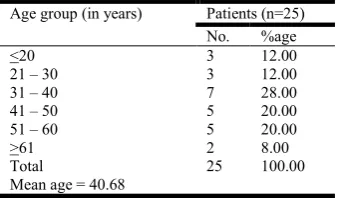
[image:2.595.194.394.374.427.2]The study was done on 25 patients who underwent re-laparotomy, following complications of index procedures. All the different parameters related to the patient and surgery were studied. Appropriate statistical tests were applied wherever necessary. Male patients dominated the study with 68% as compared to 32% female patients. Male to female ratio was 2. More patients were in the age group of 31-40 years (28%), followed by 41-50 and 51-60 years (20% each), and <20 and 21-30 years (12% each). Least number of patients were in the age group >61 years (8%). Mean age of the study group was 40.68 years with a range of 14 to 68 years. Seven (28%) patients underwent Open Appendectomy, followed by
Table 1. Distribution of patients according to sex (n=25)
Sex Patients (n=25)
No. %age
Male 17 68.00
Female 8 32.00
[image:2.595.211.380.459.558.2]Total 25 100.00
Table 2. Distribution of patients according to age (n=25)
Age group (in years) Patients (n=25)
No. %age
<20 3 12.00
21 – 30 3 12.00
31 – 40 7 28.00
41 – 50 5 20.00
51 – 60 5 20.00
>61 2 8.00
Total 25 100.00
Mean age = 40.68
Table 3. Distribution of patients according to type and indication of Index surgery (n=25)
Type of Index surgery Site of Surgery Indication for Index Surgery Patients (n=25)
No. %age
Open appendectomy Lower GI Acute Appendicits 7 28.00
Exploratory laparotomy with closure of ileal perforation Lower GI Perforation Peritonitis 2 8.00
Exploratory laparotomy with adhesiolysis Lower GI Adhesion Obstruction 2 8.00
Exploratory laparotomy with resection of gangrenous ileum with divided ileostomy
Lower GI Perforation peritonitis 2 8.00
Exploratory laparotomy with omental patch closure of duodenal perforation
Upper GI Perforation Peritonitis 2 8.00
Laparoscopic cholecystectomy Upper GI Cholelithiasis 2 8.00
Ileostomy closure Lower GI Status Ileostomy 2 8.00
Exploratory laparotomy with appendectomy Lower GI Perforation Peritonitis 1 4.00
Exploratory laparotomy with pancreatic necrosectomy Upper GI Acute Necrotising Pancreatitis 1 4.00
Laparoscopic cholecystectomy converted to open cholecystectomy and then abandoned
Upper GI Cholelithiasis 1 4.00
Rt hemicolectomy Lower GI Ca Colon(Hepatic Flexure Growth) 1 4.00
Exploratory laparotomy with closure of caecal perforation with ilesotomy Lower GI Perforation Peritonitis 1 4.00
Exploratory laparotomy with spleenectomy – Blunt Trauma Abdomen
( Hemoperitoneum)
1 4.00
[image:2.595.48.545.589.779.2]Exploratory Laparotomy with closure of Ileal Perforation, Exploratory Laparotomy with resection of gangrenous Ileum divided Ileostomy, Exploratory Laparotomy with Adhesiolysis, Exploratory Laparotomy with Omental patch closure of Duodenal perforation in 2 patients each, Laparoscopic Cholecystectomy, and Ileostomy closure in 2 patients (8%) each. Rest of the surgeries had one patient each.
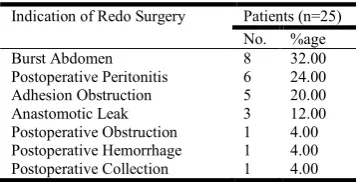
Table 4. Distribution of patients according to indication of Redo surgery (n=25)
Indication of Redo Surgery Patients (n=25)
No. %age
Burst Abdomen 8 32.00
Postoperative Peritonitis 6 24.00
Adhesion Obstruction 5 20.00
Anastomotic Leak 3 12.00
Postoperative Obstruction 1 4.00
Postoperative Hemorrhage 1 4.00
Postoperative Collection 1 4.00
Burst Abdomen was observed in 8 (32%) patients followed by 6 patients (24%) of Postoperative Peritonitis which included 2 patients with Post Laparoscopic Cholecystectomy Biliary Peritonitis, and 1 patient each of Post Laparoscopic Cholecystectomy Fecal Peritonitis, Biliary Peritonitis following Duodenal Ulcer Perforation Closure Leak, Iatrogenic Rectal Perforation, Persistent Postoperative Peritonitis following Open Appendectomy due to missed Meckel's Diverticulum.
Adhesion Obstruction was observed in 5 (20%) patients, followed by Anastomotic Leak in 3 (12%) patients. Postoperative Obstruction, Hemorrhage, Postoperative Collection was observed in 1 patient each.
Mean interval = 14.12 (1 – 37) days
The mean interval between Index Redo Surgery was 14.12 days with a range of 1 -37 days. Maximum patients 10 (40%) presented with an interval of 5 to 10 days from Index to Redo Surgery, followed by 11 to 15 days 7 (28%) and >16 days 6 (24%). Out of 25 Redo Surgeries, 8 (32%) were Secondary Suturing for Burst Abdomen, Exploratory Laparotomy with Resection of Band in 3 (12%) patients for Adhesion Obstruction and Adhesiolysis was done in 2 (8%) patients following Adhesion Obstruction. Exploratory laparotomy with adhesiolysis with resection anastomosis of ileum, exploratory laparotomy with closure of Transverse colonic perforation with cholecystectomy with loop ileostomy, exploratory laparotomy with drainage of abdominal collection, exploratory laparotomy with colostomy, exploratory laparotomy with closure of jejunal perforation with ileostomy, exploratory laparotomy with proximal ileostomy with distal mucus fistula, exploratory laparotomy with closure of rent in common hepatic duct with T-tube placement, exploratory laparotomy with drainage of collection, exploratory laparotomy with omental patch closure of duodenal ulcer perforation, exploratory laparotomy with ligation of bleeder, exploratory laparotomy with primary closure of rectal perforation with transverse colostomy, exploratory laparotomy with resection of meckel's diverticulum with ileostomy was done in one patient each. 13 (52%) patients were operated in Emergency settings whereas 12 (48%) patients were operated in Elective settings.
DISCUSSION
[image:3.595.153.446.404.474.2]In this study, a total of 10 patients had co morbidities 4 patients had type II diabetes mellitus, 3 had hypertension, 3
Table 5. Distribution of patients according to interval between Index Surgery and Redo Surgery (n=25)
Interval between Index and Redo Surgery (days) Patients (n=25)
No. %age
<5 2 8.00
5 – 10 10 40.00
11 – 15 7 28.00
>16 6 24.00
Total 25 100.00
Patientt: Distribution of patients according to type of Redo Surgery (n=25)
Type of Redo Surgery Indication Patients (n=25)
No. %age
Secondary suturing Burst Abdomen 8 32.00
Exploratory laparotomy with resection of band Adhesion obstruction 3 12.00
Exploratory adhesiolysis with loop ileostomy Post operative obstruction 2 8.00
Exploratory laparotomy with adhesiolysis with resection anastomosis of ileum Adhesion obstruction 1 4.00
Exploratory laparotomy with closure of TC perforation with cholecystectomy with loop ileostomy Post operative peritonitis 1 4.00
Exploratory laparotomy with drainage of abdominal collection Post operative peritonitis 1 4.00
Exploratory laparotomy with colostomy Anastomotic leak 1 4.00
Exploratory laparotomy with closure of jejunal perforation with ileostomy Anastomotic leak 1 4.00
Exploratory laparotomy with proximal ileostomy with distal mucus fistula Anastomotic leak 1 4.00
Exploratory laparotomy with closure of rent in common hepatic duct with T tube placement Post operative peritonitis 1 4.00
Exploratory laparotomy with drainage of collection Post appendectomy collection 1 4.00
Exploratory with omental patch closure of duodenal ulcer perforation Post operative peritonitis 1 4.00
Exploratory laparotomy with ligation of bleeder Post operative hemorrhage 1 4.00
Exploratory laparotomy with Primary closure of Rectal perforation with Transverse colostomy Post operative peritonitis 1 4.00
Exploratory laparotomy with resection of meckel's diverticulum with ileostomy Post operative peritonitis 1 4.00
[image:3.595.60.555.500.670.2]Total 25 100
Table 7. Distribution of patients according to Elective/Emergency Surgery (n=25)
Elective/Emergency Surgery Patients (n=25)
No. %age
Elective 13 52.00
Emergency 12 48.00
had COPD, 2 had malignancy and 1 patients had a history of ATT intake. Out of 4 Diabetic patients 1 had malignancy too, out of 3 hypertensive patients 1 had malignancy too while 1 had COPD, 1 had history of ATT intake. The mean value of Hemoglobin was 8.87 g/dl (7.6-10.4), TLC was 10028 cells/cubic mm (5500-14000), lower hemoglobin was seen in patients with malignancy and hemorrhage while TLC was high in patients with septicemia. The mean total serum protein was 5.50 mg/dl (4.2-7.2), while mean serum albumin was 3.13 mg/dl (2-4.2). Lower values observed in patients with wound dehiscence and anastomotic leaks. The mean serum creatinine was 1.19 mg/dl (0.5-2.8) and seum urean was 39.7 mg/dl (18-92), higher values were observed in patients with multiple comorbidities, septicemia and multi organ dysfunction.
In our study 52%(n=13) were elective redo laparotomies and 48%(n=12) were emergency redo laparotomies, compared to Koirala R, Mehta N, Varma V, et al. (2015) study which had 42% elective and 58% emergency redo procedures. The most common indication for re-exploration was burst abdomen 32%(n=8), followed by postoperative peritonitis 24%(n=6), adhesion obstruction 20%(n=5), anastomotic leak 12%(n=3), post operative obstruction, post operative hemorrhage and post operative collection each had an incidence of 4%(n=1 patient in each group). Tera H and Aberg C (1975) conducted a study in which the most common cause of re-exploration was ileus (25%), followed by wound rupture (22%) and hemorrhage (19%). In 1990, Krivitskii DI, Shuliarenko VA and Babin IA in a similar study reported the most common cause of re-exploration to be peritonitis (51%) followed by ileus (30%), hemorrhage (7.9%) and eventeration (7%). Unlap HR, Kamer E, Kar H, et al. (2006) reported anastomotic leak to be the most common cause (41.97%), followed by hemorrhage (18.51%) and intestinal perforation and intra abdominal infections or abscess (9.87%).
Koirala R, Shakya VC, Khania S, et al. (2012) conducted a study in which Burst abdomen was the most common cause of re exploration (22.5%), followed by intra abdominal collection and abscess (17.5%) and fecal peritonitis (15%). In 2015, a similar study conducted by Koirala R, Mehta N, Varma V, et al. reported postoperative bleeding to be the most common cause (34.2%) followed by abscess or fluid collection in 29.6%
cases. In a recent study conducted by Sharma A, Sahu SK, Nautiyal M, et al. (2016), anastomotic leak was the most common cause of re exploration (32.5%), followed by pyoperitoneum (27.5%) and persistent peritonitis (15%).In the table below the indications of redo surgery have been compared: In most of the studies higher mortality rate were reported following GI surgeries that need urgent re laparotomies. In this study the site of index surgery was Lower GI tract in 72% patients(n=18), upper GI tract in 24% patients(n=6), while one patient underwent splenectomy. In the study done by Koirala R, Mehta N, Varma V, et al. in 2015 the site of index surgery was lower GI tract in 57.5% of patients and upper GI tract in 30% of patients, while multiple sites were involved in 7.5% patients and 5% patients had gynecological
emergencies. In the study by Sharma A, Sahu SK, Nautiyal M,
et al. (2016), lower GI procedures were most commonly
involved in 52.5% patients(n=21), Upper GI surgery in 22.5% patients(n=9), Hepato-biliary surgeries in 17.5% patients(n=7), one patients each of Radical cystectomy and splenectomy (2.5% each). In the study by Unlap HR, Kamer E, Kar H, et al.
(2006), 34.5%(n=28) patients had Lower GI surgeries, 28.4%(n=23) patients had Upper GI surgeries, 9.8%(n=8) Hepato-biliary surgeries and 4.94%(n=4) patient each of vascular and gynecological surgeries. In the below table comparison was done between the sites of index surgeries in different studies:
[image:4.595.131.472.245.464.2]
Table 9. Comparison between sites of Index surgery in different studies
Site of index surgery
Upper GI Lower GI Others
Unlap HR et al.(2006) 34.5% 28.4% 19.68%
Koirala R et al.(2015) 30% 57.5% 12.5%
Sharma A et al.(2016) 22.5% 52.5% 22.5%
Present study 72% 24% 4%
The above data clearly indicated that Lower GI surgeries are most commonly involved as index surgeries leading to Redo laparotomies. In this study the mean time interval between index and redo surgery 14.16 days with a range of 1 to 37 days. The timing of surgery also has an impact on morbidity and mortality. early diagnosis and early redo laparotomy
Table 8. Comparison of indications of Redo surgery
Studies Indications of redo surgery
Tera H et al.(1975) Ileus(25%)
Wound rupture(22%) Hemorrhage(19%)
Krivitskii et al.(1990) Peritonitis(51%)
Ileus(30%) Eventeration(7%) Hemorrhage(7.9%)
Unalp HR et al. (2002) Leakage from intestinal repair site or from anostomosis (41.97%)
Hemorrhage (18.51%)
Intestinal perforation and intraabdominal infection or abscess (9.87%)
Koirala R et al. (2012) Burst abdomen (22.5%)
Intraabdominal collection and abscess (17.5%) Fecal peritonitis (15%)
Koirala R et al. (2015) Postoperative bleeding (34.2%)
Abscess or fluid collection (29.6)
Sharma A et al. (2016) Anastomic leak (32.5%)
Pyoperitoneum (27.5%) Persistent peritonitis (15%)
Present study (2016) Burst Abdomen (32%)
[image:4.595.321.542.659.722.2]reduces the chances of multi organ failure by upto 60% and has an impact on mortality (Hutchins RR, Gunning MP, Lucas
DN, et al., 2004). In their study, mean time interval between
index and redo surgery was 5 days. In the study by Koirala R, Shakya VC, Khania S, et al. (2012) the mean time. In this study the most common complication following redo surgery was Septicemia 40%(n=10) patients, closely followed by complications of respiratory origin 36%(n=9) and wound infection 24%(n=9). 4 patients had all the above mentioned complications, 3 patients had pulmonary complications with wound infection, 3 patients had septicemia with wound infection, 2 had septicemia with pulmonary complications. In the study done by Doeksen et al. (2007) the most common complication was of cardiovascular origin occurring in ~47% followed by COPD in ~22% patients. In the study by Koirala R, Shakya VC, Khania S, et al. (2012), the most common complication was wound infection in 32.5% patients followed by wound dehiscence in 17.5% patients, Pulmonary complications in 25%, cardiovascular complications in 15% and septicemia in 10% patients. In the study done by Sharma A, Sahu SK, Nautiyal M, et al. (2016), the most common complication was of respiratory origin followed by wound infection.
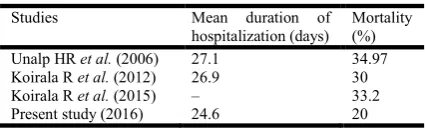
[image:5.595.56.269.474.538.2]Discussing about the long term morbidity to the patients, 7 ended up with stomas. Two of the patients had skin excoriation around the stoma while 1 patient with stoma died. The mean hospital stay of patients in the study was 24.6 days, shortest was 7 days and longest being 87 days. Hospital stay was longer in patients with multiple co morbidities, septicaemia, pulmonary complications, wound infection/dehiscence and anastomotic leaks. In the following table Mean hospital days of stay and mortality rates of different studies are compared:
Table 10. Comparison between mean hospitalisation and mortality rates
Studies Mean duration of
hospitalization (days)
Mortality (%)
Unalp HR et al. (2006) 27.1 34.97
Koirala R et al. (2012) 26.9 30
Koirala R et al. (2015) – 33.2
Present study (2016) 24.6 20
There were 5 (20%) mortalities in this study. The mean age of patients was 48.2 ± 21.04 (range, 14-68) years. Mortalities included 3 (60%) male and 2 (40%) female patients. Anastomotic leak was seen in 3 (60%) patients after index surgery. Mean interval between index and redo surgeries was 19 ± 15.47 days. Four (80%) surgeries were done on emergency basis. Mean values of haemoglobin, TLC and serum total proteins was 8.04, 13320 cells/mm3, 5.48 gm%. Mean hospital stay of these five patients was 26 days. Almost all the patients had Septicemia, pulmonary complications and wound infection. In the study done by Unalp HR et al. in 2006 reported 34.97% mortality following redo laparotomies, the most common cause being sepsis with multi organ failure. Koirala R, Shakya VC, Khania S, et al. (2012) reported a mortality rate of 30% the most common cause being sepsis with multi organ failure.
RESULTS AND CONCLUSIONS
Based on observations in our study and pertinent literature the following conclusions can be made
Redo laparotomies are not uncommon following complications of abdominal index surgeries like Burst abdomen, Post operative peritonitis, anastomotic leaks, adhesion obstruction etc. And these are more common in patients with comorbid conditions like advancing age, malignancy, metabolic disorder, poor nutrition etc. The emphasis in performing redo surgeries should be
on early diagnosis and intervention, since there is a linear relationship between morbidity/mortality and time interval between index and redo surgeries.
Therefore, it is suggested that redo surgeries should be planned and executed at the earliest to minimise the resultant morbidity and mortality. In the era of modern critical care settings intensive post operative care and monitoring should improve the outcome following these procedures.
REFERENCES
Angerpointner, T. and Jarmolowitz, C. 1980. Studies on relaprotomy in childhood. Z Kinderchir Grenzgeb. 30(1):13-5.
Batian, N.P., Khomchenko, M.N. and Narubanov, P.G. 1976. Relaprotomy in acute hemorrhage after operations on abdominal organs. Vestn Khir Im I I Grek,;116(2):68-74.
Butler, J.A., Huang, J. and Wilson, S.E. 1987. Repeated laparotomy for postoperative intra-abdominal sepsis. An analysis of outcome predictors. Arch Surg. 122(6):702-6.
Chichom Mefire, A., Tchounzou, R., Masso, M.P., et al. 2009.
Analysis of operative indications and out comes in 238 re-operations after abdominal surgery in an economically disadvantaged setting. J Chir (Paris), 146(4):387-91.
Ching, S.S., Muralikrishnan, V.P. and Whiteley, G.S. 2003. Relaparotomy: A five-year review of indications and outcome. Int J Clin Pract., 57(4):333-7.
Ellozy, S.H., Harris, M.T., Bauer, J.J., et al. 2002. Early postoperative small-bowel obstruction: a prospective evaluation in 242 consecutive abdominal operations. Dis Colon Rectum. 45(9):1214-17.
Ganchev, G., Baev, S., Milushev, G., et al. 1980. Relaparotomy in early postoperative complications in the abdominal cavity. Probl Khig., 8:111-20.
Grussner, R., Pistor, G., Kotei, D.N., et al. 1986. Relaparotomy in childhood. Langenbecks Arch Chir. 367(3):167-80.
Harris, E.A., Kelly, A.W., Pockai, B.A., et al. 2002. Reoperation on the abdomen encased in adhesions. Am J Surg., 184(6):499-504.
Hinsdale, J.G. and Jaffe, B.M. 1984. Re-operation for intra-abdominal sepsis. Indications and results in modern critical care settings. Ann. Surg., 199(1): 31-36.
Holzheimer, R.G. and Gathof, B. 2003. Re-operation for complicated secondary peritonitis - how to identify patients at risk for persistent sepsis?. Eur J Med Res., 8(3):125-34.
Hutchins, R.R., Gunning, M.P., Lucas, D.N., et al. 2004. Relaparotomy for suspected intraperitoneal sepsis after abdominal surgery. World J Surg. 28:137-41.
Koirala, R., Mehta, N., Varma, V., et al. 2015.Urgent Redo-Laparotomies: patterns and outcome--A Single Centre Experience. Indian J Surg., 77(3) 195-199.
Koperna, T. and Schulz, F. 2000. Relaparotomy in peritonitis: prognosis and treatment of patients with persistent intra abdominal infection. World J Surg. 24(1):32-7.
Lamme, B., Boermeester, M.A., Reitsma, J.B., et al. Meta-analysis of relaparotomy for secondary peritonitis. Br. J Surg. 2002; 89(12): 1516-24.
Mamchich, V.I., Shaprinskii, V.A. and Palienko, P.K. 1992. Intraabdominal hemorrhage after surgery on the abdominal organs requiring relaparotomy. Klin Khir., (8):31-4.
Krivitskii, D.I., Shuliarenko, V.A. and Babin, I.A. 1990. Indications for relaparotomy. Klin Khir., (1):18-21.
Martinez-Ordaz, J.L., Suarez-Moreno, R.M. and Filipez-Aguilar, O.J. 2005. Relaparotomy on demand: Factors related to mortality. Cir Cir., 73(3):175-8.
Myshkin, K.I., Bluvshtein, G.A., Dodin, S.V., et al. 1989. Relaparotomy after operations on the rectum and colon.
Vestn Khir Im I I Grek. 143:5-9.