Munich Personal RePEc Archive
And yet it moves (down)
Maito, Esteban Ezequiel
August 2014
Online at
https://mpra.ub.uni-muenchen.de/58007/
ARTICLE PUBLISHED IN WEEKLY WORKER ISSUE N°1023 (AUGUST 2014)
FOR THE COMPLETE DATASET OF THIS ARTICLE GO TO https://www.academia.edu/7941511/And_yet_it_moves_down_-_The_tendency_of_the_rate_of_profit_to_fall_in_United_Kingdom_1855-2009
And yet it moves (down)
Irrespective of the specific causes of the 2008-09 crisis,
writes
Esteban Ezequiel Maito
, there is an undeniable
tendency for the rate of profit to fall
In recent issues of the Weekly Worker a controversy between Arthur Bough1, on the one side, and Bruce Wallace and Steve Dobbs2, on the other, has developed over some interesting questions.
To begin with, let me say that Arthur Bough should at least take the trouble to read my articles and not draw conclusions about my position through a simple reading of a blog comment. I have written a paper that estimates - obviously in very rough way - the turnover speed of circulating capital in four countries (on the same methodological base). If Bough reads it, he would avoid falling into the unrealistic assumptions on fixed capital that he makes in his examples. He would also do well to take a look at my data series, which include annual rates of profit and surplus value.3
In another article, I have estimated the rate of profit on fixed capital in 14 countries, which currently account for 60% of the world economy.4 That article contains my own estimates, including an earlier version for the United Kingdom, and those of other authors. The inclusion of a rate of profit on fixed capital for the Chinese economy since 1978 is the result of a series built up by other authors (and on the same basis as the other 13 studies). However, in this article I emphasised the relevance of the rate of profit in China mainly in the last two decades, when its conversion into a capitalist country became a fundamental fact from a systemic point of view. In case there is any doubt, I consider irrelevant and improbable the existence of a rate of profit in 1978 in China. To question that research over that specific aspect is at least superficial.
tendency of the rate of profit to fall, even more when the debate itself has been practically focused on just one country, the United States, and that research tends to confirm the tendency in a highly representative group of countries.
So this article is not intended to explain the current crisis, but to contribute to the debate on the tendency of the rate of profit to fall and in particular in the case of the United Kingdom.
The tendency of the rate of profit to fall
Capitalist production consists of a valorisation process (M-M’) through the exploitation of the labour force (M-C...P...-C’-M’). The capital advanced in the form of money (M) is exchanged for commodities (C) - means of production, raw materials (constant capital or CC) and labour force (variable capital or VC). The secret of capitalist production is that the labour force is able to generate more than its reproduction value: namely a surplus value. For this reason, the capital advanced for the labour force is variable capital, while capital advanced for the means of production (machinery, infrastructure) and raw materials is constant capital.
Thus, the production process (P) occurs when the labour force, using the means of production, transforms inputs which are then realised in a mass of commodities of a greater value than the original money advanced (M’). The final product includes the value of constant capital consumed, plus an additional amount generated by the labour force, equal to variable capital (the reproduction value of the labour force) exchanged with the capitalist, and a surplus value. Thus capital transmutes from money-capital to capital, then productive-capital, finally returning to the form of commodity-capital and money-commodity-capital of a greater value. This last step is the one that involves the sale on the market (C’-M’): ie, the realisation of the profit and the completion of the valorisation process.
There is continual pressure for each capitalist to sell at a lower price than competitors and so raise market share. This implies a constantly increasing expenditure mainly on fixed capital - equipment and infrastructure - which enables the productivity of labour to rise, or labour time necessary to produce commodities to be reduced, thus reducing the individual value, including that of the cost of reproduction of the labour force. But to do this, there will be a relative rise in the value of constant capital compared to that of variable capital (for the reproduction of the labour force).
The means - unconditional development of the productive forces of society - comes continually into conflict with the limited purpose, the self-expansion of the existing capital.5
In Marx’s terms, this downward trend in the rate of profit would occur regardless of a decline or stagnation in wages relative to profits: ie, constant or rising rate of surplus value (profits/variable capital):
This continual relative decrease of the variable capital vis-à-vis the constant, and consequently the total, capital is identical with the progressively higher organic composition of the social capital in its average. It is likewise just another expression for the progressive development of the social productivity of labour, which is demonstrated precisely by the fact that the same number of labourers, in the same time - ie, with less labour - convert an ever-increasing quantity of raw and auxiliary materials into products, thanks to the growing application of machinery and fixed capital in general … This mode of production produces a progressive relative decrease of the variable capital as compared to the constant capital, and consequently a continuously rising organic composition of the total capital. The immediate result of this is that the rate of surplus value, at the same, or even a rising, degree of labour exploitation, is represented by a continually falling general rate of profit.6
This does not deny the fact that the rate of profit may show periods of growth, but these exist precisely because the countervailing forces manage to reverse this downward pressure for a time. This gives Marx´s law the character of a tendency:
We have thus seen in a general way that the same influences which produce a tendency in the general rate of profit to fall also call forth counter-effects, which hamper, retard and partly paralyse this fall. The latter do not do away with the law, but impair its effect. Otherwise, it would not be the fall of the general rate of profit, but rather its relative slowness, that would be incomprehensible. Thus, the law acts only as a tendency. And it is only under certain circumstances and only after long periods that its effects become strikingly pronounced.7
The tendency of the rate of profit to fall is an inherent aspect of the capitalist mode of production. It is the logical conclusion of the Marxian law of value, his explanation of technological change, competition and the formation of a general rate of profit (debunkers have usually applied lazy revisionism in these matters too). Marx himself states this obvious connection between his theory of value and the downward trend, which appears expressed in the value of any particular commodity as the “economic cell
of bourgeois society”:
single commodity, or each particular lot of commodities in the total mass of products - absorbs less living labour, and also contains less materialised labour, both in the depreciation of the fixed capital applied and in the raw and auxiliary materials consumed. Hence every single commodity contains a smaller sum of labour materialised in means of production and of labour newly added during production. This causes the price of the individual commodity to fall. But the mass of profits contained in the individual commodities may nevertheless increase if the rate of the absolute or relative surplus value grows. The commodity contains less newly added labour, but its unpaid portion grows in relation to its paid portion. However, this is the case only within certain limits. With the absolute amount of living labour newly incorporated in individual commodities decreasing enormously as production develops, the absolute mass of unpaid labour contained in them will likewise decrease, however much it may have grown as compared to the paid portion.8
As can be seen, there is a huge (and non-casual) similarity in Marx’s arguments about the value components in commodities and the tendency of the rate of profit to fall. Both refer to the same reality from two different angles. In both cases the increase in the rate of surplus value has clear limits in offsetting the relative increase in objectified labour (constant capital) in determining both the value of commodities and the rate of profit.
The connection between the law of the tendency of the rate of profit to fall and the law of value is such that, in fact, the first is practically established in volume 1 of Capital - for instance in the ‘General law of capitalist accumulation’ (chapter 25):
The accumulation of capital, though originally appearing as its quantitative extension only, is effected, as we have seen, under a progressive qualitative change in its composition, under a constant increase of its constant, at the expense of its variable, constituent.9
It is the same principle - the very tendency of capital to further increase constant capital (fixed and circulating, but mostly fixed) compared to the variable - which establishes the downward trend in the rate of profit. Constantly Marx makes clear both the validity of the law and this foundation. In chapter 25 of volume 3 he writes:
As demonstrated in part 3 of this book, the rate of profit decreases in proportion to the mounting accumulation of capital and the correspondingly increasing productivity of social labour, which is expressed precisely in the relative and progressive decrease of the variable as compared to the constant portion of capital. To produce the same rate of profit after the constant capital set in motion by one labourer increases tenfold, the surplus labour-time would have to increase tenfold, and soon the total labour-time, and finally the entire 24 hours of a day, would not suffice, even if wholly appropriated by capital.10
Turnover of circulating capital
capitalist buys a ton of steel in January and in March sells it after its transformation into metal tubes, by April he has already recovered the amount paid for the steel in January.
So in April’s production he only reinvests the circulating capital advanced in January. Thus the value of the circulating capital is totally transferred to the final product after each production process and is recovered by the capitalist once those commodities are sold, to be newly released on production and valorised.
The annual wage bill thus relates to the amount of variable capital advanced, multiplied by the annual number of turnovers performed. Indeed, the capitalist does not advance the amount of the annual wage bill, but only the variable capital, so only the latter must be included in the annual rate of profit.
Since it is the labour force, using machinery, which transforms the inputs representing circulating constant capital, the turnover of variable capital is similar to that, although it can be speculated that it is somewhat lower, due to the time lag between purchase of inputs and their real availability (obviously variations and complexities in this regard in reality are huge). Fixed constant capital turnover takes several years, transferring to the product only a minor portion of its value in a year. In national accounts this transfer appears as the depreciation or consumption of fixed capital.
The picture that Bough sought to generate without any basis is that the increase in the turnover speed of circulating capital can keep the annual rate of profit high and even growing. But this can only be said if he ignores the amount of fixed capital advanced relative to living labour - information actually present in many official national accounts (fixed capital series compared to gross domestic product or wage bill series).
UNITED KINGDOM 1855-2009
Let us now turn to my estimate of the rate of profit in the UK since 1855 (see Fig 1). It would be very interesting to see if any debunker of the tendency of the rate of profit to fall has any different estimate that could enlighten us. But it appears to be a distinctive feature of the debunkers in general, and particularly Marxists debunkers, not to provide such data. Recently Thomas Piketty tried to do so, but merely exposed his own incredible misunderstanding of Marxian theory.11
I have based my estimate on the reproductive fixed capital series of the UK’s Office for National Statistics and the distribution shares on Piketty’s data applied to the ONS official series for gross domestic product.
RoP-F is the rate of profit on fixed capital at current prices (in concrete reality capitalists are governed by current market prices, so the rate of profit has to be estimated at current prices). RoP-FR is the rate of profit on fixed capital at constant prices: ie, deflated by the relative price of investment to output prices. In this case what we get is a rate in real terms, which shows the relative evolution of the volume of the profits to the volume of fixed capital.
The average rate of profit on fixed capital (RoP-F) in 1990-2009 was 79.2% lower than the average of 1855-1874 (falling from 29.9% to 6.3%), while in the case of the real rate of return on fixed capital (RoP-FR), the averages were 39.8% in 1855-74 and 5.7% in 1990-2009, a 84.9% reduction. The difference in the rate of reduction (79.2% vs 84.9%)
0% 5% 10% 15% 20% 25% 30% 35% 40% 45% 50% 1 8 5 5 1 8 6 0 1 8 6 5 1 8 7 0 1 8 7 5 1 8 8 0 1 8 8 5 1 8 9 0 1 8 9 5 1 9 0 0 1 9 0 5 1 9 1 0 1 9 1 5 1 9 2 0 1 9 2 5 1 9 3 0 1 9 3 5 1 9 4 0 1 9 4 5 1 9 5 0 1 9 5 5 1 9 6 0 1 9 6 5 1 9 7 0 1 9 7 5 1 9 8 0 1 9 8 5 1 9 9 0 1 9 9 5 2 0 0 0 2 0 0 5
United Kingdom (1855-2009) - Rates of profit
RoP-F
RoP-N
RoP1
RoP-FR
reflects the countervailing effect of the relative cheapening of constant capital expressed in the slower rate of all at current prices. This cheapening reduces not only the denominator of the rate of profit, but also expands the numerator by reducing the amount of the consumption of fixed capital, or depreciation, therefore increasing net profits.
However, advanced capital consists not only of fixed capital. So I have made the following approximation. Taking the amount of the wage bill for each year from Piketty’s series, I imputed to the purchase of inputs, or intermediate consumption, a value that doubles the wage bill, according to the more or less stable intermediate consumption proportion to wages shown in other cases (eg, in the Netherlands and Japan). Finally, to account for the turnover speed of circulating capital, I imputed to the UK a turnover speed of 12 in the year 2008 and then extrapolated it backwards according to the variation of GDP per capita, with the turnover speed reaching 1.3 annual turnovers in 1855. The 12 turnovers imputation in 2008 was based on my work for the Netherlands and the US - two economies highly related to the British, with 12.4 and 11.4 turnovers respectively in the same year.12
Thus variable capital (VC) is equal to the annual wage bill (W), divided by annual turnovers (N); and constant circulating capital (CCC) is equal to inputs or intermediate consumption (IC), divided by annual turnovers. Then we get a rate of profit on total advanced capital adjusted (ROP-N, or P/K+CCC+VC) or unadjusted by turnover (ROP1, or P/K+IC+W).
In the case of the rate of profit on total capital unadjusted (ROP1), the fall in the rate of profit was 77.5% (14.6% to 3.2%), while the adjusted rate (RoP-N) fell less, but was still down 67.2% (17.4% to 5.7%). Again, the difference between the two falls (67.2% vs 77.5%) shows the countervailing effect (and only partially countervailing) of the increase in the turnover speed of circulating capital.
The ‘current’ rate of profit in capitalist reality, RoP-N, is expressing the two countervailing factors already mentioned (the cheapening of constant capital and the increase in turnover speed). RoP1R shows the rate of profit on capital advanced without turnover adjustment and at constant prices. Its average in 1855-74 was 16.9% and 3.0% in 1990-2009, showing a reduction of 86.8%, the largest fall in all the measures. So the two major countervailing forces explain the difference in the rate of decline between the two measures (67.2% vs 86.8%). However, ROP-N still declined sharply by 67.2%.
Fig 1 shows also the convergence over the long term between the rate of profit adjusted by turnover (RoP-N) and the rate of profit on fixed capital (ROP-F) due to the relative reduction of circulating capital advanced. Since the turnover speed was lower historically, initially the rate of profit adjusted (RoP-N) was closer to the unadjusted rate (ROP1).
A closer look
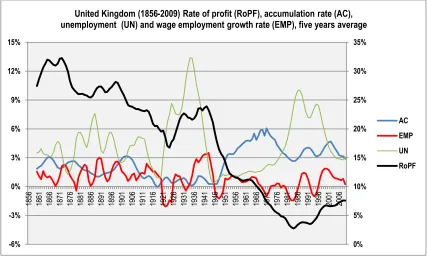
In the next diagram (Fig 2) we can see the relation between the development of the tendency of the rate of profit to fall and the higher relative growth of constant capital compared to the labour force - the only source of surplus value. For simplicity, I present the rate of accumulation in real or volume terms (AC or growth rate of fixed capital relative to the fixed capital of the current year), at constant prices.
At current prices, this rate was clearly negative after the crisis of 1871-73 and in the interwar period - in both cases reflecting a sharp devaluation of capital. By contrast, in the 1970s its growth was even higher, reaching a maximum of 21.5% in 1975, given high inflation levels, and exceeding the peak reached in World War I.
But, beyond these peculiarities, the accumulation rate in real terms allows us to compare more clearly the relative evolution of the mass of fixed capital to the mass of the labour force.
Over this long period, 1855 to 2009, two opposing trends, mediated by the interwar 0% 5% 10% 15% 20% 25% 30% 35% -6% -3% 0% 3% 6% 9% 12% 15% 1 8 5 6 1 8 6 1 1 8 6 6 1 8 7 1 1 8 7 6 1 8 8 1 1 8 8 6 1 8 9 1 1 8 9 6 1 9 0 1 1 9 0 6 1 9 1 1 1 9 1 6 1 9 2 1 1 9 2 6 1 9 3 1 1 9 3 6 1 9 4 1 1 9 4 6 1 9 5 1 1 9 5 6 1 9 6 1 1 9 6 6 1 9 7 1 1 9 7 6 1 9 8 1 1 9 8 6 1 9 9 1 1 9 9 6 2 0 0 1 2 0 0 6
United Kingdom (1856-2009) Rate of profit (RoPF), accumulation rate (AC), unemployment (UN) and wage employment growth rate (EMP), five years average
AC
EMP
UN
period, have developed, expressing the Marxian determinations explained above. The rate of accumulation reached higher levels in the post-war period (average: 3.8% per year in 1946-2009) compared to the pre-World War I period (average: 2.0% per year in 1856-1913). During these same periods, the growth in the number of employees showed the reverse, with a higher relative growth in the first part (1.3% per year) compared to post-World War II decades (0.3%). During the interwar period, in which the rate of profit recovered significantly, the accumulation rate expanded at an average annual rate of 0.5% - less than the average increase of 0.9% of the workforce.
Additionally, the sharp devaluation of capital in the interwar period mentioned earlier led to an increase in the rate of profit. Violent devaluations during crises are both a product of the crises and one of the ways in which capital restores the conditions for overcoming them. The value of fixed capital at current prices fell from £8,638 million in 1920 to £4,625 million in 1934 (a devaluation of 46.4%, which was not recovered until 1943).
Obviously, I am just exposing in an abbreviated way something that requires much more space and the inclusion of other categories, such as the mass of profit (which does not always increases). However, we can identify some patterns from these series:
The movement of the rate of profit tends to follow the relative growth of constant capital and labour. When the latter increases at a higher rate compared to fixed capital, the rate of profit shows some restoration, and vice versa. And, since the increase of constant capital tends to be higher than that of the labour force over the long run, as Marx stated, the obvious consequence is the downward trend in the rate of profit. The development of the productive power of labour and accumulation also implies that a relative higher rate of accumulation is required for the same rate of increase in the labour force.
The partial recovery of the rate of profit observed since 1982 has been further supported by an increase in the rate of surplus value and a huge cheapening of constant capital (relative price of investment). Thus the reduction of wages and consumption of fixed capital shares in output implied that the share of profits showed a steady increase, only comparable with that observed between 1855 and 1871. During this partial recovery there have been changes in the contributions of particular industries to the mass of profits and fixed capital of the total economy: eg, the decline in manufacturing and increased contribution from other less mature industries like telecommunication services.
increase investments under the pressure of competition, until the continuation in the fall in the rate of profit finally ends up affecting the accumulation rate. However, when profitability begins to increase after the slump, the accumulation rate takes time to reflect that increase, probably because in such situations there is still much idle capacity.
The increase in the unemployment rate is strongly (inversely) related to the rate of profit achieved by capitalists. As shown in Fig 2, with a fall in the rate of profit, the relative overpopulation of labour (the industrial reserve army) increases. But this relation is mediated by the accumulation rate. As the rate of accumulation increases within each cycle, the unemployment rate is reduced. However, in the rising part of the cycle of the accumulation rate, and before reaching its peak, the pace of employment growth begins to fall, while the investment effort imposed by competition through mechanisation intensifies. Once the falling rate of profit is consolidated, the accumulation rate reacts by entering a downward phase, in which net job losses increase the unemployment rate, thus expanding the relative overpopulation as a countervailing force.
Concluding remarks
Traditionally, economic cycles have been detached analytically from any long-term trend, as a succession of rising and falling waves between one horizontal and straight line. However, there is a clear relation: long-term trends develop through a series of cycles. In this sense, any analysis of the cyclical crises must refer to the long-term trends of accumulation and profitability, without neglecting the particularities of every crisis that confer its specificity.
To affirm the existence of the tendency of the rate of profit to fall in no way implies the existence of a ‘permanent crisis’ or that the rate of profit falls always. That crises may be preceded by a period of growth in the rate of profit does not deny the validity of the tendency. Nor does any increase in output necessarily imply a growth in the rate of profit. The post-war decades showed high economic growth in most economies, but over that particular period the rate of profit declined steadily, mainly due to the very basic reason that the share of investment in GDP increased more than GDP rose. Recent decades have shown a partial recovery of profitability in conjunction with lower GDP growth rates compared to post-war decades.
Although it first appears in the process of circulation, the real crisis cannot be understood as a problem of circulation or of realisation, but only as a disruption of the process of reproduction as a whole, which is constituted by production and circulation together. And, as the process of reproduction depends on the accumulation of capital, and therefore on the mass of surplus value that makes accumulation possible, it is within the sphere of production that the decisive factors (though not the only factors) of the passage from the possibility of crisis to an actual crisis are to be found ... The crisis characteristic of capital thus originates neither in production nor in circulation taken separately, but in the difficulties that arise from the tendency of the profit rate to fall inherent in accumulation and governed by the law of value.13
The tendency of the rate of profit to fall is derived from the contradictions that constitute the mode of production and the commodity itself as a product of social labour under its particular relations of production. Marxist scientific analysis, which differs from all the previous socialist political traditions and all previous forms of bourgeois economics, has clarified that it ultimately expresses something as obvious as it is elemental: capitalism is a historically bounded system. But Marxism says nothing about how or when its final limits will be reached.
Today, due to the increasing development of long-term statistics, we are able to make use of better tools that allow us to develop a more accurate analysis of the capitalist economy and its trends. This is one meeting between ‘theory’ and ‘data’ of which the debunkers have not taken note
Statistical Annex
Variables in Real Terms (ONS 2006 reference year)
Source ONS ONS Piketty
Year Fixed Capital Accumulation Rate Real GDP
GDP growth
rate
Net Profits
Consumption of Fixed Capital
Wages
Net Taxes on production
RoP-FR
at market
prices £mn %
at market
prices £mn % % % % % %
1855 61.664 59.188 36,3% 3,4% 52,7% 7,5% 34,9%
1856 62.740 1,7% 61.989 4,7% 37,7% 3,3% 51,5% 7,5% 37,2% 1857 63.935 1,9% 61.989 0,0% 39,1% 3,4% 50,1% 7,5% 37,9% 1858 65.010 1,7% 62.176 0,3% 40,7% 3,5% 48,3% 7,5% 39,0%
1862 71.344 2,6% 68.151 1,1% 42,5% 3,0% 47,0% 7,5% 40,6% 1863 73.555 3,0% 69.831 2,5% 42,9% 3,1% 46,5% 7,5% 40,8% 1864 76.064 3,3% 70.951 1,6% 43,1% 3,2% 46,3% 7,5% 40,2%
1865 78.873 3,6% 74.125 4,5% 42,4% 3,1% 47,0% 7,5% 39,8% 1866 81.203 2,9% 74.686 0,8% 42,4% 3,2% 46,9% 7,5% 39,0% 1867 82.936 2,1% 73.752 -1,3% 41,8% 3,2% 47,5% 7,5% 37,2%
1868 84.370 1,7% 76.179 3,3% 43,1% 3,3% 46,1% 7,5% 38,9% 1869 85.624 1,5% 77.673 2,0% 43,1% 3,3% 46,2% 7,5% 39,1%
1870 87.178 1,8% 84.208 8,4% 45,2% 3,1% 44,2% 7,5% 43,7% 1871 89.269 2,3% 88.520 5,1% 46,6% 3,0% 43,4% 7,1% 46,2% 1872 91.480 2,4% 88.604 0,1% 44,4% 3,2% 45,6% 6,9% 43,0%
1873 93.571 2,2% 89.281 0,8% 43,2% 3,4% 46,8% 6,6% 41,2% 1874 96.260 2,8% 93.001 4,2% 42,7% 3,4% 47,1% 6,8% 41,3% 1875 99.009 2,8% 93.846 0,9% 42,0% 3,4% 47,7% 6,9% 39,8%
1876 101.758 2,7% 94.438 0,6% 40,9% 3,5% 48,5% 7,2% 37,9% 1877 104.566 2,7% 94.945 0,5% 39,9% 3,6% 49,2% 7,3% 36,3%
1878 107.016 2,3% 95.706 0,8% 39,6% 3,6% 49,1% 7,6% 35,5% 1879 109.107 1,9% 93.593 -2,2% 38,9% 3,7% 49,8% 7,5% 33,4% 1880 110.840 1,6% 100.948 7,9% 40,5% 3,6% 48,7% 7,2% 36,9%
1881 112.931 1,9% 102.977 2,0% 40,2% 3,6% 48,9% 7,2% 36,7% 1882 114.664 1,5% 104.753 1,7% 38,9% 3,6% 50,3% 7,2% 35,6% 1883 116.576 1,6% 108.135 3,2% 37,7% 3,6% 51,5% 7,3% 35,0%
1884 118.608 1,7% 107.205 -0,9% 37,4% 3,6% 51,5% 7,5% 33,8% 1885 120.161 1,3% 106.275 -0,9% 37,6% 3,7% 51,2% 7,5% 33,2%
1886 121.177 0,8% 107.035 0,7% 38,8% 3,6% 50,2% 7,4% 34,2% 1887 122.252 0,9% 111.432 4,1% 38,2% 3,5% 51,1% 7,2% 34,8% 1888 123.507 1,0% 114.983 3,2% 38,5% 3,4% 51,2% 6,9% 35,8%
1889 125.001 1,2% 118.703 3,2% 37,4% 3,5% 52,5% 6,7% 35,5% 1890 126.555 1,2% 119.717 0,9% 36,5% 3,6% 53,1% 6,7% 34,6%
1891 128.467 1,5% 122.423 2,3% 36,0% 3,5% 53,7% 6,9% 34,3% 1892 130.379 1,5% 119.886 -2,1% 35,6% 3,5% 53,8% 7,1% 32,7% 1893 132.231 1,4% 119.041 -0,7% 35,9% 3,5% 53,5% 7,1% 32,3%
1894 134.203 1,5% 124.959 5,0% 36,8% 3,3% 52,9% 7,0% 34,3% 1895 136.354 1,6% 129.017 3,2% 36,8% 3,2% 52,9% 7,1% 34,8% 1896 138.923 1,8% 134.682 4,4% 36,4% 3,2% 53,2% 7,2% 35,3%
1897 142.150 2,3% 135.866 0,9% 36,6% 3,3% 53,1% 7,1% 35,0% 1898 146.153 2,7% 142.376 4,8% 37,0% 3,3% 52,9% 6,9% 36,1%
1901 160.733 3,3% 150.408 2,5% 35,2% 3,4% 53,8% 7,5% 33,0% 1902 166.349 3,4% 152.521 1,4% 35,2% 3,3% 53,5% 8,0% 32,2% 1903 171.667 3,1% 151.084 -0,9% 34,5% 3,4% 54,0% 8,1% 30,3%
1904 176.806 2,9% 153.029 1,3% 34,2% 3,4% 53,9% 8,4% 29,6% 1905 181.347 2,5% 157.679 3,0% 34,8% 3,4% 53,7% 8,1% 30,2% 1906 185.350 2,2% 161.568 2,5% 35,2% 3,5% 53,5% 7,7% 30,7%
1907 188.159 1,5% 164.527 1,8% 34,8% 3,6% 54,1% 7,5% 30,5% 1908 189.234 0,6% 158.355 -3,8% 34,3% 3,7% 54,4% 7,6% 28,7%
1909 190.848 0,8% 162.667 2,7% 34,3% 3,6% 54,6% 7,5% 29,2% 1910 192.580 0,9% 166.979 2,7% 33,7% 3,6% 54,9% 7,8% 29,3% 1911 194.433 1,0% 172.559 3,3% 33,7% 3,5% 55,2% 7,6% 29,9%
1912 196.285 0,9% 174.926 1,4% 34,1% 3,7% 54,7% 7,5% 30,4% 1913 198.974 1,4% 182.451 4,3% 34,2% 3,7% 54,8% 7,3% 31,3% 1914 201.782 1,4% 186.647 2,3% 31,9% 3,6% 57,5% 7,0% 29,5%
1915 202.380 0,3% 198.506 6,4% 26,4% 4,1% 62,3% 7,1% 25,9% 1916 201.065 -0,7% 202.338 1,9% 24,8% 4,3% 64,7% 6,2% 24,9%
1917 198.496 -1,3% 203.797 0,7% 28,2% 4,1% 62,9% 4,8% 29,0% 1918 198.675 0,1% 208.176 2,1% 30,7% 4,1% 61,5% 3,8% 32,1% 1919 202.320 1,8% 187.559 -9,9% 26,9% 4,8% 62,8% 5,5% 25,0%
1920 207.160 2,3% 172.963 -7,8% 25,5% 6,4% 61,0% 7,1% 21,3% 1921 207.848 0,3% 155.419 -10,1% 27,1% 6,3% 59,5% 7,1% 20,3% 1922 207.848 0,0% 165.139 6,3% 23,9% 6,0% 60,8% 9,3% 19,0%
1923 208.536 0,3% 170.290 3,1% 21,2% 6,0% 62,1% 10,7% 17,3% 1924 209.569 0,5% 178.649 4,9% 21,5% 5,6% 61,6% 11,2% 18,3%
1925 211.289 0,8% 185.210 3,7% 25,7% 5,5% 58,5% 10,4% 22,5% 1926 211.633 0,2% 179.184 -3,3% 24,8% 5,2% 59,9% 10,1% 21,0% 1927 213.010 0,6% 193.812 8,2% 23,5% 5,5% 60,2% 10,8% 21,4%
1928 215.419 1,1% 195.416 0,8% 24,2% 5,1% 59,9% 10,8% 21,9% 1929 217.828 1,1% 201.199 3,0% 25,2% 5,1% 58,6% 11,0% 23,3%
1930 219.892 0,9% 199.401 -0,9% 27,5% 5,2% 56,8% 10,5% 24,9% 1931 221.269 0,6% 189.487 -5,0% 24,9% 5,2% 59,3% 10,6% 21,3% 1932 220.925 -0,2% 190.313 0,4% 22,8% 5,6% 60,3% 11,3% 19,6%
1933 218.860 -0,9% 196.582 3,3% 21,0% 5,7% 61,0% 12,2% 18,9% 1934 219.548 0,3% 208.781 6,2% 23,1% 5,7% 59,6% 11,6% 22,0% 1935 221.269 0,8% 216.459 3,7% 23,8% 5,2% 59,5% 11,5% 23,2%
1936 224.022 1,2% 227.102 4,9% 23,6% 5,3% 59,9% 11,3% 23,9% 1937 227.463 1,5% 234.975 3,5% 24,5% 5,4% 58,9% 11,2% 25,3%
1940 232.488 0,3% 275.458 11,3% 19,6% 5,5% 63,7% 11,1% 23,3% 1941 233.107 0,3% 300.924 9,2% 22,4% 4,9% 61,0% 11,8% 28,9% 1942 233.726 0,3% 307.047 2,0% 21,5% 4,7% 60,5% 13,3% 28,3%
1943 234.344 0,3% 312.539 1,8% 21,3% 4,5% 60,9% 13,2% 28,4% 1944 234.965 0,3% 297.376 -4,9% 19,6% 5,1% 62,1% 13,3% 24,8% 1945 235.584 0,3% 281.582 -5,3% 18,5% 5,4% 63,2% 12,9% 22,1%
1946 236.203 0,3% 273.320 -2,9% 20,1% 5,5% 62,2% 12,3% 23,3% 1947 236.822 0,3% 269.723 -1,3% 21,2% 5,9% 62,6% 10,4% 24,1%
1948 243.556 2,8% 279.589 3,7% 20,9% 6,1% 62,4% 10,6% 23,9% 1949 252.535 3,6% 289.269 3,5% 19,3% 7,1% 62,2% 11,4% 22,1% 1950 262.636 3,8% 298.626 3,2% 18,8% 7,4% 63,0% 10,9% 21,4%
1951 271.616 3,3% 306.197 2,5% 17,8% 7,5% 63,5% 11,2% 20,1% 1952 279.472 2,8% 307.240 0,3% 18,0% 7,9% 62,5% 11,6% 19,8% 1953 289.574 3,5% 319.087 3,9% 18,3% 8,3% 62,2% 11,2% 20,1%
1954 299.675 3,4% 331.876 4,0% 18,4% 8,0% 62,4% 11,2% 20,3% 1955 312.021 4,0% 343.336 3,5% 17,5% 7,9% 63,6% 11,0% 19,3%
1956 326.612 4,5% 347.581 1,2% 16,1% 8,1% 64,5% 11,3% 17,1% 1957 342.325 4,6% 353.363 1,7% 16,0% 8,3% 64,6% 11,2% 16,5% 1958 358.039 4,4% 352.952 -0,1% 16,4% 8,4% 64,3% 11,0% 16,1%
1959 374.874 4,5% 366.553 3,9% 16,7% 8,5% 63,9% 10,9% 16,4% 1960 393.955 4,8% 386.464 5,4% 17,6% 8,4% 63,1% 10,9% 17,2% 1961 416.402 5,4% 396.023 2,5% 17,1% 8,4% 64,3% 10,3% 16,3%
1962 437.727 4,9% 400.903 1,2% 16,8% 8,5% 64,5% 10,2% 15,4% 1963 456.162 4,0% 405.166 1,1% 16,2% 8,7% 64,8% 10,3% 14,4%
1964 482.834 5,5% 427.915 5,6% 16,0% 8,6% 65,0% 10,4% 14,2% 1965 523.626 7,8% 439.592 2,7% 15,5% 8,6% 65,1% 10,9% 13,0% 1966 534.216 2,0% 447.628 1,8% 14,3% 8,6% 65,8% 11,3% 12,0%
1967 575.008 7,1% 455.667 1,8% 13,8% 8,7% 65,8% 11,8% 10,9% 1968 616.584 6,7% 475.499 4,4% 13,7% 8,7% 65,6% 12,0% 10,6%
1969 655.415 5,9% 486.319 2,3% 13,0% 8,7% 65,6% 12,7% 9,6% 1970 687.577 4,7% 496.224 2,0% 10,3% 8,9% 66,9% 13,9% 7,4% 1971 730.330 5,9% 507.493 2,3% 11,4% 9,1% 65,7% 13,8% 7,9%
1972 766.340 4,7% 524.782 3,4% 13,0% 9,4% 64,8% 12,8% 8,9% 1973 807.358 5,1% 564.814 7,6% 14,6% 9,9% 63,6% 11,8% 10,2% 1974 848.115 4,8% 559.310 -1,0% 12,9% 10,1% 66,6% 10,4% 8,5%
1975 882.282 3,9% 556.438 -0,5% 11,0% 10,8% 69,1% 9,1% 6,9% 1976 911.714 3,2% 571.437 2,7% 13,1% 11,2% 66,8% 9,0% 8,2%
1979 1.011.465 3,5% 613.214 2,2% 12,0% 11,7% 65,3% 11,0% 7,3% 1980 1.045.577 3,3% 601.170 -2,0% 8,7% 11,8% 67,1% 12,4% 5,0% 1981 1.066.224 1,9% 593.867 -1,2% 7,0% 12,2% 67,3% 13,5% 3,9%
1982 1.090.781 2,3% 607.758 2,3% 7,8% 12,6% 65,7% 13,9% 4,3% 1983 1.119.529 2,6% 628.842 3,5% 8,3% 12,6% 64,3% 14,8% 4,7% 1984 1.155.927 3,1% 643.602 2,3% 9,0% 12,3% 64,6% 14,0% 5,0%
1985 1.198.265 3,5% 668.508 3,9% 9,8% 12,3% 63,9% 14,0% 5,4% 1986 1.234.455 2,9% 693.529 3,7% 10,1% 12,2% 64,0% 13,7% 5,6%
1987 1.277.911 3,4% 723.646 4,3% 10,1% 11,8% 63,7% 14,4% 5,7% 1988 1.335.827 4,3% 758.511 4,8% 9,7% 11,6% 64,1% 14,6% 5,5% 1989 1.405.181 4,9% 776.039 2,3% 9,1% 11,2% 65,1% 14,5% 5,1%
1990 1.469.626 4,4% 783.402 0,9% 9,4% 11,0% 65,4% 14,2% 5,0% 1991 1.517.887 3,2% 776.229 -0,9% 8,2% 11,3% 66,5% 14,0% 4,2% 1992 1.565.219 3,0% 778.517 0,3% 7,1% 11,8% 66,2% 14,9% 3,5%
1993 1.615.896 3,1% 796.661 2,3% 9,5% 11,4% 64,2% 14,8% 4,7% 1994 1.668.886 3,2% 828.341 4,0% 11,1% 11,3% 63,2% 14,4% 5,5%
1995 1.722.957 3,1% 851.008 2,7% 12,4% 10,8% 62,6% 14,3% 6,1% 1996 1.787.194 3,6% 874.048 2,7% 13,8% 10,4% 61,1% 14,6% 6,8% 1997 1.853.066 3,6% 902.553 3,3% 13,8% 10,3% 61,6% 14,3% 6,7%
1998 1.951.110 5,0% 936.595 3,8% 13,3% 9,9% 62,5% 14,3% 6,4% 1999 2.057.106 5,2% 969.982 3,6% 13,6% 9,4% 62,9% 14,2% 6,4% 2000 2.155.037 4,5% 1.007.961 3,9% 11,7% 9,6% 63,9% 14,8% 5,5%
2001 2.262.675 4,8% 1.030.699 2,3% 11,2% 9,6% 64,3% 14,9% 5,1% 2002 2.357.831 4,0% 1.049.074 1,8% 12,7% 9,5% 63,5% 14,3% 5,6%
2003 2.438.384 3,3% 1.078.684 2,8% 13,4% 9,5% 63,2% 13,9% 5,9% 2004 2.519.128 3,2% 1.109.830 2,9% 13,8% 9,1% 63,3% 13,7% 6,1% 2005 2.596.292 3,0% 1.135.838 2,3% 13,7% 9,4% 63,2% 13,7% 6,0%
2006 2.674.955 2,9% 1.169.185 2,9% 14,3% 9,0% 63,3% 13,3% 6,3% 2007 2.771.104 3,5% 1.201.018 2,7% 13,8% 9,3% 63,5% 13,4% 6,0%
2008 2.859.646 3,1% 1.199.319 -0,1% 15,5% 9,3% 62,0% 13,2% 6,5% 2009 2.916.618 2,0% 1.139.859 -5,0% 14,6% 8,5% 64,2% 12,7% 5,7%
Notes
1. ‘False premises, false conclusions’, June 19 2014; ‘Not in awe of “experts”’, July 17 2014. 2. ‘Incomprehensible and erroneous’, July 10 2014.
3. ‘Distribution, turnover speed and profit rate in Chile, Japan, Netherlands and United States’: https://uba.academia.edu/EstebanMaito. 4. ‘The historical transience of capital’: https://uba.academia.edu/EstebanMaito.
9. www.marxists.org/archive/marx/works/1867-c1/ch25.htm.
10. www.marxists.org/archive/marx/works/1894-c3/ch24.htm. 11. ‘Piketty against Piketty’: https://uba.academia.edu/EstebanMaito.