Munich Personal RePEc Archive
Using group method of teaching to
address the problem of large class size:
an action research.
Mintah, Emmanuel Kofi
31 March 2014
Online at
https://mpra.ub.uni-muenchen.de/57475/
Abstract
Large class sizes in Ghanaians schools with its attendants problems are major factors for the
dwindling academic performance of students in Ghana. To solve this, means reducing the
number of students which implies depriving some children from their right to education or
building more schools and employing more staff which will bloat government expenditure.
This paper brings to light the best and innovative method of addressing the problem of large
class sizes. Test, interview, observation and questionnaires were the main data collection
instruments used. The study revealed that Ghanaian schools have large class sizes. The
following were identified to be problems of large classes: inappropriate methods of teaching;
inappropriate mode of assessment; stifled students’ creativity; inattention to students’
problems. The research further showed that group method of teaching Financial Accounting
is the best way of addressing the problem of large class size. It is recommended that teachers
use appropriate method of teaching to motivate, arouse and sustain students’ interest in their
subjects. Again, school administrators must organize regular in-service training to teachers
and also monitor closely the work of teachers and students. Stakeholders of education must
1.1 Background to the study
Numerous studies have been done to examine the impact of class size on teaching and
learning. Majority of these studies have focused on elementary and pre-school levels of
education. Few studies have focused on the role that class size play in teaching and learning
of Financial Accounting in the second cycle schools.
The number of students in a class has the potential to affect how much is learned in many
ways. It could affect how much time the teacher is able to focus on individual students and
their specific needs rather than on the group as a whole. Since it is easier to focus on one
individual in a smaller group, the smaller the class size, the more likely individual attention
can be given.
Studies all over the world indicate that a class size of more than 35 pupils or students
compromises quality education. According to the National Association of Graduate Teachers
(NAGRAT), Ghana, there is a correlation between the size of a class and the performance of
its students and that an over-bloated class size hinders quality teaching and learning. (Daily
Graphic, 25 August 2011)
During 2001 evaluation of the Student Achievement Guarantee in Education (SAGE), class
size reduction program by researchers at the University of Wisconsin-Milwaukee found that a
five-year-old program of class-size reduction in Wisconsin resulted in higher achievement for
children living in poverty. Research from Columbia University Teachers College in New
York showed the context of class-size reduction can affect its success in improving student
Seventh-day Adventist Senior High School established in 1953 as the first second cycle
institution of the Seventh-day Adventist church and first second cycle institution in the
Bekwai Municipal Assembly hast population of over two thousand eight hundred, and
teaching staff of one hundred twenty and auxiliary staff of ninety two. The school is densely
populated in relation to the infrastructure it has.
The population, according to the teachers and administrators, has tripled over the last decade
but the infrastructure of the school has slightly changed. The high population was attributed
to the fact that Ghanaians have come into realization that education is a key to personal and
national development. In addition, education is seen as a tool for poverty eradication. Again
the government policy to lower the entrant point from aggregate 36 to 42 has allowed more
Basic Education Certificate holders to qualify to enter into Senior High Schools. The
computer placement system which prevents the heads of Senior High School to set limits for
students they can admit is also said to be a factor for high enrolment in Senior High Schools
in Ghana.
The researcher was not surprised that the Senior High Schools in Ghana, of which
Seventh-day Adventist Senior High School is no exception, had such a high population. This high
population has led to large class size.
In a large class situation, as pertained in Seventh-day Adventist Senior High School, before
any effective teaching and learning can take place the teacher must design an innovative
approach to teaching, hence the adoption of group method of teaching to solve the problem of
1.2 Statement of the problem
Accounting studies in its broad sense is the medium of educating the individual with regard
to: creating an awareness of business, economic and financial problems of the business
world, developing an interest and concern for business as a career, acquainting students with
institutions and operation of national economy, developing problem solving skills, equipping
students with the skill of making maximum use of scarce resources and developing
competencies in computational skills. The acquisition of these skills and competencies
require a conducive learning atmosphere and appropriate teaching methods. A large class
does not give such needed environment. As a result of this, business students of Seventh-day
Adventist Senior High School and for that matter, many Senior High Schools in Ghana are
likely to perform poorly in standard examinations. Graduates from the schools find it difficult
to qualify to enter into any tertiary institution. This can be one of the reasons for the recent
rampant examination malpractices that are seen in the educational sector. In addition, it has
also discouraged a lot of people from reading accounting courses in recent times.
However reducing class size could bring negative implications on both individuals and the
government. It means more schools must be built and the infrastructure of the existing
schools must be expanded. Again, more teachers must be trained or forcing schools and
districts to hire underqualified or unprepared teachers. This will put pressure on the already
tight budgets of the government. To many policymakers in education, the solution to the
problem of large class is not to reduce class size but to use appropriate teaching methods to
increase individual instruction time, such as making learning more of child-centred. It is
therefore in the wake of this that the researcher wishes to examine the problems of teaching
Financial Accounting in large class and to see how Group Method of Teaching addresses
1.3 Objectives:
The general objective of the action research is to come out with an innovative method of
teaching Financial Accounting in a large class. The specific objectives are to:
1. identify reasons why second cycle schools have high enrolment
2. assess the effect of large class size on the teaching and learning of Financial
Accounting
3. determine the extent to which group method of teaching addresses the problem
teaching Financial Accounting in large class
4. examine how students’ perception about a subject affects their performance in that
subject.
1.4 Research questions
Several questions need to be addressed in this study. This research was guided by the
following:
1. Why do schools have high enrolment?
2. Do large class sizes affect the teaching and learning of financial accounting?
3. To what extent can group method of teaching address the problem of large class size
in the teaching of financial accounting?
4. To what extent does students’ perception about a subject affect their performance in
that subject?
1.5 Significance of the study
1. Motivating, arousing, and sustaining students’ interest in the study of financial
accounting and perform excellently
2. It will equip teachers of financial accounting with the necessary skills and techniques
in teaching financial accounting in large classes
3. Making the school authorities aware of the problems teachers face in handling large
class sizes so as to design appropriate strategies to remedy the situation
4. Bringing out knowledgeable and well-endowed personnel for nation building
Scope of the study
The study was conducted on the first year accounting students of Seventh-day Adventist
Senior High School, Bekwai. The researcher selected this school and the class because of
proximity and for easy accessibility to data.
Review of Related Literature
2.1 Introduction
The chapter reviews existing literature, which is related to the problem at stake. The chapter
tries to look at an ideal class size, the cause of large class sizes in schools, the effect of large
class on the teaching and learning, especially on the teaching and learning of financial
accounting, and the importance of Group Method of teaching to large class size.
2.2 An ideal class
Class size is not the same thing as the pupil/teacher ratio. Indeed, it is quite different. The
calculation of a pupil/teacher ratio typically includes teachers who spend all or part of their
roles outside the classroom. Thus, pupil/teacher ratio is a global measure of the human
resources brought to bear, directly and indirectly, on children’s learning. Class size refers to
the actual number of pupils taught by a teacher at a particular time. (Ehrenberg et al 2011)
An ideal class, according to Ghana Education Service policy, should have between
twenty-five and thirty-twenty-five students. When the number of students in a class is more than thirty-twenty-five
such a class is said to be large. It is interesting to note that the number of students in a class in
most Ghanaian Senior High Schools, which Seventh-day Adventist Senior High School is
inclusive, on average is sixty five. (Zainul-Deen, 2011)
2.3 Causes of large class size
According to Hou (1994), in recent times people believe that education creates social and
economic benefits for individuals, families and society. It is principally on this basis many
people, young and old, embrace education and justify their efforts to continually improve
their qualification and other levels of skills.
The problem of large class size may also be attributed to government’s inability to build more
schools and expand the facilities of the existing schools to accommodate the increasing
number of students in the country. The reports of the president’s committee on review of
education in Ghana (2005), in accounting for the factors contributing to low performance,
made mention of poor infrastructure. It further stated that, ‘the facilities in many Senior High
Schools, especially in the community day schools, are inadequate’. It recommended that
adequate number of classrooms should be provided by the ministry of education to
Pressure from old students’ associations, chiefs and opinion leaders on heads of institutions is
another reason for large class sizes in our schools. Some parents would want their wards to
attend the schools they attended perhaps for the good name the school has made for itself.
The chiefs and the opinion leaders in the communities in which the schools are situated think
that the only benefit their society could get from the school is to train their citizenry thereby
persuade the heads to admit their wards even though the school may be full to its capacity.
In recent times, there has been massive campaign for the need to educate our females. Parents
have therefore come to the realization of the importance of sending their girl-child to school.
This has contributed to the high enrolment that we see in our secondary schools.
The reduction in the grading system that qualifies one from Junior High School to Senior
High School from aggregate 36 to aggregate 42 and the computer placement system which
leaves the heads of institution no option than to accept the number of students push to them
are other factors causing high enrolment is schools.
Increase in the population of the school-going age is another reason for high enrolment in our
schools. There has been a tremendous increase in the population over the last decade
meanwhile the school infrastructures have remain almost the same. Education is a right not a
privilege therefore; every citizen should be given the opportunity. The slogan has then been
‘let’s make do with what we have’ so we have over crowded our students in the few schools
The society is also blamed for the problem of large class sizes in our schools in the sense that,
it has not done enough to support the school system by expanding its facilities. School play a
crucial role in the transformation process of any society and transformation has been the
buzzword in Ghana education since the advent of independence in 1957.
2.3 Effects of Large Class on Teaching and Learning
Irrespective of the reasons for the large class sizes in the schools of which SDA Senior High
School is among; the quality of education provided by a given institution should not be
compromised. The effectiveness of any educational system depends on the production of
competent, dedicated and efficient graduates.
The impact of large class on the teaching and learning has had long vigorous research history.
One significant issue that appears constantly in many researches is that, when it comes to
attainment of higher-order academic skills such as problem solving, written expressions and
critical thinking, students in smaller classes do acquire more of these skills than do students
in larger classes. (Schiming, 2013)
Mawutor (1999) in his article, ‘New teaching Strategies: A case study from the University
College of Education Winneba, outlined the following effects of large class sizes on the
teaching and learning; insufficient participation of students in class lessons; students
sometimes appear to be passive; control tends to be a major problem; feedback from
assignments and tests are not effective in the sense that marking of students exercises are
usually on periphery; insufficient furniture becomes a problem; and cheating in examinations
Greyling (1995) stated her point on the issue under consideration by saying, “the situation of
large class is impersonal- perhaps even overpowering-when students fill thousands of seats in
a large amphitheatre that seemingly dwarfs the lecturer and this results in students’ failure”.
Greyling in her statement attributes students’ failure to ineffective methods of teaching due to
large class sizes.
Newble and Cannon (1995) stated that large classes are essentially dominated by the lecture
method. They therefore mentioned the following problems associated with large classes: it
does not allow for critical thing; it stifles students’ creativity when activity based and
child-centred teaching methods are not used.
According to Farrant (2002), large class is characterized by a method of teaching that is quite
unable to allow for any individual differences there might be among the students. He has this
to say, ‘the weakness of the method (large class) is that it encourages a good deal of passive
learning. The teacher is the active member of the unit and, in a normal class the students have
only one chance in forty of getting an opportunity to contribute positively to the lesson at any
moment. This is far from being an ideal educational practice’.
According to Ornestein and Lasley II (2000), the critics of lecture method in large class,
contend it fails to meet the needs and interest of individual students. Teachers who use this
method tend to look upon the students as a homogenous group with common abilities,
interests, styles of learning, and motivation. Instruction is to a hypothetical average student
students eventually become bored, and low-achieving students become frustrated. The
uniqueness of each student is often lost in the large class. Extroverted students tend to
monopolize the teacher’s time, and passive students usually are not heard from or do not
receive necessary attention. Finally, students sometimes act out their behavioural problems in
teacher-centred whole class instructional formats.
Certainly, large class has untold effect on teaching and learning, especially teaching and
learning of accounting. I strongly support the assertion made by the above writers. However,
when the problem of large class is addressed by using innovative approach to teaching, such
as group method of teaching, teaching and learning of accounting in S. D. A senior high
school would improve and students would do better than they do now.
2.4 Group Method of Teaching
Marvin et al (2001) define group as ‘persons who are interacting with one another in such a
manner that each person influences and is influenced by each other’.
From the above definition, group method of teaching can be described as putting learners into
smaller groups to discuss on specific issues or work on specific task in order to achieve some
interdependent goal, such as increased understanding, coordination of activities, or a solution
to a shared problem.
According to Orstein and Lasley II (2002), dividing students into groups seems to provide an
opportunity for students to become more active in learning and for teachers to monitor
2.5 Benefit of Group method of Teaching
According to Walter (1986), acquisition of skills, attitudes and values can best be done by
practice, involving series of activities, therefore, to achieve learning in the category of skills,
attitude and values, it is recommended to use the project and group methods.
He enumerated the following as the advantages of group method of teaching: it provides a
more relaxed and natural learning situations; it creates situations that favour effective
learning; it is problem centred; it can arouse the motivation of many learners in class,
especially as one problem normally covers many varieties of interests. He further stated that,
group work offers lots of avenues for self-expression and creativity among students. A good
deal of social learning, therefore takes place, and every individual in the class is given the
opportunity to contribute his or her worth towards group success.
Farrant (2002) in his book, Principles and Practice of Education, made mention of a lot of
advantages that are derived from group method of teaching. Among these are: it gives more
students an opportunity to participate actively in the lesson; in skill subjects more students are
given the chance to practice for longer times; in a class where students are put in similar
ability groups, the slow move at their own pace without hindering the progress of the bright.
Where mixed ability grouping is well planned, the brighter students assist the slower students
in the group; grouping is the appropriate means of dealing with practical lessons.
2.6 Conditions under which group method is appropriate
According to Farrant (2002) grouping is appropriate means of dealing with practical lessons,
very difficult when the class is large therefore grouping the students is the best way of
making impact on the students.
Group method is also appropriate for tackling jobs too big for individuals and too restricting
for the whole class. For example, in projects, the task can usually be divided into several
parts and one allocated to each group. In such circumstances, the groups enjoy the
satisfaction of contributing their part and feel that they are truly involved in the project as a
whole.
In addition to the above, group method becomes necessary when the class is large, as in the
case of SDA senior High School. In such a large class, in order to identify individual
student’s problems and then institute right measures to address them you have to put the
students into smaller groups during class exercises and project.
According to Sprinthall and Sprinthall (1990), group method is appropriate where students
are to discover facts on their own and where creativity is crucial. According to them, it is a
means by which students get together in an attempt to solve problems in new and creative
ways. In this sense, each participant will individually produce more creative solutions by
Methodology
3.1 Introduction
This chapter looks at the methodology used to conduct the research. It is composed of the
research design, the population of the study, sample size, sampling techniques, instrument
used, data analysis procedures and reliability and validity.
3.2 Research design
Quantitative and qualitative techniques were used in gathering data because the focus of the
research is to design an innovative method of teaching to address the problem of teaching
Financial Accounting in a large class. In this wise, assessment were used to determine
whether the method had worked or not.
3.3 Population
Since the research was on specific course area, Accounting Studies, the population was
teachers who teach accounting classes and all the accounting students of the selected school:
Seventh-day Adventist Senior School, Bekwai-Ashanti, Ghana
3.4 Sample size
Sixty (60) first year accounting students, ten teachers of the business classes and four
administrators; the headmistress, the assistant head-domestic, assistant head-academics and
senior house master were sampled. The action research was on the accounting students, the
business studies teacher and the school administration; therefore it became imperative and
3.5 Sample method
The researcher used stratified and simple random sampling in choosing the students. For the
peculiar nature of information needed from the teachers and administrators, purposive
sampling was used.
3.6 Research instruments
The researcher used class tests and class exercises as well as questionnaires to gather
information. Observation was also used extensively. Class tests and exercises were used to
enable the researcher compare pre-intervention performance with post-intervention
performance as to whether the intervention has worked or not.
3.7 Data Analysis Procedures
For the purpose of easy understanding and simplicity the researcher analysed major
statements in the research instrument. The researcher organized the data into tables, charts
and percentages because they make for easy reading and understanding. The data collected
from the questionnaire were analysed in the following categories:
Teachers – 10
Students – 60
3.8 Reliability and validity
After all questions of the respondents have been addressed and any prejudices have been
cleared, they were given the questionnaires to fill independently. Class exercises were
conducted on both group and individual bases to confirm results from questionnaires and
Intervention and data presentation
4.1 Intervention
The intervention was in three stages. The first stage dealt with pre-intervention activities. The
second stage was on the intervention executed and the third stage was about the
post-intervention implementation stage. Intervention design was based on the information from
interviews, observation, class test and exercises conducted, and questionnaires
administration.
4.2 Pre-intervention stage
After teaching for two months, the researcher realised that teaching financial accounting in a
large class was very difficult and if care was not taken teaching of financial accounting, at the
end of the day, would be slaughtered on the altar of compromise. This was revealed through
the class exercises and a test conducted after two months of teaching, observation made and
information gathered from interview.
Based on this, the researcher decided to look for an innovative approach to teaching in such a
large class. The researcher therefore resolved to use group method of teaching.
The researcher then used one month to educate the students on the prospect of studying
financial accounting. Besides the researcher enlightened them on the approaches to the study
of accounting. These exercises motivated, aroused and sustained their interest in the study of
accounting. Not all, the exercise created a healthy competition among the students.
In addition to the above activities, questionnaires were drawn on the teachers to solicit their
On why the school has large class, 10% of the respondents were of the vicinity of the school
is densely populated. The respondents believe that a school situated at a highly populated
area is likely to have a greater enrolment and hence large class size. 20% intimated that the
school has great number of students as a result of its outstanding academic and moral
standards. They hold the view that sweet scented soup draws people to itself, so a school with
good name attracts lots of people. 70% of the respondents blame the high large class sizes on
lack of infrastructural expansion and reduction in entry requirements. This is evidenced in
table one below.
Table 1. The causes of high population in the school leading to large class sizes.
responses Number of teachers Percentage
Population in the vicinity
of the school
1 10%
High academic and moral
standards
3 20%
Lack of expansion of the
school’s facilities
6 30%
Reduction in Entry
requirement & computer
placement system
40%
total 10 100%
When teachers were asked to give the effects of large class sizes on teaching and learning,
they listed the following:
Irregular and insufficient assessment of both students and teachers
Identification of students’ problems become very difficult if not impossible
Feedback of students’ work delays
Most students become passive members of the class since it is difficult to involve all
students in a lesson
The use of inappropriate teaching methods like lecture method
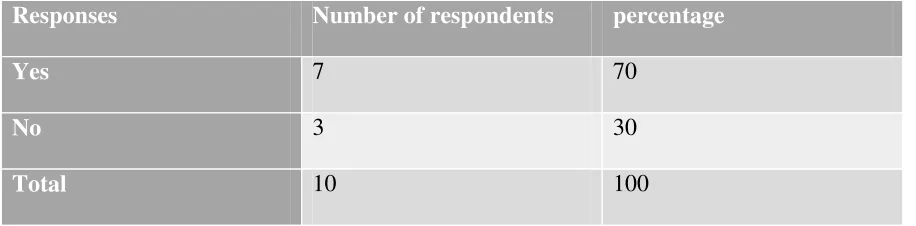
According to the table below, 70% of the respondents think that using grouping to teach in
[image:19.595.66.524.372.485.2]the large class helps in solving the problem such a class presents, but 30% disagree.
Table 2: do you think putting students into smaller groups in teaching can help address the
problem of large class?
Responses Number of respondents percentage
Yes 7 70
No 3 30
Total 10 100
On the question of benefits of group method of teaching the respondent gave the following as
the main advantages of group method of teaching
Students’ creativity is unearthed and developed
It reinforces students understanding about a concept taught since in their groups they
share problems and the good students help the dull ones.
It gives every student the opportunity to participate in the lesson, and practice what is
being taught. They therefore have a sense of belonging
It provides a platform the students to assess themselves and one another.
4.3 After all these pre-intervention activities had been done, the researcher
implemented the intervention.
4.3.1 Interventions
Discussion technique
Demonstration technique
Group method of teaching
4.3.2 Intervention implementation
According to Walter Bledge (1986), teaching for acquisition of skills, attitudes, and values is
very complex. The learning is done by practice, involving series of activities. The learning
takes place effectively only if one tries to find the solution himself or herself. Therefore, to
achieve learning in the category of skills, it is recommended to use the project and activity
based methods of teaching. Since accounting concerns skill acquisition, the best method that
offers the students opportunity to practice must be used in its presentation. This becomes very
difficult when the class size is huge.
According to Farrant, (2002) grouping is an appropriate means of dealing with practical
lessons. In view of this the researcher, put the students into two forms of grouping. In the first
category, students were grouped according to similar ability, thus similar intellectual
capabilities. In the other category, they were put into mixed ability grouping; that is brilliants
were mixed with the dull ones.
During classes, the researcher introduced the lesson and then discussed the concepts with the
were therefore asked to move into their groups. Students were given task/problem to discuss
and find solutions to them. Here the good students helped the weaker ones to get the concepts
very well, that is, when mixed ability grouping is used. Where there was a problem beyond
all the members of the group, the researcher’s attention was drawn for further explanation
and clarification. The researcher also moved round to direct and guide those with peculiar
problems.
Where a task/problem was very difficult, the similar ability grouping was used. This was
done so that students would be tasked according to their abilities. This was done so that slow
learners were given opportunity to move at their own pace without hindering the progress of
the brilliants.
Students were given time frame within which to solve a problem or task. When the time
elapses, they reform the class. A group was then called to present its report. The one to
present the report was selected by the researcher. The selection was done randomly. This was
done so that few students would not dominate the groups and also every group member
would fully participate in the group’s work as well as prepare himself or herself for a
presentation. Based on the group’s performance, marks were awarded to the members of the
group. Because of this, group leaders made sure that each member was well vest in the
problem and its solution so that should he or she is chosen, she or he would do his/her best
for the group. After presentation the groups were subjected to questioning by the class.
35 50 65 45 60 85 0 10 20 30 40 50 60 70 80 90
below average average above average
Students' performance
pre-intervention stage post-intervention stage
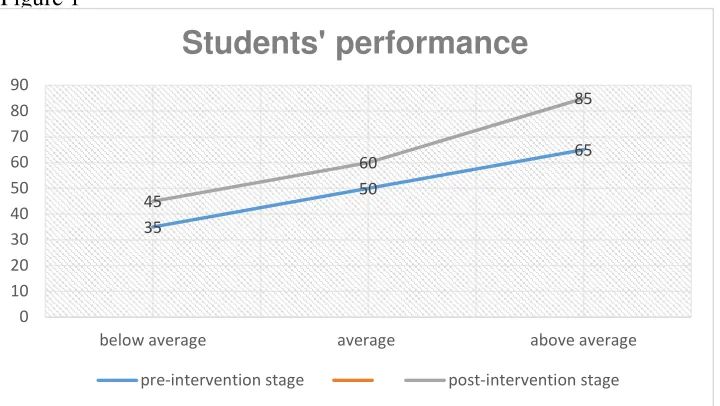
Pre-intervention and post-intervention performance
[image:22.595.66.426.463.666.2]Source: Field Survey Figure 1
Individual assessments were also conducted intermittently to monitor the progress of the
interventions and deviations were corrected. This brought a healthy competition among the
groups and individuals in the class.
4.4 Post-intervention stage
After the intervention had been implemented for a whole term (four Months), an assessment
was made to find out whether the intervention had worked. The assessment was conducted
using class test, class exercises, project work and post-intervention questionnaires.
The assessment revealed amazing facts. There was dramatic improvement in the students’
performance. When compared students’ performance of pre-intervention with
post-intervention performance, statistics showed that there had been tremendous improvement in
65%
98%
35%
2%
PRE-INTERVENTION STAGE POST-INTERVENTION STAGE Participated Not participated
Students' participation in class exercises and assignments
[image:23.595.96.457.187.410.2]Source: Field Survey Figure 2.
The class exercises and assignments conducted after the intervention revealed that students’
participation in these exercises had increased from 65% to 98%. Before this intervention,
only 65% on the average participated in these exercises. This shows that students were
motivated through the intervention used. This is evidenced in figure two below.
The questionnaire administered during post-intervention stage showed that all the 60 students
sampled for the study, had gain high interest in financial accounting. The researcher believes
that this had been so due to the innovative method used in teaching the financial accounting
in such a large class. This is shown in table three below.
Table 3: Students interest in Financial Accounting
Source: Field Survey
Responses Number of respondents Percentage
Yes 60 100%
No 0 0%
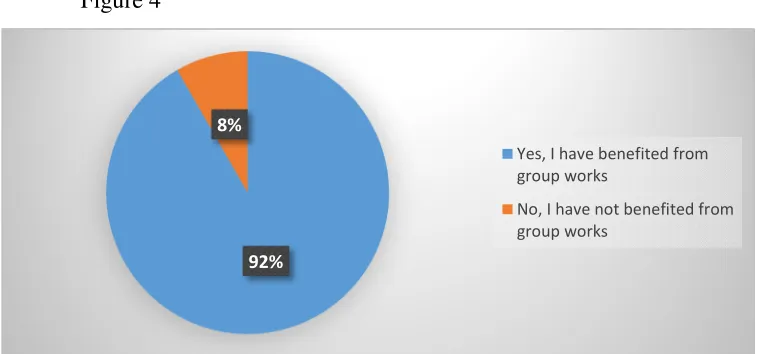
[image:23.595.63.525.607.721.2]92% 8%
Yes, I have benefited from group works
[image:24.595.79.459.599.776.2]No, I have not benefited from group works
Figure 4
Whether respondents benefited from group method of teaching or not
Source: Field Survey
On the question of students’ perception about the subject before they came to school, 68% of
the respondents said they were told the subject was very difficult. 28% were of the
knowledge that it was not difficult subject while 4% had no knowledge at all about the
subject. However, at close of the action research, 90% of the respondents came into
realization that the subject was not difficult as perceived. This is showed in figure three
below.
Perception about financial accounting before enrolling in the course
Source: Field Survey
Figure four below indicate that 55 respondents representing 92% said they had benefited
from group method of teaching used while 5 respondents representing 8% did not see any
benefit the group method brought to them. 68%
28%
4% The subject is difficult
The subject is not difficult
No knowledge about the subject
When students were asked to give the benefits they derived from group method of teaching,
they listed the following:
It reinforces understanding of what was taught by the teacher
It promotes self-confidence
It has corrected misconception about financial accounting
It offers the opportunity to develop the skill taught in class
It offers the opportunity for one to express one’s self
It gives the chance to ask questions bordering one’s mind
It encourages one to give of his or her best.
In addition, to the above, majority of the students interviewed, after the intervention said that
the method was good and should continue and if possible used in the teaching of other
subjects.
The researcher strongly believes that the change in attitude and improvement in the students’
performance was as a result of the innovative approach to the teaching of financial
accounting in that large class.
5.0 Reflections, summary of findings, conclusions and recommendations
5.1 Reflection
The reasons given by teachers and school authorities for high enrolment leading to large class
sizes cannot be over emphasised. Education is a right not a privilege therefore no one should
be deprived of such right. Every Ghanaian should be given the opportunity to develop his or
In the absence of infrastructural expansion and increased staff strength, as pertained in
Ghanaian schools, classes are likely to be large, in terms of number of students in a class. To
make teaching and learning effective under the situation, an innovative approach to teaching
must be adopted, hence the use of Group Method of Teaching so that even though classes are
large, teaching is not slaughtered on the altar of comprise.
5.2 Findings
Analysis of data revealed that the school in question has a high enrolment leading to large
classes (number of students in a class). The following were identified as causes for the high
enrolment in the school: the school’s vicinity is densely populated, the school has good moral
and academic reputation and the school has not received any infrastructural expansions over
the years.
It also came to light that the large classes are not without problems as far as teaching and
learning are concerned.
The problems of large class sizes affect teaching and learning negatively. Some of the
negative impacts on teaching and learning that came up during the study include: learner’s
creativity is stifled; evaluation system becomes less valid and effective- weakness and
strength of both teachers and students are not revealed; the aims and goals of the school and
The study further revealed that putting students into smaller groups as a method of teaching
financial accounting is the appropriate way of addressing the problem of large class sizes. As
to how effectively the group method of teaching can be used, the following issues came up;
Adequate preparation and planning be made by the teacher and the students
Suitable arrangement of furniture with enough space between groups should be
provided.
Good class management and control must be exercised
Clear instructions to students as to what to do and when to do them must be
observed.
Arousing students’ interest in the task and implementing appropriate rewarding
schemes
Students are put into mixed ability grouping for the dull to learn from the brilliants
Ability grouping are also used to allow student learn at their own pace
Enough time is given for students to finish a given task
Group works not limited to classroom work but also include project work and
assignments
Proper monitor is done so that the brilliant and extroverted students do not dominate
the group.
Feedback on groups’ performance is made on time in order to motivate all group
members to give of their best towards group achievement
Every student should be made to believe that he or she has a potential which is
needed to achieve a group’s goal.
From the study, group method of teaching when effectively used offers students the chance to
practice what they are taught in class; develop the creative skills in them; reinforces students’
self-confidence, self-expression, leadership skills, tolerance, which are essential for individual
development and nation building.
Finally, it came to light that the students appreciated the method and attest that the method
was good and even appealed that is it extended to the teaching of other subjects.
Even though the researcher was the first to use the method extensively in his lesson
presentations, the method is being used informally by some students in their private studies.
5.3 Conclusion
The sensitization programme educated the students on many issues they were ignorant of. It
also motivated, arouse and sustained their interest in the subject as well as correcting the
misconception they held about the subject.
The group method, though is time consuming (in terms of planning) and demanding (in
relation to supervision and control) is the best way of making impact on large class.
The method brought healthy competition and helped students to develop themselves. The
enthusiasm students put into learning accounting put other masters on their toes by bringing
in lots of innovation into their teaching.
5.4 Recommendations
Since the number of students cannot be reduced because doing so means depriving some
used in lesson presentation. By so doing teachers are going to make impact and students
would benefit fully from their services.
The method is demanding therefore teachers should be motivated through incentive schemes
in order to devote some private time towards the success of teaching and learning.
There should be regular fora to sensitize students about the importance of education as well
as the best ways of studies to arouse and sustain their interest.
Reward schemes should be instituted to motivate students and teachers to give of their best. It
is also recommended that parents seek for extra tuition for their wards to augment what the
teachers do in the classroom. Also enough time should be allocated for practical subjects
when drawing time table.
Finally the government as well as the community should expand the schools’ facilities, more
especially the classrooms and train more teachers and also making the teaching profession
REFERENCE
Achilles, C.M., "Class Size: New Research, Beyond STAR, Is Needed," 2008.
Anamua-Mensah, J et al (2005), Meeting the challenges of education in the twenty first
century: Report of the President’s Committee on Review of Education Reforms in
Ghana, Adwinsa publications (Gh), Accra-Ghana, p. 61-70
Angmor, C. et al (1999), Mate Masie: Journal of the University College of Education,
Winneba, Sakoa Ltd. Accra-Ghana, p. 123-129
Bledge, W. (1986), Teaching for development, Sedco publishing Ltd. Accra, Ghana
Bonney E., NAGRAT Worried About Large Class Size, Daily Graphic, 25 August 2011,
accessed 15th Feb. 2014
Chait, R., "Ineffective Uses of Elementary and Secondary Education Act Title II Funds,"
2009.
Dorko, K., Sparks, S.D., "Setting Class-Size Limits" (Interactive Map), Education Week,
2010
Ehrenberg R.G. et al, (2011), Class size and student achievement, Psychological Science in
the Public Interest, www.sagepub.com/journals/Journal20196, accessed 15th Feb., 2014
Farrant, J.S. (2002), Principles and practice of education, new edition, Longman groups, U.K
Ltd. United Kingdom
Hou,W.J. (1999), Class size and determinants of learning effectiveness, Microfiche, U.S.A.,
P. 225-230
Imenda, S.N. et al (2004), Educational management, administration and leadership, SAGE
Kyriacou, C. (1995), Effective teaching in schools, Stanly Thomas publishers Ltd. United
Kingdom, P. 33-35
Ornstein, A.C. and Lasley II, J.J. (2000), Strategies for effective teaching, the Palmer press,
Philadelphia, USA
Schiming R. C. (2013), Class Size, https://www.mnsu.edu/cetl/teachingresource
Sprinthall, A.N. and Sprinthall C.R. (1990), Educational psychology: A developmental
approach, Von Haffmann press, Inc. New York, P. 491-492.
Zainul-Deen B.D., (2011), An assessment of Ghana’s policy on quality education in the
public Senior High Schools: a case study at Ahafo Ano North and South Districts,