http://www.scirp.org/journal/jhrss ISSN Online: 2328-4870
ISSN Print: 2328-4862
Pathology of Barriers to Sharing Knowledge in
Project Management and Ranking Them by
AHP Method
Ebrahim Kalani
1,2, Ehsan Kamrani
31Department of Industrial Engineering, Tarbiat Modarres University, Tehran, Iran
2Department of Industrial Engineering, Khatam Al-Anbiya University, Tehran, Iran 3Institute of Medical Science and Technologies, Shahid Beheshti University, Tehran, Iran
Abstract
Although knowledge management is a necessary part of strategic development of organizations, resources and improvement in competition, since it is always seen just as a temporary solution, most of related experiences have faced fail-ure. Moreover since projects are mostly temporary and after they are done some of the main team members leave the company, this means the know-ledge goes with them so this will cost future projects more money and time. In the present study we will try to find the main barriers for knowledge trans-mission and to rank them by statistical method of Analytic Hierarchy Process (AHP). In the end it comes to conclusion that despite the existence of the Project Management Body of Knowledge (PMBOK), it has been overlooked. The main barriers are the lack of organizational culture of preserving and sharing the knowledge and lack of trust and appreciation for using it throughout the company.
Keywords
Project Management, Knowledge Management, Knowledge Transmission in Project Management
1. Introduction
Through analyzing the importance of the role of knowledge in organizations, it is inevitably concluded that the accessibility to latest information and knowledge is vital to their survival. Particularly in this age of rapid changes and uncertainty, constant validation of the knowledge and information in the process of produc-tion and services is necessary and also vital [1].
How to cite this paper: Kalani, E. and Kamrani, E. (2017) Pathology of Barriers to Sharing Knowledge in Project Management and Ranking Them by AHP Method. Jour-nal of Human Resource and Sustainability Studies, 5, 68-74.
https://doi.org/10.4236/jhrss.2017.51007
Received: November 13, 2016 Accepted: March 11, 2017 Published: March 14, 2017
Copyright © 2017 by authors and Scientific Research Publishing Inc. This work is licensed under the Creative Commons Attribution International License (CC BY 4.0).
Knowledge management is to explore the procedure of turning the individual and organizational data into individual and group skills so as to form an envi-ronment to share, transfer and counterfeit of knowledge between the members, because if this procedure is done correctly, it can improve company’s perfor-mance [2].
In most project based organizations [3] [4], their passing effect makes their memory very short so they will soon forget the valuable experiences and lessons. In these types of organizations knowledge assets are not made use of and this will cost more time and money each time. Organizations are made to survive and last for a long time but projects are just temporary and this opposition will be harmful to the company, so here, knowledge management will come to pic-ture to use the knowledge, information and experiences derived from these teams, as efficiently as possible as to avoid future losses.
The rest of this paper is organized as follow: in Section 2 the main knowledge sharing barriers (KSBs) have been introduced and the individual, organizational and technological KSBs have been explained respectively. The proposed research methodology applied in this work and the results have been presented and dis-cussed in Section 3. Finally, Section 4 provides some final conclusions and direc-tions for future work.
2. Knowledge Sharing Barriers
The most important barriers in transferring and sharing the knowledge, include: 1) Individual knowledge sharing barriers,
2) Organizational knowledge sharing barriers, 3) Technological knowledge sharing barriers.
These barriers have been discussed in more detail in [5]. According to the views of researchers, 10 items out of 27 have been used in order to be ranked by Analytic Hierarchy Process (AHP) method.
Due to the high volume of data caused a long processing-time, after consulting with several experts in the field (from both academy and industry), and active pioneer companies in the value engineering, the list was shorted from 36 to 10. This shortened list covered the most recommended factor, used in this study.
The main individual knowledge sharing barriers could be due to the lack of time to share knowledge or to identify colleagues that require a specific know-ledge, lack of trust, fear of sharing, experience level differences, poor or ineffi-cient communication, miscommunication, age barriers, differences in culture and social backgrounds, etc.
The main organizational knowledge sharing barriers also could be due to the poor leadership and management, lack of transparency, poor internal and/or external competitiveness, business scale, etc.
3. Proposed Research Methodology, Results and Discussion
The scope of this research is pathology, identification and ranking of the barriers which prevent knowledge from being transferred in projects with help of Ana-lytic hierarchy process. In evaluating every subject, we are going to need a benchmark. A suitable benchmark can help us in the process of comparing be-tween the alternatives. Although when we have different benchmarks, the process is going to be complicated and take a lot of time. In this process a simple evaluation tool is not going to be enough and there will be need for analytic hie-rarchy process in which we can compare different alternatives with different background.The process includes four main steps as follow: 1) First step: forming hierarchy tree;
2) Second step: allocation of benchmark index and weighing the alternatives; 3) Third step: adding up the benchmark’s indexes and alternatives weights; 4) Fourth step: compatibility test.
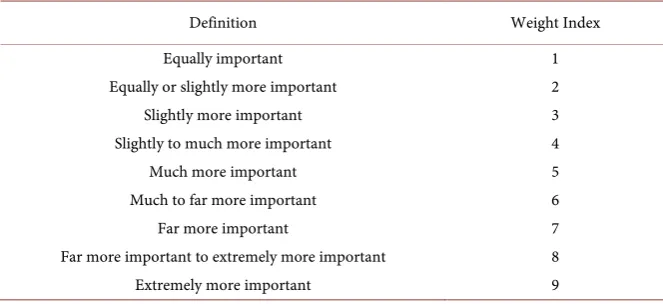
In AHP method benchmarks weight will be appointed by comparing two by two based on Table 1.
In present study, the following criterions are determined as the most impor-tant barriers to the sharing of knowledge.
• Apprehension of fear that sharing may reduce or jeopardize people’s job
se-curity;
• External competitiveness within business units or functional areas and
be-tween subsidiaries can be high (e.g. not invented here syndrome);
• Lack of leadership and managerial direction in terms of clearly
communicat-ing the benefits and values of knowledge sharcommunicat-ing practices;
• Existing corporate culture does not provide sufficient support for sharing
practices;
• Insufficient capture, evaluation, feedback, communication, and tolerance of
past mistakes that would enhance individual and organizational learning ef-fects;
• Differences in education levels;
• Not keeping skillful and experienced employee;
• Lack of transparent rewards and recognition systems that would motivate
people to share more of their knowledge;
• Gender differences;
• Not welcoming new ideas, shortage of formal and informal spaces to share,
reflect and generate (new) knowledge.
For pairwise comparison of above criterion, a questionnaire of 50 questions, includes five general questions and 45 questions based on the binary compara-tive barriers. The questionnaire was formed and distributed among nine well- experienced project managers. These people were selected among academic members from the faculties of Industrial Engineering and management with PhD degree in project management or knowledge management.
Table 1. Pairwise comparison (Saaty’s AHP).
Definition Weight Index
Equally important 1
Equally or slightly more important 2 Slightly more important 3 Slightly to much more important 4
Much more important 5
Much to far more important 6
Far more important 7
Far more important to extremely more important 8 Extremely more important 9
preference weights, even though from specialists. This could be due to this fact that different specialists may have different preferences. So a sensitivity analysis was performed on the preference weights to provide measures for assessing the sensitivity due to changes in these weights. The performed sensitivity analysis was based on the work presented in [6] [7] [8].
After collection of the questionnaires, each question’s weighted mean is ga-thered and the following matrix is formed.
The questionnaire has been prepared based on AHP [9] [10] and it is in Per-sian due to the comfort of the participants who all spoken PerPer-sian as their first language.
The five general questions covered: 1) Level of the education,
2) Field of study, 3) Field of activity,
4) Duration of experience on civil affairs operation, 5) Address and the name of the organization (optional).
The forty-five 45 binary comparative barrier questions covered the following issues:
1) The barriers to implement and use of the value engineering, 2) The importance of culture and enthusiasm/intention, 3) The importance of teamwork and optimization, 4) The team expertise/qualification impact,
5) The importance of level of risk ability and creativity, 6) The intention of creativity,
7) The employer’s adaptability and the government role, 8) Time allocation,
9) The impact of knowledge on value engineering, 10) The lack of expertise,
11) Etc.
total of its column in order to calculate the normalized matrix of pairwise com-parison, in the end geometric mean of each line in the normalized pairwise comparison matrix is calculated (Table 3).
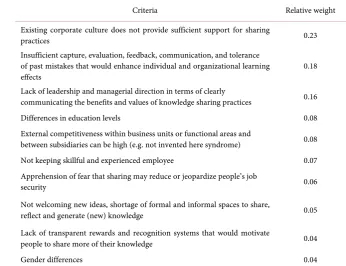
As seen in Table 4, absence of culture of supporting sharing the knowledge is the most important barrier.
Calculating consistency ratio:
Now raises the question of how trusted this hierarchy is. To answer this ques-tion, consistency ratio is used. When ratio is 1≥ ⋅C R, the ranking can be
trusted.
Consistency ratio is calculated by the following formula:
(
)
max 1 1
1 n
i Aw w
n
λ =
∑
(1)max 1 N
λ = (2)
(
max) (
)
. 1
[image:5.595.207.540.344.520.2]C I= λ − ⋅ −n n (3)
Table 2. Criterion weightmatrix (similar to [11]).
criterion m1 m2 m3 m4 m5 m6 m7 m8 m9 m10 m1 1.00 5.00 3.00 1.00 2.00 4.00 5.00 5.00 3.00 4.00 m2 0.20 1.00 0.50 0.25 0.25 0.50 1.00 1.00 0.50 1.00 m3 0.33 2.00 1.00 0.50 0.50 1.00 2.00 2.00 1.00 1.00 m4 1.00 4.00 2.00 1.00 1.00 3.00 5.00 4.00 2.00 3.00 m5 0.50 4.00 2.00 1.00 1.00 3.00 4.00 4.00 2.00 3.00 m6 0.25 2.00 1.00 0.33 0.33 1.00 2.00 1.00 1.00 1.00 m7 0.20 1.00 0.50 0.20 0.25 0.50 1.00 1.00 0.33 1.00 m8 0.20 1.00 0.50 0.25 0.25 1.00 1.00 1.00 0.50 1.00 m9 0.33 2.00 1.00 0.50 0.50 1.00 3.00 2.00 1.00 1.00 m10 0.25 1.00 1.00 0.33 0.33 1.00 1.00 1.00 1.00 1.00
Table 3. The normalized matrix (similar to [11]).
[image:5.595.207.540.552.731.2]Table 4. Final ranking of criterion.
Criteria Relative weight
Existing corporate culture does not provide sufficient support for sharing
practices 0.23
Insufficient capture, evaluation, feedback, communication, and tolerance of past mistakes that would enhance individual and organizational learning
effects 0.18
Lack of leadership and managerial direction in terms of clearly
communicating the benefits and values of knowledge sharing practices 0.16 Differences in education levels 0.08 External competitiveness within business units or functional areas and
between subsidiaries can be high (e.g. not invented here syndrome) 0.08 Not keeping skillful and experienced employee 0.07 Apprehension of fear that sharing may reduce or jeopardize people’s job
security 0.06
Not welcoming new ideas, shortage of formal and informal spaces to share,
reflect and generate (new) knowledge 0.05 Lack of transparent rewards and recognition systems that would motivate
people to share more of their knowledge 0.04
Gender differences 0.04
Table 5. Random consistency index.
n 1 2 3 4 5 6 7 8 9 10 11 12 13 14 15 R.I 0 0.2 .6 1.1 1.11 1.26 1.3 1.4 1.45 1.5 1.55 1.58 1.6 1.67 1.7
Random index: if the values in a matrix are acquired by random, then (n) is chosen from the Table 5 of random index.
Based on the results, it has been observed that:
1≥CR (4)
So the results are reliable and can be trusted.
4. Conclusion
Absence of culture of supporting sharing the knowledge is the most important barrier to sharing knowledge in accomplishing projects. Considering Table 5, elimination of these barriers can be done with regard to their priority. With eli-mination of these barriers organizations can save both time and money. Other benefits derived, are as follows: application of past experiences, preventing from future possible errors, motivating innovation and creativity in present projects and mental preparation of employees and engineers of future projects.
Acknowledgements
References
[1] Ajmal, M.M. and Koskinen, K.U. (2008) Knowledge Transfer in Project-Based Or-ganizations: An Organizational Culture Perspective. Project Management Journal, 39, 7-15. https://doi.org/10.1002/pmj.20031
[2] Bou-Llusar, J.C. and Segarra-Ciprés, M. (2006) Strategic Knowledge Transfer and Its Implications for Competitive Advantage: An Integrative Conceptual Framework. Journal of Knowledge Management, 10,100-112.
https://doi.org/10.1108/13673270610679390
[3] Matlay, H., Butler, A., Le Grice, P. and Reed, M. (2006) Delimiting Knowledge Transfer from Training. Education and Training, 48, 627-641.
https://doi.org/10.1108/00400910610710056
[4] Chi, Y.-L. and Chen, C.-Y. (2009) Project Teaming: Knowledge-Intensive Design for Composing Team Members. Expert Systems with Applications, 36, 9479-9487.
https://doi.org/10.1016/j.eswa.2008.12.015
[5] Dale, S. (2011) 36 Knowledge Sharing Barriers.
http://www.stephendale.com/2011/10/26/36-knowledge-sharing-barriers/ [6] Gao, L. and Hailu, A. (2012) Ranking Management Strategies with Complex
Out-comes: An AHP-Fuzzy Evaluation of Recreational Fishing Using an Integrated Agent-Based Model of a Coral Reef Ecosystem. Environmental Modelling & Soft-ware, 31, 3-18. https://doi.org/10.1016/j.envsoft.2011.12.002
[7] Gao, L. and Hailu, A. (2013) Identifying Preferred Management Options: An Inte-grated Agent-Based Recreational Fishing Simulation Model with an AHP-TOPSIS Evaluation Method. Ecological Modelling, 249, 75-83.
https://doi.org/10.1016/j.ecolmodel.2012.07.002
[8] Zhang, X., Gao, L., Barrett, D. and Chen, Y. (2014) Evaluating Water Management Practice for Sustainable Mining. Water, 6, 414-433.
https://doi.org/10.3390/w6020414
[9] Saaty, T.L. (2000) Fundamentals of Decision Making and Priority Theory with the Analytic Hierarchy Process (Analytic Hierarchy Process Series, Vol. 6). RWS Publi-cations, Pittsburgh.
[10] Saaty, T.L. and Vargas, L.G. (2012) Models, Methods, Concepts & Applications of the Analytic Hierarchy Process. Springer Science & Business Media, New York.
https://doi.org/10.1007/978-1-4614-3597-6
Submit or recommend next manuscript to SCIRP and we will provide best service for you:
Accepting pre-submission inquiries through Email, Facebook, LinkedIn, Twitter, etc. A wide selection of journals (inclusive of 9 subjects, more than 200 journals)
Providing 24-hour high-quality service User-friendly online submission system Fair and swift peer-review system
Efficient typesetting and proofreading procedure
Display of the result of downloads and visits, as well as the number of cited articles Maximum dissemination of your research work
![Table 2. Criterion weightmatrix (similar to [11]).](https://thumb-us.123doks.com/thumbv2/123dok_us/7776504.719594/5.595.207.540.552.731/table-criterion-weightmatrix-similar-to.webp)