Munich Personal RePEc Archive
Correlation between Islamic stock and
Commodity markets: An investigation
into the impact of financial crisis and
financialization of commodity markets
Khan, Aftab and Masih, Mansur
INCEIF, 15th Malaysian Finance Association Conference, June 3 -5,
2013, Kuala Lumpur, Malaysia
29 June 2014
Online at
https://mpra.ub.uni-muenchen.de/56979/
1 | P a g e
Correlation between Islamic stock and Commodity markets: An investigation into the
impact of financial crisis and financialization of commodity markets
Aftab Khan1 and Mansur Masih2
Abstract
The repercussions of the recent financial crisis were felt over different parts of the world causing much calamity to different markets, economies and investors. The capital markets, in particular, took a severe hit during the crisis plummeting to all-time lows. However, before the crisis, the significant rise in commodity prices since 2002 and their subsequent fall since July 2008 have revived the debate on the role of commodities in the strategic and tactical asset allocation process. Therefore, the understanding of relationship between commodities and stock markets is crucial, especially during the crisis, when investors are looking for alternative investment opportunities. In this paper, we focus on commodity markets and their relation with Islamic stock markets during the recent financial crisis. This is the first attempt to study this relationship in the important and growing area of Islamic capital markets with the help of the recent dynamic conditional correlation (DCC) GARCH methodology. The focus of the study is to look into the dynamics of the correlations between both markets, and analyze whether those time-varying correlations evolve according to the situation—bullish or bearish—in the stock market. This paper investigates the links between price returns for 5 commodity sectors and Islamic stock market over the period from January 2001 to March 2013, by paying a particular attention to the Energy sector. We show that the correlations between commodity and Islamic stock markets evolve through time and are highly volatile, particularly since the 2007-2008 financial crises. The latter has played a key role, emphasizing the links between Islamic stock and commodity markets, and underlining the financialization of commodity markets. At the idiosyncratic level, a speculation phenomenon is highlighted for energy sector (oil), while the safe-haven role of precious metal sector (gold) is evidenced.
Keywords: Islamic Capital Market, Commodity Market, Financial Crisis, Multivariate GARCH
Dynamic Conditional Correlations.
1
1
Corresponding Author-Aftab Khan is a research assistant at INCEIF. Currently, he is pursuing a PhD in Islamic Finance at INCEIF, Malaysia. Phone: +60162644561 Email: [email protected]
2
2 | P a g e
1.0 INTRODUCTION
Islamic banking and finance has mushroomed into an increasingly substantial segment of the
global financial market leading to the crystallization of the Islamic stock market, in particular, as
a viable alternative to its conventional counterpart. It is in the wake of the global economic
meltdown that Islamic finance has been put in the limelight as a force to be reckoned with.
With Muslim societies becoming more sophisticated and their financing needs more complex,
coupled with stagnating Islamic thought evolution, there comes a need to strengthen the
current Islamic financial system, in particular the equity market. The wider acceptance of equity
investments by Shariah scholars in the early 1990s paved the way for the launch of equity
markets compliment with the teachings of Islam.
Further, the establishment of credible equity benchmarks such as Dow Jones Islamic Market
Index (DJI) and FTSE Global Islamic Index Series has been a turning point for the industry,
providing a comparative platform between indices.
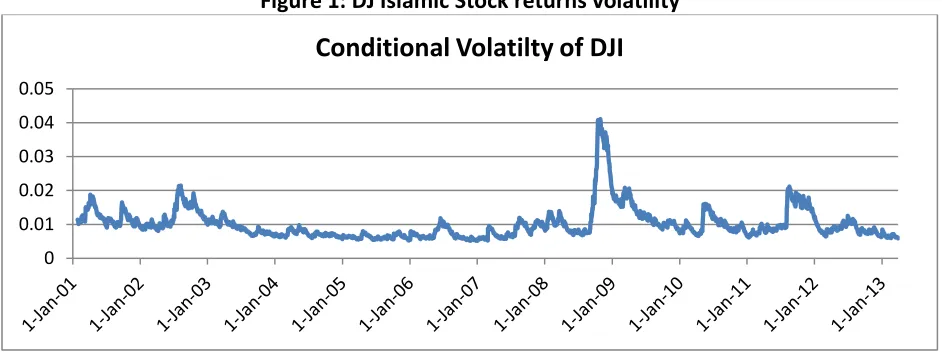
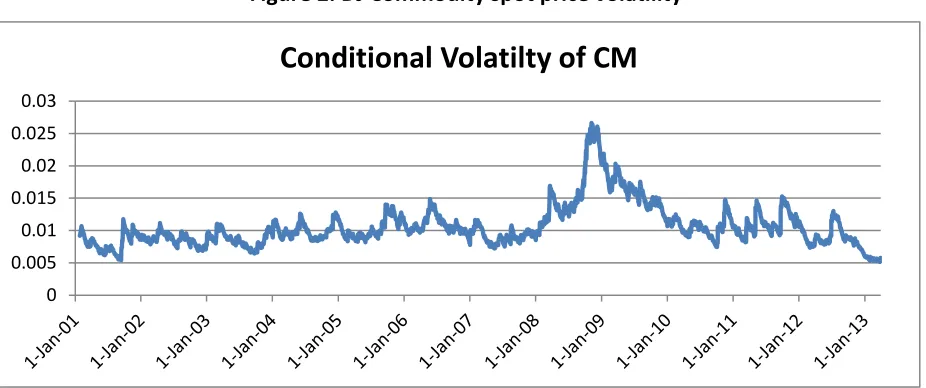
Throughout the last decade, commodity prices experienced an exceptional volatility, with
simultaneous and alternating phases of rising and falling trends. This evolution can be
compared to that of Islamic financial markets, as illustrated by Figures 1 and 2 representing the
[image:3.612.71.542.503.679.2]Dow Jones Islamic Index and Dow Jones Commodity spot price returns’ volatility.
Figure 1: DJ Islamic Stock returns volatility
0 0.01 0.02 0.03 0.04 0.05
3 | P a g e
Figure 2: DJ Commodity spot price volatility
As shown in Figure 3—which displays the dynamics of the DJ Islamic and DJ Commodity spot
price indexes—commodity prices have experienced a drop during the 2007-2008 financial crisis,
and their link to the Islamic stock prices seems to have strengthened since that turmoil. At the
same time, commodities increasingly become part of portfolio allocation, together with stock
classes.
Figure 3: Dynamics of DJ Islamic Price Index and DJ UBS Spot Commodity Index
0
0.005 0.01 0.015 0.02 0.025 0.03
4 | P a g e
At a macroeconomic level, policymakers pay a particular attention to commodity prices and
their volatility given their potential to feed inflation pressures. Volatility of commodity prices is
thus a central issue for the world economy.
Moreover, analyzing the links between commodity and Islamic capital markets is of particular
interest for financial players as raw materials enter many investment portfolios, together with
stock classes (Dwyer et al., 2011; Vivian and Wohar, 2012). Furthermore, as documented by
Choi and Hammoudeh (2010), commodity traders concurrently look at both stock and
commodity markets fluctuations to infer the trend of each market. Comparing the dynamic
volatility of raw materials and Islamic equity prices provides useful information about possible
substitution strategies between commodity and stock classes. In particular, volatility plays a key
role regarding hedging possibilities, and impacts asset allocation across raw materials and their
risk-return trade-off.
Building on the observed links between commodity and stock markets, a recent literature has
emerged regarding the impact of investors’ behavior in explaining the increase in both level and
volatility of commodity prices. But , as underlined by Vivian and Wohar (2012), no clear-cut
conclusion has been reached so far. However, the relationship between commodities and
Islamic stock markets is still an unchartered area and to the authors’ knowledge there is no
research so far done in this area.
In this paper, we humbly try to contribute to the emerging empirical literature dealing with the
relationships between commodity and Islamic stock markets. More specifically, the focus is on
the dynamics of the correlations between both markets, and analyze whether those
correlations evolve according to the situation—bullish or bearish—in the stock market. We pay
a particular attention to the recent 2007-2008 financial crisis by investigating whether it has
strengthened or disrupted the links between Islamic stock and commodity markets. From a
methodological viewpoint, we follow the dynamic conditional correlation (DCC) GARCH
approach which allows to assess the changes in correlations between commodity and stock
returns over time. The sample for research consists of 6 different sector commodity spot price
5 | P a g e
allows us to study whether commodities constitute an homogenous asset class with regard to
their links with Islamic stock markets, and whether the crisis has caused the financialization of
commodity markets.
The results show that correlations between commodity and Islamic stock markets are
time-varying and highly volatile. The impact of the 2007-2008 financial crisis is noticeable and even
the impact of recent US debt-ceiling crisis can be observed. It emphasizes the links between
commodity and Islamic stock markets, and highlights the financialization of commodity markets.
We also show that, while sharing some common features, commodities cannot be considered a
homogeneous asset class: a speculation phenomenon is for instance highlighted for energy
sector comprising oil, while the safe-haven role of gold is evidenced, which constitutes a part of
precious metal sector.
The rest of the paper is organized as follows. Section 2 briefly reviews the literature about the
links between commodity and stock markets. Section 3 presents the data and methodology,
and Section 4 shows empirical results and discussion, and Section 6 concludes the paper.
2.0 LITERATURE REVIEW
As documented in the introduction, commodity markets share several characteristics with stock
markets and financial assets. So far the literature has analyzed this phenomenon mainly by
focusing on conventional stock markets, and looking at the co-movements between
conventional stock and oil markets. Most of this literature offers substantial evidence on the
impact of oil on stock prices, putting forward a negative relationship between oil price and
stock market returns. For instance, Jones and Kaul (1996), using a standard cash-flow dividend
valuation model, find a significant negative impact of oil price shocks on US and Canadian
quarterly stock prices in the postwar period. Several models, relying on some variants of Vector
Autoregressive analysis (VAR), highlight similar findings. Park and Ratti (2008), performing a
multivariate VAR analysis, find statistically significant impact of oil prices shocks on real stock
6 | P a g e
Sadorsky (1999) investigates relationships among monthly oil prices, S&P 500 conventional
stock returns, short-term interest rate, and industrial production for the January 1947-April
1996 period by means of an unrestricted VAR model. The author shows that oil prices and oil
price volatility both play important roles in affecting S&P 500 stock returns. Papapetrou (2001)
estimates a vector error-correction model on monthly data for Greece from January 1989 to
June 1999, and concludes that oil prices drive stock price dynamics.
Shifting from the study of co-movements to volatility analysis, the most recent literature
focuses on volatility spillovers between oil/industrial commodity and conventional stock
markets. Hammoudeh et al. (2004) investigate the spillover effects, day effects, and dynamic
relationships among five daily S&P oil sector stock indices and five daily oil prices for the US oil
markets from July 17, 1995 to October 10, 2001 using co-integration techniques as well as
ARCH-type models. They evidence volatility spillovers from the oil futures market on the stocks
of some oil sectors. They also find an oil volatility transmission day effect, Friday having a
calming effect on the volatility of oil stocks. Chiou and Lee (2009) examine the asymmetric
effects of WTI daily oil prices on S&P 500 stock returns from January 1, 1992 to November 7,
2006, by investigating structure changes in this dependency relationship. Using the
Autoregressive Conditional Jump Intensity model with expected, unexpected and negative
unexpected oil price fluctuations, they find that high fluctuations in oil prices have asymmetric
unexpected effects on stock returns. Malik and Ewing (2009) rely on bivariate GARCH models to
estimate the volatility transmission between weekly WTI oil prices and equity sector returns
from January 1, 1992 to April 30, 2008 and find evidence of spillover mechanisms. Focusing on
the Brent market, Filis et al. (2011) analyze time-varying correlations between oil prices and
stock markets by differentiating importing (USA, Germany, and the Netherlands) and
oil-exporting (Canada, Mexico, and Brazil) countries. Using the multivariate DCC-GARCH approach
from January 1988 to September 2009, they find that the conditional variances of oil and stock
prices do not differ for oil-importing and oil-exporting economies. However, time-varying
correlations depend on the origin of the oil shocks: the response from aggregate demand-side
shocks is much greater than supply-side shocks originated by OPEC’s production cuts. Finally,
7 | P a g e
commodity prices of Brent oil, WTI oil, copper, gold and silver, and the S&P 500 index from
January 2, 1990 to May 1, 2006. They show that commodity correlations have increased since
2003, limiting hedging substitutability in portfolios.
Keeping in view the lack of literature, especially on Islamic stock indices, this study explores the
relationship between different commodities spot indices and Islamic stock indices. I consider 5
different commodity sectors indices, traded in the US: Energy, Precious metals, Agricultural,
Non-ferrous metals and Softs. The study allows to compare the behavior of each sector spot
index with Islamic stock market fluctuations, and to study whether correlations between
commodities and Islamic equities evolve over time and depend on the situation—bearish or
bullish—on the stock market.
3.0 DATA AND METHODOLOGY
The empirical study portion of this research is a multi-step process, where we attempt to
sequentially analyze the data starting from simple descriptive statistical numeric. The crux of
our model attempts to study the volatility of commodity sector spot indices and Islamic equity
index. All the commodity and stock indices used for the empirical study have been taken from
the Dow Jones Indices family.
We consider daily spot price series extracted from DataStream for the different sector
commodities over the January 3, 2001 - March 28, 2013 period. We investigate 5 different
commodities sectors: energy, precious metals, agricultural, non-ferrous metals and softs spot
index. All price series are quoted in US dollars. An aggregate commodity price index, the DJ Spot
commodity Index, is also considered. Regarding the equity market, we rely on Dow Jones
8 | P a g e
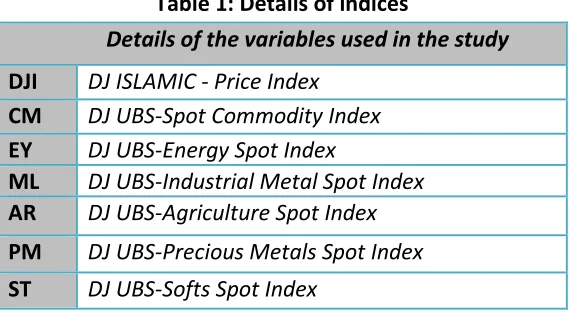
Table 1: Details of indices
Details of the variables used in the study
DJI DJ ISLAMIC - Price Index CM DJ UBS-Spot Commodity Index EY DJ UBS-Energy Spot Index
ML DJ UBS-Industrial Metal Spot Index AR DJ UBS-Agriculture Spot Index
PM DJ UBS-Precious Metals Spot Index
ST DJ UBS-Softs Spot Index
To investigate the time evolution of correlations between the stock and commodity markets,
we rely on the dynamic conditional correlation (DCC) GARCH models. To address the research
objective, we have used Multivariate Generalized Autoregressive Conditional Heteroscedastic
(MGARCH) model. Initially we test the variables on both Normal and t-distribution to determine
which distribution is a better fit to the set of variables. To have a cursory glance at the founding
basis for our research objective, regarding whether correlations between commodities and
Islamic equities evolve over time and depend on the situation, the empirical results of
unconditional correlations coefficients will suffice.
However, to address the research objective in specific, we utilize MGARCH DCC. The DCC model
allows us to observe and analyze the precise timings of shifts in conditional correlation.
Estimation of DCC is a two-step process to simplify estimation of time varying correlations. In
first stage, using GARCH model for each variable, univariate volatility parameters are estimated.
In stage two, for the time varying correlations matrix, residuals from first stage are used as
inputs for estimation. For sake of brevity, we omit details of mathematical derivations and the
9 | P a g e
4.0 EMPIRICAL EVIDENCE
4.1 DESCRIPTIVE STATISTICS
The descriptive statistics for the daily returns of the 6 commodity spot price indices and DJ
Islamic stock index, in our study provides interesting insights as represented by the standard
deviations.
Table 2: Descriptive Statistics
DJI CM EY ML AR PM ST
Mean 6.96E-05 0.000374 0.000284 0.000279 0.000372 0.000565 0.000315
Std. Dev. 0.011086 0.011149 0.020113 0.015753 0.012688 0.013486 0.013833
Skewness -0.294426 -0.238584 -0.166490 -0.281619 -0.215939 -0.399456 -0.193535
Kurtosis 10.36142 5.398383 5.293964 6.500042 6.189263 8.432199 6.458300
The energy commodities (EY) seem to differ from other commodities in terms of volatility: the
standard deviation (0.02) is much higher than the other commodity indices and even the DJ
Islamic stock index. Together with high volatility, the group of energy and metal sector exhibits
low returns on average, leading to the lowest benefit-risk trade off compared to the DJ Islamic
and the other commodity indexes. However agriculture (AR), soft (ST) and precious Metal (ML)
sector commodities are more profitable on the return-risk basis. However, DJ Islamic stock
index is highly volatile as it has a significantly higher kurtosis value (10.36).
4.2 UNCONDITIONAL VOLATILITY AND UNCONDITIONAL CORRELATION
As a first step towards estimating dynamic conditional correlations and volatilities we first take
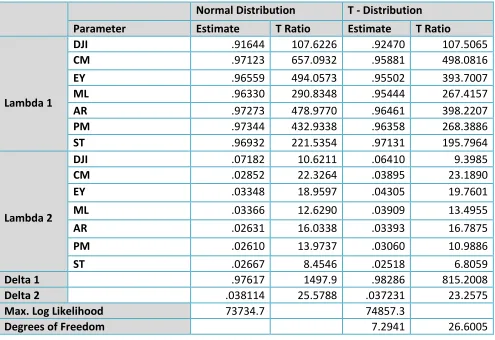
a look at the summarized results of maximum likelihood estimates of λ1 and λ2 in the table 3.
The table also summarizes the delta 1 and delta 2 estimates while comparing multivariate
normal distribution with multivariate student t-distribution. From results it is evident that all
estimates are highly significant implying gradual volatility decay for all indices. Also, if we
10 | P a g e
summation is less than one, pointing that the indices are not following IGARCH; which means
that shocks to the volatility is not permanent.
It is observed from the results that the maximized log-likelihood value for t-distribution 74857.3
is larger than the maximized log likelihood under normal distribution 73734.7. This implies that
the student t-distribution is a more appropriate representation of the fat tailed nature of
indices’ returns. These findings are in agreement with findings of Pesaran & Pesaran (2009). To further substantiate this we observe the degrees of freedom which is 7.2941, well below the
[image:11.612.60.555.287.627.2]critical level of 30. Henceforth our analysis of the study works with the t-distribution estimates.
Table 3: Estimates of λ1 and λ2 and Delta
Normal Distribution T - Distribution
Parameter Estimate T Ratio Estimate T Ratio
Lambda 1
DJI .91644 107.6226 .92470 107.5065
CM .97123 657.0932 .95881 498.0816
EY .96559 494.0573 .95502 393.7007
ML .96330 290.8348 .95444 267.4157
AR .97273 478.9770 .96461 398.2207
PM .97344 432.9338 .96358 268.3886
ST .96932 221.5354 .97131 195.7964
Lambda 2
DJI .07182 10.6211 .06410 9.3985
CM .02852 22.3264 .03895 23.1890
EY .03348 18.9597 .04305 19.7601
ML .03366 12.6290 .03909 13.4955
AR .02631 16.0338 .03393 16.7875
PM .02610 13.9737 .03060 10.9886
ST .02667 8.4546 .02518 6.8059
Delta 1 .97617 1497.9 .98286 815.2008
Delta 2 .038114 25.5788 .037231 23.2575
Max. Log Likelihood 73734.7 74857.3
Degrees of Freedom 7.2941 26.6005
Table 4 presents the unconditional correlation and volatility matrix for the 5 different DJ sector
commodity spot indices, DJ main commodity spot index and DJ Islamic stock index, within our
11 | P a g e
unconditional volatiles. The estimated unconditional volatilities are the diagonal elements
highlight and in bold while off diagonal elements represent unconditional correlations.
Table 4: Estimated Unconditional Volatility & Correlation matrix for the indices
DJI CM EY ML AR PM ST
DJI .011087 .42951 .29003 .43183 .31344 .18634 .28082
CM .42951 .011166 .83480 .62281 .68718 .49636 .50551
EY .29003 .83480 .02009 1
.30642 .34158 .26178 .27160
ML .43183 .62281 .30642 .015772 .35116 .38096 .30371
AR .31344 .68718 .34158 .35116 .0127235 .31772 .64910
PM .18634 .49636 .26178 .38096 .31772 .013534 .28204
ST .28082 .50551 .27160 .30371 .64910 .28204 .013843
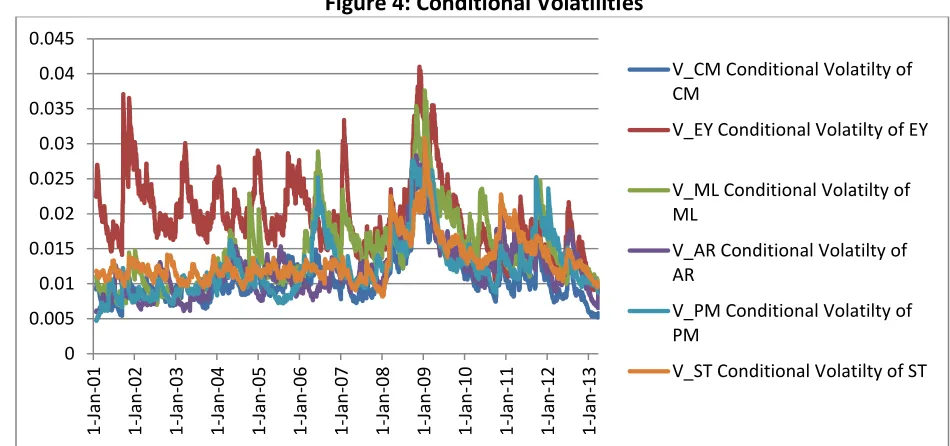
A perfunctory glance at the unconditional volatility numbers shows the highest volatility for the
Energy sector index (EY) (also shown in the figure 4), as expected and is similar to our earlier
observation in the descriptive statistics. Now this high volatility in the energy sector is from oil
and gas. The crude oil prices during the past decades have shown a tremendous increase,
translating into windfall gains for the oil companies, the movement of oil prices has been erratic.
The main volatility in oil prices arises from the speculative trading as well as geo political issues.
This erratic behavior and high volatility in oil prices, directly impacts the returns and stock
12 | P a g e
Figure 4: Conditional Volatilities
The second most volatile sector is metal (ML). The sharp increase in prices of metals is known
to be driven by an upsurge in demand for these commodities from newly industrializing
emerging economies, in particular, from the two most rapidly growing economies in the South -
China and India - due to intensive use of these raw materials for their industrialization drive,
physical infrastructure building and urbanization trends. However, a dramatic fall was reported
for a number of metal prices such as nickel, zinc and copper due to immediate and impending
reduction in world demand, notably, a drastic deterioration in global prospects for construction
and automobile industries.
To assess the evolution of correlations between Islamic stock and commodity markets over
time, figures 5 report the dynamic conditional correlations between each commodity sector
and the DJ Islamic returns series. The links between markets during periods of financial stress
are clearly underlined. The grey bands correspond to periods of bearish stock market, the white
stripes corresponding to periods of bullish stock market. It shows that investment in Islamic
equities constitutes an alternative to commodities, providing a mechanism for substitution
between asset classes. Although there are some specific features for each sector of commodity
market some common characteristics emerge. 0 0.005 0.01 0.015 0.02 0.025 0.03 0.035 0.04 0.045 1-Jan -01 1-Jan -02 1-Jan -03 1-Jan -04 1-Jan -05 1-Jan -06 1-Jan -07 1-Jan -08 1-Jan -09 1-Jan -10 1-Jan -11 1-Jan -12 1-Jan -13
V_CM Conditional Volatilty of CM
V_EY Conditional Volatilty of EY
V_ML Conditional Volatilty of ML
V_AR Conditional Volatilty of AR
V_PM Conditional Volatilty of PM
13 | P a g e
-0.6 -0.4 -0.2
0 0.2 0.4 0.6 0.8 1
1-Jan-01 1-Jan-02 1-Jan-03 1-Jan-04 1-Jan-05 1-Jan-06 1-Jan-07 1-Jan-08 1-Jan-09 1-Jan-10 1-Jan-11 1-Jan-12 Co n d iti on a l Co rr e la ti on b e twe e n CM & D JI
-0.6 -0.4 -0.2
0 0.2 0.4 0.6 0.8 1
1-Jan-01 1-Jan-02 1-Jan-03 1-Jan-04 1-Jan-05 1-Jan-06 1-Jan-07 1-Jan-08 1-Jan-09 1-Jan-10 1-Jan-11 1-Jan-12 Co n d iti on a l Co rr e la ti on b e twe e n EY & D JI
-0.8 -0.6 -0.4 -0.2
0 0.2 0.4 0.6 0.8 1
1-Jan-01 1-Jan-02 1-Jan-03 1-Jan-04 1-Jan-05 1-Jan-06 1-Jan-07 1-Jan-08 1-Jan-09 1-Jan-10 1-Jan-11 1-Jan-12 1-Jan-13 Co n d iti on a l Co rr e la ti on b e twe e n PM & D JI -0.4 -0.2
0 0.2 0.4 0.6 0.8 1
1-Jan-01 1-Jan-02 1-Jan-03 1-Jan-04 1-Jan-05 1-Jan-06 1-Jan-07 1-Jan-08 1-Jan-09 1-Jan-10 1-Jan-11 1-Jan-12 Co n d iti on a l Co rr e la ti on b e twe e n ML & D JI -0.4 -0.2
0 0.2 0.4 0.6 0.8
1-Jan-01 1-Jan-02 1-Jan-03 1-Jan-04 1-Jan-05 1-Jan-06 1-Jan-07 1-Jan-08 1-Jan-09 1-Jan-10 1-Jan-11 1-Jan-12 Co n d iti on a l Co rr e la ti on b e twe e n A R & D JI -0.4 -0.2
0 0.2 0.4 0.6 0.8
14 | P a g e
First, correlations are highly volatile throughout the period. For many raw materials, this
volatility is particularly marked after the 2007-2008 financial crises. In all cases, there is an
increase in volatility during and following the crisis. Second, in most cases, the largest drop in
the correlations appears at the time of the 2008 financial crisis. The stock market collapse has
loosened the conditional links between stock and commodity price returns, but only in the very
short run. This decrease in correlations during times of high financial markets stress may be
linked to a flight-to-quality phenomenon. When risk market rises, the benefits of diversification
are most appreciated and investors tend to choose commodities as refuge instruments. This
short-run characteristic could thus explain the temporary disrupted link between both markets.
Third, for almost all of the series, the highest correlations are observed after the crisis, at the
end of the period under study. Both DJ Islamic stock index and commodity markets move
upward during episodes of growing world demand for industrial commodities, giving an
important role to commercial traders who use commodity futures to hedge their business
activities. On the whole, the 2007-2008 financial crises has caused significant changes in the
relationship between Islamic stock index and commodity markets, as well as increased
correlation in the volatility. Regarding the long-run trends, correlations are likely to be
governed by industrialization and financialization processes, as well as by commercial and
non-commercial traders.
Let us now look more specifically at the different types of commodity sectors, starting by the
energy group (EY), which consists of Oil, Gas and Electricity. First, Oil is clearly the most related
to Islamic stock market. This predominance of oil may be due to the fact that it is one of the
most important production factors. From a theoretical viewpoint, the fundamental value of any
asset is given by its expected discounted cash flows. Consequently, an oil price increase will
generate a rise in production costs, leading to restraining profits and, in turn, to reduction in
shareholders’ value. In times of rising stock prices, the correlations between stock and oil markets increase. During periods of declining stock prices, correlations tend to decrease and
become negative during the 2007-2008 crises and 2011 debt-ceiling crisis, as shown in the
15 | P a g e
phenomenon, the increase in crude prices being prominent in times of rising stock market.
From this perspective, oil cannot be seen as a means of portfolio diversification.
Turning to the precious metals group, which mainly includes; gold, platinum and silver,
correlations are mostly negative and diminish in times of declining Islamic stock prices,
highlighting adverse evolution in the markets. This is consistent with a safe-haven role of gold.
Regarding the other groups, two main findings can be highlighted: (i) volatility evolves over
time, being quite stable before the 2007-2008 crisis, then getting stable till 2011 debt-ceiling
crisis and becoming relatively high during the US debt-ceiling turmoil, and (ii) correlations tend
to rise during the crisis, showing increased links between Islamic stock and commodity markets.
On the whole, our results show that the 2007-2008 crises have played a key role in the
evolution of the links between Islamic capital and commodity markets. Indeed, higher
correlations between both markets are generally observed during the financial turmoil,
reflecting the phenomenon of financialization of commodity markets.
This phenomenon is particularly noticeable for energy sector including oil, a result which is
consistent with the fact that oil is the most financiarized commodity. In addition, our findings
show that raw materials cannot be aggregated in an homogeneous asset class: they are
certainly influenced by common macroeconomic factors but also by their own market
determinants.
5.0 CONCLUSION
This paper investigates the links between commodity and Islamic stock markets. We rely on the
dynamic conditional correlation (DCC) GARCH methodology to establish whether the
correlations between both markets evolve over time and depend on the situation—bearish or
bullish—on the stock market.
The main findings can be summarized as follows. In the panel of 6 commodities sectors over the
16 | P a g e
commodity sectors and DJ Islamic stock returns evolve through time, being highly volatile,
particularly since the 2007-2008 financial crises. While the stock market collapse has loosened
the links between both markets on the very short run, the highest correlations are observed
during the financial turmoil, showing increased links between stock and commodity markets.
Second, some commodities are characterized by a speculation phenomenon, especially oil in
the energy sector, while their correlations with DJ Islamic returns grow in times of increasing
stock prices, they diminish in times of bearish financial markets. Third, the safe-haven role of
gold is evidenced, which constitutes a part of precious metal commodity. As the precious metal
commodities correlations with DJ Islamic returns are mostly negative and diminish in times of
declining stock prices. Fourth, while sharing some common features, commodities cannot be
considered as an homogeneous asset class.
On the whole, our findings show that the 2007-2008 financial crises has played a key role,
emphasizing the links between commodity and Islamic capital markets, and highlighting the
financialization of commodity markets. This evolution in Islamic stock and commodity
correlations reduces their potential substitutability in portfolios. At the idiosyncratic level, the
main exceptions is gold for which risk management strategies are possible, with increased risk
diversification allowed by their adverse evolution compared to the stock market in times of
declining equity prices.
REFRENCES
Baur, D.G., McDermott, T.K. (2010), “Is gold a safe haven? International evidence”,
Journal of Banking and Finance 34(8), 1886-1898.
Buyuk¸sahin, B., Harris, J.H. (2011), “Do speculators drive crude oil futures prices?” The
Energy Journal 32(2), 167-202.
Capelle-Blancard, G., Coulibaly, D. (2011), “Index trading and agricultural commodity
17 | P a g e
Chiou, J.S., Lee, Y.H. (2009), “Jump dynamics and volatility: Oil and the stock markets”,
Energy 34(6), 788-796.
Choi, K., Hammoudeh, S. (2010), “Volatility behavior of oil, industrial commodity and
stock markets in a regime-switching environment”, Energy Policy 38(8), 4388-4399.
Doyle, E., Hill, J., Jack, I. (2007), “Growth in commodity investment: risk and challenges for commodity market participants”, Financial Services Authority (FSA) Report, FSA
Markets Infrastructure Department.
Du, X., Yu, C.L., Hayes, D.J. (2011), “Speculation and volatility spillover in the crude oil
and agricultural commodity markets: A Bayesian analysis”, Energy Economics 33,
497-503.
Dwyer, A., Gardner, G., Williams, T. (2011), “Global commodity markets—Price volatility
and financialisation”, Reserve Bank of Australia Bulletin, June.
Engle, R.F. (2002), “Dynamic Conditional Correlation - A Simple Class of Multivariate GARCH Models”, Journal of Business and Economic Statistics 20(3), 339-350.
Filis, G., Degiannakis, S., Floros, C. (2011), “Dynamic correlation between stock market
and oil prices: The case of oil-importing and oil-exporting countries”, International
Review of Financial Analysis 20(3), 152-164.
Hammoudeh, S., Dibooglu, S., Aleisa, E. (2004), “Relationships among U.S. oil prices and oil industry equity indices”, International Review of Economics and Finance 13(4), 427-453.
Jones, C.M., Kaul, G. (1996), Oil and the stock markets, Journal of Finance 51, 463-491.
18 | P a g e
Manera, M., Nicolini, M., Vignati, I. (2012), “Returns in commodities futures markets and financial speculation: A multivariate GARCH approach”, Fondazione Eni Enrico
Mattei, 23.2012.
Papapetrou, E. (2001), “Oil price shocks, stock market, economic activity and employment in Greece”, Energy Economics 23(5), 511-532.
Park, J., Ratti, R.A. (2008), “Oil Price Shocks and Stock Markets in the U.S. and 13 European Countries”, Energy Economics 30, 2587-2608.
Pesaran, B., and Pesaran, M.H. (2009), “Time Series Econometrics using Microfit 5.0”,
Oxford: Oxford University Press.
Sadorsky, P. (1999), “Oil price shocks and stock market activity”, Energy Economics 21,
449-469.
Vivian, A.,Wohar, M.E. (2012), “Commodity volatility breaks”, Journal of International