organic papers
o104
Andrew Duthieet al. C14H10N2O2 DOI: 101107/S1600536801000198 Acta Cryst.(2001). E57, o104±o105 Acta Crystallographica Section EStructure Reports
Online
ISSN 1600-5368
(1,3-Benzo[
d
]dioxol-5-yl)(2-pyridyl)methyl cyanide
Andrew Duthie,aPeter
Scammells,aAndrew Katsifisb
and Edward R. T. Tiekinkc*
aCentre for Chiral and Molecular Technologies,
Deakin University, Geelong, Victoria 3217, Australia,bRadiopharmaceuticals, ANSTO,
Private Bag 1, Menai, NSW 2234, Australia, and
cDepartment of Chemistry, The University of
Adelaide, Australia 5005
Correspondence e-mail: [email protected]
Key indicators Single-crystal X-ray study T= 173 K
Mean(C±C) = 0.002 AÊ Rfactor = 0.039 wRfactor = 0.139
Data-to-parameter ratio = 15.7
For details of how these key indicators were automatically derived from the article, see http://journals.iucr.org/e.
#2001 International Union of Crystallography Printed in Great Britain ± all rights reserved
In the title compound, C14H10N2O2, the dihedral angle formed
between the substituted pyridine ring and 1,3-benzodioxole group is 67.73 (6). The crystal features chains of molecules
held together by alternating and CÐH interactions.
Comment
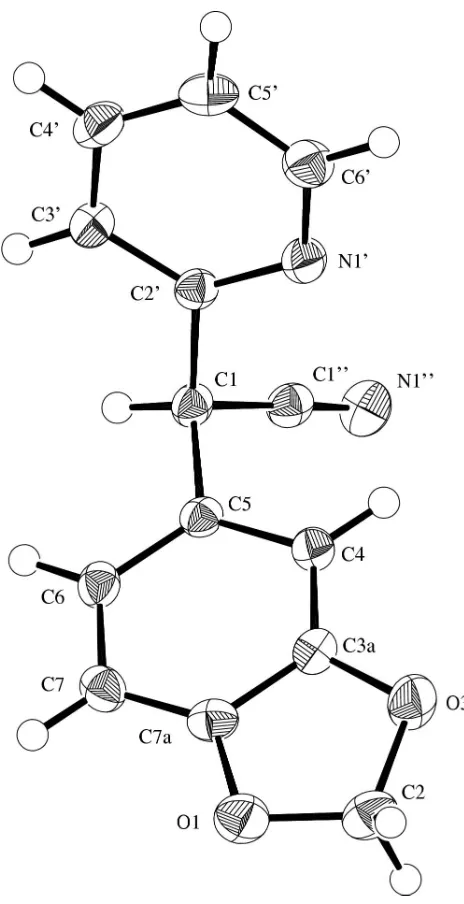
The title compound, (I), is an intermediate in the synthesis of potential cocaine antagonists. It was prepared by a nucleo-philic substitution reaction involving 2-bromopyridine and 1,3-benzodioxol-5-ylmethyl cyanide. The mean deviation of the atoms from the 1,3-benzodioxo group is 0.054 AÊ with the major deviation of 0.100 (2) AÊ associated with C2. The dihe-dral angle between this plane and that through the pyridyl group is 67.73 (6). Molecules associate in the crystal to form
chains held by alternating and CÐH interactions. Centrosymmetrically (1ÿx, 1ÿy, ÿz) related 1,3-benzo-dioxole groups are aligned so as to place the six-membered rings in close proximity. The distance separating the ring centroids is calculated to be 3.584 (2) AÊ (Spek, 1990). These pairs are capped on each sides by a symmetry related H50atom
(ÿx,ÿy,ÿz) which forms an interaction of the type CÐH with the C3a±C7a aromatic ring so that the H ring centroid separation is 2.73 AÊ and the angle at H50is 157.
Experimental
To a stirred suspension of 1.12 g (46.5 mmol) of NaH in dry THF (30 ml) under dry argon gas was added a solution of 5.00 g (161.2 mmol) of 3,4-(methylenedioxy)phenylacetonitrile and 4.90 g (31.0 mmol) of 2-bromopyridine in dry THF (30 ml). The mixture was stirred at room temperature for 1 h and then at re¯ux overnight. After cooling, the THF was removed and water (50 ml) added while cooling in an ice bath. The aqueous layer was extracted with 3
50 ml of EtOAc and the combined organic layer washed with water
and then extracted with 430 ml of 6MHCl solution. The combined aqueous layer was adjusted to pH 11 with 15% NaOH and extracted with 350 ml EtOAc. The organic layer was washed with water, dried over Na2SO4, ®ltered and the solvent removed in vacuo.
Column chromatography with EtOAc±hexane (1:4) gave 5.83 g (79%) of the title compound as a pale yellow powder with m.p. 338± 340 K.1H NMR (CDCl
3)5.22 (1H,s), 5.94 (2H,s), 6.78 (1H,d), 6.87
(1H,d), 6.91 (1H,dd), 7.24 (1H,ddd), 7.36 (1H,d), 7.69 (1H,ddd), 8.59 (1H,ddd).13C NMR (CDCl
3)44.9, 101.4, 108.1, 108.6, 119.0,
121.2, 121.8, 123.0, 128.2, 137.5, 147.7, 148.3, 149.9, 155.4. Analysis calculated for C14H10N2O2(238.24): C 70.58, H 4.23%; found: C 70.80,
H 4.20%. ES±MS [M+ H]+= 239.1. Crystals were obtained from the
slow evaporation of a CDCl3solution of the compound.
Crystal data
C14H10N2O2
Mr= 238.25 Triclinic,P1
a= 8.851 (2) AÊ
b= 11.435 (4) AÊ
c= 5.831 (1) AÊ = 94.42 (2) = 92.79 (2) = 107.65 (2)
V= 559.1 (3) AÊ3
Z= 2
Dx= 1.415 Mg mÿ3 MoKradiation Cell parameters from 25
re¯ections = 8.0±30.0 = 0.10 mmÿ1
T= 173 K Block, colourless 0.480.480.11 mm
Data collection
Rigaku AFC-7Rdiffractometer !±2scans
2731 measured re¯ections 2564 independent re¯ections 1911 re¯ections withI> 2(I)
Rint= 0.05
max= 27.5
h=ÿ11!11
k=ÿ14!14
l= 0!7
3 standard re¯ections every 400 re¯ections intensity decay: 0.2%
Re®nement
Re®nement onF2
R(F) = 0.039
wR(F2) = 0.139
S= 1.05 2564 re¯ections 163 parameters
H-atom parameters not re®ned
w= 1/[2(F
o2) + (0.1P)2] whereP= (Fo2+ 2Fc2)/3 (/)max< 0.001
max= 0.25 e AÊÿ3
min=ÿ0.25 e AÊÿ3
Data collection: MSC/AFC Diffractometer Control Software
(Molecular Structure Corporation, 1996); cell re®nement:MSC/AFC Diffractometer Control Software; data reduction: TEXSAN (Mole-cular Structure Corporation, 1997±1999); program(s) used to solve structure:SIR97 (Altomareet al., 1994); program(s) used to re®ne structure: SHELXL97 (Sheldrick, 1997); software used to prepare material for publication:TEXSAN.
The Australian Research Council is thanked for support.
References
Altomare, A., Cascarano, G., Giacovazzo, C., Guagliardi, A., Burla, M. C., Polidori, G. & Camalli, M. (1994).J. Appl. Cryst.27, 435.
Johnson, C. K. (1976).ORTEPII. Report ORNL-5138. Oak Ridge National Laboratory, Tennessee, USA.
Molecular Structure Corporation (1996).MSC/AFC Diffractometer Control Software.MSC, 3200 Research Forest Drive, The Woodlands, TX 77381, USA.
Molecular Structure Corporation (1997±1999). TEXSAN for Windows. Version 1.05. MSC, 3200 Research Forest Drive, The Woodlands, TX 77381, USA.
Sheldrick, G. M. (1997).SHELXL97. University of GoÈttingen, Germany. Spek, A. L. (1990).Acta Cryst.A46, C-34.
Figure 1
supporting information
sup-1
Acta Cryst. (2001). E57, o104–o105
supporting information
Acta Cryst. (2001). E57, o104–o105 [doi:10.1107/S1600536801000198]
(1,3-Benzo[
d
]dioxol-5-yl)(2-pyridyl)methyl cyanide
Andrew Duthie, Peter Scammells, Andrew Katsifis and Edward R. T. Tiekink
S1. Comment
The title compound, (I), is an intermediate in the synthesis of potential cocaine antagonists. It was prepared by a nucleophilic substitution reaction involving 2-bromopyridine and 1,3-benzodioxo-5-ylmethyl cyanide. The mean deviation of the atoms from the 1,3-benzodioxo group is 0.054 Å with the major deviation of 0.100 (2) Å associated with C2. The dihedral angle between this plane and that through the pyridyl group is 67.73 (6)°. Molecules associate in the crystal to form chains held by alternating π···π and C—H···π interactions. Centrosymmetrically (1 - x, 1 - y, -z) related 1,3-benzodioxo groups are aligned so as to place the six-membered rings in close proximity. The distance separating the ring centroids is calculated to be 3.584 (2) Å (Spek, 1990). These pairs are capped on each sides by a symmetry related H5′ atom (-x, -y, -z) which -forms an interaction of the type C–H···π with the C3a–C7a aromatic ring so that the H···ring centroid separation is 2.73 Å and the angle at H5′ is 157°.
S2. Experimental
To a stirred suspension of 1.12 g (46.5 mmol) of NaH in dry THF (30 ml) under dry argon gas was added a solution of 5.00 g (161.2 mmol) of 3,4-(methylenedioxy)phenylacetonitrile and 4.90 g (31.0 mmol) of 2-bromopyridine in dry THF (30 ml). The mixture was stirred at room temperature for 1 h and then at reflux overnight. After cooling, the THF was removed and water (50 ml) added while cooling in an ice bath. The aqueous layer was extracted with 3 × 50 ml of EtOAc and the combined organic layer washed with water and then extracted with 4 × 30 ml of 6M HCl solution. The combined aqueous layer was adjusted to pH 11 with 15% NaOH and extracted with 3 × 50 ml EtOAc. The organic layer was washed with water, dried over Na2SO4, filtered and the solvent removed in vacuo. Column chromatography with EtOAc–
hexane (1:4) gave 5.83 g (79%) of the title compound as a pale yellow powder with m.p. 338–340 K. 1H NMR (CDCl 3) δ
5.22 (1H, s), 5.94 (2H, s), 6.78 (1H, d), 6.87 (1H, d), 6.91 (1H, dd), 7.24 (1H, ddd), 7.36 (1H, d), 7.69 (1H, ddd), 8.59 (1H, ddd). 13C NMR (CDCl
3) δ 44.9, 101.4, 108.1, 108.6, 119.0, 121.2, 121.8, 123.0, 128.2, 137.5, 147.7, 148.3, 149.9,
155.4. Analysis calculated for C14H10N2O2 (238.24): C 70.58, H 4.23%; found: C 70.80, H 4.20%. ES—MS [M + H]+ =
Figure 1
The molecular structure of (I). Displacement ellipsoids are shown at the 50% probability level (Johnson, 1976).
(I)
Crystal data
C14H10N2O2
Mr = 238.25
Triclinic, P1
a = 8.851 (2) Å
b = 11.435 (4) Å
c = 5.831 (1) Å
α = 94.42 (2)°
β = 92.79 (2)°
γ = 107.65 (2)°
Z = 2
F(000) = 248
Dx = 1.415 Mg m−3
Mo Kα radiation, λ = 0.7107 Å Cell parameters from 25 reflections
θ = 8.0–30.0°
µ = 0.10 mm−1
supporting information
sup-3
Acta Cryst. (2001). E57, o104–o105 Data collection
Rigaku AFC-7R diffractometer
Radiation source: rotating anode Graphite monochromator
ω–2θ scans
2731 measured reflections 2564 independent reflections 1911 reflections with I > 2σ(I)
Rint = 0.050
θmax = 27.5°, θmin = 3.5°
h = −11→11
k = −14→14
l = 0→7
3 standard reflections every 400 reflections intensity decay: 0.2%
Refinement
Refinement on F2
Least-squares matrix: full
R[F2 > 2σ(F2)] = 0.039
wR(F2) = 0.139
S = 1.05 2564 reflections 163 parameters 0 restraints
Primary atom site location: structure-invariant direct methods
Secondary atom site location: difference Fourier map
Hydrogen site location: inferred from neighbouring sites
H-atom parameters not refined
w = 1/[σ2(F
o2) + (0.1P)2]
where P = (Fo2 + 2Fc2)/3
(Δ/σ)max < 0.001
Δρmax = 0.25 e Å−3
Δρmin = −0.25 e Å−3
Special details
Geometry. All e.s.d.'s (except the e.s.d. in the dihedral angle between two l.s. planes) are estimated using the full covariance matrix. The cell e.s.d.'s are taken into account individually in the estimation of e.s.d.'s in distances, angles and torsion angles; correlations between e.s.d.'s in cell parameters are only used when they are defined by crystal symmetry. An approximate (isotropic) treatment of cell e.s.d.'s is used for estimating e.s.d.'s involving l.s. planes.
Refinement. Refinement of F2 against ALL reflections. The weighted R-factor wR and goodness of fit S are based on F2,
conventional R-factors R are based on F, with F set to zero for negative F2. The threshold expression of F2 > σ(F2) is used
only for calculating R-factors(gt) etc. and is not relevant to the choice of reflections for refinement. R-factors based on F2
are statistically about twice as large as those based on F, and R- factors based on ALL data will be even larger.
Fractional atomic coordinates and isotropic or equivalent isotropic displacement parameters (Å2)
x y z Uiso*/Ueq
O1 0.19247 (14) 0.58173 (10) −0.00247 (19) 0.0375 (3) O3 0.13809 (14) 0.46384 (10) −0.35548 (18) 0.0386 (3) N1′ 0.19430 (14) 0.02168 (11) −0.2951 (2) 0.0296 (3) N1′′ 0.57051 (15) 0.18918 (12) −0.4895 (2) 0.0350 (3) C1 0.42803 (15) 0.17724 (11) −0.1053 (2) 0.0238 (3)
H1 0.5083 0.1830 0.0252 0.029*
C1′′ 0.50785 (15) 0.18228 (12) −0.3225 (2) 0.0266 (3) C2 0.13269 (19) 0.57686 (13) −0.2365 (3) 0.0343 (3) H2A 0.1986 0.6481 −0.3105 0.041* H2B 0.0220 0.5799 −0.2420 0.041* C2′ 0.29507 (15) 0.05452 (11) −0.1064 (2) 0.0229 (3) C3′ 0.27971 (17) −0.01189 (12) 0.0840 (2) 0.0282 (3)
H3′ 0.3547 0.0149 0.2142 0.034*
C3A 0.22371 (16) 0.41604 (12) −0.2071 (2) 0.0258 (3) C4 0.27607 (15) 0.31587 (12) −0.2512 (2) 0.0248 (3)
C4′ 0.15207 (18) −0.11859 (13) 0.0801 (3) 0.0323 (3) H4′ 0.1385 −0.1670 0.2073 0.039* C5 0.36395 (15) 0.28657 (11) −0.0692 (2) 0.0226 (3) C5′ 0.04548 (17) −0.15317 (12) −0.1110 (3) 0.0319 (3) H5′ −0.0438 −0.2252 −0.1174 0.038* C6′ 0.07089 (17) −0.08098 (13) −0.2933 (3) 0.0328 (3) H6′ −0.0032 −0.1054 −0.4247 0.039* C6 0.39230 (16) 0.35490 (12) 0.1439 (2) 0.0261 (3)
H6 0.4504 0.3322 0.2648 0.031*
C7 0.33715 (17) 0.45677 (13) 0.1851 (2) 0.0284 (3)
H7 0.3560 0.5035 0.3313 0.034*
C7A 0.25502 (16) 0.48561 (12) 0.0046 (2) 0.0267 (3)
Atomic displacement parameters (Å2)
U11 U22 U33 U12 U13 U23
O1 0.0475 (7) 0.0333 (6) 0.0375 (6) 0.0211 (5) 0.0073 (5) 0.0013 (4) O3 0.0516 (7) 0.0420 (6) 0.0327 (6) 0.0311 (5) −0.0017 (5) 0.0033 (5) N1′ 0.0298 (6) 0.0271 (6) 0.0291 (6) 0.0053 (5) −0.0047 (5) 0.0044 (5) N1′′ 0.0326 (7) 0.0406 (7) 0.0346 (7) 0.0136 (6) 0.0054 (5) 0.0087 (5) C1 0.0228 (6) 0.0243 (6) 0.0246 (6) 0.0074 (5) −0.0010 (5) 0.0048 (5) C1′′ 0.0234 (6) 0.0256 (6) 0.0317 (7) 0.0089 (5) −0.0015 (5) 0.0052 (5) C2 0.0374 (8) 0.0318 (7) 0.0392 (8) 0.0168 (6) 0.0094 (6) 0.0086 (6) C2′ 0.0229 (6) 0.0222 (6) 0.0254 (6) 0.0097 (5) 0.0013 (5) 0.0029 (5) C3′ 0.0316 (7) 0.0272 (7) 0.0270 (7) 0.0105 (6) 0.0013 (5) 0.0053 (5) C3A 0.0249 (6) 0.0274 (6) 0.0261 (6) 0.0086 (5) 0.0026 (5) 0.0063 (5) C4 0.0252 (6) 0.0249 (6) 0.0238 (6) 0.0071 (5) 0.0008 (5) 0.0022 (5) C4′ 0.0385 (8) 0.0285 (7) 0.0332 (7) 0.0122 (6) 0.0100 (6) 0.0109 (6) C5 0.0201 (6) 0.0208 (6) 0.0253 (6) 0.0031 (5) 0.0017 (5) 0.0050 (5) C5′ 0.0265 (7) 0.0227 (6) 0.0457 (9) 0.0054 (5) 0.0079 (6) 0.0034 (6) C6′ 0.0289 (7) 0.0294 (7) 0.0370 (8) 0.0057 (6) −0.0043 (6) 0.0020 (6) C6 0.0249 (6) 0.0275 (6) 0.0236 (6) 0.0038 (5) 0.0013 (5) 0.0055 (5) C7 0.0295 (7) 0.0276 (6) 0.0249 (6) 0.0039 (5) 0.0056 (5) 0.0002 (5) C7A 0.0254 (7) 0.0233 (6) 0.0319 (7) 0.0067 (5) 0.0091 (5) 0.0043 (5)
Geometric parameters (Å, º)
O1—C7A 1.3748 (17) C2′—C3′ 1.3819 (18)
O1—C2 1.430 (2) C3′—C4′ 1.387 (2)
O3—C3A 1.3720 (16) C3A—C4 1.3717 (19) O3—C2 1.4339 (18) C3A—C7A 1.384 (2) N1′—C2′ 1.3359 (18) C4—C5 1.4055 (18) N1′—C6′ 1.3404 (18) C4′—C5′ 1.375 (2) N1′′—C1′′ 1.1403 (19) C5—C6 1.3853 (19) C1—C1′′ 1.4765 (19) C5′—C6′ 1.382 (2)
C1—C5 1.5264 (18) C6—C7 1.402 (2)
supporting information
sup-5
Acta Cryst. (2001). E57, o104–o105