DISTRIBUTION OF ASCORBIC ACID IN THE DEVELOPING
ANTHERS OF CUCUMIS SATIVUS L.
Dr. Jyoti S. Kawalekar*
Associate Professor in Botany, K.L.E. Society’s R.L. Science, Institute (Autonomous and
CPE) Belagavi, Karnataka, India.
ABSTRACT
Ascorbic acid has been found to be present and essential to the normal
functioning of all cellular units in the higher plants and animals
including subcellular structure such as ribosomes and mitochondria. In
plants, it appears to play an essential role in photosynthesis and is
formed rapidly in all of the most active cells during the initial
germination stage in seeds. Ascorbic acid (vitamin C) is an abundant
component of plants. It has proposed functions in photosynthesis as an
enzyme cofactor (including synthesis of ethylene, gibberellins and
anthocyanins) and in control of cell growth. In relation to cell growth,
ascorbate is a cofactor for prolyl hydroxylase that posttranslationally
hydroxylates proline residues in cell wall hydroxyproline-rich
glycoproteins required for cell division and expansion. It occurs in all cell compartments
including the cell wall. Additionally, high ascorbate oxidase activity in the cell wall is
correlated with areas of rapid cell expansion. Emerging research results indicate that
ascorbate, existing widely in plants as the abundant micromolecule substance, fulfils its
essential roles in series of physiological processes such as plant defense against oxidization,
co-factor of key enzymes, plant cell division, cell expansion, growth and development, and
senescence (Smirnoff N (1996) and Horemans N, Foyer CH, Potters G, Asard H (2000b)).
Ascorbate, at least in some plant species, is also the substrate for the biosynthesis of oxalate
and tartrate (Loewus F.A., Loewus MW (1987) and Loewus F.A. (1999)). However, the
multifunction of ascorbate makes it complicated to decipher its exact role under certain
physiological process. Thus, there is need to increase our understanding of this enigmatic
molecule since it could be involved in a wide range of important functions from antioxidant
defense and photosynthesis to growth regulation. Present investigations pertain to the
Volume 6, Issue 7, 1771-1777. Research Article ISSN 2277– 7105
*Corresponding Author
Dr. Jyoti S. Kawalekar
Associate Professor in
Botany, K.L.E. Society's
R.L. Science, Institute
(Autonomous and CPE)
Belagavi, Karnataka, India. Article Received on
20 May 2017,
Revised on 10 June 2017, Accepted on 01 July 2017
histochemical assessments of general Ascorbic acid and their role in the differentiation of
tissues during anther development in Cucumis sativus L.
KEYWORDS: Ascorbic acid Cucumis sativus L., anther tissue, histochemistry.
INTRODUCTION
Ascorbic acid has been found to be present and essential to the normal functioning of all
cellular units in the higher plants and animals including sub cellular structure such as
ribosome’s and mitochondria. In plants, it appears to play an essential role in photosynthesis
and is formed rapidly in all of the most active cells during the initial germination stage in
seeds. Ascorbic acid (vitamin C) is an abundant component of plants. It has proposed
functions in photosynthesis as an enzyme cofactor (including synthesis of ethylene,
gibberellins and anthocyanins) and in control of cell growth. In relation to cell growth,
ascorbate is a cofactor for prolyl hydroxylase that posttranslationally hydroxylates proline
residues in cell wall hydroxyproline-rich glycoproteins required for cell division and
expansion. It occurs in all cell compartments including the cell wall. Additionally, high
ascorbate oxidase activity in the cell wall is correlated with areas of rapid cell expansion.
Emerging research results indicate that ascorbate, existing widely in plants as the abundant
micromolecule substance, fulfils its essential roles in series of physiological processes such
as plant defense against oxidization, co-factor of key enzymes, plant cell division, cell
expansion, growth and development, and senescence (Smirnoff N (1996) and Horemans N,
Foyer CH, Potters G, Asard H (2000b)). Ascorbate, at least in some plant species, is also the
substrate for the biosynthesis of oxalate and tartrate (Loewus F.A., Loewus MW (1987) and
Loewus F.A. (1999)). However, the multifunction of ascorbate makes it complicated to
decipher its exact role under certain physiological process.
Arabidopsis thaliana mutants lacking ascorbate cannot grow well, but it is not known which
function is critical: control of reactive oxygen or the proposed roles in modulating cell
expansion and division (Smirnoff N. (2011). Thus, there is need to increase our
understanding of this enigmatic molecule since it could be involved in a wide range of
important functions from antioxidant defense and photosynthesis to growth regulation.
Present investigations pertain to the histochemical assessments of general Ascorbic acid and
Cucumis sativus L, the garden cucumber, is a widely cultivated plant in the Gourd family
(Cucurbitaceae), which includes squash, and in the same genus as the muskmelon. The
cucumber likely originated in India, where it appears to have been cultivated for more than
3,000 years, and then spread to China. Plants are usually monoecious (male and female
flowers on separate plants), but varieties show a range of sexual systems. Cucumis sativus L.
has also served as a model system for sex determination.
MATERIAL AND METHOD
The anthers from male flower buds of Cucumis sativus L. at successive developmental stages
were collected during morning and fixed on the spot in acidified silver nitrate solution (Dave
et.al. 1968) for seven days at 00 C to 20C.After seven days flower buds were washed thrice in 5% liquid ammonia in 50% alcohol for 15 minutes under red light in dark room, dehydrated
in alcohol-xylene series, (Khasim 2002), embedded in paraffin. Five µm thick transverse
sections of flower buds were taken with the help of semi automatic Leica Microtome for
assessment of ascorbic acid.
OBSERVATIONS
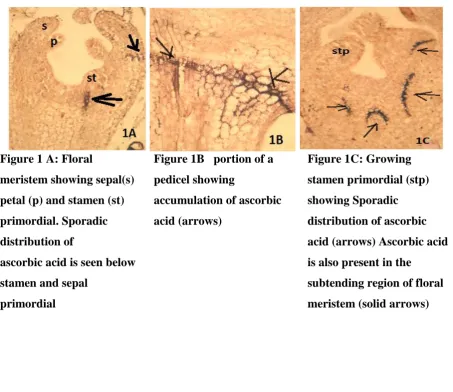
The floral meristem during the initiation of sepal and petal primordial is devoid of Ascorbic
acid. When stamen buttresses make their appearance in the third whorl sporadic distribution
of ascorbic acid is observed in the sepal primordial and in the subtending regions of stamen
primordial. (Fig.1A) In subtending region of pedicel however rich accumulation of ascorbic
acid is noticed (Fig. 1B) as the cells in stamen primordia proliferate, significant accumulation
of ascorbic acid occurs in the derivatives of floral meristems (Fig.1C). Sporadic distribution
of ascorbic acid is also observed in distal region of stamen primordium (Fig.1 C).
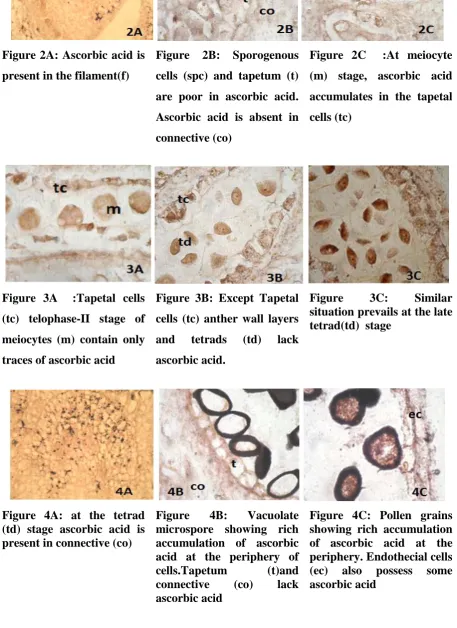
The development of stamen primordium is characterized by the rich accumulation of ascorbic
acid in the filament (Fig.2A). However the ascorbic acid is absent in the anther including
young sporogenous cells. (Fig.2A). As the sporogenous cells multiply (Fig.2B) and
meiocytes differentiate (Fig.2C) ascorbic acid begins to accumulate in the tapetal tissue.
During meiosis, only traces of ascorbic acid are seen in the tapetal tissues. (Fig.3A) At young
and old microspore tetrad stages also, appreciable amount of ascorbic acid is not observed in
any locular tissues of anther (Fig.3B and 3C). However at tetrad stage significant
Very rich accumulation of ascorbic acid is seen in the periphery of the vacuolated
microspores (Fig. 4B). At this stage ascorbic acid is totally absent in the remaining parts of
the anther. Rich peripheral distribution of ascorbic acid in the microspores persists at pollen
mitosis stage (Fig. 4C). Significantly at this stage, discrete particles of ascorbic acid are also
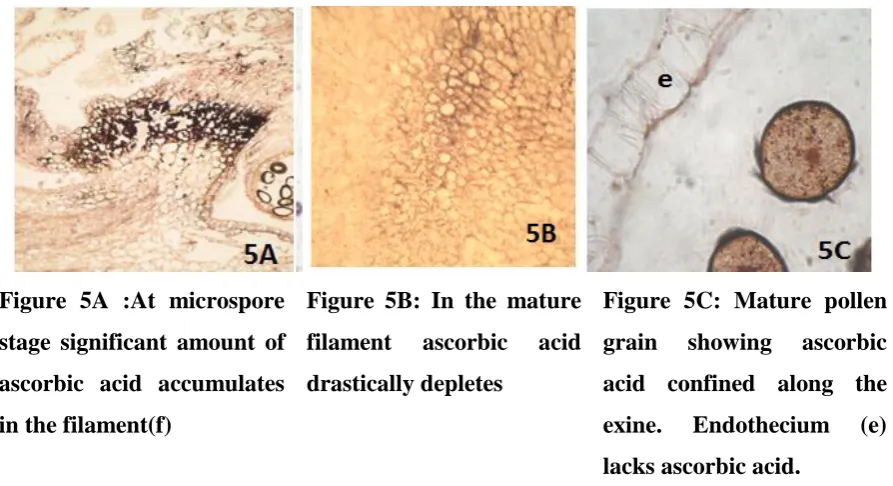
observed in the differentiating endothecium (Fig. 4C).The filament also is seen with the
presence of ascorbic acid (Fig. 5A). However in mature stamen level of ascorbic acid
significantly drops down in the filament (Fig.5B). Mature pollen grains contain rich content
of ascorbic acid along their walls (Fig. 5C).The fully differentiated endothecium lacks
ascorbic acid (Fig. 5C).
L.S. OF MALE FLOWER TESTED FOR ASCORBIC ACID
(s-sepal;p-petal;st-stamen;stp-stamen primordial;f-filament;spc-sporogenous cells;t-tapetum;
[image:4.595.72.526.328.720.2]tc-tapetal cells; co-connective; m-meiocyte;td-tetrads;ec-endothecial cells)
Figure 1 A: Floral
meristem showing sepal(s)
petal (p) and stamen (st)
primordial. Sporadic
distribution of
ascorbic acid is seen below
stamen and sepal
primordial
Figure 1B portion of a
pedicel showing
accumulation of ascorbic
acid (arrows)
Figure 1C: Growing
stamen primordial (stp)
showing Sporadic
distribution of ascorbic
acid (arrows) Ascorbic acid
is also present in the
subtending region of floral
Figure 2A: Ascorbic acid is
present in the filament(f)
Figure 2B: Sporogenous
cells (spc) and tapetum (t)
are poor in ascorbic acid.
Ascorbic acid is absent in
connective (co)
Figure 2C :At meiocyte
(m) stage, ascorbic acid
accumulates in the tapetal
cells (tc)
Figure 3A :Tapetal cells
(tc) telophase-II stage of
meiocytes (m) contain only
traces of ascorbic acid
Figure 3B: Except Tapetal
cells (tc) anther wall layers
and tetrads (td) lack
ascorbic acid.
Figure 3C: Similar
situation prevails at the late tetrad(td) stage
Figure 4A: at the tetrad (td) stage ascorbic acid is present in connective (co)
Figure 4B: Vacuolate
microspore showing rich accumulation of ascorbic acid at the periphery of
cells.Tapetum (t)and
connective (co) lack
ascorbic acid
Figure 4C: Pollen grains showing rich accumulation of ascorbic acid at the periphery. Endothecial cells
(ec) also possess some
Figure 5A :At microspore
stage significant amount of
ascorbic acid accumulates
in the filament(f)
Figure 5B: In the mature
filament ascorbic acid
drastically depletes
Figure 5C: Mature pollen
grain showing ascorbic
acid confined along the
exine. Endothecium (e)
lacks ascorbic acid.
DISCUSSION
The stamen primordial develops after the development of sepal and petal primordial and has
thin walled cells. But later the stamen primordium grows rapidly overtaking the petal
primordial and this is made possible probably by the presence of ascorbic acid along with
rich content of RNA and proteins. The differentiation of stamen primordium into filament
and other correlates with the differential distribution of ascorbic acid along with starch, RNA
and proteins. The cells of the filament are characterized by the presence of ascorbic acid and
poor presence of RNA and proteins. On the contrary, cells of anther primordial are rich in
RNA and proteins but lack storage carbohydrates and ascorbic acid. These histochemical
differences between filament and anther reflect differences in their metabolic functions. The
presence of rich content ascorbic acid in the filament presumably helps in its elongation,
because the proper positioning of the anther is equally important as the production of viable
pollen is. Filament also performs another important physiological function. The amylaceous
content from the maternal plant have to pass through the filament (Clement et.al., 1994,
1996) and thus it functions as a conduct for the nutritional supply to anther tissues.
REFERENCES
1. Clement C., Burrus M., and Audran J.C., Floral organ growth and carbohydrate content
during pollen development in Lilium. Amer. J.Bot., 1996; 83(4): 459-469.
2. Clement C., Chavant, L., Burrus M., and Audran J.C., Anther starch variations in Lium
[image:6.595.76.523.69.312.2]3. Dave I.C., Saxena O.P., Abraham P.C., and Pandey R.B. Histochemical localization of
L.-Ascorbic acid in plant tissues J.Gujarat Ubiv, 1968; 11: 199-2016.
4. Horemans N, Foyer CH, Asard H. Transport and action of ascorbate at the plant plasma
membrane. Trends Plant Sci., 2000a; 5: 263–267.
5. Horemans N, Foyer CH, Potters G, Asard H. Ascorbate functions and associated transport
systems in plants. Plant Physiol Biochem, 2000b; 38: 531–540.
6. Khasim, S. M. “Botanical Micro technique: Principles and Practice”. Capital Publishing
Company, New Delhi, 2002.
7. Loewus FA, Loewus MW. Biosynthesis and metabolism of ascorbic-acid in plants. Crit
Rev Plant Sci., 1987; 5: 101–119.
8. Loewus FA. Biosynthesis and metabolism of ascorbic acid in plants and of analogs of
ascorbic acid in fungi. Phytochemistry, 1999; 52: 193–210.
9. Smirnoff N. Vitamin C: the metabolism and functions of ascorbic acid in plants. Adv Bot.
Res., 2011; 59: 107–177.
10.Smirnoff N. The function and metabolism of ascorbic acid in plants. Ann Bot, 1996; 78: