AL-ADAILEH, Raid Moh'd.
Available from Sheffield Hallam University Research Archive (SHURA) at:
http://shura.shu.ac.uk/19230/
This document is the author deposited version. You are advised to consult the
publisher's version if you wish to cite from it.
Published version
AL-ADAILEH, Raid Moh'd. (2003). Management styles and managers attitudes
towards IT: A developing country context. Doctoral, Sheffield Hallam University
(United Kingdom)..
Copyright and re-use policy
1 0 1 7 2 5 4 1 1 7
Fines are charged at 50p per h
I u
JAN 2N5
U>k«‘
wvcit ^
...
■ />•/ ri
All rights reserved
INFORMATION TO ALL USERS
The quality of this reproduction is dependent upon the quality of the copy submitted.
In the unlikely event that the author did not send a com plete manuscript and there are missing pages, these will be noted. Also, if material had to be removed,
a note will indicate the deletion.
uest
ProQuest 10694110
Published by ProQuest LLC(2017). Copyright of the Dissertation is held by the Author.
All rights reserved.
This work is protected against unauthorized copying under Title 17, United States C ode Microform Edition © ProQuest LLC.
ProQuest LLC.
789 East Eisenhower Parkway P.O. Box 1346
IT: A Developing Country Context
Raid Moh'd Al-adaileh
A Thesis Submitted in Partial Fulfilment of the Requirements of Sheffield
Hallam University for the Degree of Doctor of Philosophy
Successful Information Technology Diffusion (ITD) requires a clear understanding of the organizational context including human and technological dimensions. Towards the establishment of this understanding, this research explores the management styles within a developing country context and the managers' attitudes towards IT. In particular, relationships between certain demographic characteristics and managers' attitudes towards IT are explored. Finally, association between management styles and managers’ attitudes towards IT as a part of an e-govemment program is explored.
The sample for this research was drawn from a list of the Jordanian Governmental Organizations (JGOs). Lower and middle line managers of public service organizations were selected to investigate the research issues. This research is mainly deductive and includes elements of both quantitative and qualitative methods. A survey approach was employed to achieve the research objectives. Moreover, six interviews were carried out with some managers to obtain insightful data and to enhance the interpretation of quantitative findings. Exploratory factor analysis, bivariate approaches, and general linear modelling were employed to explore patterns of complex multi dimensional relationships for various attitudinal components towards management styles, IT and demographic characteristics.
Five styles of management that represent two managerial dimensions were identified and ordered according to their preference. Although all these styles were prevalent to the research context indicating the diversity of management styles, people oriented management which represents the New Management Paradigm (NMP) including innovative, democratic, and participative styles was found to be more dominant than task oriented management which represents the traditional management styles including autocratic and authoritarian management. Moreover, the findings revealed that managers were found to have highly favourable attitudes towards IT. Additionally, a significant positive relationship was found between educational level and managers' attitudes towards IT. In contrast, significant negative relationships were found between managers' attitudes and age and organizational experience. No significant differences were found between male and female managers' with respect to their general attitudes towards IT. Finally, no significant relationship was found between managers' span of control and their attitudes towards IT. Managers’ attitudes towards IT including computer anxiety, computer confidence, computer liking and computer usefulness were found to have significant positive relationship with the people oriented management styles including innovative, democratic, and participative style except the relationship between participative management style and computer liking which was not statistically significant.
In the course of completing this thesis, the contents of a number of chapters have already
been published by the author. These are:
1. Al-adaileh, R., & Siddiqi, J. (May, 2003) Information Technology Diffusion: A
Strategic Perspective, Paper presented at IAMOT 2003, ENSGSI, Nancy-France.
2. Al-adaileh, R., & Siddiqi, J. (Sep, 2003) The New Management Paradigm and Arab
Culture: Analysis of Appropriateness, Paper Presented at The First Middle East
First thanks must go to my supervisor and director of studies Prof. Jawed Siddiqi, who through his constant direction and guidance led me to the completion of this thesis. His initial direction in setting up my research focus and his subsequent professional support throughout my research process were as valuable as his emotional support and friendship. From the formative stages of this thesis, to the final draft, he was there to help.
My appreciation also goes to my other supervisory team members, to Dr. Michael Grimsley for his continuous support in analyzing the data and demonstrating statistical insights and to Ana Vasconcelos and Roy Butcher.
Thanks to all of you not just for being part of my supervisory team but for all of your guidance and assistance.
I would like to extend my thanks to all my research colleagues in the school of computing and management and to all staff of CMS at Sheffield Hallam University.
I dedicate this work
o *2o my parents w fo devoted their [ife to the achievement o f this dream,
o To my 6rothers and sisters who shared with me my dream and
o With aCC my Cove to my dedicated Coving wife, Lamia and my energetic, 6right,
CAS Computer Attitude Scale
EFA Exploratory Factor Analysis
FA Factor Analysis
GLM General Linear Model
ICT Information and Communication Technology
IT Information Technology
ITD Information Technology Diffusion
JGOs Jordanian Governmental Organizations
MoICT Ministry of Information and Communication Technology
NMP New Management Paradigm
SPSS Statistical Package for Social Science
A B ST R A C T ...I P U B L IC A T IO N S... II A C K N O W LED G M EN T ... I ll D ED IC A T IO N ...IV A B B R E V IA T IO N S...V TABLE OF C O N TE N TS...VI LIST O F T A B L E S ... IX LIST O F F IG U R E S ...X
C H A PTER O N E :-... 1
IN T R O D U C T IO N ... 1
l . l The Research Is s u e s... 1
l .2 The Research Backgroundan d Co n t e x t...2
1.3 Aiman d Objectives... ..6
l .4 Research Qu e st io n s...8
1.6 Research Contribution...9
1.6 The Structureofthe Th e sis...10
C H A PTER T W O :-...14
IN FO R M A TIO N TEC H N O LO G Y D IF F U SIO N ... 14
2.1 INTRODUCTION...14
2.2 IT an d Org an iza tio n s...14
2.3 Understandingof IT D ...22
2.3.1 Structural Paradigm...... 26
2.3.2 Socio-technical Paradigm...30
2.4 ITD in D ev elo p in g C o u n tr ie s ...34
2.5 Observationsand Directions...38
2.6 Co n c l u sio n...42
CH A PTER TH R EE :-...44
M A N A G EM EN T STYLES: C O N VENTIO NA L VS. N EW M A N A G EM EN T P A R A D IG M 44 3.1 Intro ductio n... 44
3.2 Conventional Management Styles...44
3.3 The New Managem ent Paradigm...51
3.4 Managem entan d IT in Developing Co untries... 59
3.4.1 Arab Management Literature...62
3.5 Co n c l u sio n...68
C H A PTER F O U R :-... 71
M ANAG ERS' A TTITU DES TO W ARDS IT ...71
4.1 INTRODUCTION... 71
4.2 The Significanceof Attitudes ...71
4.3 The Characteristicsof Individualsan d ITD ... 75
4.3 Attitudes-related Research Questio ns... 77
4.3.1 Managers' General A ttitudes towards IT...77
4.3.2 Demographic Characterises...78
4.4 Co n c l u sio n ... 83
5.2 U M ... 86
5.2.1 Positivistic Vs. Phenomenological Approach...87
5.2.2 Deductive and Inductive D ebate...89
5.2.3 Quantitative and Qualitative Debate...90
5.3 Research De s ig n... 93
5.4 The Choiceof Methodology... 94
5.5 Data Collectionand Instrumentation...100
5.5.1 Survey Method...100
5.5.1.1 Management Styles Questionnaire... 101
5.5.1.2 Attitudes toward Computers Scale... 104
5.5.2 Interview...105
5.6 The Sa m ple...106
5.7 The Analysisof Data... 109
5.8 Ethical Issues... i l l 5.9 Co n c lu sio n...i l l C H A PTER SIX :-... 113
ANALYSIS OF M ANAGEM ENT STY LES...113
6.1 Introduction... 113
6.2 Factor An a l y sis...113
6.2.1 Two Dimension-model o f Management Styles...115
6.2.2 Identification o f Management Styles...118
6.3 Examinationofthe Management St y l e s...125
6.4 Discussionof Management St y les...127
6.5 Summary...136
CH A PTER SEV EN :-... 138
ANALYSIS OF M ANAGERS' ATTITUDES TOW ARDS I T ...138
7.1 Introduction... 138
7.2 Scale Te st in g... 139
7.3 General Attitudestowards IT ...141
7.4 Demographic Managerial Characteristics... 143
7.4.1 Classificationof Attitude Subscales... 147
7.5 Classificationof Managers Gro u ps...149
7.5.1 General Linear M odel...153
7.6 Sum m ary...155
C H A PTER E IG H T :-... 157
THE RELA TIO N SH IP BETW EEN ATTITUDES OF M ANAGERS TOW ARDS IT AND T H EIR STYLES O F M A NAGEM ENT... 157
8.1 Introduction...157
8.2 Bivariate Analysis... 157
8.3 General Linear Mo d e l... 164
8.4 Discussion... 167
8.5 Summary...170
C H A PTER NINE: -...171
SUMM ARY AND IM PLICA TIO N S FOR ITD: JORDANIAN CO N TEX T...171
9.1 Introduction...171
9.2 Summaryofthe Findings...171
9.2.1 Management Styles...171
9.2.2 Managers' Attitudes towards IT...173
9.2.3 Relationships between Management Styles and Attitudes towards IT...175
9.4.1 Managerial Dimension...191
9.4.2 Attitudinal Dimension...197
9.5 Implicationsfor Kn o w ledg e... 202
C H A PTER T E N :-... 208
C O N CLUSIO N S A ND RESEA RC H E V A L U A TIO N ...208
10.1 In t r o d u c t io n... 208
10.2 Concluding Re m a r k s...208
10.2.1 Management Styles...208
10.2.2 Managers' A ttitudes towards IT....210
10.3 Resea rc h Ev a l u a t io n... 215
10.3.1 Evaluation of the Research Methodology...215
10.3.2 Evaluation of Empirical Study...218
10.4 Issuesfor Further Resear ch... 218
10.4.1 Theoretical Direction...219
10.4.2 Practical Direction...219
10.4.3 Methodological Direction...221
R EFE R E N C E S... 224
A PP E N D IC E S...247
Appendix A: A review o f ITD literature, Fichman (1 9 9 2 )...247
Appendix B: The Questionnaire...252
Appendix C: Modification o f C A S ...256
Appendix D: Research sample and the number o f distributed and collected questionnaires... 257
Appendix E: Frequencies o f demographic characteristics... 258
Appendix F: Parameter estimates for attitude subscales and the five demographic characteristics... 261
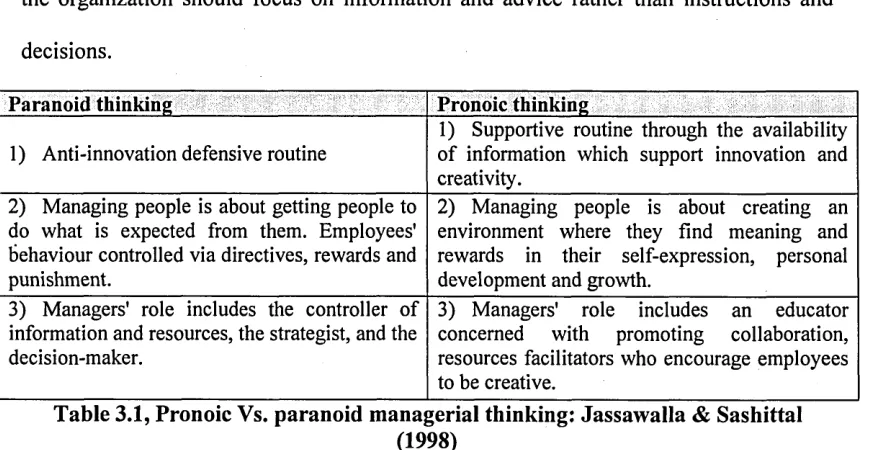
Table 3.1, Pronoic Vs. paranoid managerial thinking...52
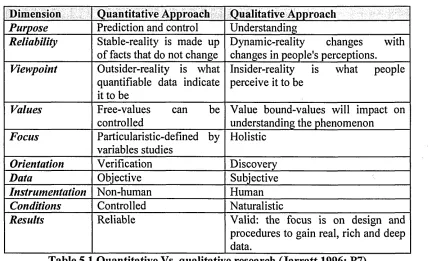
Table 5.1 Quantitative Vs. qualitative research... 92
Table 6.1 Loading o f items that represent people oriented dimensions...117
Table 6.2 Loading of items that represent task oriented dimensions...118
Table 6.3 Classification of the items according to the style they represent...121
Table 6.4 Loading of each item in its style...121
Table 6.5 Classification of items according to their style... 123
Table 6.6 Loading of each items in its style...124
Table 6.7 Means of management styles...125
Table 7.1 Correlations between attitude subscales...139
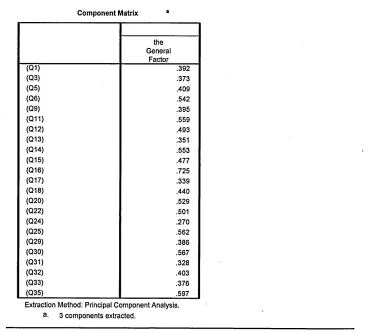
Table 7.2 Loading of the attitude subscales on the attitude towards IT....140
Table 7.3 Means of attitude subscales and overall scale...142
Table 7.4 Correlation between the four demographic characteristics and overall sum of attitude...144
Table 7.5 Correlations between subscales, overall scale and the four demographic characteristics...147
Table 7.6 GLMfor demographic characteristics and attitude subscales...154
Table 8.1 Relationships between management styles, overall attitudes and the four attitude subscales. 158 Table 8.2 Partial correlation coefficient...159
Table 8.3 Classification of management style according to the managers' scores...160
Table 8.4 Univariate GLMfor management styles and attitudes of managers towards IT....165
Figure 2.1 Flat structure with horizontal flow of information...16
Figure 2.2 The relationship between power structure, individual behaviour and ITD...19
Figure 2.3 Organizational innovation process...29
Figure 2.4 Technology acceptance model...31
Figure 2.5 Organizational maturity in the context of IS management and use...33
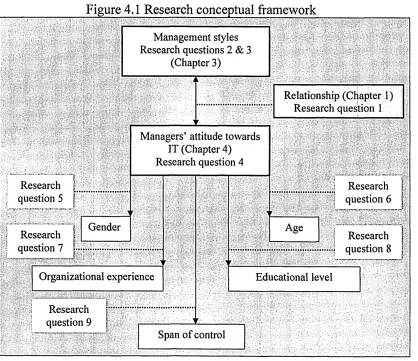
Figure 4.1 Research conceptual framework...84
Figure 6.1 Scree plot test - first dimension...120
Figure 6.2 Scree plot test - Second dimension...122
Figure 6.3 Proportions of management styles...126
Figure 7.1 Scree Plot... 140
Figure 7.2 Gender and attitude subscales error bar...149
Figure 7.3 Age and attitudes subscales error bar...151
Figure 7.4 Organizational experience and attitudes error bar...151
Figure 7.5 Educational level and attitude subscales error bar...152
Figure 7.6 Span of control and attitude subscales error bar...152
Figure 8.1 Innovative style and attitude subscales....161
Figure 8.2 Democratic style and attitude subscales...161
Figure 8.3 Participative style and attitude subscales...162
Figure 8.4 Autocratic style and attitude subscales....162
Figure 8.5 Authoritarian style and attitude subscales...163
Chapter
One:-Introduction
1.1 The Research Issues
This thesis investigates the issue of Information Technology Diffusion (ITD) from an
organizational management point of view as an attempt to overcome the technological
determinant perspective. This research argues that the ongoing pressure on
organizations to utilise IT tools successfully should be based on a clear understanding of
the diffusion context including human and technological dimensions. In particular, we
argue that the investigation of the internal organizational context and organizational
management in particular can enhance the formation of successful ITD strategy through
incorporation of organizational context with ITD strategy. As a part of this
understanding, this research explores the management styles within a technologically
developing Arab country context and provides some empirical and theoretical insights
towards understanding the changing and diversifying nature of management styles. In
addition, this research explores the managers' attitudes towards IT and the relationship
between certain demographic characteristics including gender, age, non-IT
organizational experience, educational level, and span of control and the managers'
attitudes towards IT. This enables the identification of the overall relationship between
management styles and attitudes towards IT.
A review of the available literature associated with ITD emphasises a tendency in this
literature towards focusing on the use of technology as the main driving force which
drives the process of change within organizations. The utilization of the existing
components including management and the use of IT has received little attention in the
previous literature. This motivated the researcher to explore the existing organizational
management setting and its association with ITD. Investigation of the interaction
between management styles and managers' attitudes towards IT provided a mechanism
to achieve this end. The researcher knowledge and academic background in the field of
management and his familiarity with the research particular context have supported the
exploration of this issue.
The remaining of this chapter presents a general and brief background concerning the
issues that are raised in this research and the context of this research. It also discusses
the overall aim, objectives, research questions as well as outlining the structure of the
thesis.
1
.2 The Research Background and Context
The role of IT tools has increased in the last decade since technology is linked to
corporate governance, investment and economic development (Southern, 2001). In
general, there are two major debates concerning the role of IT. The first theme views
information revolution as new opportunity since people, through the use of emerging
technologies, can create and develop an innovative and new ways of doing things. The
second theme views the increasing reliance on IT as a danger and may lead to
undesirable and radical changes within the receiving context. However, one can argue
that the role of IT depends on the way of introducing it and the extent to which the fit
between technology and the receiving context is considered. Viewing technology, for
instance, as a single powerful change agent that can regenerate an organization and
explicitly underestimating other organizational components. Although IT has imposed
many changes on organizations, it is not able to create the appropriate conditions for its
success. Therefore more interest should be directed to investigating ITD as an
organizational process, which considers the complexity of the organizational context
and the diversity of social and cultural settings among countries and regions around the
world (Nulens, 1997). The critical role that IT can play in both public and private
organizations to develop the organizational work increases the importance of ITD
studies to be strategic and more comprehensive. We argue that successful ITD is
determined by a set of different factors including technical, organizational, cultural and
individual factors. As the investigation of all these factors is beyond the limitation of
this research, organizational management as a key organizational factor was
investigated within the scope of this research.
Since the external and internal environment of today's organizations are undergoing a
process of change, new thinking regarding management styles and responsibilities has
emerged to keep pace with this rapidly changing environment. Although, there is an
established body of work in developed countries that has provided insights concerning
the impact of this changing environment on the management styles and its role in the
creation of what is so called the New Management Paradigm (NMP), the focus of these
studies was on investigation of the influence of IT on organizational management and
very few studies have explored the reciprocal relationship of management on IT.
In contrast, no empirical investigations and little theoretical insights were provided in
the previous literature concerning the interaction between management styles and ITD
investigated ITD in developing countries have focused on identification of current and
potential problems. Thus, they provided a negative perspective concerning ITD within
this context. Therefore, one can argue that the interaction between management styles
in today’s organizations and ITD is still to be explored especially in organizations of
developing and less developed countries. Since most developing countries have recently
started to realize the important role which IT can play to solve their development
problems, the results of this research are expected to be more useful to this context. The
scarcity of resources and the importance of getting as much benefits as possible from
them are other important incentives that increase the importance of this research to this
context. Moreover, the distinctive nature of the organizational environment (internal and
external) in these countries may create different managerial styles that are influenced by
the dominant cultural and social environment within these countries. Consequently, the
adoption of the results of some studies that were conducted in developed countries can
not be reliable and accurate. It is our belief that identifying the management style in
developing countries must be based on more comprehensive and empirical research,
which must involve real intervention to attain rich background about the current
management styles in the organizations of developing countries.
However, since the levels of IT development among these countries is varied depending
on each country's circumstances including cultural, political, economical, and scientific
situations, this research was conducted within the Jordanian context which is part of its
surrounding Arab and wider developing countries context. Being Jordanian has
improved the researcher ability to investigate this context and interpret the likely
situation with respect to the investigated research questions. This provided a personal
countries in terms of its economic level of development and its limited or unutilised
resources. In addition, it shares Arabic countries its cultural and social foundation,
Islamic belief, language, and level of technological development. This expands the
findings and implications of this research to include the wider Arab countries context
and provides some indications regarding the internal organizational context. Lower and
middle line managers in Jordanian Governmental Organizations (JGOs) were selected to
investigate the research questions. Top level managers were excluded because of the
difficulty of gaining access to them. In addition, carrying out a study that involves all
managerial levels might lead to misleading results since the focus of those managers is
directed towards strategic rather than practical or operational managerial activities. In
addition, the issue of organizational innovation through IT have received little attention
from the perspective of lower and middle line management (Wu et al, 2002). The
selection of public sector organizations was motivated by the Jordanian government
efforts to improve public services through the introduction of e-govemment project
which makes the investigation of ITD within this context significant. In addition,
academic literature concerning the NMP has focused on non-governmental
organizations and little research has explored the context of governmental organizations
(Polidano & Hulme, 2001).
Few studies have discussed some issues relating to management in Arab world. Ali
(1996: p4) stated that
Moreover, the available studies that investigated Arab management have generally
provided a negative perspective regarding this context. Misunderstanding and
misinterpretation of Arab management and its major driving forces including cultural
values, Islamic values, technological development, and political environment have led
to the formation of this negative perception. In addition, most of these studies have
discussed one dimension related to managerial work while there is a need to investigate
the impact of managerial dimension on ITD. The novelty of ITD in Arab countries and
the technological change that has been taking place in these countries in the last few
years increases the importance of understanding the relationship between management
styles and ITD.
1
.3 Aim and Objectives
The overall aim of this research was to explore the relationship between managerial
styles prevailing in JGOs and Jordanian managers' attitudes towards IT. Among the
objectives of this research was first to identify the management styles of middle and
lower line managers in public service organization within a developing country context
(namely Jordan). These styles were identified according to their prevalence to JGOs.
The second objective was to identify the public managers’ attitudes toward IT. Attitudes
of managers towards IT were explored in terms of computer anxiety, computer
confidence, computer liking, and computer usefulness. Moreover, this research explored
the relationship between managers’ attitudes towards IT on the one hand and gender,
age, organizational experience, educational level and span of control on the other. The
attainment of these two objectives enabled the achievement of the overall aim of this
To fulfil the overall aim and objectives of this research, a deductive approach was
adopted. To ensure that the findings of this research are valid and correct, multi
methods approach for data collection and analysis were used in this research. These
included survey, interviews, secondary literature sources including books, journals,
conference proceedings, online documents ...etc. The use of secondary data enabled
understanding of the ITD literature, management styles and the relationship between
management and ITD, and analysis of the current situation concerning ITD strategy
within JGOs.
The research process involved four phases. The first phase aimed to identify the
management styles within JGOs. A survey was used to collect the necessary data. The
second phase aimed to identify the managers’ attitudes towards IT. The Computer
Attitude Scale (CAS) developed by Loyd & Loyd (1985) was employed to achieve this
aim with very minor modifications. The CAS measures attitude based on the following
four subscales: (a) computer anxiety, (b) computer confidence, (c) computer liking, and
(d) computer usefulness. The third phase included the analysis of data and identification
of the major themes. Statistical Package for the Social Sciences (SPSS) was used to
analyse the collected data from the first two phases. In particular, factor analysis,
correlation analysis, general linear model, and error bar were the primary instruments
for the analysis of data. The fourth and final phase of this research focused on
exploration of the relationship between management styles and their attitudes towards
IT. This was based on a synthesis of the empirical findings from the previous phases
and the available literature. The overall research findings have led to the identification
of strategic implications for the current Jordanian strategy. This was enabled through
1
.4 Research Questions
From the literature survey, it was apparent that there was a gap in understanding the
relationship between management styles and demographic characteristics on the one
hand and managers' attitudes towards IT on the other, which formed, the overall aim of
this research and its first question. To enable the achievement of this aim, the following
research questions were developed based on a comprehensive and critical review of the
available literature.
o What are the management styles that dominate the public sector organizations
within the research context?
o What is the order of these styles according to their existence or dominance?
o What are the attitudes of lower and middle line managers towards IT?
o Are there significant differences between male and female managers regarding
their attitudes towards IT?
o Are there significant differences between attitudes of managers towards IT
according to their ages?
o Are there significant differences between attitudes of managers towards IT
according to the number of manager's years of work experience?
o Are there any significant relationship between the manager's level of education
and his/her attitudes towards IT?
o Are there any significant relationship between the manager's span of control and
1
.6 Research Contribution
The research outcomes are expected to provide an original contribution to the available
literature for the following reasons:
1. The management styles within the JGOs are identified in a very clear format. The
process of management styles identification assumed the absence of an ideal
management style and the integrated nature of management behaviour where several
managerial practices interact. An extensive review of traditional and NMP has
supported this assumption. Empirical validation and theoretical explanation provided in
this research present a clear evidence concerning the shape of the future management in
general and public management in particular.
2. Attitudes of Jordanian public managers towards IT were clearly identified. The
relationships between these attitudes and gender, age, organizational experience,
educational level, and span of control were also explored in some details. Some of these
characteristics (span of control and non-technical organizational experience) have
received no attention in the previous studies. Attitudes of managers' were classified in
terms of computer anxiety, computer confidence, computer liking, and computer
usefulness. The interaction between these aspects of the study was explored using in-
depth and multiple methods of analysis. Most importantly, a review of the available
literature confirms that this study is the first in-depth study within the Jordanian context.
Accordingly, it provides basic theoretical and empirical insights to further examine and
validate the results of other studies that are related to IT transfer and diffusion, and were
conducted in developed countries context.
3. The relationship between public managers' attitudes towards IT and their styles of
context where the scarcity and the fragmented nature of the available literature is a
major concern. This investigation is considered as an important step towards
investigation of the interaction between ITD and organizational management in
particular. It is also seen as an appropriate start to further investigate the interaction
between the internal organizational context and the use of IT.
4. This research's outcomes also provided guidelines for strategies' makers concerning
some possible courses of action that may be required to increase the likely success of
ITD process.
Overall, this research emphasises the importance of integration between organizational
and technological components when formulating an ITD strategy. Moreover, it invites
strategy makers to consider users' perception regarding the diffusion process and to
involve them in the process of ITD. In particular, this research has emphasised that the
management styles and demographic characteristics are key driver to shape IT diffusion
rather than the other way around as reported in the literature
1
.6 The Structure of the Thesis
To guide the overall process of research, the thesis is presented according to the
following structure:
Chapter 2- Information technology diffusion
In this chapter, the relationship between IT and organizations was evaluated and the
impact of IT on organizational structures, forms, and management was discussed. Issues
related to ITD models were also reviewed and evaluated to form the broader boundaries
of the research journey. Critical evaluation of these models was conducted and existing
Chapter 3- Management styles: conventional vs. new management paradigm
In search for the existing gap in the available studies, issues related to conventional and
NMP were reviewed and discussed in this chapter. This extensive review formed the
more specific boundaries of this research and led to the identification of two research
questions related to management styles within the context of JGOs. This chapter also
provided the theoretical foundation in which the design of the research instrument
concerning management styles was based.
Chapter 4- Managers attitudes towards IT
Studies related to managers’ attitudes towards the use of IT were reviewed and
evaluated in this chapter considering the particular demographic characteristics. This
review enabled the development of six research questions relating to the general
attitudes of managers towards IT and the relationships between these attitudes and five
demographic characteristics including gender, age, non-IT organizational experience,
educational level and span of control. In addition to chapter 2 and 3, this chapter
enabled the identification of the research conceptual framework.
Chapter 5- Research methodology
This chapter discussed the methodological approach that was used in this research and
the processes and procedures that were undertaken to collect the data, to analyse them
and consequently to achieve the research objectives. A justification of the
methodological approach was provided taking the research context, circumstances, and
limitations in consideration. This chapter also discussed the research design upon which
the study was based.
Chapter 6- Analysis of management styles
Management styles questionnaire was analysed in this chapter. Firstly, the 35 items-
management dimension they measure. Then, management styles were identified and
ordered according to the managers' preference and their proportions within the research
context.
Chapter 7-Analysis of managers’ attitudes towards IT
CAS was analysed in this chapter. Factor analysis was firstly used to assess the
appropriateness of this scale for measuring attitudes towards IT. Bivariate analysis and
general linear model were used to address the research questions relating to public
managers' attitudes towards IT. CAS was also classified into its four subscales and
relationships between each of these subscales and the five demographic characteristics
were identified in this chapter.
Chapter 8- The relationship between management styles and mangers' attitudes
towards IT
In this chapter, the results of the previous two chapters were combined to enable the
examination of the relationships between the overall managers' attitudes towards IT
including the four attitudes subscales on the one hand and their styles of management
on the other. The aim of this chapter was to find out if the attitudes of public managers
as a dependent variable were influenced by the management styles within the research
context.
Chapter 9- Summary and strategic Implications for ITD: Jordanian context
This chapter provided a summary of the research findings and discussed the Jordanian
government strategy in relation to ITD. Critical evaluation of this strategy was
presented in this chapter. This was followed by a reflection of the findings of this
research on this strategy leading to the identification of contextual implications and
guidelines for strategy makers within this context. Academic implications were also
Chapter 10- Conclusions and research evaluation
Based on the analysis of the collected data and considering the theoretical foundation
and the context of the study, a review of the research process, its contribution, and
concluding points were presented in this chapter. The research process was also
evaluated in this chapter and methodological and empirical limitations were highlighted.
Chapter
Two:-Information Technology Diffusion
2.1 Introduction
This chapter and the next two chapters aim to review and understand the theoretical
background of this research and to identify the issues that need more research and
consideration. In this chapter, the interactions between IT and organizational
components including structure, processes, management, and people are discussed.
Then, the concept of ITD and the available diffusion models are reviewed and critically
evaluated to identify the dominant themes in the available literature and what needs to
be done to fill the identified gap concerning ITD. The discussion presented in this
chapter should enable the identification of the overall aim and focus of this research.
2.2 IT and Organizations
There are continual debates in the organizational and IT literatures to clarify the
relationship between ITD and organisational components. Two levels of understanding
of the relationship between computerization and organization can be emphasised
(Preece et al, 1994). The first level concerns the impact of computerization on
organizations and assumes that computerization causes many changes in the
organizational context and is considered as a revaluation in the organizational world.
The relationship, according to this perspective, is an influence relationship where IT is
not only a change mechanism but also a key determinant of organizational components.
The second perspective focuses on explaining the reciprocal relationship between the
seen as a change agent but a consideration of organizational components is equally
important to successfully utilise any potential technology or making any desired change.
In other words, using IT tools within an organization has considerable implications on
the organization and all its components including structure, people, tasks, and culture
(Leavitt & Pondy, 1964). To deal with these implications, the organizational forms,
processes, structures, and management need to be modified and sometimes
reconstructed. On the other hand, the organizational aspects can direct the process of
ITD and impose certain courses of action to ensure the success of ITD. Thus, the
relationship between IT and organization is an interactional relationship meaning that
successful organizations and successful exploitation of IT in the business environment
today are seen as two faces for the same coin. Any organization must accurately link
them together to persevere and prosper in a changing global business environment.
Accordingly, one can argue that the interaction between organizational components and
ITD and the impact of each of them on the other should receive greater attention.
Writers like (Raymond et al, 1995) argue that the use of IT in the organization is highly
required to develop organizational structures, forms, and management strategies to get
the full range of IT deployment and to improve organizational performance by reducing
operations and transactions costs and differentiating products and services. This means
that IT deployment imposes various changes on organizational structure, form, and
management in addition to other operational changes that are related to the processing
of organizational outputs including goods and services.
With a large-scale deployment of IT, all organizational levels will be affected and
The new mechanisms of information processing and information flows within an
organization create new shifts that shorten the lines of communications through all
organizational levels. The considerable gap between these levels will not be reliable
anymore since the information can be transformed easily, smoothly, and quickly
through all organizational divisions without the need for traditional formal ways of
communication such as papers or face to face communication. The new flat reporting
structure enabled by IT can be used to replace all these traditional ways. Therefore,
these ways of reporting can be reduced or sometimes eliminated through extensive use
of IT such as the implementation of teleworking or computer supported collaborative
work systems (Cooke, 1995). These critical changes can lead to the elimination of some
traditional and routine activities so much so that they threaten some organizational
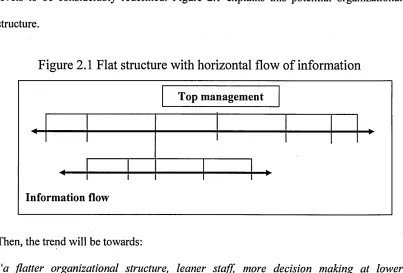
levels to be considerably redefined. Figure 2.1 explains this potential organizational
[image:31.612.90.493.339.612.2]structure.
Figure 2.1 Flat structure with horizontal flow of information
Top management
Information flow
Then, the trend will be towards:
“a flatter organizational structure, leaner staff, more decision making at lower management levels, increased computer training, and more effective information flow ” (Rosenberg, 1992: p96).
Hochstrasser & Griffiths (1991) describe different changes that are enabled by IT
instance, using IT tools has enabled horizontal communication lines between
individuals in different departments within the organization enabling managers in
different departments to overcome traditional departmental boundaries. This changes
the nature of interface between organizations and their customers and enables what so
called a customer-centred organizational approach. Consequently, more organizational
surface is exposed to customers/clients in an attempt to strengthen the relationship
between an organization and its customers. Another change is decentralization of
business activities, which is facilitated by the introduction of effective communication
links between different functions across the organization.
This impact creates some kind of uneasy relationship between the workers and new IT.
Also, and due to the introduction of IT, the relatively open social system in the office
may be replaced by a rigid, highly structured and electronic based social environment,
which will cause the feeling of social isolation. Consequently, there might be problems
in integrating people and IT tools in an efficient, safe, and productive manner
(Rosenberg, 1992).
However, it is important to emphasize here that ITD is not the only reason for the
creation of flatter organizational structure. In fact, this new organizational structure is
introduced in some organizations as a part of a comprehensive organizational reform. In
the public sector, this structural change represents a managerialistic view of public
sector reform which involves the process of introducing the skills, concepts, and
practices of private sector into the public sector organizations to improve the efficiency
and effectiveness of these organizations and to promote new and flexible culture in
customers’ demands to improve the responsiveness and quality of public services and
reduces public spending. In addition, and since ITD within the organizations provides
means for saving time and cost of organizational activities, it can be argued that the
traditional vertical forms of organizations that reflect the hierarchical and bureaucratic
ways of thinking and designing have become serious constraints for the effective
utilization of IT. These forms of organization can be changed to be more horizontal or
flat structure. This is enabled through the change in the control mechanism in the
organization as the ability of one manager to control and direct more employees will
increase (wider span of control) due to the potential change in the information
processing (decisions and reports) between different organizational levels.
Consequently, these levels will be closer and communicate more effectively.
In relation to the organizational management, technology can change the core concept
of management from controlling people and resources (centralisation) to participation
and delegation (decentralisation). Two schools of thought have emerged concerning this
issue. The first claims that IT has increased centralisation in the organization through
controlling IT as an organizational resource. This increases the power which managers
have and makes managerial activities more centralised. The second school of thought
claims that IT deployment raises the level of trust and information availability to other
members of organization and therefore makes them able to perform some activities that
were difficult to perform before. As a result, top managers will be able and more
confident to delegate some of their responsibilities to other organizational members at
lower managerial levels. In addition, the use of IT reduces the amount of time that is
required to perform some jobs. This makes it possible for people who perform these
writers (e.g. Butler & Gibbons, 1998) argue that the impact of individuals and groups on
ITD within their organizations has increased due to the rapid technological development
and the tendency towards decentralised organizations, which is, as they argue, promoted
by technological development. This, in turn, reduces the impact of direct actions of
management in the diffusion process and makes the diffusion process itself
decentralised or user-centred process. The implications of this argument change the
diffusion process from technical process into more comprehensive organizational
process. Butler & Gibbons (1998) proposed an interactive model to explain the
[image:34.616.113.502.334.492.2]relationship between power structure, individual behaviour and ITD (see figure 2.2).
Figure 2.2 The relationship between power structure, individual behaviour
and ITD, Butler & Gibbons, 1998 (p6)
Diffusion of IT
Individual behaviour Power structures
As shown in this figure, there is a reciprocal relationship between individual behaviour
and power structure on the one hand and ITD on the other. Individual behaviour has an
impact on the use of IT, which, in turn, influences the structure of power within the
organizations. Therefore, and as a result of ITD, individual behaviour is expected to
have an impact on the organizational power structure in general and organizational
management in particular. This, as one can argue, depends on the nature of management
is expected to improve the interaction between management and employees which
increases the impact of each of them on the other. This may support or hinder the
diffusion process depending on the managers and employees' perception concerning IT.
In contrast, having an authoritarian style of management may increase the management
impact on ITD and decrease the impact of employees. Moreover, writers like
Scarbrough & Corbett (1992) argue that IT changes the structures and division of power
within the organization. Through identifying who influences IT exploitation and makes
decisions about using IT, IT is able to identify potential power brokers. It can provide
either direct power to the people who control the development and use of IT or indirect
power to the people who have relevant skills, knowledge, and information in relation to
IT usage within their organization.
On the operational level, introducing IT into an organization not only changes the way
in which an organization performs its operational activities, but also redefines some
fundamental managerial tasks such as planning, controlling, decision making, directing
and so on. For example, Hochstrasser & Griffiths (1991) claim that IT threatens the role
of middle management by offering a dramatic increase in the quality of communication
between senior and line managers by cutting out redundant intermediary levels.
However, it can be argued that the role of middle management is empowered through
ITD because their tasks can involve more strategic management than before but this
requires empowering of the organizational culture to allow delegation of some strategic
tasks from top management to middle and lower line operational management. This,
however, depends on the nature of organizational management and its desire to
participate its formal power with lower level organizational members. Some issues like
the organization and the need for skilled employees and visionary managers became
even more important issues than ever before (Clegg, 1990; McKersie & Walton, 1991).
Top managers are invited to consider and encourage the availability of these success
factors.
In fact, describing the process of change within the organization should be more
comprehensive to present a real picture concerning the situation inside and outside the
organization. Writers like Boje (et al, 1996) argue that the post-modern conditions
create the need for a reconstruction process within the modem organizations. This can
assist the management to adapt to any change that may occur inside or outside the
organizational boundaries. This argument is supported by Castells (1998: p3) who states
that:
“Information technology is not the cause o f the changes we are living through. But without new information and communication technologies none o f what is changing our lives would he possible ”.
Baskerville & Smithson (1995) argue that some technological oriented methods like
business process re-engineering and networked organizations enable the development of
a new organic corporation to replace the traditional ways of organizing. Furthermore, IT
enables the organizations to be more open to their customers, suppliers, and
shareholders/stakeholders as well as to their members by taking off some previous
constraints such as the limited working hours and direct traditional contact. This became
available through using Internet technology (e.g. E-commerce, E-govemment, and E-
business). This, in turn, encourages the development of new organizational structures
As discussed above, IT imposes various changes on the organizational components
including structure, forms and management. However, one can argue that the realisation
of the benefits of ITD and the prevention of any possible drawbacks or failure highly
depend on management perception, understanding, and appreciation of IT. Management
should be seen as a key determining and influential factor that has the ability to hinder
the process of ITD or to support this process and encourage other organizational
members to adapt IT. Therefore, consideration of top managers as strategists and lower
managerial levels as decision makers and mediators between top management and
employees is highly important as a prerequisite success factor for ITD process.
To verify the extent in which organizational management has been considered in the
previous studies. The process in which IT is diffused within the organizational context
is reviewed in the next section. Studies that have been conducted in order to define the
key variables that enable the realisation of successful diffusion are discussed and
critically evaluated. The identification of the existing gaps in these studies will lead to
determination of the overall aim of this research.
2.3 Understanding of ITD
IT is a comprehensive and multifaceted concept which expands to involve various
components and their applications on the individual and organizational levels. It
includes hard components (software and hardware) which form the base of various
applications that range from personal application to networking and Internet. All these
applications involve the use of computer machines to perform individual or
organizational activities. Within the context of this research, IT includes the use of
organizations' activities are performed and the way members of these organizations are
communicated through inter-organizational activities and networking technology. The
use of IT by managers is seen as a particular type of innovation diffusion. Therefore,
this research assumes that ITD literature forms the general framework in which the
diffusion of IT applications can be reviewed.
ITD, as an innovation process, has been subject to extensive research in developed
countries (e.g. Fichman, 1992; Hanna et al, 1995; Juustila, 1995; Dasgupta, 1997;
Baskerville & Heje, 1998; Jassawalla & Sashittal, 1998; Lynn et al, 1999;Henfridsson,
2000). This concept has been discussed for a long time in different disciplines starting
from anthropological and sociological diffusion research to innovation or technology
diffusion research (Rogers, 1995). It is a concept that has always been associated with
how a new idea or a new way of individual and organizational behaviour is
communicated between people. The process of diffusion occurs among members of a
social system and always involves social change and is affected by the social framework
within the diffusion environment.
Nevertheless, it is important to emphasise that the concept of innovation has a
relativistic nature and should not always be seen as new knowledge or idea because the
perceived newness of the idea for the individual determines whether it is innovation or
not. In addition, the situation and individual perception of the innovation, as one can
argue, highly depends on the individuals’ characteristics that play an important role in
In most cases of innovation diffusion, uncertainty is expected to be a major constraint
where individuals deal with innovation with suspect and ambiguity (Rogers, 1995;
Thomas, 1996). The degree of uncertainty, as Rogers argues, depends on the available
information concerning the particular innovation. Therefore, he argues that
technological innovation, in particular, reduces the degree of uncertainty because it
embodies information. But at the same time it creates another kind of uncertainty about
its expected consequences that emerge from what he calls innovation-evaluation
information. In this regards, one can argue that not only information availability
determines the degree of uncertainty but also the nature of diffusion process (being
planned or spontaneous) and other organizational factors that have to be considered.
The most important of these factors, as we argue, is the nature of organizational
management which determines the degree of information sharing and availability. The
characteristics of innovation itself are also important to explain the rate of adoption.
Innovation that is perceived by individuals as having greater relative advantage,
compatibility, trialability, observability and less complexity is expected to be adopted
more rapidly than other innovations (Rogers, 1995).
Rogers claims that the diffusion process is a particular type of communication in which
the message content is concerned with a new idea in which one individual transfers to
one or several others. He argues that effective communication between individuals is
based on both similarity and dissimilarity (Homophily and Heterophily) among
individuals where innovation is transferred. On the one hand, similarity among
individuals in some aspects (e.g. education, social status, age) are considered as a good
base to exchange the information regarding the innovation because similar people are
do. On the other hand, dissimilarity among individuals especially in some aspects that
related to the innovation itself like (e.g. experience with innovation, technical
knowledge) can allow new information to be exchanged through the communication
process between experienced and more knowledgeable members to less experienced and
less knowledgeable members of a social entity.
In his review of the diffusion of innovation literature, O'Callaghan (1998) identifies two < basic paradigms that inspired this literature. The first paradigm views diffusion as a
process of communication and influence. People are informed about the new technology
and are persuaded to adopt this technology through their communication with prior
users. The second paradigm views diffusion as an economic process where the decision
to adopt or reject the new technology is determined by the cost of adoption and the
benefits that can be achieved as a result of the adoption of new technology. In fact, it
can be argued that the success of the diffusion is determined by both the availability of
effective communication which enables exchanging of information concerning the
diffusion and the economic benefits which can be realised as a result of the adoption of
a particular innovation. Effective communication process enables the achievement of
any economic benefits. In contrast, weak or ineffective communication may cause the
failure of diffusion process which leads to losing of economic benefits. Economic
benefits, on the other hand, may motivate the communication process which leads to
increase the growth and acceptance of innovation. The evaluation of economic benefits
of IT diffusion and the effectiveness and efficiency of the communication mechanism
that increase the rate of diffusion are determined by managers of an organization.
Accordingly, the two paradigms of diffusion, as one can argue, are implicitly or
their styles of management which determine the organizational mechanism of
communication, precipitation, and information sharing.
Towards understanding ITD in particular, several models have been proposed. A review
of these models has led to the identification of two major paradigms. The first is the
structural or procedural paradigm which describes the process of ITD as a structural
process which involves a sequence of steps (Zaltman et al, 1973; Mcfarlan &
McKenney, 1982; Cooper & Zmud, 1990; Rogers, 1995; Dasgupta, 1997). The second
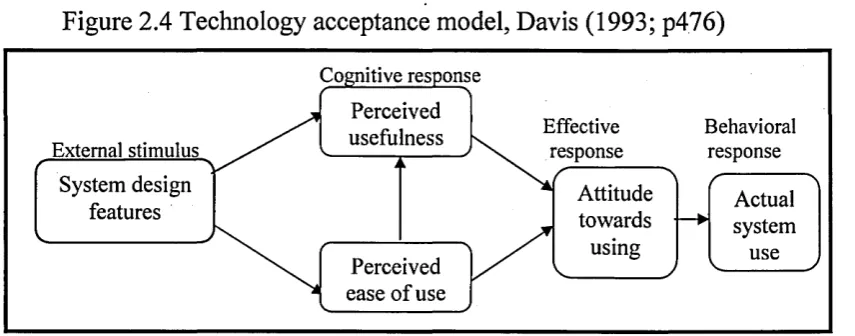
is the socio-technical paradigm which provides more comprehensive description of ITD
process and concentrates on individual and social aspects as well as on technical ones
(Davis, 1989, 1993; Auor & Ruohonen, 1996). In the next section, these two paradigms
are reviewed and evaluated.
2.3.1 Structural Paradigm
Until 1973, innovation diffusion studies had considered the individual as the main unit
of analysis. Zaltman (et al, 1973) expanded this perspective from an individual level of
analysis to an organization as the main unit of adoption. They used the process approach
to explain the diffusion of innovation. According to this approach, innovation is
composed of a set of stages or phases ordered along the temporal dimensions of their
anticipated sequence. However, they emphasised that innovation should be viewed as
involving an interrelated and complex set of forces that shift over time. This view draws
the attention towards considering innovation as a collective process starting with
knowledge-awareness sub-stage and ending with continued-sustained diffusion
(Zaltman et al, 1973). Rogers (1995) supports this argument claiming that ITD process
persuasion, decision, deployment and confirmation. This classification is emphasised by
Dasgupta (1997) who views ITD as a collective process which involves introduction,
assimilation, and permeation of information systems technology throughout an
organisation.
McFarlan & McKenney (1982) proposed an ITD procedural model which includes the
following four steps:
1. Technology identification and investment which include learning the application of
new technology.
2. Experimentation, learning and adaptation which include user's awareness of the new
technology and the problems it can solve.
3. Rationalization and management control which include upgrading staff to
acceptable knowledge levels that enable them to work with technology and control it.
4. Widespread technology transfer which includes spreading the benefits of technology
into other units.
This model depends largely on experimentation as a way to achieve successful diffusion
process. This increases the cost of diffusion. In addition, it starts with technology
identification as the first stage in the diffusion process without considering some human
aspects such as the perception of organizational management and technical skills among
users of the new technology. This can lead to the failure of the diffusion process.
Cooper & Zmud (1990) present an ITD perspective model. According to this model, the
diffusion of IT starts firstly when there is a pressure to change {initiation stage). This
{adoption stage) through development, installation, and maintenance of new
technology, and the development of new organizational procedures {adaptation stage).
If users accept this technology {acceptance stage), it becomes a normal activity
{routinization stage). The final stage of diffusion process according to this model is the
infusion stage which includes the integration of new IT with the organization's systems
to support higher levels of organizational work. This model is more comprehensive than
previous model and considers all stages that are necessary to the success of the diffusion
process. It also considers the partial deployment of new technology as a way to enhance
the diffusion process. However, the user acceptance of the new technology should be
considered before the adoption process, which includes development, installation, and
maintenance of new technology. This can facilitate the adoption process through giving
the users the opportunity to contribute in this process. It also can reduce the cost of
diffusion through supporting the decision making process and reducing the users'
resistance to the new arrangements that may be introduced as a result of the diffusion of
new technology.
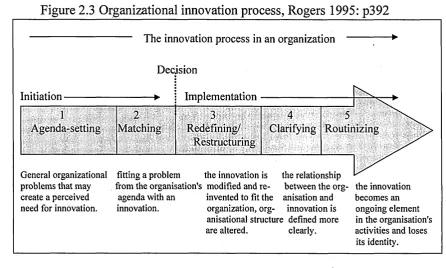
According to Rogers (1995), the innovation diffusion process within the organization
consists of two phases including initiation and implementation and a usual sequence of
five stages (see figure 2.3). The diffusion of technological innovation can be the best
example to clarify the processes of redefining innovation and restructuring of
organization where any computerised system is defined or, in most cases, designed to
match the organizational requirements (Davis, 1993; Rogers, 1995). When this
computerised system is introduced into the organization, radical changes most likely
combine it. Therefore, flexibility is required in both innovation and organizational
As the process of diffusion goes on, uncertainty that surrounded the new innovation will
be reduced through the establishment of common understanding for this innovation.
Appropriate social construction and organizational support are needed to enhance this
process. When all the questions about the innovation are clarified, innovation becomes
[image:44.615.72.519.211.479.2]the norm and incorporates into the regular organizational routine.
Figure 2.3 Organizational innovation process, Rogers 1995: p392
The innovation process in an organization
Decision
Initiation Implementation
11
liiMISpmmSM
4Agenda-setting Matching Redefining/ Clarifying
Restructuring
General organizational problems that may create a perceived need for innovation.
fitting a problem the innovation is
from the organisation's modified and re agenda with an
innovation.
the relationship between the org
Routinizing
invented to fit the anisation and organization, org- innovation is anisational structure defined more
are altered. clearly.
the innovation becomes an ongoing element in the organisation's activities and loses
its identity.
It is observed that the structural paradigm of ITD has described the diffusion of IT as a
programmed process which follows certain steps. This view provides limited insights as
no consideration is given to social aspects of organizations and the important
intercorrelations processes which take place prior to diffusion. One of the major
limitations of classical diffusion theory, which represent the structural paradigm, is the
assumption that individuals adopt innovations for their own independent use rather than
as a part of a larger community of interdependent users (Auor & Ruohonen, 1996).
managers are the power holders and the most influential group on the organizational
activities and its members' behaviour, their behaviour and perception with respect to IT
should be considered and investigated. This provides a reliable indication of
organizational innovativeness and readiness for ITD.
Moreover, viewing ITD process as a set of structured procedures that occur within a
social system ignores the basic concept of diffusion as a changing element that affect
the social system of a particular context. Successful ITD should investigate, and
consider the varying