www.wjpr.net Vol 4, Issue 09, 2015.
1123
FORMULATION AND EVALUATION OFDIMENHYDRINATE
MOUTH DISSOLVING TABLETS
Senthil Kumar Krishnan*, Rakesh Rauniyar, Mohmmed GulzarAhmed
Department of Pharmaceutics, SAC College of Pharmacy, B.G Nagara-571448 India.
ABSTRACT
Dimenhydrinate is a salt of Diphenhydramine and
8-chlorotheophylline. Diphenhydramine is an Antihistaminic drug that is
antagonistic at the H1receptor in order to prevent and treat nausea and
motion sickness. 8-chlorotheophylline is added to counteract
drowsiness triggered by diphenhydramine. Dimenhydrinate mouth
dissolving tablets were prepared by direct compression technique by
using mannitol as a diluent, crospovidoneand sodium starch glycolate
as a superdisintegrants, Aspartame as a sweetening agent which is
suitable for diabetic patients. Drug compatibility with excipients was
checked by FTIR studies. After examining the flow properties of the
powder blends, the results are found to bewithin prescribed limits and indicated good flow
property, it was subjected to tablet compression. All the formulations were subjected to post
compression parameters such ashardness and friability (≤1%), indicated that tablets had a
good mechanical strength and resistance.Percentage cumulative drug release was found to be
in the range of 87.08 to 94.35 %. The wetting time was found to be in the range of 15.9±0.62
to 32.4±0.47 seconds. Among all the designed formulations, formulation MDF2 was found to
be promising and displayed an in-vitro disintegration time, in-vitro dispersion time of
10.57±0.93 and 25.87±1.29 seconds respectively, which facilitates its faster disintegration
and dispersion in the mouth.Depend upon percentage cumulative drug release, in-vitro
disintegration time, in-vitro dispersion time, wetting time results, oneformulationMDF2 were
selected for stability studies and subjected at 400C/75%RH for 2 months. Formulations
MDF2 found tobe stable after performing physical and chemical parameters at suitable
intervals.
KEYWORD: Mouth dissolving tablets, Dimenhydrinate, Crospovidone, Sodium Starch Glycolate, Direct compression.
Volume 4, Issue 9, 1123-1134. Research Article ISSN 2277– 7105
Article Received on 30 June 2015,
Revised on 24 July 2015, Accepted on 18 Aug 2015
*Correspondence for
Author
Senthil Kumar Krishnan
Department of
Pharmaceutics, SAC
College of Pharmacy, B.G
Nagara-571448 India.
www.wjpr.net Vol 4, Issue 09, 2015.
1124 INTRODUCTION
The most popular solid dosage forms are being tablets and capsules. Drinking water plays an
important role in the swallowing of oral dosage forms. Difficulty in swallowing tablet is a
common problem of all age groups, especially elderly and Paediatrics, because of physiologic
changes associated with these groups of patients. Many patients feel difficulty in swallowing
conventional tablets when water is not available, in the case of the motion sickness
(kinetosis) and sudden episodes of coughing during the common cold, allergic condition and
bronchitis. To overcome these drawbacks, MDT has emerged as alternative oral dosage
forms. These are novel type of tablets disintegrate in saliva within few seconds of time. The
bioavailability of some drugs in oral cavity may be increased due to absorption of drugs.[1,2]
United States Food and Drug Administration (USFDA) mention fast dissolving tablet (FDT)
as a solid dosage form containing medicinal substance or active ingredient which disintegrate
rapidly usually within a matter of seconds when placed upon the Tongue. Fast dissolving
tablets are also known as mouth dissolving tablets, melt-in mouth tablets, Orodispersible
tablets, rapid melts, porous tablets, quick dissolving tablet. Fast dissolving tablets dissolve or
disintegrate in the oral cavity without the need of water.[3]
Mouth dissolving tablets are easy to administer, pregastric absorption, convenient for
administration to traveling patients, quick dissolution and rapid absorption, convenience of
administration and accurate dosing compared to liquids.[4] and demerits are insufficient
mechanical strength. Hence; careful handling is required,[5] requires special packaging for
proper storage and safety of product and it possesses mouth feeling.[6]
MDT’s are prepared by various techniques, mainly direct compression, lyophilization and
moulding. The simplicity and cost effectiveness of the direct compression process have
positioned this technique as an attractive alternate to traditional granulation technologies.[7]
Usually superdisintegrants are added to a drug formulation to facilitate the break-up or
disintegration of tablet into smaller particles that can dissolve more rapidly than in absence of
disintegrants.[8]
Dimenhydrinate is a salt of Diphenhydramine and Chlorotheophyllinate which shows the
Antiemetic and Antivertigo action. Dimenhydrinate produces Antiemetic action by its central
action on Chemoreceptor Trigger Zone (CTZ). It decreases the sensitivity of Labyrinth
www.wjpr.net Vol 4, Issue 09, 2015.
1125 Dimenhydrinate is a potent H1 receptor antihistaminic agent. It has anticholinergic and central
sedative action also. it is used in migraine due to its sedative as well as antiemetic actions.[9]
MATERIALS AND METHODS MATERIALS
Dimenhydrinate (Gift from S.S Pharma, Mumbai, India), Crospovidone, Sodium Starch
Glycolate, Mannitol, Microcrystalline cellulose, Magnesium stearate, Talc, Aspartame and
Menthol From S.D Fine Chemicals, Mumbai, India.
METHODS Solubility studies
The solubility of Dimenhydrinate was checked in different solvents such as water, alcohol,
chloroform, buffer, ether, benzene.
Compatibility study FTIR
Weighed amount of drug (3 mg) was mixed with 100mg of potassium bromide (dried at
40-50oC). The mixture was taken and compressed under 10 ton pressures in a hydraulic press to
form a transparent pellet. The pellet was scanned by IR spectrophotometer. Similar procedure
is followed for all relevant excipients used.[10]
Pre-formulation parameter studies Angle of repose
Angle of repose is an indication of the frictional forces excited between granule particles. It is
the maximum angle possible between the surface of the pile of granules and the horizontal
plane11:
Tan θ = h/r
Where, θ = the angle of repose,h = height of the heap of the powder, r = radius of the heap of
the powder.
Determination of Bulk Density and Tapped Density
20 g of the mixed blend was introduced into a 100 ml measuring cylinder, and the Initial
volume was observed. The cylinder was allowed to fall under its own weight onto a hard
surface from the height of 2.5 cm at 2 sec intervals. The tapping was continued until no
www.wjpr.net Vol 4, Issue 09, 2015.
1126 The bulk density, and tapped density were calculated using the following formulae.
Where, W = weight of the granules, VO = initial volume of the granules, VF = final volume
of the granules.
Hausner’s ratio
Flow properties of granules were determined by hausner’s ratio calculated by following
formula.[12]
Compressibility index (Carr’s Index)
Compressibility index is an important measure that can be obtained from the bulk and tapped
densities. In theory, the less compressible a material the more flowable it is. A material
having values of less than 20% has good flow property.[13]
CI = (Tapped Density – Bulk Density) × 100
Tapped Density
Preparation of mouth dissolving tablets by direct compression technique
Dimenhydrinate mouth dissolving tablets were prepared by direct compression method by
using superdisintegrants such as Crospovidone, Sodium Starch Glycolate. Mannitol,
Microcrystalline Cellulose used as a diluent, Aspartame used as a sweetening agent, Mint
used as a flavour, Magnesium Stearate, Talc used as a lubricant and glidant, and starch is
used as a binder, diluent, and disintegrant.All the ingredients (except granular directly
compressible excipients) were passed through # 60-mesh separately. Then, the ingredients
were weighed and mixed in geometrical order after sufficient mixing of drug as well as other
components and compressed into tablets of 150 mg using 4mm round flat punches on 12
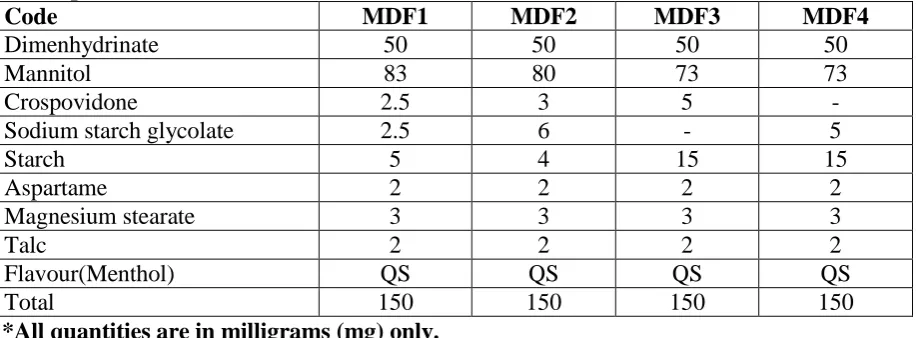
station rotary tablet machine. The formulations are shown in table no.1. Bulk density = W / VO
Tapped density = W / VF
www.wjpr.net Vol 4, Issue 09, 2015.
1127 Evaluation of MDT’s tablets (post-compression parameters)
Weight variation
Randomly, twenty tablets were selected after compression and the mean weight was
determined. None of the tablets deviate from the average weight by more
than±10.5%(USPXX).[14]
Tablet Hardness
Hardness of the tablets was measured by using hardness testers such as Monsanto hardness
tester, Pfizer hardness tester. The pressure required to break the tablets is measured as a
function of hardness (kg/cm2). The values obtained must meet the standard value.[15]
Friability
20 tablets were weighed and the initial weight of these tablets was recorded and placed in
Roche friabilator and rotated at the speed of 25 rpm for 100 revolutions. Then tablets were
removed from the friabilator dusted off the fines and again weighed and the weight was
recorded.[11]
Percentage friability was calculated by using the formula:
%Friability = Initial weight of tablets-final weight of tablets X100
Initial weight of tablets
Tablet thickness
Thickness of the tablet is important for uniformity of tablet size. Thickness was measured
using Vernier Calipers. It was determined by checking the thickness of ten tablets of each
formulation.[11]
Drug content
Twenty tablets were weighed and powdered. An amount of powder equivalent to 150 mg of
Dimenhydrinate was dissolved in 100ml of pH 7.4 phosphate buffer, filtered, diluted suitably
and analysed for drug content at 278 nm using UV-Visible spectrophotometer.[14]
In-vitro dispersion time
In-vitro dispersion time was measured by dropping a tablet in a Petridish containing 10 ml of
www.wjpr.net Vol 4, Issue 09, 2015.
1128 Disintegration time
The test was carried out on 6 tablets using the apparatus specified in I.P.-1996 saliva fluid
(Ph6.8) at 37ºC ± 2ºC was used as a disintegration media and the time in second taken for
complete disintegration of the tablet with no palatable mass remaining in the apparatus was
measured in seconds.[6]
Wetting time
A piece of tissue paper (12cmx10.75cm) folded twice was placed in a petri dish (internal
diameter=9cm) containing 9 ml of buffer solution simulating saliva pH 6.8. A tablet was
placed on the paper and the time taken for complete wetting was noted. Three tabletsfrom
each formulation were randomly selected and the average wetting time was noted.[16]
In-vitro dissolution studies
Dissolution testing of Dimenhydrinate dissolving tablets was carried out with paddle type in
USP dissolution apparatus at rpm 50 and temperature 37±0.5°C in 6.8 phosphate buffers. At
each specified intervals of time 5 ml sample was withdrawn and replaced by fresh media. The
samples were analytically tested to determine the concentration by UV spectroscopy method
at wavelength of 278nm.[17]
RESULTS AND DISCUSSION Solubility studies
Dimenhydrinate is soluble in ethanol, methanol and phosphate buffer 6.8 solution. But it was
found to be partially insoluble in water, different basic phosphate buffers of pH 6.8.
[image:6.595.71.530.589.758.2]TABLES AND FIGURES
Table no.1: Formulation development of Dimenhydrinate MDT’s by direct compression technique
Code MDF1 MDF2 MDF3 MDF4
Dimenhydrinate 50 50 50 50
Mannitol 83 80 73 73
Crospovidone 2.5 3 5 -
Sodium starch glycolate 2.5 6 - 5
Starch 5 4 15 15
Aspartame 2 2 2 2
Magnesium stearate 3 3 3 3
Talc 2 2 2 2
Flavour(Menthol) QS QS QS QS
Total 150 150 150 150
www.wjpr.net Vol 4, Issue 09, 2015.
[image:7.595.66.530.90.181.2]1129 Table no.2 Pre-Compression Parameter results
Code MDF1 MDF2 MDF3 MDF4
Bulk density (g/cm3) 0.537±0.004 0.521±0.006 0.523±0.002 0.503±0.002
Tapped density (g/cm3) 0.568±0.005 0.602±0.003 0.603±0.0031 0.598±0.008
Carr’s index(%) 10.718±0.190 14.840±0.334 14.013±0.422 15.678±0.397
Hausner’s ratio 1.275±0.206 1.300±0.226 1.154±0.025 1.176±0.029
Angle of repose(°) 26.77±0.221 27.38±0.340 24.84±0.151 24.887±3.205
Table no. 3 Post - Compression parameter results.
CODE MDF1 MDF2 MDF3 MDF4
Weight variation
(mg) 150.48±2.70 149.21±2.69
150.6±1.40
150.44±2.10
Hardness
(kg/cm2) 3.27±0.06 3.0±0.10 2.83±0.11 3.37±0.15
Friability
(%) 0.66±0.01 0.54±0.025 0.67±0.015 0.89±0.02
Thickness
(mm) 3.27±0.05 3.3±0.10 3.23±0.1 3.43±0.06
Wetting time
(sec) 21.17±0.65 15.9±0.62 27.87±0.35 32.4±0.47
Drug content
(%) 99.83±0.06 98.23±0.06 98.67±0.15 100.33±0.15
Disintegration time
(sec) 14.9±0.26 10.57±0.93 23.87±0.97 27.87±0.23
In-vitro dispersion
time(sec) 26.07±1.62 25.87±1.29 33.4±2.1 35.27±1.00
%CDR 93.06 94.35 87.08 88.25
Table no.4 Stability studies Time (Days)
MDF2 MDF2
HARDNESS
(Kg/cm2) %CDR
15 3.0 93.95
30 2.9 93.33
45 2.82 92.44
[image:7.595.66.541.210.471.2]www.wjpr.net Vol 4, Issue 09, 2015.
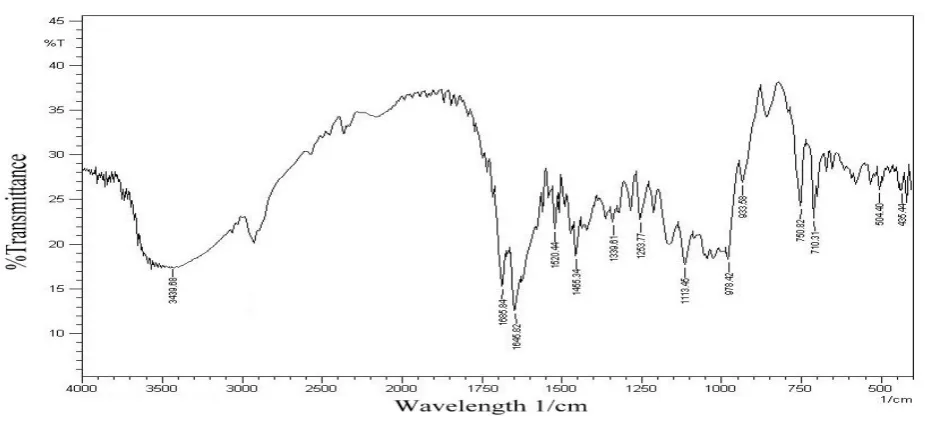
[image:8.595.79.508.74.311.2] [image:8.595.71.529.189.585.2]1130 Fig 1: FT-IR spectrum of pure drug (Dimenhydrinate).
www.wjpr.net Vol 4, Issue 09, 2015.
[image:9.595.79.546.61.797.2]1131 Figure 3: FT-IR spectrum of drug + Sodium Starch Glycolate.
Figure 4: FT-IR spectrum of drug + Mannitol.
[image:9.595.86.549.66.277.2]www.wjpr.net Vol 4, Issue 09, 2015.
1132 Figure6: Comparative drug release profilebetween MDF2 and MDF4MDT’s formulations.
DISCUSSIONS
FTIR studies revealed that there was no physico-chemical interaction between
Dimenhydrinate and other excipients results were displayed from figure no. 1 to 4. For each
designed formulation, blends of drug and excipients were prepared and evaluate for
Micromeritic properties shown in table 2.Bulk density was found to be in the range
of0.503±0.002to0.537±0.004 g/cm3, tapped density was found between 0.568±0.005 to
0.603±0.0031, Carr’s index was found between 10.82 to 15.92%,Hausner’s ratio found below
1.189 and angle of repose is found in the range of 24.84±0.151 to 27.38±0.340. This indicates
the good flow properties of powders. Four formulation of mouth dissolving tablets were
prepared by direct compression technique using superdisintegrants such as Crospovidone,
sodium starch glycolate in different ratios, Starch as a binder and Aspartame as a sweeting
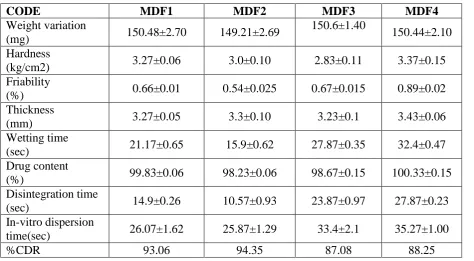
agent. All the formulation was evaluated for various physical parameters shown in table 3.The
weight variation of all formulation was within the ranges of 149.21±2.69 to 150.60±1.40, the
hardness of all MDT’s was in the ranges of 2.83±0.11 to 3.37±0.15, the friability of all formulation were below 1% indicates within the standard limit, Thickness of all MDT’s
formulation below 3.43, drug content was found to be in the ranges of 98.23 to 100.3, in-vitro
dispersion time was found between 25.87±1.29 to 35.27±1.00, The lowest in-vitro Dispersion
time for formulation F2 was 25.87 seconds and highest Dispersion time was found to be
formulation F4 was 35.27 seconds, The average in-vitro disintegration time for all the
formulations were in the range of was 10.57±0.93 to 27.87±0.23 seconds. The lowest in-vitro
www.wjpr.net Vol 4, Issue 09, 2015.
1133 was found to be formulation MDF4 was 27.87 seconds. So the amount of water uptake and
swelling will be more for this formulation F6 and this increased disintegration. The average
wetting time for all the formulations was in the range of 15.9±0.62 to 32.4±0.47 seconds. The
maximum wetting time of 32.4 seconds and minimum wetting time of 15.9 seconds were
shown by MDF4 and MDF2 respectively. The average percentage of drug release for MDT’S
formulation was found in the range of 87.08 to 94.35 % which is shown in table 3 and
comparative drug release profile of MDT’s formulation showed in fig 5 and 6. Out of all four
formulations, MDF2 is found to be best formulation. There was no change in color and shape.
There were no significant changes in hardness and %CDR. Two months of stability studies
revealed that there was no any significant degradation of the drug. The results found to be
satisfactory showed in table no.4.
CONCLUSION
Mouth dissolving tablets of Dimenhydrinate were prepared by using superdisintegrants such
as Crospovidone and Sodium Starch Glycolate by direct compression technique. A total of
four formulations were prepared which was confirmed by various characterization and
evaluation studies.All the formulations get disintegrated within a time period of 27.87
seconds when tested for in-vitro disintegration time, The MDF2 formulation containing
Crospovidone and Sodium Starch Glycolate in 1:2 ratios was found to have the higher
percentage of drug release compared with other formulations and The MDF3 formulation
containing Crospovidone and 10% Starchwas found to have the lesser percentage of drug
release compared with other formulations.
REFERENCES
1. D. Bhowmik, B. Chiranjib, Krishnakanth, Pankaj, R. Margret Chandira, Fast Dissolving
Tablet: An Overview. Journal of Chemical and Pharmaceutical Research., 2009; 1(1):
163-77.
2. Reeta Rani Thakur, Abhinave Sharma, Mridul Kashiv. Formulation, Evaluation and
Optimization of mouth dissolving tablet of losartan potassium: A cost effective
anti-hypertensive drug. Journal of pharmacy research., 2011; 4(7): 2294-6.
3. Praveen Khirwadkar, Kamlesh Dashora. A Review: Fast Dissolving Drug Delivery
System: Current Developments In Novel System Design and Technology. International
www.wjpr.net Vol 4, Issue 09, 2015.
1134
4. Velmurugan S, Sundar Vinushitha. Oral Disintegrating Tablets: An Overview:
International Journal of Chemical and Pharmaceutical Sciences., 2010; 1(2): 1-12.
5. Hitesh Jagani, Ravi Patel, Pratik Upadhyay, Jitendra Bhangale, Satish Kosalge. Fast
Dissolving Tablets: Present and Future Prospectus: Journal of Advances in Pharmacy and
Healthcare Research., 2011; 2(1): 57-70.
6. P. Ashish, M.S. Harsoliya, J.K. Pathan, S. Shruti. A Review- Formulation of Mouth
Dissolving tablet. International Journal of Pharmaceutical and Clinical Sci., 2011; 1(1):
1-8.
7. Chang RK, Guo X, Burnside BA, Couch RA. Fast-dissolving Tablets. Pharm Tech.,
2000; 24: 52-58.
8. Caraballo I, Fernandez-Arevalo M, Millan M. Superdisintegrants in Tablet Formulations.
Drug Dev Ind Pharm., 1997; 23: 665–9.
9. www.medicineindia.org/pharmacology-for-generic/226/dimenhydrinate.
10.Y.R Sharma. Elementary organic spectroscopy, principles and chemical application. 1st
ed. New delhi: S. Chand publication., 2001. p. 81-82.
11.Liberman H, Lachman L. The Theory and Practice of Industrial Pharmacy. 3rd ed.
Bombay: Verghese Publication House; 1991 p. 171-93.
12.Mohit Shrivastava, Deepak Chourasiya, Sanjay Soni, Deepak Patidar, Rajesh Jatav.
Formulation and in-vitro evaluation of mouth dissolvingtablets of phenytoin sodium using
different disintegrating agents. International Journal of Novel Drug Delivery
Technology., 2012; 2(1): 249-55.
13.Martin A, Micromeretics. In: Martin A, ed. Physical Pharmacy. Baltimores, MD:
Lippincott Williams and Wilkins; 2001. p. 423-54.
14.Kavitha .K, Sandeep D. S, Mehaboob Yadawad, More Mangesh. Formulation and
evaluation of oral fast dissolving tablets of Promethazine Hcl by sublimation method.
International Journal of Pharm Tech Research., 2011; 3(2): 660-3.
15.Ashish Garg, M.M. Gupta. A Review: Mouth Dissolving Tablets. Journal of Drug
Delivery & Therapeutics., 2013; 3(2): 207-14.
16.Ravi Kumar, M. B. Patil, Sachin R. Patil, Mahesh S. Paschapur. Development and
characterization of melt-in-mouth tablets of haloperidol by sublimation technique.
International journal of pharmacy and pharmaceutical sciences., 2009; 1(1): 65-73.
17.Errola Mahesh, G.B Kiran kumar, Mohammed G Ahmed, Kiran kumar. P. Formulation
and evaluation of Montelukast sodium fast dissolving tablets. Asian journal of biomedical