An open-source simulation platform to support the
formulation of housing stock decarbonisation strategies
Gustavo Sousaa,b,∗, Benjamin M.Jonesb, Parham A.Mirzaeib,
DarrenRobinsona
a
Sheffield School of Architecture, University of Sheffield, S10 2TN
b
Department of Architecture and Built Environment, University of Nottingham, NG7 2RD
Abstract
Housing Stock Energy Models (HSEMs) play a determinant role in the
study of strategies to decarbonise the UK housing stock. Over the past three
decades, a range of national HSEMs have been developed and deployed to
es-timate the energy demand of the 27 million dwellings that comprise the UK
housing stock. However, despite ongoing improvements in the fidelity of both
modelling strategies and calibration data, their longevity, usability and
reli-ability have been compromised by a lack of modularity and openness in the
underlying algorithms and calibration data sets. To address these shortfalls,
a new open and modular platform for the dynamic simulation of national (in
the first instance, the UK) housing stocks has been developed—thehousing
stock Energy Hub (EnHub). This paper describes EnHub’s architecture, its
underlying rationale, the datasets it employs, its current scope, examples of
its application, and plans for its further development. In this we pay
par-ticular attention to the systematic identification of housing archetypes and
their corresponding attributes to represent the stock. The scenarios we
anal-yse in our initial applications of EnHub, based on these archetypes, focus
∗
on improvements to housing fabric, the efficiency of lights and appliances
and of the related behavioural practices of their users. In this we consider a
perfect uptake scenario and a conditional (partial) uptake scenario. Results
from the disaggregation of energy use throughout the stock for the baseline
case and for our scenarios indicate that improvements to solid wall and loft
thermal performance are particularly effective, as are reductions in
infiltra-tion. Improvements in lights and appliances and reductions in the intensity
of their use are largely counteracted by increases in heating demand.
Hous-ing archetypes that offer the greatest potential savHous-ings are apartments and
detached dwellings, owing to their relatively high surface area to volume
ratio; in particular for pre-1919 and inter-war epochs.
Keywords: housing stock, dynamic energy simulation, open-source,
1. Introduction
The UK’s Climate Change Act aims to reduce the 1990 Greenhouse
Gases (GHG) emissions level by 80 % by 2050 [1]. To this end, the Committee
on Climate Change (CCC) has established a series of incremental targets
(or budgets) for the whole energy sector, including the production of 30 %
5
of electricity from renewable sources by 2020, and the reduction of GHG
emissions by 50 % by 2025. The UK emitted a total of 564 MtCO2e in 2011,
which is 36% below the peak value registered in 1979 and 28 % below that
of 1990 [2]. This reduction was mainly caused by a shift from coal to
nat-ural gas, by a displacement of industrial activity (primarily to Asia), and
10
by major improvements in the performance of the transport sector [3]. This
means that even though the reduction in this period is close to the CCC
target, this has largely been achieved in the absence of systematic structural
improvements to reduce energy demands. Some of the more significant
op-portunities for demand reduction are found in the domestic sector, where
15
emissions have been maintained at almost the same level since 1990 [2].
In 2011, the domestic sector contributed 124 MtCO2e to the total
emis-sions; two-fifths of these were caused by the generation of electrical energy
in power stations and the remainder by direct combustion of fossil fuels.
End-use energy demand in the domestic sector is attributed to four key
ser-20
vices: 60% to space heating, 20% to domestic hot water (DHW), 17% to
lighting and appliances, and 3% to cooking [4]. This highlights the
impor-tance of thermal energy flows in the development of Housing Stock Energy
Models (HSEMs).
Efforts have been made to improve the performance of the existing
hous-25
new buildings, serving a larger population, comprised of smaller households.
For this reason, a full understanding of the energy flow in dwellings, and
the factors influencing them, is required to formulate robust policies and
strategies [5, 6] to achieve significant reductions in their carbon emission
30
intensity. This requires further efforts on two fronts. On the one hand,
the disaggregated measurement of end-use energy demand to complement
existing surveys of housing characteristics for a representative sample of
archetypes; and on the other, the formulation and calibration of suitable
HSEMs, describing not only the performance of the existing stock, but also
35
how this stock is likely to evolve in response to policy measures designed to
reduce carbon intensity [7, 8].
In their recent review, Sousa et al. [9] systematically evaluated, using
a detailed matrix characterising their functionalities, usability and
accessi-bility, the attributes of the 29 HSEMs that have hitherto been developed
40
and deployed in the UK. From this they identified the Cambridge Housing
Model (CHM) as being the most fully developed. They also concluded that
a) the models should be transparent so that their underlying algorithms can
be understood and evaluated, and be amenable to improvement; b) future
HSEMs should have a modular architecture so that each module can be
45
edited and additional modules can be added; c) their underlying thermal
models should be dynamic, to support accurate prediction of indoor
tem-peratures and comfort, and the associated operation of heating systems; and
d) databases should track their sources and development, and be
continu-ally updated so they can maintain their validity. Furthermore, a successful
50
dynamic HSEM would ideally capitalise on available computing power, to
support the rigorous and exhaustive testing of alternative decarbonisation
The housing stock Energy Hub (EnHub) platform has been developed
in direct response to these observations. It is open and modular in
struc-55
ture, and enhances the virtues of existing HSEMs by dynamically simulating
the performance of the building archetypes that comprise the UK housing
stock; this latter requiring semantically attributed three-dimensional
rep-resentations. EnHub also facilitates the straightforward testing of targeted
housing stock decarbonisation scenarios, and is readily extensible to support
60
the integration of models predicting household’s investments to reduce their
carbon intensity, and the associated impacts, in response to policies and
strategies designed to stimulate these investments. By dynamically
sim-ulating the stock, it also facilitates the (future) study of how households
apportion the co-benefits arising from these investments: reducing energy
65
use and emissions on the one hand, and improving indoor thermal
com-fort and health on the other. Finally, EnHub improves on computational
scalability using cloud and high performance computing technologies.
The processing of data to represent the housing stock is achieved using
the statistical computing software R [10]. This is also used to construct
70
dwelling archetypes, which are then simulated using the dynamic building
simulation program EnergyPlus [11]. The platform creates geometrically
simplified models constructed of contiguous cuboids, following the Domestic
Ventilation Model (DOMVENT) [12] and Steadman’s model [13]; assigning
semantic attributes to these cuboids based on survey data (i.e. of envelope
75
properties and household variables). Thus, the platform is able to derive
more informative metrics than has hitherto been possible, including
inci-dences of discomfort, the proportion of the stock that over- or under-heats,
the heat gains per square metre of floor area, the disaggregation of energy
demands, and the estimation of peak thermal and power demands.
The paper begins by describing, in Section 2, the basis of EnHub: its
algorithms and data structures, and the workflow employed in its
applica-tion. Then, in Section 3, a number of scenarios to decarbonise the domestic
stock in the UK are tested and discussed in terms of their effectiveness. The
paper closes by critically evaluating the utility of EnHub, and by identifying
85
how its utility can be further enhanced to support the formulation, and the
more rigorous testing, of alternative decarbonisation policies and strategies.
2. Methods: Statistical Analysis and Engineering Models
The structure of EnHub takes its inspiration from the CHM, which is
at the core of theEnergy Consumption in the UK study [4], and has been
90
identified as the most flexible and powerful of prior HSEMs [9]. The principle
data set underpinning both EnHub and CHM is derived from the English
Housing Survey (EHS), which comprised 14,951 dwellings in its 2011 version,
and is weighted to represent the 21 million houses in England. This data
set is augmented by the Census and the Home Energy Efficiency Database.
95
The principle differences between EnHub and CHM, besides the more
granular and transparent architecture of EnHub, are that:
i. EnHub utilises the dynamic simulation programEnergyPlusfor energy
performance predictions, while CHM uses the Building Research
Es-tablishment Domestic Energy Model (BREDEM), a simplified energy
100
balance model.
ii. EnHub represents dwellings volumetrically, thus explicitly representing
built form and adjacency (e.g. exposed or shared walls), and facilitating
only scales the dwelling archetypes, limiting the analysis of envelope
105
transfers.
iii. EnHub’s archetypes represent the housing stock in a structured
hierar-chical way, which eases communication with its underlying data sets and
facilitates convenient testing of modifications to their attributes, while
CHM requires direct manipulation of models corresponding to individual
110
EHS entries: testing modifications is far from convenient.
iv. EnHub’s architecture is readily extensible to model households’ responses
to socio-economic drivers influencing investments and changes to
be-havioural practice that impact on net building energy demand.
v. EnHub employs a process of statistical data reduction to reduce the
115
number of archetypes to simulate, while CHM evaluates every instance
of the EHS data sets, with corresponding redundancy.
[Figure 1 about here.]
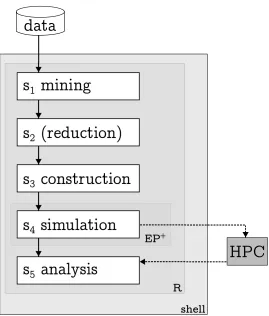
The steps involved in the application of EnHub are conceptually
sum-marised in Figure 1 and are described in detail in the following sub-sections.
120
Once the main data set is integrated into the platform, the open-source
sta-tistical computing platformRis used to mine these data and to reduce the
sample size by determining the most relevant archetypes contained in the
original data set. Then, this reduced data set is re-weighted to match the
original totals. The next step uses the archetypes to create a set of
seman-125
tically enriched volumetric models that are used byEnergyPlusto simulate
dynamic energy flows.
It is worth noting that both R and EnergyPlus can be paired with a
run in Command Language Interface (CLI) mode. In this way, both can
130
be controlled from within a shell1. The purpose of using a shell is that
1) the platform can be detached from the operating system and 2) a set
of low-level scripts can systematically control the modelling process. This
enables parallelisation, so that a High Performance Computing (HPC)
fa-cility can be called upon to accelerate the computation tasks, by around
135
two orders of magnitude. In this way, a number of computer nodes can be
simultaneously requested, each being allocated an instance of EnergyPlus
and a corresponding EnergyPlus Input Data File (idf). Hence, the
paralleli-sation of the simulation process depends on available HPC resources. The
generated data, on any chosen hardware, can then be re-integrated into the
140
process described in Figure 1. The results are then extrapolated to the
sub-sets of the UK stock represented by these archetypes, and the results are
analysed.
2.1. Step 1: Data Mining
To provide a level of confidence in the EHS data set, a data mining
pro-145
cess is performed. Data mining involves the application of diverse methods
to predict and/or classify typically complex databases [14, 15]. Predictive
methods usually apply regressions, although a highly developed sub-type
in-cludes hierarchical models (e.g. trees, additive models, neural networks) [5].
Classification methods usually apply cluster and ordination analyses, and
150
are mainly used to study large databases. Both predictive and classification
methods identify the proximity2 between variables, and can be adapted and
1
A shell is a program which provides an interface between the user and the operating system. Such an interface may be called via a CLI or via scripting files.
2
complemented to obtain further information about their emerging
relation-ships. For example, the strength of correlation between a range of input
variables and an output may determine influential input parameters; some
155
input variables may have a similar influence on the output, so they can be
combined or classified to reduce repetition. In studies employing survey
data, it is common to interpret a variable as an independent predictor (also
known as model misspecification), whereas in reality this should be linked
to functional associations. Looking at both the origin of the data and the
160
units of observation helps to identify such associations.
For housing stock studies, the chosen units of observation may be
di-rectly derived from real archetypes (representative samples) or deployed as
average archetypes (synthetic samples) [16, 17, 18, 19]. Their selection
de-pends on both the purpose of the study and the developer’s expertise. The
165
formation of archetypes requires predictive methods to define associations,
and to derive fit-for-purpose units of the stock. It is possible to use both
techniques to incorporate multiple sources of information, and to enhance
the robustness of the archetypes.
When considering a data set with inputs and outputs, the first step is
170
to test its linearity (summarised in the upper part of Algorithm 1). This is
useful for revealing similarity in the inputs, statistical independence of the
output variables, and—for the case of multiple variables—clusters of data.
To this end, two parameters are essential to define the level of linearity
among variables: proximity and correlation coefficients. Depending on the
175
structure of the data set (i.e. types of variables, number of cases, weights,
survey design), both parameters can be employed to ensure that reduced
versions of the dataset are appropriately structured and scaled. Previous
association [20, 21, 22], and there appears to be agreement in the value of
180
employing robust methods to account for the influence of categories, and
more importantly, to identify redundant variables in terms of their level of
significance [5, 23]. Robust methods apply criteria to reduce the impact of
multicollinearity, partial effects, and unclear distributions [24]; for instance,
by employing median values to identify influential variables, by removing
185
outliers, or by assuming partial distributions to avoid misleading tendencies.
Algorithm 1Data mining (on top) and reduction (on bottom) processes. Notation: ←
meansassigned from;→meansassigned to;∝meansis proportional to; := meanscreates and assigns
1. t e s t for l i n e a r i t y
L←glm(EHS, OutEnHubEnergySimulation)
190
2. t e s t for c o r r e l a t i o n
C←f pca(EHS, OutEnHubEnergySimulation)
3. s e a r c h for r e d u n d a n c y a p p l y i n g b a c k w a r d s e l i m i n a t i o n
glm(L, C, OutEnHubEnergySimulation)backwards
195
-4. re - s a m p l i n g p r o c e s s b a s e d on m i n i n g o u t c o m e s EHSreduced←(EHS∝LHS(EHS))
200
5. kruskal - w a l l i s t e s t and c o m p a r i s o n for c o n s i s t e n c y
KW t(EHS, EHSreduced)
6. o b t a i n p o p u l a t i o n s u b t o t a l s , i . e . the a c c u m u l a t e d
205
sum for e a c h g r o u p ( n )
TP →S1+S2+...+Sn
7. o b t a i n s a m p l e s u b t o t a l s Ts→s1+s2+...+sn
210
8. c o m p e n s a t e w i t h s c a l i n g f a c t o r for e a c h v a r i a b l e
cn→Sn/sn
9. a d j u s t p a r a m e t e r s a c c o r d i n g l y ( m e d i a n s or m o d e s )
215
if n:numeric t h e n si:=Sei
if n:categorical t h e n si:=Sbi
10. re - c o n s t r u c t s a m p l e u s i n g the c o m p e n s a t e d f a c t o r s Ts0→s1·c1+s2·c2+...+sn·cn
220
In our case, a linearity test is performed via Focused Principal
to identifying potential overlaps among the variables. FPCA extends the
classic approach of Principal Component Analysis (PCA) that applies scores
225
to the variance of the data and, by extracting the proximity of those
vari-ables that are ranked most highly, identifies redundant varivari-ables. It is also
useful in testing for correlations between variables, the presence of clusters,
and the measurement of variability [25] and collinearity [26]. FPCA is used
because it provides a virtual rank of the variables, thus identifying those that
230
are most influential. Furthermore, because non-linear relations and mixed
effects are expected in the EHS, FPCA is useful in ranking variables that
include categorical variables; acknowledging that, due to the dimensions of
the EHS, the outcomes are merely indicative and should be complemented
with alternative methods.
235
To tackle the problem of multicollinearity, GLMs may also be applied
to eliminate redundant variables. GLMs extend ordinary linear models by
including a distribution of the expected response and by assuming that more
than one variable is dependent [27]. In this way, as with FPCA, GLMs rank
the variance in the variables in addition of the level of significance3.
240
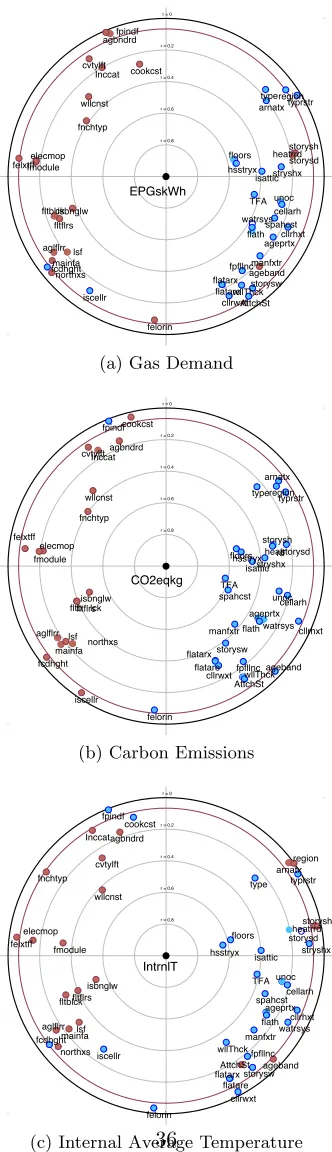
[Figure 2 about here.]
Figure 2 illustrates significant associations between input variables and
three corresponding foci: gas demand, carbon emission, and internal average
temperature. Here, the shorter the distance between a variable and the
fo-cus, the stronger their correlation [26]. The colour of the variables indicates
245
whether their correlation with the focus is positive or negative, where red
is positive and blue is negative. Also, variables in the same quadrant are
3
positively correlated, whereas those in opposite quadrants are negatively
correlated. For example, Figure 2c describes the degree of correlation of
variables with the average internal air temperatureIntrnlT. Here, both the
250
total floor area (tfa) and wall type (wllcnst) are at a similar distance from
the focus and are located in opposite quadrants. Therefore, they are
nega-tively correlated to each other, and have a similar magnitude of correlation
with their focus. However, tfa is blue and so is negatively correlated with
the focus, whereaswllcnst is red and is positively correlated with the focus.
255
These relationships can be explained by the characteristics of different
hous-ing archetypes, where older dwellhous-ings, constructed pre-1920, incorporate less
energy conserving materials in their envelope, and are generally bigger [28].
Finally, the surrounding coloured radial line indicates the limit of acceptable
associations, although the high number of variables considered in this case
260
makes this wide.
The linearity test is complemented by performing a process of backwards
elimination to remove redundant variables. This process consists of
rank-ing the variance of the variables, and systematically removrank-ing those havrank-ing
a minor influence. The level of significance of the whole model becomes
265
the criterion used to determine when the model sufficiently represents the
stock (see 3 in Algorithm 1). Because the GLM splits categorical values in
its classes to independently evaluate each of them, some uncommon
sub-categories may be eliminated in the process, but then be re-included in the
outcome regarding a main variable. For instance, this is the case when
con-270
sidering the main heating system, where 95% are central gas and electric
systems, and so the less common systems (e.g. oil, wood, and coal) are
initially removed from the GLM outcome.
the most influential parameters for each outcome, based on evaluating the
275
full EHS data set using the dynamic simulation program EnergyPlus. In
this way, it is possible to obtain different ranks according to the chosen
outcome variable. Likewise, Appendix A shows the resulting variables for
three reference outcomes of the model; here, the analysis reveals that fabric
components, particularly the geometric parameters, are essential for the
280
model, so that a relatively explicit representation of them is appropriate.
Table A.6 in the Appendix also highlights four variables that are shown as
significant in Figure 2: Total Floor Area (TFA), number of floors, DHW
and eHS (household size); each of these variables appear within the inner
circles in the Figure, and so are considered either for the reduction process
285
or in the construction of our volumetric archetypes.
[Table 1 about here.]
2.2. Step 2: Statistical Reduction
By generating volumetric archetypes, model complexity (in terms of data
inputs) and computational cost increase; for each archetype needs to be
ex-290
plicitly simulated. Therefore, it is useful to explore strategies to reduce
the number of them. An initial approach to achieve this, is to consider
the most influential geometrical parameters of the relatively homogeneous
housing stock, i.e. an attempt to encapsulate the different shapes that are
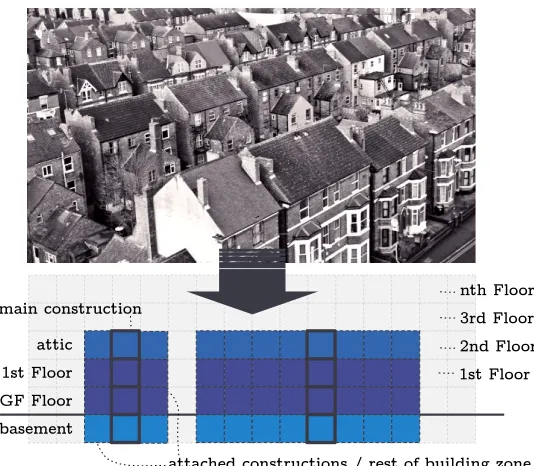
present in it. For instance, a cuboid configuration—as illustrated in
Fig-295
ure 7—is different for mid-terrace and end-of-terrace houses, which is
rele-vant when evaluating the effects of shared boundaries. It is also similar for
end-of-terrace and semi-detached houses, but with different proportions and
Variables C1−C4 in Table 1 represent the 64 combinations of
geomet-300
ric archetypes that represent the range of UK housing archetypes. These
geometric variables are complemented with semantic variables that
repre-sent heating systems, period of construction, tenure type, and region. As
expected, some of these variables are correlated with each other [29, 30, 9].
For example, older constructions employing solid masonry, have significantly
305
been larger than modern ones, have evolved from solid or oil fuels to gas,
and have mainly involved private owners. Gradually, due to the rise of local
authority housing schemes [31, 32], in addition to the simultaneous
improve-ments in energy conservation measures and policies [33, 28], the
modernisa-tion of the housing stock improved fa¸cades to reduce heat losses, introduced
310
electric heating systems, intensified the installation of efficient water
heat-ing technologies, and adapted to smaller households [34, 2]. The correlation
of such variables constitutes thus a reliable indicator among households,
dwellings and their energy performance. This can be seen, for example, in
the Government’s Standard Assessment Procedure [35], which is deployed
315
to catalogue building properties in the UK, and tabulates most of these
variables.
By including these semantic variables into the modelling of archetypes,
the relevant parameters identified in both the FPCA and the GLM are
preserved, so that the stock is effectively characterised. These variables,
320
summarised in the bottom of Table 1, are also employed to identify
re-dundancy in the data set, and hence to reduce its size by applying Latin
Hypercube Sampling (LHS), a method that improves the randomisation
pro-cess of a typical sample, by assigning a suitable distribution that describes
the range of possible values, or by specifying parameters for each variable
325
of Algorithm 1. It is worth noting that these properties are considered in
a reduced form, otherwise the combination of each category, as specified in
the EHS, would increase in size. Therefore, LHS is applied, varying the
sample size, the number of variables, and the iteration size. This sampling
330
strategy is convenient because it can handle both numerical and categorical
data, whilst ensuring that the statistical structure of the sampled synthetic
stock is a good approximation of the original survey dataset (e.g. in terms
of dwelling shape, size, envelope properties and technologies)—see Figure 5,
of which more later.
335
The results of the LHS indicate that by using the variablesC1−C8 (in
Table 1), the objective function stabilises with samples over 600 elements
and converges at around 1000 (see Figures 3a-3c). Both reference variables
and weighting values (used to compensate common properties) are used to
optimise the objective matrix for each EHS sampling unit. This reduction
340
process shows that when only a few variables are considered, the resulting
data set is highly affected by the sample size, whereas the data set with
more variables stabilises much faster. In our case, 1016 unique units are
sufficient to represent the structure of the stock. These are defined by the
combination of variables minus the non-existent configurations in the survey
345
data, that are able to represent the main composition of the housing stock;
a 15-fold reduction of the EHS data set, whilst adequately representing its
structure. An alternative method of creating a reduced stock is to associate
median parameter values to the 64 units formed from 7 of the 8 categorical
variables (C1−C6 and C8) given in Table 1 (C7 is excluded here because
350
it is too broad), but this risks an inadequate description of the structure of
[Figure 3 about here.]
Figures 5a-5b suggest that the loss of information through statistical
reduction does not have a significant impact on the representation of the
355
structure of the stock. For instance, Figure 5a shows that the median and
variance of GF area is well represented in the reduced data set; likewise the
GF storey height, albeit with slightly reduced variance. The characterisation
of categorical variables is similarly well represented, as seen in Figure 5b.
Similar results are found for all the input variables forming the data set. In
360
addition to this visual inspection, the resulting variability in the data set
is evaluated using a Kruskal-Wallis H Test (KWt) across all the variables.
This non-parametric test can be used to identify whether the variables in
the reduced data set maintain the original information. The KWt compares
the correlation of variables in the data set, so they can be numerical or
365
categorical. It is also used when the examined groups are of unequal size,
and so can be used to compare the EHS and reduced data sets of 14,951 and
1016 cases, respectively.
His a measure of the relative proximity in the correlation of both groups.
Large values ofH indicate that the data sets are significantly independent.
370
Because the KWt assumes a distribution, then H can be used to measure
the level of significance defined by the distribution under the null hypothesis;
this hypothesis establishes that the difference between the medians—of each
parameter value—in both groups is null (or quasi-null). Therefore, a value
below the level of significance suggests that the groups, in a given category,
375
are different.
Table 2 shows that six of the input variables have a p-value < 0.05,
data set. However, none of them directly affects the composition of the
volumetric cuboids. Because the EnHub platform uses the reduced data
380
set, a significant variation is expected in the level of detail of non-primary
components, such as secondary heating systems and boiler parameters. To
determine whether EnHub’s predictions of energy performance are sensitive
to these parameters, a One-at-a-time (OAT) sensitivity analysis is applied,
in which it is found that dwelling archetype significantly impacts energy
385
performance; but this variability, expressed by H, is more sensitive to the
contiguous cuboids whose geometry is configured and scaled using the
re-duced data set, i.e. modifying width, height, and depth, as well as adjusting
the openings ratio, in each of the volumetric archetypes.
2.2.1. Sensitivity Analysis 390
Sensitivity Analysis (SA) techniques are primarily used to quantify input
uncertainties [38, 39, 40, 41] and to measure the variation of model outputs
relative to their inputs [42]. SAs are important for tracking errors and
assumptions in model inputs and for determining input influence. When
applied to housing stocks, they can reveal when the resolution of the data
395
set introduces insufficiently granular representation of the parameters, and
can also quantify the extent to which modelling algorithms are unable to
effectively project the variability that is found in practice.
As a result, the implementation of SAs is useful to test the
effective-ness of strategic changes to housing stocks, identifying potentially impactful
400
parameters to study when evaluating decarbonisation scenarios, and to
im-prove the development of stock models [43, 44, 45].
Global and local SA are two common methods employed in housing
stock evaluations. The former considers a set of samples, with
simultane-405
ous changes in their variables, so that interactions between them are also
represented, to evaluate the effect on the outcome or the response; the
lat-ter performs derivative changes at a single point, so that the response is
affected by single and sequential changes only [42]. A technique commonly
employed for global and local sensitivity analysis is the regression method.
410
Tian [46] claims that it is the most widely used method for SA in building
energy analysis, particularly when the inputs are independent. However,
this requirement can be problematic when two or more model inputs are
correlated. Therefore, it is common to combine both global and local SAs
to determine the level of significance of the inputs.
415
A common local SAs method is the One-at-a-time (OAT) approach,
where each input parameter is varied at a defined interval while the
oth-ers are held constant [47, 43]. The OAT approach has been extended to
screening methods [48, 49], which compare the uncertainties in the inputs
to those in the outputs. The Morris method (also called the elementary
420
effects method) is the technique most often used in this domain. Here, each
input variable takes a discrete number of values that are chosen within
lim-its defined by their statistical properties. The method provides a measure
of the mean value, µ, which estimates the overall effect of the input on the
output, and a measure of the standard deviation,σ, that estimates
second-425
and higher-order effects of the input variable [50, 48]. This process is
out-lined in Figure 8 where the set of variations is assigned in the input data
set, enabling the possibility to compare against a baseline.
The enriched cuboids, global, and OAT analyses are performed to
iden-tify the most influential parameters in the data set, many of which have been
identified in previous studies [40, 43, 51, 45]; albeit using different simulation
workflows. In EnHub, they are directly included in the simulation platform.
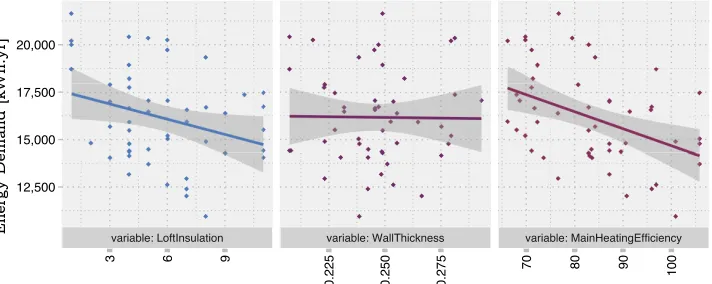
For example, Figure 4 presents results from the application of SAs by
con-trolling changes to the properties of elements contained in the catalogue of
properties used to generate idfs, and by modifying the reduced data set (or
435
indeed by modifying properties related to the external environment, such
as weather files). Figure 4a shows that changes in loft (sometimes known
as attic) insulation and heating system efficiency significantly affect the
en-ergy performance; more so than increasing the wall thickness, as indicated
by their gradients. Figures 4b and 4c compare two output variables by
ap-440
plying a screening method, which makes it possible to combine variables of
different class. Each input variable defines a dimension for the analysis in
which a trajectory of perturbation is defined. The trajectory is chosen by
advancing within the same dimension or to one other. In other words, any
input variable can be selected and changed from an initial stage, but this
445
is limited to the next possible value, either forwards or backwards in its
own dimension. The input change constitutes the next initial stage, and so
the trajectory is developed. This allows comparisons between the discrete
values of each input variable with those of the output. There is widespread
agreement that this method is versatile and useful [48, 49], but the
comput-450
ing time increases significantly and so its application to large data sets is
limited. EnHub accomplishes this analysis by selecting variables based on
expertise, and their use in national programmes and policies.
The results of the SA module are consistent with those presented in
previous studies [43, 51], where a rank of parameters establishes that the
455
differential of temperature between the outside and the inside of a dwelling
systems (space and DHW), and infiltration rates. Thermal transmittance
(commonly known as U-values) is also prominent, especially for walls, as is
the number of occupants, although this value is limited in impact since it is
460
decoupled here from the associated activities (e.g. use of appliances).
Similarly, yet limited in previous studies due to poor representation of
external parameters, solar energy technologies and socio-demographic
vari-ables are identified by the OAT analysis as being significant, and so they
are directly included into the model archetypes. Moreover, the original units
465
of the data set are directly derived from the EHS, which in turn uses the
Postcode Address File (PAF) and the Lower-Super Output Area (SOA) to
define their weights4, which are used to represent the whole English
hous-ing stock. These units are selected randomly and merge information from
nearby PAFs, and the extrapolation is delimited by census subtotals. The
470
inherent bias in this method, because of the generalisation of categorical
variables, affects solar-related parameters, and the definition of
representa-tive households. Thus, improving the quality of information describing these
variables would improve their significance.
[Table 2 about here.]
475
[Figure 5 about here.]
Once the data set has been reduced, the units are re-weighted, and their
tenure and regional information are re-calibrated following a method
em-ployed by many other nationwide surveys [52] (see 6-10 in Algorithm 1).
4A weight, or weighting variable, assigns a value to a given case in a data set to
This method compensates for the assumptions made in the sampling process
480
which, as in the EHS, introduces a loss and bias of information [51]. The
im-pact of this reduction affects the performance of the simulation algorithms,
because their inputs may not exist or may be over-generalised. Hence, there
is virtue in developing a modular approach to construct archetypes,
inde-pendently.
485
[Figure 6 about here.]
2.3. Step 3: Archetype Construction
The set of geometrically simplified models are constructed in a modular
fashion, following an Object-Oriented Modelling (OOM) approach;
essen-tially a collection of interacting objects, where each object is semantically
490
defined with variables, classes and dependencies [53]. An OOM approach
provides the ability to detach specific sections of the modelling process, so
that they can be refined independently. OOM can be represented
graphi-cally using the Unified Modelling Language (UML) architecture to provide
a clear and unambiguous structure for the model attribution workflow, and
495
to enhance the integrity of the predictions of the algorithms used to
de-scribe the energy flow pathways [54]. That is, the architecture shows the
logic in which the components are considered, as well as the distribution
and interrelationship of inputs and outputs used throughout the platform.
EnHub utilises a UML class diagram type (CD), focussed on the
char-500
acteristics of the modules and their relationships. Similar implementations
have been used elsewhere to improve the development of highly detailed
libraries of classes to support more robust management of databases and
modelling algorithms [17, 55]. The EnHub approach is based on both the
idfdocumentation [56, 11] and the BREDEM structure [57], applied using
the CHM protocol [58]. The UML architecture is presented in Figure 6 and
its main components (that form the archetype-specific idfs) are summarised
in Table 3.
To link the EHS with the archetype-specific idf modules, a base case
idfis developed where variable flags5 are used to represent instances of the
510
UML classes. In this way, each EHS sample unit can be associated with its
corresponding property fields and used to structure, scale and attribute the
volumetric archetype appropriately. These archetypes are explicitly
repre-sented as sets of contiguous cuboids (see Figure 7a) that account for the
number of floors and the presence of attics, basements, and attachments
515
such as extensions and conservatories; Table 1 summarises the variables
used to built such a base case. Specifically, an array of cuboids is built by
processing the archetype information; cuboids attached to the main zone,
either on top or at the sides, can then be scaled or removed as required.
This helps to maintain the connection of shared surfaces. In this way, it is
520
possible to represent the key residential types of the stock, such as detached
houses, semi-detached, end of terrace, mid terraced, flats (also known as
apartments) and bungalows (see Figure 7b). These forms, complemented
with their semantic attributes, comprehensively and robustly describe the
derived stock of archetypes, but are now based on an explicit volumetric
525
representation (see Figure 7c).
[Figure 7 about here.]
The volumetric representation used by an idf includes the assignment
of internal zones. EnHub follows the BREDEM representation, using two
5
zones. These are initially defined in each cuboid archetype using a main
530
zone, and a distinct secondary zone that represents the rest of the building.
For example, in Figure 7a, the ground floor (GF) is initially assigned to the
former, whereas the basement, the first floor (1F) and a room in the roof (in
some cases, interchangeably referred to as attic), are assigned to the latter.
The attached constructions are employed to incorporate differences between
535
detached dwellings and those forming terraced rows. Moreover,
relation-ships between openings (i.e. windows, doors, accesses) and total floor areas
are defined for each zone. In Figure 7b, the semi-detached house, as shown
in the middle, increases the number of surfaces at whichEnergyPlus
simu-lates solar radiation. Hence, the relevance of a volumetric representation of
540
archetypes, and the need to appropriately characterise openings.
Employing a base caseidfto construct the volumetric archetypes helps
to respect EnergyPlus’s precise coordinate structure. Furthermore, whilst
idfproperty fields can be combined in any order, it is convenient to follow
the sequential structure of the EnergyPlus format [56, 11], because this
545
helps with the readability in the representation of our archetypes, and the
convenience with which their attributes may later be manipulated. The
steps involved in adapting the base case idf are described in the pseudo
code shown in Algorithm 2.
Algorithm 2Construction, simulation and analysis of archetypes;
Notation: h,imeansis a subset of
550
1. c o n s t r u c t d w e l l i n g a r c h e t y p e s for s i m u l a t i o n ;
s r e p r e s e n t s the s i z e of the d a t a set e m p l o y e d
l o o p :
for i:=1 to s do
sA−general←f(SAP,hEHSi) 555
sB−location←f(SAP, ON S,hEHSi)
sC−schedules←f(ON S,hEHSi)
sD−envelope←f(ON S,hEHSi)
sE−geometry←f(ON S,hEHSi)
sF−internal←f(SAP, ON S,hEHSi) 560
sH−water←f(SAP, ON S,hEHSi)
sI−outputs←f(EP lib,hEHSi)
d o n e
565
2. s i m u l a t e d w e l l i n g a r c h e t y p e s l o o p :
for i:=1 to s do
simulation←f(i, weatheri, schedulesi)
d o n e
570
3. a n a l y s e s i m u l a t e d d w e l l i n g a r c h e t y p e s l o o p :
for i:=1 to s do
summary←f(i, EHS, Outi)
575
derived←f(i, EHS, Outi)
A catalogue of appliances and heating systems is included in the base
case idf to describe internal gains. Their specifications (i.e. power,
effi-ciency and heat gains) and fuel sources are defined using the EHS and the
580
Energy Consumption in the UKtables [59]. Similarly, household water
ser-vices are included in theidfs, although they are reduced to a total annual
demand. Occupants and their associated (estimated) metabolic gains are
also included, and can be directly linked to specific intensity values, such as
heat gain per person and floor area per capita.
585
The dynamic actions of devices and occupants are emulated using
sched-ules. These include time-related events, such as occupant presence, or the
use of appliances, window openings, heating systems, and water fixtures.
The schedule profiles are prepared for each model by applying a
probabilis-tic function that is dependent on the properties of each archetype, such as
590
the household composition or dwelling type (see the pseudo code shown in
Algorithm 3). This means that even though profiles follow similar patterns,
each element is unique. This approach enables the behaviours of a specific
group of archetypes to be analysed. The resolution of a schedule is
indepen-dent of the model, but they are conveniently paired with the computational
595
for each day type are built for an entire year, but they can be seasonal.
Algorithm 3Probabilistic profile generation
1. e x t r a c t p r o f i l e f r o m n a t i o n a l a v e r a g e d a i l y p r o f i l e s
Mn ← e x t r a c t ( d a t a : a v e r a g e u s a g e ); n e l e m e n t s
600
2. e x t r a c t r e p r e s e n t a t i v e h o u s e h o l d p a r a m e t e r s
Hhp ← e x t r a c t ( d a t a : h o u s e h o l d ); p p o p u l a t i o n
3. a s s i g n a p r o b a b i l i s t i c f u n c t i o n to e a c h p r o f i l e
605
b a s e d on a v e r a g e d a i l y u s a g e
dn ← P(Mn)
4. c r e a t e r a n d o m p r o f i l e b a s e d on p -f u n c t i o n for
a g i v e n p e r i o d
610
l o o p :
for i:=1 to 1 0 1 6 do
for j:=1 to n do
for k:=1 to 365 do
r a n d o m i s e (Hhi, djk)
615
In the same vein, EnHub uses a library of standardEnergyPlusWeather
(EPW) files to describe local environmental conditions for the defined
pe-riod. The appropriate weather files, used by EnergyPlus, are associated
according to the regions that the model archetype has explicitly been
allo-620
cated to. The regions are aligned to the resolution provided by the EHS:
NUTS-16 level, which encloses subdivisions of the four UK countries, and
is regulated by the European Union. These EPW files are synthesised Test
Reference Years (TRYs), where each month represents an average over a
period of around 20 years. Each month may come from a different year,
625
and so they are combined using a cubic spline method [60]. This method
interpolates the data when gaps and inconsistencies are present.
[Table 3 about here.]
6
2.4. Step 4: Dynamic Simulation
As noted earlier, the platform architecture has been designed to provide
630
for both flexibility and scalability. For example, it can simulate a single
archetype and systematically modify the parameters of A1 and C2 (see
Table 3) to increase temporal resolution; it can employ a OAT sensitivity
analysis module to analyse key independent variables (fabric properties, use
intensity, devices efficiency) for one or more archetypes; or it can simulate
635
the entire UK housing stock to evaluate different scenarios (see Sections 1
and 3). Analyses can also be geographically constrained, to simulate the
housing stock of a city. This scalability results from the ability to detach
processes, as well as from the aforementioned modularity.
The whole stock is simulated for an entire calendar year, plus an
addi-640
tional preheating period, at an hourly resolution. This resolution is
reason-able, given that we are not explicitly modelling ventilation, nor accounting
for the associated stochastic behaviours of occupants (although this will be
amended in the future); we simply utilise a fixed infiltration rate, and
ven-tilation heat gain schedules. Each simulation takes around 30 seconds to
645
complete using a single core high-end computer7. However, multiple
simula-tions of the 1016 archetypes are required and so the workflow is coupled with
a High Performance Computing (HPC) cluster8, to reduce the simulation
time by over 98%. Figure 1 presents the conceptual structure of EnHub and
shows the communication paths between the components of the platform
650
and the tools required to support it.
7
Software specifications: EnergyPlus version 8.4, R version 3.2; Hardware specifica-tions: Processor Intel Core i5 2.9 GHz CPU, 16 Gb RAM
8166 compute nodes (Dell C6220), with 2x 8-core processors (Intel Sandybridge
2.5. Step 5: Iterative Analysis
The derived energy performance indicators are processed in R so that
they can be conveniently stored and compared. Thermal comfort indicators
are computed in EnergyPlusbased on the ASHRAE-55 standard [56], but
655
in the future they could be readily complemented with other indicators of
instantaneous comfort, or of over- or under-heating risk, by post-processing
theEnergyPlusresults within EnHub.
Each batch of simulations of the 1016 archetypes is stored in a database,
in which multiple (input, output and auxiliary) data sets are linked by
com-660
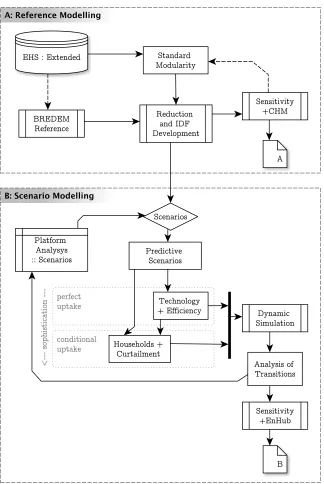
mon identifiers (see Figure 8); enriching analysis options. SA is employed
both for reference modelling (choice of archetypes and parameters to
sam-ple from) and scenario modelling (choice of parameters to act on). Figure 8
shows that there are two stages to the simulation process: the first stage
(A) focuses on data resolution, whereas the second (B) focuses on modelling
665
parsimony and the study of different scenarios.
[Figure 8 about here.]
3. Application to Evaluate De-carbonisation Scenarios
Here we deploy the EnHub platform to evaluate a baseline and a series
of measures that are designed to reduce UK housing stock carbon intensity.
670
3.1. Definition of Scenarios
The workflow summarised in Figure 1 is used to test twoCO2 reduction
scenarios that are adapted from national policies [61, 62, 4, 63]. The first
emulates a perfect uptake scenario, where the fabric properties and
appli-ances of dwellings are upgraded to be as efficient as is plausibly possible,
regardless of their current values, associated costs, or the level of
disrup-tion in adopting them. The second is a conditional uptake scenario (see
the pseudo code shown in Algorithm 4), where the upgrade is limited to a
fraction of the stock represented by a particular archetype, and considers
real-life constraints, such as costs, disruption, and the initial values of the
680
parameters of interest; so diminishing the likelihood of uptake of measures
that entail marginal gains or heavy disruption.
Algorithm 4Implementation of conditioned uptake scenarios
1. o b t a i n t e c h n i c a l p o t e n t i a l of i m p l e m e n t a t i o n
technicali←f(savings, trigger, uncertainty)
685
2. o b t a i n i n c o m e / f u e l e x p e n d i t u r e r a t i o
incomei←f(income, trigger, uncertainty)
3. o b t a i n t y p o l o g y f e a s i b i l i t y p a r a m e t e r
690
contraintsi←f(current, trigger, uncertainty)
4. o b t a i n r e t u r n of i n v e s t m e n t r a t i o
roii←f(cost, trigger, uncertainty)
695
5. i n c l u d e r a n d o m u p t a k e p r o c e s s
randomi←f(individual, trigger, uncertainty)
6. e v a l u a t e w i t h t h i e r c o r r e s p o n d i n g u p t a k e t r i g g e r s i: h o u s e h o l d s
700
Ui←f(technicali, incomei, contraintsi, roii, randomi)
[Table 4 about here.]
The selected scenarios and associated measures are summarised in
Ta-ble 4, which describes the current status of the dwellings, and the variations
705
that are then parsed to the model, with each scenario considered in isolation.
For each scenario, an additional case is tested to understand the
implica-tions of different occupancy profiles and patterns of usage; these are based
on average profiles defined in the Energy Consumption in the UK study
[4]. Here, multiple profiles are defined based on their existing probabilistic
distributions [4], so that the values relate to each archetype, and to each
element associated with an activity (as previously shown in Figure 3).
3.2. Results
[Table 5 about here.]
[Figure 9 about here.]
715
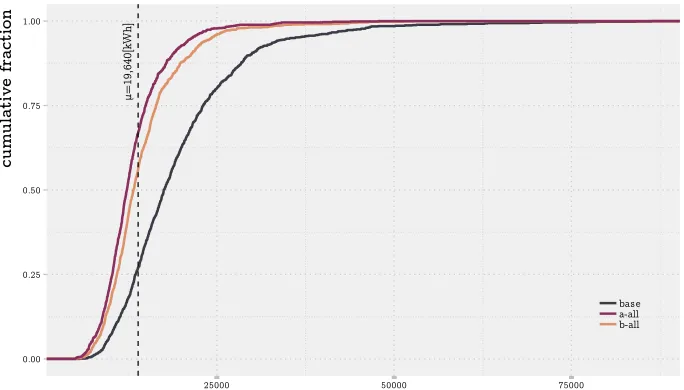
Table 5 and Figure 9 summarise the outcomes from the perfect and
conditional uptake scenarios, whose measures are given in Table 4. They
show that when perfect uptake is assumed, A02 and A01 have the greatest
impacts, arising from improved fabric performance. Other impactful
scenar-ios are A05, A08, and A06; these latter two being partially counteracted by
720
increased heating loads, affecting indoor temperature. When household
con-straints are considered in respect of scenario 02 (A01 to B02), the potential
emissions reduction is reduced by around 40%. The constraints considered
in measures B01-B07 are related to the disposable income of a household
or to the increased costs associated with more technically challenging cases,
725
such as housing in conservation areas, solid masonry walls in old buildings,
or the insulation of loft spaces that are used for storage purposes with limited
accessibility.
[Figure 10 about here.]
The combined scenario (A01+A02) has a relatively high impact on
en-730
ergy demand reduction (319 TWh, 25% less than the baseline). Table 5
shows that their combination is roughly equivalent to all the scenarios
com-bined (All). Likewise, Table 5 outlines the associated potential to reduce
some of the benefits of the individual measures overlap, so that the outcome
735
is not the simple arithmetic sum of each respective saving, and so combining
multiple measures does not guarantee a substantial improvement. This can
be seen, for example, in Figures 9 and 10 that reveal the extent to which
energy demand is reduced by combining all the measures.
[Figure 11 about here.]
740
Improvements to the fabric may be more likely to be viable for old and
large dwellings because of the relatively poor performance of their fabric
elements, and their relatively large surface areas. However, sometimes the
spaces within these type of buildings have been repurposed and cannot be
modified. For example, it is difficult to install energy conservation measures
745
in a loft that has been designated for storage. Figure 11 outlines the
pro-portion of dwelling typologies (by epoch and type) in terms of accumulated
floor area in the housing stock. This helps to identify the archetypes that
have particular decarbonisation potential, or lack of. For example, pre-1919
terraced dwellings accumulate the greatest floor area in the stock, but their
750
uptake potential is limited by the aforementioned constraints.
[Figure 12 about here.]
Figures 12a and 12b outline differences in the energy intensity of dwellings
by archetype. The area formed by the axis variables represents the total
energy demand (428 TWh for the baseline case). This helps to better
un-755
derstand the effectiveness of the different measures, particularly when there
are real-world constraints that affect their implementation. For instance,
Figure 12a shows that, even though the accumulated energy demand
be seriously constrained. Figure 12b shows that apartments are particularly
760
sensitive to our modelled perfect uptake measures; albeit constrained by the
relatively small cumulative floor area.
[Figure 13 about here.]
Figure 13 suggests that renovation measures may impact on occupants’
thermal satisfaction, as the mean indoor temperature is elevated (relative
765
to the base conditions) by around +0.8 K. This is due to indoor air
temper-atures that exceed the heating system set-point when it is on (due to excess
solar gains), or are higher when the heating system is off (due to better
con-servation of energy). These improvements are expectedly more noticeable
in the cold season, reducing energy bills among the population. Due to a
770
lack of supporting data, any co-benefits to carbon emissions and comfort
levels that arise from renovation measures are ignored here (meaning that
potential energy savings may not be fully realised due to improved comfort
from higher indoor temperatures).
Finally, while scenarios A06-07 and B06-07 show that substitutions of
775
lights and appliances are low-cost upgrades with a quick return on
invest-ment, they are not very effective. Increasing the efficiency of appliances is
clearly a quick and easy way to reduce electrical energy demand, but this
can be counteracted by increased heating demands.
The study of scenarios is useful because it enables the quick and
conve-780
nient exploration of the limits of potential impacts arising from related
poli-cies or strategies. The testing of scenarios that consider the conditional
up-take of measures gives an understanding of potential to upup-take constraints;
but they do not shed light on probable outcomes. This would require a
thorough understanding of the underlying drivers affecting the uptake of
energy-related improvements by households, and the associated trade-offs
between energy demand, costs, comfort, and convenience; likewise, changes
to energy-using practices. EnHub will be continually improved to facilitate
more granular analyses, and to integrate a platform simulating occupants’
energy-using behaviours and associated adaptive comfort, as well as a
so-790
cial simulation platform to predict changes in households’ investment and
energy-using behaviours.
This combined platform has the potential to considerably improve upon
the ability to reliably diagnose where the greatest potential for socio-technical
innovation lies on the one hand—with a view to decarbonise the housing
795
stock; and to design, test and implement policies and strategies to realise
this potential on the other.
4. Conclusion
This paper presents a new open-access modular platform for the dynamic
simulation of the UK housing stock—EnHub, with a view to efficiently
eval-800
uating the effectiveness of national decarbonisation strategies. At present,
this is restricted to the analysis of the possible implications from perfect
or assumed uptake of these strategies, whether physical (building envelope,
systems and appliances), or behavioural.
Housing stock decarbonisation is a long-term endeavour that requires
805
constant updates to the evidence base and recalibration of models. We
believe that EnHub can facilitate better inter- and trans-disciplinary
col-laboration, by providing a standardised hub to combine data models from
different perspectives. We also believe that an open-source dynamic
simula-tion platform, such as EnHub, offers greater utility and longevity, compared
to its closed and steady-state counterparts. This is reinforced by making
each component, of the semantically attributed 3D representations of the
archetypes comprising the UK housing stock, editable and verifiable.
To facilitate widespread accessibility, EnHub may be downloaded, upon
signing a by-attribution license agreement, from the open source version
815
control repository GitHub. This also helps to facilitate and manage
con-tributions from other potential developers of EnHub—further enriching its
future functionality. Furthermore, work is currently underway to improve
the usability of EnHub, through a graphical user interface. In principle, this
may widen the user base from those interested in national decarbonisation
820
policy, to include those that are interested in regional and city scale
de-carbonisation policy and planning interventions—by including geographical
constraints in its application.
Finally, to address the above restriction of assumed uptake of
decarbon-isation strategies, we plan to facilitate the combined modelling of household
825
investment behaviours, and their responses to changes to the underlying
drivers that influence them (e.g. regulatory, financial, educational, social,
technical), and energy-using behavioural practices; this latter through
in-tegration with the multi-agent stochastic simulation platform Nottingham
Multi-Agent Stochastic Simulation (No-MASS) [64].
HPC
data
[image:34.612.169.438.125.441.2]shell
Figure 1: Steps involved in the application of EnHub. The statistical platformRis em-ployed to perform all the steps. The computationally-intensive tasks, such as the simula-tion step, can be performed using a different hardware whereEnergyPlusis installed.
835
●
r = 0
r = 0.2
r = 0.4
r = 0.6
r = 0.8
● ● ● ● ● ● ● ● ● ●● ●● ● ● ● ● ● ● ●● ●● ● ● ● ● ● ● ● ●● ● ● ● ● ●● ●● ● ● ● ● ● EPGskWh arnatx fmodule felorin northxs region ageband type isattic iscellr floors AttchSt heatrrd agbndrd Inccat flatare typrstr felxtff cvtylft wllcnst wllThck elecmop fpindf unoc ageprtx fnchtyp watrsys hsstryx cellarh storysw storysd storysh cllrwxt cllrhxt stryshx fcdhght manfxtr ● aglflrr●lsf fltblckisbnglw fltflrs flath flatarx fpfllnc spahcst cookcst TFA . . ●mainfa
(a) Gas Demand
●
r = 0
r = 0.2
r = 0.4
r = 0.6
r = 0.8
● ● ● ● ● ● ● ● ●● ● ● ● ● ● ● ●● ● ● ● ● ●●● ● ● ● ● ● ● ● ● ● ● ● ● ● ● ● ● ● ●●● ● ● ● CO2eqkg arnatx fmodule felorin northxs region ageband type isattic iscellr floors AttchSt heatr agbndrd Inccat flatare typrstr felxtff cvtylft wllcnst wllThck elecmop fpindf unoc ageprtx fnchtyp watrsys hsstryx isbnglw cellarh storysw rdstorysd storysh cllrwxt cllrhxt stryshx fcdhght mainfa manfxtr aglflrr lsf
fltbfltflrslck
flath flatarx fpfllnc spahcst cookcst TFA . .
(b) Carbon Emissions
●
r = 0
r = 0.2
r = 0.4
r = 0.6
r = 0.8
● ● ● ● ● ● ● ● ● ● ●● ● ● ● ● ● ● ●● ●● ● ● ● ● ● ● ●● ● ● ● ● ● ● ● ● ● ● ●● ● ● ● ●● IntrnlT arnatx fmodule felorin northxs region ageband type isattic iscellr floors AttchSt ●heatrrd agbndrd Inccat flatare typrstr felxtff cvtylft wllcnst wllThck elecmop fpindf unoc ageprtx fnchtyp watrsys hsstryx isbnglw cellarh storysw storysd storysh cllrwxt cllrhxt stryshx
fcdhghtmainfa manfxtr
aglflrr lsf fltblckfltflrs flath flatarx fpfllnc spahcst cookcst TFA . .
[image:36.612.222.388.126.702.2](c) Internal Average Temperature
Figure 2: Focused Principal Component Analysis (FPCA) visualisation. The estimated energy demand in the models is the sum of fuel energy demands, in which (a) considers the main fuel used in the stock. To identify other variables affecting the overall energy demand, (b) considers the associated carbon emissions, which is directly dependent of
100 200 400 800 3200 1600 6400
0 250 500 750 1000 1250
iterations: sample size
100 200 400 800 1600 3200 6400 160.0% 120.0% 80.0% 40.0% ob jectiv e criterion
(a) 3 pivotal variables - from Table 1
100 200 400 800 3200 1600 6400 99.8%
100.0% 100.2% 100.4%
0 250 500 750 1000 1250
iterations: sample size
100 200 400 800 1600 3200 6400 ob jectiv e criterion
(b) 7 pivotal variables - from Table 1
100 200 400 800 3200 1600 6400
0 250 500 750 1000 1250
iterations: sample size
100 200 400 800 1600 3200 6400 180.0% 150.0% 120.0% 90.0% ob jectiv e criterion
[image:37.612.128.486.116.594.2](c) 40 pivotal variables - from EHS
Energy
Demand
[k
Wh.yr]
(a) Global SA - insulation, thickness, efficiency. The Confidence Interval (CI) is determined by applyinglocally weighted scatterplot smoothing.
250 500 750 1000 1250 1500 1750 2000
750 1500 2250 3000 3750 4500 5250 6000 ∆ differential mean [kWh]
standard deviati on [k Wh] BASE AOc FHg HEf FCn Dft WTk WAr LIn Reg WTy
(b) Screening Method - energy demand reference 0.200 0.400 0.600 0.800 1.000 1.200 1.400
0.100 0.200 0.300 0.400 0.500 0.600 0.700 0.800
∆ differential mean [K]
standard deviati on [K] BASE AOc FHg HEf FCn Dft WTk WAr LIn Reg WTy
[image:38.612.133.489.207.349.2](c) Screening Method - indoor tempera-ture reference
Figure 4: Examples of the SA module: screening method
0 100 200 300 400 2 3 4 5 6
0 100 200 300 400
2 3 4 5 6 2 0 4 0 6 0 8 0 1 0 0 2 .0 2 .2 2 .4 2 .6 2 .8 GFArea G F S to re y H e ig h t GFArea G F S to re y H e ig h t LHS dataset survey dataset G F S to re y H e ig h t G F A re a
sample | survey
(a) GF dimensions
L SE EoE SW WM EM NW YaTH NE
la oo pr R
Tenure Tenure
Regi
on
la oo pr R
Survey LHS
[image:39.612.130.488.136.632.2](b) Region and tenure variables


![Figure 6:Development of UML architecture aligned with the BREDEM structure(adapted from [55])](https://thumb-us.123doks.com/thumbv2/123dok_us/8562247.366015/40.612.154.445.167.593/figure-development-uml-architecture-aligned-bredem-structure-adapted.webp)