THE EFFECTS OF TEMPERATURE ACCLIMATION ON
THE STRUCTURE AND FUNCTION OF MYOTOMAL
MUSCLES FROM THE CARP (CYPRIMUS CARPIO, L.)
John Richard Fleming
A Thesis Submitted for the Degree of PhD
at the
University of St Andrews
1989
Full metadata for this item is available in
St Andrews Research Repository
at:
http://research-repository.st-andrews.ac.uk/
Please use this identifier to cite or link to this item:
http://hdl.handle.net/10023/14941
The effects of temperature acclimation on the structure and function of myotomal muscles from the carp
(Cvprinus caroio L . )
A thesis submitted to the University of St. Andrews for the degree of Doctor of Philosophy
by
John Richard Fleming
Department of Biology and Preclinical Medicine University of St. Andrews
ProQuest Number: 10167084
All rights reserved
INFORMATION TO ALL USERS
The quality of this reproduction is dependent upon the quality of the copy submitted.
In the unlikely event that the author did not send a com plete manuscript and there are missing pages, these will be noted. Also, if material had to be removed,
a note will indicate the deletion.
uest
ProQuest 10167084
Published by ProQuest LLO (2017). Copyright of the Dissertation is held by the Author.
All rights reserved.
This work is protected against unauthorized copying under Title 17, United States C ode Microform Edition © ProQuest LLO.
ProQuest LLO.
789 East Eisenhower Parkway P.Q. Box 1346
CONTENTS Declaration
Page
SUMMARY 1
Chapter 1 General introduction
Part I The structure and function of fish muscle 6 Part II Mechanisms of temperature acclimation in
fish 24
Chapter 2 The effects of temperature acclimation on muscle
relaxation in the carp 41
Chapter 3 The effects of temperature acclimation on the pCa-tension relationship of skinned slow fibres
from the carp 59
Chapter 4 The role of thyroid hormones in temperature
acclimation 7 9
Chapter 5 General discussion 110
Bibliography 118
DECLARATION
I hereby declare that the research reported in this thesis was carried out by me and that the thesis is my own composition. No part of this work has been previously submitted for a higher degree.
The research was conducted in the Department of Biology and Preclinical Medicine, United College of St. Salvator and St. Leonard, University of St. Andrews, under the direction of Professor Ian A. Johnston.
CERTIFICATE
SUMMARY
Chapter One
Introduction
Research in the structure, biochemistry, electrophysiology and mechanical properties of fish muscle is reviewed. A variety of mechanisms underlying temperature acclimation and adaptation is described.
Chapter Two
The effects of temperature acclimation on muscle relaxation in the carp (Cvprinus carpio L . 1
1. Common carp were acclimated to either 7 or 21 for a minimum of one month, and the twitch contraction kinetics of a nerve-muscle preparation investigated.
2. A significant compensation for the acute effects of a temperature change was achieved in twitch kinetics by
acclimation to 8 °C. An acute drop in temperature from 20 a to 8 °C in 20 °C-acclimated preparations led to |
approximately 2 and 3 fold increases in the half times for
activation and relaxation. 4
lower in 8 °C-acclimated preparations relative to those at 20 °C from 20 =C-acclimated fish, indicating a partial
capacity adaptation in rates of both twitch activation and relaxation.
4. A quantitative ultrastructural study was performed on the sarcoplasmic reticulum (SR) of fast and slow myotomal muscles.
5. During processing for electron microscopy a greater degree of shrinkage was observed in fibres from warm- than cold-acclimated fish.
6. Significantly more SR was revealed using osmium
ferricyanide stain than with Reynolds lead citrate alone. 7. The only difference observed in SR membranes following temperature acclimation was a higher surface density of SR and terminal cisternae in slow fibres from warm- than
cold-acclimated fish.
8. The Ca^+-ATPase activity of SR-enriched microsomes
prepared from fast myotomal muscle was 60% higher at 8 in cold- than warm-acclimated fish. This suggests that changes in the kinetics and/or density of Ca=+ pumps contribute to the observed capacity adaptation in relaxation rate with temperature acclimation.
9. Other possible mechanisms for enhancing muscle
Chapter Three
The effects of temperature acclimation on the pCa-tension relationship of slow myotomal muscle fibres from the carp
1. Common carp (Cvprinus carpio L.) were acclimated to either 7 °C or 23 ^C for at least one month.
2. The pCa-tension relationship of skinned slow fibres isolated from the anterior myotomes was investigated at pH 7.0, 7.6 and at 0 ®C and 15 °C.
3. Sigmoid pCa-tension curves were obtained with 'n' (i.e. Hill coefficient) values between 2 and 3.
4. Temperature acclimation did not alter the sensitivity of the contractile apparatus to calcium under any of the
conditions of pH or temperature investigated.
5. An increase in temperature from 0 °C to 15 ®C at pH 7.6, but not at pH 7, shifted the pCa-tension relationship
towards higher pCa values.
6. Lowering pH from pH 7.6 to pH 7.0 resulted in a
rightward shift of the pCa-tension relationship at both 0 ‘=*C and 15 ° C .
7. The results are discussed in the context of providing a mechanism to compensate for the effects of low temperature on the contraction and relaxation of muscle following
cold-acclimation.
8. It was concluded that a shift in the pCa-tension
mechanism to explain a more rapid rate of relaxation in muscle fibres from cold- than warm-acclimated carp.
Chapter Four
The role of thyroid hormones in temperature acclimation
1. Common carp {Cvprinus carpio L . ) were acclimated to either 8 °C or 22 ‘=’C for at least one month.
2. One group of cold-acclimated fish were made hypothyroid by treatment with methimazole (80mg/100ml 0.9% NaCl)
O.Spg/g body weight once every two days.
3. The level of T3 and T4 in the plasma of carp was determined using a radioimmunoassay technique.
4. Frozen sections of m. hyohyoideus muscles were cut and stained for the activity of succinic dehydrogenase and alkali-stable myosin ATPase to determine the percentage cross-sectional area of different fibre types.
5. m. hyohyoideus muscles from cold-acclimated fish had a higher proportion of slow oxidative fibres and fast
oxidative glycolytic fibres than similar muscles from warm-acclimated carp.
6. The ultrastructure of slow myotomal muscle was
investigated by electron microscopy. The volume fraction of mitochondria was higher in fibres from cold- than
myofibrils decreased in the series cold-acclimated > warm-acclimated > cold-acclimated, hypothyroid (P<0,01). The mean cross-sectional area of individual myofibrils
decreased in the series, warm-acclimated > cold-acclimated > cold-acclimated hypothyroid.
7. Hypothyroidism did not affect the total volume fraction of mitochondria in cold-acclimated fish. The volume
fraction of mitochondria in the intermyofibrillar zone was higher in cold-acclimated euthyroid than hypothyroid fish
(P<0.001).
8. Neither temperature acclimation nor hypothyroidism affected the volume or surface density of cristae within mitochondria.
9. The effects of temperature acclimation and hypothyroidism on the performance, composition and
ultrastructure of muscle are compared and the involvement of thyroid hormones in temperature acclimation is discussed.
Chapter Five
General Discussion
CHAPTER 1 INTRODUCTION
The Structure and function of fish skeletal muscle
In terrestrial locomotion the power required for motion increases linearly with increasing speed. In aquatic locomotion each increment in swimming speed requires an increase in power proportional to swimming velocity cubed
(Webb, 1975). To meet this demand for power fish require a disproportionately larger mass of muscle for every
additional increment in swimming speed. The bouyancy of muscle in water reduces the need for weight economy and
allows fish to carry large masses of muscle specifically for fast swimming speeds. Depending on the species, muscle may constitute between 40 and 75% of total body mass of which 90% may be fast contracting, white fibres, used during burst swimming (Greer-Walker and Pull, 1975; Bone, 1978a). Unlike most other vertebrates where fibre number is fixed at birth,
fibre number in fish continues to increase throughout life (Greer-Walker, 1970).
The orientation of muscle fibres in mvotomes
/
■-Î
1959). Each myotome consists of muscle fibres that are 4 ) inserted, via tendons, at both ends into sheaths of flexible
I
connective tissue called myosepta or myocommata. Theorientation of fibres within the myotome varies both along | the body and with distance from the vertebral column. This
complex orientation of fibres is thought to enable similar 4 degrees of sarcomere shortening at different stages in the i
% contraction cycle optimising the overlap between the thick j?
4 and thin filaments at all depths within the myotome 4
(Alexander, 1969).
In general, slow muscle fibres form a thin sheet lying 1 just underneath the lateral line, running from head to tail
parallel to the long axis of the fish (Greene and Greene, 4 1913; Johnston, Patterson, Ward and Goldspink, 1974;
Johnston and Moon, 1980a, b; Johnston, Davidson and Goldspink, 1977). However in skipjack tuna fKatsuwonus
oelmis ) , red muscle shows a more complex arrangement. In J addition to forming a wedge along the lateral line, the red
muscle also extends deep into the white muscle and is associated with a counter-current heat exchange portal
system. These fibres differ markedly from more superficial red fibres by having ten times as many mitochondria (with more complex cristae) and a more highly developed capillary bed (Bone, 1978b).
(Wainwright, 1983). Successive myotomes form a series of helices with their axis running parallel to the long axis of the body. The development of this W-shape is dependent on the evolutionary advancement of the fish, being best formed in teleosts and least in the chondricthyes. The
cross-sectional area of the muscle mass decreases cranio-caudally (Alexander, 1969).
The myotomal muscles contract in waves which originate from the head region and run backwards to end at the tail fin. It is thought that the thicker head muscles provide the propulsive force to the tail fin while the thin tail muscles stiffen the caudal peduncle. The complex forces produced by this movement can be resolved into two
components, caudo-cranial and ventro-dorsal. The former propels the fish forwards and the latter provides bouyancy
(Videler, 1977; Wardle, 1985).
Types of muscle fibre
Originally muscle from the electric ray (Torpedo) was
divided, on the basis of colour, into two classes, red and white (Lorenzini, 1678). High concentrations of myoglobin,
they lack haemoglobin and the myoglobin gene is only expressed to a limited degree (Feller and Hamoir, 1981). The muscles in these fish are highly aerobic and are either yellow or white depending on the concentration of cytochrome present (Rudd, 1954; Walesby, Nicol and Johnston, 1982).
By using biochemical, histochemical, mechanical, ultrastructural and physiological criteria red and white fibres have been sub-divided into a number of other fibre types. For example. Bone (1966) has distinguished four fibre types from superficial red to deep white in dogfish. Two fibre types have been reported in brook trout,
Salvelinus fontinalis (Johnston and Moon, 1980b), and mackerel. Scomber scombrus (Bone, 1978b) while in other teleosts such as the carp, Cvprinus carpio L. three fibre types have been identified (Johnston et , 1977).
Slow muscle
Recently, histochemical techniques and investigations into the mechanics of muscle contraction have shown that red muscle has low myofibrillar ATPase activity (Johnston et a l . , 1974) and a low typically 30-50% of that found for fast fibres (Johnston and Brill, 1984).
peak twitch tension at 20‘=’C (Akster ^ a T . , 1985). Muscle fibres with these characteristics are now termed slow
muscle.
Maximum force production by fish slow fibres at 10°C is in the range 50-100 kN (Altringham and Johnston, 1982; Bone et a J ., 1986 ) ♦
In addition, slow muscle has large lipid and glycogen stores (Johnston and Walesby, 1980; Johnston, 1982; Love, 1980), high activities of tricarboxylic acid cycle enzymes
(Johnston et ^ . , 1977) and an extensive capillary bed confering a high aerobic capacity. In teleost slow fibres the major lipid fuel for contraction is the oxidation of fatty acids (Bilinski, 1974) while ketone bodies are the main lipid fuel in elasmobranchs (Zamitt and Newsholme,
1979). In tuna, both fast and slow muscle fibres have a significant capacity for aerobic glucose metabolism (Guppy, Hubert and Hochachka, 1979).
The proportion of slow to fast muscle is generally higher in active pelagic species such as the Anchovy
Fast muscle
11
:
White fibres have a high myosin ATPase activity (Barany, 1967; Bone, 1978a; Love, 1980; Johnston, 1981a) enabling a fast maximal velocity of contraction (Viti«,3c) and a high power output. For skinned fast fibres from cod (Gadus morhua) and dogfish ( Scvliorhinus canicula ) was around 1-3 muscle
lengths s~^ (L=s -^) at 8®C (Altringham and Johnston, 1982).
Recent research showed that is higher for intact f fibres. For example fast myotomal fibres from Mvoxocephalus
scorpius have V«xaac values of around 4-6 LoS at 3°C
(Altringham and Johnston, 1988a). Maximum isometric tension (Po) for skinned fast fibres at 12 is around 180 KN m- = (Bone et a l ., 1986). Fibres that have these histochemical and mechanical properties are termed fast fibres.
Generally, fast fibres have larger diameters than slow
fibres. However there is a continuous distribution of fibre diameter depending upon the age of a fibre and the size of fish (Magnuson, 1973). Exceptionally large fast fibres occur in some antarctic species. These fibres may have diameters in excess of 500pm (Davison and Macdonald, 1985).
The capillary density is lower (3-110mm-2) in fast than slow fibres but varies with the habit of the fish.
Capillary density is generally higher in pelagic than
sedentary, demersal species (Mosse, 1979). A well developed capillary bed is of less importance for fast muscle since fuel for contraction is mainly derived through anaerobic
pathways. Low aerobic capacity is further reflected by a very low but variable volume density of mitochondria
(0.5-8%).
Ultrastructure of muscle fibres
Transverse sections of muscle fibres reveal small, polygonal myofibrils (lpm=) that become more ribbon-like on the
periphery of the myofibrillar mass (Nag, 1972).
Longitudinal sections show that each myofibril consists of two sets of interdigitating filaments which appear as bands. These bands are called A (anisotropic) and I
(isotropic). The A-band is composed of "thick" myosin filaments which are about 1.7 pm long in fish (Akster et a l ., 1985). The I-band is made up of "thin", actin
filaments which eminate from the Z-line and extend into the thick filaments. Thin filaments are usually around 2 pm long (e.g. sharks, Kryvi, 1977). The region between two Z-lines is called a sarcomere. This is the basic contractile unit of muscle and its length depends on the degree of
overlap between the thick and thin filaments. In contrast to other vertebrates, fast and slow fibres from fish have a prominent M-line midway between the two Z-lines (Patterson and Goldspink, 1972; Johnston, 1981a). Thick filaments are joined together at the M-line.
"4
sarcolemma. The transmission of this depolarisation throughout the myofibrillar mass, occurs via a three
dimensional network of tubules called the T-system. Tubules are visible at the level of the Z-line and form diads and triads with the terminal cisternae of the sarcoplasmic reticulum (SR) (Nag, 1972).
In fish, fast and slow fibres have similar surface and i volume densities of SR per unit myofibrillar volume.
(Patterson and Goldspink, 1972; Johnston, 1980, 1980a). For example, volume densities of SR in slow fibres are 6% for the eel (Anguilla anguilla) (Egginton and Johnston, 1982) 2.7% for anchovy (Engraulis encrasicolus L.) (Johnston, 1982a) and 5.1% for trout (Salmo gairdneri) (Nag, 1972).
Comparison of the ultrastructure of slow and fast fibres
Transverse sections of slow muscle fibres reveal a volume density of myofibrils varying between 50 and 65%. This is around 30% lower than that found in fast fibres (Bone,
1978a; Johnston, 1981a). Longitudinal sections of fish slow and fast muscle reveal straight Z-lines and prominent
M-lines. Z-lines are thicker in slow than fast fibres (Patterson and Goldspink, 1972; Bone, 1978a).
Slow muscle fibres contain a volume density of
mitochondria in the range 15-46%, among the highest found for any striated muscle (Johnston, 1981a). In contrast, the
volume density of mitochondria in fast muscle is usually less than 8%.
Slow muscle from more advanced teleosts shows a good correlation between the volume density of mitochondria and the volume density of capillaries (Johnston and Bernard, 1982; Egginton and Johnston, 1983; Egginton, 1986).
Capillary density for slow fibres varies between 118 mm-^ for Chimera monstrosa (Totland, Kryvi, Bone and Flood, 1981) to 6000 mm-^ for the anchovy (Johnston, 1982). Average
cross-sectional area of capillaries in fish slow muscle is in the range 15-30 pm^ (Johnston and Bernard, 1982).
Notothenoid fishes from the antarctic are exceptional as average capillary cross-sectional area can be 2-3 times greater than for other teleosts (Fitch and Johnston, 1983).
Intermediate muscle fibres
Histochemical techniques have identified another fibre type in the myotome of a number of species of fish (Johnston et
a l ., 1974; Patterson et al., 1974). In the mirror carp j
'!
(Cvprinus carpio L. ) these fibres comprise around 10% of the -j myotomal bulk making them slightly more numerous than red
-I
and fast muscle fibres (Johnston and Maitland, 1980;
Johnston et a l ., 1977). FOG fibres have high concentrations of glycogen and utilise both oxidative and glycolytic
pathways for energy. In addition, FOG fibres have unique myosin heavy chains (Scapolo and Rowlerson, 1987) and the
light chains of fast fibres (Johnston et aJL. , 1977 ).
Tonic fibres
Fibres with similar structural, electrophysiological, and contractile properties to vertebrate tonic fibres are uncommon in fish. However, in the dogfish, Scvliorhinus canicula a few superficial large diameter fibres form an interupted single layer external to the zone of red fibres. These fibres have a number of characteristics not shared by other types of muscle fibre. For example, although they have large diameters and contain few mitochondria, they have
low activity for myofibrillar ATPase and are multiply innervated (Bone, Johnston, Pulsford and Ryan, 1986).
Moreover they form only a small proportion (< 0.5%) of the total number of fibres in the myotome.
in fast and slow fibres (Bone et a l ., 1986).
Maximum Ca^^-activated force for superficial fibres from the dogfish was 49 kN m-^ compared with 70 kN and 180 k Nm- 2 for slow and fast fibres respectively. At 12*=*C
unloaded contraction velocity was 0.58 LoS-^ compared with 1.53 LoS-i for slow and 4.5 LoS for fast fibres.
Superficial fibres may have a role in maintaining body tone and/or attitude when the dogfish is resting on the seabed
(Bone ,et , 1986).
In addition, the myotomes of some freshwater fish such as the stickleback, Gasterosteus aculeatus L. contain a small number of fibres that have small diameters, long sarcomere lengths, thick Z-lines and stain weakly for succinic dehydrogenase activity compared with other fibre types (Kilarski and Kozlowska, 1983). These fibres may posses a number of characteristics in common with
superficial fibres from the dogfish but more work is required to determine their physiological properties.
Muscle fibre recruitment
In less advanced fish groups (elasmobranchs, dipnoans, primitive teleosts) there is a complete anatomical and functional divison between fast and slow motor systems
(Bone, 1966). For example in dogfish and Pacific herring, slow sustainable swimming speeds are supported by the
recruitment of fast glycolytic (FG) fibres which fatigue rapidly in 1-2 minutes (Bone, 1966; Bone et , 1978b).
Fast muscle in advanced teleosts is unusual among
vertebrates in having multiple innervation. Recruitment of these fibres occurs over a lower, broader range of swimming speeds compared to focally innervated fast fibres. For example in saithe (Johnston and Moon, 1980a), brook trout
(Johnston and Moon, 1980b), rainbow trout (Hudson, 1973) and common carp (Johnston ^ ai* f 1977 ) the threshold for the recruitment of fast fibres is around 0.8-1.9 body lengths per second for fish 40 cm in length at 15 ^C. In teleosts, electromyographical studies have shown the order of
recruitment to be red >intermediate >white (Hudson, 1969; Johnston et al.. , 1977; Johnston and Moon, 1980a). For example in carp and coalfish, the e.m.g. activity recorded from fast muscle fibres during low sustainable swimming is similar to that found in slow muscle (Johnston and Moon, 1980a). Higher amplitude spike potentials are seen during high speed and burst swimming. The recruitment of fast
fibres also depends on their depth within the myotome, with superficial fibres being recruited before deeper fibres
(Johnston and Moon, 1980b). FG fibres are recruited at high burst swimming speeds and since they rely on anaerobic
metabolism, fatigue rapidly limiting burst activity.
rossii), are characterised by having low activities of both aerobic and anaerobic enzymes and are thought to rely on the the hydrolysis of phosphocreatine for their energy supply
(Johnston and Harrison, 1985; Johnston and Dunn, 1987). The supply of phosphocreatine is very limited and they fatigue rapidly.
FOG fibres are less susceptible to fatigue than either FG or Fg fibres and are recruited over a range of swim speeds from low sustainable speeds to high burst speeds
(Johnston and Moon, 1980a; Rome, Loughna and Goldspink, 1984).
Innervation
A distributed, multiple innervation pattern has been found for teleost red myotomal muscles in all taxonomic groups examined (Bone and Ono, 1982). However the pattern of innervation in white myotomal muscles is more variable.
(Gillerman cited by Ono, 1983). Stomiiformes possess a rather different distributed pattern which may be a
transitional stage from terminal to a distributed pattern in teleosts (Bone and Ono, 1982).
The innervation of slow muscle
Slow fibres are multiply innervated with small diameter myelinated axons, forming "en-araooe" type terminals along each fibre (Bone, 1966, 1970). Tonic fibres are multiply innervated and are activated by junction potentials (JPs) only. Early reports found that slow myotomal muscles in teleosts were activated by JPs (Barets, 1961), while Stanfield (1972) suggested that homologous fibres in elasmobranchs could be capable of generating action
potentials (APs). Recent studies showed that respiratory and pectoral muscles of teleosts are composed of slow twitch fibres (Granzier et ^ . , 1982; Akster et ad., 1985;
Johnston, 1987). Slow myotomal muscle fibres from
Mvoxocephalus scorpius are activated by JPs and overshooting APs (Altringham and Johnston, 1988b).
The innervation of fast fibres
fibres. Elasmobranchs, dipnoans, agnathans, chondrosteans and holosteans possess focally innervated fast fibres, with en-grappe type terminations at one end of the fibre. For example, in dogfish, Scvliorhinus canicula L. each fibre is innervated by two large diameter axons that fuse to form one end-plate (Bone, 1964, 1972). These fast fibres show a
propagating action potential that overshoots zero potential (Hagiwara and Takahashi, 1967).
On the other hand most teleost fast fibres are
multi-terminally innervated. Each fibre receives numerous nerve terminals from axons that run down the myosepta and then spread across the surface of the myotome (Bone, 1964). In cod Gadus morhua, each fast fibre may receive up to 23 motor terminations, depending on where in the myotome the fibre is situated. Superficial fast fibres have a higher density of end plates than deeper fibres (Altringham and Johnston, 1981). The number of end plates per fast fibre is also related to the position of the fish taxonimically
(Bone, 1964, 1970).
With the exception of the work done by Barets (1961) and Hudson (1969), most early studies on the electrophysiology of fish muscles were confined to fin and opercular muscles. Hudson (1969) studied the multiply innervated fast muscle of the teleost fish, Mvoxocephalus scorpius and found that
stimulation of spinal nerves produced either local junction potentials leading to a slow graded contraction or a
These studies suggested that polyneuronally innervated fast fibres were capable of« responding to stimulation with
JPs/local contractions at slow swimming speeds, and
APS/twitches at higher swimming speeds. In recent studies, fast fibres have responded to nerve stimulation with APs only (Westerfield ^ a i ., 1986; Altringham and Johnston, 1988a, b ) .
The resting membrane potential of fast fibres from
either pectoral fin muscle or myotomal muscle are similar at between -80 mV and -85 mV (Westerfield ^ a l ., 1986;
Altringham and Johnston, 1988a, b ) . This is determined by potassium conductance in all fish except elasmobranchs where the concentration of chloride ions inside and outside the cell determines the resting membrane potential (Luttgau, 1963; Hagiwara and Takahashi, 1967). APs that overshoot zero voltage have been reported as rare (Yamamoto, 1972) or frequent (Hagiwara and Takahashi, 1967; Hidaka and Toida, 1969). In contrast, APs were absent in fast and slow fibres from the dorsal fin of the pacific sand dab. Contraction of these fibres resulted from JPs only (Gilly and Aladjem,
1987) .
The response of muscle fibres to nerve stimulation may be altered by the physiological condition of the fish. For example, in experiments on gravid female sculpin
Mvoxocephalus scoroius, Altringham and Johnston (1988a)
recruitment of several axons was required to trigger an A P . The composition of the Ringer solution used during
electrophysiological experiments may also alter the response of fibres to stimulation (Hudson, 1969).
Times to peak twitch tension for slow fibres are about 2-3 fold longer than for fast fibres. For example, at 20 °C, fast and slow muscle fibres from the m. hyohoideus muscle of Cvprinus carpio L. had times to peak twitch tension of 32 ms and 59 ms respectively (Granzier et al,. , 1983).
On stimulating different fibre types repetitively,
fatigue occurs at different rates. Fast fibres fatigue more rapidly than slow fibres. Fast and slow fibres have similar fusion frequencies of around 20-60 Hz at temperatures
between 0 and 17 (Takeuchi, 1959; Altringham and Johnston, 1987, 1988a, b).
The function of polvneuronal innervation
Altringham and Johnston (1988a) studied the
electrophysiological properties of focally (Anguilla anguilla) and polyneuronally (Mvoxocephalus scorpius)
polyneuronal innervation as several groups of fish seem to have evolved it independently (Bone and Ono, 1982). Reasons for this are unclear but one suggestion is that the
sequential activation of spinal nerves, whose myotomal fields overlap, may lead to the multiple stimulation of
muscle fibres and thus maximise power output over a range of swimming speeds (Altringham and Johnston, 1988b). Evidence to support this hypothesis was provided by Josephson (1985).
Working on insect fight muscle he showed that multiple stimuli during an oscillatory work cycle increased power output above that generated from single twitch contractions.
Other advantages of polyneuronal innervation may include an increase in fine motor control. If individual muscle fibres can respond to both JPs and APs, a graded contractile response may be possible (Gilly and Aladjem, 1987;
Altringham and Johnston, 1988b). On the other hand,
INTRODUCTION PART II
Temperature acclimation
The body temperature of most fishes varies directly with the temperature of their surroundings. For example, the mean excess body temperature of Tilapia mossambica was 0.27^0 at an ambient temperature of 22 °C (Stevens and Fry, 1970). However certain groups of fishes such as tuna and lammnid sharks appear to be warm bodied. In such fish the
temperature of eye, brain and muscle can be 2-12 *=’C higher than the ambient water temperature. Elevated body
temperatures are achieved by use of a counter current heat exchange system (Stevens and Fry, 1971).
Despite the profound effect of temperature on the rate of biochemical reactions, groups of fishes have evolved to exploit a wide range of thermal niches. Environmental temperature can range from -1.9 ° C for antarctic fish to over 40 ^C for fish inhabiting geothermal hot springs. In some species the annual variation in body temperature is less than 1 ‘^C while in others temperature can change by
20-30 ="C over a few hours.
Within the cell an intricate chemical network of
days or even months. For example, glycolytic flux in skeletal muscle may increase up to 1 0 0 -fold following the
onset of burst activity (Newsholme and Start, 1973). On the other hand, acclimatory responses such as changes in
mitochondrial density may take several weeks to complete (Precht, 1958; Johnston and Maitland, 1980).
Resistance adaptations modify upper and/ or lower lethal limits and therefore delineate the temperature range over which normal function is maintained. Capacity adaptations modify rate processes and compensate for the effects of temperature over the normal thermal range of the fish
(Precht, 1958).
Oxygen consumption and cellular metabolism
An estimate of total energy production can be obtained from measurements of oxygen consumption provided there is no net contribution from anaerobic metabolism. Standard or basal metabolism is represented by the oxygen uptake of animals in the post-absorbtive state in the absence of activity.
Measurements of steady state oxygen consumption at maximum sustainable swimming speeds (i.e. speeds that can be
when a fish experiences an acute drop in temperature, oxygen consumption declines immediately due to the direct effects of temperature on the reactions involved. After a period of time the animal begins to acclimate and oxygen consumption rises to a value characteristic of the
cold-acclimated state. When fishes are subjected to a persistent change in environmental temperature adaptive changes are initiated that allow the fish to maintain a similar metabolic rate across a range of body temperatures.
Adaption to a given situation usually consists of a genetic and a non-genetic component. Genetic adaptation is the basis for evolution. Individuals with favourable
characteristics in a given environment, survive and
reproduce better than less-fit individuals, and if these characteristics have a genetic basis they gradually become fixed within the population after several generations.
Physiological responses to a well-defined stimulus under laboratory conditions are called acclimations (Prosser, 1973). There are often major differences between fish acclimated to low temperatures in the laboratory and under winter conditions in the field.
Several patterns of temperature acclimation have been observed. These responses are usually classified according to schemes devised either by Precht (1958) or Precht et a l .
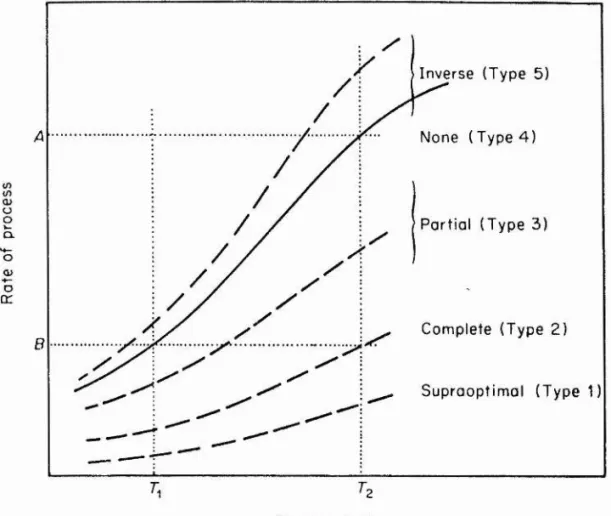
(1973). Precht (1958) has categorised capacity adaptation into five subdivisions: 1 ) overcompensâtion 2 ) perfect
compensation 3) partial compensation 4) no compensation and 5) inverse compensation (Fig. 1). These responses are based upon the comparison of the rate of any particular process immediately after transfer to a new temperature with the rate measured at the new temperature after a period of acclimation. Based on the oxygen consumption of whole animals type 2 and type 3 are the most common responses to thermal stress (Meuvis and Heuts, 1957, carp; Precht, 1951, eel; Roberts, 1964 sunfish). Most stenothermal species of fish have lost the ability to acclimate to changes in
temperature and therefore show a type 4 response. Several examples of type 5 (inverse) acclimation have been reported particularly for amphibians and reptiles which do not
maintain normal levels of activity in the cold (Holzman and McManus, 1973; Patterson and Davies, 1978). Inverse
o
CD O
tr
Inverse (T y p e 5)
None (T y p e 4 )
4
Partial (T y p e 3)
Co mplete (Ty pe 2 )
B
Supr ao pti mal (T yp e 1 )
Tempera tur e
Fig 1. Schematic diagram to illustrate the terminology of Precht (1958) concerning the compensation of rate processes following transfer of fish from to T2. The solid line represents the increase in rate upon
transfer to the higher temperature. After a period of acclimation at T2
Thus some fish species such as the eel (Walsh et al^. , 1983) and the striped bass (Crawshaw, 1984), cease feeding
altogether and can remain buried in the mud for the whole winter. Inverse compensation is usually accompanied by a high temperature coefficient which permits a rapid
transition from torpidity to activity in response to an increase in temperature. Starvation can cause digestive enzymes in the carp to exhibit either no or inverse
compensation compared to partial compensation in well fed fish (Mews, 1957). In addition, starvation can also reduce the ability of fish to compensate for changes in the
environment by reducing protein synthesis to a low level (Heap, Watt and Goldspink, 1986).
Acclimated largemouth bass, Micropterus salmoides become torpid below 7 °C, yet maintain a similar level of
spontaneous activity between 7-30 °C (Lemons and Crawshaw, 1985). Feeding in this species is inhibited at higher temperatures ( 1 0 '=»C) than are required to supress
locomotion, suggesting that not all physiological systems respond in the same manner to a given change in body
temperature (Lemons and Crawshaw, 1985).
Due to the effect of increasing temperature on the solubility of oxygen, a fish exposed to an increase in temperature is faced with a higher oxygen demand in an environment that is relatively hypoxic. Homeostatic
oxygen content within the environment may vary widely. In largemouth bass (Micropterus salmoidesI, aerobic scope
increased between 15 and 30 but was lower at 35 than 30°C (Beamish, 1970). It was suggested that the temperature at which aerobic scope starts to decline marks the point at which energy demands for ventilation can no longer be met
(Jones, 1971).
In some freshwater teleosts increased oxygen demand at higher temperatures is met by increasing the oxygen-carrying capacity of the blood. In carp (Houston and Dewilde, 1968), rainbow trout (Houston and Dewilde, 1969) and brook trout
(Dewilde and Houston, 1967) there is a direct correlation between the composition of the blood (i.e. red cell number, packed cell volume and haemoglobin content) and acclimation temperature.
The relationship between adaption temperature, basal oxygen consumption and active oxygen consumption is
complicated by interspecific variation in activity patterns since activity has a greater effect on total energy
production than changes in acclimation temperature (Brett, 1964) .
Adaptations in whole animal oxygen consumption are reflected by comparable compensations in tissue oxygen consumption following a period of acclimation to the cold. For example, Jones and Sidell (1982) found an
overcompensation in the rate of oxygen consumption for skeletal muscle from striped bass (Morone saxatilis ) . The
rate of oxygen consumption in cold-acclimated striped bass was greater than that of warm-acclimated bass even when measured at their respective acclimation temperatures. However not all tissues reflect the acclimation pattern of the whole animal. For example brain tissue from rainbow trout showed complete compensation of oxygen consumption while gill tissue showed no compensation following
temperature acclimation (Evans, Purdie and Hickman, 1962).
Spontaneous activity and locomotorv performance
Physiological compensation in fish permits similar levels of locomotory performance and activity over a range of body temperatures. A higher rate of spontaneous locomotor activity was reported for 6 ®C- than for 18 °C-acclimated
Atlantic salmon when measured at an intermediate temperature (Peterson and Anderson, 1969). Many fish show optimal
locomotory performance at the temperature to which they have been acclimated (Fry, 1967). For example, green sunfish
(Roots and Prosser, 1962) and juvenile coho salmon (Griffiths and Alderdice, 1972) exhibited a positive correlation between acclimation temperature and maximum swimming speed.
Recent reports have suggested mechanisms to explain the maintenance of swimming speed at low temperatures.
output of oxidative fibres is reduced at low temperature and thus glycolytic fibres must be employed at lower swim speeds resulting in fatigue (Loughna, Rome and Goldspink, 1983). Following acclimation to 8 °C, 15 °C and 26 ‘=’0 carp were
swum at 10 '=’C and 20 *=*0. At 10 ®C, the swimming speed at which white muscle was initially recruited was significantly higher in fish acclimated to low temperatures. Thus
temperature acclimation of muscle allows fish to maintain higher sustainable swimming speeds at low temperatures
(Loughna et ^ . , 1983; Rome et a T . , 1984, 1985).
The effects of temperature acclimation on the mechanical properties of muscle fibres
Acclimatory mechanisms which may allow the maintenance of sustained activity at low temperature include increases in the relative proportion of aerobic to anaerobic fibre types in cold-acclimated fish (goldfish, Johnston and Lucking, 1978;.Striped bass, Jones and Sidell, 1982). In addition, Johnston, Sidell and Driedzic (1985) found that when
measured at 7 contraction velocity was about 2-fold
higher and maximal force was about 70% higher in slow fibres from 7 °C- compared with 23 ‘=’C-acc lima ted carp.
Furthermore, pectoral fin adductor muscles from
similar muscles from warm-acclimated fish (Heap, Watt and Goldspink, 1987). Penney and Goldspink (1980) reported a higher surface density of the SR in cold- than
warm-acclimated goldfish. This could promote more rapid relaxation in the cold by reducing the diffusion distance of calcium out of the contractile apparatus.
The molecular mechanisms underlying changes in
contractile properties following temperature acclimation are unknown. It is likely that both qualitative and
quantitative changes in myofibrillar proteins are involved. Actomyosins that have been stripped of their
tropomyosin-troponin complex have similar actomyosin ATPase activities at all temperatures regardless of the acclimation temperature of the fish from which they were prepared
(Johnston, 1979). Higher activities of myofibrillar ATPase have been reported for cold- than warm-acclimated fish for a number of eurythermal species (Johnston, Davison and
Goldspink, 1975; Sidell, 1980; Penney and Goldspink, 1981; Heap, Watt and Goldspink, 1985). For example, the activity of myofibrillar ATPase from fast muscle of 1 «C-acclimated goldfish was 2 .8 -fold higher than for 26 -acclimated fish
when assayed at a temperature of 1®C (Johnston, Davidson and Goldspink, 1975).
Altringham and Johnston (1985a) determined the activity of myofibrillar ATPase in skinned muscle fibres from carp under force generating conditions by measuring ADP
When measured at 7 °C, ATP turnover per myosin head was 50% lower and the amount of power (force.time) obtained per ATP hydrolysed was 50% higher in fibres from cold- than
warm-acclimated fish.
Molecular mechanisms that underlie metabolic compensation to temperature acclimation
Biochemical studies of fish tissues showed that the maximal activities of some enzymes involved in pathways of aerobic energy metabolism increased following cold-acclimation
(Sidell, 1980; Shaklee ^ a d ., 1977; Johnston, Sidell and Driedzic, 1985; Jones and Sidell, 1982; Johnston and Wokoma, 1986) while those enzymes involved in glycolysis (eg lactate dehydrogenase) found in the cytoplasmic compartment showed no compensation (Shaklee et aJL., 1977; Sidell, 1980;
Johnston ^ a^. , 1985). This may result from an increase in the volume density of mitochondria in muscles from cold-compared to warm-acclimated fish (Johnston and Maitland, 1980) and by higher activities of aerobic enzymes in
mitochondria from cold- than warm-acclimated fish. Wodtke (1981) found similar amounts of cytochrome c oxidase per mg mitochondrial protein and similar Km values for cytochrome c from warm- and cold-acclimated carp. However the molar
activities of cytochrome c intercalated in 1 0 ‘=’C-acclimated
mitochondrial membrane from 30 ^C-acclimated fish. Wodtke (1981) concluded that during thermal acclimation the molar activity of cytochrome c was controlled by the fluidity of the mitochondrial membrane (Wodtke, 1980).
Adaptive value of adjusting enzyme concentration
A wide range of environmental stimuli can elicit changes in the concentration of cellular proteins. Temperature is one of the most important and has profound effects on the level and type of metabolism in fish. For example
cold-acclimation results in an increase in the concentration of both cytochrome oxidase (Wilson, 1973) and cytochrome c
(Sidell, 1977, 1980) in the skeletal muscle of fish.
At least two mechanisms are available for changing the concentration of active enzymes within the cell: (1 )
readjustment of the rate of synthesis and breakdown of the enzyme and (2 ) enzymatic interconversion between existing
pools of active and inactive forms, frequently by reversible phosphorylation of the enzyme. Responses to thermal
acclimation are often accompanied by changes in the level of protein synthesis and in the activity of enzymes involved in protein synthesis such as aminoacyltransferase (Haselkorn and Rothman-Denes, 1973).
skeletal muscle cytochrome c, but the rate constant for the degradation of this protein was reduced even more.
Consequently the concentration of cytochrome c increased during cold- and decreased during warm-acclimation. The differential changes in the rates of synthesis and
degradation enable the organism to achieve an increase in the concentration of an enzyme while actually reducing the rate of enzyme synthesis. Therefore a change in the
concentration of cytochrome c results from a passive effect of temperature on the rate constants for synthesis and
degradation.
Enzvme-modulator interactions
The lowered environmental/ cell temperature encountered during cold-acclimation decreases the rate of diffusion of oxygen and metabolites within the cell because of both the direct effect of temperature on molecular kinetic energy and the resultant increase in the viscosity of the cytosol
(Sidell and Hazel, 1987; Egginton and Sidell, 1989). As a result the diffusion coefficient for oxygen in frog skeletal muscle decreases more than 40% between 23 and 0 ‘=’0
(Mahler, 1978). Muscle from cold-acclimated fish has a higher oxygen capacitance and higher concentrations of cellular lipid than muscle from warm-acclimated fish
these factors may compensate for the effects of low
temperature on the diffusion of oxygen through the cytosol. In contrast, Sidell (1980) reported an increase in the concentration of cellular myoglobin in slow muscle of the goldfish following cold-acclimation. This result is
unexpected since increased concentrations of myoglobin in muscle from warm-acclimated fish would alleviate a reduction in the dissolved oxygen content in the cell at higher
temperatures. More recently, Johnston et al. (1985) found higher concentrations of myoglobin in slow muscle from warm-than cold-acclimated common carp.
The effect of temperature on interactions between enzymes and various modulating metabolites can modify catalytic function. For example, lactate dehydrogenase isozymes present in fast skeletal muscle of the mudsucker exibit substrate (pyruvate) inhibition at temperatures below 25 . Therefore at high ambient temperatures, when oxygen availability is low and activity high, pyruvate is
efficiently converted to lactate. Conversely at low
temperatures, when the availability of oxygen is increased, pyruvate is channelled through the Krebs cycle (Somero, 1973). If the effectiveness of two metabolic pathways to compete for a common substrate varies with temperature, a change in temperature can shift the balance of that
affects both the flow of carbon through a pathway and the contribution of various pathways to overall metabolism.
Measurement of the activities of enzymes jji vitro
following temperature acclimation may provide information on the relative capacities of metabolic pathways jji vivo (Hazel and Prosser, 1974). Newsholme and Paul (1983) suggested that the activities of non-equilibrium enzymes can be used to provide a quantitative index of the flux through a
pathway. For example, the activity of hexokinase and carnitine palmitoyltransferase may provide quantitative measures of glucose and fatty acid oxidation, respectively
(Newsholme and Paul, 1983). Kacser and Burns (1979) suggested that the activities of equilibrium enzymes may also exert a degree of control over total flux.
The rate of carbon flow through glycolytic pathways is increased in the cold (Hochachka, 1967? Ekberg, 1962), For example glucose-6 -phosphate, a branch point metabolite, can
either be stored as glycogen or catabolised via the hexose monophosphate shunt and glycolysis. Furthermore Hochachka (1968) showed that higher temperature increased the rate of glycogen synthesis and the activity of the hexose
monophosphate shunt relative to the rate of glycolysis.
The catalytic activity and regulatory ability of enzymes is dependent on proper ligand (substrate, cofactor and
allosteric modulator) binding to enzyme molecules. Temperature changes may affect enzyme-metabolite
enzyme-metabolite complexes are weak and can be directly influenced by the thermal energy of the environment? complex formation may be hindered or facilitated by the resultant change in enzyme structure. 2 ) temperature may alter the
affinity of an enzyme for its substrate due to changes in the geometry of the binding site. Substrate binding
necessitates that the enzyme is able to form highly stable complexes with its substrate in addition to having a binding
capacity such that the enzyme does not become saturated with i
substrate. Reserve capacity for activity confers greater scope for metabolic regulation, allows the system to
accomodate increased demands, perhaps resulting from an increase in locomotory activity and also reduces the build up of highly reactive intermediates (Atkinson, 1969).
At sub-saturating concentrations of substrate,
velocities are dependent on the ability of an enzyme to bind substrate (approximated by apparent values) and therefore the effect of temperature on Km can control the rate of
reaction at physiological substrate concentrations. Enzymes with temperature-dependent Km's are found in both
Acid base balance
Low molecular weight constituents of the cell may have a major influence on the iu situ structural and functional properties of enzyme and contractile proteins. Hydrogen ions are the most important of these constituents and may affect the catalytic ability of enzymes as well as effecting the assembly and function of other proteins.
The normal blood pH of fish varies inversely with temperature with a change in pH/^C value of around -0.018. The change in pH/^C for neutral water between 3 °C and 37 °C is -0.017, therefore the difference between the pH of blood and that of neutral water remains constant suggesting that fish regulate a constant degree of alkalinity in relation to the neutral point of water (Reeves, 1977).
The regulation of pH in this way is thought to conserve the fractional disociation state of imidazole groups over a range of temperature. This in turn maintains key properties of proteins that are dependent on the degree of protonation or deprotonation of histidine residues (Somero, 1981).
However changes in the intracellular pH of muscle with temperature are often less than required by the alphastat hypothesis (Walsh and Moon, 1982; Mutungi and Johnston,
1988). Consequently enzymes that exhibit pH dependencies within the normal physiological range of pH are subject to pH regulation. For example, the small increase in
sufficient to cause a marked increase in the activity of phosphofructokinase in goldfish and may explain the enhanced glycolytic flux characteristic of many cold-acclimated fish
(Freed, 1971). Many other enzymes may be activated by changes in pH due to temperature acclimation (reviewed by Hazel and Prosser, 1974).
In fast skeletal muscle of fishes the amount of buffering capacity increases with rising potential for anaerobic glycolysis (Castellini and Somero, 1981). Adaptive differences in the buffering capacity of white muscle would seem to ensure optimal pH for muscle function despite the build up of acidic end-products during burst swimming. A variety of substances are used to absorb protons generated during metabolism including the
CHAPTER 2
The effects of temperature acclimation on muscle relaxation in the carp, a mechanical, biochemical and ultrastructural study
Introduction
Muscle contractility is modified by temperature acclimation in some freshwater fish (family Cyprinidae) (Johnston and Dunn, 1987). For example, the Mg=+-Ca*+ myofibrillar ATPase activity of myofibrils at 1 °C was found to be 3-times
higher in goldfish acclimated to 1 °C than 26 (Johnston, Davidson and Goldspink, 1975). The myofibrillar ATPase from cold-acclimated goldfish was also much more susceptible to heat dénaturation. Changes in ATPase activity with
temperature acclimation require several weeks for completion and probably involve the synthesis of new proteins (Heap, Watt and Goldspink, 1985). Studies with skinned muscle fibres from common carp have shown that cold acclimation increases force production, contraction velocity (Johnston, Sidell and Driedzic, 1985), and the economy of isometric contraction (Altringham and Johnston, 1985a). Recently, Heap et a_l. , (1987) studied preparations from the pectoral fin muscles of the goldfish, acclimated to either 1 0 or
activation and relaxation of twitch tension were two times faster in cold- than warm-acclimated fish.
What mechanisms underlie capacity adaptation in
relaxation rate ? Penney and Goldspink (1980) reported that cold-acclimation in goldfish resulted in a remodelling of sarcoplasmic reticulum (SR) and myofibrils. They suggested that the surface density of SR, and the reduction in
myofibril diameter found in fast fibres from cold- relative to warm-acclimated fish, may provide at least part of the explanation.
However, preliminary experiments indicated that during preparation for electron microscopy muscle fibres from warm-acclimated fish exhibited a greater degree of
shrinkage. Furthermore, an osmium ferricyanide staining method (Peachey, Waugh and Sommer, 1974) revealed
significantly more sarcoplasmic reticulum membrane than the Reynolds (1963) lead citrate stain used by Penney and
Goldspink (1980). These results prompted a re-investigation of their original findings using the common carp. The
present study was also extended to include slow muscle. In order to obtain further insights into the effects of
Materials and methods
Fish
Common carp (Cvprinus carpio L . ) were obtained from Humberside Fisheries, Driffield, England. For electron microscopy experiments, 14 fish (142g + 5g body weight,
17.4cm + 0.5cm standard length, mean + s.e.) were maintained at either 7 °C ( ± 0 . 5 ^C) or 23 ‘^"C (± 1 ‘=*C) under an 8 h
light ; 16h dark photoperiod in filtered recirculated
freshwater for at least one month. A second population was used for the mechanical and biochemical studies, maintained under a similar regime at 8 and 20 °C (10 fish, 691g ±36g
body weight, 31.0cm ± 0.6cm standard length, mean ± s.e.). All fish were fed commercial fish pellets ^ lib. Fish were killed by a blow to the head followed by transection of the spinal cord.
Mechanics
was pinned out in a temperature controlled bath, and
immersed in ringer solution of the following composition: NaCl, 132 mM; Na pyruvate, 10 mM; KCl, 2.6 itiM; Na HCOa, 18.5 mM; Na H2 PO4 , 3.2mM; MgCla, ImM; CaCla, 2.7 mM; pH 7.4 at 8
°C (Hudson, 1969). The central spinal nerve was drawn into a suction electrode, and single stimuli yeilding a maximum force response were given through the spinal nerve. Muscle force was recorded by resting a strain gauge (AE801, A M E , Horten, Norway) on the surface of the myotome immediately rostral to the spinal nerve. This method gave highly reproducible measurements of contraction kinetics in the intact myotome, independent of the positioning of the strain gauge. However, the system could not be calibrated for
force generation by the muscle, since although the strain gauge was arranged to record in a plane parallel to the longitudinal axis of the fibres, some of the fibres in adjacent myotomes also contracted. Nevertheless, it was usual to see an increase in the amplitude of the force records with increasing temperature. Experiments were
performed at both 8 ‘=’C and 2 0 over at least 2 temperature
change cycles, and the times taken to reach half-maximal tension (to.sa) and half-relaxation (to.5 =) were measured.
Electron microscopy
Tissue preparation
Small bundles of fast and slow muscle fibres were dissected from dorsal myotomes at a point adjacent to the insertion of the first dorsal fin ray. Tissue was processed by one of two methods. In the first, fibre bundles were pinned to cork strips at their jji vivo resting length and fixed
overnight in 2% gluteraldehyde, 0.15M phosphate buffer at pH 7.2 (at 4°C). The outer fibre layers were removed, washed in buffer and post-fixed in 1% osmium tetraoxide, 0.15M phosphate buffer, pH 7.2 for 1 hour. Fibre bundles were rinsed in distilled water, stained in uranyl acetate and lead citrate, dehydrated in a series of alcohols up to absolute, cleared in propylene oxide and embedded in araldite CY 212 resin.
A second method was used in an attempt to improve the contrast and resolution of SR membranes. Fibre bundles were fixed in several changes of 2% gluteraldehyde, 0.15M
cacodylate buffer, 10 mM CaClz, pH 7.2 (at 4 ®C) overnight. Following further dissection the tissue was washed in
cacodylate buffer and post-fixed for 2h in 2% osmium tetraoxide, 0.15M cacodylate buffer, lOmM CaCls, 0.8%
distilled water and stained ^ bloc for 30 min in a saturated aqueous solution of uranyl acetate to improve contrast. Fibres were subsequently dehydrated in acetone and vacuum embedded in araldite resin. This method of processing was found to reduce lipid leaching.
Ultra-thin sections (50-100 nm) were cut from blocks prepared by both methods on a RIECHERT 0MU2 ultramicrotome and mounted on 150 mesh copper grids coated with 3%
pyroxyline in amyl nitrate. Sections were double stained with aqueous, saturated uranyl acetate (30 min) and Reynolds
(1963) lead citrate (5 min) and examined with a PHILIPS 301 electron microscope at 60KV.
Five fish were taken from each acclimation group and five blocks made of each fibre type per fish, giving a total of 50 blocks per acclimation temperature (25 fast, 25 slow).
Plates were analysed from all the fish in each group.
Quantitative analvsis
Volume and surface densities of SR were estimated from
comparisons between acclimation groups or fibre types. Maximum measurement error was ±3%, estimated by repeated
tracing of the same SR profiles (5 times 5 plates). The volume and surface density of total SR and terminal
cisternae were calculated per unit myofibrillar volume using stereology software (Imagan system, Kompira, Salsburgh,
Scotland). The mean length of 10 A-filaments was measured for each plate. Surface density of SR was negatively
correlated with measured A-band length (least squares regression, P<0.01). This suggests that A-band length
provides a good measure of shrinkage. A-band length (Table 1) was therefore used to correct for shrinkage between
acclimation groups, assuming a reference A-band length of 1.5 pm (Page and Huxley, 1963; ter Keurs, Luff and Luff, 1984). No assumptions were made about differential
shrinkage between organelles, due to the lack of satisfactory methods.
Sarcoplasmic reticulum calcium ATPase activity
Samples of fast myotomal muscle (20g) were minced with
scissors and homogenised for three X 20s in three volumes of 0.3M sucrose, 10 mM imidazole, pH 7.3 (at 0 °C) using a