Solid e
ff
ect DNP polarization dynamics in a system of many spins
Daniel Wi´sniewski, Alexander Karabanov, Igor Lesanovsky, Walter K¨ockenberger
Sir Peter Mansfield Magnetic Resonance Centre, School of Physics and Astronomy, University of Nottingham, University Park, Nottingham NG7 2RD, United Kingdom
Abstract
We discuss the polarization dynamics during solid effect dynamic nuclear polarization (DNP) in a central spin model that consists of an electron surrounded by many nuclei. To this end we use a recently developed formalism and validate first its performance by comparing its predictions to results obtained by solving the Liouville von Neumann master equation. The use of a Monte Carlo method in our formalism makes it possible to significantly increase the number of spins considered in the model system. We then analyse the dependence of the nuclear bulk polarization on the presence of nuclei in the vicinity of the electron and demonstrate that increasing the minimal distance between nuclei and electrons leads to a rise of the nuclear bulk polarization. These observations have implications for the design of radicals that can lead to impoved values of nuclear spin polarization. Furthermore, we discuss the potential to extend our formalism for more complex spin systems such as cross effect DNP.
Keywords: Dynamic Nuclear Polarization, Solid Effect DNP, Many Spins Simulation, Lindblad Formalism
1. Introduction
Dynamic nuclear polarization (DNP) is a method for trans-ferring spin polarization from radical electrons to surrounding nuclei to create a highly polarized non-thermal state which sub-sequently can be used to acquire a strongly enhanced NMR sig-nal. Several applications of DNP have recently highlighted the huge potential that this method offers for increasing the low sen-sitivity of magnetic resonance imaging (MRI) and spectroscopy experiments [1, 2, 3]. In particular, applications of dissolution DNP [4, 5] to prepare highly polarized13C labelled molecules in conjuction with spectroscopic MRI have led to the devel-opment of novel experimental protocols for human cancer di-agnostics [6, 7]. Despite the recent success of the technique, its mechanism is not yet fully understood and significant effort has gone into developing suitable theoretical models to pre-dict the polarization dynamics during DNP. Most model sim-ulations have focused on the numerical analysis of spin sys-tems that consist of only a few spins [8, 9] since the dimension of the required state space of the quantum mechanical prob-lem scales exponentially in the number of constituents and the available computer memory limits the calculations to only up to 10 - 14 spins. In addition, thermodynamical models based on the concept of spin temperature have been used to analyze the dependence of the spin polarization on experimental param-eters [10, 11, 12] as well as several attempts have been made to describe the polarization dynamics by a set of rate equations [13, 14, 15]. We have recently developed a formalism that al-lows simulations of the polarization dynamics in large many-spin systems for solid effect DNP (SE DNP) [16]. The formal-ism opens up the possibility of analysing polarization transport in systems consisting up to a few thousand coupled spins. In this contribution we demonstrate the insight that such
simula-tions can provide for understanding the dynamics of many cou-pled spins during DNP. In particular, we show how the bulk po-larization level crucially depends on the molecular environment of the unpaired electron. Furthermore, we include a comparison of our formalism with conventional simulation methods based on solving the quantum mechanical master equation in the full Liouville space. In addition, we discuss the prospects to extend the formalism to more complex DNP pathways in systems with interacting electrons and nuclear spins.
2. Full quantum mechanical description
SE DNP can be observed in systems where the electrons have little or no g-anisotropy and their concentration is relatively low, resulting in weak dipolar coupling between them and nar-row ESR spectra with a linewidth less than the Zeeman splitting of the surrounding nuclear spins [8, 17, 18, 19, 20]. A quantum model, representative for a spin system in which SE DNP can occur, is the central spin model, where an unpaired electronS
is surrounded by an ensemble ofM nucleiIk, k =1, . . . ,M
Hamilto-nian in the reference frame of the microwaves
ˆ
H = ∆Sˆz+
∑
k
(
ωIIˆkz+AkSˆzIˆkz+1
2Bk+Iˆk+Sˆz
+ 1
2Bk−Iˆk−Sˆz
) +ωA
2
(
ˆ
S++Sˆ−). (1)
∆ represents the microwave offset in respect to the electron Larmor frequency, ωI is the nuclear Larmor frequency, Ak is the strength of the secular part and Bk± is the strength of the pseudo-secular part of the hyperfine interaction between the electron S and the k-th nuclei Ik, and ωA is the strength of the applied microwave field. Relaxation is introduced by a Lindbladian dissipator, which has the general form: D(Lˆk
)
ˆ ρ=
ˆ
LkρˆLˆ†k−
{
ˆ ρ,Lˆ†
kLˆk
}
/2 with a set of jump operators defined in the basis ofLk∈
{
ˆ
S±,Sˆz,Iˆk±,Iˆkz
}
, each with an associated effective rate [23]. The Lindbladian is commonly used in quantum optics and in the description of dissipation in open quantum systems [24, 25]. The dissipator describes relaxation as jumps between different states with effective jump rates that are in our case related to the longitudinal relaxation rates R1, and dephasing terms with effective rates that are given by the transverse relax-ation ratesR2observed in the spin system. Using this dissipator form it is straight-forward to introduce more complicated re-laxation pathways for the system (e.g. spin cross-rere-laxation). The action of the Lindbladian dissipator is identical to the use of double-commutator relaxation superoperators, which can be illustrated by the following simple rearrangement. If we take a generic operator ˆX(which could for example be one of the low-ering or raising operators) along with its hermitian conjugate indicated by the dagger symbol, we can write it in a double-commutator form of a relaxation superoperator
Γρˆ=−R1 2
([
ˆ
X,[Xˆ†,ρˆ]]+[Xˆ†,[Xˆ,ρˆ]])
≡ −R1 2
(
−2 ˆXρˆXˆ†−2 ˆX†ρˆXˆ+XˆXˆ†ρˆ+ρˆXˆXˆ†+Xˆ†Xˆρˆ+ρˆXˆ†Xˆ)
≡R1
(
ˆ
XρˆXˆ†−{ρ,ˆ Xˆ†Xˆ}/2+Xˆ†ρˆXˆ−{ρ,ˆ XˆXˆ†}/2)
≡R1
(
D(Xˆ)+D(Xˆ†))ρˆ
The Lindbladian is therefore analogous to the Redfield relax-ation superoperator. No normalisrelax-ation term is required with the Lindbladian for the system to relax to thermal equilibrium, as the normalisation term may be included in the effective rate us-ing the principle of detailed balance. In [23] we discussed the differences in simulations seen between using a Lindblad style dissipator defined in the Zeeman basis, and the relaxation su-peroperator form used by Hovav et. al. [8] in the eigenbasis of the stationary Hamiltonian. Furthermore, we describe in [23] the possibility of addition of other dissipation parts to the re-laxation superoperator. The operators S±,Ik± are responsible for transitions between eigenstates of the system and introduce longitudinal relaxation in the system. The operators ˆSz, ˆIkzare mainly responsible for decay of coherences in the system. Writ-ten explicitly for SE DNP, the dissipator arising from a standard random fluctuation model for relaxation in the solid state has
the form [23]:
Γρˆ = R
(I) 1 2 M ∑ k
D(Iˆk±
) ˆ ρ + R (S) 1
2 (1±p0)D
(
ˆ
S±)ρˆ
+ 2R(I)2
M
∑
k
D(Iˆkz
)
ˆ ρ
+ 2R(S2)D(Sˆkz
)
ˆ
ρ, (2)
where p0 is the electron thermal equilibrium polarization,
R(S)1 ,R(I)1 are the rates of longitudinal relaxation to thermal equi-librium of the electron and nuclei respectively, andR(S2),R(I)2 the corresponding rates of transverse relaxation. The nuclear ther-mal equilibrium polarization is assumed to be negligible com-pared to the electron thermal polarization. A bold font is used for superoperators throughout the text.
The spin dynamics are simulated by solving the Liouville von Neumann master equation acting in Liouville space
˙ˆ
ρ=−i[Hˆ,ρˆ]+Γρ.ˆ (3)
3. Classical dynamics in the Zeeman subspace
We have recently demonstrated that the dynamics of the nuclear spin polarization during SE DNP can be well ap-proximated by using only the states contained in the Zeeman subspace [16]. This subspace is spanned by the operators
{
1,Sˆz,SˆzIˆkz,SˆzIˆkzIˆk′z. . .
}
. The effective master equation in the Zeeman subspace can be written in the Lindblad form [24, 25] using four jump operators and their corresponding effective rates, representing only four different quantum jumps: electron and nuclear single spin flips, flip-flops between the electron and nuclear spins and flip-flops between spins in nuclear spin pairs. The details of the mathematical procedure can be found in [16]. There we also discuss the advantages of many-body spin sim-ulations, particularly when looking at diffusion of polarization into the bulk of a sample. Limitations of the procedure and the conditions when it can be applied are also provided. The eff ec-tive master equation has the form
˙ˆ ρZ =
M
∑
k
Γ(I) k±D
(
ˆ
Ik±
)
ˆ ρZ
+ Γ(S)
± D
(
ˆ
S±)ρˆZ
+
M
∑
k
Γ(IS) k D ( ˆ Yk ) ˆ ρZ + M ∑
k<j
Γ(II) k,jD
(
ˆ
Xk j
)
ˆ
ρZ, (4)
the full Liouville space which has dimension 4N. The effective evolution of the spin polarization in the central electron system is completely classical in the sense that the evolution relies on classical state-dependent rate equations describing the evolu-tion of system polarizaevolu-tion, and it is only based on single spin flips and two spin flip-flops and does not require the calcula-tion of any quantum coherences. Hence the evolucalcula-tion connects only classical states in the Zeeman basis and does not create any superpostions unlike a general quantum Master equation dynamics. The effective ratesΓ(I)k±, Γ(S±), Γ(ISk )andΓ(II)k,j describe the rates by which these single spin flips and two spin flip-flops occur in the quantum system. An analysis of the mathematical form of the effective rates reveals the dependence of the polar-ization dynamics on the various system parameters such as the hyperfine interaction strengths AkandBk, the microwave field strength ωA and the relaxation time constants. Moreover, the effective rates can be used to distinguish between bulk and core nuclei.
The effective rates for the single-spin flips are for the electron and individual nuclear spins, respectively:
Γ(S)
± = 12(1∓p0)R (S) 1 +
ω2 A 2ω2IR
(S)
2 , (5)
Γ(I) k±=
1 2R
(I) 1k+
|Bk|2 8ω2 I
R(I)2k. (6)
Eq. (5) represents the rates for up and down jumps of the elec-tron spin. The different weighting of these two processes arises from the requirement that the electron should relax due to lon-gitudinal relaxation to its thermal equilibrium value p0. The additional term in Eq. (5) stems from the microwave irradiation which, due to the induced Rabi oscillations, can also lead to re-orientation of the electron spin. Similarly, Eq. (6) describes the effective longitudinal relaxation of the nuclei in the Zeeman frame. The perturbation in this case is due to the coupling with the electron. A more detailed analysis of the second order cor-rection terms can be found in [16].
The dissipative processes acting on two spins describe polariza-tion transfer through flip-flop jumps either involving the elec-tron and a nucleus or two nuclei:
Γ(IS)
k =
ω2 A|Bk|2
(
R(I)2k+R(S2))
8ω2I
[(
R(I)2k+R(S2))2+Dˆ2k ]−1
(7)
Γ(II) k,j =
d2 k j
(
R(I)2k+R(I)2j)
2
[(
R(I)2k+R(I)2j)2+Cˆ2k j ]−1
, (8)
where ˆDkand ˆCk jare operator valued terms
ˆ
Dk=λ+ ω
2
A
2ωI − |Bk|2
8ωI + ∑
s,k
AsIˆsz (9)
ˆ
Ck j=
( Ak−Aj
)
ˆ
Sz+8ω1I
(
|Bk|2−Bj 2)
. (10)
Eq. (7) describes transfer of polarization from the source elec-tron to the surrounding nuclei. This process depends on the mi-crowave field amplitude squaredω2
A, the pseudo secular hyper-fine coupling strength Bkmagnitude squared, the nuclear Lar-mor frequency squaredω2I, the rates of transverse relaxation of
the electron R(S)2 and coupled nucleus R(I)2k, and the operator-valued term in Eq. (9). This term depends on the spin state of the nuclear ensemble which can be intuitively understood be-cause the effective rate for polarization transfer from the elec-tron must at steady-state tend towards the rate by which po-larization is lost in the nuclear ensemble due to longitudinal relaxation. In cases of a mismatch of the microwave carrier fre-quency with either the ZQ or DQ transition frefre-quency, the offset parameterλis large and the polarization transport efficiency is decreased.
Eq. (8) is the effective rate responsible for diffusion of po-larization away from core nuclei close to the electron to the bulk. Polarization transfer is driven by nuclear flip-flops, the rate magnitude is dependent on the strength of the dipolar cou-pling squareddk j2. The presence ofR2 values implies that the underlying quantum-mechanical process is affected by trans-verse relaxation. The effective flip-flop rate is also reduced in cases where there is a large difference between the secular cou-pling parametersAkof two nuclei. This implies, that in the case of nuclei very close to the electron, their transport of polariza-tion into the bulk of the sample is inefficient.
The second part of Eq. (10) is much smaller than the first, and hence ˆCk j can be approximated as (Ak−Aj) ˆSz, the square of which is(Ak−Aj
)2
/4 and therefore Eq. (8) becomes indepen-dent of the spin state of the electron.
Γ(II) k,j =
d2 k j
2(R(I)2k+R(I)2j) 1+1
4
RA(I)k−Aj 2k+R
(I) 2j 2 −1 .
Comparison between the two rates (Eqs. (7) and 8) for a nu-cleus determines whether it belongs to the core or to the bulk. In the case that the effective hyperfine rate, Eq. (7), is greater than the effective nuclear dipolar rate, Eq. (8), the interaction with the electron will be dominating, indicating a core nucleus. The opposite would be true for a bulk nucleus.
3.1. Comparison between Zeeman projection and Liouville von Neuman equation
−5
0
5
−5 0 5 −10 −5 0 5 10
X Y
[image:4.595.318.568.86.262.2]Z
Figure 1: Geometry of the model system consisting of one electron (S) and five nuclei (Ik,k=1, . . . ,5). The distance parameterawas varied between 2 Å and 10 Å in a set of simulation to compare the results obtained using the master equation derived from the Zeeman subspace projection with the results of the Liouville von Neuman equation.
Hereais a variable distance between spins which was varied in simulations between 2 Å and 10 Å. The errorδp was then computed by taking the difference between the polarization val-uespLvNobtained from the Liouville von Neuman master equa-tion (3), and the Zeeman-projected master equaequa-tion (4) pZeeman,
normalized to the results of the Liouville von Neuman equation, i.e.
δp=(pLvN−pZeeman)/pLvN. (11)
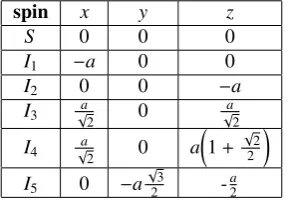
The coordinates of the nuclei seen in Fig. 1 are listed in Tab. 1. For simulations a uniform 5% randomization in position was used.
spin x y z
S 0 0 0
I1 −a 0 0
I2 0 0 −a
I3 √a2 0 √a2
I4 √a2 0 a
(
1+
√
2 2
)
I5 0 −a
√
3
2
-a 2
Table 1: Coordinates of the electron and the nuclei in the model configuration
The simulations were carried out using the gyromagnetic constant of the1H nucleus. It was necessary to use a microwave strength ωA = 500 kHz in conjunction with the distance pa-rameter valuea=2 Å to generate a significant nuclear polar-ization enhancement. Such microwave strength is difficult to experimentally implement without a cavity. The remaining pa-rameters wereT =1 K,Bz = 3.4 T,T
(S)
1 =1 ms,T (I) 1 =1 h,
T2(S) =200 ns,T2(I) =0.2 ms, simulation duration=1 h. This parameter set was used for consistency for all simulations with
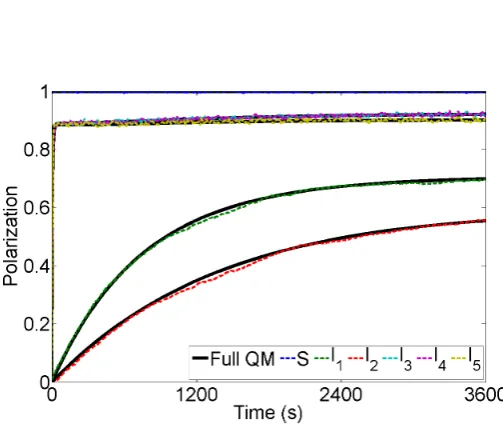
[image:4.595.61.235.95.256.2]abetween 2-5 Å. Curves showing the polarization dynamics for the nuclei and the electron are shown in Fig. 2.
Figure 2: Polarization curves for spin separation of 2 Å. Details of the simula-tion parameters used are provided in the text.
Figure 3: Error between the calculation based on the Liouville von Neuman equation and the Zeeman master equation for a model spin system with separa-tion parameter value of 2Å
The error in polarization for this configuration of the model spin system is shown in Fig. 3. It does not exceed 3%. If the separation parameterais set to 3 or 4 Å, the error decreases fur-ther, e.g. for 4 Å the error never exceeds 1.5%. For separations of 5-10 Å the microwave power was reduced to an experimen-tally more realistic strength ofωA =200 kHz and the electron transverse relaxation time constantT2 was increased 5-fold to
T2(S) = 1µs. All other parameters were kept the same as de-scribed previously. The maximum error never exceeded 1% for any value choice ofabetween 5 Å and 10 Å. In all cases of the error analysis, the steady-state error was lower than the maxi-mum error, which usually was found for the data in the initial fast polarization build-up phase.
[image:4.595.311.569.323.496.2] [image:4.595.37.181.494.595.2]approxi-mation [16], there are also parameter regimes where the error is likely to be greater than shown here. In particular, the dynamics in model spin systems with very small average distances (below 2Å) or long transverse relaxation time constants is not well ap-proximated by an adiabatic elimination procedure to project the dynamics onto the Zeeman subspace. In this case coherences are not negligible for the evolution of the spin system and need to be taken into account by including states outside of the Zee-man subspace into the calculations.
3.2. Kinetic Monte Carlo simulations
The dynamics of spin systems containing a large numberN
[image:5.595.40.267.402.551.2]of coupled spins cannot be calculated by conventional propa-gation using Eq. (4) because the dimensions of the required state space scales with 2N. However, because of the classical nature of Eq. (4), the dynamics can be well approximated using a kinetic Monte Carlo (KMC) method [26]. It provides a CPU efficient way to find numerical solutions for the evolution of the density operator in Eq. (4). Like the static variants, KMC relies on averaging over many trajectories that correspond to possible evolutions of the system. The Zeeman-projected mas-ter equation (4) is already in a form suitable for this method. The effective rates in Eqs. (5 - 8) along with their correspond-ing Lindblad operators can be directly used. The formalism is schematically described in Fig. 4.
Figure 4: Flow diagram of the kinetic Monte Carlo algorithm
The initial state for a trajectory is generated based on the ther-mal equilibrium polarization values of the electron (the nuclear spin polarization was assumed to be zero).
Due to the Markovian nature of the dynamics in the many spin system only knowledge of the current state is sufficient to prop-agate the system in time. The Lindblad rates (Eqs. (5) - (8)) are first calculated based on the system parameters. The rate for the flip-flop interaction between an electron and a nuclei (Eq. (7)) is state-dependent and hence is initiated using the thermal equilibrium state. Next, two random numbersr1andr2are gen-erated. The time required for the next event to take place is calculated using a natural logarithm of the first random number and the inverse of the sum of all rates of jumps that are possible in the system. In the next step it is decided which type of jump will be carried out. For this purpose all rates are normalised to
sum up to ’1’, and arranged in a cumulative sum array. An ele-ment in this array is identified which is higher in value than the second random number. The operation corresponding to that rate in the array element is carried out. Accordingly, operations with higher rate values are statistically more likely to occur than events with low rates. Once the operation or jump is carried out, the effective rates for the flip flop jump between a nucleus and the electron (Eq. (7)) are re-calculated based on the current sys-tem state. The steps outlined are repeated until a desired time is reached in the trajectory. Many trajectories are computed and averaged to approximate the polarization dynamics of the system. The method does not require vasts amounts of mem-ory since only anN-element binary array is required that stores the current orientation of thez-component of each individual spin. The KMC method was implemented using MATLAB on a 3GHz 20 core desktop computer.1
[image:5.595.317.569.409.621.2]A comparison of the polarization dynamics was carried out for the model spin system described previously witha =5 Å inter-spin separation using the same parameter set as previously listed.
Figure 5: Comparison between Zeeman master equation and KMC
Figure 6: Error between Zeeman master equation and KMC
Fig. 5 shows polarization build-up curves computed using the Zeeman master equation (Eq. (4), black solid lines) over-layed with the polarization build-up curves approximated by using the KMC algorithm (coloured, dashed lines). A total of 10 000 trajectories was averaged in the KMC procedure. Fig. 6 shows the difference between the results of the two meth-ods. The KMC polarization curves match the curves obtained by solving the Zeeman master equation very well, but are sub-ject to a random error. This is an inherent property of the KMC algorithm and its dependence on random events. The difference does not generally exceed 2% in polarization value, with the exception of early times. Averaging over a larger number of trajectories decreases the random error seen in the polarization curves obtained from the KMC method.
4. Central electron model consisting of many nuclei
To gain further insight into the optimal conditions for SE DNP for achieving the highest nuclear spin polarization and the fasted buildup rate simulations with many nuclear spins were carried out. This kind of analysis provides important information for a tailored radical design in which radical compounds are synthesized with desired properties. To analyze the spin dynamics during SE DNP in a central electron system containing many nuclear spins, a cubic grid of 124 13C spins with a nearest neighbour separation of 4Å was chosen with 1% uniform randomization in position of each nuclei. Such average distance corresponds to 26 M of a13C labeled molecule or in other words it is slightly shorter then the average distance between 13C nuclei in free pyruvic acid (4.8 Å) [27]. The magnetic field was set to be 3.4T, the temperature was set 1K, and a microwave field amplitude of 20 kHz was chosen to approximate realistic experimental conditions. The relaxation parameters were: T(S1) =0.5 s, T(S2 ) =10µs, T(I)1 =1 h, T(I)2 = 0.5 ms. The polarization dynamics for one hour of microwave irradiation was simulated using our KMC method.
Figs. 7 and 8 show the spatial dependence of the secular and pseudosecular hyperfine interaction strengthsAkandBkfor the
[image:6.595.317.565.345.512.2]12413C nuclei.
Figure 7: Strength of the secular hyperfine interactionAkbetween the central
electron (black) and the 12413C nuclei. The colour scale indicates the coupling
strength in kHz.
Figure 8: Strength of the pseudosecular hyperfine interactionBkbetween the
central electron (black) and the 12413C nuclei. The colour scale indicates the
coupling strength in kHz.
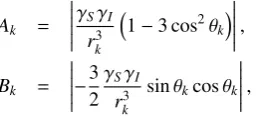
The magnitudes of the secular part and the pseudosecular part of the hyperfine interaction are given by
Ak = γSγI
rk3 (
1−3 cos2θk),
Bk =
−3
2 γSγI
r3k sinθkcosθk ,
[image:6.595.328.457.613.671.2]with angle θ = 0 orθ = π. Conversely, the strength of the pseudosecular part of the hyperfine interaction is zero at these positions and strongest at positions characterized byθ = π/4 or θ= 3π/4. The interaction strength scales also withr−3
k , so drops offrelatively quickly with increasing distance between nuclei and the electron.
[image:7.595.307.542.169.326.2]By calculating the effective rates, Eq. (7), for the flip-flop jumps between the electronS and the nucleusIkand comparing it to the effective rates with which the nucleusIkcan carry out flip-flop jumps with adjacent nuclei, Eq. (8), it is possible to determine the nuclei that will predominately interact with the electron. We call these the core nuclei. All the remaining nuclei belong to the bulk (Fig. 9).
[image:7.595.49.294.256.421.2]Figure 9: The nuclei in the ensemble around the central electron belong either to the core (red, effective rate for flip-flop jumps between electron and nucleus, Eq. (7), is higher than any of the effective inter-nuclei flip-flop rates, Eq. (8)) or to the bulk (blue, effective rate Eq. (7) is smaller than effective rate Eq. (8)). Note that because of the 1% uniform randomization of the position the configuration is not fully symmetric.
Fig. 10 shows the buildup of nuclear spin polarization in the system at various points in time. As expected the highest polarization increase is for nuclei with the highest strength of the pseudosecular interaction Bk. The polarization is also dis-tributed by effective spin diffusion to regions in which Bk is very small. This can be shown by setting the effective rate for internuclei flip-flops to zero in the simulation. In this case only nuclei in regions withBk,0 receive significant electronic po-larization during SE DNP.
5. The effect of nuclei close to the electron
We analyze now the effect on the average bulk polarization if the configuration of this model system is changed by first re-moving the six nuclei with the highest secular hyperfine inter-action strength (Ak) and then subsequently also further nuclei adjacent to the electron. To the best of our knowledge a study as such is only possible with simulations involving large many-body systems, using the KMC algorithm and Zeeman-subspace master equation. The idea here is to understand the role of the secular and pseudosecular term of the hyperfine interaction of
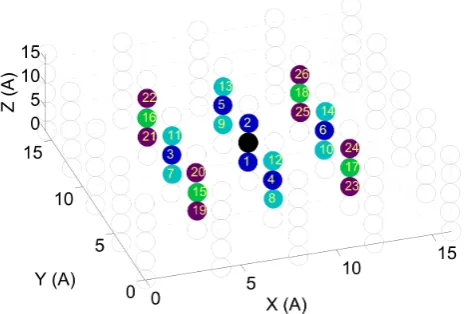
nuclei in immediate proximity of the electron for the bulk nu-clear polarization. Every time one nucleus was removed the polarization dynamics were simulated starting from the initial thermal equilibrium state and the average nuclear spin polariza-tion per nucleus has been calculated for the steady-state. Fig. 11 shows the order and the position of the removed nuclei.
Figure 11: The order by which the layer of nuclei adjacent to the electron was removed in successive simulations is indicated by the numbers. Different colour coding was used to group nuclei in four groups: The first six nuclei with strong secular hyperfine interaction and weak pseudosecular hyperfine interac-tion (dark blue), eight nuclei with relatively strong pseudosecular interacinterac-tion (light blue). Four nuclei with strong secular hyperfine interaction and weak pseudosecular hyperfine interaction strength (green) and eight nuclei with rela-tively strong pseudosecular interaction strength (purple)
Figure 12: Mean polarization per nucleus versus the number of nuclei removed from the model system. The colour coding is identical to the one used in fig. 11. The first data point corresponds to the mean polarization without any nu-cleus removed (black). The next six data points (dark blue) correspond to the mean polarization if the six nuclei with strongest secular hyperfine interaction strengthAkare removed. The next eight data points (light blue) corresponds to
the mean polarization if nuclei with strong pseudosecular interaction strength are removed (Bk). The next four data points again corresponds to removal of
nuclei with highAkvalues and the next eight data points (purple) corresponds
to removal of nuclei with highBkvalues. The broken black line has been added
as a visual guide only
[image:7.595.316.566.446.622.2]Figure 10: A) The distribution of the nuclear spin polarization at various time points during the buildup. A careful comparison with Fig. 8 reveals that the nuclei with the strongestBkvalues have in the initial phase the highest polarization. B) Nuclear steady-state polarization if the nuclear dipolar interaction coefficientsdi j
are set to zero . The nuclei are only polarized via the pseudo-secular part of the hyperfine interaction
nucleus at steady state on the number of the removed nuclei is summarized in fig. 12. The first date point (black) represents the average nuclear spin polarization in the system without removal of any nuclei. The next six data points (dark blue) indicate the average nuclear spin polarization if the six nuclei with the strongest secular hyperfine interaction strength Ak are successively removed. These are the nuclei just directly above and below the electron and next to the electron in the
xy-plane in which the electron is located (see fig. 11 for the position of the removed nuclei and fig. 7 for the Akvalues). The pseudosecular interaction strength Bk of these six nuclei are all very low (see fig. 8) and none of the removed nuclei belongs to the core nuclei group with high effective transfer rates of polarization from the electron (fig. 9). The average nuclear spin polarization improves by more than a factor 2 due to the removal of these nuclei. The next eight nuclei that were successively removed (light blue colour) have the highest pseudosecular interaction strength Bk and also relatively high
Akvalues (see see figs. 11, 7 and 8). Removal of these nuclei decreases the average nuclear spin polarization by about 15 %. Seven of these eight nuclei belong to the core nuclei group. The next four nuclei (green) that were removed have highAkvalues and lowBkvalues. The removal of these nuclei increases again the average nuclear spin polarization in the ensemble. Com-pared to the polarization level of the last bright blue data point the increase is more than 30%. The polarization level compared to the average polarization for the reference system without any nuclei removed is increased by more than a factor of 2.3. The last eight nuclei that were removed have highBkvalues and the average nuclear spin polarization level decreases by about 10%.
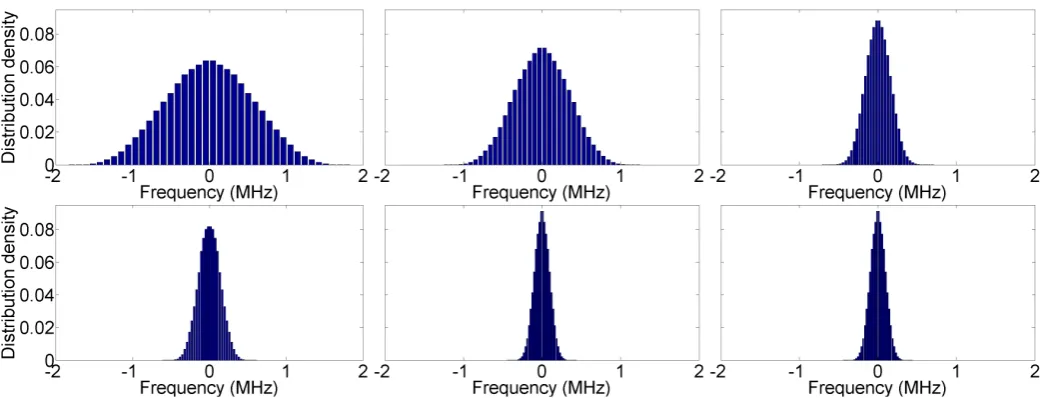
In order to interpret these results it is instructive to analyze the distribution of frequencies which are characteristic for SE DNP. The effect of the nuclei with strong secular hyperfine interaction (high Ak values) is a splitting of the frequencies ωS ±ωI at which SE DNP is mediated by an excitation of ZQ or DQ transitions [28, 8]. The splitting of these frequencies for each nucleiIkcan be calculated by using [28, 8]
ωDNP
Ik =ωS ±ωI−
1 2
∑
i,k
siAi, si=±1, (12)
where si is the sum means that one needs to add up over all possible permutations. Because of the very high number of fre-quencies that will result from the coupling of 124 nuclei to the
electron we have selected only 25 nuclei to calculate these fre-quencies. The 25 nuclei were identified by ordering the nuclei with decreasing secular hyperfine interaction strength Ak and by selecting the first 25 with relatively highAkvalues. The dis-tributions of frequencies calculated using Eq. (12) are shown in histograms (see fig. 13). In these histograms the fractional number of transition frequency at which nucleus-electron flip-flop occur are plotted against the frequency offset to the ZQ fre-quencyωS +ωI. Note that with removal of the first six nuclei the distribution becomes significantly narrower. Any further re-moval of nuclei reduces the width of the distribution further un-til theAkvalues of the removed nuclei are so weak that no fur-ther change can be observed. From fig. 13 we can conclude that initially successive removal of nuclei increasingly causes nuclei to have ZQ transition frequencies closer to the microwave car-rier frequency set toωS +ωI and hence SE DNP will become more efficient. However, while this has a positive effect on the average nuclear spin polarization, removal of nuclei with high
Bkvalues that can pass polarization on to the bulk by spin diff u-sion has a negative effect of the average nuclear spin polariza-tion. These considerations show the delicate interplay between the various parameters in the spin ensemble.
Figure 13: Histograms shows the distribution of frequencies for ZQ transitions that occur in the model spin ensemble. The frequencies are given as offset frequencies in respect to the ZQ transitionωS+ωI. Successively nuclei are removed (none, 2, 6, 14, 18 and 24 removed) and the frequencies for ZQ transitions are calculated. First two of the nuclei with the strongest secular hyperfine interactionAwere removed followed by additional nuclei in descending order given by their secular hyperfine interaction strength. Fig 11 shows the positions of the removed nuclei. Note that the width of the distribution becomes initially narrower with increasing numbers of nuclei removed. However, since the six nuclei that were removed at the end have only very weakAkvalues there is no significant change between the
last two histograms
6. Extension to systems with more electrons
With the success of the Zeeman projection for SE DNP dy-namics, we are currently pursuing a similar approach for the cross effect DNP mechanism (CE DNP), where electron pairs play a key role, leading to polarization dynamics more efficient than in the SE DNP case [29, 30]. Using again two adiabatic eliminations it is possible to first project the dynamics onto a subspace that contains all operators that commute with the nu-clear Zeeman operatorsIkzand the Zeeman operator of one of the electrons [31], and subsequently project it on to the Zee-man subspace to obtain a master equation that can be written in the Lindblad form. However, in contrast to the Lindblad master equation for SE DNP, Eq. 4), the set of jump operators contains additional three spin operators that describe flip flops between two electrons and a concomitant change of orientation of the nuclear spin. The Lindblad master equation for CE DNP can also be used in a wide parameter space but stricter conditions apply in comparison to SE DNP. Further extensions of this for-malism to the case of rotating solids for simulations of DNP during magic angle spinning are also feasible. In addition, it was shown recently that also the dynamics of a system contain-ing several electrons and one nuclear spin can be described by a master equation in Lindblad form [32].
There are only few experiments published in the literature where SE DNP seems to be the sole mechanism for generating the non-thermal nuclear spin state. Seminal work by Vega and coworkers has demonstrated that rather a mixture of SE DNP and CE DNP is responsible for the build up of nuclear polariza-tion at cryo-temperatures using the trityl radical [15, 14]. Even for such complex systems it appears to be feasible, based on our work involving the reduction of the required state space, to de-rive a set of equations that can describe the nuclear polarization
dynamics.
7. Radical design
The simulations presented in this work point to a possible ex-planation why the trityl radical currently frequently used for13C dissolution DNP seems to perform particularly well [33, 34]. The explanation is based on the assumption that there is also an optimal distance for CE DNP between the electron and the nuclei. The bulky aromatic groups of the tritly compound keep the molecules that carry the13C-label (e.g. [1−13C] pyruvate) at an appreciable distance to the electron (for an analysis using 1H see [35]). The relatively high value of the nearest distance
between13C nuclei and the electron results in a relatively nar-row distribution of the possible DNP transition frequencies in the nuclear spin ensemble but on the other hand the13C nuclei are still near enough to ensure a high pseudosecular interac-tion between the first layer of nuclei and the electron. Further-more, in this case the difference between the secular hyperfine interaction strength of adjacent nuclei will not be as high as for a configuration in which the nuclei can get very close to the electron. This in turn will lead to more efficient spin diffusion (rate Eq. (8)) between nuclei closer to the electron and the next layer further away. These considerations demonstrate that the performance of DNP is critically dependent on the immediate molecular environment of the paramagnetic centre and that im-provements in the performance of DNP could be obtained by specific radical design.
8. Conclusion
the accuracy of the approach for a small spin system with a varied inter-spin separation. Our results show that the Zeeman projection agrees with the full quantum-mechanical master equation down to 2 Å separations, where the maximal ob-served relative error was less than 3%. The projection is valid even for parameters which might be considered as extreme in cases of DNP experiments. We show also that simulations relying on the Kinetic Monte Carlo algorithm are in agreement with the Zeeman-projected master equation, subject to random error, which is reduced for simulations with higher numbers of trajectories. The classical KMC algorithm presents a powerful tool, suitable for use in any system where the dynamics are incoherent and resemble classical behaviour.
We show the necessity and advantage of using large, many-spin simulations when studying the mechanism of DNP by analyzing the effect of the nuclei in immediate vicinity to the electron on the DNP performance. We studied the effect of removing core-nuclei from a virtual cubic lattice system on polarization build-up rates of remaining nuclei, as well as their steady-state values. A clear improvement in both can be seen when core nuclei - those in the immediate vicinity of the electron, are removed from the system. Build-up rates increase significantly, and the mean steady-state polarization level increases by more than a factor of 2. We explain this using simulated DNP transition spectra, which show linewidth narrowing with the removal of nuclei strongly coupled to the electron. Crucially, the improvement can be explained using the effective rates previously derived. The results presented here may give an insight or guidance in radical-design for optimised DNP experiments. The efficiency of designed radicals can be theoretically predicted and assessed.
9. Acknowledgements
This work was funded by the UK Engineering and Physi-cal Science Research Council by a grant to WK (EP/I027254) and by funding provided to IL from the European Research Council under the European Union’s Seventh Framework Pro-gramme (FP/2007-2013)/ERC Grant Agreement n. 335266 (ESCQUMA)
[1] R. Griffin, T. Prisner, Phys. Chem. Chem. Phys. 12 (2010) 5737–5740. [2] A. Atsarkin, W. W. K¨ockenberger, Appl. Magn. Reson. 43 (2012) 1–2. [3] T. Maly, G. Debelouchina, V. Bajaj, K. Hu, C. Joo, M. Mak-Jurkauskas,
J. Sirigiri, P. van der Wel, J. Herzfeld, R. Temkin, R. Griffin, J. Chem. Phys. 128 (2008) 052211–052229.
[4] J. Ardenkjaer-Larsen, B. Fridlund, A. Gram, G. Hansson, L. Hansson, M. Lerche, R. Servin, M. Thaning, K. Golman, Proc. Natl. Acad. Science USA. 100 (2003) 10158 – 10163.
[5] K. Golman, J. Ardenkjaer-Larsen, J. Petersson, S. Mansson, L. I., Proc. Natl. Acad. Science USA. 100 (2003) 10435 – 10439.
[6] S. Day, M. Kettunen, F. Gallagher, D. Hu, M. Lerche, J. Wolber, K. Gol-man, J. Ardenkjaer-Larsen, K. Brindle, Nature Med. 13 (2007) 1382– 1387.
[7] S. Nelson, J. Kurhanewicz, D. Vigneron, P. Larson, H. A.L., M. Fer-rone, M. van Criekinge, J. Chang, R. Bok, I. Park, G. Reed, L. Carva-jal, E. Small, P. Munster, V. Weinberg, J. Ardenkjaer-Larsen, A. Chen, R. Hurd, L. Odegardstuen, F. Robb, J. Tropp, J. A. Murray, Science Trans. Med. 5 (2013) 198ra108.
[8] Y. Hovav, A. Feintuch, S. Vega, J. Magn. Reson. 207 (2010) 176.
[9] Y. Hovav, A. Feintuch, S. Vega, J. Magn. Reson. 214 (2012) 29. [10] S. Cox, S. Read, W. T. Wenckebach, J. Phys. C. 10 (1977) 2917 – 2936. [11] W. Wenckebach, T. Swanenburg, N. Poulis, Phys. Rep. 14 (1974) 182 –
255.
[12] A. Abragam, M. Goldman, Nuclear magnetism: order and disorder, Clarendon Press, Oxford, 1982.
[13] A. Smith, B. Corzilius, A. Barnes, T. Maly, R. Griffin, J. Phys. C. 10 (2008) 2917 – 2936.
[14] D. Banerjee, D. Shimon, A. Feintuch, S. Vega, D. Goldfarb, J. Magn. Reson. 230 (2013) 212–219.
[15] Y. Hovav, D. Shimon, I. Kaminker, D. Feintuch, A. Goldfarb, S. Vega, Phys. Chem. Chem. Phys 17 (2015) 6053–6065.
[16] A. Karabanov, D. Wi´sniewski, I. Lesanovsky, W. K¨ockenberger, Phys. Rev. Lett. 115 (2015) 020404.
[17] C. Jefferies, Phys. Rev. 106 (1957) 164–165.
[18] A. Abragam, W. Proctor, C.R. Hebd. Seances. Acad. Sci. 246 (1958) 2253–2256.
[19] T. Schmugge, C. Jeffries, Phys. Rev. 138 (1965) A1785 – A1801. [20] M. Borghini, A. Abragam, C.R. Hebd. Seances Acad. Sci. 203 (1959)
1803.
[21] M. Stanley, C. Matthiesen, J. Hansom, C. Le Gall, C. Schulte, E. Clarke, M. Atat¨ure, Phys. Rev. B (2014) 195305.
[22] T. Dietl, Phys. Rev. 91 (2015) 125204.
[23] A. Karabanov, G. Kwiatkowski, W. K¨ockenberger, Mol. Phys. 112 (2014) 1838.
[24] G. Lindblad, Commun. Math. Phys. 48 (1976) 119–130.
[25] H. Breuer, F. Petruccione, The Theory of Open Quantum Sytems, Oxford University Press, New York, 2007.
[26] A. Voter, Introduction to the kinetic monte carlo method, in: K. Sickafus, E. Kotomin, B. Uberuaga (Eds.), Radiation Effects in Solids, Vol. 235, Nato Science Series, Spinger, Netherlands, 2007, pp. 1–23.
[27] J. Ardenkjaer-Larsen, S. Macholl, H. Johannesson, Appl. Magn. Reson. 34 (2008) 509 – 522.
[28] V. Nagarajan, Y. Hovav, A. Feintuch, S. Vega, D. Goldfarb, J. Chem. Phys. 132 (2010) 214504.
[29] A. Kessenikh, A. Manenkov, G. Pyatnitskii, Sov. Phys. Solid. State 6 (1964) 641 – 643.
[30] C. Hwang, D. Hill, Phys. Rev. Lett. 19 (1967) 1011.
[31] A. Karabanov, G. Kwiatkowski, W. K¨ockenberger, Appl. Magn. Reson. 43 (2010) 43.
[32] A. De Luca, A. Rosso, Phys. Rev. Lett. 115 (2015) 080401.
[33] J. Ardenkjaer-Larsen, I. Laursen, I. Leunbach, G. Ehnholm, L. Wistrand, J. S. Petersson, K. Golman, J. Magn. Reson. 133 (1998) 1 –12. [34] H. Johanneson, S. Macholl, J. Ardenkjaer-Larsen, J. Magn. Reson. 197
(2009) 167–175.