A Thesis Submitted for the Degree of PhD at the University of Warwick
http://go.warwick.ac.uk/wrap/46924
This thesis is made available online and is protected by original copyright. Please scroll down to view the document itself.
Evolvable Process Design
By
Hemal Parekh
A thesis submitted in partial fulfilment of the requirements for
the degree of Doctor of Philosophy in Chemistry
University of Warwick
Department of Chemistry
i
Contents
Acknowledgements v
Declaration vii
Abstract viii
Abbreviations x
Chapter 1 Introduction 1
1.1 Project Objectives 1
1.2 Dynamic Combinatorial Chemistry 4
1.2.1 Origins of Dynamic Combinatorial Chemistry 5
1.2.2 Stabilization of Library Components 8
1.2.2.1 Chemical Templates 8
1.2.2.2 Self Templating 9
1.2.2.3 External Physical or Chemical Stimuli 10
1.2.2.4 Phase Change 11
1.2.3 Exchange Reactions 12
1.2.4 Imine Dynamic Combinatorial Libraries 17
1.2.4.1 Selection via Casting 20
1.2.4.2 Selection via Moulding 27
1.2.4.3 Selection through External Physical
or Chemical Stimuli 38
1.2.4.4 Selection through Phase Change 44
ii
Chapter 2 Determining a Suitable Analytical Method for our Imine
Dynamic Combinatorial Libraries 48
2.1 Introduction 48
2.2 Results and Discussion 52
2.3 Conclusion 69
Chapter 3 Synthesis of Highly Conjugated Fluorinated Imines 70
3.1 Introduction 70
3.1.1 Highly Conjugated Aromatics 70
3.1.2 The Fluorine Atom 72
3.2 Results and Discussion 75
3.2.1 Synthesis of Conjugated Building Blocks 78
3.2.2 Synthesis of Complex Imines 87
3.3 Conclusion 91
Chapter 4 Development of the ‘Machine’ 92
4.1 Introduction 92
4.2 Results and Discussion 93
4.2.1 Preparing a Trial Reaction for the „Machine‟ 93
4.2.2 Designing a Mini-Flow System 98
4.2.3 Development of a more Complex System 105
4.2.4 Inorganic Building Blocks for the „Machine‟ 111
iii
Pre-Chapter 5 Summary 113
Chapter 5 Developing Efficient Catalysts for Atom Transfer Radical Cyclisation 115
5.1 Introduction 115
5.1.1 Atom Transfter Radical Cyclisation (ATRC) 117
5.1.2 Ligands used in Copper-Mediated ATRC 121
5.2 Results and Discussion 126
5.2.1 Screening Bidentate Imine Ligands for ATRC 126
5.2.2 Screening Multidentate Imine Ligands for ATRC 132
5.3 Conclusion 136
Chapter 6 Additives used in Copper-Mediated ATRC 137
6.1 Introduction 137
6.2 Results and Discussion 141
6.2.1 Borohydrides as Additives for ATRC 141
6.2.2 UV / Vis Experiments 149
6.2.3 The Effect of Reaction Concentration on Copper-Mediated ATRC 154
6.2.4 Sonication 160
iv
Chapter 7 Synthesizing Oxindoles via Copper-Mediated Cyclisation 164
7.1 Introduction 164
7.1.1 Radical Cyclisation Reactions 165
7.1.2 Palladium-Catalysed Oxindole Synthesis 1) Heck Reaction 166
7.1.3 Palladium-Catalysed Oxindole Synthesis 2) via Buchwald and Hartwig Method 167
7.1.4 Direct Coupling of C-H and Aryl-H 168
7.1.5 Direct Photolysis of ortho-Substituted Aniline Precursors 170
7.2 Results and Discussion 171
7.3 Conclusion 187
Chapter 8 Experimental 189
8.1 General Information 189
8.2 Products Synthesized in Chapter 2 190
8.3 Products Synthesized in Chapter 3 202
8.4 Products Synthesized in Chapter 5 230
8.5 Products Synthesized in Chapter 6 248
8.6 Products Synthesized in Chapter 7 253
v
Acknowledgements
I would like to send special thanks to my academic supervisor Dr Andrew
Clark for allowing me to be part of his research group and putting his faith in me to
deliver in such a unique multidisciplinary project. His guidance and the working
environment he provided me have proved ideal for my development as a
multidisciplinary synthetic organic chemist and this will not be forgotten throughout
my career. I would also like to thank the ever expanding Clark group, who have
helped me throughout my PhD. Thanks also to my advisory committee academics,
Prof. Mike Shipman and Dr David Fox who provided priceless guidance in the
development of my research. Throughout the department there are countless people
that deserved credit for the excellent jobs they do. Dr Lijiang Song and Mr Philip
Aston run an efficient mass spec service and I am grateful to him for all the high
resolution mass spectra he performed. Special thanks must go to the NMR service
run by Dr Adam Clarke, Dr Ivan Prokes and Mr Edward Tunnah who performed
numerous 500 and 600 MHz NMR‟s for my complex fluorinated imines. I would
also like to thank our collaborators who have played a very important part in this
project, especially Dr Leonid Paramovov at Brunel University who helped me gain
priceless knowledge in the area of systems engineering.
Away from the university I would like to thank my friends who are
extremely important to me in my life. I would also like to thank my brother who
has been with me at the University of Warwick throughout my PhD! And finally, I
would like to thank my parents. It is extremely difficult to describe in words how
vi
are pleased with their investment and that this work and all that I can achieve in
the future would make them proud of me as I am of them.
Collaborators:
Prof. Tong Sun
Dr Hien Nguyen
Dr Adam Harvey
Dr Anh Phan Dr Harris Makatsoris
Dr Leonid Paramonov Prof. Lee Cronin
Dr Craig Richmond
vii
Declaration
The work presented in this thesis is the original work of the author. References to
previous related results and ideas have been fully acknowledged. All work was
performed in the Department of Chemistry at the University of Warwick between
October 2007 and February 2011 and has not been submitted for a degree at any
other institution.
viii
Abstract
The aim of this project lied in the development of an Evolvable Process
Design (EPD) reactor platform such that „evolved‟ chemical reactions could be
investigated for the first time. The development of this „machine‟ would allow us to
take small organic / inorganic building blocks and use them to prepare any
theoretical compound with any theoretical property that is determined by the
„machine‟. One of the essential components required were building blocks that can
reversibly react under various conditions until a product with a desired property has
been evolved. As we were developing a proof-of-principle EPD, we at Warwick
concentrated on synthesizing a library of uniquely coloured imine products to prove
a desired coloured imine could be evolved in the „machine‟.
For this we first required a suitable analytical method that could accurately
detect multiple components in a mixture (three aldehydes, three amines resulting in
nine imine products) so we could understand the reaction before placing into the
„machine‟. In chapter 2, we demonstrated that 19
F NMR spectroscopy was sufficient
to monitor in real time the equilibrium of a 3 x 3 matrix of fluorinated amine +
aldehyde building blocks (nine imines). We also demonstrated that the system of our
study was under a dynamic equilibrium and that by altering the acid or base
concentrations, we can affect the dynamics of the reaction and monitor it
quantitatively.
In chapter 3, we synthesized a library of highly conjugated aromatic imines
from fluorinated aldehydes and non-fluorinated amines. These imines possessed
unique UV / Vis profiles (and unique 19F NMR data) therefore could be monitored in
ix
In chapter 4, a reaction was ready to be trailed on the „machine‟ as previously
synthesized in chapter three but no such „machine‟ had been developed by our
collaborators and therefore we created our own mini-flow system to test in situ UV /
Vis absorbance measurements of our library of imines.
In chapter 5 we focused on synthesizing imine ligands for metal mediated
atom transfer radical cyclization reactions (ATRC) (extensively studied by the Clark
group) as this „machine‟ was still under development by our collaborators. We knew
that once the „machine‟ was developed, we could tweak the system in a way which
would allow us to develop optimised imine catalysts for ATRC reactions.
In chapter 6 we demonstrated KBH4 to be the most efficient reducing agent
for copper mediated AGET / ARGET – ATRC and by increasing the concentration
of the reaction mixtures we significantly improved the efficiency of copper mediated
AGET–ATRC of previously investigated reactions by the Clark group. We also
demonstrated copper mediated AGET-ATRC in water at good conversions using
ultrasound, replacing a toxic solvent and may now be considered as „green‟
chemistry.
In chapter 7, we were able to demonstrate an alternative procedure to
oxindoles via copper meditated cyclisation reaction. In the presence of 1.1 equiv. of
CuBr / TPA in methanol at 50 oC we were able to show 100% conversions of
substrates 2-Bromo-N-butyl-2-methyl-N-(p-tolyl)propanamide and 2-Bromo-N
-butyl-2-methyl-N-(m-tolyl)propanamide. We then performed a series of reactions to
reduce the transition metal and ligand loadings by using borohydride reducing agents
x
Abbreviations
Ac Acetyl
acac Acetoacetate
AcOH Acetic Acid
Ag Silver
AIBN Azabisisobutyronitrile
AGET- Activators generated by electron transfer
Ar Aryl
ARGET- Activators regenerated by electron transfer
ATRA Atom transfer radical addition
ATRC Atom transfer radical cyclisation
ATRP Atom transfer radical polymerisation
9-BBN 9-Borabicyclo[3.3.1]nonane
Bipy Bipyridine
Bn Benzyl
Boc tert-Butylcarbamate
br Broad
Bu Butyl
t
Bu tert-Butyl
BuLi Butyl Lithium
Bu3SnH Tributyltin hydride
Bu3SnSnBu3 Hexabutylditin
CA Carbonic Anhydrase
CCl4 Carbon tetrachloride
CBr4 Carbon tetrabromide
CDCl3 Deuterated Chloroform
CDL Constitutional Dynamic Chemistry
Co Cobalt
Conv Conversion
Cr Chromium
CSTR Continuous Stirred-Tank Reactor
xi
d Doublet
DCC Dynamic Combinatorial Chemistry
DCL Dynamic Combinatorial Library
dd Doublet of doublets
ddd Doublet of doublet of doublets
ddt Doublet of doublet of triplets
dt Doublet of triplets
DCE Dichloroethane
DCM Dichloromethane
de Diastereomeric excess
DMAP Dimethylaminopyridine
DMF Dimethylformamide
DNA Deoxyribonucleic Acid
D2O Deuterium Oxide
ESI Electron Spray Ionisation
EPD Evolvable Process Design
Equiv Equivalents
ESI Electrospray Ionisation
Et Ethyl
Et3B Triethylborane
Et3N Triethylamine
Et2O Diethyl ether
EtOH Ethanol
FAB-MS Fast Atom Bombardment Mass Spectrometry
Fe Iron
GIST Gastrointestinal Stromal Tumor
HBr Hydrogen Bromide
hCA Human Carbonic Anhydrase
HEWL Hen Egg-White Lysosome
HPLC High Performance Liquid Chromatography
HRMS High Resolution Mass Spectroscopy
Hz Hertz
xii
K2CO3 Potassium Carbonate
LLCT Ligand to Ligand Charge Transfer
m Multiplet
MB Mass Balance
Me Methyl
MeCN Acetonitrile
MeOH Methanol
Me6-Tren N,N,N’,N’,N’’,N’’-hexamethyltriethylenetetramine
Mg Magnesium
MMA Methyl Methacrylate
Mo Molybdenum
mpt Melting Point
NA Neuraminidase Inhibitors
Ni Nickel
nm Nanometers
NMPI Pyridine-imine ligand
NMR Nuclear magnetic resonance
OBR Oscillatory Baffled Reactor
PEEK Polyetheretherketone
PFR Plug Flow Reactor
Ph Phenyl
PMDETA N,N,N’,N’,N’’-pentamethyldiethylenetriamine
ppm Parts per million
PTFE Polytetrafluorothylene
q Quartet
RCC Renal Cell Carcinoma
RNA Ribonucleic Acid
rt Room temperature
RTK Receptor Tyrosine Kinases
Ru Ruthenium
s Singlet
SDS Sodium Dodecyl Sulfonate
xiii
SET Single electron transfer
SET-LRP Single electron transfer living radical polymerisation
SM Starting Material
t Triplet
t1/2 Half-life
Temp Temperature
THF Tetrahydrofuran
TLC Thin Layer Chromatography
TMEDA Tetramethylethylenediamine
TMS Trimethylsilyl
Tol Toluene
TsOH Toluenesulfonic Acid
TPA Tripyridylamine
Ts Tosyl
Ugi-4CR Ugi Four Component Reaction
UV Ultraviolet
Vis Visible
1
1.0 Introduction
1.1 Project Objectives
We are part of a large EPSRC funded consortium that wishes to engineer a
„machine‟ that will take small organic and/or inorganic building blocks and use them
to prepare any theoretical compound with any theoretical property that has been
determined by the „machine‟.
This research lies in the development of an Evolvable Process Design (EPD)
reactor platform (Figure 1) such that „evolved‟ chemical reactions can be
investigated for the first time. The research proposed here outlines a radical approach
to the development of a system that allows molecular evolution; the evolutionary
direction being dictated by the properties that form the fitness landscape (or selection
criteria). Initially this system will allow these selection criteria to be imposed
artificially, and thus allow the possibility of designing molecules and materials with
desired function.
The realisation of the EPD concept platform will require: building blocks that
can reversibly connect; a reactor / reaction to connect the blocks equipped with a
range of sensors and feedback controllers; separators to isolate the product(s) for
analysis; an integrated „property sensor‟ and flow control system; a property to
2 Figure 1: Schematic of the proposed reactor platform.
Organic building blocks that can reversibly react will be reacted under
various conditions until a product with desired property (certain mass of product, UV
/ Vis absorbance, biological activity etc.) is evolved. This will be detected by a
suitable probe (e.g. mass spectrometer, UV / Vis spectrometry or enzyme assay etc.).
If the desired product cannot be evolved or the concentration is low then the products
are rejected, recycled and re-introduced back into the reaction chamber with the
addition of different building blocks (X). If the product is evolving (Y), the products
flow back into the reaction chamber with slight change of conditions (pH,
temperature, pressure etc.) until a suitable amount of desired product is evolved that
can then be collected (Z). Our engineering partners will be working on the hardware
and the software control of this reactor system.
X
Y
3
At Warwick University, our goal was to create a dynamic combinatorial
library of imine products using simple aldehyde and amine building blocks that
would reversibly react under a variety of conditions. We were then to progress into
creating a complex dynamic combinatorial library which would generate imine
products of various colours that could be uniquely identified using a UV / Vis
spectrometer in the „machine‟. We are to collect these data for our engineer partners
to aid them on the design of the „machine‟, to prove that we can evolve a compound
with a specific property. We will eventually be designing a range of building blocks
that contain multiple functionalities and thus can undergo multiple reactions to
achieve our goal of an almost unlimited combination of „evolvable products‟.
We also decided to synthesize imine ligands to improve the reaction
efficiency for metal mediated atom transfer radical cyclization reactions (ATRC)
(Scheme 1) which is extensively studied by the Clark group. We knew that once the
„machine‟ was developed, we could adapt the system in a way which would allow us
to develop optimised imine catalysts for ATRC reactions.
Scheme 1. An example of ATRC reaction for the 5-exo cyclisation process of
N-allyl-2-bromo-2-methyl-N-tosylpropanamide 1 to
4
1.2 Dynamic Combinatorial Chemistry
Dynamic combinatorial chemistry (DCC) is a powerful tool which offers
access to wide range of substances generated by a small library of molecules without
having to individually synthesize each molecule. These are molecular systems that
are able to self-replicate, or in which the most effective members become amplified.
DCC requires inter-conversion of library members into one another through a
reversible chemical process via covalent or non-covalent bonds including
metal-ligand interaction, generating dynamic combinatorial libraries (DCL).1,2
Scheme 2: Re-Equilibrium of a DCL upon Addition of a Template, Resulting with an
Amplification of Molecules which Tightly Bind to the Target in the Expense of
Non-Binders.
In chemistry, Le Châtelier's principle states that: “If a chemical system at
equilibrium experiences a change in concentration, temperature, volume, or
partial pressure, then the equilibrium shifts to counteract the imposed change and a new equilibrium is established.”3
Luckily, DCL relies on thermodynamic control and, therefore, this principle
can be numerously exploited (Section 1.2.4). For example, upon addition of a
re-5
equilibrates to generate high concentration of new components based on its affinity
for the template (Scheme 2). Such shift in equilibrium will lead to amplification of
molecules with a high affinity for the template which can then be identified within
the library of molecules and isolated with minimal separation.4
1.2.1 Origins of Dynamic Combinatorial Chemistry
The basic principle of dynamic combinatorial chemistry was first introduced
by Paul Brady in 19965 from the realization that biological systems have been able to
construct effective receptors that are capable of specific molecular recognition
through millions of years of evolution, but constructing an effective molecule
through a simple synthetic design approach had been an extremely difficult task.
Therefore, a new, more efficient general approach was introduced consisting of
combinatorial, selection and amplification elements shown by the mammalian
immune system. Some of the elements were already present in two areas of
chemistry; conventional combinatorial chemistry and supramolecular chemistry.6
The concept of conventional combinatorial chemistry was first introduced in
the 1990‟s to improve the probability of finding a desired product by generating
larger numbers of small molecules.7 These solution phase molecules were then
screened for the affinity to a receptor and lead to a large library of molecules
creating analytical and de-convolution problems.8
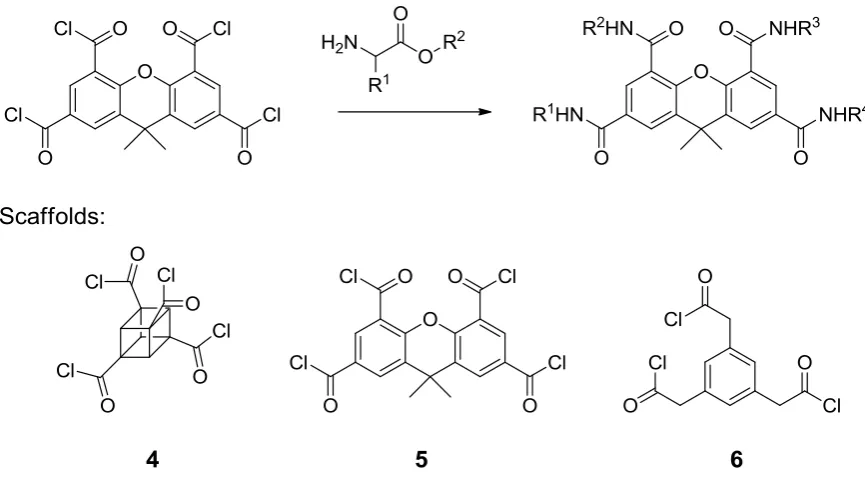
For example, The Rebek group reacted a range of amines with one of three
core tri- or tetra-acid halides (compounds 4-6, Figure 2) which resulted in a library
of up to 97,461 members.9-11 HPLC traces of those crude members showed that
6
identify which of those components were biologically active. Compound 7 was later
identified as the most effective trypsin inhibitor after repetitive deconvolution
[image:21.595.102.535.155.404.2]protocols.12
Figure 2: Reactive Scaffolds Used in the Preparation of Solution-Phase Mixture Libraries.
In parallel development,
self-assembly processes directed by molecular
recognition were also investigated in
supramolecular chemistry13.
Supermolecules are complexes that are
associated by two or more chemical
species which are held together by intermolecular forces such as hydrogen14
bonding, metal to ligand attraction15, π-π binding dispersion interactions16, and
7
Supramolecular chemistry involves the study of complexes which have a
cavity (the host or the molecular receptor) that enable smaller molecules (the guest
or the substrate) to fit into the cavity of the host. For example, hosts are the receptor
sites of enzymes and antibodies of the immune system, or ionophores and guests are
the counterparts of the hosts such as substrates, antigens, cofactors, inhibitors or
drugs.13
The concept of dynamic combinatorial chemistry (DCC) was created from
combining these two areas of chemistry (Scheme 3).13, 18, 19 The guest molecule can
select its own, most effective host that it could strongly bind to, among a mixture of
possible hosts. The most successful host from this equilibrium mixture of potential
hosts would cause a shift in the equilibrium position and amplify the “best binder”.
In principle, this minimizes the synthetic effort, in which a wide range of effective
large, complex products can be evolved from a small number of simple building
blocks.
8
1.2.2 Stabilization of Library Components
As dynamic combinatorial chemistry is thermodynamically controlled, stable
libraries can be generated in a number of different ways; chemical templates, self
templating, external stimulus or by phase change.
1.2.2.1 Chemical Templates
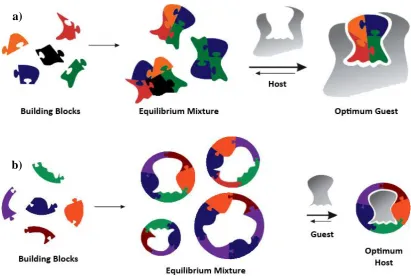
The concept of templating in the fashion of „casting‟ and „moulding‟ was first
employed by Lehn and co-workers.20 In „casting‟, a macromolecule (host) provides a
cavity within which the optimum ligand (guest) may be trapped via noncovalent
interactions (Figure 3, a). The poor candidates remain in solution and are consumed
by the equilibrium process. In „moulding‟, the ligand collects the optimum receptor
around itself also via noncovalent interactions (Figure 3, b). Examples of these used
9 Figure 3: Diagrammatic representation of (a) „casting‟ and (b) „moulding‟ in dynamic
combinatorial libraries.21
1.2.2.2 Self templating
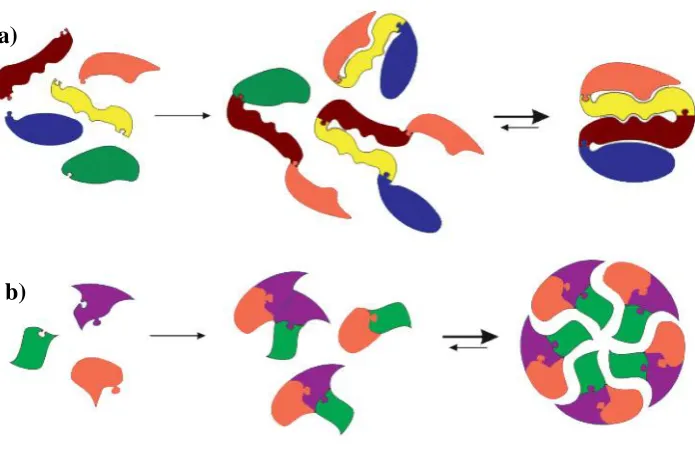
Stabilization of library components by self-assembly involves intermolecular
noncovalent forces such as hydrophobic interactions, coordination around a metal
ion or hydrogen bonding, generating libraries with stable assemblies or aggregates
(Figure 4, b). Foldamers arrange themselves to the structural conformation with the
most stable intermolecular noncovalent interactions, over those library members
which lack such stabilization (Figure 4, a).21 Examples of these used for imine
DCL‟s are discussed in detail in Sections 1.2.4.1 and 1.2.4.2. a)
10 Figure 4: Diagrammatic representation of a) „foldamers‟ and b) „self-assembly‟ in dynamic
combinatorial libraries.21
1.2.2.3 External Physical or Chemical Stimuli
Stabilization of library components shown by casting, moulding,
self-assembly and foldamers are driven by molecular recognition that requires
noncovalent bond interactions, but library components that are able to reorganise and
amplify by purely covalent bond interactions in the presence of an external
influence, in the form of physical (electric field, pressure, temperature) or chemical
(molecules, ions, protons) triggers22, 23 is known as constitutional dynamic chemistry
(CDC).24 Examples of these used for imine DCL‟s are discussed in detail in Section
1.2.4.3. a)
11
1.2.2.4 Phase Change
This is a process of self-organisation by selection, where the formation of a
structured phase (for example, a gel) drives the selection of the components, thus
amplifying the highly organised and most stable assembly.
One of the early examples of phase change was reported by Lehn.25
Guanosine hydrazine 8, although not soluble in water itself was able to from stable
free-standing gels. This is because it performs quadruple association into G-quartets
through Hoogsten type hydrogen bonding forming supramolecular macrocycles that
stack into G4 assemblies in the presence of Na+, K+, NH4+ and Me4N- at neutral pH
(Figure 5).
Figure 5. Guanine Derivatives Self-Assemble into G-Quartets in the Presence of Metal Ions.
Guanosine hydrazine 8 and its assemblies can be reversibly reacted with
various aldehydes to form acylhydrazones (Scheme 4). When 8 and 9 were mixed
with aldehydes 10 and 11 at 1:1:1:1 molar ratio, acylhydrazones 12 and 13 and
acylhydrazone G-quartets 14 and 15 were formed. These hydrazones were
12
was close to equal, but at cooler temperatures of 25oC, the equilibrium strongly
favoured the formation of acylhydrazone 15 which formed the strongest gel.
Scheme 4. Generation of a Dynamic Library of Hydrazones 12-15.
A further example of selection via phase change used for imine DCL is
demonstrated in Section 1.2.4.4.
1.2.3 Exchange Reactions
The most important element of DCC is the requirement of building blocks
13
building blocks must comply with certain standards for it to be effective for dynamic
combinatorial libraries.21
I) The reaction must be reversible within acceptable time scale. The equilibrium
and selection occurs simultaneously and, therefore, the components must be
suitable with the reaction conditions of the selection process (phase changes,
templates and external physical or chemical influences).
II) Noncovalent bonding interactions are weaker than covalent bonding
interactions (Table 1) and therefore in the presence of noncovalent bonds, the
reaction conditions (concentration, temperature and pressure) needs to be mild
to prevent disturbances to the weak noncovalent bonds.
III) At equilibrium, the reaction components should be soluble and there should be
a way to freeze the reaction to isolate the library member(s).
IV) The library member(s) are required to be of equal energy, this would prevent
production of reaction mixtures that would strongly favour in producing a
certain product which would result in high energy costs to return the products
back to equilibrium.
interactions energy (kJ/mol) lability
covalent bonds 150-800a low
coordinative bonds 1st rowb 80-350 high
2nd rowb 80-350 medium
3rd rowb 80-350 low
hydrogen bonds 0-20 high
a
typical range for single and double bonds. b localization of the metal in the d block of the periodic table (3d-5d series)
14
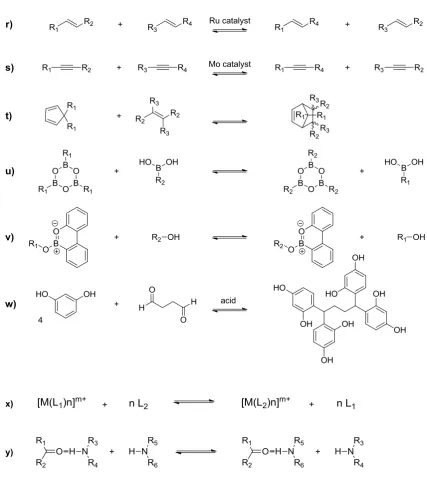
There is a huge diversity of covalent and noncovalent bond types that have
been shown in DCL generation which has been reviewed by Sanders and Otto
(Figure 6).26 We are only interested in looking at covalent bonds of imine exchange
reactions, including molecular recognition of imine DCLs via noncovalent
interactions used in DCC to aid the development of our „machine‟. These reactions
16 Figure 6. Various Reversible Reactions used in DCC; a) transesterification; b)
transallylesterification; c) transamidation; d) aldol exchange; e) transthioesterification; f)
Michael / retro-Michael reactions; g) nitroaldol exchange; h) acetal exchange; i) thioacetal
exchange; j) pyrazolotriazone metathesis; k) disulfide exchange; l) reversible benzylic
nucleophilic substitution; m) phosphazide exchange; n) imine exchange; o) hydrazine
[image:31.595.110.538.100.594.2]17 metathesis; t) Diels-Alder / retro-Diels-Alder reactions; u) reversible boroxine formation; v)
transboroxoaromatic esterification; w) reversible resorcinol and 1, 4-butanedial
condensation; x) metal-ligand exchange; and y) hydrogen bond exchange.
1.2.4 Imine DCL
Imine bonds (azomethine linkage) are formed when reacting an aldehyde or
ketone with a primary amine. This reaction is acid catalysed and was first discovered
by Schiff 27 and the imines are, therefore, also known as Schiff bases.
Scheme 5: A Mechanism for Imine Formation.
Acid is not required for the first step of the mechanism (addition of the amine
to the aldehyde) (Scheme 5), where, in the presence of strong acid, the amine will be
protonated and slow down the reaction. Acid is however required to protonate the
alcohol in step three to aid the removal of water. The optimum pH for imine
18
precede slowly, just like biological reactions, imine reactions precede fastest near
neutral pH.28
Imines generated by reacting diaryl or arylalkyl ketones with primary amines
require the removal of water from the reaction to drive the equilibrium towards
product formation; this can be achieved by either 1) separating it physically using a
Dean-Stark apparatus, or 2) by adding a drying agent that absorbs water from the
reaction. Imine formation by reacting dialkyl ketone or aldehydes with primary
amines can proceed without the removal of water from the reaction. Due to the fact
that removing water from a reaction to synthesize imine bonds would create
difficulties in DCC, there is only a limited number of papers reported to date that
have used ketones and primary amines DCL‟s to generate imines.29
Once azomethine linkages have been generated in the reaction, the exchange
of building blocks can be obtained via hydrolysis,28 aminolysis (transimination or
exchange)30, 31 or metathesis reactions.21, 26
Hydrolysis reactions involve breaking the azomethine linkage in the presence
of water and acid generating the aldehyde / ketone and primary amine starting
material, but as imine reactions are reversible, the equilibrium can then be shifted
back towards product formation by alteration of pH towards neutrality. In the
presence of new building blocks, new imines can be generated.28
Aminolysis reaction is a direct replacement of the amine component of a
Schiff base by another amine in the presence of acid. This reaction proceeds via a
two-step reaction pathway involving a formation of gem-diamine as an intermediate
19 Scheme 6: An Aminolysis Reaction.
In a metathesis reaction, an introduction of a second imine can result in a reaction
where the two R groups are exchanged (Scheme 7).
Scheme 7. A Metathesis Reaction.
In the presence of electron-withdrawing groups, the rate of hydrolysis of the
azomethine linkage is increased, while decreased in the presence of
electron-donating groups.32 Rate-determining steps for hydrolysis and aminolysis are similar;
hence the exchange reaction is expected to be similar.21 Imine reactions are generally
carried out in water free conditions33 or biphasic systems34 as they are susceptible to
hydrolysis in the presence of water. Analysis of imine libraries by chromatographic
methods that require water are generally avoided unless the library components are
20
1.2.4.1 Selection via Casting
In 1997, Lehn and co-workers20 demonstrated ligand „casting‟ by creating a
dynamic combinatorial library of imines generated from four amines and three
aldehydes in an attempt to discover effective inhibitors for human carbonic
anhydrase I (hCAI) (Scheme 8). The imine mixtures were allowed to reach
equilibrium and with the addition of CA, there was a two-fold increase in
concentration of compound 16 when compared to the control experiment. These
imines were detected by HPLC, which required a fixed library composition. This
was achieved by freezing the equilibrium by irreversible reduction of imines with
21 Scheme 8. Amplification of a Successful Binder to CA from a DCL of Imines.
Since then, much research has been carried out on CA and currently there are
13 catalytically active α-CA isozymes, human carbonic anhydrases hCAI and hCAII
are the most selective isoforms, selective inhibition of these could lead to effective
antiglaucoma, antiepileptic, anti-obesity, or anticancer drugs.36 By using DCC, a
22
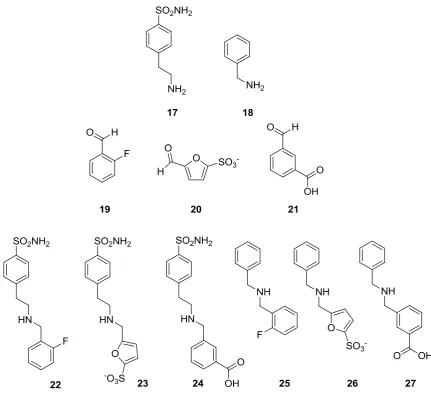
imine interconversion as reversible chemistry.36 Two amines 17, 18 and three
aldehydes 19 - 21 were selected. Amine 17 was selected due to the presence of a
sulfonamide group which are one of the best zinc binding groups (ZBG) present in
hCAI and hCAII active sites allowing generation of potent CAIs. Aldehyde 20 and
21 contain weaker ZBG where 18 and 19 contained phenyl hydrophobic moieties to
probe the hydrophobic interactions of the hydrophobic pocket above the active
[image:37.595.112.544.262.659.2]enzyme site (Figure 7).
23
Placing amines 17, 18 with aldehydes 19 – 21 resulted in six possible imine
products in equilibrium with initial components. In the presence of hCAI and hCAII,
the distribution of products was highly altered. After the reduction of imines by
NaBH3CN to 22 – 27 and HPLC analysis, in the presence of hCAI, they found a
significant amplification of amine 24 (350%) compared to no hCAI, which
confirmed the strong inhibition power of the sulfonamide group combined to
hydrophobic effects of the carboxylic acid group of component 21 in hydrophobic
pockets. A minor amplification of 26 was also observed. When they exposed the
imine library to a more active (selective) isoform of CA family (hCAII), a strong
amplification of compounds 22 – 24 (250 – 420 %) was observed again confirming
the strong inhibition power of the sulfonamide group. The dynamic screening of the
imine library was successful in terms of identifying components 26 and 24 as a
potent inhibitor of hCAI and sulfonamide inhibitors 22 – 24 for hCAII isozyme.
Apart from using imine DCL for effective inhibition of CA, work was also
carried out on neuraminidase, which is a key enzyme responsible for influenza virus
propagation.37 Neuraminidase is a major target for drug action on influenza.38 The
enzyme structure is well known and for the most important
functionalities are the presences of carboxylate and
acetamido groups for efficient inhibition. For example
compound 28, which is the active component of the
24 Scheme 9: Structures of the Scaffold and Library Composition.
Eliseev and co-workers designed a library of potential inhibitors using an
amine based central scaffold 29 and various aldehyde components.40 Exposing 29 in
vitro to various aldehydes resulted in four transient library components (hemiaminals
or imines, scheme 9) which existed in rapid dynamic equilibrium with each other and
with building blocks, suggesting the system was capable of generating libraries of
high diversity (up to 40 000 components). With the addition of the enzyme target to
the dynamic library, a shift in equilibrium towards monosubstituted scaffold was
observed (after freezing the library by reduction of imines to amines allowing HPLC
analysis), a property known for neuraminidase inhibitors. Their DCC experiment
identified product 30 demonstrating amplification to a factor of 120, revealing the
25
Although ketones are rarely used in DCC, Eliseev and co-workers also
worked on ketone components to discover a selective NA inhibitor.29 Again diamine
29 was used to generate dynamic imine libraries by exposing with 20 various
ketones, and then reduced to their corresponding amines for LC / MS analysis.
Comparing the relative amounts of imines with or without the presence of NA target,
they clearly observed amplification of selected amine peaks due to the interactions
with the neuraminidase active site.
Another example of enzyme inhibition was shown by Beau and
co-workers.41, 42 They demonstrated the use of dynamic imine library as potential active
site ligands comprising of an aryl group mimicking a carbohydrate group for the
inhibition of hen egg-white lysosome (HEWL). They were able to identify amine 31
from its corresponding imine to be the most amplified product being around 100-fold
more active that the previously known inhibitor N-acetyl-D-glucosamine.
Selective molecular recognition between synthetic oligonucleotide ligands
and nucleic acid targets play an important role in molecular biology, biotechnology
26
properties of natural DNA or RNA oligonucleotide can be altered (e.g. affinity,
nuclease resistance, membrane permeability). Designing these chemical modifiers is
not a simple task, but with the use of DCC, this effort can be greatly reduced.
Early work of Miller and Klekota44,45 revealed
that exposing salicyaldehyde with six different amines
lead to a imine DCL, which in the presence of Zn(II)
ions, amplified compound 32 as one of the highest
binding affinity to an immobilised double-stranded
DNA-cellulose resin used as the affinity target.
Bugart et al. used imine DCL for the identification of covalently appended
small molecules that stabilize nucleic acid complexes.46 They demonstrated that
reversible exchange reaction between imine libraries formed from
2‟-amino-nucleotide, incorporated into an oligonucleotide ligand and a group of aldehydes can
be influenced by the presence of a nucleic acid target, where the strongest binding
conjugated products were amplified. In their experiment they used an
oligonucleotide ligand 34, incorporated by two 2‟-deoxy-2‟aminouridine (U*) in
positions 3 and 9. This reactive ligand was then exposed to three aldehydes (35 – 37)
both in the presence and without the presence of the complementary
oligoribonucleotide 33 as the target, to observe which imine component successfully
stabilizes the RNA duplex formed between 33 and 34 (Scheme 10). HPLC analysis
of the corresponding amines reduced by NaBH3CN of the possible 15 imine products
(six monoconjugated and nine biconjugated products) with and without the presence
27
position 3 of the ligand in the expense of other products, hence stabilizing the duplex
formed with 33.
Scheme 10. Using DCC to Stabilize the RNA Duplex Formed Between Target 33 and
Complementary 34 Incorporating 2‟-deoxy-2‟aminouridine (U*) in Positions 3 and 9.
1.2.4.2 Selection via Moulding
Reversible imine chemistry has been used to form cyclic ligands for
transition metals for several decades. Addition of a template would direct the
synthesis of soluble cyclic adducts from insoluble polymers and shift the
condensation equilibrium to completion. For example, in the absence of a metal
template, o-aminobenzaldehyde self-condenses into a linear trimer (due to an
28
Ni(II) and Co(II), a closed tri- or tetradentate macrocyclic ligands are formed
(Scheme 11).47
Scheme 11: One of the Earliest Examples of Thermodynamically Templated Imine
Synthesis.
Lehn and co-workers have provided insight into the thermodynamic and
kinetic feature of imine formation, using scandium and lanthanide cations as
transimination catalysts in organic medium.48 Sc(OTf)3 is a powerful and general
Lewis acid in organic media, it has shown acceleration of the reaction by up to 105
-fold, which is more effective compared to BrØnstead acids at same concentrations.
Catalysis by H+ is less effective, especially with the most basic amines, as
protonation reduces the reactivity of the amine. Scandium mediated catalysts are
most effective in solvents with low dielectric constant, whereas coordinating
solvents greatly reduces the catalytic effect. Lanthanide mediated catalysts have
resulted in the most nucleophilic amines forming the thermodynamically most stable
29
ion complex, resulting in a nucleophilic attack of the amine in the rate determining
step. Amines which strongly coordinate will react most efficiently.
Various metal ions have been used in DCC to identify the most suitable
imine ligand to synthesize the most efficient metal - ligand complex. Examples of
some metals include B,49 Zn,33, 34, 50, 51 Cd34, 52 and Ba.52 Our primary interest is with
Cu(I) and (II) ions, as the Clark group has been extensively working with this metal
for many years to catalyse atom transfer radical cyclization (ATRC) reactions. Using
our “machine” we may be able to develop an efficient ligand to improve ATRC
reactions (Chapter 5).
Nitschke and co-workers demonstrated the technique of subcomponent
self-assembly, a process where intra-ligand (covalent (generally C=N)) bonds form at the
same time as metal-ligand (non-covalent) bonds.53,54 They examined how electronic
effects may provide a thermodynamic driving force for imine exchange within
Cu(I)-imine complexes.55
Scheme 12. Formation of Equilibrium Mixtures of Imines from Unsubstituted and
4-Substituted Anilines with Pyridine-2-carbaldehyde (left); Reactions of these Imines with
30
Working with unsubstituted and 4-substituted anilines, a relationship was
found between the equilibrium constant of an imine exchange reactions and the
electron-donating ability of the aniline‟s 4-substituent which was measured by
Hammett ζpara parameter. This showed that electron rich anilines displace electron
poor anilines, this transformation can be performed in the same reaction flask with
imine exchange step generating more than 95% yield. Creating a wide range of
electron poor aniline complexes and then adding one electron-rich aniline resulted in
a quantitative displacement of all electron poor anilines giving just one imine
complex.
The equilibrium constant K for the two imines and two amines shown in
scheme 2 (left) were determined by integrating the 1H NMR resonances. The
addition of copper (I) tetrafluoroborate resulted in quantitative formation of a
mixture of imine complexes (Scheme 12, right) for which a new equilibrium was
measured as equilibrium constant K’. These data were used to generate a Hammett
plot (Figure 8). This showed that the incorporation of electron-rich aniline will
strongly stabilize both imine ligands and copper (I) complexes. The cationic metal
31 Figure 8: Hammett Plots for the Thermodynamic Competition of Anilines to Form Imines
(Scheme 12) in the Presence and Absence of Copper(I), Including the Linear Regressions
used to Obtain p and p‟.
Structural complexity through subcomponents was introduced by
incorporating substituted anilines into larger molecules shown by Scheme 13. In the
same reaction vessel, three distinct subsequent transformations were carried out. The
aniline ζ values were used as driving forces for the first two substitutions. The last
reaction was pushed forward by adding a more chelating ligand. Substituent
electronic effects can be readily employed to drive ligand subcomponent substitution
and may also be used to control and shape the constitution of dynamic combinatorial
32 Scheme 13. A One-Pot Synthesis of Transformations, Using Substituent Effects and the
Chelate Effect to Provide Driving Forces for Imine Exchange.
With the realization of copper(I)-imine complexes undergoing ligand
substitution, they worked on a simple three component system of imine DCL, which
combined to give five possible ligands in the absence of copper(I) ions (Equation
1).53 In the presence of copper(I) ions, the ligands had performed thermodynamic
self-sorting process amplifying the most successful ligand, and eliminating mixed
ligands from the system.
Equation 1
In 2006, they presented a more complex self-organizing system, in which a
larger dynamic combinatorial library of potential imine ligands self-assemble in the
6-33
methyl-pyridine-2-carbaldehyde (39), tris(2-aminoethyl)amine (40) and
ethanolamine (41) gave a dynamic library of imines (Scheme 14). With the addition
of copper(I) tetrafluoroborate and iron(II) sulphate, the dynamic mixture of imines
collapsed within 12 hours at 323K to give thermodynamically stable complexes of
42 and 43.
Scheme 14: The Formation of a Dynamic Combinatorial Library of Ligands, and the
Collapse of this Library Following the Addition of CuI and FeII ions.
By further investigations, three distinct preferences observed by copper and iron
were concluded; (1) Copper(I) ions preferred methylated aldehyde 39 than 38 in a
pseudo-tetrahedral complex, this was due to the electron-donating methyl group on
B, which would allow greater stabilization of the cationic copper(I) centre. (2)
Iron(II) ions preferred triamine 40 pseudo-octahedral complexes over monoamine
41. They managed to displace monoamine 41 by exposing compound 44 with an
equimolar amount of triamine 40 in aqueous solution (Scheme 15). The displacement
34
force of greater than 22 kJ mol-1 resulting in the substitution of ligand 41. It was later
proved that the chelate effect plays an essential role in stabilizing complex 42 against
subcomponent substitution.57 (3) Iron(II) ions strong preference to incorporate 38 in
preference to 39 was possibly due to the high energy penalty paid for the steric clash
in iron(II) pseudo-octahedral type complexes.
Scheme 15. The Choice of Iron: The Entropically Driven Displacement of Monoamine 41
by Triamine 40.
By controlling the stoichiometry of the four subcomponents, Nitschke and
co-workers were able to produce three products at any relative proportions, in which
the synthesis of these products were directed by the rules of valence satisfaction
(Scheme 16).58 The smallest possible structures will be formed where all copper(I)
ions tetracoordinate and all nitrogen atoms are bound to copper(I). Though imine
products formed from dialdehyde subcomponent 48 generates di or trinuclear
helicates, as they are poorly configured to chelate a single copper(I) ion
35 Scheme 16. By changing the stoichiometry of 45, 46, 47 and 48, any of complexes 49, 50
and 51 can be amplified.
Theoretically, a reaction of two aldehydes and two
amines in stoichiometric amounts would result in four possible
imine products, but with the addition of Cu(I) ions, complexes
49, 50 and 51 were generated, only synthesizing three of the
possible imines. The imine product formed by reacting 46 with
47 which would generate structure 52 was forbidden as the Cu(I) centres were not
tetrahedrally coordinated. Overall, their results demonstrated that the observed
36
products, as it largely relies on the rules of valence satisfaction which must be
applied to the system as whole.
Using DCC to synthesize macrocycles such as rotaxanes has been of great
interest. Macrocycles are a subclass of cyclic compounds, and only a small number
of macrocycles exist in nature, therefore, is it very important to develop efficient
routes to synthesize these molecules. The synthesis of most macrocycles are
unstrained, therefore their enthalpy of formation is comparable to that of five- or six
membered rings. There are no thermodynamic arguments against the formation of
unstrained macrocycles, but the kinetics is different. The synthesis of a large
macrocycle is difficult, as the remote ends have to connect. Formation of a
macrocycle is an intramolecular process which competes with the intermolecular
process of oligo- or polymerization, hence most cyclization mixtures will contain
macrocycles, oligomers and polymers in a dynamic library, but by molecular
recognition, the macrocycles can be amplified, as macrocycles possess a
well-defined cavity, and with the correct guest that binds complementary into this cavity,
amplification of that macrocycle can be achieved.59
Rotaxanes can be formed in several ways, such as clipping and threading
followed by stoppering. Syntheses of macrocycles are at low priority to this project.
Meyer et al. presented a detailed review on macrocycles.60 But an example of the
first thermodynamic synthesis of rotaxanes by imine DCL‟s was demonstrated by
Glink et al. in 2001 by the clipping method (Scheme 17).61 A library of macrocycles
along with linear products were synthesized by the condensation reaction between
tetraethylene glycol bis(1-amino-phenyl)ether (57) and 2,6-diformylpyridine (53).
Analysis by 1H NMR spectroscopy revealed 50% of starting components condensing
37
in high order macrocycles and other linear product. Addition of one equivalent of
dumbbell bis(3,5-dimethoxybenzyl)ammonium hexafluorophosphate (56a) resulted
in a sharp increase in [2]rotaxane shown by 1H NMR and fast atom bombardment
mass spectrometry (FAB-MS). This amplification of [2]rotaxane was observed
because the ammonium centre of the dumbbell acts as a template to aid the formation
of [24]crown-8 derivative using weak acid catalysis and bringing stability to the
structure through hydrogen bonding. The reaction was frozen using a slight excess of
BH3.2,6-lutidine in CD3CN.
Scheme 17: Synthesis of[2]Rotaxanes by Clipping Process.
Soon after, they repeated the experiment,62 generating a total of nine
38
using dumbbell 56c, [2]rotaxanes were the most stable. 56a resulted in [2]rotaxanes
to be the least stable. This demonstrated that a more π-electron deficient dumbbell is
the most efficient. [2]Rotaxane formed from 55 was the least stable, followed by 53,
while 54 resulted in the most stable macrocycle due to the enhanced basicity of the
π-electron stabilized imino and phenoxy units acting as better hydrogen bond
acceptors.
So far we have shown the selection of molecules via casting and moulding
techniques in DCC. In the early stage of this project, implementing selection through
casting would be difficult in our „machine‟, but we could use the idea of moulding in
DCC in our „machine‟ to identify successful imine ligands for ATRC reactions by
exposing copper salts to a dynamic library of imines to identify which imines would
bind efficiently to the copper metal forming the most stable complexes (see Chapter
5). However, the casting and moulding technique would be difficult to implement in
our „machine‟ for the evolution of a desired coloured imine compound from a DCL
of coloured imines; therefore we would be looking at a simpler external physical or
chemical stimulus to drive amplification of a desired product.
1.2.4.3 Selection through External Physical or Chemical Stimulus
Guiseppone and Lehn had first shown constituent reorganisation and
amplification / selection by means of component exchange in a DCL by means of
external physical (temperature) and chemical (H+) influence.63
In one of their experiments, they took a dynamic set of aromatic imines 62 -
39
aldehydes 60 – 61 building blocks (Scheme 18). 58 - 61 possessed different emission
properties and, therefore, resulted in imine products with a dynamic emissive library.
The equilibrium mixture was treated with variable concentrations of CF3CO2D
(6.29x10⁻⁶ – 4.99x10⁻¹ M) and temperature (298 to 368 K) to observe the selectivity
of the system in terms of relative amounts of imine products.
The library was analysed by 1H NMR spectroscopy and it was discovered
that 62 and 64 predominate in the localised low [H+] / high temperature region, 63
and then 62 predominate towards moderate [H+] as temperature increases, 62 and
then 65 predominate over the whole temperature range at moderate and high [H+]
respectively.
Scheme 18. Dynamic Library of the Four Components 58 – 61 and the Four Constituents 62
40
The complexity of the effects had not allowed for a detailed quantitative
explanation in terms of structure and mechanism, but their study had successfully
shown constitutional recomposition of a dynamic library under the effect of acidity,
temperature and also the possibility of modulating a given functional property (in
this case optical) induced by a specific trigger. Our studies would be expanding on
this research and determine a method for detailed quantitative analysis of our imine
DCL‟s. We would be using external physical or chemical stimulus in our „machine‟
to evolve an imine of a desired colour from our imine DCL each with a unique UV /
Vis absorption spectrum.
Constitutional dynamic polymers, dynamers, are polymeric entities based on
monomeric components connected through reversible bonds.64, 65 Amplification of a
given dynamer of DCL can be achieved by stabilizing its microscopic structures.
Lehn had shown amplification of a given dynamer of a DCL synthesized using
reversible imine bonds under the pressure of self-organization process favouring the
dynamer that formed the most stable phase. These dynamers would stabilize or
destabilize influenced by an external physical stimuli (neat or solvent).66
Polymers 70 – 73 were connected through imine bonds and were synthesized
using amines (66 and 67) and aldehydes (68 and 69) (Scheme 19). The dynamic
behaviour of these polymers was demonstrated by the occurrence of ligand exchange
and recombination. They had blended together homopolymers 70 and 71 in CDCl3
with equal molar ratio and 1% pentadecafluorooctanoic acid (catalyst). Analysis of
the mixture after 24h by 1H NMR spectroscopy had shown the formation of two new
connections, 72 and 73 that had resulted from recombination of all four polymers
with polymer ratio of 70 : 71 : 72 : 73; 3 : 3 : 2 : 2. When 70 and 71 were blended
41
observed, but 71 and 72 were not observed with polymer ratio of 70 : 71 : 72 : 73; 0 :
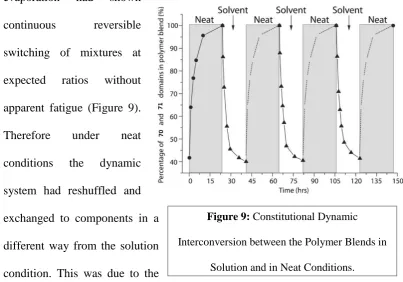
0 : 5 : 5. Successive solvent and neat cycles of the blended mixture 70 and 71 by
evaporation had shown
continuous reversible
switching of mixtures at
expected ratios without
apparent fatigue (Figure 9).
Therefore under neat
conditions the dynamic
system had reshuffled and
exchanged to components in a
different way from the solution
condition. This was due to the
strong driving force of the only crystalline polymer 73 which had shifted the
equilibrium of the CDL towards itself in neat conditions and, as a consequence,
[image:56.595.110.514.137.419.2]generated also agonistically the copolymer 72.
Figure 9: Constitutional Dynamic
Interconversion between the Polymer Blends in
42 Scheme 19: Structure of Diamines 66 and 67, of the Dialdehydes 68 and 69 and of the
Polymers Obtained by Polycondensation: 70 (68 + 67), 71 (69 + 66), 72 (68 + 66) and 73
(69 and 67).
Fujii and Lehn had also shown that dynamers generated by condensation
polymerisation through the reversible formation of imine bonds can undergo driven
evolution under the double effect of donor-acceptor stacking and metal ion binding
43
able to show adaptation behaviour associated with specific constitutional changes
with different optical signals showing specific positioning of donor and acceptor
units within the folded dynamer.67
Constituent reorganisation and amplification/selection by means of
component exchange in a DCL with the influence of an electric field was recently
shown by Guiseppone and Lehn.68, 69 An electric field was applied to liquid
crystalline type imines with a negative dielectric anisotrophy such as N
-(4-methoxybenzylidene)-4-butylaniline (MBBA, 74) (Scheme 20). In the presence of
compounds that do not participate in the liquid crystalline phase formation of the
imine (e.g. an alcohol such as cyclopentanol) are expelled from the liquid crystal
with the treatment of an electric field.
Scheme 20. Principle of Constitutional Reorganisation by Component Exchange of MBBA
44
Whereas in the presence of compounds such as cyclopentylamine 75 that
react reversibly with the liquid crystalline phase forming an imine, component
exchange by transamination and the release of 76 was observed. They also
investigated whether an exchange and release of an aldehyde / ketone part of the
imine reaction was possible as amines are less interesting as bioactive compounds to
be released. In the presence of an electric field and trace amounts of water, aldehyde
component exchange 77 was observed releasing 78, while exchange of ketone
component failed. Component exchange of a DCL with the influence of an electric
field could one day allow construction of devices that would allow accurate release
of components in response to the strength of the electric field, hence allow efficient
release of a broad variety of biologically active compounds in the area of life
sciences.70
1.2.4.4 Selection though Phase Change
Work carried out on selection through phase change using a dynamic imine
library is very limited. An example was shown by Li and co-workers.71 They
demonstrated gelation-driven component selection of cholesterol moieties that were
connected to an aromatic or other rigid unit by a flexible linker. They exposed
cholesterol-appended aniline 79 and cholesterol-free aniline 80 to aldehydes 81a –
81c to form a dynamic library of imines 82a – 82c and 83a – 83c in protic solvents
(Scheme 21). Individual studies of these imines had shown that cholesterol-free
aniline based imines (83a – 83c) did not gelate, while cholesterol-appended aniline
based imines (82a – 83c) gelated at room temperature. For quantitative analysis, the
imines were reduced to amines by NaBH3CN generating 84a – 84c and 85a – 85c.
45
– 83c) allowed them to investigate their expression in gel and solution phases. In a
five component system 79, 80 and 81a – 81c, they observed that even though the
electron rich butoxyl group of 80 was stronger than the amide group 79 in promoting
the condensation reaction to the corresponding imines, the formation of the gel phase
of products 82a and 82b were favoured. Products 82c and 83c were absent due to the
precipitation of 82c during the reaction. Kinetically imines 83 were more favoured,
but enrichment of 82 over time had confirmed the amplification of 82 by the
reversible feature of the imine bond through the gelation process.
46
1.3 Summary
The development of our „machine‟ would allow us to take small organic /
inorganic building blocks and use them to prepare any theoretical compound with
any theoretical property that is determined by the „machine‟. For this „machine‟ to
work, one of the essential components required are organic building blocks that can
reversibly react under various conditions until a product with a desired property has
been evolved.
We here at Warwick are to use DCC to generate a library of imine
components with a specific property that would allow us to prove that such
„machine‟ can be developed. The beauty of DCC is that it allows us to access a wide
range of substances generated by a small library of molecules without having to
synthesize each molecule individually, which are in equilibrium with each other. We
have shown that imine DCL‟s have been developed where in the addition of a
suitable target, such as a biological enzyme, metal ions, or by external or physical
triggers, the most effective members of the library can be amplified. As these are
products of reversible reactions, if not satisfied, the product can be recycled back to
starting components.
As a proof of concept, we will use this same approach by designing a
dynamic imine library for our „machine‟. The machine will have a sensor to measure
a UV / Vis absorbance of the components. With subject to external physical
stimulus, compounds which are amplified with the desired absorbance would be
isolated, whereas products that fail to have the correct absorbance are recycled and
47
While the „machine‟ is being developed, we also aim to develop new imine
ligands which have been used with Cu(I) to catalyse well known atom transfer
48 2.0 Determining a Suitable Analytical Method for our Imine DCLs
2.1 Introduction
Imine bonds are unstable under the conditions of many standard purification
techniques and therefore most commonly the imine library components are reduced
to amines then analysed by HPLC (previously shown in chapter 1). An alternative
method is to stabilize the library by using the Ugi freezing method.72 Leon and
co-workers had developed a novel approach to freezing the imine exchange reactions in
a DCL by using acid and isocyanide components. They demonstrated freezing the
imine exchange process by Ugi four component reaction (Ugi-4CR). Ugi-4CR is the
one pot condensation of a primary amine, an oxo component, a carboxylic acid and a
isocyanide to afford a N-substituted peptide backbone, a multicomponent reaction
(MCR) type II which involves a sequence of reversible steps followed by irreversible
steps.
Dialdehyde 87 was exposed to diamine 86 and 88 with or without the
presence of MgII or BaII ions (Table 2). The relative formation of macrocycles 89 –
92 was then examined. They discovered that exposing these macrocycles to metal
ions at room temperature for long periods resulted in formation of some precipitates,
and due to these instabilities of imine bonds, a quantitative and qualitative analysis
of this DCL by HPLC would not be possible. Therefore, with the addition of a
threefold excess of isocyanide and carboxylic acid, the imine DCL was frozen to
amine based macrocycles 93 – 96 and then was able to analyse the mixtures by