University of Warwick institutional repository: http://go.warwick.ac.uk/wrap
This paper is made available online in accordance with
publisher policies. Please scroll down to view the document
itself. Please refer to the repository record for this item and our
policy information available from the repository home page for
further information.
To see the final version of this paper please visit the publisher’s website.
Access to the published version may require a subscription.
Author(s): Miguel A. JUÁREZ and Mark F. J. STEEL
Article Title: Model-Based Clustering of Non-Gaussian Panel
Data Based on Skew-t Distributions
Year of publication: 2010
Link to published article:
Model-based Clustering of non-Gaussian Panel Data Based on
Skew-
t
Distributions
Miguel A. Juárez and Mark F. J. Steel∗
University of Warwick
Abstract
We propose a model-based method to cluster units within a panel. The underlying model is autoregressive and
non-Gaussian, allowing for both skewness and fat tails, and the units are clustered according to their dynamic
behaviour, equilibrium level and the effect of covariates. Inference is addressed from a Bayesian perspective and
model comparison is conducted using Bayes factors. Particular attention is paid to prior elicitation and posterior
propriety. We suggest priors that require little subjective input and possess hierarchical structures that enhance
inference robustness. We apply our methodology to GDP growth of European regions and to employment growth
of Spanish firms.
keywords: autoregressive modelling; employment growth; GDP growth convergence; hierarchical prior;
model comparison; posterior propriety; skewness.
1 Introduction
Models for panel or longitudinal data are used extensively in economics and related disciplines (Baltagi, 2001;
Hsiao, 2003), as well as in health and biological sciences (Diggleet al., 2002; Weiss, 2005). Typically, panels are
formed according to some criteria (e.g.geographical, economical, demographical, etc.) with the intention of
gain-ing strength when estimatgain-ing quantities common to all individual units in the panel. However, this groupgain-ing may
strongly affect inference if presumed common characteristics of the units are, in reality, quite different. In these
cases, clustering units within the panel may prove useful. This will allow the units to share some common
para-meters, thus borrowing strength in their estimation, but to also have some cluster-specific parameters. In particular,
we will consider model-based clustering, which is based on a formal statistical framework (Banfield and Raftery,
1993; Fraley and Raftery, 2002). In an economic context, Bauwens and Rombouts (2007) propose a method for
clustering many GARCH models, while Frühwirth-Schnatter and Kaufmann (2008) discuss a Bayesian clustering
∗Corresponding author: Mark Steel, University of Warwick, Department of Statistics, CV4 7AL, Coventry, UK. Email:
2 1. Introduction
method for multiple time series data. From a frequentist perspective, Lin and Ng (2007) propose nonparametric
model-based clustering methods for panel data with fixed effects.
Even though the majority of the literature uses Gaussian models, it is often the case that data contain outliers,
which can be dealt with by allowing for heavier-than-Normal tail behaviour, as well as asymmetries, which require
the underlying distribution to allow a certain amount of skewness. The former issue is frequently addressed by
assuming a Student distribution withνdegrees of freedom (denoted here bytν), usually with νfixed at a small
value. In comparison, there has been much less development in dealing with asymmetry. Hirano (2002) proposes
a semiparametric framework, with a nonparametric distribution on the error term, using a Dirichlet prior. In this
paper we will use fully parametric, yet flexible, models, partly based on the models in Juárez and Steel (2006), yet
allowing for clustering and additional covariates, and conduct inference from a Bayesian viewpoint.
As the aims of this paper are rather similar to those of Frühwirth-Schnatter and Kaufmann (2008), we briefly
highlight the differences with the approach used in that paper. Firstly, our modelling allows for skewness and
imposes stationarity. In addition, we use shrinkage within the clusters only for the equilibrium levels, whereas
we pool for the autoregressive coefficients. Frühwirth-Schnatter and Kaufmann (2008) either shrink or pool both
(although Frühwirth-Schnatter and Kaufmann, 2006 pool only part of the parameters in a somewhat related model).
The prior used in the present paper is carefully elicited and is improper, unlike the conditionally natural-conjugate
prior used in Frühwirth-Schnatter and Kaufmann (2008). This implies we need to make sure that the posterior exists
(we derive a simple and easily verifiable condition for propriety), but we need to elicit fewer hyperparameters and,
more importantly, our prior enjoys a natural invariance (for the parameter we are improper on) with respect to affine
transformations of the data, which leads to desirable robustness properties. In addition, we reduce the dependence
of the Bayes factors on prior assumptions by using hierarchical prior structures. Finally, we allow for the data to
inform us on the tails of the error distribution, as we leaveνa free parameter.
An important contribution of this paper is the introduction of a flexible model that can be applied in a wide
variety of economic contexts with a “benchmark” prior that will be a reasonable reflection of prior ideas in many
applied situations. Thus, the aim is to provide a more or less “automatic” Bayesian procedure, that can be used
by applied researchers without substantial requirements for prior elicitation. The prior structure asks the user
for a mean and a variance of the parameters describing long-run equilibrium levels, and allows for comparison
(or averaging) of models with different numbers of clusters through Bayes factors. Priors on the model-specific
parameters are given a hierarchical structure. This leads to greater flexibility, and, more importantly, reduces
the dependence of posterior inference and especially Bayes factors on prior assumptions, thus inducing a larger
degree of robustness. Matlab code which implements the methodology described in this paper is freely available at
http://www.warwick.ac.uk/go/msteel/steel_homepage/software/, along with the data sets used in
2. The model 3
The rest of the paper is organized as follows: Section 2 describes the model and discusses the prior specification
and posterior propriety. Numerical methods for conducting inference with this model are briefly discussed in
Section 3. Section 4 discusses the analysis of simulated data, which are used to assess the model performance in
terms of clustering. Two real data sets are analysed in Section 5 to illustrate the implementation of the model:
one comprising per-capita GDP growth data for European regions and the other describes employment growth in
Spanish manufacturing firms. Concluding remarks are presented in Section 6.
2 The model
Assume that the data available,y = {yi t}, form a (possibly unbalanced) panel ofi = 1, . . . ,mindividuals for each
of which we haveTi consecutive observations. In addition, we observe a vector,xi t =(x1i t, . . . ,xi tp)0, of covariates.
We will focus on the first-order autoregressive model:
yi t=βi(1−α)+αyi t−1+(1−α)µxi t+λ− 1
2εi t, (1)
where the errors{εi t} are independent and identically distributed random quantities with mode at zero and unit
precision, α is the parameter governing the dynamic behaviour of the panel and µ = (µ1, . . . , µp) is a vector
of coefficients related to p explanatory variables in xi t. We assume that the process is stationary, i.e.|α| < 1.
The parametersβi are individual effects. Since the error distribution has zero mode, these individual effects can
be interpreted as reflecting differences in the long-run modal tendencies for the corresponding individuals. In
addition, the individual effects are assumed to be related according toβi ∼ N
βi | β, τ−1
, which is a commonly
used normal random effects specification, found e.g. in Liu and Tiao (1980), Nandram and Petruccelli (1997) and
Gelman (2006), whereβis a common mean andτthe precision. Within a Bayesian framework, this is merely a
hierarchical specification of the prior on theβi’s, which puts a bit more structure on the problem and allows us to
parameterise the model in terms ofβ andτ, rather than allmindividual effects. Finally, we condition throughout
on the initial observed values,yi0, and assume that the process started a long time ago.
In order to accommodate skewness while retaining a unique mode at zero, we assume that the error term follows
a skew distribution as in Fernández and Steel (1998). Thus, given a unimodal probability density function f which
has support on the real line and is symmetric around zero, we consider
fs(x | γ)= 2
γ+γ−1
f(xγ) 1[x≤0]+ f(xγ−1) 1[x>0]
, (2)
where 1[A] = 1 if condition Aholds and 0 otherwise, andγ >0 is the skewness parameter. Clearly, forγ = 1 the
4 2. The model
skewness corresponds toγ > 1, while negative skewness is generated byγ ∈ (0,1). Fernández and Steel (1998)
derive an explicit expression for the moments in terms of the moments of f. Of course, we could use other ways
of introducing skewness, such as in Jones and Faddy (2003) and Azzalini and Capitanio (2003), but we prefer
the approach adopted here because it retains a zero mode and because of its inferential simplicity and the clear
interpretation of the extra parameterγ. The latter also facilitates prior elicitation.
To also allow for fat tails, we will focus on skew versions of the Student-tνdistribution, leading to
tνs(ε| γ)= 2
γ+γ−1
Γ[(ν+1)/2]
Γ[ν/2]
r
1
ν π
1+ 1
νε
2γ21
[ε≤0]+γ−21[ε>0]
−ν+1 2
, (3)
where the degrees of freedomνwill be treated as a free parameter.
The basic model then consists of (1) withεi tdistributed according to (3). In this model, we can clearly interpret
αas the parameter governing the dynamics of the panel,λas the observational precision,βias the individual
long-run level andµas a measure of the long-run modal effect of the covariates on the observable. In addition,γ will
control the skewness andνdetermines the tail behaviour.
As discussed before, pooling similar time series can be beneficial when estimating a model, but when the
behaviour is not homogeneous enough, the resulting pooled estimates may be misleading, as will be illustrated
in the applications in the sequel. Clustering is one way to keep the advantages of pooling, while also allowing
for heterogeneity within the panel (see e. g. Canova, 2004; Frühwirth-Schnatter and Kaufmann, 2008; Hoogstrate
et al., 2000). In order to allow for clustering within the panel, we assume that all units share a common parameter
vector, say, θC and each has a cluster-specific set of parameters in θj, for j = 1, . . . ,K, with K the number of
clusters in the panel.
Specifically, we assume that the different behaviour may arise either from the dynamics, the coefficients of the
covariates or from the equilibrium level of the series. So, extending (1) to allow for different dynamics, covariate
effects and levels for each cluster yields
yi t=βi(1−αj)+αjyi t−1+(1−αj)µjxi t+λ− 1
2εi t, (4)
withαj<1 and
βi∼N
βi | βj, τ−1
; j=1, . . . ,K. (5)
Thus,θC = {γ, ν, λ, τ}andθj = nαj, βj,µjo. The interpretation of the cluster-specific parameters is as follows: αj
characterizes the autoregressive dynamics, while the long-run average equilibrium level is given byβj, provided we
standardizexi tto have mean zero for each unit. Finally, the equilibrium level at each time point will also depend
onxi tthrough the coefficients inµj.
2.1. Prior specification 5
parameters of the error distribution in (3). This reflects both our judgement that these are unlikely to be parameters
of interest and the relative difficulty of learning from data about the non-normality parameters, especiallyν. Making
more parameters cluster-specific is perfectly feasible, but we feel the current specification is a good way to focus
attention on differences between the clusters that we can easily interpret. Finally, we can also consider alternative
partitions of the parameters, wheree.g.only the dynamics are cluster-specific, i.e.the model withβj = β,µj =
µ,j=1, . . . ,K, leading toθC ={β,µ, γ, ν, λ, τ}andθj =αj.
2.1 Prior specification
We specify a product form prior for our clustering model in (4) and (5), combined with (3)
π(α,β,M, τ, λ, γ, ν)=π(α) π(β) π(M) π(τ) π(λ) π(γ) π(ν) , (6)
whereα = (α1, . . . , αK)0, M = (µ1,µ2, . . . ,µK) and β = (β1, . . . , βK)0 denote the cluster-specific parameters, the
prior of which will be discussed in the next subsection.
We adopt a standard diffuse (improper) prior for λ, which is invariant with respect to affine transformations.
Theorem 1 will provide a simple condition for posterior existence under this improper prior. Forτ, however, we
need a proper prior and we adopt a gamma distribution with shape parameter 2 and a scale that is consistent with
the observed between-group variance of the group (i.e.individual) means, s2
β, by making the prior mode equal to
2/s2
β (this distribution is denoted by Ga(2,s2β/2)). The prior on γis induced by a uniform prior on the skewness
measure defined as one minus twice the mass to the left of the mode. Full details and further motivation for these
choices are provided in Juárez and Steel (2006). Thus, we adopt
π(λ)∝λ−1 (7)
τ∼Ga(2,s2β/2) (8)
π(γ)=2γ 1+γ2−2 . (9)
The degrees of freedom parameterνis often not that clearly determined by the data, so we consider three different
priors. Firstly, we take a Ga(2,1/10) prior forνwith mass covering a large range of relevant values (prior mean 20
and variance 200). This prior leads to the probability density function (pdf)
π1(ν)= 100ν exp[−ν/10], (10)
6 2.2. The prior on the cluster-specific parameters
an exponential prior on the scale parameter of a gamma distribution with shape parameter 2, which leads to the pdf
π2(ν)=2d(ν+νd)3 . (11)
This introduces a parameterd > 0, which controls the mode (d/2) and the median ((1+ √2)d). The tail is now
too heavy to allow for a mean. Finally, in the context of Student-tregression models, Fonsecaet al.(2006) derive
a Jeffreys’ prior forν, which has an “objective” flavour and performs well in terms of frequentist coverage. This
prior is proper with pdf
π3(ν)∝
" ν
ν+3
ψ0
ν
2
−ψ0 ν+1
2
!
− 2(ν+3)
ν(ν+1)2
!#1 2
, (12)
whereψ0(·) is the trigamma function. This prior has the same right tail behaviour asπ
2, not allowing for a mean,
but has quite different behaviour close to zero, as it is unbounded asνtends to zero. The median is always equal to
0.55. Thus, the prior onνis given by either one of (10), (11) or (12).
We also need to specify a prior on the assignment of units to clusters. A common approach is to augment the
data with the indicator variableSi ∈ {1, . . . ,K}, whereSi = jmeans that unitibelongs to cluster j. Thus, we may
write
f yi | Si,θ
= fyi | θj,θC for Si= j, j=1, . . . ,K,
whereθ=(θC,θ1, . . . ,θK).
A priori we assume that independently
P[Si = j| η]=ηj,
whereηj is the relative size of cluster j = 1, . . . ,K andη = (η1, . . . , ηK)0. Obviously,η0ι = 1 (whereιdenotes
a K-dimensional vector of ones) and thus it is natural to specify the Dirichlet priorπ(η) = Di η| e, where we
will use a “Jeffrey’s type” prior withe =(1/2)×ι(see Berger and Bernardo, 1992). In addition, we exclude from
the sampler cluster assignments that do not lead to a proper posterior (as will be explained in Subsection 2.3).
Therefore, the joint prior forS={S1, . . . ,Sm}andηis
π S,η= m
Y
i=i
π Si | η π ηI(S)∝ m
Y
i=1
ηSi
K
Y
j=1
η−j1/2I(S), (13)
whereI(S) is one if the assignment gives rise to a proper posterior and zero otherwise.
2.2 The prior on the cluster-specific parameters
An important reason for wanting to put a carefully elicited proper prior on cluster-specific parameters is that we
2.2. The prior on the cluster-specific parameters 7
have, say, a commonβandµ, that would be perfectly feasible with a flat improper prior on (β,µ), but in the general
case whereβj’s and/orµj’s are cluster-specific, such Bayes factors would no longer be defined. Of course, any
proper prior on the cluster-specific parameters inθjwill give us Bayes factors, but we need to be very careful that
the prior onα,βandMtruly reflects reasonable prior assumptions, since the Bayes factors will depend crucially
on the particular prior used.
Within each cluster, the dynamics parameterαgets a rescaled Beta prior (on (−1,1)), and we make the
hyper-parameters of this Beta distribution random, with equal gamma priors. This hierarchical structure of the prior onα
leads to more flexibility. In particular, we adopt
π(α| aα,bα)= 2
1−aα−bα
B(aα,bα) 1+α aα−1
1−αbα−1 |α|<1 (14)
with
aα∼Ga(2,1/10) and bα ∼Ga(2,1/10). (15)
The implied marginal prior on α is roughly bell-shaped with P(|α| < 0.5) = 0.65 and P(|α| > 0.9) = 0.03,
in line with reasonable prior beliefs for our (and most) applications. In the context of our clustering model we
will use independent and identical priors for the dynamics parameters, thus, defining aα = (aα1, . . . ,aαK)0 and
bα= (bα1, . . . ,bαK)0, we have
π(α | aα,bα)=
K
Y
j=1
παj | aαj,bαj
(16)
π(aα,bα)=
K
Y
j=1
π aαj
π bαj
(17)
where each component prior is specified as above. Note that this hierarchical prior structure onαwill make the
Bayes factors between models with differentKless dependent on the prior assumptions.
The long-run equilibrium levels associated with each cluster are often quantities that we possess some prior
information about. Within the product form of (6), we propose the following multivariate normal prior forβ:
β∼NKβ| mι,c2(1−a) I+aι ι0, (18)
wherec>0 and−1/(K−1)<a<1. The prior in (18) generates an equicorrelated prior structure forβwith prior
correlationathroughout. Thus, ifa = 0 we have independent normally distributedβj’s, but ifa→1 they tend to
perfect positive correlation. The main reason for allowing for nonzeroabecomes clear when we consider that (18)
implies thatβj ∼ N(m,c2),j= 1, . . . ,K andβi −βj ∼ N(0,2c2(1−a)),i, j, i,j= 1, . . . ,K. Thus, fora= 0 the
8 2.3. Propriety of the posterior
the level of any cluster. This would seem counterintuitive, and positive values ofawould be closer to most prior
beliefs. In fact,a=3/4, leading to Var(βi−βj)=(1/2)×Var(βj) might be more reasonable.
As we typically will have a fair amount of sample information onβj, we can go one step further and, rather
than fixinga at, say, a reasonable positive value, we can keep a random and put a prior on it. This implies an
additional level in the prior hierarchy and would allow us to learn aboutafrom the data. We put a beta prior ona,
rescaled to the interval (−1/(K−1),1), and posterior inference onathen provides valuable information regarding
the assumption that allβj’s are equal. In particular, if we find a lot of posterior mass close to one fora, that would
imply that a model withβj=β, j=1, . . . ,K(where only theαj’s andµj’s differ across clusters) might be preferable
to the model with cluster-specificβj’s.
We will specify a similar prior structure on the coefficientsM. In order to be able to interpret these coefficients,
we will standardise each of thepcovariates to have mean zero and variance one for each individual unit. Then, we
will set the mean of the prior at0and use a similar covariance structure for the Kcluster-specific coefficients of
regressorl, grouped inµl =(µ1
l, . . . , µKl )0, leading to
µl ∼NK
µl | 0,c2l (1−al) I+alι ι0 , l=1, . . . ,p, (19)
where we choosecl>0 and we specify a rescaled beta prior for eachal∈(−1/(K−1),1).
As an important bonus of such a hierarchical prior structure, the sensitivity of the Bayes factors to the prior
assumptions will be much reduced. For example, in the model with cluster-specificβj’s, Bayes factors between
models with differentK depend on the prior onβmostly through the implied prior on the contrastsβi−βj. If the
priorπβi−βjis unreasonably vague (corresponding toavery far from 1), we will tend to favour smaller values
ofK, whereas for excessively preciseπβi−βj(i.e. avery close to 1), Bayes factors would point to models with
more components. By changingawe can thus affect model choice, and makingalargely determined by the data
reduces the dependence of Bayes factors on prior assumptions.
The prior in this subsection is similar to that specified in Deschamps (2006) for the regression coefficients in a
Markov switching model, although there the same prior is also used for the dynamics parameters (thus precluding
stationarity).
2.3 Propriety of the posterior
Note that (7) yields an improper joint prior, so we need to verify the existence of the posterior. Define mj =
Pm
i=11[Si=j], the number of units assigned to cluster j, and letTj = Pm
i=1Ti1[Si=j] denote the number of available
observations for cluster j. We can derive the following necessary and sufficient condition for posterior propriety:
Theorem 1.
specific-3. Model estimation 9
ation as described in Subsections 2.1 and 2.2. The posterior is proper if and only ifTj > mj+p+1holds for at
least one j=1, . . . ,K.
The condition of Theorem 1 is so weak that any sample with at least one unit with more thanp+2 observations
will always lead to a proper posterior. As the prior is only improper on the precisionλ, existence of the posterior
can only be destroyed by having so few observations that we can find a perfect fit in all clusters. As long as we have
one cluster where we can not fit the data perfectly, we have a valid Bayesian analysis. Since there are no
cluster-specific parameters with an improper prior, empty clusters will not preclude Bayesian inference. The condition in
Theorem 1 will be imposed in the sampler by truncating the prior in (13) throughI(S).
If we assume a common level βj = β and/or a commonµj = µ, the existence condition of Theorem 1 will
continue to hold, as it is a necessary condition for integrating out the precisionλ.
In fact, we can also prove existence under improper flat priors onβandMunder a slightly stronger condition.
More details and proofs of these results can be found in an earlier version of this paper at
http://www.warwick.ac.uk/go/msteel/steel_homepage/techrep/clustnew.pdf.
3 Model estimation
There is a large literature on mixture models, seee.g.the monographs by Titteringtonet al.(1985) and McLachlan
and Peel (2000). Diebolt and Robert (1994), Marinet al. (2005) and, in particular, Frühwirth-Schnatter (2006)
provide an exhaustive discussion from the Bayesian perspective.
3.1 Likelihood
Augmenting the data with cluster indicatorsSias described above, we can write the likelihood as
L(θ,S)= m
Y
i=1
p(yi|θC,θSi),
whereyi =(yi1, . . . ,yi Ti) and the use of (3), (4) and (5) leads to
p(yi t|θC,θj)=
√
2/π γ+γ−1
(ν/2)ν/2
Γ[ν/2]λ
1/2
ˆ
<+
ων−21 i t
ˆ
<
exp
" −1
2ωi t
ν+λh2i t#fN(βi|βj, τ−1) dβidωi t
with
hi t =
yi t−βi(1−αj)−αjyi t−1−(1−αj)µjxi t
γ1[hi t≤0]+γ −11
[hi t>0]
,
and where fN(x|µ, ζ−1) is the pdf of a normal distribution onxwith meanµand precisionζ.
In the sampling density above, we have used the representation of the Student distribution as a gamma scale
10 3.2. Computational implementation
the mixing variables ωi t in the sampler. We have also integrated the sampling density in (4) with the random
effects distribution in (5). Again, we will include the individual effectsβiin the sampler, which is computationally
convenient and also allows for inference on each unit’s individual effect.
Analytic solutions for this mixture model are not available and, thus, we will resort to Monte Carlo techniques,
briefly described in the next section. When dealing with an unknown number of clusters, two alternative approaches
may be followed: direct estimation in the sampler or model comparison. The first involves a Markov chain moving
in spaces of different dimensions and is implemented by e.g. Green (1995) and Richardson and Green (1997)
through reversible jump Markov chain Monte Carlo, while Stephens (2000a) and Phillips and Smith (1996) propose
alternative samplers that move between models. We will adopt the second approach, i.e. we fit the model for
different values of K and then compute Bayes factors in order to decide which number of clusters performs best,
as in Bensmail et al.(1997), Frühwirth-Schnatter and Kaufmann (2008) and Raftery (1996). This approach is
particularly useful in cases where the clusters have a specific interpretation, as inference given a chosen number of
components is immediately available.
3.2 Computational implementation
In order to conduct inference, we will use Markov chain Monte Carlo (MCMC) methods, as is now common in the
Bayesian literature on finite mixture models. As most of the ideas can be found in the literature (seee.g.Bensmail
et al., 1997, Marinet al., 2005 and Frühwirth-Schnatter, 2006), we will not provide much detail here. We have
blocked the sampler into separate steps for each of the (vector) parameters, and use Gibbs steps for the precisions
λandτ, the membership probabilities and indicators ηandS and the auxiliary mixing variables{ωit}. The long
run equilibrium parametersβandMare drawn with random walk Metropolis steps with independentt3proposals,
with the scale chosen so as to obtain an appropriate acceptance rate. For all other parameters we use
Metropolis-Hastings steps from proposals with the mode equal to the previous draw, tuning the free parameter to achieve
the desired acceptance rates. We adopt independent rescaled Beta proposals for the components of the dynamics
parameterαand the correlationsaand{al}. Independent gamma proposal distributions are used for the dynamics
hyperparametersaαandbα, the skewness parameterγand the degrees of freedomν.
As pointed out by Celeux et al.(2000), Stephens (2000b) and Casella et al.(2004), a number of difficulties
may arise when constructing a sampler for a mixture model. In particular, we need to take into account the
multimodality of the posterior distribution caused by the invariance under permutation of the cluster labels. To
overcome this problem, Diebolt and Robert (1994) propose to impose identifiability constraints, while Celeuxet al.
(2000) and Stephens (2000b) use decision-theoretical criteria. Casellaet al. (2004) suggest a method based on
an appropriate partition of the space of augmented variables. Casellaet al.(2002) introduce a perfect sampling
3.2. Computational implementation 11
distribution, Frühwirth-Schnatter (2001) proposes a random permutation scheme, while Geweke (2007) introduces
the permutation-augmented simulator, a deterministic modification of the usual MCMC sampler. Comprehensive
discussions are found in Jasraet al.(2005) and Frühwirth-Schnatter (2006).
In our setting, we are interested in differentiating between the components in terms of dynamics, long-run
behaviour or covariate effects. It would not be meaningful to distinguish between the clusters in terms of the
weightsηj. Thus, we propose to consider scatterplots of all the draws on (α,β,M) before deciding on the labels.
This will suggest which of the sets of parameters (α,βorM) are best separated between the clusters, and the one
that provides the clearest separation will be used to identify the labels through an order constraint. This can then be
done by simply post-processing the MCMC output. In both of the real-data examples in this paper, this indicates
that imposing an identifiability constraint through the dynamics parameter,α, is a natural way to identify the labels.
To perform model comparison we use the formal tool of Bayes factors. Posterior odds between any two models
are then immediately obtained by multiplying the prior odds with the appropriate Bayes factor. These can then
be used either for model comparison or Bayesian model averaging (for inference on quantities that are not
model-specific, such as predictive inference). The Bayes factor between any two models is simply defined as the ratio of
the marginal likelihoods. The marginal likelihood is the sampling density integrated out with the prior, and is not
immediately obtained from MCMC output. Several ways of approximating the marginal likelihood are available
in the literature, see e.g. Chib (1995), DiCiccioet al.(1997), Newton and Raftery (1994) and references therein.
However, in our case these methods may yield poor results due to the potential multimodality of the posterior. Steele
et al.(2006) and Ishwaranet al.(2001) provide alternative methods specifically designed for mixture models. Here
we compute the marginal likelihood based on a particular permutation of the cluster labels, obtained from
post-processing the output as explained above. This implies that we need to correct the marginal likelihood by a factor
K! (the number of possible permutations), as we have effectively underestimated the prior density by the same
factor. As explained in Frühwirth-Schnatter (2004), this leads to a very precise estimate for well-separated clusters.
In case the clusters are less well separated, the appropriate correction factor will be in (1,K!) and this procedure will
give us an upper bound to the actual marginal likelihood. More precise estimation for such cases can be based on
the method proposed in Frühwirth-Schnatter (2004), but this would not change any conclusions in the applications
studied here.
In the sequel, we will compute the marginal likelihood using the bridge sampler of Meng and Wong (1996).
This method was used and extensively discussed in Frühwirth-Schnatter (2004) in a related context. DiCiccioet al.
(1997) and Frühwirth-Schnatter (2006) provide comprehensive discussions. Bridge sampling generalizes
import-ance sampling and combines sampling from the posterior distribution with that from an importimport-ance function. The
marginal likelihood can be approximated by a ratio of sample averages; one from the importance function and
12 4. Simulated Data and Clustering Performance
subject to an integrability constraint. An important advantage of bridge sampling is its robustness with respect
to the relative tail behaviour of the importance function. Given the complexity of the target distribution, which
potentially will have heavy tails and be skewed, we construct the importance function using Student-t3
distribu-tions, centred at the modal MCMC values, for parameters with support on<; gamma densities with parameters
matching the first two moments of the MCMC output, for positive parameters; and rescaled Beta distributions, with
parameters matching the first two moments of the chain, for the dynamics parameter as well as the correlationsa
in (18) andalin (19). The variance of these distributions is then doubled to aid sampling from the entire posterior
support. This choice is intended to mimic the posterior closely, while still allowing for easy sampling from the
importance density. Finally, we use the iterative procedure suggested by Meng and Wong (1996) to calculate the
optimal bridge function. Using other special cases of bridge sampling, such as ordinary importance sampling or
the harmonic mean estimator (see DiCiccioet al., 1997) always leads to the same conclusions in terms of model
choice in the examples that follow.
In the particular case that one model is a simple parametric restriction of another model, we can often compute
Bayes factors through the Savage-Dickey density ratio, which is the ratio of the posterior and the prior density
values at the restriction (see Verdinelli and Wasserman, 1995). For example, the Bayes factor in favour of a
symmetric model over its skewed counterpart will be p(γ = 1|data)/p(γ = 1). This way of computing Bayes
factors is typically easier and can be more precise than using the methods estimating the marginal likelihoods
mentioned above, but is not always applicable (e.g.when the restriction corresponds to a boundary or limit of the
parameter space).
4 Simulated Data and Clustering Performance
On the basis of various simulated data sets, we conclude that the numerical methods work well and that the prior
described in Subsections 2.1 and 2.2 is reasonable and not overly informative. Inference based on both simulated
and real data indicates that there is very little difference between the three different priors forν. In particular, none
of the results reported in the paper was noticeably affected by this prior choice. The only difference we identified
was for situations where the data are close to normality, due to the variations in right-hand tail behaviour. In
particular, the sampler then mixes less well with the fatter tailed priorsπ2(ν) and π3(ν), as a consequence of the
combination of a relatively flat likelihood with a very fat prior tail. Since any value ofνabove 50 or so is practically
indistinguishable from normality, we are not too interested in minor differences in the far right-hand tail, and will
only report results with the priorπ1(ν) in the sequel.
We now use simulated data to highlight the ability of the model to correctly identify the clusters. This will help
our understanding of the properties and limitations of the model.
4.1. Effect of the error distribution 13
i=1, . . . ,m. Note that we do not start from “equilibrium” conditions, making it more challenging for the model to
adequately cluster in terms ofβ. p=3 covariates were generated from a uniform distribution and then standardised.
We use the parameter values,
γ=0.85, ν=5, λ=200, τ=2000 M0=
−0.05 0.2 0.01
−0.1 0.2 0.01
,
which means the clusters are always distinguished by a very small difference in M. Throughout, membership
probabilities are{0.3,0.7}.
The prior used is as described in Subsections 2.1 and 2.2, withm=0 andc=0.3 in (18),cl =1 in (19), and a
uniform prior on correlationsaandal.
With these simulated data, we ran MCMC chains of 50,000, discarding the first 10,000 and recording every 10th
draw. The computational cost for each chain was about 1.4 hrs of CPU time using our Matlab code on a single-core
Xeon processor with a clock-speed of 3 GHz (we could run up to four runs in parallel using a workstation with two
processors). Running considerably longer chains led to virtually identical results.
4.1 Effect of the error distribution
An interesting question is whether the non-Gaussian error distribution has a large effect on our estimates. We
gen-erate data from the skew-tmodel described above. In order to further distinguish between the clusters, we take
α=(0.1,0.3)0while we use identical long-run levelsβ=(0.02,0.02)0. Posterior inference on the parameters using
the correct skew-tmodel is well concentrated around the values used to generate the data with a relatively small
spread. Neglecting fat tails mostly affects the inference on the observational precision,λ, as can be expected.
Neg-lecting skewness as well by estimating the usual Gaussian model has an additional large effect on the equilibrium
levels, which are shifted downward by over 60% of the length of the 95% credible intervals (CI’s) (throughout,
CI’s are taken from the 2.5th to the 97.5th percentiles). Again, this is as expected, since we attempt to capture a
negatively skewed distribution (γ <1) by a symmetric one, which will underestimate the mode.
To assess the classification performance, we consider the average probability of mis-classification, defined as
P(Si , j| yiis generated by clusterj) averaged over allmunits. Table 1 summarizes our findings for these data,
as well as another dataset generated as above but withν=2 (which is not an unusual value in light of our real data
applications below). Clearly, not accounting for either of the non-Gaussian aspects of the error distribution worsens
14 4.2. Effect of the distance between clusters
Table 1. Synthetic skewed and fat-tailed data. Average mis-classification probabilities for each model using two
different data sets (generated with different tail behaviour).
ν=5 ν=2
Normal 0.16 0.54
skew-Normal 0.15 0.37
skew-t 0.14 0.16
4.2 Effect of the distance between clusters
We examine two ways in which the clusters differ. First we fix the dynamics parameters both at 0.1 and vary the
equilibrium locations by takingβ1=0 and varyingβ2. We express the normalised difference as∆ =τ1/2(β2−β1).
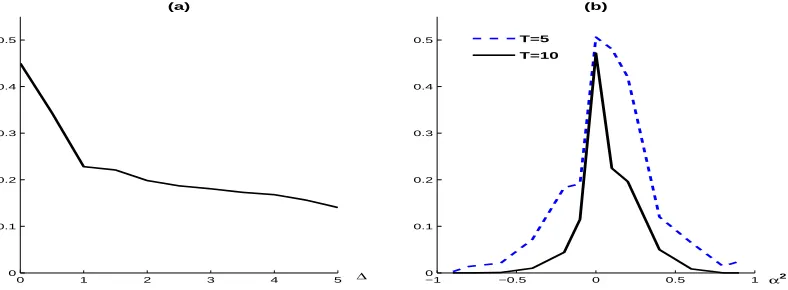
Figure 1(a) indicates the average probability of mis-classification, as defined above. We see that the ability to
correctly classify the data increases with the distance between the clusters, as expected. Despite the fact that the
data for both clusters have the same starting value, we already have a significant improvement in the clustering
ability when the long run levels are one (random effect) standard deviation apart.
Then we fix β1 = β2 = 0.02 andα1 = 0 and letα2 vary. Figure 1(b) shows that we can quite accurately
distinguish the clusters for α2 < −0.2 orα2 > 0.4. In this case, we also repeat the experiment with a smaller
time dimension,T = 5. Of course, this decreases the model performance somewhat, but we still have quite good
clustering properties for values ofα2far away from the extremes. In both samples, it appears to be easier to identify
the clusters for a given|α2|ifα2<0, as the implied alternating behaviour is quite noticeable.
0 1 2 3 4 5
0 0.1 0.2 0.3 0.4 0.5
∆
(a)
−1 −0.5 0 0.5 1
0 0.1 0.2 0.3 0.4 0.5
(b)
α2
[image:15.595.95.489.464.609.2]T=5 T=10
Figure 1. Average mis-classification probabilities for the simulated data. (a)α1 =α2and∆is the normalised
difference betweenβ1andβ2. (b)α1=0, β1=β2.
5 Applications
Two real data sets are analysed in this section. The first contains per-capita GDP of European regions similar to
that used in Canova (2004) and Frühwirth-Schnatter and Kaufmann (2008). Here we focus on annual GDP growth.
The second is a panel of 738 Spanish manufacturing firms, taken from Arellano (2003, Sec. 6.7), where we model
5.1. Per-capita income of European regions 15
We use the prior in Subsections 2.1 and 2.2. The induced prior on each long-run growth level βj will be
N(0.05,0.052) for the GDP data, and N(0,0.052) for the firms example. In the case of the GDP growth data, we
will use a covariate, the (standardized) level of GDP in the previous period, for which the prior ofµj is N(0,1).
For the correlation parametersain (18) andal in (19), we will use a uniform prior over (−1/(K−1),1) in both
applications.
MCMC samplers were run for 170,000 iterations, discarding the first 20,000 and then taking every 10th draw,
ending up with an effective size of 15,000. This required roughly 13 and 19.5 hrs on a single-core 3 GHz Xeon
processor for each application, respectively.
5.1 Per-capita income of European regions
There is a vast literature concerned with economic growth and convergence. While there seems not to be empirical
evidence of overall growth convergence (Durlauf and Johnson, 1995; Durlauf and Quah, 1999; Temple, 1999), some
clusters of homogeneous growing countries/regions or convergence clubs have been found; see e.g. Canova (2004)
and Quah (1997). Pesaran (2007), using data from the Penn World Tables, found evidence against convergence in
levels, but in favour of convergence in growth rates.
Here we concentrate on annual per-capita GDP growth rates from 258 NUTS2 European regions, for the period
1995–2004. The NUTS Classification (Nomenclature des Unités Territoriales Statistiques) was introduced by
Euro-stat in order to provide a single uniform breakdown of territorial units. NUTS2 units are of intermediate size and
roughly corresponds to regional level. These data cover 21 European countries and are collected by Eurostat, based
on the European System of National and Regional Accounts (ESA95). We define the growth of regionifrom time
t−1 to tasyi t = log(xi t/xi t−1), where xi t is the per-capita GDP of regioniat time t. Thus, we end up with a
balanced panel ofT = 9 andm = 258. As a single covariate we use the lagged level of GDP, xi t−1standardized
to have mean zero and variance one for each region. This means thatβnow corresponds to the average long-run
modal growth levels over time, whereasMcan be interpreted in terms of a stabilizing temporal effect. In particular,
for our situation with positive growth, negative values forµj would imply a decreasing trend of growth over time
within cluster j.
We fit the model forK =1,2,3,4,5. Estimated log Bayes factors (BF) are shown in Table 2, a positive value
implying support in favour of the model in the row. For example, the model withK =2 is preferred over the pooled
model (K = 1) by a Bayes factor of exp(35) = 1.58×10¹⁵and by even more over the models withK >2. Thus,
with unitary prior odds (or any prior odds that are likely to be used in practice), the posterior probability of the
two-cluster model will be virtually one. Interestingly, the simplest, completely pooled model is clearly preferred to
K = 3,4 and 5, but the best model by far is the one with two clusters. Since the model withK = 5 was the least
16 5.1. Per-capita income of European regions
[image:17.595.220.366.123.213.2]context).
Table 2. NUTS2 GDP growth data. Log-BF, according to the number of clusters. A positive figure indicates support in favour of the model in the row.
K K
2 3 4 5
1 -35 532 2037 2295
2 567 2071 2331
3 1504 1764
4 259
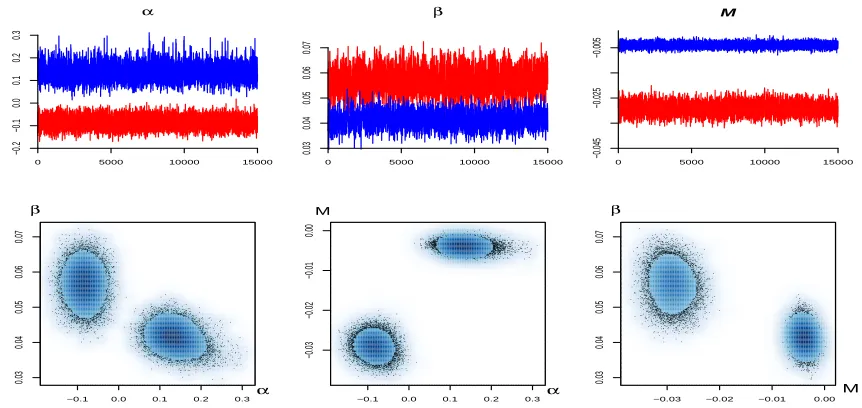
Figure 2 shows traces and scatterplots (with a smoothed density representation) of the drawn values for (α,β,M)
in the chain with two components using the permutation sampler (Frühwirth-Schnatter, 2001), to ensure we
ad-equately explore the entire posterior distribution. Both the traces and the scatterplots illustrates that the dimensions
in which the components are most different are the dynamics parameterαand the covariate effectM. Here, we use
the labelling convention according to the values ofα, and impose thatα1 < α2in post-processing the data. This
perfectly implements the separation between the two visually different clusters in the scatterplots. Ordering with
respect toµgives exactly the same results.
α
0 5000 10000 15000
−0.2 −0.1 0.0 0.1 0.2 0.3 β
0 5000 10000 15000
0.03 0.04 0.05 0.06 0.07 M
0 5000 10000 15000
−0.045
−0.025
−0.005
−0.1 0.0 0.1 0.2 0.3
0.03 0.04 0.05 0.06 0.07 β α
−0.1 0.0 0.1 0.2 0.3
−0.03 −0.02 −0.01 0.00 M α
−0.03 −0.02 −0.01 0.00
[image:17.595.73.504.387.591.2]0.03 0.04 0.05 0.06 0.07 β M
Figure 2. NUTS2 GDP growth data. Traces and scatterplots of the sampler for α, βand M, using K = 2.
Different shades indicate cluster assignment, after post-processing.
A second important conclusion from Figure 2 is the fact that posterior dependence between the various
cluster-specific parameters is quite small. This suggests that the parameterisation used clearly distinguishes between
different aspects of the data and that the parameters have a well-defined role.
Figure 3 shows estimated marginal posterior densities for the model-specific parameters of the models with
K = 1,3,4,5. Throughout, we also plot the prior density in these graphs, indicated by long dashes. Estimation of
the common parameters is virtually unaffected by the number of clusters. Comparing the plots forαwith different
5.1. Per-capita income of European regions 17
whole panel, yielding misleading inference on the dynamics and an illusion of precise estimation (note the different
scales). Also, it is clear from the inference onαwithK = 3,4 and 5 that these models contain more clusters than
supported by the data, as there is no clear separation between the clusters with lowerαj. This lack of separation
leads to markedly multimodal posteriors forµj and can clearly not be solved by choosing a different ordering
constraint. It is reassuring that model choice through Bayes factors strongly avoids the inclusion of unwarranted
clusters in our model. This illustrates, in particular, the sensible calibration of our prior assumptions.
K=1
α
0.00 0.04 0.08 0.12
K=3
C1
C2
C3
−0.35 −0.10 0.15 0.40 0.65
0 3 6 9 12 15 K=4 C1 C2 C3 C4
−0.4 −0.2 0.0 0.2 0.4 0.6 0.8
0 3 6 9 K=5 C1 C2 C3 C4 C5
−0.4 −0.2 0.0 0.2 0.4 0.6 0.8
0
3
6
9
β
0.0400 0.0450 0.0500 0.0550
β
C1
C2 C3
0.02 0.03 0.04 0.05 0.06 0.07
0 20 40 60 80 C1 C2 C3 C4
0.02 0.03 0.04 0.05 0.06 0.07 0.08
0 20 40 60 80 C1 C2 C3 C4 C5
0.02 0.03 0.04 0.05 0.06 0.07 0.08
0 20 40 60 80 M
−0.010 −0.008 −0.006
0 150 300 450 C1 C2 C3
−0.04 −0.03 −0.02 −0.01 0.00
0 50 100 150 C1 C2 C3 C4
−0.05 −0.03 −0.01 0.01
0 30 60 90 120 C1 C2 C3 C4 C5
−0.05 −0.03 −0.01 0.01
0
30
60
[image:18.595.64.545.201.517.2]90
Figure 3. NUTS2 GDP growth data. Prior (light long dashes) and posterior (as in legend) densities for the
cluster-specific parameters, using K =1,3,4,5. Different values of K correspond to different columns. Rows
relate to the densities ofα(top),β(middle) and M (bottom). In the legends Ciindicates cluster i.
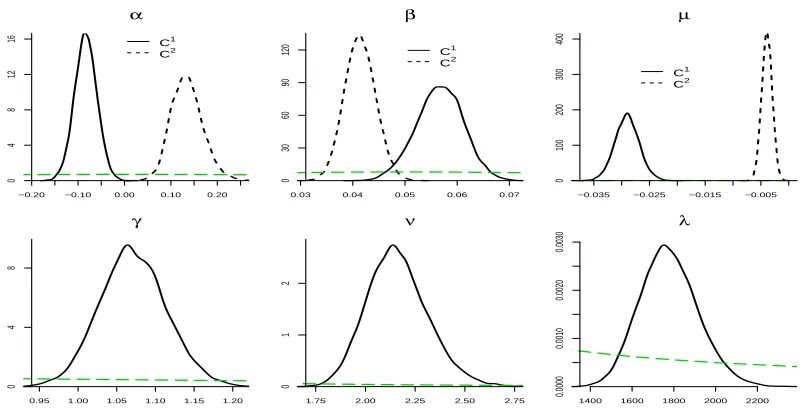
As we saw in Table 2, the two-cluster model is decisively preferred over the others. Posterior results are
displayed in Figure 4. Note that the prior onλis improper and its scaling is, therefore, arbitrary. For this best
model with two clusters, convergence is fairly rapid (values ofαj are not large in absolute value), and we have a
small club of regions with small negative first order growth autocorrelation (i.e.those with a small negative value
ofα) and a larger subset with small positive first order autocorrelation, as indicated in the top left graph of Figure 4.
The posterior mean relative cluster sizes are{0.28,0.72}. In addition, Figure 5 shows the individual membership
probabilities with the regions ordered in ascending order according to initial GDP level. This illustrates that the
first cluster tends to consist of regions with relatively low GDP in 1995. In particular, it groups emerging regions
such as all of the Polish regions in the sample and most of the Czech regions, but also includese.g.Inner London
18 5.1. Per-capita income of European regions
the sequel).
α
C1
C2
−0.20 −0.10 0.00 0.10 0.20
0 4 8 12 16 β C1 C2
0.03 0.04 0.05 0.06 0.07
0 30 60 90 120 µ C1 C2
−0.035 −0.025 −0.015 −0.005
0 100 200 300 400 γ
0.95 1.00 1.05 1.10 1.15 1.20
0
4
8
ν
1.75 2.00 2.25 2.50 2.75
0
1
2
λ
1400 1600 1800 2000 2200
0.0000
0.0010
0.0020
[image:19.595.89.492.83.288.2]0.0030
Figure 4.NUTS2 GDP growth data. Prior (long dashes) and posterior (as in legend) densities for parameters of
the model with K=2. For the cluster-specific parameters Ciindicates cluster i.
Membership Probabilities C1 C2 Regions 0.00 0.25 0.50 0.75 1.00
Figure 5. NUTS2 GDP growth data. Membership probabilities for the model with K = 2, with the 258 units (regions) ordered according to initial GDP level. Bars indicate the posterior probability of belonging to cluster 1 for each region.
The first club has a mean value for α1 of -0.084, with (-0.130, -0.038) the posterior CI of probability 0.95.
For the other club,α2has a mean of 0.135, and lies within (0.073, 0.208) with posterior probability of 0.95. Note
that the posterior distribution ofαfor the pooled model (K =1) in Figure 3 is concentrated around an area which
receives only very little probability mass from the posteriors of α1 and α2 in the two-component model, so its
averaged nature really does not correspond to any “observed” dynamic behaviour. A summary of the marginal
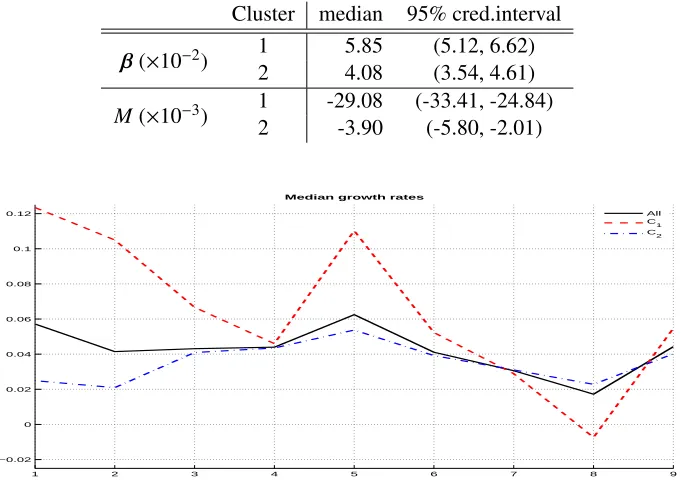
posterior distributions ofβj is shown in Table 3, which suggests that both clubs have different long-run average
growth rates. The log Savage-Dickey density ratio in favour ofβ1 = β2 is -17.3, strongly supporting a different
average steady-state level. The economies with alternating growth dynamics (first cluster) correspond to a higher
median growth rate of around 5.9%, while the second group has a median of about 4.1%. The lower part of Table 3
[image:19.595.94.488.339.507.2]5.1. Per-capita income of European regions 19
values, implying a fairly substantial negative trend of growth over time. For the second cluster, this effect is much
smaller. Indeed, looking at Figure 6, which groups average (over regions) observed growth rates for each year, it is
clear that growth rates for cluster 1 tend to go down over the sample period, while those for cluster 2 remain almost
unaffected. It is also apparent that the time pattern of growth rates for cluster 2 is more stable, with the negative
value ofα1reflected in a more unstable growth pattern for cluster 1. This is in line with cluster 1 grouping mostly
emerging economies, which are growing more rapidly in the beginning of the sample period. Interestingly, Figure 6
[image:20.595.136.477.243.485.2]suggests convergence in growth between the two clusters by the end of the sample period.
Table 3.NUTS2 GDP growth data. Summary statistics ofβandµfor the skew-t model with K=2.
Cluster median 95% cred.interval
1 5.85 (5.12, 6.62)
β(×10−2)
2 4.08 (3.54, 4.61)
1 -29.08 (-33.41, -24.84)
M(×10−3) 2 -3.90 (-5.80, -2.01)
1 2 3 4 5 6 7 8 9
−0.02 0 0.02 0.04 0.06 0.08 0.1 0.12
Median growth rates
All C1 C2
Figure 6. NUTS2 GDP growth data. Median observed GDP growth over countries with membership according to maximum posterior probability. Solid line: full sample; dashed line: cluster 1; dot-dashed line: cluster 2.
Figure 4 illustrates that fat tails are a very prominent feature of these data. Posterior inference onνis quite
concentrated on small values in all cases, typicallyν∈(1.9,2.5) with 0.95 posterior probability. Also, some right
skewness is present in this data set. Indeed,γ ∈ (0.99,1.16) with posterior probability of 0.95. However, the log
Savage-Dickey density ratio in favour ofγ=1 is 1.7, providing mild evidence in favour of the symmetric model.
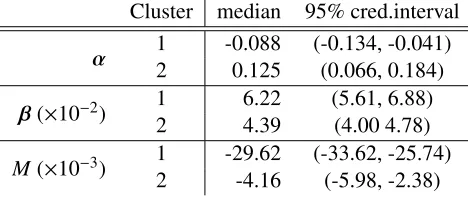
Given this moderate evidence in favour of γ = 1, we estimated the symmetric t model with K = 2. The
estimates of the common parameters and cluster membership probabilities (not shown) were very little affected by
imposing symmetry. We did, however, find some small differences for the cluster specific parameters, which we
present in Table 4. Clearly, the symmetric model shifts the distribution of the long-run average levelsβto the right,
in order to compensate for the right skewness in the data. Nevertheless, all estimated medians for the parameters of
this model are contained in the corresponding 95% CI’s of the skew version and viceversa.
Frühwirth-Schnatter and Kaufmann (2008) use a related setting to model the level of per-capita income for a
20 5.1. Per-capita income of European regions
Table 4. NUTS2 GDP growth data. Summary statistics of the cluster-specific parameters, using the symmetric
t-model with K =2.
Cluster median 95% cred.interval
1 -0.088 (-0.134, -0.041)
α 2 0.125 (0.066, 0.184)
1 6.22 (5.61, 6.88)
β(×10−2)
2 4.39 (4.00 4.78)
1 -29.62 (-33.62, -25.74)
M(×10−3)
2 -4.16 (-5.98, -2.38)
time point, by the European average (see Canova, 2004). This effectively reduces the dynamic behaviour of the
individual regions to movement within the European distribution of incomes. In addition, this data set differs from
our growth data in that it does not include any Central European regions (or regions in Finland, Sweden and Latvia).
Bearing this in mind, we analysed this data set chiefly for comparison with their results. We fitted our model to
these level data, usingK = 2 and no covariates. Like Frühwirth-Schnatter and Kaufmann (2008), we found two
well separated clusters, summarized in Table 5, with estimated relative sizesη= (0.13,0.87)0. Thus, we have one
small converged cluster withα1close to zero and a large group with important dynamic behaviour whereα2is very
close to one. Despite the large differences in dynamic behaviour, there is no overwhelming difference in long-term
levels (as measured byβ).
Table 5. NUTS2 income level data. Summary statistics of the cluster-specific parameters using both t models
with K=2. Numbers reported are median (95% CI).
Clus Skew-t t
1 0.014 (-0.020, 0.045) 0.017 (-0.014, 0.049)
α 2 0.993 (0.988, 0.998) 0.992 (0.988, 0.996)
1 -0.038 (-0.129, 0.057) -0.086 (-0.184, 0.041)
β 2 0.023 (-0.070, 0.112) -0.102 (-0.190, -0.007)
Clustering regions according to maximum posterior probabilities, yields m1 = 15 and m2= 129, not unlike
the results in Frühwirth-Schnatter and Kaufmann (2008). However, our membership assignments are not quite the
same as those in Frühwirth-Schnatter and Kaufmann (2008). We have to keep in mind, though, that their model
uses initial income as a covariate for the membership probability.
Our model here differs from the one used in Frühwirth-Schnatter and Kaufmann (2008) in a number of respects,
the following of which can have most effect on the results in this application:
i. We do not allow for unit roots, which is of some importance here as thear(1) process on the levels is close
to a unit root for one of the two clusters they find (see their Table 5 and our Table 5). Note that with these
data we are modelling levels rather than growth rates.
ii. The other priors are also quite different. They use normals throughout, centred at 0 and with higher variances
[image:21.595.144.441.452.524.2]5.2. Spanish firm employment 21
iii. They do not allow for skewness. Left skewness, however, is a prominent feature of the data, as γ ∈
(0.815,0.892) with prob. 0.95. As we have seen with both the simulated and the growth data, neglecting
skewness can have an important impact on the estimation of the steady-state levels.
iv. They fix the degrees of freedom for the Student-tmodel at 8. In contrast, we find the tails to be extremely fat,
with (1.1,1.3) the 95% CI forν, irrespective of the model used (skewed or symmetric). Of course, this will
also affect the estimated observational variance and can well influence the clustering (see Subsection 4.1).
In line with the latter point, the evidence in favour of Student-ttails over normal tails is overwhelming, both for
symmetric and skewed models. Once we choose a Student model, skewness is strongly preferred by the data. For
normal models, however, the log Savage-Dickey density ratio in favour ofγ =1 is 3.12 (which is in line with the
BF obtained from the bridge sampler). It is quite unusual to see the evidence in favour of skewness disappear when
we ignore the heavy tails. Thus, if we would not consider (unknown) heavy tails, we would be led dramatically
astray in the evidence regarding skewness. Of course, all other models are massively dominated by the skew-t
model. Table 5 presents the estimated cluster-specific parameters for both skewed and symmetrictmodels. The
effect of neglecting skewness is similar to that with the previous data: while the dynamics are not much influenced
by the inclusion of skewness, long-run levels are affected (but due to the left skewness, now in the other direction).
Note thatβ2is shifted much more thanβ1.
5.2 Spanish firm employment
The data set is described in the Appendix of Alonso-Borrego and Arellano (1999) and is also used in Arellano
(2003, Sec. 6.7). It consists of a balanced panel of 738 manufacturing companies, recorded yearly from 1983 to
1990 and represents more than 40% of the Spanish value added in manufacturing in 1985.
In particular, we model employment growth in these firms. With our model described in Section 2, and letting
K = 1, we obtain 95% CI’s of (0.04, 0.08) for αand (-0.0043, 0.0030) forβ. Again, inference on parameters
common to models with different values ofKis virtually unaffected by the choice of the number of clusters.
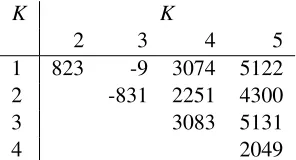
As shown in Table 6,K = 1 is strongly preferred toK = 2,K = 4 andK = 5. However, the model with three
clusters performs considerably better than the pooled model, and we will concentrate on the model withK = 3 in
[image:22.595.231.379.710.790.2]the sequel. Since the model with five clusters was not preferred to any other, we did not use larger values ofK.
Table 6. Spanish firm data. Log-BF, according to the number of clusters. A positive figure indicates support in favour of the model in the row.
K K
2 3 4 5
1 823 -9 3074 5122
2 -831 2251 4300
3 3083 5131
22 5.2. Spanish firm employment
Scatterplots of the drawn values for (α,β) in the chain withK = 3 clearly suggest that identifying the labels
through ordering the values ofαjis the natural approach, just like in the previous example.
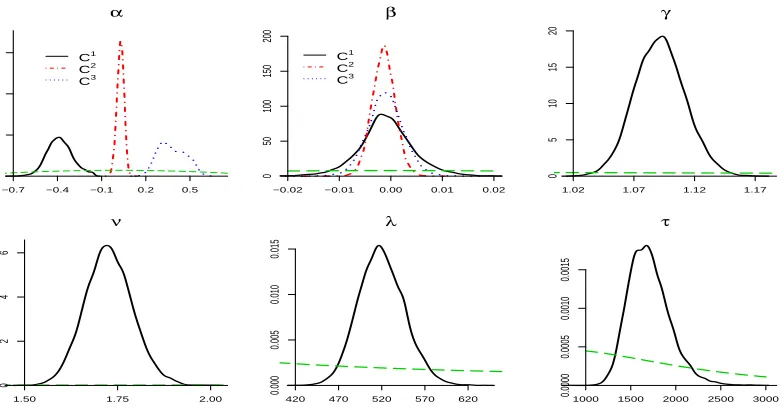
From the posterior densities in Figure 7, it is apparent that tail behaviour is extremely heavy and very well
determined by this (fairly large) data set. These data also clearly present right skewness with (1.05, 1.13) the 95%
CI forγ. Both the Savage-Dickey density ratio and bridge sampling indicate massive evidence in favour of the
skewed model.
α
C1
C2
C3
−0.7 −0.4 −0.1 0.2 0.5
0 5 10 15 β C1 C2 C3
−0.02 −0.01 0.00 0.01 0.02
0 50 100 150 200 γ
1.02 1.07 1.12 1.17
0 5 10 15 20 ν
1.50 1.75 2.00
0
2
4
6
λ
420 470 520 570 620
0.000
0.005
0.010
0.015
τ
1000 1500 2000 2500 3000
0.0000
0.0005
0.0010
[image:23.595.99.489.194.399.2]0.0015
Figure 7. Spanish firm data. Prior (long dashes) and posterior (as in legend) densities for parameters of the
model with K=3. For the cluster-specific parameters Ciindicates cluster i.
The relative size of each cluster, i.e.the average probability of cluster membership, is {0.132,0.651,0.217}.
From Figure 7 is is obvious that there are two relatively small clusters of “extreme” dynamic behaviour: one with
negativeα(suggesting alternating behaviour) and one with positiveα(slowly converging) existing besides one big
club with more or less random walk employment behaviour. In fact, the cluster displaying negative αtends to
contain smaller firms, which are more volatile and often overadapt to market situations. Firms that have a high
probability of belonging to the slowly converging cluster are typically larger firms which display much more stable
long-term employment strategies. The firms in the main cluster cover a wide range of sizes and have, on average,
experienced a small decline in employment over the sample period. Again, the effect of pooling all units to estimate
the dynamics parameter is apparent from comparing Figure 7 with the 95% CI of (0.04, 0.08) forαwithK = 1:
rather than gaining strength in the process, opposites are averaged out and the spread of the dynamic behaviour is
dramatically underestimated when we use only one cluster.
We have already reported that the skewed model is strongly favoured by the data over its symmetric counterpart.
In order to assess whether allowing for skewness makes a practical difference in this example, we have estimated
the symmetric Student model (i.e.γ = 1) with 3 components. The main difference is in the equilibrium values
βj. The posterior medians forβj with skewness were all within (-0.0011, -0.0008), and these are now all positive,
5.2. Spanish firm employment 23
account the skewness, we would erroneously conclude that long-run employment growth is positive, whereas our
skewed model assigns most probability to negative equilibrium growth of employment in Spanish manufacturing
firms.
Both for the skewed and symmetric cases, the three clusters of firms converge to very similar equilibrium levels,
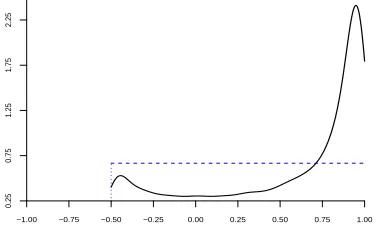
suggesting that we might also pool this parameter to gain strength. Figure 8 shows that the posterior density of the
correlation parametera, as defined in (18), has a lot of mass close to one and thus strongly supports this model
simplification. This is confirmed by the formal log-BF in favour of commonβj’s, which is estimated at 13.4. Other
parameters are virtually unaffected by this reduction of the model. The common long-run levelβ∈(−0.005,0.003)
with posterior probability 0.95, very much in line with the results for cluster-specificβj’s with the skew-tmodel
(see Figure 7), except that inference is now a bit more precise as a consequence of borrowing strength.
−1.00 −0.75 −0.50 −0.25 0.00 0.25 0.50 0.75 1.00
0.25
0.75
1.25
1.75
[image:24.595.210.398.287.400.2]2.25
Figure 8. Spanish firm data. Posterior (solid) and prior (dashed) densities for a in(18)using K =3. Note that
a∈(−1/(K−1),1).
Finally, we calculate the predictive distribution of the employment of two firms in the sample for 1991 (one
year after the last observation in the sample), using a commonβ. As we are predicting employment itself (rather
than its growth), we condition on the actual employment values in the sample years. Firms 433 and 31 are selected:
the former grows from 30 to 37 employees in 1990 and in the model withK=3 it is assigned to the three clusters
with posterior weights {0.834,0.165,0.001}; the latter shrinks its employment in 1990 from 126 to 62 and has
cluster probabilities{0.324,0.636,0.040}. Figure 9 presents these predictives for the pooled model (K=1) and the
model with three components (a symmetric and a skewed version). The model withK = 1 has a slightly positive
αand will thus concentrate the predictive at a value which slightly extends the last observed movement. In the
three-cluster model, Firm 433 (Figure 9 (a)) has most mass on the first cluster, which corresponds to large negative
values forα(see Figure 7), and will thus counteract the last movement, which results in much more predictive mass
on lower employment values. Firm 31 has non-negligible mass for all three clusters and this results in a multimodal
predictive, with the first cluster providing predictive mass around 80 (partially counteracting the last movement)
and the third (least important) cluster resulting in slightly more weight on lower values. The latter is a consequence
of the large positive values for the dynamics parameters, which lead to a pronounced extrapolation of the last
observed change. Finally, the second cluster (which has most of the weight) corresponds to very small, mostly