http://wrap.warwick.ac.uk/
Original citation:Czumaj, Artur (1992) Parallel algorithm for the matrix chain product problem. University of Warwick. Department of Computer Science. (Department of Computer Science Research Report). (Unpublished) CS-RR-225
Permanent WRAP url:
http://wrap.warwick.ac.uk/60914
Copyright and reuse:
The Warwick Research Archive Portal (WRAP) makes this work by researchers of the University of Warwick available open access under the following conditions. Copyright © and all moral rights to the version of the paper presented here belong to the individual author(s) and/or other copyright owners. To the extent reasonable and practicable the material made available in WRAP has been checked for eligibility before being made available.
Copies of full items can be used for personal research or study, educational, or not-for-profit purposes without prior permission or charge. Provided that the authors, title and full bibliographic details are credited, a hyperlink and/or URL is given for the original metadata page and the content is not changed in any way.
A note on versions:
The version presented in WRAP is the published version or, version of record, and may be cited as it appears here.For more information, please contact the WRAP Team at:
-r-Research
Report
225
Department of Computer Science University of Warwick
Coventry Cv47AL United Kingdom
Parallel Algorithm
for
theMatrix
Problem*
Czumaj A
RR225
Chain Product
This paper considers the problem of finding an optimal order of the multiplication chain of
matrices.
All
parallel algorithms known use the dynamic programming approach and run in apolylogarithmic time using,
in
the best case,n6nog6,
processors. Our algorithm uses adifferent approach and reduces the problem to computing some recurence on a ffee. We show that this recurrence can be optimally solved which enables us to improve the parallel bound by a
few factors. Our algorithm runs in O (log3 n ) time using n2Aog3,? processors on a CREW PRAM and in O (log2
n
log log n ) time using nLl(log}n
loglogn)
processors on a CRCWPRAM. This algorithm solves also the problem of finding an optimal riangulation in a convex
polygon. We show that for a monotone polygon this result can be even improved to get an O (log2 n ) time and
n
processor algorithm on a CREW PRAM.*
This work was supported by the grant KBN 2-ll-90-91-01.Parallel
Algorithm for
the
Matrix
Chain
Product
Problem*
Artur
Czumaj
Warsaw
University
and
University of Warwick
June,
L992Abstract
This paper consiclers the problem of finding an optimal order of the rnultipli-cation chain of matrices. A11 parallel algorithrns known use the dynamic program-nring approach ancl run in a polylogarithmic time using, in the best case, n6 flog6 n
processols. Our algorithm uses a cliferent approach and reduces the problem to computing sorne recurrence on a tree. We show that this recurrence can be opti-mally solved which enables us to iurprove the parallel bound by a few factors. Our algorithm runs in O(log3 z) tirne using ri,2/og3 n, processors on a CR.EW PRAM
ancl in O(log2rr,loglogn) tirne using
;;7_{*
processors on a CRCW PRAM. This algorithm solves also theor"ilrJK;i'hT?lL;
an optirnal triangulationin
a convex polygorr. We show that for a monotone polygon this result can be even improvecl to get an O(log2 n) time and z processor algorithrn on a CREW PRAM.fntroduction
The problern of courputing
ar
opt'imal order of matrir mult'ipl'ication (thematrir
chain produ.ct problem) is defined as follows (see also e.g. [AHU-7a]).Consider the evaluation of the product of. n rnatrices
M:MtxMzx"'xMn
wlrere M; ts a
d;-t
x d; (dt>
1) matrix. Since matrix rnultiplication satisfies theassocia-tive law, the final result is the same for all orders of rnultiplying. However, the order of nrultiplic.ation greatly a{Iects the total nurnber of operations to evalu ate M . The problem is to find an optimal order of multiplying the rnatrices, such
that
the total nurnber of*'Ihis work was supported by the grant KBN 2-11
,,\
t.
q nnn
''""" I
loo.oou,/l/
,/
t ,' 20.000
\ ')0n
1.000 '.
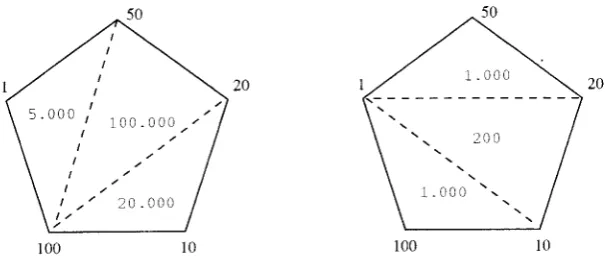
[image:4.595.138.444.68.199.2]100 100
Figure
1:
Geornetric angles correspond to50x20x10x100x1.
while ihe right one torepresentation
of
the evaluationof
a rnatrixchain.
Above tri-tlre chainMr x
Mzx
Msx
Ma, where dimensions are as follows Lefi triangualtion corresponds to the order (Mt x (Mz x M3)) x MaMt x
(Mzx ((Mt
x Ml).
The second order is optirnal.operatiols is minimized. Here, we assurle that tlte number of operzrtions to rnultiply a ?
x
qmatlix
by a gx
r
rnatrix is Pgr'.One can show
that
this problcrn is equivalent to the problern of finding at optirnaltriangulation of a conver, Ttolygon (see [HS-80]). Given a corlvex poiygon (u0''u1,. .. , u,).
Divide
it into
triangles, such that the total cost of partitioning is the smallest possible. Byihe total
costof
a triangulation we rnean the sumof
costs ofall
trianglesin
thispartition. The cost of a triangle is the product of weights a,t each vertex of the triangle (see also figure 1).
Tralsforrnation frorn one problem
to
another one can be donein
lirrear secluentialtime
[HS-80] [HS-82] and alsoin
0(l)
parallei tirne usingn
processors oI1a
CR.EWPRAM [Cz-92). Thus rve
will
consider only the latter problern. In figure 1 there is an exarnple of ordering of rnatrices and the corresponding triangulation of a polygon.Both above problems c.an be solved
in
O(nlogn)
serialtinie
[HS-80]. This ancl allother known algorithrns seern to be trighly sequential. The best previous knor,vn approach to design parallel algorithms is basecl on clynarnic programrning.
Ii
gives us NC algo-ritlrms which runin
O(log2 rz) tirne usingrf
flogk ?) processors orl a CREW PRAM forsorne constants k ([Ry-aa] and [GP-92]).
So there was a big gap between the best sequential ancl parallel algorithms. A sirnilar
situatiol fuolds in general, for ali tree problerns which c.an be solved by dynamic
pro€yarl-rling"
Such problems like the optimal binary search trees, the alphabetic binary trees, the problern of finding the optimal triangulation in a polygon and the recognizing ofcou-text free languages can, to the best of our knowledge, be solved in O(log2 rr) using almost
rz6 processors. But the best sequential algorithrns for these problems ruu in O(rf ), O(rf ) or even
tn
O(ntogn) time.
The only exception is the Huffrnan coding problerrr rvheretlre best parallel NC algorithrn performs O(n21ogn) operatiorrs [AKLMT-89] compared witlr optimal O(nlog
n)
sequential time.of rnatrix multiplication
in
O(logn)
time on a CREW PRAM andin
O(log logn)
timeon
a
CRCW PRAM,in
both
caseswitir
linear nurnber of operations [Cz-92]. Thesealgoritirms partially
fill the
gap between thetotal
workin
the sequential and parallel approaches.In
this
paper we present parallel algorithrnfor
thematrix
chain product problem and for the problern of an optimal triangulation of a convex polygon. This algorithrn irnproves the best previous parallel bound by a few factors.It
runsin
O(log3 rz) timeusing only rt2 flog3 r, pro."ssors orr a CREW PRAM. It can be also implernented on a
CRCW PRAM model to run
in
O(log2 rz log log n ) tirne with O(n3) total work.This paper is organized as follows.
In
Section 2 we introduce some basic concepts and notations. We also describe anO(rf)
time sequentiai algorithm for the problem offinding an optimal triangulation of a convex polygon. Then
in
Section 3 we show the rnain idea of our parallel algoritiunfor
thematrix
chain product problern and divideit
into a sequence of operations PEBBLE and COMPRESS. Section 4 gives anO(rf)
work
NC
parallel algorithrnfor
solving the recurrencefor
computingthe
costof
anoptirnal triangulation of a corlvex poiygon. In Section 5 we show how to find an optimal
triangulation using computed recurrence. Then surnmarize all results we obtain an NC algorithm for the rnatrix chain product problern with O(n2) total work. In Section 6 we describe extension of our algorithrn to optimal triangulation of a monotone polygon.
Basic
notations
and definitions
The following lemrna is useful in analyzing parallel algorithms, since
it
allows us to count only the time and the total number of operations.Lemma
2.I
[Br-Ta] LetA
be. a given algorithn with a paralleJ comput,ationtine
of t. Suppose that A involves a tcttal nurnbel of nt. contputational operations. ThenA
can beirnplernented using
p
processors in O(tI
mlp) parallel tinte..This lemma requires two qualifications before orle can apply
it
to a
PRAM.At
the beginning of thei-th
paraliel step we must be able to compute the amount of the work I.4{ done bythat
stepin
O(Wolp) time using p processors, and we rnust lcnow hot to assign processorsto
their
tasks. Both these conditionswill
be easily satisfied by our algorithms.2,L
The
single-source
minimum path problem
In
this paper we consicler a particular single-source rninirnum path problem. We are givenaclirectetlacyclicgraph (DAG) whoseverticesare{1,...,?}}.
LetM
bethenxn
matrix giving the weights of the edges of thegraph.
Since our digraph is acyclic we assurnethat for
i
>
j,
M(i,
j):
+oo.
Forall
others entries (i.e.,for
i
<
j)
defineM(i,i)
:
w(i,7),
whereu
is sorne real-valued function.The single-source minimum path problern is to find in a graph a shortest path from
l
ecluivalent to the least weight subsequence problem [HL-87]. Given a real-valued weight function
-(i,
j)
and d(1). Computed(
j) :
,r1,ir {r1(i)
t
u(i,j)},
for all I < j { nThis problem was recently analysed in many papers, since it has a long list of applications.
The weight function T.r.'
is
saidto
be
conrerif it
satisfies the inverse quadrangleinequality
.li,j)
*
u(z+r,j
+1)
>
-(i,j
+l)
+u(i+r,j),
forall 1<
i <
j -!
<rt
We will also said the function tr to be concaae if
it
satisfics the cluadrangle inequality*(i,
j)+u,(i+1,
j
+1)
<.(i,
j
+1)
+u(i+r,
j),
for all1<
i <
j -r
<n
In
the general case the least weight subsequence problern can be solvedin
O(rz2)optirnal sequential tirne and in 0(log2 rz) time using O(rr"3 floga n) processors on a CREW
PRAM [GP-92].
But
when the weight functions are either cor]cave or convex we car]do
it
muchbetter.
The best sequential algorithrn runsin
O(n) time when the weigirtlurrctions are concave [Wil-88] and
in
O(na(n))
timefor
t]re convex weights [KK-90]. Recently there was discoverecl also parallel algorithrns. The best NC algorithrt. for the concave weight rurrsin
O11og2n)
time usingrf
flogn processors. For the convex weightfunction we can do
it
rnore efficientiy.Fact
2.2
[CL-90] The cotlexleast weigltt subsequence problen can lte solvedin O(1og2 rz) tintt: using rL processor,s on a CREW PRAMT,2.2
Notation
concerning
the
triangulation
problem
Throughout this paper we will uSe u6, ul,. . . , u,, to denote vertices as well as their weights in a convex polygon. For simpiicity we assume that all weights are clistinct.
If
tirere aresome vertices with the same weights then we assume that a particular ordering is cirosen and remains fixed.
Define a vertex u;
to
be tlte smallesf (nrinimurn) oneif
for each other vertex uj welrave u;
<
u;.
Sirnilarly we define theftth
sm,allest vertex u;if
there are exactly k-
Lvertices srnaller than u;.
Define
a
bas'ic polygon,to
be a polygor. wh.ere the second and the thircl smallest vertices are neigirbours of the srnallest vertex. The following fact reduces our problemto tlre triangulation of basi.c polygons.
Fact
2.3
[HS 80] There exisfs an optintal triangulation of a corrvex polygon containing arcsor
sicles betweenthe
smallest vertex and both tlte second and th.ethird
snallestot]es
lChan ancl Lam showecl in his paper an algorithm which runs in O(log2nloglogn) tilne with
O(nlog2 n) total work on a CREW PRAM. But using result for finding the all row minimain a totally
---'\
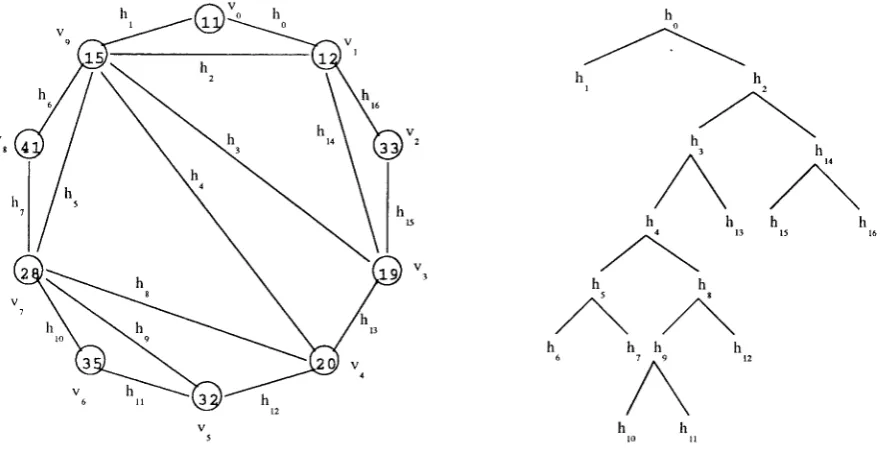
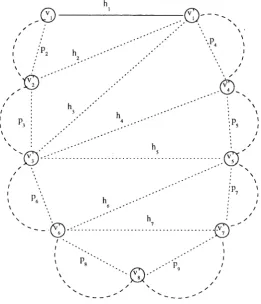
Figure 2: Candidates in a polygon and corresponding tree of candidates.
Fact 2.3 implies a partition of a convex polygon into srnaller nonintersecting basic sub-polygons which are
in
an optirnal triangulation.In
[Cz-92] was shown that suchparti-tioning can be found
in
O(log n) time using nllogr) processors on a CREW PRAM. From now orl) wewill
find an optimal triangulationin
each basic. subpolygon inde-penclently. Wewillconsideronlybasicpolygons(r0,rr,...,u,,).,
where us{u1
11t,,1u;,
foreaclrl<i<rt.
Also the folloiving fact holds.
Fact
2.4
IHS 80] There exisfs an optitnaltriangulation of a convexpolygon containing eitlter the arc joining the snallest vertex with the fourth smallest one or the arc joining tfte secorrd srnaiJest vertexwitlt
thetltird
sntallesf one.Tlris fact allows us to clesign a sequential O(nz) time algorithm.
2.3
An
sequential
O("t) time
algorithm
for
the
matrix
chain
product
problem
Yao uses tabulation methods (dynamic program.rning) to find an optirnal triangulation rn O(rt)) sequential tirne [Yao-82]. We briefly describe this algorithm.
Define a candi,date to be an arc or side
(rr,r)
such that for each k,i
<
k <
7, the ineqrralities u; ( ukt Dj{
urhold.
One c.an show that no candidates intersect (except possibly at the endpoint), thus the number of candidates is linear (in an n-gon there areexactly 2n
-3
candidates).Define the tree of candid,a,fes. Candidate (u;, u;) is an ancestor of candiclate (u6, u;)
if
and only i{i <
k<
l
<
7 and(rr,r) I
@n,o;).It
is easy to see that such defined tree isbinary.
h
lCz-921rvas showtt irow to find the tree of candidatesin
O(logn)
tirne using tt,flogrz processors oI] a CREW PRAM. In this tree, the sides of the polygon are leaves,h,h
,/\
\
n
X
.1,,/ \
,/\
/\,/\
hhhh
^4
t1 t5
,/\
./\
nn^..
^..
,/\,/\
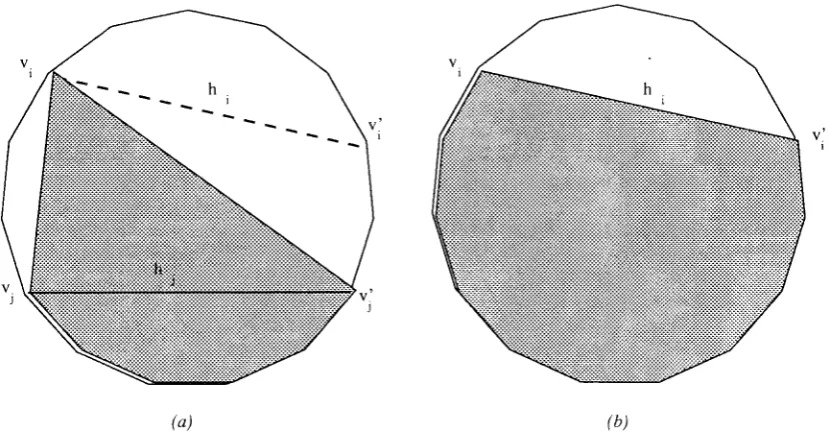
(a) (b)
Figure 3: Cones
-
(a) coneQ(ho,hi);
(b) c.one Q(h;,h,)except the side (uo,ur) which is the root of the tree. We
will
also use the notation h; to denote a candidate (u;,ul) andin
such case wewill
always assume that u; ( T.,j. An exarnple of candiclates and of a tree of candidates is shown in figure 2.We
willsay
that apolygon P isbelow a,r] arc (u;,ur) wherei
< j,if. P:(u;,...,trr).
In figure 2 the polygon below candidate (ue,ug) is
P:
(rt,rn,usru6, u7,us,us).Define also
the
coneto
be a subpolygon Q of theinput
polygon, suchthat
Q isequal to the sum of the polygon below some candidate A;
:
(uj,uj)
and of the triangle(u;,ujtuj)
where u; is on a candidate A; rvhich is an ancestor of h1 or h;-
hr.
We wilidenote sucir a cone as
Q(h;,h)
orQ(i,j).
Infigure 3 is shown the cone Q(ho,hr) - withassunrption (a)
that
li;
is an ancestor of.hi
or
(b) A;- hj.
Also,in
figure 2 the coneQ(rr, hs) is tlie polygon Q
-
(rr, rn, us,u6,u7).Define
/(t) (r(t))
to be the left(rigilt)
son of candidate h; in the tree of carLdidates.Let us also define .s(i) (g(i)) to be the son of h; in the tree of c.ancliclates which is joining with srnaller (greater) vertex on a candidate h;, that is with u; (respectivelyrj). Denote
by
A(i,7)
the cost of the triangle (u;,'ui,uf). Define also by ,(i, j) the cost of an optinraltriangulation of a cone QU,
j).
Let us assume that we want to cornpute value
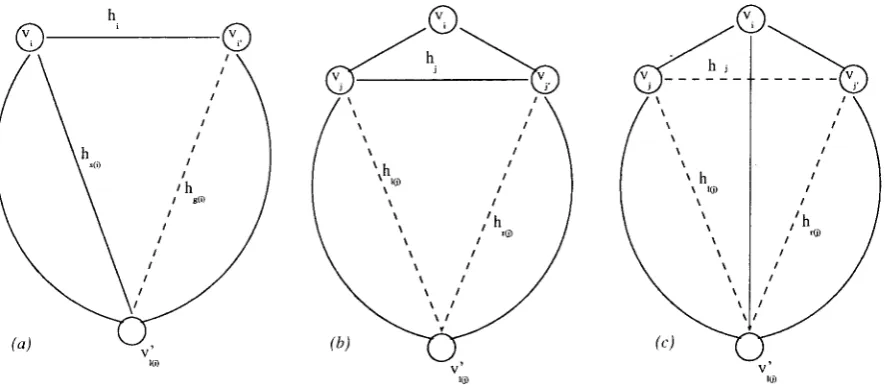
c(i,i)
(see figure +(u)).
Sincec(i,i)
denotes the cost of the polygon below h; where u; is the srnallest vertex and uj is the second srnallest one and rnoreover uilo; is thethird
smallest one, we canjoin
vertex u; with u/1,1 using Fact 2.3.Let us assume that we want to compute value c(.i,
j)
where h; is a ancestor of h; (seefigure + (U)(c)).
In
Q(i,j),
r,
is the smallest vertex, 'ui,uti are the second and the thircl srnallest ones and uf,r; is the fourth srnallest one. Thrrs rrsing Fact 2.4 we have to choose6)
-/."
a-.
n,(r-Possible partitioning of a
(u)
c(i,i)
(b)
,
(i,j)
(.)
,(i,i)
Our goal is
to
compute the value .((ro,ur), (ro,u1)), i.e.,, c(noor,aoor)' And it is clear tlrat the reconstruction of an optirnal triangulation from computed values ,(i, j) can be clone in0(n)
sequential tirne.Fact
2.5
[Yao-82] There exisf.s an algorithntfor contputing an optimal triangulation ofa convex polygon whiclt runs
in
O(nz)tine.
Proof:
Correctnessof
the algorithm follows from the previous cornments (see also [Yao-82]). We computefunction ,(i,,j)
in a bottorn-up ulanr]er. Before we start to com-prrtec(i,/)
we have already computed all valuesc(i,k)
arrd c(s,j)
for all [t - descendants of h, and h" - descendants ol h;. Thus anO(#)
running tirne isclear.
r
3
Outline
of
a
parallel
algorithm for the
triangula-tion
problem
In
Section 2 we showed how to reduc.e our probleur to the problem of cornputing some recurrence on trees. Using standard rnethods IGR 88] we can solve this recurrence in [image:9.595.72.515.69.262.2]0(log2
z)
time using rz6 processors.In
this section we show how to reduce the nurnber Figure 4:"on" -rO possible computations of ,rurtr", ..
:
c(i,s
(i)) + c (.s (i),.s (i)):
L(i,
i)
+
,
(i,i)
:
c(i,l u))
+
c(i,r
(j))
if.
i
:7
and h; is a leafit
i
+
7 and lzi is a leafil i
:1
and h, is not a leafif
h; is an ancestor of h,1 and A; is not a leafrecurrences in the tree.
fq
I
zr("'i)
c(i.7)
:
{,(i.s(i))
+c(,.(i),'(t))
|
,,,i,,{
o(i''r)+ c(j'j)
of processors needed.
Our algorithrn runs
in
the {ollowing four steps: 1. Divides the polygon into basic polygons.2.
Cornputes the tree of candidates for basic polygons.3.
Computes c(i,7) for all pairs i,7.4.
Finds an optimal triangulation using the values ,(i,j).
Steps
(i)
aiid (2)
can be donein
O(logn) using nf logr?. processors ona
CREWPRAM
[Cz-92]. So we only show howto
implement steps (3) and (a)in
an efficientway. Lr this section we give
al outline of
step (3) whichwill
be analysedin
detail in the following section. Section 5 gives algorithm for reconstruction of an optimal polygon from recurrence for the array c.Let us define a vertex A,
in
the tree of c.andidates to be pebbledif
ail valuesc(i,j)
and c(7,i)
have been computed.At
the beginning of the algorithm we can easily pebble all leaves (corresponding tothe sicles of a basic polygon)
in
O(1)tirnc'with
n2 prt,cr,sscirs. Anclat
the end of thealgorithm we want to pebble the root of the tree.
We will use the iclea of tree contracti,on IMP"-85] [Ry-85]. Define two operations on a tree. Operation PEBBLE pebbles all vertices for which both sons are alreacly pebbled. Operation COMPRESS operates on a chain of vertic.es (see ligure 5).
Suppose we have a sequence of vertices h,t,. . ., h6 such that
o
h; is a father of h;11 ando
each h; is not pebbled ando
h6 has two pebbled sons ando
each h; (except h6) has got exactly one pebbled sonWe
will
call such a sequerlce the chain. The operatio:n COMPRESS pebble all vertices orr all chains in the tree.It is well
knownthat in
a binary treewith
rn vertices the foliowing algorithm willpebble the root of the tree.
repeat
[og,rnl
times PEBBLtr; COMPRESS;Thus
it is
enougir to show how the operations PEBBLE antl COMPRESS may be executedin
an efficientrvay.
Wewill
also ensure the following invariant after eachoperation.
If
vertex h; is pebbled then all its descendants are also pebbled.The operatron PEBBLE can be easily performed in constant tirne with O(n2) oper-atiorrs on a CREW PRAM. This is because to pebble vertex h; we need only to have already computed all values c for its sons. And we know that these values are computecl because both sons are pebbled.
In
the following section we show howto
execute thert)
h
'-65
\:/
n
[image:11.595.162.424.68.373.2]6
Figure
5:
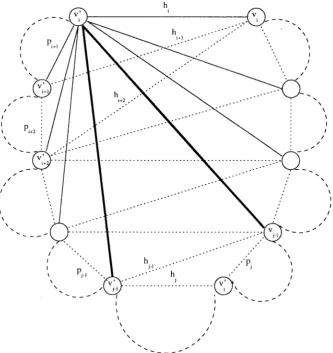
Chainht,h,r,...,hr.
Candidates pz,...,pe are pebbled and h; is a father of h;+t.4
Computing
the
cost
of an optimal triangualtion
of
a
polygon
Since tlre operation PEBBLE can be easily executed in constant time with O(rf 7 nurnber of processors, we have only to show how to perform with the same bound the operation
COMPRESS,
We are given a chain of candidates h1
,hr,...,
h6 (see figure5).
h; is the father ofh;11 and p;+r irr the tree of candiacltes, and p;+r has already beerr pebbled. Both sons
of h6 (p;a1 and p612) have already been pebbled. One property of such a chain is that
u;
l
ut; (.r'o+, and that either ui:
ui+7, otu';:
I)i+7.We start by computing values
c(i,i)
forall
I
<
i ,(i,j)
for allhi
or
the chain.4.L
Computing
values
c(i,i)
(
k
and then we compute valuesLrlt bottom(i) denotes the cost of an optimal triangulation of the polygon below candidate h; without candidates from the chain. Let also
fan(i,7)
denotes the cost of an optimaltriangulatiorr of the polygon between two c.andidates from
tlie
chain lz; andh;,
where tirere is no other candidate from the chain. We will always assurne that h; is an ancestor of h1. For example in figure 5, fan(2,6) denotes the cost of an optirnal partitioning ofrp
p
n '8
.-
r,\
-- l' I
\i/
I
\
\
h
3
polygon P :
(r'r...u'n...rL,rL...u't...u).
In an optimal triangulation of the polygon below h; we have two cases - either below
h; tlrere exists at least one candidate frorn the chain
hr,hr,...,hk,
or there does rrot.If
below /z;in
an optima,l trianguiation there is no candidate frorn the chain thcnc(i,i):
bottorn,(i).If
tliere are, then lethi
be the highest candidate from this partition (i.e.,withthesmailestindex).Inthiscaselmegetc(i,i):fan(i,,j)+r(j,7).
Thus,sincewe are interested in the best partitioning, we obtain ihe following formula for computing values
c(i,i).
,..\
.
Ibottom(i)
c\? 12 )
:
r'ln
I
rnini.;5* {fan(i,j)
+,(j
,j)}
This recurfence is ccluivalent
to
the single-source rninimum path problernin
a DAG. We are given the weight of the edge from the source-
bottom(i). For each vertexl,
aminirnum path is either the edge directly from the source or is a rninimurn path to one
of precetles vertices and then the edge frorn this vertex to i. To reduce our problern to tlre above one we have to cornpute in advance values bottom(i) and
fan(i,/)
W" can cloit
using the following lernma.Lemma
4.L
Let h,; anrlhi
be two cancliclates, where h,; is an ancestor of h,1.If
in
anoptintal partitioning of the polygott below h; therc is no candidate wlticlt lir:s between h,;
ancl Lt,i then there exi,sts an optirnal triangulation where u; is joined to both ui and'uti.
Proof:
Our proof is by incluction.If
i+
1:
7 then in the polygon belorv h;, 'r; is the smallest vertex, uj is the third smallest one and u; is either equal to u; or u; is the second smallest one. Thus using Fact 2.3 the result follows.So, assume that
i <
j -
1. Frorr the induction assumption we get that 'u; is conrrectedbotlr with
u;-r
ancl uj-1. This implies that the cote Q(i,i -
I)
is in an optimal partitionof the polygon (see figure 6). Now we consider only a triangulation of this cone. Because
eitlrer uj : uj-7 or ?j : u'i-1,
it
is enough to prove only tirat u; is joined with url. Sinceu;-r
is not joinedwith
uj-r
we get u;f ui-r.
Thusin
the cone Q(i,j -
1), ur is the snrallest vertex,uj-t
-
the second, r'j*7 - thethird
and uj-
the fourth smallest vertex. Sinceur-r
is rrot joined withuj-r,
Fact 2.4 implies that u; is corrnected rvith uj.!
Using this lemma we can conrpute the functions bottom a:nd fan.
bottorn(i)
:
c(hr., P,)J
fan(i,
j):
L(hr,h)
+ D
,(ho,p,)r =2+l
Here
c(h;,p,)
clenotes the cost of an optimal triangulation of the coneQ(h;,p,).
And sinceall
calclidatesp.
have been pebbled,all
valuesc(h;,p,)
are already computed. Hence we can c.ornpute the values bottorn(i) and fan(i,7)ir
()(log n) time using ti2 f lognprocessors on a CREW PRAM.
k+2
\-lJ r-rf1
Figure
6:
Chainh;,h,;+t,...,h.i-t,hi.
In
an optimal partition of the polygon below h; tirere is no candidates betweenh;
a:nd h;.To reduc.e our problem to the sin6qle-source minimum path one we define the weight
matrix of the graph as follows.
[
+o"
i>i
.l
M(i.j):\ fan(i,i)
i<
j<k
lbottom(i)
i<i:k+t
and we are loohing for the rninirnurn path from the source k
+
1.Thus usirrg standard rnethocls we car] compute
ail
valuesc(i,i)
with
almost O(n3)work, but we can irnprove this bound because the following lemma holds.
Lemma
4.2
MatrixM
is convex.Proof:
To prove thatM
is a convex matrix we rnust check whether below inequalityholds.
M(i,j)+
M(i,+7,j
+1)
*
M(i,j
+1)
-
M(i+
1,j)
>
0
for
alti
<j -r
First we consider the case when -i
+
1<
k+
1. From the definitiorr w'e getJ
M(i,i)
-
fan(i,j):
L(h;,h)
+ D
,(h,,p,)
r=i*7
J+1
M(i
+
I,j
+
1):
fan(i+ 1,i +
1):
A(h,*r,
hi*)
+ D
,(h,+r,p,) r=t*2j+t
M(i,j
+
1):
fan(i,j
+
t)
:
A(h;,hi+t)+
,L,"(h,,tt,1
M(i
+
I,j)
:fan(i
1
1,-r):
A(;
+
1,j)
+
f,
,(ho*r,p,)r=i12 Thus
M(i,j)+M(i+r,j
+1)
-
M(i,j
+1)
-
M(i+r,j)
:
fan(i,t)
*fan(i
+r,i
+
1)-fan(i,i
+
t;
-
fan(i1r,i)
:
A(h;,
hi)*
A(h,11,hi+t)
-
A(hr,hi*r)
*
A(h;n1,h,)
*
c(h;+.t,pt+.r)-
c(h,pi+r):
uiuj'DtjI
u;L4uia1u'r*,-'u;uigtu|at
-
u;4ruiutiI
c(h;+t,Pj+t)-
c(h;,1tia1):
(u;+r-
,;)@i+tr'j*,
- rir') I
,(h;+t,pi+t)
-
c(h;,pi+t)Now we can use sorne properties of the chain
o
u;1
ul, u;I
u;+t, ul1
,'r*r, for alli
o
if P
anclP'
are both m-gons where the corresponding weights satisfies w; I 'wti, then the costof
an optimumpartitiol
ofP
is less than or ecluaito
the cost of an optimurn partition ofP'.
This natural observation was shown firstin
IHS 82].Fronr the above follows tirat c(h;a1
,pj+t)
)
c(h;,pr+r). From these properties we get the result.Now we corrsider the case rvhen
j
+
I:,t
+
1. Frorn the definition we get.k
M(i,
i):
fan(i, k):
A(A;' h*)* D
,(h,,P,) r=l*1k+2
M(i+7,j+1)
:bottorn(i1t)
: L
r(h;+',p,)
r=i1.2
k+'2
M(i,j
+1) :bottom(i)
: D
r(h,,p,) r=i*7A
M(i
+
I,i)
:
fan(i*
1, k):
A(ho+',hr)
+ D
,(ho+',p,) r=i*'2Thus
M(i,j)+M(i+1,j +1)-
M(i,j
+1)- M(i+r,j)
:
(r;
-
u;a1)u1"u'1,* c(h;*t,p*+i)-
r(h;,pr+r)f
,(h;+t,It*+z)-
c(h;,Itt+z)Now we must look
nore
carefullyat
the definition of,(h;+t,pr+r).
This functionde-notes
the
costof a
mirrimal triangulationof
the polygon below.p6alwith
a
triangleA(hr+t,p*+r). In
this polygon all vertices u1,u" (except u;+r) satisfy u1u")
upul,. Let us consider the same triangualationwith
weight u; instead of u;-,.1. Denoteits
cost asd(h;,,p1,a1).
It
is clearthat
,(h;,pt"+t)S
d(h,,p*+r). In both polygons corresponding toc(h,+t,pr+r) and d(b;,p*+r) there must be some triangle
with
vertex u;11 (respectivelyu;). Let other vertices of this triangle be u1 and u". Thus we get
,(h;+t,pp+t)
-
d(ho,p*+r)2
(r,+t-
u;)up,And sinc.e u1u"
)
u6ul and c(h;,,p*+t)!
d(h;,p*+r), we obtain(r,
-
ro+r)ueul"I r(h;+t,pp+t)-
c(h;,/.r*+r))
0Sirrce there is also ,(h;+t,p*+z)
-
c(h;,p*+z))
0 we get the result.Because we have
to
computein
advance the arrays bottom andfan(i,7) with O("')
total
work, we need O(logn)
timewith
n2/logrl
processors oil.a
CREW PRAM for preprocessing.And
then, since our weights are corlvex, we computeall
valuesc(i,i)
usirrg Far.t 2.2in
O(1og2n)
tirnewith
n
processors. This gives us O(log2 n)
tirne and O(rJ) operations for this step.4.2
Computing entries
"(i,
j)
Now we desc.ribe how to comptrte the values c(.i,
j) for
either h; or hi from the chain. We Irray assumethat
h; is an ancestor of. h1, since whenh;:
hj
we have cornputed these valuesin
the previous section. And because we have already cornputed such values for aIl h1 whicir are notin
the chain and are below the candidate's root on the chain, we will only consider h; from the chain.Frorn Leuuna 2.4 we obtain the following recun'ence for ,(i, j)
r:(i, j
):
rni.
'
{
+lt,
i,) .+4j
,,i)|.
.(t.,'("r))+
c(i,l(j))
Since the values
A(t,j),
c(j,j)
and eitherc(i,r(7))
orc(i,/(j))
(because either h11;; orA,1ry is pebbled) are already computed, we may assume
that
are computedin
advance. For fixed indexi
this recurrence can be solved using standard algorithrns for expressionevaluation problern [GiRy-86]. This gives us O(logn)
timewith
O(n)workfor
fixed i.Tlrus we can coilrpute values ,(i, j) for all
i
#
j,
suchthat
h; lies on a chain, in O(logn)tinre rvith rt) flogrl processors on a CREW PRAM.
4.3
Computing
all
entries of
the
array
cI\ow lve can count the
total
work of thealgoriihrn.
The operatiorPEBBLE
can be donein
O(1) time with rz2 processors on a CREW PRAM. To compute values c(i,i)
we need O(log2n) tirne with rz2/log", pro."rsors and to cornpute all other values c(i,j)
we need O(log rz) timewith
n2/log n processors on a CREW PRAM. Hence we obtain an tr1e
algorithm for solving the recurrence for the array c, which runs
in
O(log3n)
time rvithn2 f\og2 ?? processors on a CREW PRAM.
But we can look more precisely at the neeclecl number of operatiorrs. Let rni be the nurnber of vertices which are pebblecl in the
f-th
step of the rnain loop. The operationPEBBLE can be done
in
constant tinrewith
O(nt!) operations. The operation COM-PRESS need O(iog2n)
time and only O(nm1) operations on a CREW PR.AM. Hence irr tlref-tlr
step both the operationsPEBBLE
and COMPRESS can be executed inO(log2
n)
timewith
O(nrn,) total work. Sinc.elrnt,1
:
O(n), we getO("')
nurnber of operations in the whole algorithrn. Using Brent's Lernma 2.1 we can decrease the number of needed processors to nz/log3n
for a CREW PRAM ancito
*t*t*
for a CR,CW PRAM. This lemrna requires the assignment of processors to their taslts, which can be easily done irr our aigorithm. Hence we obtain the following lemrna.Lemma
4.3
We calt cornpute tlte affay cin
O(lc,g3n)
tine
usilg n,2fIog3 ?z processolson
a
CREWPRAM
attdin
O(log2 n log logrt) tint:
usingE{#;C;
processors on aCRCW PRAM,
5
Reconstruction of
an
optimal triangulation
Now wc are given correctly computed the array c. Thus to solve the whole triangulation problem we must only show how to fincl an optinral partition of a basic corlvex polygon using the array c. There exists simple sequential linezr,r iime algorithm for reconstruction brrt is harder to find
ar
O(n2 ) work NC parallel algorithm for this problern.Our algorithrn runs
in
three steps. First,it
finds for each canclidate tts cer,l. Thenit
computes for each candidate the set of descenclants which are in an optimai triangulation of the poly6lon below this candidate.In
the last step algorithrn finds all arcs which are in an optimal triangulation.One can show that the reconstruction can be clone during the executing of algorithm which cornputes the array
c.
But for better presentation we clescribe these operations inclepenclently.5.1
Finding
ceils
For each candidate A; define its ce'il to be the set of candidates
{hir,...,hj,,}
such that1. every Ar. is a descenclant of h;
2. every h;" exists in an optirnal triangulation in the polygon below b;
3. all candidates from the ceil are the highest ones which satisfy (1) and (2), that is
if
h* lies between h, and hr" then h6 does not belong to the ceil of lz;Sucir defiriecl set we
will
clenote as Ceil(h;).We cornpute the sets C eil(h;) for each A; independently. From recurrence fbr the array c follows
that
one of sons of h; is in its ceil. Thus to cornpute C ei,l(h;) we consider thesubtree of the tree of candidates which is rooted at the second son of h; -
hsq. It
is easy tosee tlrat if c(i, sU))
:
A(i,9(i))+
"kl(i),g(i))
tlien hn1;y exists in an optirnal triangulation. Otlrerwise,c(i,g(i)) <
A(i,9(t))+ ,b(i),9(i))
arrd in this case a sqn h6 of. hn6 exists in an optimal triangulation of the polygon below h; onlyif c(i,l')
:
A(f , k) +c(k,k).
Thisobservation gives us tire following condition for candidates from ihe ceil of. h;. h*
€
C eil(rt.;)if
and onlyif
either lt.p:
h4;1 orc
h*-
hn61 or A6 is a descendant of hn1;; ando
c(h;,hr):
A(h,,t
*)i
c(hp,ha) ando
if
h,n lies between h; and lzr then h,"/
C eil(h;)Hence our probleln can be reduced to the following one. We are given a binary tree
7
(hn6istherootof
thistree). Therearesollremarkedverticesinthetree(h;isrnarkediffc(h,;,hr):
A(h,,
h1) + c(h1,4;)). For each rnarked vertex check whether all its ancestors are not marked. This problern car] be solveclin
O(log rz) time using n/log ?i, processorson a CREW PRAM as follows.
First we create the Euler tour of the tree of candidates [TaVi-S5]
in
constant tiurewith n processors on a CREW PRAM.
Tliat
is, we create a list of clirected edges of the tree in such a way. Let for any vertex,,
f(r)
denotes its father, /(u) denotes its left son,and
r(u)
denotesits right
son. Thenif
u is a leaf we take the edge following(/(r), r)
to be
(r,/(r)).
Otherwise we follow(f(r),r)
by(u,l(u)),
and(/(u),r)
by(u,r(u))
and(,'(r)',
r)
by
(r,/(r)).
Additionallyif
u is the root, then ihe edge (u,/(u))
is the first vertex on the list, ancl(r(r),
u) is the last one.Now we can solve our problem using the prefix computation scheme.
If a
vertexu
is not
marked, then assignfor
the eclges(u,l(u)), (/(u),u),
(u,r(u))
and (r(u),u)value
0.
Otherwise assign for the edges (u, /(u)) and (u,r(u))
value 1 and for the eclges (/(u),u) and(r(u),u)
value-1.
From the construction of the Euler tour follows that fore\rery vertex u ali its ancestors are not rnarked
if
and onlyif
the sutr. of all edges which precede the edge(r,./(r))
is equalz to0.
Using an optinial O(log n) time algorithm forlist ranking [CV-86]) we can compute this surn in O(logrz) time r.rsinpE nflogrz processors on a CREW
PRAM.
Hence we carl fr:nd C eil(h;) for all candidates in O(1og n) time withO(rt2\ total work on a CR.EW PRAM.
5.2
Finding
all
candidates
which exist
in
an optimal
triangu-lation
of
the
polygon below
h;For each two candidates
h;,h;,
whereh; is
an ancestorof
hi,
defineD(i,j) :
1iff
irr an optimal triangulation
of
the polygon below h; exists candidates/z;.
OtherwiseD(i,j):
g.
It is
clearthat the
anayD
denotes the transitive closure of the functionC eil.
Iriitialy
we set D(i,,j)::
0for
all i,j.
We willfilI
entries of the amayD
during the operationsPEBBLE
ancl COMPRESS of the algorithm. Wewill
ensure the followingzTo bc nrore precise, this value is equal to the number of ancestors of o which are markecl.
invariant after each
operation.
If
a
candid ale h; is pebbled, tiren we have correctly computed values D(i. j) for all j,When we pebble sorne vertex
h;,
we can colnpute valuesD(i,j)
asfollows.
LetCeil(h;)
: {hi,,...,hj,,}.
W" start with settingD(i,,k)::
1 forall
hse
Ce'il(h,;).All
otlrer candidates which exist
in
an optimal triangulation of the polygon belowh;
are descenclants of candidatesfton
Ceil(h;).
Thus for every h4 which is a descendant of sornevertexhr
e
Ceil(h;) we rnay setD(i,
rI)::
D(k,d).
It
can be dorrein
O(1) time andn
plocessors for each pebbled vertex. Thus we can execute aII PEBB.LE steps inO(log n) time with O(n2) time-processor procluct on a CREW PR.AM.
Wlren we perforrn the operation COMPRESS on the chain, we may com.pute values D(i, j)
in
a sirnilar way. Frorn the formula forc(i,i),
we get c(i,i)
-- fan(i,.s)+
c(.s,.s),wlrere either
i:.s
(thel
fan(i,i)
:0)
or h" is a descendant of A;fron
the chain. Usingthis equality we can easily find for every i independently, all candiclates on the "uriniruum
path".
That
is, we can finclall
candidates from the chain which existin
an optimaltriangulation of the polygon below /z;. Denote thern as
{hi,hi,,...
;hin,} in such a way that h,;, is alwzLys an ancestor of h,i,*r. Let us also derr<ttehjo:
lro. These cantlicla,tes canbe easily found
in
O(iogn)
timewith
O(n) total rvorh for each h; indepentlently.It
iseasy to see that h,j,*, e Cei,l(h1). We begin with setting
D(i,i,) r:1,
for all I lr 1m.
Norv we find the "highest pebbled ceil" ofh;.
That is, we find the highest canclidateswhich are not on the chain and exist in an optimal triangulation of the polygon beiow h;. We can get them using values Ceil(h1) for 0
( r
1rn.
The highest pebbled ceil of lz; isthe sumover all
r',0
(
r'l
rrl, of setsCeil(h;)-{hj,*,}.
Denoie this ceil as HPCeil(lt;).We start with setting
D(i,l.)
::
1 for evcry vertex h* eHPCeil(h;).
Then for every h,lwhiclr is a descendant of sorne vertex b* € HPCeil(h.;) we set
D(i,d)::
D(k,d).
Hence we can compute all values D(i,j)
f.or lr; on the chainin
0(logrz) timewith
0(n)
totalwork on a CREW PRAM.
Sumrnarizing the cliscussiorr above, we can c.ompute the array
D in
O(1og2n)
timeusing n2 flogz n processols on a CREW PRAM3.
5.3
Reconstruction of
an
triangulation triangulation
Now we can easily reconstruct an optimal triangulation from tire arrays
D
a:nd Ceil.Frorrr values
D(0,j),
where h6 denotes the root of the treeof
candidates, we get allcancliclates whicli exist
in
optimal triangulation of the whole pol5tgon. Let h; exists in this onc. We know that between h; and its ceil there does not exist any candiclate. Thrrs we may triangulate the polygon betweerr h, and its ceil using Lernrna 4.1. We must onlyjoin u; with all vertices
fromCeil(lz;).
Hence we caII perform this step in constant timewith O(n) work on a CRtrW PRAM.
Surnmarizing all discussions so far, we have the following lemma.
Lemma
5.L
We can rec.onstruc.tan
optintal triangttlationof
tJre cortvex polygon in O(logz rt) tirne usirig n2f\og2 ?t, pl'oces,sors on a CREW PRAM.This lernma irnplies the main theorcnt.
3One can also improve this result to O(logn) tirie with O(nz) total work on a CREW I'RAM.
Theorem
1The
natrix
cltain product problen and the problem of finding anoptinal
triangulation ofa
c.onvex polygott can be soJvedin
O(log3n)
tine
usingrf
f\og3n
processo.rs on a CREWPRAM
andin
O(log2 rz log logn)
tine
usilg rt2 f log2 n log logn
processo.rsor
aCRCW PRAM.
6
Algorithm
for
an
optimal
triangulation
of
a
mono-tone
polygon
Defirre
a
monotone pohlgon,to
be a convex basic polygonwith
weights(ro,rr,...,u,),
where u6(
?1polygon the tree
of
candidates is almost achain.
Each vertex is either a leaf or hasat least one son whose is a
leaf.
Thus after pebbling all leaves, we obtain exactly one cliain, On this chain, all non-chained candidates correspond to sides of a polygon. Thatis, using the same notation as
in
Section 4, allp;
are sides (see also figure5).
So, our problern is reduced to finding an optirnal triangulation below h1 (the root of the tree). We can solveit
in
a sirnilar way asin
Section 4 to get an O(n2) total work algorithrn.But
since we are interested onlyin
the value c(hy,h1), we can reduce our problem to the single-source minirnum path problem. And sincein
our acyclic digraph the weightnratrix is convex, we can use algorithm from Fact2.2 [CL-90].
It
gives us an O(log2rt)time and r) processors CREW PRAM algorithm. But unfortunately, the preprocessing for tlris problem (i.e., cornputing weights in the graph) seens to need O(rtz) work.
To c.ornpute value bottom,(i,) we have
to
cornpute the surn,
Df!?+rr(h;,p,).But
intlris case each value c(h,;,p,) clenotes the cost of a triangle. In fac.t we can write this surn
irr tlre following way
-
Dfli*,
u;u,r.nt,, whereu,,
u',
denote the weights on the side p,. Moreover we get.k+2
k+z
iY
u;-,.1
: t
u;to,wt,-lu;u,u,|
r=i+7 r'=1 r=1
Tlrus let us clenote
lsurn(i)
:
Dl=rw,u',.Now
it
is clea,r thatbottctn(i) *- u;(LSum(k + 2)
*
tSun(i))
Ancl since we can cornpute all values of the an'ay -LSurn
in
O(logn) timeusingnflogn
processors on a CREW PRAM, with the same bound we can compute all values in theanay bottom.
In a similar lnanner we c.an cornpute the array
/an.
From the definition we get.;
fan(i,
j)
:
A(h;,h)
+
D,r@,,P,)
r=ltrLet rrs clenote USurn(z)
:Dl!-?*r'tu,ut',.
This gives us thefollowingforrnula f.or fan.fan(i,i):
L(h;,hi)
+ u;(LSum(l,+2)
-
LSurn(i)-
USurn(j))Tlrus we can in secluential constant tirne with one processor compute the entry fan(i,1).
Hence instead of holding these values in the array we can conpute them every time when
they are needed.
To summarize the discussion above, we can compute the cost of an optirnal
triangrr-lation of a monotone polygon in O(log2
n)
tirne usirrg rz processors oil a CREW PRAM.And
it
is
easyto
seethat
we canfind this
partitionin
O(logn) tirne using rtflogtt processors on a CREW PRAM. This gives us the follorving theorern.Theorem
2The problen of fincling an optintal triangulation of a tnonotone polygon can be solvecl
in
O(log2n)
tirne using n plocessols on a CREW PRAM.References
IAHU-741
A.V.
Aho, J.E. Hopcroft, J.D. Ullman, "The design and analysis of com-puter algorithms", Addison-Wesley, 1974.IAKLMT-S9] M..L Atallah, S.R. Kosajaru, L.L. Larmole, G.L. Miller, S-H. Teng, "Cott-structing trees in parallei" , Proceedings of the 1st ACM Sympositrm' on Par-allel Algori,thms and Architecture-s,1989, pp. 421 43I'
[AK-eo]
IBr-7a]
IcL-eo]
lcv-861
lCz-e2)
M.J. Atallah, S.R. Kosajaru,
"An
e{ficient aigorithm for the row rniniuraof a totally tnonotone rnatrix" , Proceed"ing.s of the Znd An,nual ACM-SIAM Symposium on, D'iscrete Algorzthrns, 1991, pp.394-403, ancl also Purchre CS
Teclr. Rept. 959 (2128190).
R.P.
Brent,
"The parallel evaluaiionof
general arithrnetic exptessions",Journal of the ACM, Vol. 21, 1974, pp.
20I
206.K.F. Chan, T.W. Lam, "Finding least-weight subsequences with fewer pro-cessols"
,
Proceedings of the 1st SIGAL Internat'ional S'ymposi'(LTn on Algo-ritlrms,1990, Lecture Notes in Computer Science 450, Springer-Verlag, pp. 318-327.R. Cole, U. Vishkin, "Approxirnate and exact parallei scheduling with
ap-plications to list, tree and graph problems" , Proceedings of th'e 27th' Ann'ual IEEE Symposium on the Foundations of Conr'puter Scie.nce , 1986, pp. 478
49r.
A.
Czumaj, "Arr optimal parallel algorithm for conrputirrg a uear-optitnal order o{ matrix rnu}tiplications", rnanuscript, February 1992, also to appearir
Proceedi,ngsof
the 7rd Scandi,naai,an Worl;shop on Algorr'thm Tlteory, 1992"Z. GaItI, K. Park, "Parallel dynauric programrrting", tnanuscript, 1992.
IGP-e2]
[GiR.y
86]
A.M. Gibbons, W. Rytter, "An optirnal parallel algorithm for the dynarnic expression evaluation andits
applications",
Proceedings of Symposium on Foundations of Softuare Tech,nology and Theoreti,cal Computer Sc'ience,Lec-ture Notes
in
Coinputer Science, 1986, pp. 453-469.[GR-88]
A.M. Gibbons, 'W. Rytter, "Efficient parallel algorithms", Cambridge Uni-versity Press, 1988.[HL-87]
D.S. Hirschberg,L.L.
Larmore, "The least weight subsequence problem",SIAM Journal of Cornputing, Vol. 16, No. 4, 7987, pp. 628-638.
IHS
80]
T.C. Hu, M.T. Shing, "Some theorerns about matrix multiplications",Pro-ceed'ings of the 21st Annual IEEE Sympos'ium on the Foundati.ons of Corn-puter Science,1980, pp. 28-35.
[HS-82]
T.C. Hu,
M.T.
Shing, "Cornputationof
rnatrix chain products. PartI",
SiAM Journal of Computing, Vol. 11, No. 2,, 1982, pp. 362-373.
[KK-90]
M.M. Klawe, D.J. Kleitman, "An altnost linear time algorithm for general-ized rnatrix searching", SIAM Journal of Discrete Mathematics, Vol. 3, No.1, 1990, pp. 81 97.
[KR-90]
R.M. Karp, V. Rarnachandran, "A survey of parallel algorithms for shared-rnernory urachines",It
Handbook of Theoretical Comytuter Sc'ience, North-Holland, 1990, pp. 869-941.[MR-85]
G.L. Miller, .].H. Reif, "Parallel tree contraction and its applications" , Pro-ceedings of the 26th Annual Sym,pos'irmn on Foundations of Computer Sct-ence,IEEE Cornputer Society, 1985, pp. 478 489.[Ry
85]
W. Rytter, "Remarks on pebble gailres on graphs", Conference onCornbina-torial Analysis ancl its Applications 1985, also 'in Zastosowania Matem,atyki, Vol.
XIX,
No.3-/,
1987, pp, 569-577.[Ry-88]
W. Rytter, "On efficient parallel computations for sorne dynarnic program-ming problems", Theoretical Computer Science, Vol. 59, 1988, pp. 297-307.[TaVi
85]
R.E. Tarjan, U. Vishkin, "An efficient parallel biconnectivity algorithms", SIAM Journal of Computing, Vol. 14, No. 4, 1985, pp. 862-874.[Wil-88]
R. Wilber, "T]re concave least weight subsequence problem revisited",.Iour-nal of Algorithms, Vol. 9, No. 3, pp. 478 425.