Managing the influences and risks of Industry
4.0
Author: Dion Engelbertink & Stijn Woudstra
University of TwenteP.O. Box 217, 7500AE Enschede The Netherlands
During the last centuries, the industrial sector has faced significant changes; it
has undergone several revolutions. Currently, men are saying we are at the dawn
of the fourth revolution, which is marked by using cyber-physical systems and
the Internet of Things. This possible new revolution is marked as Industry 4.0
(I4.0). Currently, I4.0 is becoming a top priority for many research centres,
universities, and companies. However, impacts are not clear.
This study is concerned with identifying current Industry 4.0 applications within
firms, even as future states and risks in order to explore the possible state of
industry 4.0. To learn about the subject and to know what is in ‘’the field’’ of
industry 4.0 a desk-research will be performed. When literature is acquired and
researched, a survey will be constructed while following concepts of acquired
theories. This survey aims at receiving data from twelve companies in a
qualitative way. Thereafter data will be processed in order to provide a view of
current and future states even as risk regarding I4.0.
Following this research there could be said companies are taken Industry 4.0 in
mind and see a future in this phenomenon, however, there is also a hyped part in
it. Companies are working towards a more digitized environment in which
processes are automated, monitored real-time and self-configured. Companies
are getting more transparent by the use of more data which is acquired, analysed
and used to make decisions. Industry 4.0 also enables more flexibility which
supports mass-customization. Besides this more data will be shared throughout
the supply chain which will optimize transparency and Supply Chain
performances. Important in this process is to take risks into account. On both
side, cyber and physical, risks occur and companies are getting more vulnerable.
Risk assessment while using risk models should create awareness of risks.
Graduation Committee members:
Prof. Dr. Holger Schiele and Msc. Msc. Msc Frederik Vos
Keywords
Industry 4.0, Internet of Things, Cyber-Physical, Risk, Smart Factory,
Permission to make digital or hard copies of all or part of this work for personal or classroom use is granted without fee provided that copies are not made or distributed for profit or commercial advantage and that copies bear this notice and the full citation on the first page. To copy otherwise, or republish, to post on servers or to redistribute to lists, requires prior specific permission and/or a fee.
9th IBA Bachelor Thesis Conference, July 5th, 2017, Enschede, The Netherlands.
1.
INTRODUCTION
1.1 Industry 4.0
During the last centuries, the industrial sector has faced significant changes; it has undergone several revolutions. At the beginning of the 1700’s the steam engine was invented. This technique became only useful when subsequent innovations made it possible to apply these techniques. The technical development of the steam engine and the ability to use these techniques within realistic settings changed the operations in a fundamental way. This technological development was the beginning of the first industrial revolution. This industrial revolution made it possible to make use of mechanization within industrial companies. This revolution followed by the second industrial revolution which is based on electricity making it possible to scale up to mass production and the third revolution of digitalization while using Electronics and IT. Currently, men are saying we are at the dawn of the fourth revolution, which is marked by using cyber-physical systems and the Internet of Things. (Jazdi, 2014)
This possible new revolution is marked as Industry 4.0 (I4.0) it indicates a process that started in Germany with the term ‘Industrie 4.0’. I4.0 takes the automation of manufacturing processes in companies to a whole new level, due to the integration of the Internet of Things (IoT) and mass production technologies, which simplifies the use of Cyber-Physical Systems.
Currently, I4.0 is becoming a top priority for many research centres, universities, and companies. However the meaning of the term is made rather blurry and vague than clear
(Bauernhansl, Ten Hompel, & Vogel-Heuser, 2014). The term is mainly discussed in Germany since the German government announced it as a key initiative of the high-tech
strategy(Kagermann, Helbig, Hellinger, & Wahlster, 2013). Outside Germany, this topic is less known, but similar ideas exist under different terms, such as Smart Industries or Advanced Manufacturing.
With I4.0 entire companies change and business processes change. I4.0 takes care of the digitalization of a company and will lead to a renewal of products and services. The impact of I4.0 is not clear, and in contrast to the previous industrial revolution, the current revolution is predicted in front rather than observed after (Drath & Horch, 2014). That is why it is not sure what this phenomenon will bring for manufacturing companies among other things. However, researchers expect I4.0 will have significant influences on businesses and
economic. Besides that, a change in operational performances is expected even as changes in products, services, and business models. (Kagermann, Wahlster, & Helbig, 2013).
This affects the company a lot in different ways. In most industries is I4.0 a rather new thing, many manufacturing industries are still finding out a way to implement the I4.0 in their company in an efficient way. In this process, it brings many risks into the company in a way of how to implement it without making too many changes and keeping stakeholders satisfied. Companies need to find a way of implementing I4.0 without making too many changes and taking too many risks, along with influences outside the company and which difficulties it will bring for the business.
Even with the uncertainty of I4.0; key enablers are identified. These key enablers could also be seen as a distinction between the third and fourth industrial revolution. The first enabler is the
Internet of Things. Internet of Things refers to the networked interconnection of everyday objects, which are often equipped with ubiquitous intelligence (Xia, Yang, Wang, & Vinel, 2012). Besides the Internet of Things, I4.0 consists of the use of cyber-physical systems in manufacturing companies. Cyber-Physical Systems (CPS) is defined as transformative technologies for managing interconnected systems between its physical assets and computational capabilities (Baheti & Gill, 2011).The Integration of Internet of Things and Cyber-Physical Systems in operations will lead to smart factories which drive I4.0.
Within this case study, there will be made use of an exploratory view to give an impression of the current and future influences and extent of I4.0 to identify what I4.0 will bring in manufacturing companies in the future and so, how operations of manufacturing companies are affected by I4.0. This description leads us to the central research question: ‘’In which way will
industry 4.0 influence the operations of manufacturing companies without taking too many risks for the company itself? ‘’. To investigate what I4.0 will bring. First, the term will be conceptualized and operationalized to acquire a common understanding throughout this study. After that, there will be investigated to which extent I4.0 is currently implemented in manufacturing companies and in which ways I4.0 influences the businesses and what risks it brings. After identifying the current scope and influences of I4.0, future goals and desires will be determined, even as expected impacts on manufacturing companies. Relating all these parts and finding out how companies can get a better view of a most efficient way of integrating I4.0 will be examined in the case study.
1.2 Problem Statement
The impact of I4.0 is not clear, and in contrast to the previous industrial revolution, the current revolution is predicted in front rather than observed after (Drath & Horch, 2014). That is why it is not sure what this phenomenon will bring for manufacturing companies among other things. However, researchers expect I4.0 will have significant influences on organizations and economic. Besides that, a change in operational performances is expected even as changes in products, services and business models (Kagermann, Wahlster, & Helbig, 2013). Also taken risks into account with for example; Reluctance of employees, investment costs, and changing strategy. This demands a lot from a company to take on. To manage all these influences and risks, a company needs to make choices of what they implement first and what later. To make priorities is important but also hard to do, because only investing in parts of the future keeps other parts behind in line and ideas of a future state of a company.
1.3 Research Question
Description above gives a clear Research Question as described as, In which way will industry 4.0 influence the operations of manufacturing companies without taking too many risks for the company itself?
1.1.1
Sub Research Questions
What is industry 4.0?
- To get a better idea of what Industry 4.0 exactly is and get a better understanding of the risks, the basics needed to be learned and understood. By finding a good idea of Industry 4.0 it is easier to get through with the case study.
To which extent is industry 4.0 currently implemented in production companies?
- to see if the company already has knowledge of I4.0 What is the desired future state of production companies regarding industry 4.0?
-
What do companies expect from I4.0, and what does the company desire from I4.0Why would a company make use of Industry 4.0?
- Companies want to know what the benefits are for them to implement industry 4.0 after taking all the risks necessary for implementing Industry 4.0.
What is the current cyber-physical level within companies?
- Because the cyber-physical level is an enabler for I4.0.
What type of risks do you need to take into account as a Company when implementing Industry 4.0?
- To find all the risks, it is good for future companies to see what they should take into account when they will use I4.0. Finding the best way is the main study for this investigation.
2.
LITERATURE
2.1 Theory
This study is concerned with identifying current I4.0 applications within firms, even as future states and risks in order to explore the possible state of I4.0.
I4.0 has characteristics in which it distinguishes itself from the third industrial revolution. I4.0 has a cyber-physical aspect and consists of making use of the internet of things within industrial practices.
Cyber-Physical Systems (CPS) could be defined as transformative technologies for managing interconnected systems between its physical assets and computational
capabilities (Baheti & Gill, 2011). The Integration of Internet of Things and Cyber-Physical Systems in operations will lead to smart factories which drive I4.0. This study will identify the Physical aspect of I4.0 while using the 5-level Cyber-Physical Systems structure proposed by (Lee, Bagheri, & Kao, 2015)This model identifies 5 levels of Cyber-Physical Systems uses and will be used to categorize different companies within these levels. As the driver of I4.0, the cyber-physical aspect could be seen as an important part. This model gives a clear overview in which state companies are at the moment and which cyber-physical aspects could be implemented or improved in order to provide a better foundation for I4.0. The model consists of 5 stages: the smart connection level, data-to-information level, cyber level, cognition level and configuration level. This model could be found below:
When the cyber-physical level of companies are determined the study will focus on identifying I4.0 applications throughout the company and supply chain.
To identify I4.0 in the company the Digital Compass of McKinsey and the Readiness model of the IMPULS foundation of the German Engineering Federation (VDMA) will be used. These models give a proper view to which extent I4.0 is implemented within companies and could help companies to provide a structure for companies to implement Industry 4.0. The McKinsey model consists of 8 value drivers and 26 Industry levels which could be seen as practical applications. In this case, we will use the model to identify Industry 4.0 levers within companies to investigate in which areas I4.0 is
implemented. This model is implemented as Appendix A (Baur & Wee, 2015).
The I4.0 Readiness Model could help companies to find out if they are prepared of I4.0 and where improvements could take place. It identifies six level from level zero till level five. The foundation of the model consists of six key dimensions respectively: strategy and organization, smart factory, smart operations, smart products, data-driven services, and
employees. Within each level, requirements are set which needs to be fulfilled in order to reach the next level. This model is implemented asAppendix B.
The discussed models of McKinsey and the IMPULS foundation of the German Engineering Federation provides a clear overview of necessities of I4.0 and practical
applications. However, within this models, the Supply Chain part is very limited. A potential new industrial revolution will also provide the potential of the Supply Chain. Therefore there will be created a new model which includes both models, McKinsey as well as the IMPULS model, and a Supply Chain part to provide a more extensive overview of the
implementation of I4.0 within the company and throughout its Supply Chain.
factor is implemented will be assessed. For example, a smart product does not necessarily have to come from a smart factory. So, some factors are more applicable to certain companies than other. That is why this model will identify I4.0 and could help companies to implement I4.0 via a contingency approach. The main factors of the model will be complemented by
requirements of the IMPULS model and drivers and levers according to the McKinsey model which provide more in-depth applications of I4.0. The latter factors are principles which are yet mainly used for identifying I4.0 but could change over time since standards are not set and I4.0 is in its beginning. Throughout the time these factors might be changed while the core of the model is rather stable and more applicable in longer terms. The model is expanded with a scoring model which is provided in Appendix C. Via this way companies could assess to which extent I4.0 is implemented. In case all aspects within a factor are present, a score of 100% per cent could be assigned. At the end, the percentages could be used as a benchmark and eventual room for improvement could be found. In case applications are present and used within daily operations it receives a V in the scoring list, in case the specific application is not present or is not actively implemented in the process it receives an X. The number of V’s are divided by the total number of applications within the driver and multiplied by 100. The numbers could be seen as part of 100%. Currently no distinction is made within applications, it is marked as implemented or not implemented. Future studies could conceptualize and operationalize applications further in order to provide a more nuanced view. Because of the scarce resource time, this is not done yet.
As mentioned the supply chain part is rather limited, therefore a proper foundation of supply chain aspects needs to be
implemented. These aspects will be derived from the eight key elements proposed by Schrauff & Berttram (2016), respectively a partner and principle of PWC. These authors propose the evolution of traditional supply chains toward a connected, smart, and highly efficient supply chain ecosystem based on these factors (How digitization makes the supply chain more efficient, agile-, and customer-focused; S. Schrauf, P. Berttram; 2016; p.6). The supply chain part within the executed models could be read the same as other drivers. A total score consists of several applications which are derived from a scoring model. The applications considering a digitized supply chain is provided in Appendix F.
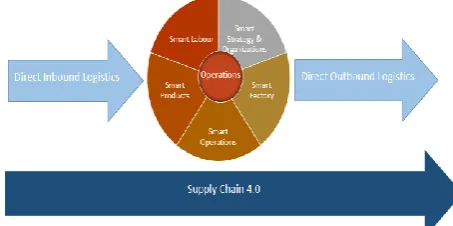
While constructing a model the three models discussed before are taken in mind. This led to the following model. In order to make things more clear first a representation of the model will be provided below:
[image:4.595.65.292.631.744.2]Figure 2: Industry 4.0 Identification Model.
It is very important to analyse risks and react well to them. The 5 steps of managing risks and how to act on them.
1. Identify Risks: determine the risks of a new investment in e.g. new machine or new software. What risks does it bring into the company? 2. Risk Assess & Analyze: Make an assessment of the
risk and examine what kind of risk it will be and how much it can impact the company. If there are more risks, they should be identified based on priority, to see which one is more important to handle first.
3. Plan Action: Base on the analysis a plan of how to reduce the risk or eliminate the risk.
4. Implement: The actual plan is taken into action, the
primary objective of the program should be
performed and carried out in a safe and efficient way
5. Measure, Control, and Monitor: Measure if there is
any change required? There needs to be a full controllable risk after taken all the steps.
Figure 3. 5 steps of risk management.
3.
RESEARCH METHODS
First, a desk-research will be conducted for several reasons. To learn about the subject and to know what is in ‘’the field’’ of I4.0 desk-research will be performed. This will also be used to set a definition of Industry 4.0 and its drivers. Theory acquired of desk research will be applied in order to construct questions which will be used in case studies.
Physical literature as books and online databases as Google Scholar, Scopus, and Web of Science will be consulted to acquire relevant knowledge. There will be mainly searched for terms as ‘Industry 4.0’ and ‘Industrie 4.0’. However, as discussed I4.0 is mainly a familiar term in Germany in which the latter searching term is the German variant. So, also other terms which are used for similar settings should not be neglected. Besides the general term of I4.0, there will also be searched for other terms regarding operations and Internet of Things and Cyber-Physical Systems which are main drivers of I4.0.
desired future states of I4.0 even as what companies’ representatives will think of I4.0.
For this study, a sample size of 12 will be used. A sample size of 12 allows the investigators to investigate companies within several industries and companies with different sizes and structure. This gives us enough samples to make a good and thorough statement.
When the survey is constructed, it will be used for several mini case studies in which companies will be compared with each other to identify the current and future state of I4.0. Therefore, a case study approach will be used. Several manufacturing companies will be visited and the qualitative data and
quantitative data will be collected by conducting the interviews. While working with questionnaires for companies, dependency could act as a limitation or complication. First, the right companies have to be found which are willing to cooperate. I4.0 is a relatively new concept and companies might not want to share all the necessary information since it is part of their strategy in order to keep competitive in the market. Trying to make clear agreements with the company prevents biases and withholding of information from the company. Besides that, I4.0 is a relatively new subject and is not clearly defined in concepts and future statuses are unclear. That is why an explorative research is chosen. This study will explore the current and future status of I4.0 and the influences on manufacturing companies’ operations.
4.
DATA COLLECTION & ANALYSIS
4.1
Industry 4.0 according to literature
At this moment we are at the beginning of the fourth industrial revolution, also called Industry 4.0 (I4.0) or Smart Industry. I4.0 is a strategy that has to be aligned with the current strategy of the company to fully adapt to the new industrial revolution. I4.0 is defined in different ways according to literature as for example; ‘Industry 4.0 focuses on the establishment of intelligent products and production processes. In future manufacturing, factories have to cope with the need of rapid product development, flexible production as well as complex environments (Brettel, Friederichsen, Keller, & Rosenberg, 2014). Another definition; ‘Industry 4.0 describes the organisation of production processes based on technology and devices autonomously communicating with each other along the value chain: a model of the ‘smart’ factory of the future where computer-driven systems monitor physical processes, create a virtual copy of the physical world and make decentralised decisions based on self-organisation mechanisms’ (Smit, Kreutzer, Moeller, & Carlberg, 2016). But as it is summarized by the German prime minister Angela Merkel: ‘It is a way of dealing quickly with the fusion of the online world and the world of industrial production’
The main features of I4.0 are described as (Schlaepfer, Koch, & Merkhofer, 2015):
- Vertical networking of smart production systems: This is the use of cyber-physical systems to react fast to changes and faults of machinery, this allows companies to produce customer specific products.
- Horizontal integration: Horizontal integration enables transparency within companies and a high level of flexibility, this causes a better global optimisation and competitiveness. With the transparency, there is a higher chance of new models, because there is a lot of cooperation and ideas between the stakeholders.
- Through-engineering: Taking the product through the entire value chain to not only optimize production processes but also make a smart end product. This optimizes the product life cycle. - Acceleration through exponential technologies: This allows
individual solutions per product, a lot of cost savings and flexible work, 3D printing is one of the prime examples for this, because it allows new product solutions and development methods.
As it is widely described by many people and organizations, I4.0 has some core elements along the supply chain of a company (The Quintessence, Industry Agents, 2015, p.6-7): - - Suppliers: Networking from company to a supplier and
production systems gives an opportunity to analyse alternative suppliers and capacities of others in real time.
- - Supply Chain: The supply chain responds dynamically to demands and mistakes within the supply chain, machines can adapt to mistakes and will try to deal with the fault from earlier on.
- - Raw Materials: Resources will be dealt with, in an efficient way. Information of waste will be saved directly to use later on. This simplifies the process of the re-use of raw materials. - - Product: The making of intelligent products is a must and the
products know all about their own capabilities to make themselves as efficient as possible in the process.
- - Machines: Intelligent machines adapt to different jobs and environments, to catch up with the demand of customers. - - Manual Labour: Employees are supported by the data stored
by the machines which they can use, also their work is
optimized by Augmented reality and the low-cost automation of their work processes.
- - Robot: Robots are key in the process and adapt quickly to changes and highly flexible workers
- - Warehouse: The warehouse has intelligent inventory holders to send information about what the company needs for their processes and keep the warehouse up to date with storage of products.
- - End-User Customer: Customers giving details about how they are going to use the products delivered by the company to optimize the processes within the company to adapt more to the demand of the customer.
By combining the core elements and features with each other there is a massive increase in competitiveness, because the flexibility and agility are a lot higher. By having a flexible workforce and a rapid adjustment to the environment, risks are reduced. With I4.0 the chances to change the supply chain are higher than ever, changing individual segments are easier to optimize production processes. All the data stored in an early age before I4.0 there is now an ability to actually do something with the information they stored and to use this information in the supply chain optimization.
4.1.1 Industry 4.0 according to companies
According to 12 interviewed companies, I4.0 could be seen as increasing steps in automation and mechanisation of processes. It builds upon existing automation and mechanisation but it will be more advanced. I4.0 is often not seen as a revolution but more as an evolution of the 3rd industrial revolution. It takes
incremental steps to build further upon the digitization of companies.
I4.0 should be investigated and implemented in companies’ processes in order to sustain market positions since competition is high. The software is very important in this process to store all the data and make decisions.
unmanned. Overall it is seen as a term to boost the industry. Because it is getting widely known around the world, no one wants to keep behind their competitors and will follow the I4.0 route. If a company does not implement I4.0 it is often seen as a misstep in their strategy to not follow this strategy.
In general, it is easier to implement I4.0 for small companies because they do not have to make huge changes in their company in comparison to big enterprises, smaller companies only have a lack of resources to commit to the big changes. Most of the small companies already have the strategy for the implementation of I4.0 but are waiting for the bigger companies to set out the market concepts. Bigger companies need a lot longer for I4.0 because they have a larger factory, more employees and more steps of hierarchy. Before the big company can change, it needs to go through all the steps. So, in conclusion, the small companies already have a plan but are waiting for the market leaders who need more time to fully implement I4.0 in a precise and in an efficient way.
4.2. Cyber-physical level
‘’Recent advances in manufacturing industry has paved way for a systematic deployment of Cyber-Physical Systems (CPS), within which information from all related perspectives is closely monitored and synchronized between the physical factory floor and the cyber computational space.’’ (Lee, Bagheri, & Kao, 2014, p17) The integration of Cyber-Physical systems within factories is an enabler of I4.0. The 5C-level architecture of James Lee et. al (2014) proposes a structure for cyber-physical systems. Therefore this model will be used in order to identify current cyber-physical levels.
Level 0
Three companies mentioned having low levels regarding cyber-physical applications. One of these companies is an engineering company which applies applications within current electrical systems. They were using old-fashioned techniques. For this company, a cyber-physical level was not applicable. Another company was not yet working automated, the customized low-volume aspect did not trigger the company yet to automate most processes. This did not enable higher cyber-physical levels. This also was the case for the third company which did not enable cyber-physical processes. However, this company wanted to automate more processes and take the cyber-physical level in mind.
Smart Connection Level
All other companies meet the demand of the smart connection level. This level demands to acquire reliable data from machines and components.
Data-to-Information Conversion Level
The data-to-information conversion level requires acquiring meaningful information from the data which is acquired at the smart connection level. Three companies mentioned being active in this level. One of these companies was already translating data to useful information but did reach the next level since they did not send it to a central data point yet. The next stage they wanted to reach is connecting their data to central hubs and represent all decentralized data in central overviews. The other two companies fulfilled the first stage by acquiring data, but are exploring how to translate this data into useful information. One of these companies is working on a concrete project on translating data into useful information. The other company invested in a new machine which allowed the cognition level but was working on the implementation.
Cyber-Level
The cyber level considers a central information hub within the architecture. Data is sent from decentralized machines/ components to this central point. The six companies which fulfilled the cyber-level mentioned are all situated in the cognition or configuration level, none of the companies is ‘’stuck’’ or situated in the cyber-level.
Cognition level
The cognition level enables a deeper understanding of the provided information. This level proposes having decent representations of the acquired information in such a way it supports right decision making of expert users. Five companies mentioned being in this phase. All these companies acquire data, transform it into information, send it to a database and present it in a proper way on a real-time basis. Two of these companies are working towards a self-configured factory by sending data back from databases to machines. Some machines are already able to adjust themselves to data and some practical applications in this aspect already exist within these companies. Another company which is situated in the cognition level did choose to do not implement self-configuring installations on purpose. The company is against self-adapting systems since the company wants to know what is happening in the process and why things are going well or wrong in order to improve the process.
Configuration level
The last level in the 5c-level architecture is the configuration level.In the configuration level data is sent back from the cyberspace to the machines which could make machines self-adaptive. One company was able to reach this level. This company, which has its roots in Germany, manufactures machines installation which enables the self-configuration level and the company possesses smart-factories itself. Within the company, the assembly line connects people, machines, and products. All operations are monitored and automated processes could be self-configured by acquired data. The data and information are shown on interactive communication platform. This interactive system is able to collect, process and visualize relevant data in a real-time manner. The interactive software could diagnose and optimize operations and detect failures. Besides this, the platform could be easily connected with several digital systems and allows third-party applications.
4.3 Industry 4.0 within companies
During the research 12 companies were visited to collect data regarding I4.0. Within this study, I4.0 applications were identified within these companies. The respondents had to identify I4.0 according to the Identification model which is constructed from The Industry Readiness Level Model created by the IMPULS Foundation of the German Engineering Federation (2015), the Digital Compass of McKinsey (2015) and the Supply Chain 4.0 factors proposed by S. Schrauf and P. Berttram (2016). This part will discuss these applications of Industry 4.0 within companies even as the desired future state and the reason why companies started or will start
implementing I4.0 or why not. Executed scoring models could be found in Appendix E.
4.3.1 Current Industry 4.0 applications
operations consist of the following factors: smart factory, smart operations, smart products and smart labour. The goal is to explore to which extent the drivers and factors are implemented throughout the company and supply chain. This will be discussed in this part. An overview of the applications and the number of implementations is provided in Appendix D. This overview shows how many companies, with a total of the twelve companies surveyed, implemented the I4.0 applications. Furthermore, executed models which provide an overview of the extent of I4.0 applications per company could be found in Appendix G and H.
4.3.1.1 Direct Inbound Logistics
Direct inbound logistics consists of several factors which are integrated planning/ execution, logistics visibility, and autonomous logistics. With integrated planning and execution in direct inbound logistics, a connection and execution with direct suppliers are meant. This survey showed 11 companies were integrating planning and execution with direct suppliers. However, within most companies, not all suppliers did have an interface with the companies. Most of the times companies only had a tight line with key suppliers. The next factor logistic could also be seen as a popular factor. Also, eleven companies did mention this aspect. However, the extent of logistics of visibility was sometimes limited to a track and trace service of the delivering company for some parts. Only two companies also mentioned the visibility of parts within their own process, so visibility is most of the times limited by transport between companies. The last aspect, autonomous logistics, was not mentioned. This could be the case for several reasons. Technology regarding this topic needs to be improved even as regulations within countries which should be adjusted.
4.3.1.2 Operations
Smart Strategy & Organizations
The first driver of the internal operations is smart strategy & organizations. This will be the start of the implementation of I4.0 applications. This driver consists of strategy, investments and innovations management. To fulfill these factors I4.0 should be actively implemented within companies’ strategy and investments must be made regarding I4.0. Innovations
management should be seen as an existing innovative
environment within the company. Seven companies mentioned having I4.0 implemented in the strategy. This varied from having vague guidelines of I4.0 implemented in strategy till fully developed strategies. Interesting is that 8 companies were investing in I4.0 applications while only seven companies implemented I4.0 in their strategy. A common statement we identified was that companies are willing to innovate within their company, whether it was an I4.0 application or not. Almost all companies mentioned having an innovative climate and are willing to innovate within their company. Therefore several actions are taken parallel to operations. Only one company did not actively participate regarding innovations management. The respondent explained that the company was applying old-fashioned techniques and knowledge on existing machine installations. He mentioned this as a competitive advantage since less and less companies were focussing on this aspect. In general, most companies did implement I4.0 in their strategy and invested in applications. Most companies also did have an innovative climate.
Smart Factory
This part will discuss till which extent the factories are ‘’smart’’. The smart factory driver considers partly the IT
structure of the factory and applications within the company itself as inventories, internal logistic and resource and process usage. This part excludes the internal core operations. Starting with the IT part, smart companies make use of digital modeling and gather data and provide data so it could be used by decision makers. Data collection and usage is an important step in digitized companies. All companies mentioned having IT-systems present within the company which is almost
indispensable these days for companies. The extent to which IT is implemented however is heavily variable among these companies. Some companies implemented IT systems throughout the entire operation while some companies mainly used it as a connection to the external world and for
administration purposes. Eight companies mentioned using data which is generated. However, only four companies were able to gather this in a real-time perspective. Digital modeling was often mentioned. Production companies did have advantages regarding time, money and quality to implement these programs. CAD-CAM software was often mentioned as development software in order to develop and produce components and products. Regarding inventories 3D printing and batch size decisions by data is less used. Only 3 companies made use of 3D printing to print sub-components for products and only 2 companies used data to determine batch sizes. The resources and processes within factories were also less mentioned. Two companies monitored their use of electricity and tried to optimize this while using data. Also, two companies made use of intelligent lots, which improves the internal logistics visibility. Real-time yield optimization was four times mentioned. These four companies monitored their operations real-time in order to determine the costs of operations. AGV’s were not mentioned within this research. As for, eight companies mentioned the automation of processes. Not all processes within the companies were fully automated but in general, companies wanted to automate as much as possible within their operations. This part discussed the extent to which companies are smart. Generally, companies implemented IT systems, used data till certain extents and made use of digital modeling. So most companies are involved in the IT part. However, besides automation, fewer companies do have I4.0 applications.
Smart Operations
means machines could be used in a flexible way and multiple routes could be taken regarding production. Most companies used these applications but it was not always done fully digital. Five companies had also the ability to monitor and control their operations remotely. Fewer companies (2) are able to predict maintenance within their processes. This was mostly due to machines which did not have this specification. However, companies were working on this aspect. Besides this, also augmented reality for maintenance repair and operations was less popular (2). According to companies, this was still too innovative to implement in own operations. The last aspect of smart operations considers quality management. This aspect was more popular among companies. Nine companies monitored quality digitally, seven companies had a form of advanced process control and eight companies used statistics in the process to control manufactured products or components. Most companies mentioned a focus on the quality aspect of their produced goods and are willing to invest in this.
Smart Products
The smart product driver shows the extent to which companies make smart products. This works kind of the same as in factories. In order to have a smart product, the product should provide data and have the possibility of a connection with IT-based systems. Other factors are data analyses of the generated data and self-diagnose function with the possibility of predictive maintenance. As for, a completely smart product could also adjust itself by using feedback from the data which is sent to IT-systems. This factor is not always applicable for companies. During the study, four companies were visited which produced rather static products or components and one company was an engineering company which did not produce smart products and did not apply smart products. The other seven companies mentioned having products which were able to produce data and have a connection to IT. Several companies mentioned focussing on their offered products first before implementing I4.0 themselves. These companies wanted to make sure their products were ready to connect to IT-systems, so their customers could use the products in a smart way. Other companies were also focusing on own operations and were supplying smart products. The products varied from switchboards, trucks, satellite systems, hydraulic/ electrical presses, machine installations to radar systems. So all these products from surveyed companies could be connected to IT in some way and generate data. Not all products were able to analyse the data themselves (5) and to provide a self-diagnose(5). Only one company produced products which are also self-adaptable by feedback send back by IT-systems. The latter could be seen as the final step in creating smart products. So, in general, all companies which produced products which are no static are working on the digitization of their products. However, the extent to which these products are smart differs.
Smart Labour
The last step regarding internal operations is smart labour. Implementing Industry 4.0 within processes leads to a change in work processes of employees. Smart labour addresses the required skills and knowledge, but also human-robot
collaboration. Besides this human aspect, smart labour will also address whether the performances are monitored if remote control/ monitoring is present and whether knowledge is automated. Five companies already have employees which do have the right skill set in order to fulfill requirements of I4.0 workplaces. Seven companies were acquiring new employees which are better compatible with I4.0 applications and were taking this into account. Only one company already made use of
human-robot collaboration in the form of co-bots (collaborative robots). Eight companies monitored performances of their employees in order to measure quality. As last three companies were working on the automation of knowledge work. So this does not only include repetitive work but the knowledge aspect within processes.
Direct Outbound Logistics
Direct outbound logistics considers the connection with direct customers. Four aspects are considered which are service/ after sales, time to market, supply/ demand match and a supply chain part. This supply chain part only considers the integrated planning/ execution part, logistics visibility part and autonomous B2C Logistics part. Regarding service and aftersales, the virtually guided self-service is only offered by one company. Four companies are offering remote maintenance and also four companies provide products which could predict maintenance. However, the privacy issue of customers was mentioned. The companies do have the possibilities to remotely use their products at customers but only apply this in case the customer wants to. Considering time to market eleven
companies mentioned using a form co-creation with customers. However, none of the companies did mention open innovation. Looking at supply and demand match, five companies used data to create value for customers. This is relatively low since eleven companies did mention using customer co-creation and putting an emphasis on value for customers. Four companies used data in order to predict demand. As for, the connection to customers and traceability were often mentioned, nine and twelve times respectively. Companies used interfaces with customers and used shared planning in order to adapt their operations to demand. Even as with the inbound logistics, autonomous logistics was not mentioned for several reasons.
Supply Chain 4.0
sensors but also transaction based or inventory administratively based. In all of this 5 cases inventories were expressed in ERP systems. Internal autonomous transport was only executed in one company. This was done via rails and not yet via agv’s, so certain tracks or rails were present. Seven companies are improving internal transport. The locations of several machines or workstations were considered in order to optimize this process even as implementing autonomous transport as agv’s. Only one company was focusing on efficient spare parts management. This company was predicting maintenance of machines and had the possibility of printing 3d spare parts. Fully autonomous logistics was not applied within the twelve companies. This techniques is currently under construction and is faded in test phases. One company which provides trucks was able to run its products for 20% autonomously. As last five companies are using advanced analytics for demand production and supply chain optimization
within the supply chain, five companies are using advanced analytics for supply chain prescription and one company used advanced analytics for decision support systems in the supply chain. More in-depth descriptions of digitized supply chain applications per company could be found in the company cases provided in the Appendix I.
The cross case comparison table identifies the most important Industry 4.0 factors of every company interviewed. These factors are based on performances regarding to I4.0 and reveals the strong disciplines of the companies. The cross-case comparison table enables to seek or construct an
idea/explanation why one case is different from the others. The analysis makes it possible to compare companies from different settings.
Companies Direct inbound logistics Smart strategy & Organizations
Smart Factory Smart Operations
A
B
C Logistics Visibility, it always needs to be known where products are and to be precise to make products just in time.
Information sharing, when information is
available, the data stored is shared with the customer. How far the product is, within the process. ‘Smart’ product data within the trucks is provided to customers to see if there are any failures.
D Routing Flexibility, when an order is
received, immediately there is connected which route needs to be followed for the most efficient planning and schedule
E Digital Modelling of
products is one of the key factors, in the past this was all done by hand
F Automated Processes,
highly flexible machines are able to repeat older processes and don’t need to be installed for this process.
IT security is improved after being hacked, the complete system is changed and the security is done by someone from windows within his network.
Machine Flexibility, the flexibility is high of machines, robots can make products with high precision and flexibility
G Innovation
Management is highly integrated because of the German roots and the self-awareness of I4.0 and they need to keep a leading role of I4.0
Data Usage, use of data is highly available, machines are self-configured with data. Automated Processes are used by the available data, the data is stored and directly used for the machines
Machine Flexibility is high, because of the use of data within the machine data is immediately transmitted to the machine to adapt to a product.
H Investments are mostly
aimed at I4.0 to create a better workflow and be more efficient, they just build a new facility to make this possible
Real time yield, based on what the customer needs there is use of price elasticity within the products
Remote monitoring/control machines are remotely on distance
I 3D printing is used to
make products and already identify problems within millimetres.
J Integrated planning, all stakeholders are involved to get an optimized supply chain, they look into the most efficient way of a suitable course of action
Digital Modelling for
customers to see if the planned product is correct and to make it easier for employees to see what they should produce
Cloud Usage, IT security, Information Sharing, Digital Quality Management,
K Investments are very
high for the
I4.0 market to compete with competitors.
IT security is very high due to the
products they make for big companies, everything needs to be safe and is linked as one of the safest digital environments L Logistics Visibility
customers are able to see what happens with the product when they order it, this is a key initiator
Companies Smart Products Smart Labour Direct outbound logistics Digitized Supply Chain
A Company A provides a
product that is a solution to take over a machine or process by virtualisation with fully independent knowledge.
Digital performance aspect, The company can make digitized models to enable the features to get a better picture of the project.
Customer co-creation is a strong point for Company A, every order they get is specifically made with the customer to experience the best possible collaboration.
B Customer Co-creation,
together with the customer, Company B is able to produce customer specific products.
C Self-Diagnose, Company C is able to let products they produce to diagnose themselves by having a support system to let products follow each other closely to get an optimized and safe environment
Connection of systems is
highly integrated within company’s C’s network
D data-driven demand
prediction, coupled systems to base on data which products are necessary for new elements of machines.
Real time data sharing within the company and systems are well connected
E
F Employee Skill Set because only
3 people were working in the company at the moment we were there, so the skill set should be extended for possible failures.
Smart procurement,
stocks are supplied automatically
G Adaptable via Data which they provide to customers, products can make decisions based on data.
human robot collaboration, is possible by an interactive system which shows the movements of the operator to react on them and enables a connection between cyber- and physical world
H Integrated planning is
highly sufficient, because of the flow of products, they do not need much time to get to the next line of production
I Traceability, through the
are back traceable which is important to production
J customer co-creation with the
ability to walk through a digital model of the concrete models, the customer can immediately make changes where necessary.,
Integrated planning, because of the collaboration with stakeholders, the flow of working is highly efficient
K Remote monitoring/control is
highly used and the company receives data from the sensors and systems to use this now for transmitting it to the machines and make it a safer workplace
L customer co-creation,
together with the customer it is possible to make a digitized model to see what is wished for the customer and what the possibilities are.
4.3.2 Desired state Industry 4.0
This part will discuss the desired future state of companies regarding I4.0. Besides a view on I4.0 in general, the companies were also asked to provide a future view regarding their own operations.
Strategy
Seven companies did implement I4.0 within their strategy and eight companies were investing in applications. Three multinationals, of which two have its roots in Germany, have a dedicated strategy and view on I4.0. The other companies are following an innovation strategy in which I4.0 plays a part. Besides I4.0 applications also lean-manufacturing was still implemented in some strategies even as agile manufacturing. One company’s innovation strategy emphasized lean
manufacturing and did not yet included I4.0 but will implement applications in case they have proven its reliability and performance. Two other companies also did not implement it within its strategy but are searching for applications to improve processes. So, in general, most companies are exploring I4.0 and its application while seven companies did implement I4.0 within their strategy.
Concrete Applications
During the research, companies were asked which concrete applications they wanted to implement within the short term. This helps to provide structure and a view of I4.0 in the short term. Besides one engineering/ consulting company every company wanted to implement new applications in the short term. About five companies mentioned increasing automation within its processes in the short term. This does not necessarily be an I4.0 application but it could enable I4.0. The actual connection of the machine park with IT-systems was mentioned three times. Regarding automation, one company which is active in the steel editing industry is considering applying AGV’s within its process. Furthermore, one two companies are working on their machine park so it will predict failures. Another aspect in which companies are currently investing is the acquisition of data and the actual use of this data. Six companies are currently willing to gather more data out of the process and five companies are working on monitoring this data real-time. During the research, several companies mentioned the loss of data: data was acquired but was not used. The current level of data gathering and analysis could be found in
the Cyber-Physical part of this report. As fo, a popular topic of interest regarding concrete applications in the short term addresses the connectivity with suppliers, customers and throughout the suppliers. Three companies were actively working on connecting systems with suppliers and customers in order to optimize the amount of flow throughout the supply chain. One company also mentioned using data in order to find a better match between supply and demand regarding products. this could be seen as a form of data driven design to value. As last companies mentioned the improvement of the quality and value to its customers. This was already present in most companies but there is still an emphasis on improving quality performances. So, companies are currently focussing on automation, connecting to it-systems, connectivity throughout the supply chain and quality management.
4.3.3 Why Industry 4.0?
In order to determine a possible future for I4.0, companies were asked why they did or did not implement I4.0. First, there will be discussed why companies started implementing I4.0, thereafter reasons will be given why some companies did not actively start implementing I4.0.
Why companies started
order to keep work in western regions. As for, one company with departments in Germany mentioned the great expected potential and wanted to take initiative in this area.
Why companies did not start
Five companies provided reasons why they did not actively start entering the world of I4.0. One company mentioned having other priorities due to limited resources and size. They were thinking about I4.0 applications on a smaller scale but other priorities exist. Another small company keeps working on the old-fashioned way since this is their current competitive advantage. Besides this, one company did not implement it because of a lack of strategic direction. In this case, more structure regarding I4.0 strategy is necessary in order to implement applications. As for, one company did not implement I4.0 because they only want to implement the proven technology. Since I4.0 is in its beginning most
applications should be further developed before it has proven its reliability. The latter company has still a strong focus on lean manufacturing and I4.0 is not yet on the agenda.
4.4 Risks of Industry 4.0
I4.0 improves a lot within the company according to, the flexibility of work, speed, cost reduction, higher quality, and dependability, but I4.0 also has some risks to take into account before the implementation of I4.0 and during the process when I4.0 is integrated within the company.
Risks for I4.0 are (as we see it) divided in a physical and IT part. The physical part of the risks contains risks as stated as an investment/capital part and employee part. IT part is aimed at the cyber security and privacy of customers. (Geissbauer, Vedso, & Schrauf, 2016)
4.4.1 Physical
To implement I4.0 it requires a huge investment. To take in a new technology that is expensive to integrate and buy, such a decision has to be made on a CEO level. What risks does it take along while investing in I4.0, does it withhold other investments and running projects, or does the company get money issues regarding their high investments, reputation problems, and their expense might even hurt their market share in the future. I4.0 implementation requires a smooth set up and the risk of a production stop must be avoided.
Based on early speculations on the employment level with the adoption of I4.0 worldwide, it is necessary for employees to learn differently or a new set of skills. I4.0 might help to let production run faster but this has a risk to take away jobs from employees. To let these employees keep their job they need to invest time in studying and practicing the skills to be able to maintain their job. Employees might also not accept the change, they might feel it as a threat and want to stay in their old habits. It is very important to involve employees in the change to convince them of the new way of working.
4.4.2 IT
Privacy is not only the problem of the customer but also from the producer, how does a producer handle all the data stored from customers, what do they do with the information from a customer about what he or she did on a particular website. To a customer this might look like a threat to their privacy,
companies need to be as transparent as possible to reduce risks of distrust and take a customer completely along in their process of what happens with the stored data they provided. IT security is the most challenging risk of implementing I4.0. The online integration of a company makes room for security
breaches and opportunities for hackers to steal sensitive data, which is later on sold back to the company for a lot of money. This data refers to the confidential information of customers, suppliers and even personal data from employees. Not only costs this a lot of money it also hurts the reputation of the company, that is why a company needs to invest in their cyber security for an optimized security control and prevention of Data Breaches.
5.
CONCLUSION
In this study, we wanted to explore in which way I4.0 is developing and what it will bring to industries. therefore we investigated what I4.0 is according to literature and companies, to which extent I4.0 is currently implemented, which desires companies have regarding I4.0, why I4.0 should be implemented or why not according to companies, what the cyber-physical level is within several companies and which risks are involved regarding I4.0.
What is industry 4.0?
I4.0 is the fourth industrial revolution, it is originated from a project in Germany from the high-tech sector where they say ‘Industrie 4.0’. I4.0 has to be aligned with the current strategy to get the maximum and most efficient workflow.
As discussed in the paper, we have the main features of I4.0 and the core elements, these elements and features combined will make a flexible, agile and dependable supply chain. Together with increasing competitiveness and reduction of risks, because the production process is optimized with robots which are more precise than humans.
To which extent is industry 4.0 currently implemented within manufacturing companies?
During the research I4.0, a wide extent of I4.0 applications was identified divided under the drivers inbound/ outbound logistics, smart factory, smart operations, smart products, smart labour and supply chain 4.0. Most companies did already have I4.0 applications. The kind of applications were rather
diversified. However, some application were available in almost all companies such as integrated planning & logistics, logistics visibility, innovations management, IT security and customer co-creation. However, there was still a difference to which extends applications were applied. The least popular applications were batch size estimation, smart energy, intelligent lots, agv’s, self-configuring products, virtually guided self-service, open innovations and autonomous b2c logistics. Furthermore, other applications were divided among companies. So, most companies did have applications but could not be seen as 100% smart. One company scored high on I4.0 applications and five companies could not fully be identified as smart but came close.
What is the desired future state of production companies regarding industry 4.0?
most popular applications are a higher extent of automation, connecting physical components/ machines with IT, connecting systems with suppliers/ customers, a higher extent of data acquisition and usage and failure prediction.
Why would a company make use of Industry 4.0?
Several reasons were given why companies should and should not ‘’start’’ making use of I4.0.
The main reason to start implementing I4.0 applications is to sustain in a competitive environment. Companies increase chances of sustaining while innovating in a responsible way. I4.0 could help with this aspect. Furthermore, companies mentioned new business opportunities brought by I4.0 and improvements in performance factors.
Besides reasons for the implementation of I4.0 applications, companies who did not actively start provided reasons why. Some companies did not start because of a lack of resources. I4.0 applications could be expensive and could take time before successfully implemented. Another reason is the innovative aspect. Industry 4.0 could be sometimes too innovate and not all technologies are fully proven yet. So, costs and risks could be identified as a main reason to not implement applications yet.
What is the current cyber-physical level within companies?
The cyber-physical systems could be seen as enablers of I4.0 and so is interesting to investigate. The proper acquisition, usage, representation of big data is an important aspect and should be treated carefully while applying I4.0. Regarding the cyber-physical level three companies mentioned having low levels regarding cyber-physical applications, three companies mentioned being active in the data-to-information conversion level, five companies mentioned being in the cognition phase and one company was able to reach the configuration level. While being in a higher cyber-physical level, companies are better able to manage data and are closer to the smart factory level. So, one company already could be marked as a smart factory in which operations could adapt it selves and five companies have applications to enable a deeper understanding of the provided information.
What type of risks do you need to take into account as a Company when implementing Industry 4.0?
As a company, it is important to, whenever you are making a change in the company you need to take into account the risks it will bring with it. With I4.0 there are some risks according to a ‘physical’ and ‘IT’ part. This contains employment and capital on the physical part, with cyber security and privacy on the IT part. These are the main risks which need to be taken into account when implementing I4.0, because when these risks are not considered as a threat there is a huge chance of failure.
In which way will industry 4.0 influence the operations of manufacturing companies without taking too many risks for the company itself?
Following this research there could be said companies are taken I4.0 in mind and see a future in this phenomenon, however, there is also a hyped part in it. Companies are working towards a more digitized environment in which processes are automated, monitored real-time and self-configured. Companies are getting more transparent by the use of more data which is acquired, analysed and used to make decisions. I4.0 also enables more flexibility which supports mass-customization. Besides this more data will be shared throughout the supply chain which will optimize transparency and Supply Chain performances. Important in this process is to take risks into account. On both
side, cyber and physical, risks occur and companies are getting more vulnerable. Risk assessment while using risk models should create awareness of risks.
6.
RECOMMENDATIONS
The study pointed out most companies did see a future in I4.0. Because of the hyped-character of I4.0 it was also seen as a buzzword, but the companies did definitely see possibilities in smart factories. The companies which did implement I4.0 saw an increase in performances based on speed, dependability, quality, flexibility and costs. The opportunities which could be brought by I4.0 are worth studying. Companies need to innovate in order to remain competitive and I4.0 offers possibilities to increase companies’ performances. However, companies should not just implement applications only because they think so. Implementing I4.0 applications should be carefully considered in companies’ innovation strategy. Every company is different and should be treated as such, therefore there must be investigated which application fits best within the specific organization. This paper proposes the following steps for implementing I4.0 applications:
1. We first suggest to create a proper view of current operations. Companies should understand where they currently stand. For the I4.0 part, companies could follow the I4.0 identification model to identify applications and use the cyber-physical model to identify cyber-physical levels.
2. The second step will be creating a strategy regarding I4.0. Companies should determine which value will be provided and which future setting fits best in the short-, medium- and long-term.
3. In order to create a fit with strategy, a roadmap should be created. The roadmap should create a fit between company and applications. First, the foundation should be taken in mind. It is important to have a cyber-environment and physical applications which are connected. Therefore the cyber-physical model could be used even as the I4.0 identification model for IT applications. Thereafter companies could use the I4.0 identification model to choose further applications. Important is to see the bigger picture of Supply Chain 4.0, Direct Inbound/ Outbound Logistics and Operations, rather than only internal operations.
4. While creating a roadmap, risk should be taken in mind. The risk model implemented in this study could help as a basis in order to manage risks.
5. While a roadmap is set, and risks are assessed, the implementation could start by using pilots in order to prove technologies.
6. When pilots are successful, companies could start implementing the actual technology.
7. After the implementation, the process should be managed and monitored.
7.
CONTRIBUTION
unidentified. As mentioned before, this study will identify current and future extents and influences of I4.0. This will create a more identified view of I4.0 in current and future settings. As times goes by, future investigations could build upon this research to create a more specific view regarding influences and extents of I4.0 in manufacturing companies. In a practical way, companies could identify their level of I4.0 applications and use the study as a benchmark with own operations. Companies might or might not feel a need to get more engaged in this topic.
8.
ACKNOWLEDGEMENTS
We want to thank our first supervisor Prof. Dr. habil. Holger Schiele and second supervisor MSc. MSc. MSc. Frederik Vos for the guidance, dedication throughout our Bachelor Thesis and the opportunity to investigate the interesting topic of I4.0 in practical settings. We want to thank the twelve responding companies for offering scarce time and effort regarding our research. Furthermore we want to thank relevant members of the McKinsey Company, the IMPULS Foundation, the PWC group, PDF Class and J. Lee et. al for providing models used in this research even as other writers which contributed in a literary manner. At last we want to thank relatives and acquaintances for their personal support in our process of conducting research.
9.
APPENDIX
Appendix A: McKinsey Digital Compass.
Appendix B: Industry 4.0 Readiness Model.
Industry 4.0 Readiness Model
Appendix D: I4.0 applications within
companies.
Appendix E: Executed Models I4.0
Applications per Company
Appendix F: Scoring Model Digitized Supply
Chain
Appendix G: Digitized Supply Chain
company scores
Appendix H Executed I4.0 application
scoring model per company.
V = (partly) present. X = Not Present. Blank spaces = Not present/not applicable