University of Twente
Developing and testing
a high-tech serious
game “Tower of
Infinity” for supply
chain management
Bachelor ThesisAuthor:
B.H.G. (Bram) Schrooten
Student number:
s1598392
E-Mail:
[email protected]
1
stsupervisor:
M. C. van den Berg
2
ndsupervisor:
J. T. Voordijk
Abstract
The field of supply chain management in construction is lagging behind in regard to other fields, due to the unique characteristics that this field owns. As an attempt to create insight in this field, a serious board game called ‘Tower of Infinity’ has been developed using Triadic Game Design. However, a digital game might offer more possibilities than a traditional board game. A high tech version of ‘Tower of Infinity’ will be developed and tested, where the strong aspects of digital games will be optimized. Triadic Game Design and Agile Software Development have been used to develop the game, jMonkey has been used for programming the game, and the testing will be done in a workshop with multiple experts.
Out of the game- and literature-analysis, it became clear which characteristics were already present in the low-tech version of “Tower of Infinity”, where the interface between design, production and construction has a significant priority. These aspects have been implemented into the first version of the high-tech game, where only one aspect was not possible to translate into the high-tech version due to its single-player restriction. Out of feedback-sessions, it became clear that the usability was deficient. In the final version of the game, this has been improved. The first high-tech version of “Tower of Infinity” has been used in a presentation during a knowledge-table, after which a questionnaire was handed out that questioned the attendees about the functionality of the game. The response from this questionnaire was mostly positive. From this, it can be said that the high-tech game has more possibilities to gain insight from: through playing the game, but also through a presentation as a discussion starter.
Table of Contents
1. Introduction ... 4
2. Research methodology ... 5
2.1. Research aim ... 5
2.2. Research questions ... 5
2.3. Research methods ... 5
3. Theoretical background ... 6
3.1. Supply chain management in construction ... 6
3.2. Serious Gaming ... 7
3.3. “Tower of Infinity” ... 9
4. Results ...10
4.1. Characteristics of construction supply chain management ...10
4.2. Construction SCM problems that are present in “Tower of Infinity” ...13
4.3. High-tech (dis)advantages of “Tower of Infinity” ...16
4.3.1. (Dis)advantages of traditional computer games ...16
4.3.2. (Dis)advantages of modern high-tech games ...17
4.3.3. Performance of high-tech games ...17
4.3.4. Context of “Tower of Infinity” ...18
4.4. Development of “Tower of Infinity” ...19
4.4.1. Triadic Game Design ...19
4.4.2. Agile Software Development ...21
4.4.3. First version of “Tower of Infinity” ...21
4.4.4. Feedback...24
4.4.5. Final version of “Tower of Infinity” ...25
4.5. Creating awareness with “Tower of Infinity” ...26
5. Discussion ...28
5.1. Contributions ...28
5.2. Further development of “Tower of Infinity” ...28
5.3. Limits and boundaries ...29
6. Conclusion ...30
7. Acknowledgements ...31
8. Bibliography ...32
Appendix A: Terminology ...34
Appendix B: Characteristics of “Tower of Infinity” ...35
B.1. Procedure of “Tower of Infinity” ...35
Appendix C: All versions of “Tower of Infinity” ...40
Appendix D: Extensive feedback of first version ...43
Appendix E: Images of development of “Tower of Infinity” ...45
1.
Introduction
In this thesis, a high-tech version of the serious game “Tower of Infinity” will be developed and tested. In this introductory part, the problem is briefly explained. For a clear description of different definitions that are used in this report, please refer to Appendix A.
Instead of dividing the supply chain, supply chain management (SCM) views the entire supply chain, and aims to increase transparency and alignment of the supply chain’s co-ordination and configuration (Vrijhoef & Koskela, 2000). However, in the field of construction supply chain management, productivity did not increase significantly around 2000, while the costs of construction objects had (Vrijhoef & Koskela, 2000). Because every supply chain in construction management is unique (Segerstedt & Olofsson, 2010), there is not one optimal supply chain approach for every construction. Due to its unique nature and the risks of costs and time of real-life testing, easy and cheap ways to gain insight into SCM in construction must be created to add to the productivity of the construction industry.
2.
Research methodology
In this part, the base of the research is given. The aim of the research, the main question, sub-questions and methods are all given in this chapter.
2.1.
Research aim
The aim of this research is to analyse how a high-tech version of “Tower of Infinity” can create insight in supply chain management for practitioners that work in the construction industry. Advantages of high-tech games as opposed to low-high-tech games will be analysed and these characteristics will be implemented in the game. At first, only the current base of the board game will be implemented. Then, further analysis will be done on what the current version is still missing.
2.2.
Research questions
In short, the following research question has to be answered:
How do users of a high-tech game “Tower of Infinity” become more aware of different problems of the field of supply chain management in construction?
This can be divided into several different sub-questions:
1. What are the characteristics of construction supply chain management?
2. How are problem areas already implemented in the low-tech version of “Tower of Infinity”?
3. What advantages and disadvantages do high-tech games have in regard to low-tech games?
4. How can the high-tech version of “Tower of Infinity” be developed?
5. How can “Tower of Infinity” create awareness for its users about the problems of SCM in construction?
2.3.
Research methods
To design the high-tech version of “Tower of Infinity”, the game engine jMonkey will be used. Game engines are toolkits aimed to ease the development of videogames, acting as a superstructure of several development efforts (Navarro, Pradilla, & Rios, 2012). Because jMonkey is written in Java, it has many possibilities in the desktop world, allowing development for different platforms. The only complaint of Navarro was that jMonkey did not support Android devices yet. However, they now do support Android and iOS devices (jMonkeyEngine, 2017). There are also no plans to create a mobile version of “Tower of Infinity”. Additionally, jMonkey has an active online community, where answers are answered fairly quickly.
Figure 1: Generic configuration of a supply chain in manufacturing (Vrijhoef & Koskela, 2000)
3.
Theo
r
etical background
In this research, two main fields are analysed: Supply chain management in construction and serious gaming. The theoretical background contains summaries of all researches that are used for this thesis.
3.1.
Supply chain management in construction
According to Christopher (as stated in Vrijhoef & Koskela, 2000), the supply chain has been defined as “the network of organisations that are involved, through upstream and downstream linkages, in the different processes and activities that produce value in the form of products and services in the hands of the ultimate customers”. Instead of dividing this network, supply chain management (SCM) views the entire supply chain, and aims to increase transparency and alignment of the supply chain’s co-ordination and configuration (Vrijhoef & Koskela, 2000). A generic visualisation of SCM is given in Figure 1. For example, if a customer demands a certain item, this demand will ‘flow’ backwards and show up at the retailer. This retailer knows how to create this item, but needs other supplies to create the demanded item for the customer. The demand changes to what the retailer needs, and flows further back in the supply chain. This repeats until the demand ends up at the end of the supply chain, and the process moves forward again, towards the earlier mentioned customer. Because these supply chains consist of so many different organizations, it is crucial that management between these different organizations goes as smooth as possible.
In this research, the focus lies on supply chain management in construction. Eccles (as stated in Segerstedt & Olofsson, 2010) defined construction as “the erection, maintenance, and repair of immobile structures, the demolition of existing structures, and land development”. Some papers claim that the annual productivity increase in building construction – only 3% in the Netherlands – is not enough to compensate for the average increase on labour costs (Vrijhoef & Koskela, 2000). However, another paper claims that these kind of investigations for SCM in construction may be debatable, due to uniqueness in output that is produced, firm size and use of technology in different sectors. These differences make it hard to characterize and measure the performance of construction on industry level (Segerstedt & Olofsson, 2010). Nevertheless, the papers do both agree that increase of productivity in the construction industry is still possible.
However, the construction industry differs significantly from industries like the manufacturing industry, because of their one-of-a-kind products, temporary organization and on-site production. Additionally, only 25% of the product’s value is built solely by the principal construction company (Segerstedt & Olofsson, 2010). For these reasons, the construction industry must find other ways to improve performance and efficiency. Vrijhoef & Koskela (2010) characterized the construction supply chain in terms of structure and function as the following:
- A converging supply chain where all materials are directed at the construction site where the project is assembled from all incoming materials. In contrast to the manufacturing industry, the specific “construction factory” is set up around a single product instead of multiple products; - It is in most cases only a temporary supply chain producing one-off construction projects. This
means that every construction supply chain has a different structure, and so is characterized by instability, fragmentation and separation between the design and the actual construction of the object;
- It is a typical make-to-order supply chain: every project creates a different product or prototype. Apart from rare exceptions, there is little repetition in these supply chains. However, in particular cases the process can be very similar.
Because of these characteristics, combined with the risk of losing valuable time and money if wrong decisions are made, this field is currently inefficient and full of risks.
3.2.
Serious Gaming
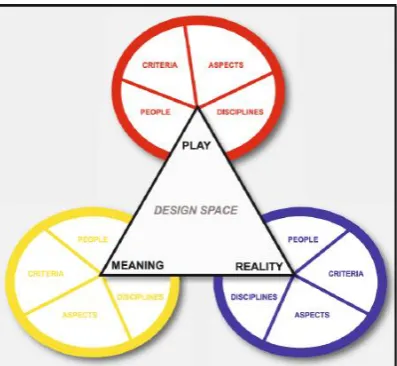
In every field of work where design is involved, it is important to consider certain methods, techniques procedures, theories, and approaches. Triadic Game Design (TGD) is a game design approach that is specifically oriented at serious games (Harteveld, 2011). At the same time, TGD must be seen as a design philosophy: it does not give a fixed roadmap on how to work on a design, but it does give a certain way of thinking: how one should look at their design, and what kind of aspects it needs. In TGD, the focus lies on the balance between the worlds of Meaning (one should learn something from it), Reality (it should have a link with reality) and Play (it should be fun): these three aspects are equally important, and they constitute the design space of developing a game. If one of these worlds is missing in the final design, the game collapses due to its unfulfilled purpose (Harteveld, 2011). A visualisation of this triadic game design approach in given in Figure 2.
One of the fundamental serious games about SCM is called the ‘beer distribution game’ (Sterman, 1987). This game is a multi-player game, where participants take the role of managers in a simulated inventory management system. In this simulation, there are multiple actors, feedbacks, nonlinearities and time delays present. Analysis of this serious game shows that the participants fall victim to misperceptions of feedback. This results in a so-called ‘bullwhip effect’, where “variances of orders may be larger than that of sales, and the distortion tends to increase as one moves upstream” (Lee, Padmanabhan, & Whang, 1997). This game has been fundamental for showing the usefulness of serious games. However, several weaknesses exist in this game (Knolmayer, Schmidt, & Rihs, 2007):
- There is a inflexibility in the structure of the supply chain;
- The supply chain is introduced as a linear system, neglecting effects of decisions by companies that are not members of the supply chain;
- Capacity constraints are neglected;
- There are unrealistic assumptions, such as the delay in transferring information, which do not reflect the potential of today’s powerful communication systems;
- There is a inflexibility in changing underlying parameters which hampers students’ natural desire to play around with the model.
On the other hand, many serious games about construction management have been developed through the years. For example, Construct.it (Mayer, et al., 2013) is one of these serious games. Construct.it is a high-tech multiplayer planning game concerning the urban reconstruction of a seaport area in a real Dutch town.
[image:9.595.356.555.68.251.2]Still, both of these serious games are not about supply chain management in construction specifically. The ‘Beer Game’ assumed the supply chain as a linear system, which was also fixed – meaning there are no differences in the supply chain between the different chains. However, due to one-of-a-kind products, the supply chain of every construction project is unique. While Construct.it does talk about (re)construction, it is not about one construction project but an entire area. Up until the latest years, there has not been a serious game about SCM in construction.
3.3.
“Tower of Infinity”
In the latest years, a serious game regarding construction SCM was developed, dubbed “Tower of Infinity”. In this game, you play the role of a company that has gotten a contract for the design and construction of a big building project. It is a single-player board game where the player takes the role of the main contractor and needs to make sure that all processes in the design and construction processes run as smooth as possible. This game has already undergone testing by students of the course “Supply Chain Management & ICT” at the University of Twente and by a group of educational experts (van den Berg M. C., 2015).
In “Tower of Infinity”, you need to design a model, order the materials and assemble it on the construction site. When ordering bricks, there are multiple possibilities to order this brick, where the brick either costs more but is delivered quicker or the other way around. There is also the chance that delay occurs in a certain part of the production-sequence. A detailed analysis of “Tower of Infinity” can be found in Appendix B.
4.
Results
Based on detailed analyses, the different sub-questions can be answered. The detailed analyses can be found in appendices, while the summarised conclusions are given here.
4.1.
Characteristics of construction supply chain management
Before the goals of “Tower of Infinity” can be researched, it must first be analysed what kind of roles and characteristics SCM in construction has. After this is known, “Tower of Infinity” will be evaluated and different roles and characters of SCM in construction will be linked to different aspects of the game. Based on literature, the characteristics will be divided and explained in the following headings:
1. Roles
2. Comparison to the traditional approach 3. Framework
4. Problems
Roles
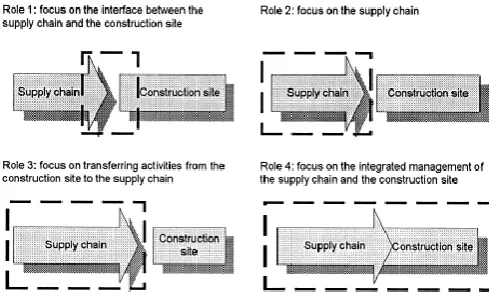
As mentioned in Chapter 3.1, supply chain management views the entire supply chain instead of only one group of manufacturers or suppliers. This way, SCM aims to boost the transparency and co-ordination of projects (Vrijhoef & Koskela, 2000). However, there are different ways that these aims are fulfilled. According to Vrijhoef & Koskela (2000), SCM in construction features four major roles, which are also visualised in Figure 3:
1. Firstly, the focus could lie on the impacts of the supply chain on site activities, as well as on the interface between these the supply chain and construction site. The aim of this role is to make sure that the translation from the supplier to the construction site goes as smoothly as possible, by means of dependable material and labour. These factors should result in a minimization of disruptions in the workflow, and so reducing costs and duration of on-site activities.
2. The focus might also be on the supply chain itself, where the goal is to reduce costs, especially those that are related to logistic, lead-time and inventory.
In this role, the construction site is not taken into account for the most part.
3. Another role is to transfer activities from the construction site to the supply chain. This is useful, because the construction site has inferior conditions compared to the supply chain, next to many technical dependencies. The goal is again to reduce the total costs and duration of the project. 4. Lastly, the focus may be on the integrated management and improvement of the supply chain and
the site production. This means that the construction site is also seen as part of the supply chain, and integrated into the supply chain management.
[image:11.595.333.578.374.525.2]The difference between these roles is mostly how the construction site is taken into account. In role 1, the focus lies on the translation, which means that only the translation to the construction site is taken into account. In role 2 however, the construction site is mostly disregarded, because the focus is on getting through the supply chain as efficient as possible. Role 3 takes the construction site, and tries to transfer as much activities from the construction site to the supply chain. Role 4 merges the construction site completely into SCM.
It is mentioned that these roles should not be seen as mutually exclusive and are often used jointly (Vrijhoef & Koskela, 2000). This is important, because if only one role is taken into account, aspects from other roles might suffer significantly. For example, if only role 2 is taken into account, the supply chain will be the most cost-effective. However, the delays at the construction site will cause much bigger costs, because delays are not taken into account in role 2.
Apart from aforementioned roles, SCM in construction also has a number of characteristics that are very important to take into account. As mentioned in Chapter 3.1, Vrijhoef & Koskela (2010) characterized the construction supply chain as the following:
- A converging supply chain where all materials are directed at the construction site where the project is assembled from all incoming materials. In contrast to the manufacturing industry, the specific “construction factory” is set up around a single product instead of multiple products; - It is in most cases only a temporary supply chain producing one-off construction projects. This
means that every construction supply chain has a different structure, and so is characterized by instability, fragmentation and separation between the design and the actual construction of the object;
- It is a typical make-to-order supply chain: every project creates a different product or prototype. Apart from rare exceptions, there is little repetition in these supply chains. However, in particular cases the process can be very similar.
Comparison to traditional approach
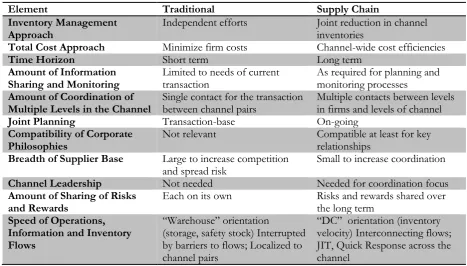
[image:12.595.63.531.428.694.2]The characteristics of SCM can also be defined by comparing it to the traditional approach. The significant differences between these two approaches are given in Table 1.
Table 1: Traditional and Supply Chain Management Approaches Compared (Cooper & Ellram, 1993)
Element Traditional Supply Chain Inventory Management
Approach Independent efforts Joint reduction in channel inventories
Total Cost Approach Minimize firm costs Channel-wide cost efficiencies
Time Horizon Short term Long term
Amount of Information
Sharing and Monitoring Limited to needs of current transaction As required for planning and monitoring processes
Amount of Coordination of
Multiple Levels in the Channel Single contact for the transaction between channel pairs Multiple contacts between levels in firms and levels of channel
Joint Planning Transaction-base On-going
Compatibility of Corporate
Philosophies Not relevant Compatible at least for key relationships
Breadth of Supplier Base Large to increase competition
and spread risk Small to increase coordination
Channel Leadership Not needed Needed for coordination focus
Amount of Sharing of Risks
and Rewards Each on its own Risks and rewards shared over the long term
Speed of Operations, Information and Inventory Flows
“Warehouse” orientation
(storage, safety stock) Interrupted by barriers to flows; Localized to channel pairs
Framework
Another way to explain the characteristics of supply chain management is by elaborating on the three primary structural aspects of a company’s network structure (Lambert, Cooper, & Pagh, 1998):
- The members of the supply chain: The members of a supply chain include all companies and organizations with whom the focal company interacts directly or indirectly through its suppliers or customers. As a simplification measure, a distinction is made between primary members (companies that perform operational and/or managerial activities to produce a specific output) and supporting members (companies that only provide resources, knowledge, etc. for the primary units).
- The structural dimensions of the network: Three structural dimensions of the supply chain are essential when describing, analysing and managing the supply chain: the horizontal structure, the vertical structure and the horizontal position of the focal company.
o The horizontal structure refers to how long the supply chain is. A supply chain can have only three tiers of suppliers, while another has five.
o The vertical structure refers to how broad the supply chain is. The focal company may have only one supplier, but might as well have three different suppliers. While this only counts as one tier in the horizontal structure, the vertical structure is much more complicated.
o The horizontal position of the focal company refers to how much tiers the supply chain still has to pass before and after the supply of the focal company. The focal company could be close to the initial source of supply, the ultimate customer or somewhere in-between.
- Types of Business Process Links: Because managing all process links is not efficient, priorities have to be made. Because of this, allocating scarce recourses in the supply chain is crucial. In supply chain management, four different types of business process links can be identified:
o Managed Process Links: Links where the focal company integrates a process with one or more customers or suppliers;
o Monitored Process Links: Links that are not as critical to the focal company as managed process links. Still, it is important to the focal company that these process links are integrated and managed appropriately between other member companies.
o Not-managed Process Links: Links where the focal company is not actively involved, due to scarcity of recourses and/or little importance of the process link.
o Non-member Process Links: Links between members of the focal company’s supply chain and non-members of this supply chain. These non-members can be competitors, and are important to take into account because of possible shortage of a certain supply.
Problems
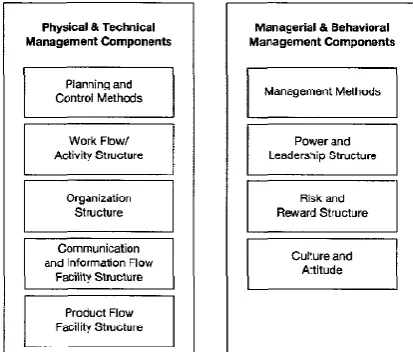
[image:13.595.374.581.595.771.2]Management components are also an important element of the SCM framework. The fundamental components are given in Figure 4. While the physical and technical components are the most visible, tangible, measurable and easy-to-change, this should not be the only focus of managerial attention. Much literature on change management shows that this will cause the supply chain to most likely fail (Lambert, Cooper, & Pagh, 1998). The managerial and behavioural components are much harder to assess and alter, but define how the other components can be implemented.
Many researches have mentioned the importance of business processes and relations in supply chain management. Working with the supplier as a partner in a long-term relationship would improve the quality and decrease the costs of production (Deming, 1982). Supply chains can create superior and unique performances by changing the structure of activities within and between companies. These activities must be integrated into key supply chain business processes, instead of managing only individual functions (Lambert, Cooper, & Pagh, 1998). The construction industry suffers from poor performance, and is lagging behind in terms of supply chain practices and efficiency (Vrijhoef & Koskela, 2000). The dominating focus on projects, fragmentation of the industry and separation of the design and production processes have been suggested as the root causes for this poor performance, next to lack of coordination and communication between participants, adversarial contractual relationships, lack of customer-supplier focus, price-based selection, and ineffective use of technology (Bankvall, Bygballe, Dubois, & Jahre, 2010). Most SCM models that are not developed for SCM in construction are problematic to use in the construction industry, because the pattern of interdependencies is very different in construction compared to other industries.
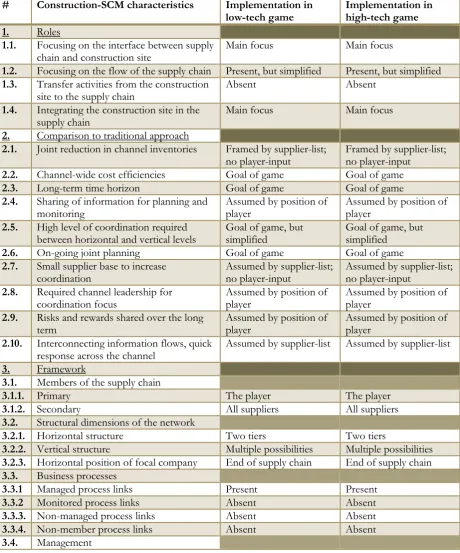
In conclusion, Table 2 is created that is branched into groups of characteristics of SCM in construction. This table is used later to easily analyse which characteristics have already been implemented in “Tower of Infinity”.
4.2.
Construction SCM problems that are present in “Tower of Infinity”
Before characteristics of construction supply chain management can be assigned to aspects of “Tower of Infinity”, the game itself needs to be analysed. This analysis is given in Appendix B. After this, construction SCM can be compared to “Tower of Infinity”. This will be done by taking the different SCM-headings from Chapter 4.1 and analysing which characteristics of these headings are and are not present in “Tower of Infinity”.
Roles (Vrijhoef & Koskela, 2000)
The main role that “Tower of Infinity” focuses on is ‘the interface between supply chain and construction site’. As the player, you need to make sure that the supply chain is integrated well with the construction site, so that materials don’t have to be stored, and that there is always work to do on the construction site. The second role – focusing on the supply chain – is present, but very simplified. The supply chain is visualised as a system, where every materials starts at a specific week (represents the preparation time of the material), and then flows linearly through this system, with a 1/6 chance of a delay when it’s in its final 6 weeks of production. The chance for all materials are the same. All of these aspects are simplified, so while the supply chain is present, that is not the main focus of this game.
In the game, there is no possibility to transfer activities from the construction site to the supply chain. Every material has fixed supply rates and assembly rates. While there are different supply-rate choices for some materials, this is not the case for the assembly. Because of this, the third role is not present in “Tower of Infinity”.
Comparison to traditional approach (Cooper & Ellram, 1993)
The characteristics that are the most important to “Tower of Infinity” are ‘channel-wide costs efficiencies’, ‘long-term time horizon’, ‘on-going joint planning’ and ‘high level of coordination’. In the game, you try to spend as little money as possible through the entire project, and do not give any attention to where this is spent. The player also plans orders and assemblies so that these tasks are completed at the right time in the long-term. This is also an aspect of joint planning, where the supply and construction are integrated to acquire the best transition between these two chains.
The remaining aspects are also present in “Tower of Infinity” but are not influenced by the player, and so not as important as the abovementioned aspects. ‘Joint reduction in channel inventories’ and ‘Small supplier base’ are both framed by the product list. This list is a lot smaller and simpler than all the possibilities that are present in real-life. ‘Sharing of information desired’, ‘High level of coordination required’, ‘Required channel leadership’, ‘Risks and rewards shared over the long term’ and ‘Interconnecting information flows’ are all present due to the position that the player is placed in. The player overlooks the project from a top view, and so has all information of the project. The leadership is done singlehandedly by the player, and so coordination is relatively easy. The risks and rewards are observed globally at the end of the project, so that risks and rewards are shared.
Framework (Lambert, Cooper, & Pagh, 1998)
In “Tower of Infinity”, there is no explicit division between primary and secondary members of the supply chain. Materials in the product list are not related to any supplier. The members that provide this product list could be seen as secondary members, since they only provide resources for the construction of the design. The focal company – which is played by the player – is the only primary member in this supply chain.
The structural dimensions have been significantly simplified in “Tower of Infinity”. While the vertical structure is still fairly broad (there are a lot of different materials needed in the project), the horizontal structure only has a total of two tiers: all suppliers and the focal company. Because of this small structure, the position of the focal company is automatically at the end of the supply chain.
Social processes – like building a relationship with a certain supplier – are not implemented into the game. However, the different types of business processes can still be analysed. Still, the only process link that is used in “Tower of Infinity” is the managed process link; links where the focal company integrates a process with one or more customers suppliers. Because there is not more than one tier, every supplier is in direct contact with the focal company, and other links than managed process links are not possible. In the management-aspect, the physical & technical components – planning & control, work flow & structure – have the priority in “Tower of Infinity”. These are the aspects that the player has to optimise through the gameplay. However, there are also little aspects of the managerial behavioural components, for example, management methods and power & leadership structure. These aspects are fixed throughout the entire game; the power and leadership are completely done by the player.
Problems (Vrijhoef & Koskela, 2000)(Lambert, Cooper, & Pagh, 1998)
The remaining problems – ‘fragmentation of the industry’, ‘separation of design and production process’, and ‘price-based selection’ – are all aspects that are implemented into the game. All of these problems are also aspects that the player has to decide on. The player must try to blend design and production processes together, so that a smoothly running supply chain is created. . Selection between different materials should be a choice that is made while taking the current situation of the supply chain into account, instead of a price-based selection.
[image:16.595.69.530.213.767.2]The results from this research and are also summarised in Table 2.
Table 2: Characteristics and implementation of construction-SCM
# Construction-SCM characteristics Implementation in
low-tech game Implementation in high-tech game 1. Roles
1.1. Focusing on the interface between supply
chain and construction site Main focus Main focus
1.2. Focusing on the flow of the supply chain Present, but simplified Present, but simplified
1.3. Transfer activities from the construction
site to the supply chain Absent Absent
1.4. Integrating the construction site in the
supply chain Main focus Main focus
2. Comparison to traditional approach
2.1. Joint reduction in channel inventories Framed by supplier-list;
no player-input Framed by supplier-list; no player-input
2.2. Channel-wide cost efficiencies Goal of game Goal of game
2.3. Long-term time horizon Goal of game Goal of game
2.4. Sharing of information for planning and
monitoring Assumed by position of player Assumed by position of player
2.5. High level of coordination required
between horizontal and vertical levels Goal of game, but simplified Goal of game, but simplified
2.6. On-going joint planning Goal of game Goal of game
2.7. Small supplier base to increase
coordination Assumed by supplier-list; no player-input Assumed by supplier-list; no player-input
2.8. Required channel leadership for
coordination focus Assumed by position of player Assumed by position of player
2.9. Risks and rewards shared over the long
term Assumed by position of player Assumed by position of player
2.10. Interconnecting information flows, quick
response across the channel Assumed by supplier-list Assumed by supplier-list
3. Framework
3.1. Members of the supply chain
3.1.1. Primary The player The player
3.1.2. Secondary All suppliers All suppliers
3.2. Structural dimensions of the network
3.2.1. Horizontal structure Two tiers Two tiers
3.2.2. Vertical structure Multiple possibilities Multiple possibilities
3.2.3. Horizontal position of focal company End of supply chain End of supply chain
3.3. Business processes
3.3.1 Managed process links Present Present
3.3.2 Monitored process links Absent Absent
3.3.3. Non-managed process links Absent Absent
3.3.4. Non-member process links Absent Absent
3.4.1. Physical & Technical components Priority of game Priority of game
3.4.2. Managerial & Behavioural components Fixed by position of
player Fixed by position of player
4. Problems
4.1. Dominating focus on projects Absent Absent
4.2. Fragmentation of the industry Priority of game Priority of game
4.3. Separation of design and production
process Priority of game Priority of game
4.4. Lack of coordination and communication
between participants Absent Absent
4.5. Adversarial contractual relationships Only present due to
competing players Absent
4.6. Lack of customer-supplier focus Absent Absent
4.7. Price-based selection Priority of game Priority of game
4.8. Ineffective use of technology Absent Absent
4.3.
High-tech (dis)advantages of “Tower of Infinity”
Now that SCM in construction has been characterised and aspects that are already implemented into “Tower of Infinity” have been given, the advantages and disadvantages of high-tech (serious) games in regard to low-tech versions can be analysed. Literature regarding this comparison will be used to give a summary of a more general comparison. Then, a more specific comparison is done by using a play-test that was mentioned in the previous part. Throughout the gameplay, some observations were done, while the fellow players were asked what they thought of a potential high-tech version. At the end, a conclusion is given that summarizes the different advantages and disadvantages.
4.3.1. (Dis)advantages of traditional computer games
Before “Tower of Infinity” will be added to the context of this comparison, there are some general advantages that apply to most games (Crawford, 1984). One of the most significant differences between high- and low-tech games is that a high-tech game contains a high level of responsiveness, which arises from its plasticity. Digital games have the possibility to adapt to the wishes of the developer or the player. You cannot modify a board-game as easily as a computer-game. Another advantage of high-tech games is that it can function as a referee. Normally, other players must keep track that rules are not broken, but a computer can restrict what the player is able to do in certain phases of the game. Because a computer can perform complex equations at a much higher speed, this also gives the possibility to complicate the game rules.
However, computers also have weaknesses. First of all, the limited input-output capability of most computers can cause problems. A computer can get through administrative matters quickly and is very responsive, but if the player cannot tell what it wants, all of these advantages are nullified. Graphics are the most essential output. In the article of Crawford, it is mentioned that good graphics are hard to come by, but the latest developments in game design have created very realistic games, or games with great aesthetic features. The computer games also have an advantage in the graphical aspect: animation and scenery provide a lot of possibilities that board-games cannot provide.
However, the largest restriction of computer games comes from the input. Input to the computer must come from the keyboard and controllers. This can make things very difficult for the game designer. How can key-presses accurately simulate reality? More than often, keyboard input does not represent real life actions very well. For example, walking around in real life does not feel the same as pressing the ‘W’-button.
Another disadvantage is more social: computer-games are based on a single-user orientation. Two players are accepted, but more players on the same computer are largely discouraged. This results in computer-games giving off the feeling of being anti-social. Lastly, programming a computer-game is a tedious and much more difficult project than designing a board game is. Because a computer needs to programmed exactly to the wishes of the developer, this takes a lot of time, while board-games are created relatively easily, and the players itself play through the game, without a program helping them.
4.3.2. (Dis)advantages of modern high-tech games
In a relatively recently released study, Harteveld (2011) argues that the difference between digital and analog games is not clear-cut. Some analog games are supported by computers or other digital devices (a Monopoly game that uses a DVD for certain dice-rolls or events), or digital games are accompanied by real-life meanings, that cannot be imitated with digital devices. Harteveld mentions that the distinction lies in the intensity of the use of computer technology. The “intense” use of computer can make a difference (Harteveld, 2011):
i. Due to the option to automate procedures, digital games allow for more complex rules and more detailed functional worlds;
ii. When a digital game is played, a focus is initially placed on the aesthetics rather than the rules that manipulate these fictional elements;
iii. Because digital games are immaterial, they can depict worlds more easily than analog games. The first difference is mentioned in the article of Crawford as ‘additional possibilities due to its complex nature’ in digital games. The third point is also mentioned in this article, under the definition of ‘high level of responsiveness due to plasticity’. However, the second point is not mentioned. This is an important detail, because in serious games, the aim of the game should still be to learn the player something, and not to completely distract the player by use of aesthetics.
4.3.3. Performance of high-tech games
4.3.4. Context of “Tower of Infinity”
When taking the aspects of “Tower of Infinity” into account, it can be seen that the different advantages and disadvantages are already present in this game. When the board game was played in a test-session, it became clear that the list of rules were too much to handle for the players that were new to the game. Even during the second round, it was unclear to them how some game-mechanisms worked, and what was and was not possible. A computer game will give the possibility to always request these explanations, so that the leader of the workshop does not have to walk around continuously. Additionally, at some point – when the player had to wait multiple weeks for a brick to arrive – the player forgot how many weeks had went by, and wasn’t sure of the week that the player was currently in. These are all administrative matters that the computer can do instead of the player, which makes playing the game much more accessible. It was also apparent that the different players did not obey the rules to the fullest. When it became clear that the building of one player was not high enough, it placed a finished construction-brick from the lower floors to the top, without removing, re-ordering and re-assembling the brick. These kind of actions are also not possible with a high-tech version. In this case, the digital game will function as a referee. However, there are some advantages that do not apply for “Tower of Infinity”. Firstly, artificial intelligence as an opponent is unnecessary, since the game is expected to be played in workshop sessions. Also, the game is a single-player game, so direct opponents are not required to play. The other advantage regarding multi-player games can also be disregarded because of the two abovementioned reasons.
The disadvantages of computer games are the current strong points of the low-tech version. Currently, the player grabs and places its LEGO-bricks in the corresponding areas. The actions of the player feel much more real, because he fulfils these actions themselves. When this changes into a high-tech game, everything will be done by pressing buttons and clicking the mouse. Because of this, the game will feel much less ‘real’ – since you are not placing the bricks yourself - and enjoyment might decrease. The anti-social aspect of this game is partly present. Since “Tower of Infinity” has been developed as a one-player game, there is no real restriction on that part. However, the pile of construction-bricks is shared by every participating in the workshop with the board-game, which is not possible when playing the digital game. This does degrade the social aspect of the game to a certain extent. When the participants of the play-test were asked about what they thought of a potential high-tech version of “Tower of Infinity”, the reactions were dominatingly positive. The first reaction that was given is that it might give a lot of possibilities regarding choice-restrictions. As an example, a computer game of backgammon only allows a player to place its figures on the places that the dice allows them to. They also saw a possibility to make it more complex due to the adaptation to a high-tech game.
4.4.
Development of “Tower of Infinity”
Now that the analyses of have been completed in Chapter 4.1 to 4.3, the game can be developed. To make sure that the development of the game goes as smoothly as possible, certain design approaches will be applied. During the development of the low-tech version, Triadic Game Design (TGD) has been used as the main design approach (van den Berg, Voordijk, Adriaanse, & Hartmann, 2017). This will be further used in the transition to the high-tech game. Since the process of programming is a large project, another additional design-approach has to be used.
4.4.1. Triadic Game Design
Firstly, Triadic Game Design is a game design approach that has been created by Harteveld (2011). This approach indicates what serious games should consist of: the worlds of Reality, Meaning and Play. These worlds are all inhabited by different people, disciplines, aspects and criteria. It is argued that if these three worlds are not balanced well, the game will collapse. The different worlds mean the following:
World of Reality
The first world is the world of Reality. This world is the link between the game and the real world. Non-serious games rarely represent the real world perfectly, and more than often a completely other world is created. In serious games however, the world of Reality is essential to the effectiveness of the serious game. This connection between game and reality suggests that games contain an underlying model of reality (Harteveld, 2011), and so are able to apply the knowledge from the game into real life.
To create such a serious game, the recent developments and characteristics in SCM in construction have been analysed by van den Berg (2017). Firstly, a great part – around 75% - of the product’s value is built with materials and services from subcontractors and suppliers. In the construction industry, these supply chains are also very short-lived due to its “make-to-order” nature (production only starts after an order is received). The chain should also remain flexible to match the needs during the project execution. These supply chain also feature dynamics, uncertainty and partial information sharing. Construction supply chains are typically converging (where materials are being clustered and transported to a single
construction site). When talking about recent developments, integrated contracts like Design & Construct contracts (where the main contractor is responsible for both the design and construction of the building. “Stable, predictable production, multi-skilled crews that can perform multiple construction-related tasks are being recognized as a key to achieve stable, predictable production”. Another tool that is being used more frequently is Building Information Modelling (BIM). The construction industry also realises that virgin resources are limited.
The world of Reality has been implemented into “Tower of Infinity” in the following ways (van den Berg, Voordijk, Adriaanse, & Hartmann, 2017):
- The player needs to purchase building materials from suppliers by choosing a product from a supplier’s product guide (containing options with different costs and lead-times for the same product);
- An empty construction site of limited size is created to which purchased materials are transported after their manufacturing is completed;
- Materials are only being manufactured after the player places an order;
- The player is placed control of both the design and construction project stages and by offering four crews that can all perform several kinds of actions;
- A three-dimensional prototype needs to be ‘modelled before any materials can be ordered, manufactured and eventually assembled;
World of Meaning
The second world is the world of meaning. In this world, the focus lies on what the player ‘learns’ from the game, and what can be taken “home” (Harteveld, 2011). A game always has a meaning, but it is the choice of the player to decide to either take this meaning and apply it to real life or not. For a serious game, it is essential that the world of reality and meaning are intertwined. Else, the world of reality doesn’t apply for what the player learns, and might learn something that is (partly) wrong.
The goal of “Tower of Infinity” is to acquire an intuitive understanding about optimizing project activities regardless of functional or corporate boundaries. Overall, the following three learning objectives are specified (van den Berg, Voordijk, Adriaanse, & Hartmann, 2017):
1. Coordinating design and construction tasks coherently; 2. Taking constructability aspects into account when designing; 3. Continuously balancing scope, time and cost.
Next to the players, observers and researchers also have the possibility to collect data or test a theory using this serious game. However, to be able to test a theory or collect data, the game must keep track of certain variables in the game, and these variables should represent something within its context. In the current board-game, this kind of information is kept track of by using pencils with different colours, that each individual player has to write down themselves (van den Berg, Voordijk, Adriaanse, & Hartmann, 2017).
World of Play
The last world is the world of play. Since the definition of a ‘game’ is different for each individual, the difference lies in the play-aspect. To develop a game, designers need to come up with a game concept which is a detailed idea of what the game is like (Harteveld, 2011). In the book of Harteveld, six different genres are given: action, adventure, puzzle, role-playing, simulation, strategy and virtual world games. “Tower of Infinity” has been developed as a simulation game (van den Berg, Voordijk, Adriaanse, & Hartmann, 2017). According to Harteveld (2011), such games are characterised by a closer connection to reality (probably because it is a serious game), the lack of an extensive story as the player progresses and many degrees of freedom and openness. The basic game has been elaborated on by defining the four basic elements that are part of every game: its mechanics (you can only perform a specific amount of tasks per week/round), story (you are the main contractor of a Design & Construct contract), aesthetics (basic layout of the game) and technology (board game and LEGO-bricks). An extensive analysis of the game has already been given in Appendix B.
Conclusion
4.4.2. Agile Software Development
Apart from the Triadic Game Design, the actual programming is a freestanding design-process. Since there should be possibilities for others to work further on this project, it’s important that the design is very open and agile. For this reason, Agile Software Development (ASD) has been recommended to use. “ASD is a methodology for the creative process that anticipates the need for flexibility and applies a level of pragmatism into the delivery of the finished project. ASD focuses on keeping code simple, testing often, and delivering functional bits of the application as soon as they’re ready. The goal is to build upon small client-approved parts as the project progresses, as opposed to delivering one large application at the end of the project” (TechTarget, 2007).
To keep the code as simple as possible, different files will be created in which different actions are done (the selecting of bricks, going to the next week and doing delay-tests). Each of these files will be created when they are needed. This means that during the process, each of these files will be created when they are needed, and updated accordingly. At the start, the code starts very simple. The specific steps that are taken will be elaborated on in the next part.
4.4.3. First version of “Tower of Infinity”
Using ASD, multiple versions of Tower of Infinity have been saved to always have a backup available. The development of these versions are explained in Appendix C. In this part, the game will be analysed on how certain aspects from the board-game have been designed in the high-tech version, as well as the reasoning behind it.
The most influential factor to take into account is that the learning-goals from the board-game are not decreased significantly. This has been taken into account by implementing the factors that have been used to test the efficiency of the board-game (van den Berg, Voordijk, Adriaanse, & Hartmann, 2017):
The player experientially learns improving a construction supply chain through: 1. Coordinating design and construction tasks coherently:
a) Uses systems perspective to focus on the entire supply chain b) Tries to achieve a lean process and/or Just-In-Time deliveries 2. Taking constructability aspects into account when designing:
a) Recognized construction sequences
b) Adapts strategy based on product lead-times and assembling rates
c) Bases design on availability of materials and construction site characteristics 3. Continuously balancing scope, time and cost
a) Makes systematic trade-offs to fulfil client requirements b) Balances time and cost when ordering construction materials c) Makes trade-offs in response to manufacturing delays
Figure 5: Example of a message that the player receives when breaking a rule
Information that was acquired before developing “Tower of Infinity” has also been used to design the game. Firstly, during the design of the computer-game, the feedback that was acquired during the play-test mentioned in Chapter 4.3.4 is applied. Certain characteristics of the board-game in regard to a computer-game could be analysed during computer-game-play of participants, and other (dis)advantages were discussed after the game was finished by all participants. The main problem of the board-game was that there were many rules that needed to be taken into account, and so rules were – deliberately or accidently – broken fairly quickly. This was also the direct response when the participants were told a computer-version was being developed. The participants explained how in a computer game, the game restricts you from performing actions and so learns you the rules while still playing through the game. In the computer-game, you cannot go to menus that are not accessible yet or perform actions that are not allowed according to the rules. In addition, the player will be told when it tries to break a rule (for example, placing an unfinished design-brick on top of another unfinished design-design-brick). An example of these messages is given in Figure 5.
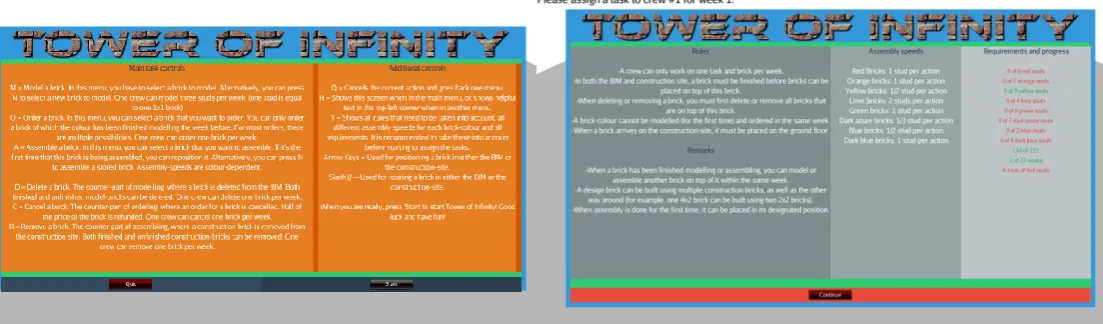
Another related problem was that all rules are too much to remember at the start of the workshop. A solution for this was that all rules and controls can be found by pressing either the help- or rules-button. When the player is in the main menu, screens get called that show all information. The player cannot call the rules-screen when in another menu. When the help-button is pressed while an action is being
[image:23.595.28.580.415.577.2]performed, it gives custom information about that action. This way, the player can always get feedback on what needs to be done. The and rules-screen can be found in Figure 6, and an example of a help-message is given in Figure 7.
Figure 6: The screen containing all controls (left) and the screen containing the rules, assembly-speeds and requirements (right)
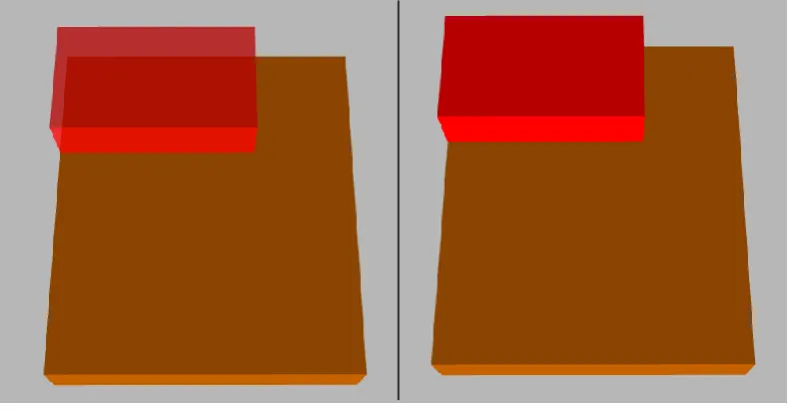
Figure 8: Both an unfinished brick (left) and a finished brick (right)
Additionally, literature research has also given some differences between board and computer-games. As mentioned in Chapter 4.3, computers can do all calculations and keep track of all administrative work. In the board-game of “Tower of Infinity”, each participant had to do that for themselves. In the computer game, players get information about the progress of a certain brick whenever they perform an action on it. The planning that is present in the board game – and needs to be edited by each individual player in the board game – is automatically edited by the computer during the gameplay. Bricks are also
semi-transparent when they are unfinished, and will become opaque when they are finished. This is also related to the advanced visuals that computer-games bring with them. The difference between unfinished and finished bricks can be found in Figure 8 and a filled-in planning is given in Figure 9.
The disadvantages of computer-games, where actions – like placing a brick – feel less real, or that aesthetics distract from the real purpose of the game, have also been taken into account. While the computer-game will still not feel as real as using the LEGO-bricks in real life, the use of arrow-keys instead of the mouse requires more action from the player. The focus of the game-design is also not on the aesthetics, so distraction because of this will be minimal.
The game has been developed using all information that was acquired in preparation for this research. However, some things might have been overlooked that isn’t by others. For this reason, feedback sessions have been performed with both the developer of the board game as well as people with fewer knowledge about the game.
4.4.4. Feedback
The focus on these feedback-sessions was on the usability of the game: the game should be playable with little to none assistance, and the controls should feel intuitive. The reason for this focus was that if the game was only able to be played with a lot of assistance, it was not possible to test the game as a serious game altogether. All individual feedback-sessions are elaborated on in Appendix D.
Overall, there were a lot of comments regarding the start of the game, where the explanation was given of the entire game. Too much text was present (as seen in Figure 6), while all aspects of the game – like the delay only happening in the last 6 weeks – were still not explained. Additionally, the different places that represent the BIM and construction site are not given a name in the visualisation. The controls did also not feel intuitive, due to the switching between keyboard and mouse. Furthermore, players did not get notified enough by the game when/if actions were completed. Lastly, information about requirements, assembly-speeds and delay is not shown at useful points of the game, or not at all. All of these points of improvement are part of the world of play, since this contains all rules and goals of the game (van den Berg, Voordijk, Adriaanse, & Hartmann, 2017). If the rules and controls are not explained, the world of play is not present, and the game will collapse (Harteveld, 2011).
4.4.5. Final version of “Tower of Infinity”
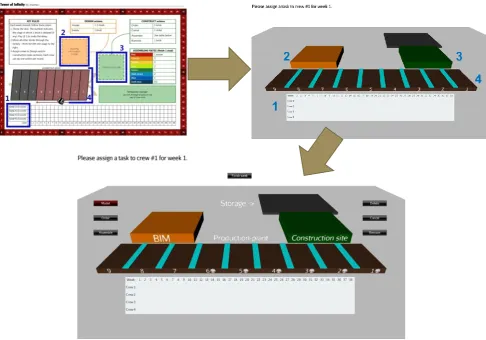
[image:26.595.61.548.162.502.2]In the final version, the points of improvement from Chapter 4.4.4 has been applied. The development of the game-board can be seen in Figure 10. More screenshots comparing the first and iterated version of “Tower of Infinity” can be found in Appendix E. The elaboration of all Java-files and their methods is given in Appendix F. All aspects that are present in this final version is given in Table 2.
4.5.
Creating awareness with “Tower of Infinity”
Because there was no time to plan a workshop after applying the feedback from the first version, the game has been presented in a knowledge-table-meeting, since the game could not be played using the version that was available at that time. A knowledge-table is a meeting of multiple experts in a certain field, to discuss about matters in that field and to share knowledge. This knowledge-table consisted of around twenty experts and was mainly about the fact that the focal company does not have any insight into the chain-costs of the subcontractor. There is also distrust from the sub-contractors, and due to shortage of time, companies just fall into the safe and trusted mode of the least risk and outsourcing everything to sub-contractors.
In the presentation, the game was explained and played through briefly, after which different statements were shown to start a discussion on the problems of SCM in construction. These statements were accompanied by screenshots from the game, to show how the problems of the statement were applied in the game. In total, four statements were in the presentation, but due to time-restriction, there was only the time to discuss two of these statements:
- Without transparency of the suppliers, a successful project will never occur.
While it took a while before the first response came, the first reactions were all that this statement is an obvious ‘yes’. However, the problem lies in the reasoning behind the suppliers that do not want to be transparent, and how this can be fixed. This resulted in a long discussion mostly about while utility buildings are mostly unique, the same suppliers are still chosen every project. This means that some form of a contract or trust could be acquired, while this has not been done yet in most cases.
- A contractor should take responsibility to help resolve delivery issues with a subcontractor or supplier.
At first, the majority didn’t agree with this statement. Suppliers should fix their own problems, and a contractor has nothing to do with it, since they would be solving the problems of someone else. After discussing the matter however, some came with the solution to act before a problem occurs instead of reacting when a problem occurs (active instead of reactive). Additionally, an example was taken from the manufacturing industry, where manufacturing-companies actually did help their suppliers when delivery issues appeared, and resulted in long-term profit.
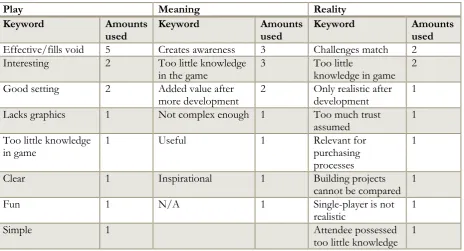
After the presentation was finished, all attendees were asked to fill in a questionnaire which asked them questions about the world of play, meaning and reality. In Table 3, all keywords that have been used to define the game in each of these worlds are given (n = 10). Because the game has not been played by the attendees, it was sometimes hard for the attendees to give detailed feedback on the meaning and realism of the game. However, it can be seen from the results that – when not playing the game themselves – the attendees thought that the world of play was well-balanced. The reason that the attendees are positive about the world of play, while the participants of feedback-sessions were not, is that the attendees did not play the game themselves. The largest problem with the first version is that the controls are not explained well-enough. During the presentation, the attendees were only shown the different rules and goals of the game.
Table 3: Results questionnaire
Play Meaning Reality Keyword Amounts
used Keyword Amounts used Keyword Amounts used
Effective/fills void 5 Creates awareness 3 Challenges match 2
Interesting 2 Too little knowledge
in the game 3 Too little knowledge in game 2
Good setting 2 Added value after
more development 2 Only realistic after development 1
Lacks graphics 1 Not complex enough 1 Too much trust
assumed 1
Too little knowledge
in game 1 Useful 1 Relevant for purchasing
processes
1
Clear 1 Inspirational 1 Building projects
cannot be compared 1
Fun 1 N/A 1 Single-player is not
realistic 1
Simple 1 Attendee possessed
5.
Discussion
This research does not only have the goal of designing a high-tech serious game, but there are other contributions that this research aims to provide. There is also still room for improvement in the game itself. Lastly, there are certain limits and boundaries that this research had to take into account. All of this information is given here.
5.1.
Contributions
This research mainly hopes to let users of “Tower of Infinity” gain more insight into SCM in construction. This game will try to make its users more aware of certain bottlenecks that are present in construction SCM. Game designers may also find necessary information in this research about how to translate a low-tech game into a high-low-tech version.
In addition, the aim of this research is also that the high-tech version of “Tower of Infinity” creates an open game-framework, so that other researchers have the possibility to work further on this project, and use their own insight to further develop the game. This way, it could become one of the fundamental tools for gaining insight in supply chain management in construction.
Ultimately, this research and the developed high-tech version of “Tower of Infinity” should lead to an increase in productivity in the field of supply chain management in construction.
5.2.
Further development of “Tower of Infinity”
The final version of this research is not the final version of “Tower of Infinity”. After this research, the end-product will be used to develop “Tower of Infinity” further. For this reason, an analysis is performed of some of the aspects that are still missing in the high-tech game. These aspects can also be found in Table 2.
Firstly, there are too little horizontal tiers in the supply chain. Most supply chains have multiple horizontal tiers, which means that the suppliers of the focal company are dependent to other suppliers (Lambert, Cooper, & Pagh, 1998). In the current game, there is only one tier underneath the focal company.
Secondly, according to experts in the field of SCM in construction, too much trust is assumed in the game, and too much information is given to the player. In reality, no company possesses all cost-information about all suppliers. A possible solution is that production times could be made variable and/or vague, where instead of a delivery time of three weeks, it could be either three or four weeks (and the player wouldn’t know until the brick arrives).
Thirdly, one of the points of improvement from the low-tech game was that the current version contained the same risk probabilities for all bricks, which is unrealistic (van den Berg, Voordijk, Adriaanse, & Hartmann, 2017). An improvement is to set a higher chance of delay for higher bricks, or to create more purchase options where costs, time and delay-chance vary.
Fourthly, as mentioned in the feedback sessions, multiple levels are needed to learn the player solve different problems in construction SCM. This suggestion was also made by one of the attendees of the presentation, who said that different projects could not be compared in the game. With different levels, different aspects of construction SCM can have the priority in each of these levels.
5.3.
Limits and boundaries
In this project, there are a number of limits and boundaries that need to be taken into account before it can be understood what this thesis plans to contribute to the field of supply chain management in construction.
Firstly, one of the boundaries that applies is that this thesis is about supply chain management in construction only. It does not take any other field into account, nor will the game be designed to gain insight in any other field other than SCM in construction. Secondly, the high-tech game that will be designed will be based on the low-tech version of “Tower of Infinity”. There is little freedom in designing the base of the game, since this will be based on the low-tech version. However, it can be argued that this boundary is needed, due to the 10-week period that this thesis will be written in. If this freedom for design was present, it would take too long to create the base-game.
6.
Conclusion
In this research, characteristics of supply chain management in construction have been analysed, and placed in the context of the low-tech serious game “Tower of Infinity”. After this, (dis)advantages of high-tech games in regard to low-tech games have been analysed. After all these analyses were finished, the first high-tech version of “Tower of Infinity” has been developed. This version has been tested with multiple participants that had a broad range of knowledge about supply chain management in construction. Out of these sessions, it became clear that the world of Play was not integrated into the high-tech game well. This feedback was applied to create a final version where the player is guided through the game much better: sounds and buttons give a much more intuitive game. The first version has been used in a presentation during a knowledge table. According to the questionnaires that were handed after the presentation, the response was mostly positive.
In conclusion, users of the high-tech version of “Tower of Infinity” now have more possibilities to become aware of problems in the field of supply chain management in construction. Apart from being used solely as a game, it can also be used in a presentation to create scenarios as a discussion-starter. While the efficiency of the final high-tech version of “Tower of Infinity” has not been tested, the results from the game-analysis (given in Table 2) and the presentation (given in Table 3) show that the high-tech game points to the same problems as the low-tech version, and can still be used after usability has been