University of Warwick institutional repository
This paper is made available online in accordance with publisher policies. Please scroll down to view the document itself. Please refer to the repository record for this item and our policy information available from the repository home page for further information.
To see the final version of this paper please visit the publisher’s website. Access to the published version may require a subscription.
Author(s:
Article Title: Is Social Mobility an Echo of Educational Mobility? Parents' Educations and Occupations and Their Children's Occupational
Attainment
Richard Lampard
Year of publication: 2007
Is Social Mobility an Echo of Educational Mobility?
Parents’ Educations and Occupations and their Children’s
Occupational Attainment.
[Pre copy-editing version: August 2007]
Richard Lampard
Biographical note
Richard Lampard is a Senior Lecturer in the Department of
Sociology at the University of Warwick. His current research
interests include social and educational mobility, the impact of
family structure on educational outcomes, the formerly
partnered and repartnering, and various other aspects of union
formation and dissolution.
Department of Sociology
University of Warwick
Gibbet Hill Road
Coventry CV4 7AL
United Kingdom
Is Social Mobility an Echo of Educational Mobility?
Parents’ Educations and Occupations and their Children’s
Occupational Attainment.
Abstract
Quantitative studies of occupational attainment and intergenerational social mobility
have often devoted little attention to the roles of parental education and educational
inheritance. Informed by the ideas of authors who see class reproduction as reflecting
more than occupations and economic resources (including Devine, Savage and
Crompton), this paper assesses the importance of parents’ educations, and considers
the relevance of education to class analysis and class reproduction processes.
Logistic regressions using British Household Panel Survey (BHPS) data establish the
relative importance of parents’ educations and parents’ occupational classes as
determinants of children’s attainment of service class occupations. These multivariate
analyses reiterate the salience of mother’s class, but also show that mother’s education
has an independent impact. However, this is more limited if both parents can be
assigned to classes. The only difference between daughters and sons that is found in
the impact of parental characteristics is a weaker impact of father’s class on
daughter’s occupational attainment than on son’s occupational attainment. For both
The relationship between parents’ and children’s educations accounts for relatively
little of the relationship between parents’ and children’s occupational classes. Hence
intergenerational class mobility patterns do not simply echo intergenerational
educational mobility patterns. However, an examination of the direct and indirect
effects of parents’ educations and classes on children’s occupational attainment shows
parental education to play a substantial role in the intergenerational transmission of
advantage, and indicates that part (but not all) of the relationship between class origin
and occupational attainment can be explained in terms of the intergenerational
transmission of cultural capital. In contrast, a substantial part of the indirect effect of
parental class via children’s qualifications does not reflect parental education. Hence
the conversion of parental economic resources into children’s educational credentials
also appears important.
Keywords
Educational mobility; class mobility; social mobility; occupational attainment; class
inequality; service class; mother’s education; mother’s class; cultural capital;
Is Social Mobility an Echo of Educational Mobility?
Parents’ Educations and Occupations and their Children’s
Occupational Attainment.
Introduction
In many earlier studies of social mobility or occupational attainment the role of
parents’ educational characteristics has not been a central concern. Often, such studies
have not included parents’ educations within their analyses. Sometimes no data
relating to parents’ educations have been available, but in many instances parents’
educations do not appear to have been perceived as being of conceptual importance.
Hence in this paper, statistical analyses are used to examine the impact of parents’
educational attainments, in order to assess the empirical importance of parents’
educations and also to highlight their conceptual significance.
One of the empirical objectives of this paper is to establish the degree of dependence
of one form of intergenerational mobility, occupational class mobility, on another,
educational mobility.1 Given that past studies of social mobility and occupational
attainment have shown children’s educational attainment to be an important mediator
of the relationship between parents’ and children’s occupational classes (Breen and
Jonsson 2005: 233), much of this relationship between classes could be a by-product
of the relationship between parents’ and children’s educational attainments. In other
words, the extent of social mobility within a society might largely be an ‘echo’ of the
A broader empirical objective of this paper is to establish how important parents’
educational achievements are, as direct or indirect determinants of children’s
occupational attainment. In an earlier paper focusing on Britain (Lampard 1995), both
parents’ occupational classes were shown to have an impact on children’s
occupational attainment, or, more precisely, attainment of an occupation within the
service class. This paper builds upon that earlier consideration of the impact of
parental characteristics, utilising data relating to parents’ educational achievements
that have since become available.
The earlier paper suggested that incorporating mother’s education within an analysis
of children’s occupational attainment would be desirable (Lampard 1995: 718, 725),
since the available information regarding mother’s occupation may not constitute an
adequately full or reliable measure of the mother’s social position from a stratification
perspective.2 There is a limited amount of evidence, mostly from North American or
continental European studies, that parental education has an impact within analyses
that control for parents’ occupations. Thus, just as mother’s occupational class has too
marked an impact to be ignored when establishing a family’s class position within
analyses of children’s occupational attainment (Lampard 1995: 726), parents’
educational achievements may also make a sufficiently important contribution to the
explanation of children’s occupational attainment to demand attention.
Both the above empirical objectives relate to the broader issue of the role of education
in intergenerational ‘class reproduction’, or, to put it in more general terms, the
visible within recent discussions of class analysis in general and class reproduction in
particular are of relevance in this context. First, authors such as Crompton and Scott
(2000: 1-3) suggest that it is not self-evident that ‘classes’ in contemporary society (in
the sense of hierarchical social groupings that show a tendency towards
intergenerational reproduction) should be conceptualised solely in terms of
occupational categories. More specifically, Gershuny (2000: 43) has developed an
“indicator of social position”, to be used as an alternative to class in the analysis of
life-chances (Crompton and Scott 2000: 9), which incorporates education (in the form
of highest educational qualification). In general, the reproduction of advantage may
involve social positions that can be defined appropriately in educational as well as
occupational terms.3 Thus analyses of educational mobility may be of equal relevance
to analyses of occupational class mobility.
Second, an important criticism that is made of authors such as Goldthorpe (1996,
2000), who define class in terms of employment relations and ‘employment
aggregates’ (Crompton 1998), is that their approach fails to encompass the cultural
dimension of ‘class’, or of the reproduction of advantage more generally (Crompton
2006: 660; Devine 1998: 23). This criticism is frequently accompanied by discussion
of the ideas of Bourdieu (1973, 1984), who “does not ultimately reduce class to
economic relations or position in the division of labour” (Savage et al. 2005: 41).
Bourdieu’s ideas about cultural capital and its intergenerational transmission
constitute a useful counter-balance to Goldthorpe’s emphasis on the role of economic
resources in class reproduction, although the ideas of both authors are open to
Whether one views class reproduction as being determined by parents’ economic
resources, or as reflecting their cultural capital, or as linked to both of these,
children’s education has been shown to be (and is widely accepted as being) a key
aspect of the mechanism via which the intergenerational transmission of advantageous
class positions operates (e.g. Marshall et al. 1997; Devine 2004). As discussed in the
next section, parents’ educations have not received the same degree of attention in
studies of occupational attainment. However, they have frequently been linked
conceptually to the idea of cultural capital, and have been shown to have an impact on
children’s educational attainment. As such, parental education can be viewed as an
important component of the cultural element of the process of class reproduction.
While Crompton views the material and cultural “strands of the transmission of class
advantage and disadvantage via the family” as interwoven (Crompton 2006: 661), she
also states that “[t]he processes of material and cultural reproduction are inter-twined,
but analytically, they may be treated as distinct.” (Crompton 2006: 673). Conversely,
other authors suggest that the economic and cultural determinants of ‘class position’
(and the economic and cultural dimensions of processes of ‘class reproduction’) need
to be considered simultaneously and in an analytically integrated fashion (Devine and
Savage 2000: 193; Devine 2004: 182; Savage et al. 2005: 41). One implication of
adopting this latter position would seem to be that parents’ educations have a
potentially important role to play in analyses of class reproduction in general.
Of course, parents’ educations may also be an important aspect of the economic
dimension of the intergenerational transmission of class position. Furthermore, given
been argued to be a key aspect of the process of class reproduction (Devine 2004:
178; Savage et al. 2005: 44), making a distinction between ‘economic’ and ‘cultural’
aspects of class reproduction when reflecting upon the relevance of parents’
educations is over-simplistic. What is crucial to an assessment of the relevance of
parents’ educations is whether they constitute an important aspect of the overall social
positions of children’s families of origin. Of equal importance are the roles that
parental education may play in the processes via which advantage is transmitted
intergenerationally.
Literature review
This review concentrates upon some relevant aspects of the approaches and findings
of past empirical studies. It starts with an assessment of past (quantitative) studies
examining the impact of parental characteristics on children’s occupational or
educational attainment. This assessment highlights the characteristics that are
included and excluded and their relative explanatory importance. Before focusing on
studies corresponding to Britain and other European countries, the review considers
relevant aspects of North American studies, including studies belonging to the status
attainment tradition exemplified by Blau and Duncan (1967). However, the relevance
of findings relating to parental education from other countries is constrained by
variations between national educational systems.
The review moves on to an examination of the ways in which parental education has
been seen to fit conceptually into the intergenerational transmission of cultural and
possibility that the relationship between parents’ and children’s educations underpins
intergenerational class mobility, although the concerns and approaches of past authors
have not led them to explore this possibility.
Parental characteristics in North American studies
Frequently, studies of occupational attainment in North America have failed to
consider the impact of mother’s occupation (Warren et al. 2002), sometimes because
of a lack of data (Treiman and Terrell 1975), perhaps reflecting the historical ‘rarity’
of employed mothers (Pearson 1983: 214). Where studies of women’s occupational
attainment have incorporated mother’s occupation, they have typically found it to be
of broadly equivalent importance to father’s occupation, but such studies have often
not considered parents’ educations (Rosenfeld 1978; Pearson 1983; Stevens 1986).
Not all studies that have examined the effect of parental education have found it to be
of significance (McClendon 1976), but Hayes and Miller (1993: 662-3) discuss a
small number of studies that have examined the effects of both parents’ occupations
and educations simultaneously, and have identified educational effects. Some studies
that have examined the effects of both parents’ characteristics have reported effects to
be stronger where a parent and child are of the same sex (Stevens 1986: 160; Miller
and Hayes 1990: 63). Overall, despite the lack of emphasis on mother’s occupation
and parents’ educations, research focusing on North America has shown that these can
Parents’ educations in British or European studies
Relatively few British or European studies have examined the impact of both parents’
educations on children’s occupational attainment. Studies that have (Egerton 1997;
Bond and Saunders 1999), like studies considering father’s education only (Western
1999), have sometimes operationalised parental education quite crudely, using small
numbers of school-leaving age categories.5 Even studies of educational outcomes
have often focused on one parent’s education only (Jæger and Holm 2003; Comi
2003; see also Breen and Jonsson 2005: 225), or have combined father’s and mother’s
educations within a single measure (Erikson and Jonsson 1998; De Graaf et al. 2000;
Sieben and De Graaf 2001; Sullivan 2001), despite both parents’ educations being
important determinants of children’s educational attainment (Halsey et al. 1980: 87;
Dearden et al. 1997: 57; Korupp et al. 2002: 37; Chevalier et al. 2003: 3; Sieben and
De Graaf, 2003: 47).
In educational attainment studies, parents’ educations are seldom treated as of primary
explanatory importance, often being viewed as one aspect of the broader concept of
‘family background’ (Jonsson and Erikson 2000: 356; Sieben and De Graaf 2001:
441; Chevalier and Lanot, 2002: 179), or even simply as something to be controlled
for in analyses of the impact of class origin (Goldthorpe 1996: 497). Indeed,
inequalities in educational attainment are frequently assessed primarily with reference
to class origin (Halsey et al. 1980: 201; Jonsson and Erikson 2000: 369; Breen and
Jonsson 2005: 225). In relatively recent studies of educational or occupational
attainment, class origin has often still been operationalised using father’s occupation
Breen and Jonsson 2005), or the ‘dominant’ parental occupation (Erikson and Jonsson
1998; Sullivan 2001), despite evidence that father’s and mother’s occupations have
independent effects on children’s attainment (Lampard 1995: 725; Hayes and Miller
1989: 443).
Parents’ educations have been shown to have a non-negligible effect upon children’s
educational attainment, controlling for the impact of parental class (Egerton 1997:
275; Sieben and De Graaf 2001: 451), but the extent to which parents’ educations
have been found to have direct effects on children’s occupational attainment has
depended upon the other variables included within multivariate analyses. Kerckhoff et
al. (1982: 353), Hayes and Miller (1989: 443), and Bond and Saunders (1999: 236)
found no direct effects, and Western (1999: 442) found a very limited direct effect of
father’s education on son’s occupational class attainment, but Erikson and Jonsson
(1998: 24-5) found effects of parents’ educations within parents’ classes, and Egerton
(1997: 277) found persisting effects of both parents’ educations, controlling for
children’s qualifications and ability, although this may reflect the measures that she
used.6
Viewed collectively, past quantitative studies of occupational and educational
attainment have not ascribed the same conceptual significance to parents’ educations
as they have to parents’ occupational classes, especially father’s class. The patchy
evidence for direct effects of parental education on occupational attainment, and the
limited magnitude of the effects that have been identified, may have contributed to
this tendency. However, as will be suggested later in this paper, the indirect effects of
importance of these effects, past studies have perpetuated the under-estimation of the
significance of parental education in the context of processes of class reproduction.
Parental education and the intergenerational transmission of cultural and
socio-economic status
Lareau and Weininger (2003) have pointed out that empirical studies utilising the
concept of ‘cultural capital’ in ways that apparently reflect the ideas of Bourdieu
(1984 [1979]) have often interpreted the concept in a narrower way than Bourdieu
may have intended. More specifically, such studies have often focused on indicators
relating to participation in ‘highbrow’ cultural activities (Lareau and Weininger 2003:
575), whereas Bourdieu’s understanding of the term appears broader, and he does not
view cultural capital as distinct from, or independent of, technical skills and ‘ability’
(2003: 580). Despite their assertion that a ‘dominant interpretation’ of cultural capital
has emerged (2003: 569), Lareau and Weininger acknowledge the existence of
variations in approach to the concept of cultural capital among studies broadly
adopting the dominant interpretation (2003: 576).
It is thus unsurprising that studies vary in their operationalization of cultural capital
(Sullivan 2001: 896; De Graaf et al. 2000: 107-8), and also in how they see it as
relating to parental education. Parental education is sometimes viewed as an
acceptable proxy for parental cultural capital (Halsey et al. 1980: 198; Egerton 1997),
although other authors interpret it as constituting ‘human capital’ (Chevalier et al.
2003: 2). However, authors using it as a proxy for cultural capital sometimes
those generating dedicated measures of cultural capital view this practice as
problematic (De Graaf et al. 2000; Sullivan 2001: 896). Nevertheless, while parental
education may not be an appropriate proxy for cultural capital, cultural capital and
human capital are arguably both transmitted and also created by education (Halsey et
al. 1980: 199; Goldthorpe 1996: 488; Gunn, 2005: 58; Becker and Tomes 1986: S6).
Authors differ as to whether they see parental education as more strongly linked to
parental cultural status or to parental socio-economic status. Some contrast the effects
of parental education and parental income (Comi 2003: 17), but others view parental
education as indicating parents’ socio-economic position (De Graaf et al. 2000: 107;
Sieben and De Graaf, 2003: 39). Similarly, some authors see parental occupational
class as indicating socio-economic position, once parental education and/or cultural
capital have been taken into account (Sullivan 2001: 893; Jæger and Holm 2003: 16),
but others see parental class as relating both to cultural capital and also to other assets
or resources (Egerton 1997: 277).
Arguably, it is not constructive to attempt to match parental education and parental
class to cultural capital and socio-economic resources in a one-to-one fashion. De
Graaf and Kalmijn (2001) exhibit a flexible way of thinking about the relationships
between class, education, and the transmission of cultural and economic status,
suggesting that parental class incorporates cultural and economic dimensions that can
be transmitted directly, or indirectly via children’s education. Savage et al. (2005)
propose a flexible approach to thinking about the intergenerational transmission of
cultural and economic status that is similarly of value. This approach draws upon the
social, symbolic) and the scope for converting, say, cultural capital into a more
‘field-specific’ form such as educational capital.7 Such flexible approaches can
accommodate the perspectives of authors who see differential educational outcomes
as reflecting rational action given class-based differentials in the distribution and
investment of (economic) resources (Goldthorpe 1996: 497; Ultee and Luijkx 2003:
7), as well as the perspectives of authors who concentrate upon the impact of
class-related differentials in cultural capital on educational attainment (Sullivan 2001: 894).
An appropriately cautious approach would seem to be to view both parental class and
parental education as indicators of parents’ cultural characteristics and also of their
socio-economic characteristics, but to assume that parental class is more closely
related to economic resources and that parental education is more closely related to
cultural capital.
Social mobility as an echo of educational mobility?
A recurring idea within the literature (albeit sometimes implicit) is that another
relationship may underpin intergenerational class or earnings mobility. The range of
possible underlying relationships that have been suggested in this context includes:
the relationship between parents’ and children’s educations (Dearden et al. 1997: 57),
the relationship between the educational or status levels of parents’ and children’s
occupations (Western 1999: 445), a ‘circuit of cultural capital’ (Savage et al. 2005:
44), and the intergenerational transmission of human capital (Becker and Tomes
1986: S31). Similarly, Jonsson and Erikson (2000: 377) imply that class differentials
advantages. However, while the persistence of direct class effects on occupational
attainment, controlling for indirect effects via education, is often examined (Egerton
1997: 277; Erikson and Jonsson 1998: 19; Bond and Saunders 1999: 245; Breen and
Jonsson 2005: 233), the extent to which the relationship between parents’ and
children’s classes reflects some other intergenerational relationship has not been
examined explicitly.
Focusing on the possibility that social mobility simply echoes the relationship
between parents and children’s educational qualifications necessitates a concern with
the role of formal educational credentials in occupational attainment, akin to that
which gained visibility in the work of ‘LSE school’ authors such as Glass, Halsey and
Westergaard (Payne 1987: 124-5). However, these authors, like the subsequent
literature on educational attainment more generally, also have a concern with trends in
class-related inequalities which is of less relevance in this context. Class differences
in educational attainment are not of direct relevance, since what is needed for this
form of educational mobility to account for social mobility is simply a high level of
credentialism within each generation, plus a strong degree of educational inheritance.
In some studies, much of the impact of educational inheritance on occupational
attainment has been obscured by an emphasis on direct effects. The direct effect of
parental education in an analysis including a child’s own education corresponds to the
part of the overall effect that does not operate via educational inheritance. Even if the
child’s own education is not included, any indirect effects of parental education via
parental class may still be obscured. Unfortunately, the level of attention paid to
The relatively few studies focusing explicitly upon educational mobility often view it
as measuring equality of opportunity within a society, or societal openness, as
facilitated by the educational system and state (Chevalier et al. 2003: 11; Comi 2003:
2; Ultee and Luijkx 2003: 3-6).8 The absence of a sociological study examining the
role played by educational mobility, or more precisely patterns of educational
inheritance, in underpinning patterns of intergenerational social class mobility may at
first sight seem surprising. Typically, however, in studies which focus upon the
relationship between class and education, sociologists appear either to conceptualise
education simply as a vehicle via which particular occupational class positions may be
reached, or to view educational attainment simply as one of a range of outcomes that
depend upon class background. Hence the possibility that the intergenerational
transmission of socio-economic position is driven by the ability of children to
capitalise in some way upon their parents’ ‘educational capital’ has not been explored.
In consequence, the possibility that education is a concept that is as important as (or
more important than) occupational class, in the context of the intergenerational
reproduction of the social stratification of contemporary societies, has also been
neglected.
In conclusion, the preceding review of past quantitative studies suggests that a study
of the intergenerational transmission of occupational advantage should place a greater
emphasis on parental education and its effects (whether indirect or direct) than has
typically been the case in earlier studies, but also suggests that caution needs to be
exercised in relation to assuming too close a match between parental education or
Data and methods
This paper uses data for 1991-2004 from Waves 1-13 of the British Household Panel
Survey (BHPS), including the work-life history files discussed by Halpin (1997),
specifically those incorporating Wave 12.9
Dependent and independent variables
The dichotomous dependent variable indicates whether individuals who had ever had
an occupation had at some stage had one in the ‘service class’, as defined by the
Goldthorpe class schema (Goldthorpe et al. 1987: 40-43).10 The data used to derive
the dependent variable came primarily from the work-life history files, supplemented
by Wave 13 information relating to current occupations and occupations since Wave
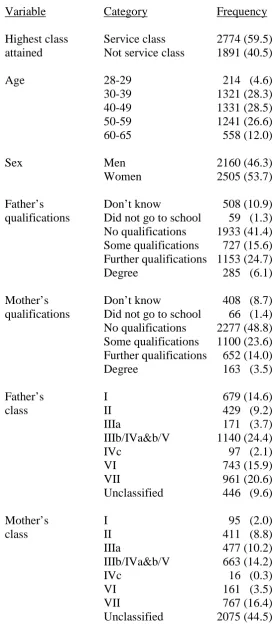
12. As can be seen in Table 1, 59.5 per cent of individuals in the sample examined in
this paper had had a service class occupation. At first sight, this value seems rather
high. Evans and Mills (2000: 647) report a value of 41 per cent for current
occupations, based on 1996 Office for National Statistics Omnibus survey data. A
comparable value constructed from the 2003/4 BHPS Wave 13 data is 45.9 per cent.
Thus the difference between highest class and current class is crucial to the
superficially high value of 59.5 per cent; the main reason why the service class
percentage for the sample analysed in this paper is higher than those for other studies
focusing on similar issues is that this paper incorporates the whole of each
individual’s work history when determining occupational attainment, rather than just
The distinction between the service class and other occupations is arguably the most
clear-cut hierarchical class distinction11, leads to two relatively evenly balanced
categories, and has been used elsewhere (Lampard 1995: 719; Erikson and Jonsson
1998: 25). The cost of using it is the loss of more detailed distinctions: informed by a
discussion of important internal divisions within the service class (Savage et al. 1992),
Egerton kept professionals and managers separate, finding that parental education was
more pertinent to attaining the former grouping (Egerton 1997: 275). Other potentially
important internal distinctions relate to gender segregation within the service class and
to the existence of an internal hierarchy within the service class.12
The independent variables relating to parents’ occupations were derived primarily
from the questions ‘Thinking back to when you were 14, what job was your father
doing at that time?’ and ‘And what job was your mother doing when you were 14?’
The data were classified according to the 11-category Goldthorpe class schema
(Erikson and Goldthorpe 1993: 38-39), but in this paper four ‘intermediate class’
categories, specifically IIIb (lower grade routine non-manual employees in sales and
services), IVa and IVb (small proprietors, artisans, etc., with and without employees),
and V (lower grade technicians and manual supervisors), are aggregated, as are
categories VIIa (semi-skilled and unskilled manual workers) and VIIb (agricultural
workers).13 The variables thus have eight categories, including an unclassified
category. Four out of nine mothers were unclassified, compared to less than a tenth of
fathers. More than nine out of ten of the unclassified mothers were not working, with
small proportions being deceased or having unknown occupations. Unclassified
The independent variables relating to parents’ educations reflect questions asked
within Wave 13: ‘Thinking first about your father’s educational qualifications, please
look at this card and tell me which best describes the type of qualifications your father
gained?’ and ‘And thinking about your mother’s educational qualifications, which
best describes the type of qualifications your mother gained?’ A limited choice of
answers was offered: ‘Did not go to school at all’, ‘Left school with no qualifications
or certificates’, ‘Left school with some qualifications or certificates’, ‘Gained further
qualifications or certificates after leaving school (e.g. an apprenticeship, nursing or
teaching qualifications, City and Guilds certificates)’, ‘Gained a university degree or
higher degree’ and ‘Don’t know’. All six categories of the resulting variables are used
in the analyses in this paper.
The independent variable corresponding to children’s education was constructed from
two derived variables indicating highest academic qualification and highest
educational qualification.14 The resulting composite variable has ten categories:
Higher Degree, First Degree, Teaching or Nursing Qualification, HND or HNC, A
level plus other Higher Qualification, O level plus other Higher Qualification, A level,
O level or equivalent or Commercial Qualification or CSE plus other Higher
Qualification, Other Higher Qualification, None of the preceding qualifications.
The sample
Table 1 shows the percentages of the sample falling into the categories of each of the
Parental education data were only collected at BHPS Wave 13, hence only Wave 13
respondents are used. The Wave 13 sample size was 8,701.15 Respondents lacking
data for explanatory variables (2,089) were discarded.16 Respondents aged over 65
years were particularly likely to lack data for the dependent variable, and were
discarded (1,325).17 Respondents aged under 25 years were substantially less likely to
have attained a service class occupation, and were often still in the educational
system. Furthermore, since a significant proportion of respondents aged under 28 had
already been discarded, the remainder were potentially unrepresentative. Respondents
aged less than 28 were therefore also discarded (330).18
Of the remaining 4,957 respondents, 240 lacked the occupational data needed for the
dependent variable. However, all but one of these were not currently in paid
employment, suggesting that the lack of data often reflected respondents never having
been employed.19 A further 52 respondents were zero-weighted, hence the final
sample size is 4,665.20 (As indicated earlier, this final sample includes a substantial
number of cases who were unclassified for one or both of the parental class variables).
Modelling approach
This paper uses binary logistic regression, in which the impacts of explanatory
variables on an outcome are quantified as logarithms of odds ratios. Exponentiated
parameter estimates, i.e. odds ratios, are presented, since readers may find their
meaning easier to grasp. Each odds ratio corresponds to the multiplicative impact of
category used as a point of reference, on the odds of ever having had a service class
occupation.
Lampard (1995) carried out separate logistic regressions for women and for men, but
here both are included within a single analysis. This allows interaction terms to be
used as a way of checking for gender differences, such as a greater impact of the
characteristics of the same-sex parent, as found in some North American studies.
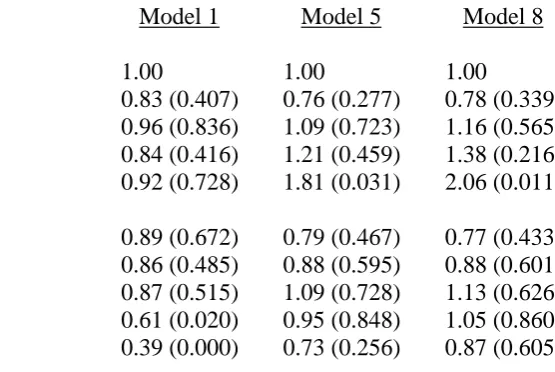
Explanatory variables are added to the models sequentially, so that any overlap
between the effects of different variables can be established. Model 1, which controls
for age, sex, and the interaction between age and sex, is used as a starting point.21 It
accounts for the relatively low rates of service class attainment for women aged 50
plus, and, in particular, 60 plus.22 Models 2 and 3 include the parental education
variables and the parental class variables respectively, with Model 4 including both of
these. Models 5 to 8 correspond to Models 1 to 4, with the addition of the children’s
Findings
Eight models of service class attainment
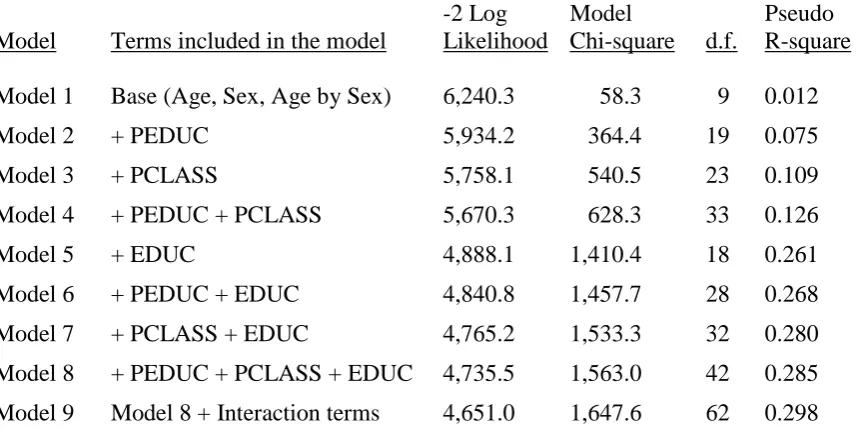
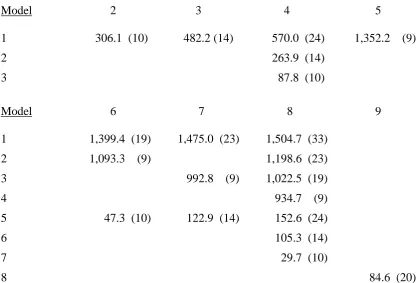
Table 2 documents the models’ goodness-of-fit, and Table 3 shows how this differs
between various pairs of models. Changes in model fit can be used to establish, albeit
crudely, the fractions of the relationships between the main explanatory variables
(parents’ educations, parents’ classes and children’s qualifications) and the dependent
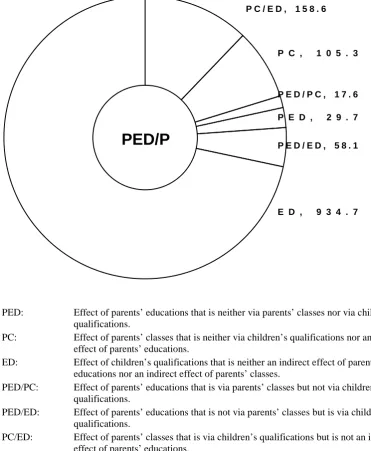
variable that correspond to different explanatory ‘paths’. Figure 1 illustrates the way
in which the overall change in model fit between Model 1 (containing none of the
main explanatory variables) and Model 8 (containing all of the main explanatory
variables) can be subdivided into components corresponding to the various
explanatory paths, with each of these paths being represented in Figure 1 by a specific
area, the size of which is proportional to the size of the component corresponding to
that path. (The overall effect of parental education corresponds to a particular set of
four adjacent areas, as do the overall effects of parental class and of qualifications.)
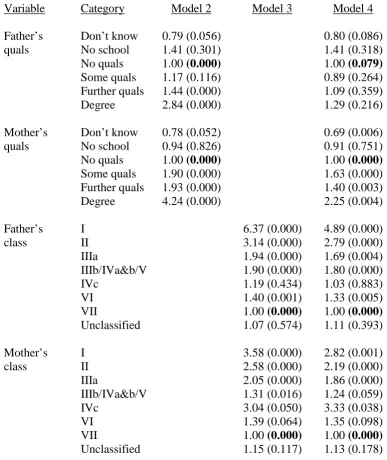
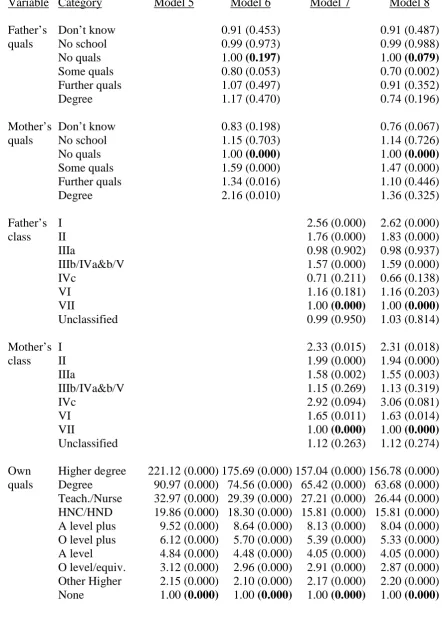
Table 4 contains the exponentiated parameter estimates from the models, allowing the
impact of each set of explanatory variables to be established, both when included
separately and also controlling for each other. The results for Model 2 in Table 4
show that, relative to parents with no qualifications, both a mother with any
qualifications and also a father with post-school qualifications increase the odds of
service class attainment. This is especially true for parents with degree level
qualifications, where the odds are multiplied by 4.24 and 2.84 for mothers and fathers
significantly lower, being multiplied by a factor of about 0.8, if someone does not
know the qualifications of one of their parents than they are if that parent is reported
as having no qualifications.23
The results for Model 3 show that the odds of service class attainment vary markedly
according to both father’s and mother’s occupational classes, when these are included
simultaneously. Having a parent with a service class occupation gives the highest
odds in favour of attaining a service class occupation, particularly where the father
belongs to Class I. The odds ratios comparing Classes I and VII are 6.37 for fathers
and 3.58 for mothers. Having a father in some of the intermediate class categories is
more advantageous than having a mother in these categories, although having either
parent in Class IIIa as opposed to Class VII approximately doubles the odds of service
class attainment. The number of Class IVc mothers is small, hence the corresponding
effect, although apparently strong, is only of borderline statistical significance. The
effects of parents’ classes echo those reported by Lampard (1995), although slightly
more detailed effects are evident, possibly reflecting the use of a single analysis
incorporating both sexes.
The results for Model 4 show the effects of the four parental characteristics when
included simultaneously. The magnitudes of the effects corresponding to parents’
classes are reduced for most categories, but are still substantial; the overall pattern
remains similar. The consequences of simultaneous inclusion for the effects of
parents’ educations are more marked; however, the effects of mother’s education are
Table 3 shows that most of the change in fit between Models 1 and 3, corresponding
to the inclusion of parents’ classes, is still obtained when parents’ educations have
already been included, as evident from the change in fit between Models 2 and 4
(263.9 out of 482.2). Conversely, markedly less than a third of the change in fit
between Models 1 and 2, corresponding to the inclusion of parents’ educations, is still
obtained when parents’ classes have already been included, as evident from the
change in fit between Models 3 and 4 (87.8 out of 306.1). Given the overlap between
the explanatory impacts of the two pairs of variables, parents’ classes can achieve, on
their own, the vast majority of the improvement in model fit that can be achieved by
the inclusion of both pairs of variables (482.2 out of 570.0).24
Nevertheless, the effect of mother’s education in Model 4 as shown in Table 4, the
change in model fit between Models 3 and 4 as presented in Table 3, and the
difference between the pseudo R-square measures for Models 3 and 4 visible in Table
2, all indicate that mother’s education has an impact on service class attainment that
adds substantially to the impact of parents’ classes. Furthermore, given the
dependence of parents’ classes on parents’ educations, the effect of parents’ classes
incorporates a substantial indirect effect corresponding to parents’ educations, and the
changes in model fit between Models 1 and 2 and between Models 2 and 4 suggest
that the combined direct and indirect effects of parents’ educations outweigh the
remainder of the effect of parents’ classes (306.1 compared to 263.9). Thus it appears
that service class attainment is too strongly linked to parents’ educations to be
justifiably examined with reference to parents’ classes alone. However, as shown
The results for Model 5 in Table 4 highlight the very strong effect of qualifications on
the odds of service class attainment. While the effects of degree-level qualifications
are particularly striking, with a degree multiplying the odds of service class attainment
by 90.97 relative to no qualifications, the multiplicative nature of the odds ratios
presented in Table 4 means that the observed effects constitute a series of distinct
‘steps up’ corresponding to additional or superior qualifications, with each odds ratio
being between 1.26 and 2.75 times as large as the preceding one.
The change in model fit between Models 5 and 8 (152.6) shows that adding parents’
educations and classes to Model 5 still results in a substantial improvement in fit, but
a comparison with the change in fit between Models 1 and 4 (570.0) shows that more
than two-thirds of the original improvement (417.4 out of 570.0) can be accounted for
by the children’s qualifications. In particular, the contribution made by the inclusion
of parents’ educations diminishes markedly. While the change in fit between Models
7 and 8 (29.7) shows that including parents’ educations still improves the fit of the
model significantly, the p-value and odds ratios for father’s education in Model 8, as
shown in Table 4, indicate that father’s education no longer has a statistically
significant or easily interpretable impact. The corresponding results for mother’s
education suggest that a mother having qualifications still increases the odds of
service class attainment, but the effect is much weaker than in Model 4. Thus the
effects of parents’ educations largely operate indirectly, via children’s qualifications.
The change in fit between Models 6 and 8 indicates that a substantial minority of the
evidence of the effect of parents’ classes persists once both parents’ educations and
a comparison of the results for parents’ classes from Models 4 and 8, as shown in
Table 4, indicates that the effect of father’s class in particular is weakened by the
inclusion of children’s qualifications in the model. Again, the effects of parents’
classes appear to operate to a large extent via their children’s qualifications, but there
are still substantial advantages to having parents in some of the higher classes,
especially Class I when compared to Class VII: a father in Class I multiplies the odds
of service class attainment by 2.62 and a mother in Class I multiplies them by 2.31.
More generally, while there are subtle differences between the sets of effects for
fathers and for mothers, their magnitudes are broadly similar.
Since the change in fit between Models 6 and 8 implies that a non-negligible fraction
of the relationship between parents’ and children’s occupational classes cannot be
explained via their respective educations, intergenerational occupational class
mobility patterns cannot be viewed simply as an echo of intergenerational educational
mobility patterns. Furthermore, not all of the indirect effect of parents’ classes on
service class attainment that operates via children’s qualifications is in turn an indirect
effect of parents’ educations, and some of the indirect effect of parents’ educations
that operates via parents’ classes does not also operate via their children’s
qualifications. Thus, as illustrated below, a smaller part of the relationship between
parents’ and children’s occupational classes can be explained in terms of the
relationship between their respective educations than can be explained via their
The next few paragraphs establish the fractions of the relationship between parents’
and children’s occupational classes that correspond to different explanatory paths (as
illustrated in Figure 1). The change in fit between Models 6 and 8 (105.3) constitutes
the evidence of an effect of parents’ classes on service class attainment which is not
an indirect effect of parental education and does not operate indirectly via children’s
qualifications.
The change in fit between Models 2 and 6 constitutes the evidence of an effect of
children’s qualifications that is not an indirect effect of parental education, and the
change in fit between Models 4 and 8 constitutes the evidence of an effect of
children’s qualifications that is not an indirect effect of their parents’ educations or
parents’ classes. Hence the difference between these changes (1093.3 – 934.7 =
158.6) constitutes the evidence of an effect of children’s qualifications which is also
an indirect effect of their parents’ classes, but is not an indirect effect of their parents’
educations.
The change in fit between Models 5 and 6 constitutes the evidence of an effect of
parental education that does not operate indirectly via children’s qualifications, and
the change in fit between Models 7 and 8 constitutes the evidence of an effect of
parental education that does not operate via either the children’s qualifications or their
parents’ classes. Hence the difference between these changes (47.3 – 29.7 = 17.6)
constitutes the evidence of an effect of parental education that operates via parents’
The total amount of evidence of an effect of parents’ classes on service class
attainment corresponds to the change in fit between Models 1 and 3. Hence the
evidence for the part of this overall parental class effect that is both an indirect effect
of parents’ educations and operates via children’s qualifications is equal to 482.2 –
(105.3 + 158.6 + 17.6) = 200.7. Thus, markedly less than half of the evidence of a
relationship between parents’ classes and their children’s occupational attainment
(200.7 out of 482.2) reflects the relationship between their respective educations. In
other words, less than half of the evidence of an intergenerational occupational class
relationship can be traced back to the intergenerational educational relationship.
The above findings also show that, while the majority of the evidence of an indirect
effect of parents’ classes operating via children’s qualifications corresponds to the
part of this effect that is also an indirect effect of parents’ educations (200.7 out of
359.3), a substantial proportion of the evidence corresponds to the part of this effect
that is not an indirect effect of parents’ educations (158.6 out of 359.3). Hence, much
of the part of the relationship between parents’ and children’s classes that operates
indirectly via children’s education is not a reflection of educational inheritance.
Interactions
Model 8, which does not allow for any interactions between the effects of independent
variables, apart from age and sex, is arguably over-simplistic. Gender differences in
the effects of the class and education variables, like those found in North American
studies, and trends over time in the effects of these variables, can be represented by
variables may themselves interact: for example, the effect of mother’s class may vary
according to father’s class.
Changes in model fit corresponding to all twenty interactions of the above types were
examined. Initially, only three interactions led to statistically significant
improvements in model fit. However, where an interaction involved a substantial
number of degrees of freedom, an interaction effect corresponding to some of the
categories of the two variables could have been obscured by a lack of interaction more
generally.25 In fact, two further interactions generated significant improvements in
model fit when categories within one or both of the variables involved were
aggregated. Model 9 thus incorporates five additional interactions: an interaction
between the effects of father’s class and mother’s class, a gender difference in the
impact of father’s class, an interaction between the effects of mother’s education and
children’s education, and interactions between age and the effects of both parents’
educations.26
More specifically, having a father in a class other than the service class together with
a mother outside the service class is associated with lower odds of service class
attainment than is implied by a straightforward combination of the effects of a father
and a mother with these characteristics. The odds ratios corresponding to this
interaction effect are 0.507 (p=0.032) for a mother in Classes III to VII, and 0.311
(p<0.001) for an unclassified mother. To put this finding another way, once someone
has one service class parent, the positive impact of their other parent being in the
service class is diminished. However, for men, the additional impact of having a
having one Class I parent. Hence operationalising parental class using the ‘dominant’
parental occupation, an approach adopted by Erikson and Jonsson (1998: 24) among
others, would not have been appropriate here.
Only one significant interaction effect observed here echoes the greater impact of the
same-sex parent’s characteristics identified in North American studies. The positive
effect of a Class I father on the odds of service class attainment is less strong for
women than for men. Furthermore, the negative effect of a father in Class IVc rather
than Class I is much less strong for women. For example, where the mother belongs to
a class other than the service class, the odds ratios corresponding to this effect are
0.440 for women and 0.159 for men. While this gender difference is not quite
statistically significant (p=0.068), it may reflect a greater tendency for sons of Class
IVc fathers than for daughters to inherit their father’s class position.27
Taking into account both the interaction between the effects of father’s class and
mother’s class and also the gender difference in the impact of father’s class, father’s
class has relatively little effect on service class attainment among women with service
class mothers. For example, the impact on the predicted odds of service class
attainment of being the daughter of a service class mother and a father in Class VI or
VII is as positive as the impact corresponding to having two service class parents.
Turning to the interaction between the effects of mother’s and children’s educations,
the negative effect of having a mother with no qualifications decreases as the level of
an individual’s own highest qualification increases, ceasing to be negative if an
specific to individuals whose own highest qualifications are above O-level but below
degree-level. The two remaining interactions indicate that both parents’ educations
vary in impact according to an individual’s age, but the trends are not clear-cut.
Among younger respondents, having graduate parents seems to have been more
advantageous, but having parents with no qualifications also seems to have been less
disadvantageous.
Unpacking the role of parents’ educations
Parents’ educations are likely to add more to the explanation of service class
attainment for some groups of individuals than for others. More specifically, parental
education may be more influential where a parent or parents are not assigned to class
categories. Focusing on a combination of the direct effect of parental education on
service class attainment and the indirect effect via children’s qualifications only28, an
examination of Model 4 applied to individuals with at least one parent not assigned to
a class category shows mother’s education to be of significance, with father’s
education having a weaker, hence statistically insignificant, impact.29 In these
circumstances, having a mother with any qualifications multiplies the odds of service
class attainment by 1.757 (p=0.000) relative to having a mother with no
qualifications, and having a father with qualifications multiplies them by 1.161
(p=0.198). Thus parental education is of explanatory value where occupational
When class information is available for both parents, the effect of parental education
instead relates primarily to the distinction between individuals who know both their
parents’ qualifications and those who do not. In these circumstances, not knowing a
parent’s qualifications reduces the odds of service class attainment relative to having a
parent with no qualifications, multiplying the odds by a factor of about 0.6 (p<0.05).
Beyond this, the only further effect is that having a mother with qualifications
multiplies the odds of service class attainment by 1.363 (p=0.008). The negative
impact of not knowing a parent’s qualifications, relative to having a parent with no
qualifications, may be rooted in family structure, the nature of the relevant
parent-child relationship, or the relevant parent’s perception of the value of educational
qualifications.
The effects of unknown parental qualifications may have led to an over-estimation of
the ability of educational inheritance to explain social mobility patterns. Restricting
attention to individuals for whom each parent has a known level of qualifications, and
can also be assigned to a class category, has an impact on the proportion of the
relationship between parents’ classes and children’s occupational attainment which is
attributable to the relationship between their educations, reducing it from more than
two-fifths to almost exactly a third. Hence, where full information about parental
characteristics is available, educational mobility has even less power to explain social
Discussion
This section starts with a general consideration of the impact of parental
characteristics on service class attainment. This paper has reiterated that the analysis
of service class attainment cannot justifiably be carried out solely with reference to
father’s occupation, since mother’s occupation also has a significant impact.
Furthermore, parental education, particularly mother’s education, has an impact,
especially where parental occupational information is lacking. However, the increase
in explanatory power provided by parental education is quite limited where both
parents’ occupations (when an individual was 14) are known, and more detailed
parental occupational histories might reduce the scope for parental education to
compensate for an absence of parental occupational information. Thus, this paper’s
findings do not necessarily invalidate examinations of intergenerational mobility that
conceptualise origins and destinations solely in terms of parents’ and children’s
occupational classes, if they utilize detailed occupational histories and take both
parents’ classes into consideration. Conversely, future studies using more detailed or
reliable parental qualification data, or a wider range of educational measures, might
confirm the explanatory value of supplementing parental class measures with
information on parents’ educations.31
Only limited evidence is provided by this paper that mothers’ and fathers’
occupational and educational characteristics have different implications for daughters
and sons. Specifically, father’s occupational class appears less influential for
daughters, especially where the mother is in the service class, or where the father is a
characteristics, particularly mother’s education, vary in impact in other ways. For
example, the impact of mother’s education has been found to vary according to their
child’s own education, and to vary over time. The trends identified in the direct effect
of parental education suggest that there may be a shifting relationship between
educational levels and the typical underlying characteristics of parents attaining
qualifications at each level. Specifically, parental characteristics that increase
children’s chances of service class attainment, which once were spread across a range
of educational levels, may now be more concentrated within the growing category of
graduate parents.
This discussion now turns to a more general account of the relationship between
education and class, starting with a consideration of the specific importance of
educational inheritance. This paper has shown that a relatively small proportion of the
relationship between parents’ classes and children’s chances of attaining a service
class occupation can be accounted for by the underlying relationship between parents’
and children’s educations. Thus, intergenerational class mobility patterns do not
simply echo intergenerational educational mobility patterns. However, trends in
educational inheritance may nevertheless have a substantial impact on trends in class
mobility. Hence future research would benefit from greater attention to educational
mobility patterns, and more conceptually sophisticated analyses of the nature and
implications of such patterns would be useful.
Of course, education does not just act as a vehicle for the transmission of parental
advantage. It can be seen from Figure 1 that more than two-thirds of the evidence of
out of 1352.1) does not relate to the indirect effects of parents’ classes and educational
levels. Thus it is evident that education is to a large extent a determinant of class in its
own right.
The indirect effect of parental class on service class attainment operating via
education can be interpreted as reflecting differential parental resources and
investment in children, highlighting in particular the way in which such resources may
be ‘converted’ into educational credentials (Goldthorpe 2000; Devine 2004). This
paper has shown that a substantial proportion of this indirect effect is not
simultaneously an indirect effect of parental education. Consequently, education can
be seen to be, in part, a direct consequence of (parental) class, rather than simply
being an indirect consequence of parental education; this may reflect economic
resources linked to parental class being used to ‘buy’ educational credentials. A
further implication of the above finding is that interpreting all of the indirect effect of
parental class via education as reflecting the intergenerational transmission of cultural
capital only makes sense if parental education is viewed as an inadequate proxy for
parental cultural capital and parental class is viewed as being, to a substantial extent
(and in its own right), a measure of parental cultural capital.
The direct effect of parents’ classes on their children’s occupational attainment may
also reflect the influence of parents’ socio-economic resources as much as, or more
than, it reflects the influence of parental cultural capital. In this context it is worth
noting that only a small minority of this direct effect is in turn an indirect effect of
parental education (see Figure 1). De Graaf and Kalmijn (2001: 65) suggest that the
also suggest that education has become ‘less the domain of the cultural elite’. This
paper’s findings might similarly be interpreted as indicating that parental class
influences educational and occupational attainment in a way that relates at least as
much to the availability and impact of resources, assets and capital viewed in broad
terms (Savage et al. 2005: 39) as it does to the intergenerational transmission of
cultural capital more specifically.
This paper suggests that most of the effect of parental class operates via education,
and that the majority of this indirect effect is in turn an indirect effect of parental
education. Given that no trends relating to the direct effects of parental class or of an
individual’s own education were identified in this paper32, the extent of the
‘conversion’ of parental class into educational credentials (acting, in part, as a
mechanism allowing parents to pass on the advantages that their own educational
credentials gave them in terms of occupational attainment) must have been crucial to
the presence or absence of any trends in intergenerational class mobility. Building
upon the research of authors such as Devine (2004) to achieve a more developed
understanding of the processes that enable education to act as a vehicle for the
intergenerational transmission of cultural and economic status thus seems to be an
objective of considerable importance for future studies.
As illustrated by Figure 1, a substantial minority of the overall evidence of the impact
of parents’ classes and educations on the odds of service class attainment (200.7 out
of 570.0) relates to the part of the indirect effect of parental class operating via
education which is also an indirect effect of parental education. There is thus quite
relation to which the distinction between educational inheritance and (occupational)
class reproduction is, in a sense, redundant, since the process in question can be linked
to both of these. This process may reflect the intergenerational transmission of
cultural capital, or of a form of educational capital of which both educational
qualifications and occupational class are good indicators. Since this process can be
viewed as a process of ‘class reproduction’, education, like occupation, can in
consequence be interpreted as an integral aspect of ‘class’, at least when the concept is
defined in this way.
In addition to the process discussed in the previous paragraph, two other effects might
be interpreted as relating primarily to the intergenerational transmission of cultural
capital, namely the indirect effect of parents’ educations on their children’s
occupational attainment which operates via the children’s qualifications but not via
the parents’ classes, and the direct effect of parents’ educations on their children’s
occupational attainment. Together, these three explanatory pathways account for
about half of the evidence corresponding to the impact of parents’ educations and
classes on service class attainment. Thus it can be argued that the intergenerational
transmission of cultural capital, to a large extent via children’s educational attainment,
plays an important role in class reproduction. However, an equally substantial
proportion of the evidence appears more consistent with parental economic resources
playing a crucial role in class reproduction, to some extent in the form of the direct
transmission of economic advantage, but to a greater extent via the conversion of
It is important to recognise that this paper’s analyses are limited in generality by their
focus on service class attainment as opposed to occupational attainment more
generally. The relevance of educational inheritance to occupational attainment might
be expected to vary between different groups within the service class (for example,
managers and professionals); the same is likely to be true for the remainder of the
class structure, given variations between different occupations in the relevance of
educational credentials.33 Hence analyses using a more disaggregated dependent
variable would provide a wider-ranging picture of the relevance of educational
inheritance and of parental characteristics more generally. Furthermore,
disaggregating the dependent variable used in this paper in a way that took account of
the gendered nature of occupations within the service class might reveal additional
gender differences in patterns of occupational attainment. This paper has also paid
limited attention to the significance of change over time; occupational and educational
changes in Britain during the latter part of the 20th Century make a more detailed
examination of trends a desirable extension of the analyses presented here.34 This
paper’s findings might thus act as a useful starting point for elaborations of the above
sort.35
Acknowledgements
The author would like to acknowledge the helpful feedback and suggestions relating
to earlier versions of this paper that were provided by the anonymous reviewers for
Notes
1
The terms ‘occupational class mobility’ and ‘educational mobility’ are here used as a
form of shorthand for the relationships between parents’ and children’s occupational
classes and between parents’ and children’s educational levels. In other words, the
focus of the paper is on parent/child relationships in general, rather than just on
individuals who have been upwardly or downwardly mobile.
2
A similar argument, although not necessarily equally convincing, might justify the
incorporation of father’s education.
3
Gershuny makes the important point that a desirable property of an indicator of
social position is that it links all the population to locations within the social structure,
rather than just the working population (Gershuny 2000: 64).
4
Devine has made the useful point that both Goldthorpe and Bourdieu appear to
ascribe relatively little importance to the role of social resources in the reproduction
of advantage, thus arguably under-estimating their significance in this context (Devine
2004: 182).
5
Sometimes such crudities reflect the data source used: Bond and Saunders, like
Egerton, used 1958 birth cohort (NCDS) data, partly explaining their variables’
limitations. Elsewhere, parental education has been operationalized as a measure of
level attained, in terms either of qualifications or ‘virtual years of education’, i.e. the
minimum number required to reach an individual’s highest level of study (Sieben and
6
Egerton’s operationalizations of qualifications and of father’s class lacked detail
within the lower educational and occupational strata, so parents’ educations may have
acted as proxies for differences in class origins and qualifications at that level.
7
Gunn (2005: 62) discusses institutionalised educational credentials’ role in the
reproduction of cultural capital.
8
In addition to the educational mobility studies that have focused upon educational
achievements, Halsey et al. (1980: 75) focused upon type of school.
9
University of Essex, Institute for Social and Economic Research. British Household
Panel Survey; Waves 1-13, 1991-2004 [computer file]. Colchester, Essex: UK Data
Archive [distributor], April 2005. SN: 5151.
Halpin, B. British Household Panel Survey Combined Work-Life History Data,
1990-2003 (4th Edition) [computer file]. Colchester, Essex: UK Data Archive [distributor],
October 2004. SN: 3954.
10
Using ‘highest’ class rather than the class of an individual’s current (or last)
occupation takes account of downwards intragenerational mobility, especially (but not
only) by women (Lampard 1995: 722).
11
It is evident that Goldthorpe (2000: 248-250) views the service class (taken as a
whole) as a relevant entity when analyzing intergenerational mobility; more
specifically, he states that it “appears capable of conferring the greatest degree of
advantage as a class of origin” (Goldthorpe 2000: 240).
12
Crompton (2000: 167-168) notes that the growth in the representation of women in
existing patterns of gender segregation, with the increase being concentrated within
‘service-type’ aspects of management and the professions. However, she also relates
the “gendered restructuring of the middle classes” to the professional/managerial
distinction (Crompton 2000: 178-179). Marshall et al. (1997: 106-132) use the service
class (“salariat”) within their intergenerational mobility analyses, but break it down
into “higher” and “lower” parts (i.e. Goldthorpe classes I and II), to the extent that
their sample size makes this possible. Devine (2004: 195) also views this hierarchical
distinction as of potential importance.
13
For both parents, these categories could be aggregated without a statistically
significant deterioration in the fit of Models 3 and 8. Class IVc (farmers/smallholders)
and the unclassified category could also have been aggregated with other categories
without a significant deterioration in model fit, but have been kept separate for
conceptual reasons.
14
The latter variable, with twelve categories to the former’s seven, incorporates a
broader range of qualifications but also includes a heterogeneous ‘Other higher
qualification’ category. The derivation of the composite variable, and the aggregation
of categories leading to its finalized form, made use of the proportions of individuals
within categories who had attained service class occupations.
15
Data from additional samples of households in Wales and Scotland (which were
added to the main BHPS sample in 1999) and from an additional sample of
households in Northern Ireland (which was added in 2001) are not used.
16
For most of these (1,348), the design of the BHPS meant that data had not been