Differentiation factors between free and
premium among different cloud computing
services
Author: Martijn Beltman
University of Twente P.O. Box 217, 7500AE Enschede
The Netherlands
ABSTRACT: This paper tries to give more insight in the differentiation factors between
free and premium versions for consumers among various cloud computing services. The
design is a comparative case study by which Spotify, MBAM, LinkedIn, DropBox, Flickr
and Skype are subjected to qualitative content analysis. The product of this essay is a
taxonomy formed of literature, applied to the cases. The results show that the
differentiation factors are different as well as the cases. Most of the cases have multiple
differentiation factors (a mix) to go premium. The theoretical implications of this paper
(due to limitations) shows the need for more research for a more complete understanding.
Practical implications could be the rise in awareness in the decision to go premium for
consumers.
Supervisor: F. Wijnhoven
Keywords
Versioning, Freemium, Differentiation, Cloud computing services
Permission to make digital or hard copies of all or part of this work for personal or classroom use is granted without fee provided that copies are not made or distributed for profit or commercial advantage and that copies bear this notice and the full citation on the first page. To copy otherwise, or republish, to post on servers or to redistribute to lists, requires prior specific permission and/or a fee.
5th IBA Bachelor Thesis Conference, July 2nd, 2015, Enschede, The Netherlands.
1.
INTRODUCTION
The term freemium is coined used two words free and premium. It describes a business model where you give away a core product for free and then generate revenue by selling premium products to a small amount of free users. Freemium business models play a key role in business today. They are widely use in a range of industries. An example of this is that apps with freemium models account for 98% of the revenue in googles app store and 95 % in apples app store. The freemium concept dates back to the 1980s when software firms like Adobe started to publish software in “light” versions. These sharewares, or cripple wares, did not include all the functionalities and were free of charge (Wagner, Benlian, & Hees, 2014).This model was initially only used within the software industry, but this is no longer the case anymore. Newspapers, music, publishing, telecom, education and far more industries are now facing competition for freemium business models. The underlying concept that makes this possible is the rise of digital production. The fact that is currently possible to produce and distribute a wide variety of value propositions using computers and the internet. Because of the ever decreasing cost of computer power, storage and internet bandwidth, the marginal cost of distributing this value is virtually zero. Once a musician has produced an album, it costs him practically the same to have 10 people or 1 million download the album (Froberg, 2015). The fact that this business model is growing in a lot of industries opens the question in what way it is used to gain a completer understanding of the concept. The ``what is free´´ and ´´what is paid´´ questions are very different across industries who are using freemium. The delta between what is free and what is paid is call product differentiation (Pujol, 2010). This paper is structured as followed: freemium products/services case studies in this paper are seen as cloud computing services. In the theory are these concept illustrated by literature. The theory concludes with a research question, which is further in this paper answered.
2.
THEORY
2.1
Cloud computing services
A prior study (Kim & Lee, 2011) on cloud computing shows that many people defines cloud computing as an emerging computing paradigm where data and services reside in massively scalable data centers and can be ubiquitously accessed from any connected devices over the internet. That means that users are able to obtain useful information they want and use a variety of services and computing resources through the internet as a cloud without the constraints of time and place (Kim & Lee, 2011). Furthermore the National Institute of Standards and Technology (NIST) in the USA developed also a definition of this concept: ‘’Cloud computing is a model for enabling ubiquitous, convenient, on-demand network access to a shared pool of configurable computing resources (e.g., networks, servers, storage, applications, and services) that can be rapidly provisioned and released with minimal management effort or service provider interaction.’’ (Mell & Grance, 2011, p. p2). Perhaps the most famous examples of cloud computing, which people do not see as a cloud computing service at first glance are social networking websites like Facebook, LinkedIn and Twitter. Besides, web-based email services like Hotmail or Windows Live Mail from Microsoft are also cloud computing services. Furthermore back up services like Dropbox and Google Drive are cloud computing services as well. All cloud services deliver information goods. Information can be defined very broadly as anything that can be digitized (that is, encoded as a stream of bits): text, images, voice, data, audio and video
(Shapiro & Varian, 1999). These formats are generically called information goods. Books, movies, music, magazines, software, games, databases, telephone conversations, stock quotes, Web pages, news, ringtones, etc. all fall into this category. Information goods have the characteristics of involving high fixed costs, but low (often zero) marginal costs. (Belleflamme, 2006)
2.2
Freemium
companies providing freemium services can increase the probability of user conversion by providing a strong functional fit between their free and premium services. (Doerr, Benlian, Vetter, & Hess, 2010) surveyed 132 MaaS users to determine different service features’ influence on their willingness to pay for a premium MaaS. This research concludes that next to price, contract duration and music quality as the most important product attributes determine willingness to pay. But in this research no distinction has been made between different consumer types, like professional users and students. Especially in the case of freemium it is important by means of versioning to attract the right consumer type. Therefore it is of high interest to identify the most important premium features. Another study which comes close to this is from Semenzin, Meulendijks, Seele, Wagner, and Brinkkemper (2012) who identified the differentiation factors that mark the transition from a free to premium version of a software product. They selected 17 freemium cloud based companies in the field of cloud storage (Dropbox), music players (Spotify), presentation tools (Prezi) and image sharing services (Flickr). They found different relationships between the free and premium version among the different categories like the number of premium versions. A notable difference is the amount of premium versions per vendor. In their sample the average number of premium levels was measured at 2.05 per vendor; storage products had an average of 3.0, opposed to the average of 1 in case of image sharing services and 2 in the case of music players and presentation tools. On the contrary there were also similarities between the different cloud computing services; the gap between the free package and the first level of premium was at least one order of greatness. For example in the case of music players, which consist of a considerable gap between free and premium of 10 and 730 music hours (still one order of magnitude) per month. Furthermore not surprisingly prices grow linearly with privileges. Although in this study a distinction between different cloud computing services has been made, it lacks the perspective of different consumer types.
2.3
Versioning
To identify the incentives to pay for a premium type of cloud computing services it is important to know what exactly the differences are between a free version and a paid version. The work of Shapiro and Varian highlight this business model (freemium) among the concept of versioning. According to Shapiro and Varian versioning means offering your information product into different versions for different market segments (Shapiro & Varian, 1999). Versioning is very important for information goods, thus also cloud computing services. Information goods must be priced according to the value consumers attach to it, not according to its production costs (marginal costs are practically zero). According to Vargo and Lusch (2004) leads this to a shifting focus from producer to consumer, and thus towards interactivity, connectivity and ongoing relationships. Moreover, as different consumers attach very different values to the same information good, the producer should set not a single price, but several value-based prices for its information good. This practice is known as price discrimination. (Belleflamme, 2006). Every individual has its difference in the maximum amount of what to pay for a good (reservation price), but to retrieve that information for every individual is too expensive for a company. In fact the concept of versioning implies that a company can better design versions that emphasize customer differences. In fact to differentiate the price by groups to create segments. The key for a company is then to identify dimensions of an information good that are highly valued by some customers yet of little importance to others.
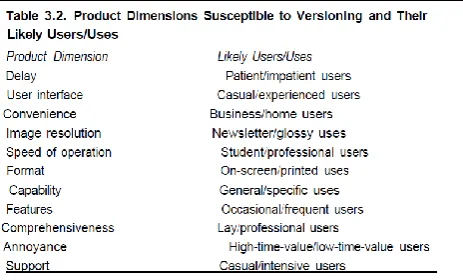
[image:3.595.316.548.155.295.2](Shapiro & Varian, 1999). Furthermore the work of Shapiro and Varian (1999) include a list of various dimensions alongside a lists of users or uses for which these dimensions have meaning. This list (next page) is not meant to be complete. There are as many dimensions on which to version as there are dimensions to your product. Versioning is thus very product-specific. See table below
Table 1: Information Rules: Chapter 3 Versioning Table 3.2 (Shapiro & Varian, 1999): Explanation table: Relation product
dimension/likely users/uses in the table: For example the product dimension ‘’Capability’’: Kurzweil, a software producer of voice recognition products distinguished their products by the total size of the vocabulary included and by the
addition of vocabulary appropriate to specific professions. The high-end version for surgeons was hundred times more expensive than the entry level software. (Shapiro & Varian,
1999)
the products are only offered in the package (premium version) (Shapiro & Varian, 1999).
2.4
Research question
This paper tries to give more insight in the conversion from a free to a premium cloud computing service from a consumer perspective, thus not business to business. It is interesting to see which product differentiation factors are important to go premium for a consumer among the different cloud computing services. Further do the differentiation factors between free and premium versions of the cloud computing services really differ from each other? And how to measure this? This paper tries to give more insight in the complexity of the freemium concept. The research question of this paper is: What are the differences in differentiation factors of cloud computing services between free and premium versions? The product of this essay will be a taxonomy, which is applied to cases), which is defined as follows: Taxonomy (from Greek taxis meaning arrangement or division and nomos meaning law) is the science of Classification according to a pre -determined system , with the resulting catalog used to providence a conceptual framework for discussion, analysis, or information retrieval. In theory, the development of a good taxonomy takes into account the importance of separating elements of a group (taxon) into subgroups (taxa) That are mutually exclusive , unambiguous , and taken together, include all possibilities . In practice, a good taxonomy shoulde be simple, easy to remember and easy to use (Bruno & Richmond, 2003). A taxonomy is thus a good way to understand the concept of freemium.
3.
METHODOLOGY
3.1
Choice of research design
To answer the research question in this paper, a comparative case study methodology is used. Case studies often ask “how” and “why” questions (Tellis, 1997), as this paper does: How the decision to go for a premium version can be made for different cloud computing services among different types of consumers. In addition the decision to go for premium is different among several cloud computing services, which is the reason why a comparative research design is suitable in this case. A
comparative case study enable a detailed and intensive analysis of a set of cases, and facilitates theoretical reflections based on the distinguishing characteristics of these cases (Bryman, 2012) This offers the possibility for a taxonomy.
3.2
Choice of research method
There are many possible sources of evidence in case studies, including documents, interviews, and participant-observation (Tellis 1997). For the purpose of answering the research question in this paper, an unobtrusive measure was chosen. For that reason this paper is based on the extensive public
information sharing of companies that have used or is still using freemium. As such, the research method used in this paper is qualitative content analysis. Content analysis is about interpreting meaning from the content of data, and the goal is “to provide knowledge and understanding of the phenomenon under study” (Downe‐Wamboldt, 1992). Krippendorff (2012) defines it as “a research technique for making replicable and valid inferences from texts (or other meaningful matter) to the contexts of their use.” This paper entails a subjective
interpretation of the information about shared about the free and premium versions from the chosen companies.
3.3
Sampling and case selection
The cases are not chosen randomly, they are sampled to give a moderate overview of cloud services categories that use the freemium concept on the market. The following six cloud services categories were chosen: network, cloud storage, music, telecommunication, media hosting and software services. The process in selecting suitable cases is based on the three steps on the methodology in the research of Bekkelund (2011) The steps include:
3.3.1
Accessibility of information
The first step is to assemble a comprehensive collection of cases that have been or is still using freemium. These cases will be screened on whether or not they have extensively shared information about their use of freemium, which is measured subjectively from case to case as the information is inherently unstructured and in different channels. This process will be primarily performed using search engines such as Google and Bing (measured at the ease of access to the information on the website and its clarity).
3.3.2
Amount of information available
There should be enough information available for each case in order to perform a decent research. This includes a decent number of details available per pricing option (version), which is done subjectively.
3.3.3
Comparability free and premium versions
The free and premium price models should be easily comparable in order to determine the distinguishing factors which are important for different types of consumers. Each case should have at least two versions, but preferably more. Versions of cases which are intended for businesses are mentioned but not taken into account, because this research focuses on business to consumer (B2C) and not business to business (B2B).
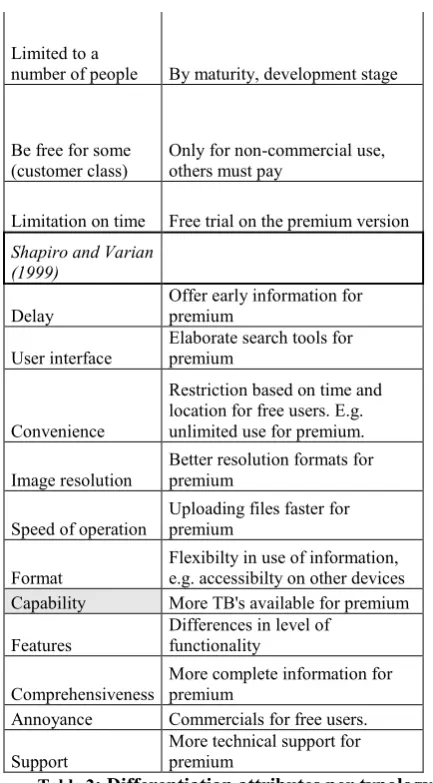
The differences between the free version and the premium version(s) of the cases will be explained on the basis of the typologies of Shapiro and Varian, Pujol and Anderson (see theory). As mentioned these topologies differ (also similarities) from each other: Below in the table an overview of the typologies.
Differentation attributes per
typology Example
Pujol (2010)
Quantity
Quantity limitation, and time limitation
Features
Differences in level of product functionality and services level between free and premium
Distribution Split between free and commercial levels
Anderson (2009)
Functionality Differences in level of functionality
Limited to a
number of people By maturity, development stage
Be free for some
(customer class) Only for non-commercial use, others must pay
Limitation on time Free trial on the premium version
Shapiro and Varian
(1999)
Delay
Offer early information for premium
User interface Elaborate search tools for premium
Convenience
Restriction based on time and location for free users. E.g. unlimited use for premium.
Image resolution
Better resolution formats for premium
Speed of operation
Uploading files faster for premium
Format Flexibilty in use of information, e.g. accessibilty on other devices Capability More TB's available for premium
Features
Differences in level of functionality
Comprehensiveness
More complete information for premium
Annoyance Commercials for free users.
[image:5.595.52.269.66.458.2]Support More technical support for premium
Table 2: Differentiation attributes per typology
Bekkelund (2011) noted that what Pujol (2010) terms distribution is similar to what Anderson (2009) terms customer class. Further he noted that the typologies are similar, but Pujol (2010) has far more inclusive quantity category, and therefore a less specific differentiation than the one presented by Anderson (2009). The dimensions of Shapiro&Varian fall into the typologies of Pujol and Anderson, e.g. Capability is the same as capacity and quantity (see grey areas in the table). The theory of Shapiro&Varian does not take a free trial (limitation on time) into account, that is why it as added to the new taxonomy (Table 3). Furthermore Image resolution is too specific and can only be used cloud computing services who make use of image, therefore it is changed in quality. For example premium users can enjoy music in high-definition.
Attributes suitable for analysis Delay
User interface Quality
Speed of operation Format
Capability
Features
Comprehensiveness Annoyance Support
[image:5.595.361.498.67.149.2]Limitation on time (free trial)
Table 3: Taxonomy: Differentiation attributes (categories) suitable for analysis
This is done to create a comparison of the cloud services in the most uniform way. The list may not be sufficient/large enough to explain the difference between free and premium among the cases en is therefore potentially enlarged by specific product dimensions (attributes) who do not fall into the list. The attributes which are most relevant to go for the premium version are explained per case. The result of this paper is a taxonomy of the different attributes which will lead to a premium service among the different cloud computing cases. Probably more attributes are important to distinguish between free and premium, because the key is to create the right mix of features to segment out the people who are willing to pay, but without alienating the users who make up the free audience (Chen, 2009). To improve the replicability of this research, current URLs of the case websites from which information is extracted are provided.
4.
PRESENTATION OF THE 6 CASES
The cases are illustrated with information from Wikipedia. This Wikipedia is often considered as an example of collaborative knowledge. Wikipedia entries are based on three core principles, which serve as leading rules for its contributors and aim at holding up the quality standards: verifiability (i.e. readers have to be able to retrieve content in reliable sources), no original search (Wikipedia does not accept new (unpublished) research or thought), and neutral point of view (based on facts to avoid bias) (Niederer & Van Dijck, 2010). Based on these principles makes Wikipedia a suitable source to illustrate the cases. The following six cases are suitable for analysis:
LinkedIn (network service):
Basic Free Account, Job Seeker, Sales Navigator, Recruiter Lite and Business Plus (note the last three versions are more B2B than B2C):
LinkedIn is a business-oriented social networking service and launched in 2003. It is mainly used for professional networking. The basic functionality of LinkedIn allows users (workers and employers) to create profiles and connections to each other in an online social network, which may represent real-world professional relationships.
(http://en.wikipedia.org/wiki/LinkedIn)
DropBox (cloud storage service):
Dropbox Free up to 2GB, then option to update to DropBox Pro 1TB (also B2B versions available which not taken account in this paper)
Skype (telecommunication service): Skype free, Skype Subcription/credit
Skype is a telecommunications application software product that specializes in providing video chat and voice calls from computers, tablets, and mobile devices via the internet to other devices or telephones/smartphones. Users can also send instant messages, exchange files and images, send video messages, and create conference calls. Skype is released in 2003. (http://en.wikipedia.org/wiki/Skype)
Spotify (music as a service): Spotify Free, Spotify Premium.
Spotify is a commercial music streaming, podcast and video service that provides digital rights management-restricted content from record labels and media companies including BBC, Sony, Warner Music Group, EMI and Universal. Music can be browsed or searched by artist, album, genre, playlist or record
label and was launched in 2008.
(http://en.wikipedia.org/wiki/Spotify)
Flickr (media hosting service):
Flickr Free, Flickr AdFree, Flickr Doublr.
Flickr is an image hosting and video hosting website that was launched by Ludicorp in 2004 and acquired by Yahoo in 2005. The services is a popular website for users to share en embed personal photographs, and effectively build an online community. The service is widely used by photo researchers and by bloggers to host images that they embed in blogs and social media.
(http://en.wikipedia.org/wiki/Flickr)
Malwarebytes Anti-Malware (MBAM) (software as a service, virus scanner):
MBAM Free, MBAM Premium.
MBAM is an application for computers running under the Microsoft Windows operating system that finds and removes malware. Malware is any software used to disrupt computer operation, gather sensitive operation, or gain access to private computer systems. MBAM is made by Malwarebytes
Corporation and was released in 2008.
(http://en.wikipedia.org/wiki/Malwarebytes%27_Anti-Malware#cite_note-PCW-3). Antivirus and malware are often confused. A virus is specific type of malware designed to replicate and spread, while malware is a broad term to describe all sorts of unwanted or malicious code (e.g. viruses, spyware, adware nag ware, trojans and worms) (Henry, 2013).
5.
RESULTS
The findings per case are presented here below. To determine the main differentiation factors of the cases analysis is done on the websites of the cases in which they give the main advantages of a premium version. It is likely for a user of a free version to make his decision to go premium by means of that information. More extensive research (e.g. blogs, unofficial comparing tables) leads to more specific differences between free and premium, but is it assumed that those differences are not relevant in the decision to go premium. To illustrate this with an example; DropBox Pro offers priority support, but it is assumed this has no contribution in the premium decision and is therefore not relevant.
5.1
Spotify
Spotify is a music-as-a-service provider and offers in the Netherlands in June 2015 two versions: Spotify Free and Spotify Premium (9, 99 Euro per month). According to their website the premium version has multiple main advantages with
respect to the free version: no advertisement, offline listening (no internet connection needed), on demand listening on mobile, unlimited numbers skipping, better sound quality. No advertisement falls into the annoyance category, offline listening and on demand listening falls into the format category, which imply: flexibility in use of information. Unlimited numbers skipping, which is limited to 6 times per hour on mobile on the free version is a form of convenience differentiation and better sound quality falls into the quality attribute. Furthermore: Spotify offers a free trial for the premium version of two months
(https://www.spotify.com/nl/#premium: 8-6-2014).Further remarkable findings include: the decision of Spotify to drop the limit of music listening for the free account in 2014, if it was maintained it was a form capability differentiation.
5.2
Dropbox
DropBox is a cloud storage service and offers two currently two versions for consumers: DropBox Basic (free) and DropBox Pro (9, 99 Euro monthly or 99 Euro annually). Furthermore it offers a version for businesses (include a free trial), which is not taken into account in this paper. The main differences according their website (https://www.dropbox.com/plans) between the free and the premium version are: the option for more storage space (from 2GB to 1000GB), some extra functions in sharing information and the possibility to delete files extern (e.g. Dropbox can delete the files from a stolen device without losing it, because it is stored). A remarkable option to create more value for your free account is the option to earn more storage space up to 16GB by inviting friends for trying out DropBox (https://www.dropbox.com/help/54). This is a good way to speed up the diffusion process. The main differentiation factors between free and premium are assigned as followed: the option for more storage space is assigned to capabilities; the extra functions in sharing information and the option to delete files extern are assigned to features.
https://blogs.dropbox.com/dropbox/2014/08/introducing-more-powerful-dropbox-pro/
5.3
Flickr
Flickr is an image and video (media) service.Since March 2013 Flickr offers two three versions: Flickr Free, Flickr Ad Free (5, 99 Dollar monthly or 49, 99 Dollar annually) and Flickr Doublr (499, 99 Dollar annually). The differentiation factor between Flickr Free and Flickr AdFree is the presence of advertisement in the free version
(https://www.flickr.com/account/upgrade/adfree/). The difference between Flickr Free and Flickr Doublr is the amount of storage space for photos and videos, which is double from 1TB to 2TB. So a rise in capabilities,
(http://tweakers.net/nieuws/89198/nieuwe-versie-flickr-geeft-gebruikers-1tb-aan-opslag.html). Before May 2013, Flickr offered two types of accounts, Free and Pro. Free accounts were limited in data storage, accessibility, and interaction. Pro accounts received unlimited bandwidth and storage, and allowed users to upload an unlimited number of images and videos every month. (http://mashable.com/2013/05/20/flickr-pro-changes/)
5.4
month. The main differentiation attributes according to their site are: Direct contact with a recruiter or the poster of vacancy; become on top on the list of applicants of recruiters; review of who saw your account the last 90 days; information about other applicants
(https://www.linkedin.com/premium/products?displayProducts =&trk=hb_ft_upyracct). LinkedIn offers the option of a free trial of one month for Job Seeker. To assign the differentiation factors to the table the following choices been made; direct contact with a recruiter is an extra feature as well as the placement on top of the list of the recruiter. The information about other applicants/users is limited in the free version, and will be complete in the premium version, thus it falls into the comprehensives attribute. The review of who saw you in the last 90 days is unlimited, compared to the five persons in the free versions en therefor thus more complete. So this advantage is also assigned to the comprehensiveness attribute.
5.5
Skype
Skype is telecommunications service and offered till the summer of 2014 two versions: Skype Free and Skype Premium. Skype Premium had the following add-ons: the ability to make group video calls and the ability to share screen with up to 10 other people, improved customer support and the removal of ads. The Skype premium version stopped to exist, because group video calls and screen sharing were made free. Currently Skype earns his money via Skype credit or a subscription, which enables users to make calls outside the inside Skype Network e.g. if a Skype user wants to call a mobile line or a landline phone from his PC or Skype compatible devices. (http://en.wikipedia.org/wiki/Features_of_Skype#Skype_Premi um). These add-ons are an increase in features.
5.6
MBAM
MBAM is an anti-malware service and offers two versions for consumer: MBAM Free and MBAM Premium (24, 54 Euro annually). Furthermore offers MBAM four versions for businesses. The main differences with respect to the free version are: Option to schedule automatic scans and database updates, instead of manually; prevents access to and from malicious webpages; faster scan; real time protection detection before infection). In addition is there a free trial of 14 days available (https://www.malwarebytes.org/antimalware/). The first difference is an extra feature as well as the access protection from and to malicious websites. A faster scan is assigned to speed of operation. Real time protection is differentiation based on the delay attribute.
[image:7.595.309.543.134.369.2]5.7
Taxonomy applied to cases in a table
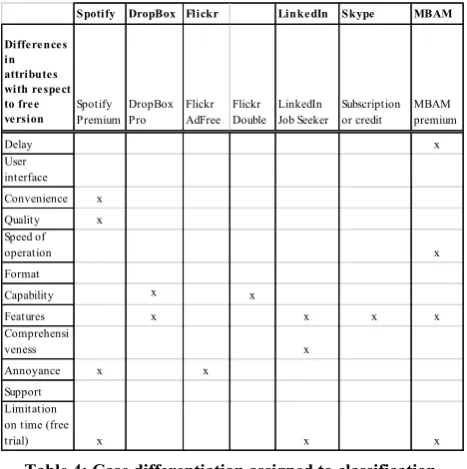
Table 4 present the attribution of product differentiation factors of the cases (horizontal axis) to the taxonomy categories (vertical axis), which are explained per case earlier this section.Table 4: Case differentiation assigned to classification. By analyzing the cases which are applied to the taxonomy in table 4 it is remarkable to see that differentiation factors really differ among the cases. Furthermore it shows that most companies are using a mix of differentiation factors for premium versions. Besides that a distinction can be made between common and not common product differentiation attributes among these cases, which are shown in table 4. A remarkable finding it the decrease in versions among the cases. Most of them consist of one premium version focused on consumers.
6.
CONCLUSION
This paper present a taxonomy which is applied to various cloud computing services. As the cloud computing services to differ from each other, so the differentiation factors do. An important note to this research is that there are no certain rules for a category attribute (e.g. if a case has the following attribute, then it should be assigned to the following category). That means that certain classifications for cases are open for discussion. The lack of detail both in the rules of taxonomy (which are lacking in this paper, as already stated as a subjective interpretation) and in the cases themselves still leaves room for ambiguity for the precise meaning of any particular differentiation factor. Although this serious limitation this paper tries to give more insight in the complexity of freemium.
7.
DISCUSSION
This paper tries to clarify the differentiation factors for users between free and premium among several cloud computing services applied to a taxonomy. This analysis is limited to the differentiation factors of the producers themselves, which they share on their websites. Further this paper only state which differentiating factors producers are using, but not the relative importance of it. E.g. for a consumer the increase in capabilities may have the biggest influence in the decision to go premium. A suggestion for future researcher may be a survey in which
Spotify DropBox Flickr LinkedIn Skype MBAM
Differences in attributes with respect to free version
Spotify Premium
DropBox Pro
Flickr AdFree
Flickr Double
LinkedIn Job Seeker
Subscription or credit
MBAM premium
Delay x
User interface Convenience x
Quality x
Speed of
operation x
Format
Capability x x
Features x x x x
Comprehensi
veness x
Annoyance x x
Support Limitation on time (free
responders have to rate their importance of the differentiating attributes. Measuring this gives probably more insight on how the decision to go premium in a consumer perspective can be made. A possible product of that kind of research will be a decision tool, in which users are advised to go for a certain premium version based on their ratings of differentiation factors. Furthermore previous research on the concept of freemium, in particular differentiation factors was limited, therefore more research on this topic is admirable.
8.
REFERENCES
Agarwal, R., & Prasad, J. (1997). The role of innovation characteristics and perceived voluntariness in the acceptance of information technologies. Decision sciences, 28(3), 557-582.
Anderson, C. (2009). Free-The future of a Radical Price. Bakos, Y., & Brynjolfsson, E. (1999). Bundling Information
Goods: Pricing, Profits, and Efficiency. Management Science, 45, 1613-1630.
Bekkelund, K. J. (2011). Succeeding with Freemium: Exploring Why Companies Have Succeeded & Failed With Freemium. Norwegian University of Science and Technology, Trondheim.
Belleflamme, P. (2006). Versioning Information Goods. In G. Illing & M. Peitz (Eds.), Industrial Organization and the Digital Economy (pp. 145-207): MIT Press. Bruno, D., & Richmond, H. (2003). The truth about
taxonomies. Information Management, 37(2), 44. Bryman, A. (2012). Social research methods: Oxford university
press.
Doerr, J., Benlian, A., Vetter, J., & Hess, T. (2010). Pricing of Content Services – An Empirical
Investigation of Music as a ServiceSustainable e-Business Management (pp. 13-24): Springer-Verlag Berlin Heidelberg.
Downe‐Wamboldt, B. (1992). Content analysis: method, applications, and issues. Health care for women international, 13(3), 313-321.
Froberg, P. (2015). What is freemium? Retrieved 9-6-2015, 2015, from http://www.freemium.org/what-is-freemium-2/
Gallaugher, J. M., & Wang, Y.-M. (2002). Understanding network effects in software markets: evidence from web server pricing. Mis Quarterly, 303-327. Henry, A. (2013). The Difference Between Anti-Virus and
Anti-Malware (and Which to Use). Retrieved from http://lifehacker.com/the-difference-between-antivirus-and-anti-malware-and-1176942277
Hudson, C. (2009). Thought On Free Powered Business Models And Why Time Beats Features. Retrieved from
http://www.charleshudson.net/thoughts-on-free- powered-business-models-and-why-time-beats-features
Jiang, Z. (2010). How to give away software with successive versions. Decision Support Systems, 49(4), 430-441. Jiang, Z., & Sarkar, S. (2009). Speed matters: The role of free
software offer in software diffusion. Journal of Management Information Systems, 26(3), 207-240. Katz, M. L., & Shapiro, C. (1985). Network externalities,
competition, and compatibility. The American economic review, 424-440.
Kim, M., & Lee, H. (2011). SMCC: Social Media Cloud Computing Model for Developing SNS Based on Social MediaCommunications in Computer and Information Science (pp. 259-267): Springer Krippendorff, K. (2012). Content analysis: An introduction to
its methodology: Sage.
Mell, P., & Grance, T. (2011). The NIST Definition of Cloud Computing. Gaithersburg: National Institute of Standards and Technology.
Niculescu, M. F., & Wu, D. J. (2011). When Should Software Firms Commercialize New
Products via Freemium Business Models?
Niederer, S., & Van Dijck, J. (2010). Wisdom of the crowd or technicity of content? Wikipedia as a sociotechnical system. New Media & Society, 12(8), 1368-1387. Pujol, N. (2010). Freemium: attributes of an emerging business
model. http://ecgi.ssrn.com/
Robles, P. (2009). Freemium vs. Trials: pros and cons. Retrieved from https://econsultancy.com/blog/4672-freemiums-vs-trials-pros-and-cons
Semenzin, D., Meulendijks, E., Seele, W., Wagner, C., & Brinkkemper, S. (2012). Differentation in Freemium: Where Does the Line Lie? Software Business (pp. 291-296): Springer-Verlag Heidelberg.
Shampanier, K., Mazar, N., & Ariely, D. (2007). Zero as a special price: The true value of free products.
Marketing science, 26(6), 742-757.
Shapiro, C., & Varian, H. R. (1999). Information Rules A Strategic Guide To The Network Economy (pp. 352). Vargo, S. L., & Lusch, R. F. (2004). Evolving to a new
dominant logic for marketing. Journal of marketing, 68(1), 1-17.
Wagner, T. M., Benlian, A., & Hees, T. (2014). Converting freemium customers from free to premium—the role of the perceived premium fit in the case of music as a serviceElectron Markets (pp. 259-268). doi:
10.1007/s12525-014-0168-4