University of Warwick institutional repository: http://go.warwick.ac.uk/wrap
A Thesis Submitted for the Degree of PhD at the University of Warwick
http://go.warwick.ac.uk/wrap/1221
This thesis is made available online and is protected by original copyright. Please scroll down to view the document itself.
Lit
AN EXPLORATION OF THE
CONSTRUCT OF MASTERS
LEVEL CLINICAL PRACTICE
By
ALISON RUSHTON
MSc, GradDipPhys, MCSP, Cert Ed, DipTP, MMACP •
A thesis submitted in fulfilment of the requirements
for the degree of Doctor of Education (EdD)
CONTENTS PAGE NUMBER
List of Tables 4
List of Figures 6
Acknowledgements 7
Declaration 8
List of abbreviations 9
Abstract 10
1 Introduction 11
2 Literature review 13
2.1 Scope of the review 13
2.2 Context of Health 13
2.3 Context of Continuing Education 15
2.4 Masters level 17
2.4.1 Defining Masters level 17
2.4.2 Standards in Masters level education 22
2.5 Expertise 23
2.5.1 Definition of expertise 23
2.5.2 Evolution of research 24
2.5.3 Characteristics of expertise 25
2.5.4 Characteristics of expertise in physiotherapy 31
2.6 Knowledge 32
2.6.1 Forms of knowledge 32
2.6.2 Organisation of knowledge 36
2.6.3 Organisation of knowledge in other professions 39
and specialities
2.6.4 Conclusions regarding knowledge 42
2.7 Clinical Reasoning 43
2.7.1 Background 43
2.7.2 Clinical reasoning in medicine 43
2.7.3 Diagnostic reasoning 44
2.7.4 Pattern recognition 45
2.7.5 Clinical reasoning across professions and specialities 47
2.7.6 Clinical reasoning in physiotherapy 47
2.8 Specialisation 52
2.8.1 The concept of specialisation 52
2.8.2 Expertise and specialisation 53
2.8.3 Linking specialisation and academic level 54
3 Methodology 60
3.1 Methodological perspective 60
3.1.1 Philosophical tradition 60
3.1.2 Position regarding claims on knowledge 61
3.1.3 Methodology 63
3.2 Mixed methods approach 63
3.3 Conceptual framework 65
3.4 Research questions 66
3.5 Quantitative Delphi study 67
3.5.1 Design 67
3.5.2 Method 67
3.5.3 Sample for the Delphi study 71
3.5.4 Procedure 74
3.5.5 Data analysis 77
3.5.6 Reliability and validity 84
3.6 Qualitative case study 85
3.6.1 Design 85
3.6.2 Methods 87
3.6.3 Procedure 89
3.6.4 Sample for the case study 93
3.6.5 Data analysis 95
3.6.6 Quality of data analysis 97
3.7 Concurrent procedures of the mixed methods 99
approach
3.8 Ethical considerations 101
3.8.1 Informed consent 101
3.8.2 Privacy and confidentiality 102
3.8.3 Anonymity 102
3.8.4 Deception 102
3.8.5 Risk of harm 103
3.8.6 Ethical approval 103
4 Results 104
4.1 Results of the quantitative Delphi study 104
4.1.1 Round 1 104
4.1.2 Round 2 110
4.1.3 Round 3 119
4.2 Results of the qualitative case study 132
4.2.1 Interviews with students 132
4.2.2 Interviews with clinical tutors 145
4.2.3 Participant observation of examination of 156
clinical practice
4.2.4 Triangulation of data from the case study 168
4.3 Convergence of data across Delphi study 170
5 Discussion 172
5.1 Discussion of the Delphi study 172
5.1.1 Response rate 172
5.1.2 Round 1 findings 174
5.1.3 Round 2 findings 175
5.1.4 Round 3 findings 177
5.1.5 Discussion of behaviours 181
5.1.6 Limitations of the Delphi study 187
5.2 Discussion of the case study 189
5.2.1 Interviews with students 189
5.2.2 Interviews with clinical tutors 190
5.2.3 Participant observation 190
5.2.4 Quality of qualitative data and analysis 191
5.2.5 Findings of triangulation of interviews and observations
194
5.2.6 Limitations of the case study 205
5.3 Convergence of methods 206
6 Conclusion 212
6.1 Measurement validity of the construct 212
6.2 Construct validation 213
6.3 Conclusions of the study 213
6.4 Limitations and recommendations for future research
214
7 References 215
8 Appendices
8.1 Participant information Delphi study 8.2 Delphi letter round 1
8.3 Delphi questionnaire round 1 8.4 Delphi letter round 2
8.5 Delphi questionnaire round 2 8.6 Delphi letter round 3
8.7 Delphi questionnaire round 3 8.8 Interview guide students 8.9 Interview guide clinical tutors 8.10 Participant information case study 8.11 Example interview with student 8.12 Example interview with clinical tutor 8.13 Participant observation guide
8.14 Example observation notes 8.15 Letter of ethical approval
8.16 Report on Delphi data round 1 by independent researcher 8.17 Statistical analysis of round 2 data
Table 2.1 Table 2.2 Table 4.1 Table 4.2 Table 4.3 Table 4.4
LIST OF TABLES PAGE NUMBER
Table 2.3 Table 2.4 Table 2.5 Table 2.6 Table 4.5 Table 4.6 Table 4.7 Table 4.8 Table 4.9 Table 4.10 Table 4.11 Table 4.12
QAA descriptor for a qualification at Masters level 18 Characteristics of Masters level from empirical studies 20 in healthcare
Three principles of developing expertise 26
Benner's levels of practice 27
Proposals regarding the organisation of knowledge 37 from empirical studies in medicine
Collated characteristics of expertise as supported 56 by empirical evidence
Course background for the participants of round 1 105 Behaviours provided by the participants as indicative 106 of the construct of Masters level clinical practice
Course background for the participants of round 2 111 Participant rating of the importance of each behaviour 112 to the construct of Masters level clinical practice
Changes to the wording of behaviours prior to round 3 118 Course background for the participants of round 3 120 Participant ranking of the importance of each behaviour 121 to the construct of Masters level clinical practice
Behaviours demonstrating consensus of ranking 123 of importance to the construct
Behaviours demonstrating consensus comparing 125 physiotherapy and radiography groups
Theoretical propositions and analytic categories for 133 the construct of Masters level clinical practice from
student interviews
Most important components of the construct of Masters 144 level clinical practice as perceived by the students
Theoretical propositions and analytic categories for 146 the construct of Masters level clinical practice from
Table 4.13 Most important components of the construct of Masters 155 level clinical practice as perceived by the clinical tutors
Table 4.14 Components of the examination process 156
Table 4.15 Theoretical propositions and analytic categories for 157 the construct of Masters level clinical practice from
the participant observations
Table 4.16 Triangulation of the data from the case study 169 Table 4.17 Convergence of findings across the Delphi and 170
Figure 2.1 Figure 2.2 Figure 2.3 Figure 2.4 Figure 2.5 Figure 3.1 Figure 3.2 Figure 3.3 Figure 3.4 Figure 3.5 Figure 4.1 Figure 4.2 Figure 4.3 Figure 4.4
Figure 5.1 Generic components of the construct of Masters 208 level clinical practice
LIST OF FIGURES PAGE NUMBER
Model of evidence based practice
A skill continuum for continuing education
Modified skill continuum for continuing education
Representation of different forms of knowledge
Representation of use of the different forms of knowledge in an expert healthcare practitioner
Conceptual framework for the study
Key stages of the Delphi method
Sample of participants contributing to the Delphi study
Proposed strategy of data collection
Concurrent timing of the Delphi and case study
Error chart of the participants' ratings of the importance of the behaviours
Comparison of the participants' ranking of the importance of the behaviours to the construct
Comparison of the participants' ranking of the importance of the behaviours to the construct for the physiotherapy group
Comparison of the participants' ranking of the importance of the behaviours to the construct for the radiography group
15 16 22 35 42 65 69 73 94 100 113 122 124 124
Figure 5.2 Components of the construct of Masters level clinical practice for manipulative physiotherapy
ACKNOWLEDGEMENTS
I would like to take this opportunity to thank the many people who have
supported me throughout the EdD, concluding with this thesis. In particular, the following people deserve a special mention.
Geoff Lindsay, my research supervisor throughout the four years, for his enthusiasm for my ideas and constructive criticality in facilitating my development both as a researcher and author.
Carolyn Roskell, a colleague and close friend, for her critical friendship that in particular developed the breadth and context to my ideas and at the same time provided constant support and encouragement.
Gill James, a colleague and friend, for her critical friendship throughout the early projects of the EdD, and for her independent analysis of the Delphi study.
Ann Thomson, for her mentorship and encouragement, and in particular for enabling access to the specialist course within the case study.
Finally to my husband Clive, for his constant support, encouragement and unerring belief in my ability. Also to Antony (7) and Emily (5) for their love and distraction, enabling me to effectively combine a family and research.
I would also like to thank the following sources of funding for this study:
The University of Birmingham, School of Health Sciences, £1000 research grant (2002).
DECLARATION
I declare that the work in this thesis is my own and contains no material which
has been published or used before in any context. The thesis has not been
LIST OF ABBREVIATIONS
CPD Continuing Professional Development CSP Chartered Society of Physiotherapy CV Coefficient of variation
DOH Department of Health EBP Evidence Based Practice
HE Higher Education
HEQC Higher Education Quality Council
NCIHE National Committee of Inquiry into Higher Education NHS National Health Service
QAA Quality Assurance Agency for Higher Education RCN Royal College of Nursing
SD Standard deviation
UK United Kingdom
WCPT World Confederation of Physical Therapy
ABSTRACT
This study aimed to explore the construct of Masters level clinical practice. A mixed methods approach converging quantitative and qualitative data was undertaken.
Consensus of behaviours indicative of the construct was explored through a quantitative Delphi study. Participants represented a total population sample of Masters course tutors in healthcare (n = 48). Round 1 requested behaviours indicative of the construct. Quantitative content analysis informed the
behaviours explored in round 2, where participants rated their relative importance. Round 3 asked participants to rank the behaviours in order of importance. Descriptive and inferential analysis enabled interpretation of consensus.
The construct was also explored through an in-depth qualitative case study, using semi-structured interviews and participant observation. Purposive sampling selected the `case' of a manipulative physiotherapy course and the participants for the study. Analytic categories were derived from the data using a constant comparative process until saturation of the data were achieved. Theoretical propositions to identify the components of the construct were developed.
The response rate for the Delphi study was very good (79.1%, 77.1% and 70.8% for rounds 1-3 respectively). Rounds 1 and 2 achieved good consensus enabling 21 agreed 'important' behaviours to be taken into round 3. The ranking process in round 3 afforded consensus overall, but also highlighted some
differences between professions regarding the prioritisation of components of the construct. There was good convergence of the data with the case study, with clinical reasoning and knowledge identified as the most important components of the construct.
1. INTRODUCTION
Rapid developments in healthcare knowledge and technology over the past decade have contributed to a demand for healthcare professionals to develop expertise in managing more complex problems. Several developments have specifically contributed to the emphasis on Masters level courses as a means of developing this expertise. This has included the migration of healthcare
professional courses into Higher Education (HE), the mandatory requirement for Continuing Professional Development (CPD) and the development of
specialisation within clinical practice, with roles of 'clinical specialist', 'extended scope', and 'consultant' becoming commonplace. Central to the current
proliferation of Masters courses is the emphasis on developing clinical expertise (Rushton, 2002).
Increased provision of academic opportunities have contributed to uncertainty surrounding the differentiation of academic level in relation to clinical practice in nursing (Davis and Burnard, 1992; Elkan and Robinson, 1995; James and Redfern, 1995; Gerrish et al, 2000), with Masters level frequently being equated with the role of clinical specialist (Whyte et al, 2000). These difficulties regarding level are mirrored in the wider educational literature (Winter, 1994; Higher
Education Quality Council [HEQC], 1996). Although clarity has been provided through the framework for HE qualifications (Quality Assurance Agency for Higher Education [QAA], 2001a) for the academic aspects of an award,
A critical analysis of the literature facilitated through a conceptual framework of a soft systems methodology, identified a gap within the literature relating to Masters level clinical education (Rushton, 2000; 2001; Rushton and Lindsay, 2003). An exploration of this complex area was initially facilitated by a
descriptive survey that explored the characteristics of existing courses for healthcare professionals that aimed to develop clinical expertise (Rushton, 2002; 2003). The survey highlighted many important issues of current practice, with a central feature being the articulation of the 'Masters levelness' of clinical practice. This study therefore aimed to explore the 'Masters levelness' of clinical practice, to provide insight into this so far elusive concept. 'Masters levelness' can be considered as a construct, which is a term originating from psychology to describe something that is not directly observable (Thorndike and Hagen,
1997). A construct was therefore developed to enable communication of its components and their subsequent exploration.
Masters level has been described as enabling students to apply knowledge, and develop an understanding of how boundaries are advanced through research. Students will also be able to manage complex issues systematically, with self-direction, creatively and with originality (QAA, 2001a). This definition
predominantly reflects what can be considered as the 'academic component' of
the construct that is generalisable across all Masters courses. Its equivalence therefore for the 'clinical component' of the construct merits consideration
through issues of clinical expertise. This is particularly important with the current emphasis on developing clinical expertise through the political health agenda
2. LITERATURE REVIEW
2.1 Scope of the Review
The review of the literature encompassed many aspects of theory in providing
the detailed rationale and theoretical basis for this study. It primarily explored
issues of expertise with an emphasis on knowledge and clinical reasoning that
have been identified as the most important characteristics of expertise within
healthcare. Other aspects of expertise from the wider literature are
acknowledged as important, for example speed of activity, but were beyond the
scope of this study. The literature was explored with specific reference to
healthcare and to physiotherapy, the author's own profession and the
profession used within the case study method. The scope of the existing
literature was vast and therefore discrimination of the content for the review was
defined closely to this study. It was therefore beyond the scope of the review to
explore allied subject areas, including: competence, professionalisation,
professional socialisation, decision theory, memory, artificial intelligence and
expert systems. The review therefore shares a similar basis to most of the
healthcare literature that uses cognitive theory as an exploration of expertise.
The review also reflects the literature informing current practice that
encompasses the past 30 years of research.
2.2 Context of Health
II
a system through which National Health Service (NHS) organisations are accountable for continuously improving the quality of their services and safeguarding high standards of care by creating an environment in which excellence in clinical care will flourish"
(Scally and Donaldson, 1998, p 61)
The World Health Organisation (WHO) usefully examines clinical governance through its four components of: professional performance, resource use, risk management and patient satisfaction (WHO, 1983). The component of professional performance has subsequently been developed through key initiatives within healthcare (DOH, 2000a; 2000b), and has contributed to the emphasis on CPD and the development of clinical expertise, where staff in the NHS receive support from employers to enable them to fulfil the professional requirements of clinical governance and re-registration through the Health Professions Council or equivalent body. The aim of 'Meeting the Challenge' (DOH, 2000b) was also for CPD opportunities to become more strategic, contributing to the current proliferation of educational opportunities.
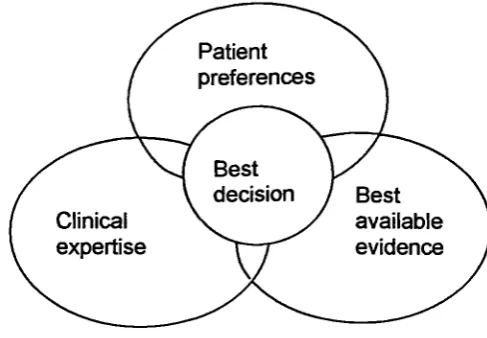
Figure 2.1: Model of evidence based practice, developed from Bury (1998)
Patient preferences
Best decision Clinical
expertise
Best available evidence
2.3 Context of Continuing Education
The origins of lifelong learning date back to the work of Dewey, Lindeman and
Yeaxlee in the early 1900s (Jarvis, 1995), and it is acknowledged that a
commitment to lifelong learning requires individuals to take responsibility for
their own continuing education. The context of HE has changed considerably,
developing from the elite, fulltime approach for the 18-21 age group of Robbins
(Committee on Higher Education, 1963) to the current mass system that was
identified by Dearing. The Dearing report (National Committee of Inquiry into
Higher Education [NCIHE], 1997) represented a retrospective and prospective
analysis of HE, identifying the concept of lifelong learning as a crucial outcome
of education. Houle (1980) identified the need to continually prepare individuals
for their 40 years of practice, rather than the initial approach of providing their
education intensively for 3 to 5 years, and Frost (2001) also argues that there is
no profession that would claim expertise based on professional education
completed 5 or 10 years previously. This approach to continuing education has
been advocated through professional bodies within healthcare, for example by
Continuing education Expert
..
nnn Novice
Undergraduate • Postgraduate
the past 20 years has been the integration of CPD into processes of
accountability within professional practice (Cervero, 2001). Roskell and Cross
(2001) graphically defined continuing education as a skill continuum (Figure 2.2)
illustrating the seamless provision of educational opportunity that also makes
[image:18.595.96.465.281.458.2]delineation of the different educational levels important.
Figure 2.2: A skill continuum for continuing education (adapted from Roskell
and Cross, 2001)
Barnett (1990) explored the concept of professional education within HE,
lending support to the role of education in developing skills of critical analysis
and reflection that can be applied within professional practice. The link to level
of courses within HE however, remains elusive, and several authors have called
for an evaluation of the role of Masters level education in developing
professional roles (Gosling, 1999; Whyte et al, 2000). For nursing, Masters
courses represented a shift in emphasis, as previously it had been espoused
based on the work of Benner (1984), that extensive clinical practice was
required to develop a nurse's clinical ability. This was accompanied by a
context (Hardy et al, 1984), a concern mirrored in physiotherapy (Gosling, 1999). The relevance of Masters level study to clinical practice was therefore questioned, with a perception that practitioners educated to Masters level were less able in the clinical context (Gosling, 1999). This perception was however balanced in Gosling's (1999) study against the need to raise awareness of the possible benefits of Masters level study.
The contexts of health and continuing education are synonymous with the 'interactional professional' model of professional socialisation proposed by Higgs and Hunt (1999) as a basis for clinical practice and expertise, reflecting generic skills of lifelong learning, research, reflective and autonomous practice, all enabling patient-centred practice.
2.4 Masters Level
2.4.1 Defining Masters level
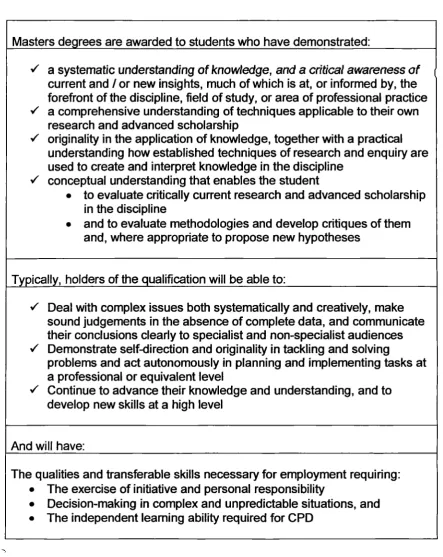
The framework for HE qualifications (QAA, 2001a) describes students studying at Masters level demonstrating:
> Application of knowledge
> Understanding of how boundaries are advanced through research > Management of complex problems systematically and creatively > Originality in solving problems
These characteristics will be reflected in all Masters courses, as the framework is now used as the basis for curriculum design. The QAA (2001a) also
contexts requiring personal responsibility, initiative, and judgement in complex and unpredictable professional environments. The emphasis of the QAA descriptor for qualification at Masters level is on knowledge (Table 2.1).
Table 2.1: QAA descriptor for a qualification at Masters level (2001a, o.3)
Masters degrees are awarded to students who have demonstrated:
i a systematic understanding of knowledge, and a critical awareness of
current and / or new insights, much of which is at, or informed by, the forefront of the discipline, field of study, or area of professional practice .7 a comprehensive understanding of techniques applicable to their own
research and advanced scholarship
.7 originality in the application of knowledge, together with a practical understanding how established techniques of research and enquiry are used to create and interpret knowledge in the discipline
.7 conceptual understanding that enables the student
• to evaluate critically current research and advanced scholarship in the discipline
• and to evaluate methodologies and develop critiques of them and, where appropriate to propose new hypotheses
Typically, holders of the qualification will be able to:
.7 Deal with complex issues both systematically and creatively, make sound judgements in the absence of complete data, and communicate their conclusions clearly to specialist and non-specialist audiences .7 Demonstrate self-direction and originality in tackling and solving
problems and act autonomously in planning and implementing tasks at a professional or equivalent level
.7 Continue to advance their knowledge and understanding, and to develop new skills at a high level
And will have:
The qualities and transferable skills necessary for employment requiring: • The exercise of initiative and personal responsibility
Although the descriptor is written to reflect the academic component of the
Masters level construct, its breadth encompasses many aspects of clinical
practice. In light of the current context of healthcare and the need for
practitioners to manage patients in a complex and changing environment, the
applicability of the descriptor to clinical practice appears insightful. The
descriptor is also synonymous with the requirements for specialist posts (for
example, CSP, 1995; World Confederation of Physical Therapy [WCPT], 1995),
and similarly to Whyte et al (2000) comparability of specialist practice to
Masters level can therefore be proposed.
Few studies have explored the characteristics of Masters level in healthcare.
Through a modified Delphi study, Davis and Burnard (1992) sought the
attributes of Masters level from ten Professors of Nursing in the United Kingdom
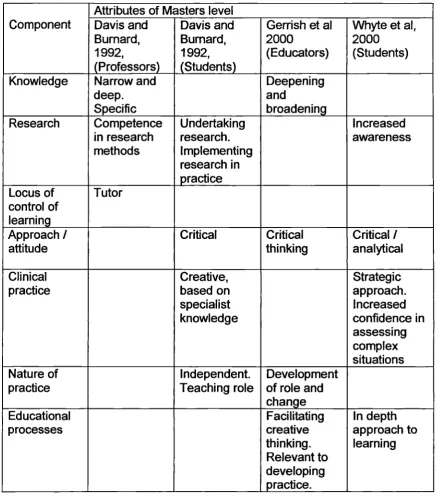
(UK). Their findings are summarised in Table 2.2, and are interesting, in
particular the tutor having the locus of control for learning that is in contrast to
the QAA's (2001a) emphasis on the student. Davis and Burnard (1992)
unfortunately did not follow the Delphi method in returning the attributes to the
Professors for further consideration, as it would have been interesting to see
how the attributes developed through subsequent rounds. They did however,
seek the same attributes from Dutch students on a Masters course and found
many differences (Table 2.2), although a comparison is problematic owing to
the different educational structures across the two countries and only one
course being studied. It is interesting to note the emphasis by the students on
clinical practice, although for both sets of data the emphasis was on the
application of academic skills to the clinical context, rather than the
Gerrish et al (2000) explored Masters level practice through focus groups, informing in-depth interviews of 19 nurse educators involved in Masters level education. In identifying 'dilemmas', the findings of this study did highlight expectations of Masters level clinical practice (Table 2.2).
Table 2.2: Characteristics of Masters level from empirical studies in healthcare
Component
Attributes of Masters level Davis and Burnard, 1992, (Professors) Davis and Bumard, 1992, (Students)
Gerrish et al 2000
(Educators)
Whyte et al, 2000
(Students)
Knowledge Narrow and deep. Specific Deepening and broadening Research Competence in research methods Undertaking research. Implementing research in practice Increased awareness Locus of control of learning Tutor
Approach
/
attitude
Critical Critical thinking
Critical
/
Whyte et al (2000) explored the influences of completing a Masters course by
nurses between 1989 and 1996. They found that teaching was the dominant
career pathway taken by respondents (50%) with only 13% of respondents in
clinical posts. The dates of the cohorts are however essential to analysing their
findings, as this study was prior to the increasing pathways for clinical
progression within the NHS (DOH, 2000a), and at a time when professional
courses were becoming integrated into HE. The emphasis on teaching is
therefore not surprising. In exploring the relevance of their course to clinical
practice, the findings from the students are also detailed in Table 2.2. Although
interesting, these findings must be interpreted with caution as only one
institution was studied, but more importantly a significant number of
non-responders (33.1%) were not followed up, so non-response bias may have
influenced the findings. The attributes from these studies exploring healthcare
courses highlight differences to the QAA (2001a) framework, to support further
the rationale for this study and a focus on courses developing clinical expertise.
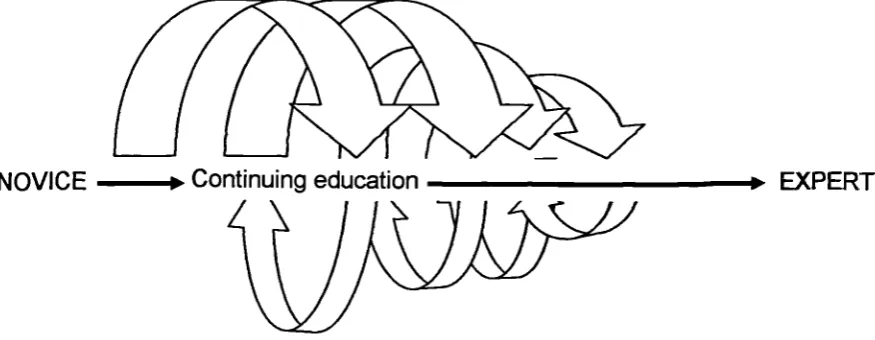
From their study, Davis and Burnard (1992) proposed a spiral model of
professional development, describing how a nurse through continuing education
moves through different stages and a continuous process of reflection. The
concept of the spiral can therefore be used to develop the skill continuum model
n EXPERT Figure 2.3: Modified skill continuum for continuing education
NOVICE --n Continuing education
2.4.2 Standards in Masters level education
The proliferation of Masters courses has raised concerns over maintaining standards, as articulated in both the Harris (Higher Education Funding Council
for England, 1996) and Dearing reports (NCIHE, 1997), although there is no empirical evidence of an actual decline in standards. Following these reports, Atkins and Redley (1998) were commissioned to examine the identification, description, and monitoring of standards across a stratified sample of 12 HE institutions, encompassing a total of 94 Masters courses. They found variation across the institutions regarding the explicit definition of levels, and no
2.5 Expertise
2.5.1 Definition of expertise
Interest in expertise is facilitated by the argument that understanding how experts think, what they know, and how they perform is essential to the
development of a profession, particularly through the enabling of an individual's professional development (Benner et al, 1996; Ericsson, 1996). The definition of expertise has been recognised as a difficult exercise, and has been explored across professions (Delitto et al, 1989; Starkes, 1993; Coulon et al, 1996), being commonly articulated as the capacity to perform using cognitive and practical skills not employed by novices. These skills are applied to complex situations (Schon, 1983; Carter et al, 1987), the complex situations mirroring the QAA descriptor (2001a).
The literature highlights the problematic distinction between 'expert and 'expertise' (Higgs and Titchen, 2001), as the terms are frequently used synonymously. 'Expert' tends to describe an individual and their role, and 'expertise' the characteristics of an expert's practice. Ericsson and Smith (1991 p 2) support this distinction in defining expertise as what distinguishes an expert from a novice. An expert therefore possesses a comprehensive array of the characteristics of expertise. In physiotherapy, Delitto et al (1989) defined an expert as a highly skilled or trained practitioner who was informed in their field. This definition is useful in that it highlights the important combination of
practitioners who if required, could make decisions on the basis of inadequate data, therefore using intuition. Definition of an expert therefore remains elusive and researchers have resorted to practical mechanisms for determining the expert participants for their studies. Criteria have included the peer nomination of experts and the use of years of experience or seniority, all of which are problematic as explored throughout this review. This fundamental difficulty therefore provides a limitation to most research within this area.
2.5.2 Evolution of research
It is possible to delineate the theory of expertise within healthcare into two 'generations' that illustrate a process of evolution (Jensen et al, 2000). The first generation was centred on the expert as an individual, possessing a range of reasoning strategies that were employed to solve problems. Central to this generation was the work of Elstein et al (1978) who explored problem-solving strategies within clinical practice, and subsequently the emphasis on
hypothetico-deductive reasoning developed. The evolution of the second
'generation' (Jensen et al, 2000) was prompted by the increasing evidence from other disciplines suggesting that hypothetico-deductive reasoning was not the central issue in distinguishing practitioners with different levels of expertise
2.5.3 Characteristics of expertise
Most researchers have addressed the issue of expertise through the implicit
concept of the continuum between novice and expert (Figure 2.3). Current work
exploring skill development and expertise builds upon the pioneering work of de
Groot (1965) who found that in chess, experts were superior to novices in their
ability to select moves after only a brief glimpse at a chess board. There is
however a major flaw in this analogy as experts in chess are identified by their
success in tournaments, therefore with a clear performance measure of
expertise (Paley, 1996) unlike for example, healthcare. However, the analogy
has served to develop the literature within this area, and Rossano (2003)
collates the subsequent work exploring skill development and expertise, to
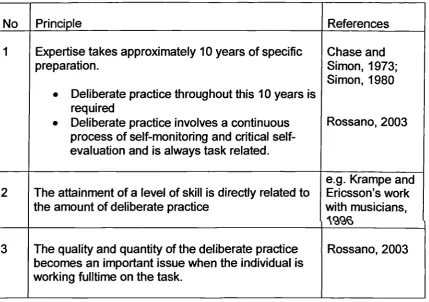
develop three principles (Table 2.3). For healthcare, this concept of deliberate
practice can be paralleled to clinical practice. The authentic context of the
practice facilitates the development of expertise, as professionals learn and
develop knowledge (Schon, 1983). Some authors have proposed a relationship
between this experience and expertise, but this point is contentious (Jensen et
al, 1990; Ericsson et al, 1993; Starkes, 1993). In describing expert nurses,
Benner (1984) contends that 5 years of context-dependent experience is
required before a practitioner reaches a level of expertise. Support for this
concept is afforded by Simon (1980), although he contends that 10 years is
required to develop proficiency. Schon (1983) also agrees that experience is a
prerequisite for expertise, but argues that experience is only one factor
Table 2.3: Three principles of developing expertise
No Principle References
1 Expertise takes approximately 10 years of specific preparation.
•
Deliberate practice throughout this 10 years is required•
Deliberate practice involves a continuous process of monitoring and critical self-evaluation and is always task related.Chase and Simon, 1973; Simon, 1980
Rossano, 2003
2 The attainment of a level of skill is directly related to the amount of deliberate practice
e.g. Krampe and Ericsson's work with musicians,
AS96
3 The quality and quantity of the deliberate practice becomes an important issue when the individual is working fulltime on the task.
Rossano, 2003
It is perhaps the word 'experience' and the synonymous use of 'clinical mileage' that is problematic, as often a passive process is implied. However, Benner (1984, p 36) did emphasise that experience is not just related to time but "the refinement of preconceived notions and theory through encounters with many actual practical situations that add nuances or shades of difference to theory", which is describing experiential learning (Kolb, 1984), emphasising Schon's 'reflection-on-action' (1983) as the process developing experience into knowledge. A commonly used definition of reflection is:
".... The process of internally examining and exploring an issue of
concern, triggered by an experience, which creates and clarifies meaning in terms of self, and which results in a changed conceptual perspective"
along the continuum in Figure 2.3, providing support to the current emphasis on
experiential learning for CPD and again the concept of a spiral model of
developing expertise.
Benner has been pivotal in exploring the concept of expertise in healthcare.
Benner's (1984) description of an expert in nursing described a practitioner who
could understand a situation intuitively, effectively identified problems by
avoiding the need to consider a wide range of alternatives, and then
demonstrated action based on their understanding of the situation rather than
using a set of rules. The acknowledged importance of this tacit / intuitive
knowledge to expertise again emphasises the value of experiential learning
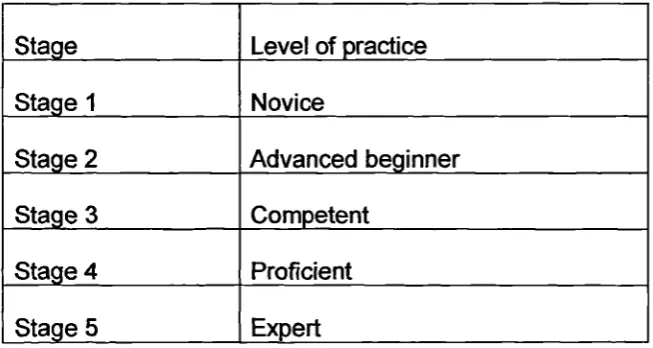
(Davids and Myers, 1990). Benner (1984) describes five levels of nursing
practice in moving from novice to expert practitioner (Table 2.4), based on the
work of Dreyfus and Dreyfus (1986). The five levels are distinguished through
the variation in cognitive processes and actual performance, synonymous with
[image:29.595.133.460.575.749.2]the knowledge and skills discussed in the definitions of expert and expertise.
Table 2.4: Benner's levels of practice
Stage Level of practice
Stage 1 Novice
Stage 2 Advanced beginner
Stage 3 Competent
Stage 4 Proficient
A further development to this evolving theory was through acknowledgement of
Schon's concept of 'reflection-in-action' (Schon, 1983), where the process of
reflection occurs in practice at the time of the activity. It is a continuous process
of the construction and evaluation of theories using knowledge and can
therefore be described through Kolb's learning cycle, although Schon (1983)
emphasised its on-the-spot nature. Reflection-in-action is therefore intrinsically
linked to processes of clinical reasoning and the development of informal
theories, and Schon (1987) contended that educational programmes should
therefore focus on the development of a student's capability for
reflection-in-action.
The concept of reflection-in-action has however generated debate within the
literature, particularly centred on the issue of time. Time for self-awareness and
reflection is limited in many clinical situations, limiting the scope for this form of
activity. Eraut (1994) therefore argues that in these situations,
reflection-in-action is best considered as a metacognitive process, with fast interpretation of
information and resultant decision-making. Eraut (1994) is therefore describing
refection-on-action as the more considered process that would develop
expertise, through the active development of theory. However, in exploring the
characteristics of expert practice that are collated from empirical research
(Table 2.6, p 56), the concept of reflection-in-action is implicit to a number of
them. It is probably a combination of the two reflective processes therefore that
is useful to the expert practitioner.
In physics, Chi et al (1981) found that experts were more aware of their errors
(1983) two concepts of reflection, and the concept of metacognition which is the
self-monitoring of one's thinking. The experts in Jensen et al's (2000) study
demonstrated effective metacognitive skills, in contrast to Embrey et al (1996)
who found that experts and novices demonstrated similar and frequent
self-monitoring, that perhaps places emphasis on the quality of the self-monitoring /
metacognitive processes occurring.
Carr and Kemmis (1986) defined the concept of developing theories through
reflection-in-action as 'informal theory'. They highlighted the value of informal
theory in guiding practice, as without this process, practice would be
uncoordinated and random in nature or tightly bound by rules. Rolfe (1997)
proposed that the use of informal theory and reflection-in-action contributes to a
'reflexive practitioner', a stage beyond the expert practitioner, concentrating on
even the simplest task, and learning from every task. However this definition of
a new level of practice is dependent on the acceptance of Benner's (1984)
description of an expert linked to intuition, which Rolfe (1997) interprets as a
level of automaticity and without thought. Automaticity, however, can
encompass high level skills that are performed at a level where conscious
monitoring is not required, enabling scope for other activities (Glaser, 1999), for
example, reflection-in-action.
Several characteristics of expertise are explicit in the above discussion. The two
consistent characteristics throughout the literature of knowledge and clinical
reasoning will be explored in depth later, but others will be considered here.
Carter et al (1987) evaluated teachers' plans for managing a class at short
are synonymous with Benner's (1984) evaluation of nurses:
3 Recall of meaningful facts, features and patterns
./ Higher level inferences from knowledge base
3 Prioritisation of data
3 Speed of accessing knowledge, and
3 The organisation of information
Benner (1984) also described an experts 'deep' understanding of a situation.
Similarly, Berliner (1988) found that experts applied meanings to photographs of
classrooms to a greater degree than novices, evaluating them for patterns and
inconsistencies. In addition, Berliner found that experts could multitask by
processing information concurrently from three sources, and that they had the
ability to gain different types of information from a single source. Jasper's (1994)
concept analysis of expert identified the four components of knowledge,
experience, pattern recognition and recognition by others. Although similar to
the issues identified above, this analysis was limited in its scope to nursing and
therefore did not explore the literature more widely, commencing with Benner's
model (1984) and framework.
Researchers exploring the characteristics of experts and novices have also
demonstrated differences related to the individual's ability to synthesise
knowledge and experience, to recognise the significance of critical cues, and to
be able to prioritise what is important (Elstein et al, 1978; Larkin et al, 1980;
Dreyfus and Dreyfus, 1986). Schmidt et al (1990) also found that expertise was
specific to individual cases and therefore closely linked to a practitioner's
2.5.4 Characteristics of expertise in physiotherapy
In physiotherapy, a number of qualitative studies (May and Dennis, 1991;
Jensen et al, 1992; King and Bithell, 1998; Jensen et al, 2000; Doody and
McAteer, 2002) afford insight into characteristics of expertise. Knowledge and
clinical reasoning are explored later but two of the studies are discussed here.
In a study of three experts and three novices in orthopaedic physiotherapy,
Jensen et al (1992) identified the importance of the organisation of knowledge,
and their control and management of a situation in distinguishing the expert.
The management of a situation relates back to the reflection-in-action described
by Schon (1983) with the practitioner constantly evaluating what they are doing
and what they need to do. This was however a small data set in a defined
clinical speciality and further work exploring these issues would be valuable, a
point well recognised by the authors.
Through a grounded theory approach using case study analysis, Jensen et al
(2000) identified four dimensions of expert practice in physiotherapy as
knowledge and clinical reasoning (explored later), and movement and virtues.
Evaluation of movement provided a framework for the assessment and
management of patients, perhaps highlighting how the central concepts of a
profession such as movement, inform an individual's model of expertise. This
perhaps provides a rationale for differences between professions and merits
further exploration. Virtues encompassed a commitment to learning, and a
caring attitude towards patients. However, this study investigated practitioners
from four specialities and any existing variations were not explored despite
Jensen et al (2000) also found that reflection was an important component of
practice for the experts. It was used actively to develop learning through their
experiences and particularly therefore their personal knowledge, although the
process of reflection was not explored relative to 'in-action' or 'on-action'
concepts.
2.6 Knowledge
2.6.1 Forms of knowledge
The complexity of knowledge is often oversimplified by describing it as
possessing two components of 'knowing that' and 'knowing how' (Williams,
1998). Eraut (1994, p 103) advocated use of the terms 'propositional, personal
and process' knowledge as a means of addressing this oversimplification and
the extensive use of varied terminology l . A key justification for the use of these
forms of knowledge in the context of this study is the distinction of personal and
process knowledge that is required to explore the existing evidence regarding
expertise. The classification used here is therefore in contrast to the concept of
'professional craft knowledge', which is argued as encompassing aspects of
Eraut's (1994) three forms of knowledge (Higgs and Andresen, 2001). Analysis
of the literature emphasises different notions concerning knowledge relevant to
this study, in particular: forms of knowledge, acquisition of knowledge,
interactivity of forms of knowledge, and the context of using knowledge.
Propositional knowledge as a form of knowledge is reflected throughout the
literature (Higgs and Andresen, 2001), and encompasses that knowledge
publicly available relating to discipline specific theories and concepts arising
from sources of systematic knowledge, including research.
Eraut (1994) recognises process (procedural) knowledge as:
"....knowing how to conduct the various processes that contribute to
professional action. This includes knowing how to access and make
good use of propositional knowledge" (p 107).
Process knowledge therefore encompasses clinical / psychomotor skills that are
central to healthcare practice.
In contrast, personal knowledge is that knowledge acquired by the individual
through experience, where experience and therefore experiential learning guide
the development of knowledge (Eraut, 1994). Some personal knowledge
develops into propositional / process knowledge, but it is the remaining personal
knowledge that is distinct to the other forms of knowledge and its contribution to
action that is poorly understood to date. In contrast to other classifications,
personal knowledge is therefore justified as a separate form of knowledge.
Eraut (1994) describes the remaining personal knowledge as 'impressions', that
with further experience are refined, organised and transformed into other forms
of knowledge. The impressions encompass information regarding experiences
and cases, which are at different stages of development depending upon the
degree of reflection and theorising that has occurred. Eraut (1994) links the
varying degrees of development of personal knowledge to the learning intent. If
if not, it is left as an impression. Through clinical practice and experiential
learning therefore, ongoing contributions are made to personal knowledge that
is continuously refined.
The acquisition of knowledge is commonly distinguished as that learnt through
formal teaching (e.g. a lecture) or that learnt through experience, reflecting
experiential learning (Kolb, 1984). The emphasis of personal knowledge as
reflected above is on knowledge acquisition through experiential learning,
whereas the emphasis of propositional knowledge is usually on formal teaching
and use of texts. In contrast, process knowledge can be acquired through both
means, for example, a skill may be learnt formally in a classroom but adapted
through experience. It has also been argued that propositions and therefore
propositional knowledge can also be developed through experience (Titchen
and Ersser, 2001). Eraut (1994) supports the acquisition of all forms of
knowledge through experience, but develops the argument one stage further to
contend also that some knowledge needs to be used in practice before it can
develop any meaning for an individual.
Although the different forms of knowledge constituting a professional's domain
specific knowledge appear distinct, in practice their boundaries are blurred and
each informs the others, and can be transformed into the others (Higgs et al,
2001). Their use is reflected by concurrent use of the different forms of
knowledge, emphasising their interactivity and interdependence (Figure 2.4).
For example, personal knowledge will include propositional and process
knowledge that is reviewed through the experience of using it in practice. New
Process knowledge Personal
knowledge
knowledge. The evaluation and development of new knowledge is therefore
important to professional development, and experts will constantly be learning,
necessitating concurrent use of all forms of knowledge, that are integrated and
[image:37.595.192.400.237.433.2]utilised in a purposeful way.
Figure 2.4: Representation of different forms of knowledge
Propositional knowledge
Eraut (1985) argued that use of knowledge is dependent upon context,
describing academic, organisational and action contexts. He went on to argue
that in an action context the practitioner is in a 'doing' situation and will use their
personal knowledge more than their propositional knowledge (Eraut, 1994).
Eraut's concept of an action context reflects the clinical environment for
healthcare professionals. This dependence of knowledge upon context is also
thought to facilitate intuitive functioning (Benner, 1984; Benner et al, 1996;
Paley, 1996) and is what Polanyi (1962) defined as 'tacit' knowledge. Dreyfus
and Dreyfus (1986) described tacit knowledge as the practitioner developing a
'feel' for the activity, so that they can do it without thinking, and its development
the rules that guided practice from their undergraduate education and their knowledge is transformed into knowledge that is individual, difficult to express, and linked to action (Cervero, 1988). Secondly, professionals monitor and evaluate their own practice to inform the subsequent development of this knowledge. The concept of intuition as defining expert practice (Benner, 1984) has however been questioned (English, 1993; Paley, 1996), with arguments centred on novices also using intuition.
2.6.2 Organisation of knowledge
In the absence of knowledge it is recognised that reasoning skills are limited in their value. Effective practitioners require a sound background knowledge that is relevant to the clinical area and organised into meaningful patterns (Norman, 1990). It has been suggested that cognitive structure is applied through
knowledge that is connected to specific conditions (Glaser and Chi, 1988). The assumption is that the organisation of knowledge stored from past experiences, enables retrieval and comparison to current cases. Expertise is therefore
thought to be related to the structure of subject specific domain knowledge that is stored in long-term memory (Anderson, 1987; Eysenck and Keane, 1990).
Clarity of what is meant by the organisation of knowledge is however still elusive, despite researchers in a variety of disciplines attempting to represent
activity reflected in a meaningful string of moves. The complexity characterised
by the experts reflected a greater number of moves within the 'chunk'. In
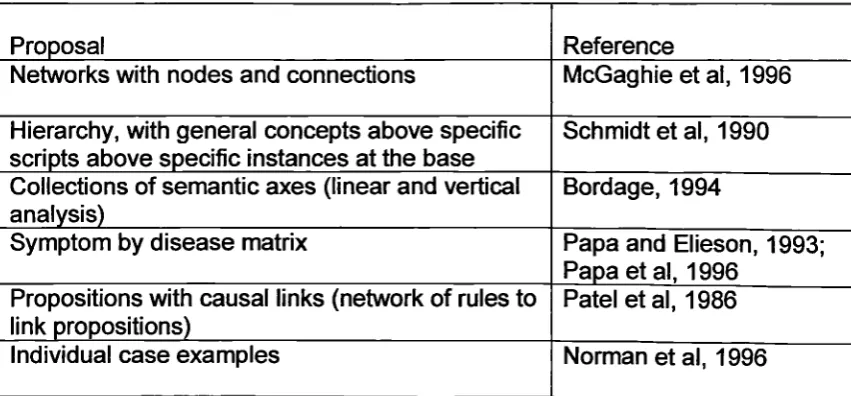
medicine, several proposals have developed regarding the organisation of
knowledge (Table 2.5), and their scope highlights the complexities of the
cognitive ability and chunking. However one limitation of extrapolating the
proposals is the focus of the studies on patient diagnosis, reflecting one aspect
of practice. This therefore limits generalisation to other healthcare professions
where the emphasis may be on management rather than diagnosis, although
the findings provide a useful basis for understanding and future research.
Exploring the literature related to errors of diagnosis also informs this argument
as several studies have demonstrated that errors are not as a consequence of
inadequate knowledge, but due to the inability to retrieve knowledge stored in
[image:39.595.79.505.520.718.2]memory (Bordage and Zacks, 1984; Bordage and Lemieux, 1991).
Table 2.5: Proposals regarding the organisation of knowledge from empirical
studies in medicine
Proposal Reference
Networks with nodes and connections McGaghie et al, 1996
Hierarchy, with general concepts above specific scripts above specific instances at the base
Schmidt et al, 1990
Collections of semantic axes (linear and vertical analysis)
Bordage, 1994
Symptom by disease matrix Papa and Elieson, 1993;
Papa et al, 1996 Propositions with causal links (network of rules to
link propositions)
Patel et al, 1986
It has been argued that central to this organisation of knowledge is the
understanding developed through the use of propositional knowledge (Chi et al,
1981; Feltovich and Barrows, 1984; Lesgold et al, 1988). This idea is supported
through the theoretical work of Jones (1992) who contends that knowledge is
used through the assistance of principles or rules. However, other authors have
challenged this perspective and suggested that personal knowledge is more
important (Patel and Groen, 1986; Schmidt et al, 1990; Eraut, 1994) with rules
superseded through the development of knowledge (Jarvis, 1992), and reliance
on propositional knowledge characterising the reasoning of novices.
These opposing perspectives are each supported by empirical research. For
example Patel and Groen (1986) found that expert cardiologists provided less
extensive pathophysiological explanations compared to novice students, while
Lesgold et al (1988), in two studies of residents and expert radiologists found
that the biomedical knowledge used by experts was more precise and applied in
greater detail. However, a limitation of this research is the low number of
participants in expert and novice groups, the definition of expert not being
comparable between studies, the opposing perspectives being supported by
two contrasting groups of researchers, and the reliance on think aloud or post
hoc procedures. The retrospective think aloud procedure is inherently isolated
from the ongoing decision-making that occurs in everyday practice, a criticism
supported by the move away from think aloud accounts by key researchers
(Elstein, 2000). The think aloud protocol does however attempt to access
ongoing reasoning, which methodologically may be preferable to reflections on
a case through a post hoc methodology. However, Boshuizen and Schmidt
results supported the greater emphasis on personal knowledge. Taking into
account the empirical findings and the limitations of the studies, in agreement
with Eraut (1994) there appears to be some support for the use of propositional
knowledge reducing and the use of personal knowledge increasing as expertise
develops. Several possible explanations have been proposed that emphasise
the interactivity of the different forms of knowledge, for example propositional
knowledge becoming encapsulated in personal knowledge and applied in a tacit
manner (Boshuizen and Schmidt, 1992), with this developing automaticity
affording greater capacity for attention to other issues.
The medical literature has provided considerable evidence that 'expert'
practitioners often do not agree with one another (McGaghie et al, 1994; Wolf et
al, 1994, Hatala et al, 1996), supporting Benner et al's observations (1996) that
experts have different possible ways of managing a situation. This suggests that
organisation of knowledge is not consistent across experts within a particular
area, for example McGaghie et al (1994) found more variation in
anaethesiologists' data compared to general internists when exploring concepts
of pulmonary physiology. Their study was however limited by use of a new
method for exploring knowledge structure based upon an assumption of a
particular proposal of organisation, and the use of small convenience samples
that were then analysed using inferential analysis.
2.6.3 Organisation of knowledge in other professions and specialities
The concept of domain specific knowledge is difficult to research, and this
knowledge in other healthcare professions. Benner (1984) argued that nurse
experts manage complex problems by using a body of personal knowledge that
is constituted by a range of similar situations encountered previously, and this
emphasis on the value of personal knowledge is clear across the professions
(Rolfe, 1997; Higgs and Titchen, 2001), and supported by Jensen et al's (2000)
study, where the patient was the key source of knowledge to the
physiotherapist. The patient as a source of knowledge introduces the variability
of their cognitive ability and values systems that will therefore influence a
practitioner's personal knowledge.
Reischman and Yarandi (2002) concluded that experts in nursing cognitively
structure problems differently to novices. However, this conclusion was based
on the recognition of highly relevant (HRC) and total number of cues (TC) for
patient diagnosis, with the key assumption that the index of HRC/TC is an
indicator of effective processing. The results are therefore interesting but need
to be followed up with further research. The authors also observed that two of
the four case presentations appeared easier for the experts, and felt that the
easier two were characterised by more distinctive patterns, perhaps enabling
easier access to domain specific knowledge. However, it may also relate to
previous exposure to that case presentation (Schmidt et al, 1990; Brooks et al,
1991), linking to pattern recognition (Section 2.7.4).
In occupational therapy, Robertson (1996) found that experts possessed
well-developed schemata of previous clinical experience. Their organisation of
knowledge enabled reasonable predictions to be made confidently, in contrast
and understanding of their clinical environment. However the experts in this
study were practitioners with no further detail provided and the novices were 2'd
and 3rd year undergraduate students, limiting comparison and generalisation of
the findings. Similarly to Jensen et al (1992), the researchers also found that the
practitioner's representation of a problem was patient-centred, in contrast to the
students who gained the patient's perspective but were unable to integrate it
within the 'whole'. This finding characterises the practitioners at Benner's (1984)
stage of 'advanced beginner' where the practitioner is able to relate to the
patient as an individual. Some authors (Dreyfus and Dreyfus, 1986; Robertson,
1996) have explained these difficulties through a deficit of personal knowledge
regarding the situation. There are however other possible explanations, with the
predominance of a medical model within healthcare consciously, and perhaps
now subconsciously contributing to an emphasis on biomedical issues as
opposed to the patient's perspective.
In contrast to the above emphasis on personal knowledge, Jensen et al (1992)
also recognised experts as possessing more process knowledge, as they knew
when they needed to gather further information and knew how to go about it in a
selective manner, therefore linking the concept of expertise to process
knowledge. This is supported by the work of Cervero (1988) who contended
that an expert's propositional knowledge remains static, compared to their
dynamic process knowledge that is transformational, and by Chi et al (1981)
who found experts' schemata characterised by process knowledge. In reality
however, experts have probably developed all forms of knowledge (Jasper,
1994), and its integration and organisation, with greatest emphasis on personal
Process knowledge (encompassing clinical skills) Personal
[image:44.595.161.488.122.330.2]knowledge
Figure 2.5: Representation of use of the different forms of knowledge in an
expert healthcare practitioner
Propositional knowledge
2.6.4 Conclusions regarding knowledge
The organisation of knowledge, encompassing its acquisition and retrieval, is
therefore justified as the central feature of expertise (Table 2.6) in a synthesis of
the existing empirical evidence. The value placed upon knowledge also links
effectively to Masters level. Gerrish et al (2000) had identified the importance of
developing the scope of knowledge in addressing depth and breadth, in
assisting the organisation of existing knowledge and the establishment of links
to new knowledge through the patterns that exist. There is some contention
therefore to the QAA's (1998), and Davis and Burnard's (1992) emphasis on
depth from the Professors, through a narrow, research informed deepening of
knowledge at Masters level, and it is interesting that the narrow focus on
2.7 Clinical Reasoning
2.7.1 Background
The descriptions of clinical reasoning and problem solving are used
synonymously within the literature to describe processes that have similar
stages. For the purposes of this review, the term clinical reasoning has been
used throughout to reflect the current terminology in healthcare (Higgs and
Jones, 2000; Rushton, 2002). Clinical reasoning is defined as the cognitive
processes used in the assessment and management of patients (Jones, 1992).
The origin of the literature exploring clinical reasoning is again from medicine,
and based on the past 30 years of research a clear understanding of aspects of
the process have developed. This literature has subsequently been elaborated
into research exploring other healthcare professions. It is therefore prudent to
commence with an analysis of clinical reasoning in medicine.
2.7.2 Clinical reasoning in medicine
The emphasis of the research in clinical reasoning has predominantly focused
on the issue of diagnosis. The initial research was focused on 'clinical reasoning
skills' that could be used in any clinical situation (Norman, 2000). However, as
the research evolved, and in particular practitioners demonstrated poor
generalisability from one problem to another (Shulman et al, 1978), it became
clear that knowledge was the key component to reasoning (Ericsson and Smith,
2.7.3 Diagnostic reasoning
Diagnostic reasoning is one component of clinical reasoning, although it has
received greatest attention in the literature to date. Diagnosis has been defined
as a central feature of medical reasoning, and has arguably become
increasingly important for other healthcare professions with the changing NHS
culture and the increased emphasis on autonomous practice (DOH, 2000a).
Cognitive theories have positioned medical diagnosis as a process of
reasoning, with the representation of the problem, the practitioner's internal
model of the problem as the central feature (Feltovich and Barrows, 1984). This
representation has been described as an 'illness script', enabling organisation of
all of the information (Schmidt et al, 1990).
From the outset, diagnostic reasoning has been observed as a process of
hypothesis testing, a hypothetico-deductive process. Diagnostic problems were
resolved through the early generation of hypotheses. Each formed hypothesis is
linked to further clinical findings that would be present if it follows through to be
the correct hypothesis, and this then guides the collection of further data
(Elstein et al, 1978). Cue acquisition and hypothesis generation were identified
as important components, and through research they were identified as
common to all practitioners. Elstein's et al's (1978) model was completed with
the stages of cue interpretation and hypothesis evaluation. Hypothesis
formation is central to overcoming limitations of memory capacity, as this
enables narrowing of the area of memory searched for a solution. The quality of
the hypotheses are consequently central to the correct diagnosis and
expert practitioners form initial hypotheses earlier than novices, and the quality
of their hypotheses is superior (Elstein and Schwarz, 2002).
2.7.4 Pattern recognition
Research subsequently demonstrated that experts do not always use
hypothetico-deductive processes in situations that are familiar (Schmidt et al,
1990; Brooks et al, 1991). Through the framework of the diagnostic model of
reasoning, a process of pattern recognition was proposed. The concept of
pattern recognition was first introduced into the expertise literature through the
studies in chess (de Groot, 1965; Chase and Simon, 1973), and was
subsequently adopted into medicine, as experts were observed recalling
knowledge through a pattern that was thought to increase the size of the
'chunks' stored in memory (Simon and Gilmartin, 1973). Hypothetico-deductive
reasoning was subsequently seen as used by experts for unfamiliar or complex
cases, otherwise pattern recognition was used (Patel and Groen, 1986).
Pattern recognition is also described as categorisation, as a patient case is
assigned by the practitioner to a category (Elstein and Schwarz, 2002). This
process of assignment has been described as occurring in different ways.
Firstly, through a matching process that categorises a case according to its
similarity to previous cases (Schmidt et al, 1990; Brooks et al, 1991). Further
support to this model is afforded by Norman et al (1996) who found that the
process of diagnosis is also influenced by context, for example the position of a
skin rash on the body. However all of this work is from the same group of
setting out to explore similar research questions. Secondly, other authors have
observed clinical experience enabling the development of mental models or
prototypes (Rosch and Mervis, 1975; Bordage and Zacks, 1984). Support for
this proposal is provided through the ability of experts to recognise the findings
that would complete a clinical picture, suggesting a complex network of links
between possible diagnoses and clinical features (Lemieux and Bordage,
1992). Although there are different proposals for how the process operates,
there is consensus that pattern recognition exists within medicine, and this
process lends further support to the emphasis on the organisation of knowledge
and the role of personal knowledge in particular in experts.
Research investigating visual pattern recognition skills in medicine has
suggested that greater experience reflected by exposure to prior examples,
develops the ability to utilise pattern recognition to identify typical cases / illness
scripts (Schmidt et al, 1990; Norman et al, 1996). A role for experience of
specific presentations is also advocated by Regehr et al (1994), who found that
pattern recognition assisted accurate diagnosis, and was not affected by
deliberate manipulation of data as was hypothetico-deductive processing.
However, in following through the arguments regarding the organisation of
knowledge, illness scripts can be developed differently by practitioners
depending upon their experiences with patients. Therefore, for the same
disease, Schmidt et al (1990) argued that practitioners might have different
scripts. This variation is also to be expected as every patient presents
differently, highlighting the complexity of clinical reasoning in healthcare. Again,
the role of reflective and evaluative practice to inform the development of such
2.7.5 Clinical reasoning across professions and specialities
Generalisation of the medical work on clinical reasoning to other healthcare
professions is problematic as the emphasis has been on diagnostic reasoning,
in contrast to other healthcare professions where the greater emphasis may be
on management (Roberts, 1996). However, it has also been argued that the
issue of diagnosis is central to models of clinical reasoning for all healthcare
professions (Higgs and Jones, 2000), hence the justification for the emphasis of
the literature within this review, and in practice it may be the actual term
'diagnosis' that is problematic and the medical connotations that it implies.
There is some empirical evidence from several professions to support adoption
of this research to provide the basis for further investigation. For example, in
nursing it has been demonstrated that nurses use hypothetico-deductive
processes during diagnosis (Gordon, 1980; Tanner et al, 1987). Tanner et al
(1987) found early generation of hypotheses and Gordon (1980) observed a
relationship between cue quality and the order of testing hypotheses. However,
these studies represent preliminary work in this area that requires further
consideration.
2.7.6 Clinical reasoning in physiotherapy
In physiotherapy, there has been increasing attention within the literature to
clinical reasoning. However, the majority of the literature is theoretical in nature
based upon the findings from medicine, with little empirical research. Payton
(1985) investigated 10 physiotherapy experts across a variety of specialist