University of Warwick institutional repository
This paper is made available online in accordance with
publisher policies. Please scroll down to view the document
itself. Please refer to the repository record for this item and our
policy information available from the repository home page for
further information.
To see the final version of this paper please visit the publisher’s website.
Access to the published version may require a subscription.
Author(s): Simon Gates, Mark A Williams, Emma Withers, Esther
Williamson, Shahrul Mt-Isa, and Sarah E Lamb
Article Title: Does a monetary incentive improve the response to a
postal questionnaire in a randomised controlled trial? The MINT
incentive study
Year of publication: 2009
Link to published version :
Open Access
Research
Does a monetary incentive improve the response to a postal
questionnaire in a randomised controlled trial? The MINT incentive
study
Simon Gates*
1, Mark A Williams
1, Emma Withers
1, Esther Williamson
1,
Shahrul Mt-Isa
2and Sarah E Lamb
1Address: 1Warwick Medical School Clinical Trials Unit, University of Warwick, Coventry, UK and 2Division of Epidemiology, Dept of
Epidemiology & Public Health, Imperial College London, St Mary's Campus, Norfolk Place, London, UK
Email: Simon Gates* - [email protected]; Mark A Williams - [email protected];
Emma Withers - [email protected]; Esther Williamson - [email protected]; Shahrul Mt-Isa - [email protected]; Sarah E Lamb - [email protected]
* Corresponding author
Abstract
Background: Sending a monetary incentive with postal questionnaires has been found to improve the proportion of responders, in research in non-healthcare settings. However, there is little research on use of incentives to improve follow-up rates in clinical trials, and existing studies are inconclusive. We conducted a randomised trial among participants in the Managing Injuries of the Neck Trial (MINT) to investigate the effects on the proportion of questionnaires returned and overall non-response of sending a £5 gift voucher with a follow-up questionnaire.
Methods: Participants in MINT were randomised to receive either: (a) a £5 gift voucher (incentive group) or (b) no gift voucher (no incentive group), with their 4 month or 8 month follow-up questionnaire. We recorded, for each group, the number of questionnaires returned, the number returned without any chasing from the study office, the overall number of non-responders (after all chasing efforts by the study office), and the costs of following up each group.
Results: 2144 participants were randomised, 1070 to the incentive group and 1074 to the no incentive group. The proportion of questionnaires returned (RR 1.10 (95% CI 1.05, 1.16)) and the proportion returned without chasing (RR 1.14 (95% CI 1.05, 1.24) were higher in the incentive group, and the overall non-response rate was lower (RR 0.68 (95% CI 0.53, 0.87)). Adjustment for injury severity and hospital of recruitment to MINT made no difference to these results, and there were no differences in results between the 4-month and 8-month follow up questionnaires. Analysis of costs suggested a cost of £67.29 per additional questionnaire returned.
Conclusion: Monetary incentives may be an effective way to increase the proportion of postal questionnaires returned and minimise loss to follow-up in clinical trials.
Trial registration number: ISRCTN61305297
Published: 22 June 2009
Trials 2009, 10:44 doi:10.1186/1745-6215-10-44
Received: 9 March 2009 Accepted: 22 June 2009
This article is available from: http://www.trialsjournal.com/content/10/1/44
© 2009 Gates et al; licensee BioMed Central Ltd.
Trials 2009, 10:44 http://www.trialsjournal.com/content/10/1/44
Background
Postal questionnaires to participants are used by many randomised controlled trials and other research studies as a method of data collection, especially for long-term fol-low-up collecting data on quality of life, resource use and patient-reported outcome measures. Failure to return questionnaires results in missing data, which could poten-tially introduce bias into the trial's results, and strategies are therefore frequently employed to promote question-naire return. Often this involves a system of follow-up contacts by post and telephone to ensure that data are col-lected from as many participants as possible. This type of system is labour-intensive, especially if large numbers of questionnaires need to be chased, and other methods of improving questionnaire return rates may also be useful.
The use of a monetary incentive sent with the question-naire is an easily implemented strategy that may help to increase the proportion returned. A Cochrane systematic review of randomised trials of monetary incentives to pro-mote questionnaire return showed that this intervention was effective (OR 1.99, 95% CI 1.81, 2.18).[1] However, the majority of the studies in this review were not con-ducted in healthcare settings and none of them involved participants in clinical trials. The relevance of this result to follow-up in clinical trials is therefore questionable. A recent systematic review of the use of incentives in health care settings[2] did not show an improvement in ques-tionnaire return (OR 1.09, 95% CI 0.94, 1.27); however, this analysis included only four studies, and two more recent studies[3,4] have suggested that monetary incen-tives may have a beneficial effect. There is therefore uncer-tainty as to whether monetary incentives are effective, and further research is justified.
Use of incentives involves an additional cost (of the incen-tive itself), but, if the proportion returned is improved, costs involved in following up questionnaires by tele-phone and post may be saved. Monetary incentives may therefore be able to achieve a useful increase in response at little or no additional cost. Only one study, an observa-tional study conducted alongside a randomised trial in primary care[5], has estimated the costs of using incen-tives, and it found an additional cost per extra question-naire returned of £48.28. However, the calculation did not include the costs of staff time, so it is possible that, if using an incentive reduced the effort in chasing non-returned questionnaires, the true additional cost would be lower than this.
Here we report the results of the MINT incentive study, a randomised controlled trial of a £5 incentive, conducted alongside the Managing Injuries of the Neck Trial (MINT).[6] MINT was a cluster randomised trial of advice interventions given in emergency departments to patients
presenting with acute whiplash injuries, in which eligible patients were identified by participating emergency departments. Participants were then followed up by postal questionnaires sent from the study office, 4, 8 and 12 months after their injury
Methods
We included participants in MINT who were being sent a follow-up questionnaire at 4 months or 8 months after their whiplash injury. Each participant was randomised into the incentive study only once; participants who were randomised to receive an incentive or no incentive with their 4 month questionnaire were not randomised again when they reached the 8 month follow-up. We used both follow-up time points to maximise the number of partici-pants that could be included. When the incentive study started, MINT had already been recruiting for about 16 months, and hence randomising participants to incentive or no incentive at only the 4 month time point would have restricted the sample size available. Because the 4 month and 8 month questionnaires were identical, it was reasonable to include both of them in the incentive study, enabling us to randomise participants who had already passed the 4 month follow-up point. The follow-up ques-tionnaires consisted of the Neck Disability Index (NDI)[7], two standard quality of life measures (SF-12 and EQ-5D), and questions on resource use and beliefs about neck pain. The total number of questions was 49. The questionnaire consisted of 15 A4 sized pages, and was sent out with a personalised covering letter and prepaid return envelope. The trial's standard method of chasing non-returned questionnaires was used. This was as fol-lows: a second copy of the questionnaire was sent after two weeks, followed by up to three attempts to make con-tact by telephone to request return of the questionnaire. Finally, participants were offered the option to provide the most important outcome data by telephone. The ques-tionnaire sent at the 12 month follow-up was slightly dif-ferent, so this time point was not included in the incentive study.
We estimated that a sample size of 2,160 (1,080 per arm) would be sufficient to demonstrate an increase in ques-tionnaire return from 53% (the proportion of 4 month follow-up questionnaires returned in the early part of MINT, at the time of planning the incentive study) in the no incentive group, to 60% in the incentive group, at 5% significance level with 90% power (risk ratio of 1.13).
We used risk ratios (RR) and their 95% confidence inter-vals to compare the proportions of questionnaires returned, the proportion returned without any chasing, and the proportions of participants classified as non-responders after all chasing efforts, between the incentive and no incentive arms. We performed logistic regression analyses to explore the effects of adjusting for potential baseline imbalances in hospital of recruitment and sever-ity of injury. We also performed a subgroup analysis to investigate whether there was any evidence of different effects of incentives at the 4 month and 8 month time points.
We also estimated the cost of following up each group, including the costs of printing questionnaires and enve-lopes, postage, and staff time to make follow-up tele-phone calls (using average durations of calls estimated by the trial staff, and 2007 salary data), as well as the costs of the incentives themselves.
Results
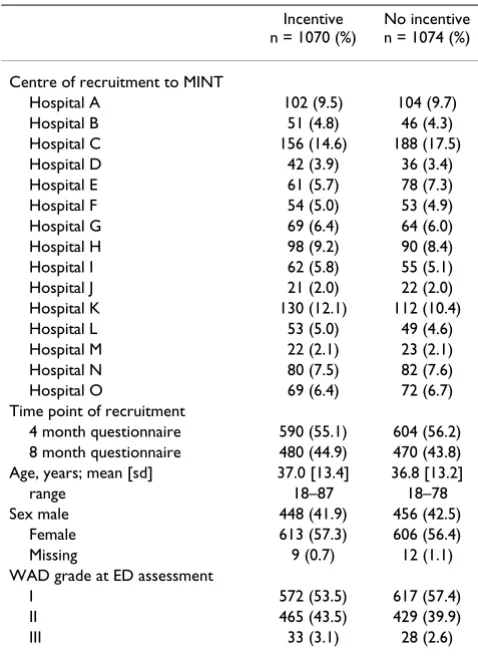
Baseline characteristics (Table 1)
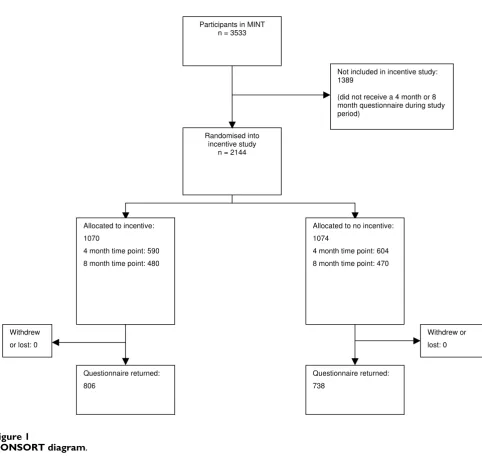
The total number of participants in the incentive study was 2,144 (Figure 1). Of these, 1,194 were randomised at the 4 month time point, and 950 at 8 months. Balance between the study arms in patient characteristics and cen-tre of recruitment to MINT was good. There were only small imbalances in centre of recruitment and in severity of injury, measured by the WAD (Whiplash Associated Disorder) grading system[8].
Effects of incentives (Table 2)
People who received an incentive were more likely to return the questionnaire (RR 1.10 (95% confidence inter-val (CI) 1.05, 1.16)), more likely to return the question-naire without the need for any chasing by the study office (i.e. sending a second copy of the questionnaire and sub-sequent phone calls) (RR 1.14 (95% CI 1.05, 1.24), and less likely to be a non-responder after all data-chasing efforts (including collection of core outcomes by tele-phone for people who did not return the questionnaire) (RR 0.68 (95% CI 0.53, 0.87)). The risk difference for return of the questionnaire was +0.07 (95% CI +0.03, +0.11); this corresponds to 14 incentives being sent for one additional questionnaire returned. There was no dif-ference in the time taken to return questionnaires (mean difference = -0.55 days (95% CI -2.27, 1.17). The
sub-group analysis showed no evidence of different effects at the 4 month and 8 month time points (Table 3). Among participants randomised at the 4-month time point, there was a small improvement in the proportion of 8 month questionnaires returned in the incentive group (incentive group 511/590, no incentive group 492/604, RR 1.06 (95% CI 1.01, 1.12).
Logistic regression controlling for hospital of recruitment to MINT and WAD grade showed that the results for ques-tionnaire return were unaffected. The unadjusted odds ratio for incentive versus no incentive was 1.43 (95% CI 1.17, 1.72); adjustment for hospital of recruitment had a very small effect (χ2 = 20.31, 14 df, p = 0.12, adjusted OR 1.42 (95% CI 1.18, 1.72)), as did adjustment for WAD grade (χ2 = 2.45, 2 df, p = 0.29, adjusted OR 1.41 (95% CI 1.17, 1.72)).
[image:4.612.313.552.99.428.2]The analysis of costs (Table 4) showed an average cost per participant of £9.35 in the incentive group and £4.64 in the no incentive group. Costs per questionnaire returned were £12.35 in the incentive group and £6.76 in the no incentive group. The cost per additional questionnaire returned was £67.29 and the cost per additional overall
Table 1: Baseline characteristics
Incentive n = 1070 (%)
No incentive n = 1074 (%)
Centre of recruitment to MINT
Hospital A 102 (9.5) 104 (9.7) Hospital B 51 (4.8) 46 (4.3) Hospital C 156 (14.6) 188 (17.5) Hospital D 42 (3.9) 36 (3.4) Hospital E 61 (5.7) 78 (7.3) Hospital F 54 (5.0) 53 (4.9) Hospital G 69 (6.4) 64 (6.0) Hospital H 98 (9.2) 90 (8.4) Hospital I 62 (5.8) 55 (5.1) Hospital J 21 (2.0) 22 (2.0) Hospital K 130 (12.1) 112 (10.4) Hospital L 53 (5.0) 49 (4.6) Hospital M 22 (2.1) 23 (2.1) Hospital N 80 (7.5) 82 (7.6) Hospital O 69 (6.4) 72 (6.7) Time point of recruitment
4 month questionnaire 590 (55.1) 604 (56.2) 8 month questionnaire 480 (44.9) 470 (43.8) Age, years; mean [sd] 37.0 [13.4] 36.8 [13.2]
range 18–87 18–78
Sex male 448 (41.9) 456 (42.5) Female 613 (57.3) 606 (56.4) Missing 9 (0.7) 12 (1.1) WAD grade at ED assessment
I 572 (53.5) 617 (57.4) II 465 (43.5) 429 (39.9)
Trials 2009, 10:44 http://www.trialsjournal.com/content/10/1/44
CONSORT diagram Figure 1
CONSORT diagram.
Randomised into incentive study
n = 2144 Participants in MINT
n = 3533
Not included in incentive study: 1389
(did not receive a 4 month or 8 month questionnaire during study period)
Questionnaire returned: 806
Questionnaire returned: 738
Allocated to incentive:
1070
4 month time point: 590 8 month time point: 480
Allocated to no incentive:
1074
4 month time point: 604 8 month time point: 470
Withdrew
or lost: 0
Withdrew or
[image:5.612.62.544.87.543.2]lost: 0
Table 2: Outcomes
Incentive n = 1070 (%)
No incentive n = 1074 (%)
Risk ratio
response (including data collection by telephone) was £110.62.
Discussion
In this trial, sending an incentive resulted in an increase in the proportion of questionnaires returned and a decrease in the number of non-responders. This indicates that incentives may be able to give a useful improvement in questionnaire return and help to reduce the quantity of missing data in trials, and hence improve the quality of evidence they provide. In the population studied here, sending an incentive produced a moderate improvement in questionnaire return for minimal extra effort on the part of the trial staff. The size of the increase in the propor-tion returned (an absolute difference of 7%) was similar to that found by two other recent studies. Dirmaier et al[3], in a study of patients being followed up after inpa-tient treatment for mental health problems, found a 7.3% increase with a small monetary incentive (with a value of 5 Deutschmarks), and Kenyon et al[4] found an improve-ment of 11.7% with a £5 gift voucher, in a study of long-term follow-up of participants in a randomised trial of antibiotics for preterm labour[9,10].
The main cost involved in using incentives is the addi-tional cost of the incentives themselves. These costs were not offset by a corresponding reduction in the costs of chasing non-returned questionnaires; the difference in cost per participant between the incentive and no incen-tive groups was close to the cost of the incenincen-tive. The cost per additional questionnaire returned was about £67, which is comparable to the cost estimated by Brealey et al[5]. In a trial of 1000 patients, therefore, the additional cost to improve the proportion of questionnaires returned by 7% would be less than £5,000. This is a small amount in the context of current trial budgets, where the cost per recruit often exceeds £1,000, and provision of an uncon-ditional incentive is therefore a feasible strategy.
[image:6.612.54.553.100.220.2]We used a quasi-randomisation procedure rather than true randomisation to allocate participants to the incen-tive and non-incenincen-tive arms. This was adopted because of the practical difficulty of performing a true randomisation at the time questionnaires were sent out. The study num-bers were allocated consecutively in the hospital emer-gency departments at the time that that potential participants were first identified. Not all of these patients agreed to join MINT, hence the trial population did not contain exactly equal numbers of participants with odd
Table 3: Subgroup analysis
4 month questionnaire 8 month questionnaire Incentive
n = 590 (%)
No incentive n = 604 (%)
Incentive n = 480 (%)
No incentive n = 470 (%)
Interaction stats
Ratio of RR, 4 months versus 8 months (95% CI)
Questionnaire returned 473 (80.2) 435 (72.0) 337(70.2) 303 (64.5) 1.02 (0.92, 1.14) Questionnaire returned without chasing 338 (57.3) 287 (47.5) 222 (46.3) 206 (43.8) 1.14
(0.96, 1.37) Non-responder (after all follow-up efforts) 46 (7.8) 73 (12.1) 50 (10.4) 69 (14.7) 0.91
(0.56, 1.48)
Table 4: Costs
Number
Cost Incentive No incentive
Randomised 1070 1074
Initial mailing (printing, envelope, postage) £1.25 1070 1074
Incentive £5 1070 0
Repeat copy of mailing (printing, envelope, postage) £1.25 504 577
First follow-up phone call £0.90 808 844
Second follow-up phone call £0.90 497 578
Telephone data collection – unsuccessful £1.09 396 472 Telephone data collection – successful £6.54 101 115
Questionnaire returned £0.52 810 738
Cost per participant randomised £9.35 £4.64
[image:6.612.58.553.565.730.2]Trials 2009, 10:44 http://www.trialsjournal.com/content/10/1/44
and even digits. It is extremely unlikely that there was any association between odd and even digits and any patient characteristics, and therefore there were unlikely to have been any systematic differences between the incentive and no-incentive groups. The lack of concealment of alloca-tions before randomisation was not a major concern because it would have been very difficult for the staff in the study office who were sending out the questionnaires to have selectively allocated systematically different patients to the trial arms. Similarly, although the trial office staff were unblinded, this was very unlikely to have introduced bias, as they had no influence over any partic-ipant's decision to return the questionnaire, and postal and telephone follow-up contacts were performed in a standardised way for all participants, without any refer-ence to whether or not they were participating in the incentive study.
In this study we regarded vouchers as a monetary incen-tive, but it is not known if they are valued in the same way as cash, or whether the effects of a cash incentive would be similar. It seems likely that this type of voucher, which can be exchanged for goods in a large number of shops, in the same way as cash, would be valued by recipients similarly to cash. Several trials of non-monetary incentive were included in the Cochrane review[1], and were analysed separately from monetary incentives. These non-mone-tary incentives included small gifts such as pens, lottery tickets, entry to a prize draw, or donations to charity. Our view is that the vouchers evaluated in this trial would be valued much more similarly to cash than to these types of non-monetary incentive.
Several questions remain about the use of monetary incentives to promote questionnaire return. It is not yet clear whether (and how) the effectiveness of incentives varies between different populations and different types of trial. Incentives have not yet been tested in a wide enough variety of populations to be confident of their general applicability. It is possible that they may be most useful in situations where proportions returned are often low, for example in trials of acute injuries, where most participants will have recovered by the time of follow-up and may have little motivation to return questionnaires. The most cost-effective size of incentive is uncertain; for convenience we followed an earlier study in using a £5 gift voucher, but it is not known whether a smaller incentive would have been equally effective, or a larger one more effective. Existing evidence, from a systematic review of trials mainly in non-patient populations, suggests that there is a non-linear relationship between the size of the incentive and the improvement in response.[11] In this review there was an increase in the odds ratio for response up to an incentive size of $5 (US), but no further increase beyond this.
This study adds to the evidence that incentives may be an effective means of reducing the amount of missing data with postal data collection in clinical trials. Questions remain about how they might best be used. In this study we used an "unconditional" incentive, that was sent out with the questionnaire, rather than a "conditional" incen-tive, provided only once a questionnaire is returned[1]. Existing evidence suggests that unconditional incentives are more effective, and they are also administratively sim-pler. However, almost all of this evidence is not from par-ticipants in health research studies, and its applicability to these populations is unknown. Furthermore, in many research studies (including MINT), participants are fol-lowed up at several time points, and the aim is to sustain a high rate of questionnaire return over a year or more. The most cost-effective use of incentives in this situation is uncertain. It may be most effective, but also most costly, to send an incentive with every questionnaire, but there is a possibility that effectiveness might decline with repeti-tion, resulting in a lower proportion returned for later questionnaires. If the primary outcome is measured at one particular time point, an incentive could be used for this questionnaire only, but this may risk a poor response at earlier time points. Alternatively, it may be best to send an incentive with the first questionnaire, as its effects may carry over to subsequent time points. Our results in this study suggest that there may be some "carry over" effect, as receipt of an incentive with the 4 month questionnaire improved the proportion of 8 month questionnaires returned.
Conclusion
A small financial incentive in the form of a £5 gift voucher gave an absolute increase in the proportion of question-naires returned of about 7% and a relative increase of 10%. The cost per additional questionnaire returned was low.
Competing interests
The authors declare that they have no competing interests.
Authors' contributions
SG, SEL, MAW and EmW were responsible for the study conception and design. MAW, EmW, EsW and SMI were responsible for the study conduct. EmW, SMI and MAW were responsible for data management. SG was responsi-ble for analysis and drafting the manuscript. All authors were responsible for revising the manuscript.
Acknowledgements
Publish with BioMed Central and every scientist can read your work free of charge
"BioMed Central will be the most significant development for disseminating the results of biomedical researc h in our lifetime."
Sir Paul Nurse, Cancer Research UK
Your research papers will be:
available free of charge to the entire biomedical community
peer reviewed and published immediately upon acceptance
cited in PubMed and archived on PubMed Central
yours — you keep the copyright
Submit your manuscript here:
http://www.biomedcentral.com/info/publishing_adv.asp
BioMedcentral
those of the authors and do not necessarily reflect those of the Department of Health.
References
1. Edwards PJ, Roberts IG, Clarke MJ, DiGuiseppi C, Wentz R, Kwan I, Cooper R, Felix L, Pratap S: Methods to increase response rates to postal questionnaires. Cochrane Database Syst Rev 2007, 18(2):MR000008.
2. Nakash RA, Hutton JL, Jorstad-Stein EC, Gates S, Lamb SE, Nakash RA, Hutton JL, Jorstad-Stein EC, Gates S, Lamb SE: Maximising response to postal questionnaires-a systematic review of randomised trials in health research. BMC Med Res Methodol
2006, 6:5.
3. Dirmaier J, Harfst T, Koch U, Schulz H, Dirmaier J, Harfst T, Koch U, Schulz H: Incentives increased return rates but did not influ-ence partial nonresponse or treatment outcome in a rand-omized trial. J Clin Epidemiol 2007, 60(12):1263-1270.
4. Kenyon S, Pike K, Jones D, Taylor D, Salt A, Marlow N, Brocklehurst P, Kenyon S, Pike K, Jones D, et al.: The effect of a monetary incentive on return of a postal health and development ques-tionnaire: a randomised trial [ISRCTN53994660]. BMC Health Serv Res 2005, 5:55.
5. Brealey SD, Atwell C, Bryan S, Coulton S, Cox H, Cross B, Fylan F, Garratt A, Gilbert FJ, Gillan MG, et al.: Improving response rates using a monetary incentive for patient completion of ques-tionnaires: an observational study. BMC Med Res Methodol 2007, 7:12.
6. Lamb SE, Gates S, Underwood MR, Cooke MW, Ashby D, Szczepura A, Williams MA, Williamson EM, Withers EJ, Mt-Isa S, et al.: Manag-ing Injuries of the Neck Trial (MINT): design of a randomised controlled trial of treatments for whiplash associated disor-ders. BMC Musculoskelet Disord 2007, 8:7.
7. Vernon H, Mior S: The Neck Disability Index: a study of relia-bility and validity. J Manipulative Physiol Ther 1991, 14(7):409-415. 8. Spitzer WO, Skovron ML, Salmi LR, Cassidy JD, Duranceau J, Suissa S, Zeiss E: Scientific monograph of the Quebec Task Force on Whiplash-Associated Disorders: redefining "whiplash" and its management. Spine 1995, 20(8 Suppl):1S-73S.
9. Kenyon SL, Taylor DJ, Tarnow-Mordi W, Group OC: Broad-spec-trum antibiotics for preterm, prelabour rupture of fetal membranes: the ORACLE I randomised trial. ORACLE Col-laborative Group. Lancet 2001, 357(9261):979-988.
10. Kenyon SL, Taylor DJ, Tarnow-Mordi W, Group OC: Broad-spec-trum antibiotics for spontaneous preterm labour: the ORA-CLE II randomised trial. ORAORA-CLE Collaborative Group.
Lancet 2001, 357(9261):989-994.