Community Answer Summarization for Multi-Sentence Question with
Group
L
1Regularization
Wen Chan†, Xiangdong Zhou†, Wei Wang†, Tat-Seng Chua‡ †School of Computer Science, Fudan University, Shanghai, 200433, China
{11110240007,xdzhou,weiwang1}@fudan.edu.cn ‡School of Computing, National University of Singapore
Abstract
We present a novel answer summarization method for community Question Answering services (cQAs) to address the problem of “in-complete answer”, i.e., the “best answer” of a complex multi-sentence question misses valu-able information that is contained in other an-swers. In order to automatically generate a novel and non-redundant community answer summary, we segment the complex original multi-sentence question into several sub ques-tions and then propose a general Conditional Random Field (CRF) based answer summary method with groupL1 regularization.
Vari-ous textual and non-textual QA features are explored. Specifically, we explore four differ-ent types of contextual factors, namely, the in-formation novelty and non-redundancy mod-eling for local and non-local sentence inter-actions under question segmentation. To fur-ther unleash the potential of the abundant cQA features, we introduce the group L1
regu-larization for feature learning. Experimental results on a Yahoo! Answers dataset show that our proposed method significantly outper-forms state-of-the-art methods on cQA sum-marization task.
1 Introduction
Community Question and Answering services (cQAs) have become valuable resources for users to pose questions of their interests and share their knowledge by providing answers to questions. They perform much better than the traditional frequently asked questions (FAQ) systems (Jijkoun and Rijke , 2005; Riezler et al., 2007) which are just based
on natural language processing and information re-trieving technologies due to the need for human in-telligence in user generated contents(Gyongyi et al., 2007). In cQAs such as Yahoo! Answers, a resolved question often gets more than one answers and a “best answer” will be chosen by the asker or voted by other community participants. This {question, best answer}pair is then stored and indexed for fur-ther uses such as question retrieval. It performs very well in simple factoid QA settings, where the an-swers to factoid questions often relate to a single named entity like a person, time or location. How-ever, when it comes to the more sophisticated multi-sentence questions, it would suffer from the problem of “incomplete answer”. That is, such question often comprises several sub questions in specific contexts and the asker wishes to get elaborated answers for as many aspects of the question as possible. In which case, the single best answer that covers just one or few aspects may not be a good choice (Liu et al., 2008; Takechi et al., 2007). Since “everyone knows something” (Adamic et al., 2008), the use of a single best answer often misses valuable human generated information contained in other answers.
In an early literature, Liu et al.(2008) reported that no more than48%of the 400 best answers were in-deed the unique best answers in 4 most popular Ya-hoo! Answers categories. Table 1 shows an example of the “incomplete answer” problem from Yahoo! Answers1. The asker wishes to know why his teeth bloods and how to prevent it. However, the best an-swer only gives information on the reason of teeth
1
http://answers.yahoo.com/question/index?qid= 20100610161858AAmAGrV
blooding. It is clear that some valuable information about the reasons of gums blooding and some solu-tions are presented in other answers.
Question
Why do teeth bleed at night and how do you prevent/stop it? This morning I woke up with blood caked between my two front teeth. This is the third morning in a row that it has happened. I brush and floss regularly, and I also eat a balanced, healthy diet. Why is this happening and how do I stop it?
Best Answer - Chosen by Asker
Periodontal disease is a possibility, gingivitis, or some gum infec-tion. Teeth don’t bleed; gums bleed.
Other Answers Vitamin C deficiency!
Ever heard of a dentist? Not all the problems in life are solved on the Internet.
You could be brushing or flossing too hard. Try a brush with softer bristles or brushing/flossing lighter and slower. If this doesn’t solve your problem, try seeing a dentist or doctor. Gums that bleed could be a sign of a more serious issue like leukemia, an infection, gum disease, a blood disorder, or a vitamin deficiency.
wash your mouth with warm water and salt, it will help to strengthen your gum and teeth, also salt avoid infection. You probably have weak gums, so just try to follow the advice, it works in many cases of oral problems.
Table 1: An example of question with incomplete answer problem from Yahoo! Answers. The “best answer” seems to miss valuable information and will not be ideal for re-use when similar question is asked again.
In general, as noted in (Jurafsky and Martin , 2009), most interesting questions are not factoid questions. User’s needs require longer, more infor-mative answers than a single phrase. In fact, it is often the case, that a complex multi-sentence ques-tion could be answered from multiple aspects by dif-ferent people focusing on difdif-ferent sub questions. Therefore we address the incomplete answer prob-lem by developing a novel summarization technique taking different sub questions and contexts into con-sideration. Specifically we want to learn a concise summary from a set of corresponding answers as supplement or replacement to the “best answer”.
We tackle the answer summary task as a sequen-tial labeling process under the general Conditional Random Fields (CRF) framework: every answer sentence in the question thread is labeled as a sum-mary sentence or non-summary sentence, and we concatenate the sentences with summary label to form the final summarized answer. The contribution of this paper is two-fold:
First, we present a general CRF based framework
and incorporate four different contextual factors based on question segmentation to model the local and non-local semantic sentence interactions to ad-dress the problem of redundancy and information novelty. Various textual and non-textual question answering features are exploited in the work. Second, we propose a group L1-regularization
ap-proach in the CRF model for automatic optimal fea-ture learning to unleash the potential of the feafea-tures and enhance the performance of answer summariza-tion.
We conduct experiments on a Yahoo! Answers dataset. The experimental results show that the proposed model improve the performance signifi-cantly(in terms of precision, recall and F1 measures) as well as the ROUGE-1, ROUGE-2 and ROUGE-L measures as compared to the state-of-the-art meth-ods, such as Support Vector Machines (SVM), Lo-gistic Regression (LR) and Linear CRF (LCRF) (Shen et al., 2007).
The rest of the paper is arranged as follows: Sec-tion 2 presents some definiSec-tions and a brief review of related research. In Section 3, we propose the summarization framework and then in Section 4 and 5 we detail the experimental setups and results re-spectively. We conclude the paper in Section 6.
2 Definitions and Related Work
2.1 Definitions
In this subsection we define some concepts that would be helpful to clarify our problems. First we define acomplex multi-sentencequestion as a ques-tion with the following properties:
Definition: A complex multi-sentence question
is one that contains multiple sub-questions.
In the cQAs scenario a question often consists of one or more main question sentences accompany by some context sentences described by askers. We treat the original question and context as a whole single complex multi-sentence question and obtain the sub questions by question segmentation. We then define theincomplete answerproblem as:
thresh-olds.
We study the issues of similarity threshold and the minimal number of stars empirically in the experi-mental section and show that they are useful in iden-tifying questions with the incomplete answer prob-lem.
2.2 Related Work
There exist several attempts to alleviate the answer completeness problem in cQA. One of them is to segment the multi-sentence question into a set of sub-questions along with their contexts, then se-quentially retrieve the sub questions one by one, and return similar questions and their best answers (Wang et al., 2010). This strategy works well in gen-eral, however, as the automatic question segmenta-tion is imperfect and the matched similar quessegmenta-tions are likely to be generated in different contextual sit-uations, this strategy often could not combine multi-ple independent best answers of sub questions seam-lessly and may introduce redundancy in final answer. On general problem of cQA answer summariza-tion, Liu et al.(2008) manually classified both ques-tions and answers into different taxonomies and ap-plied clustering algorithms for answer summariza-tion.They utilized textual features for open and opin-ion type questopin-ions. Through exploiting metadata, Tomasoni and Huang(2010) introduced four char-acteristics (constraints) of summarized answer and combined them in an additional model as well as a multiplicative model. In order to leverage con-text, Yang et al.(2011) employed a dual wing fac-tor graph to mutually enhance the performance of social document summarization with user generated content like tweets. Wang et al. (2011) learned on-line discussion structures such as the replying rela-tionship by using the general CRFs and presented a detailed description of their feature designs for sites and edges embedded in discussion thread structures. However there is no previous work that explores the complex multi-sentence question segmentation and its contextual modeling for community answer sum-marization.
Some other works examined the evaluation of the quality of features for answers extracted from cQA services (Jeon et al., 2006; Hong and Davison , 2009; Shah et al., 2010). In the work of Shah et al.(2010), a large number of features extracted for
predicting asker-rated quality of answers was evalu-ated by using a logistic regression model. However, to the best of our knowledge, there is no work in evaluating the quality of features for community an-swer summarization. In our work we model the fea-ture learning and evaluation problem as a groupL1
regularization problem (Schmidt , 2010) on different feature groups.
3 The Summarization Framework
3.1 Conditional Random Fields
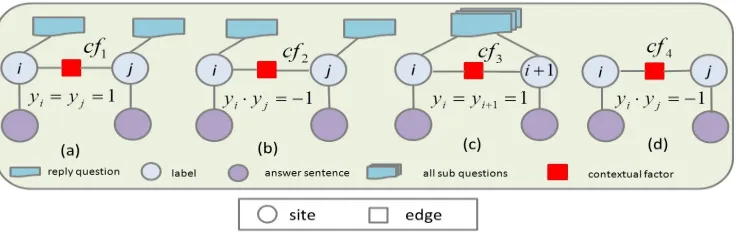
We utilize the probabilistic graphical model to solve the answer summarization task, Figure 1 gives some illustrations, in which the sites correspond to the sentences and the edges are utilized to model the interactions between sentences. Specifically, let x
be the sentence sequence to all answers within a question thread, andybe the corresponding label se-quence. Every componentyiofyhas a binary value, with +1 for the summary sentence and -1 otherwise. Then under CRF (Lafferty et al., 2001), the condi-tional probability of y given xobeys the following distribution:
p(y|x) = 1
Z(x)exp(
∑
v∈V,l
µlgl(v,y|v,x)
+ ∑
e∈E,k
λkfk(e,y|e,x)), (1)
whereZ(x) is the normalization constant called partition function,gl denotes the cQA feature func-tion of sitel,fkdenotes the function of edgek( mod-eling the interactions between sentences), µ and λ are respectively the weights of function of sites and edges, andy|tdenotes the components of yrelated to site (edge)t.
3.2 cQA Features and Contextual Modeling
In this section, we give a detailed description of the different sentence-level cQA features and the contextual modeling between sentences used in our model for answer summarization.
Sentence-level Features
The textual features used are:
1. Sentence Length: The length of the sentence in the answers with the stop words removed. It seems that a long sentence may contain more information.
2.Position: The sentence’s position within the answer. If a sentence is at the beginning or at the end of one answer, it might be a generation or viewpoint sentence and will be given higher weight in the summarization task. 3.Answer Length: The length of the answer to which the sentence belonged, again with the stop words removed. 4. Stopwords Rate: The rate of stop words in the sentence. If a sentence contains too many stop words, it is more likely a spam or chitchat sentence rather than an informative one.
5. Uppercase Rate: The rate of uppercase words. Uppercase words are often people’s name, address or other name entities interested by askers.
6. Has LinkWhether the sentence contains a hyperlink or not. The link often points to a more detailed informa-tion source.
7. Similarity to Question: Semantic similarity to the question and question context. It imports the semantic information relevance to the question and question context.
The non-textual features used include:
8. Best Answer Star: The stars of the best answer received by the askers or voters.
9. Thumbs Up: The number of thumbs-ups the answer which contains the sentence receives. Users are often used to support one answer by giving a thumbs up after reading some relevant or interesting information for their intentions.
10.Author Level: The level of stars the author who gives the answer sentence acquires. The higher the star level, the more authoritative the asker is.
11. Best Answer Rate: Rate of answers annotated as the best answer the author who gives the answer sentence receives.
12. Total Answer Number: The number of total answers by the author who gives the answer sentence. The more answers one gives, the more experience he or she acquires.
13. Total Points: The total points that the author who gives the answer sentence receives.
The previous literature (Shah et al., 2010) hinted that some cQA features, such as Sentence Length, Has Link and Best Answer Star, may be more
im-portant than others. We also expect that some ture may be redundant when their most related fea-tures are given, e.g., theAuthor Levelfeature is pos-itively related with theTotal Pointsreceived by an-swerers, and Stopwords Rate is of little help when bothSentence Length(not including stop words) and Uppercase Rateare given. Therefore, to explore the optimal combination of these features, we propose a group L1 regularization term in the general CRF model (Section 3.3) for feature learning.
All features presented here can be extracted au-tomatically from the Yahoo! Answers website. We normalize all these feature values to real numbers between 0 and 1 by dividing them by the corre-sponding maximal value of these features. These sentence-level features can be easily utilized in the CRF framework. For instance, if the rate of upper-case words is prominent or the position is close to the beginning or end of the answer, then the proba-bility of the label +1 (summary sentence) should be boosted by assigning it with a large value.
Contextual Modeling Under Question Segmentation
For cQAs summarization, the semantic interac-tions between different sentence sites are crucial, that is, some context co-occurrences should be en-couraged and others should be penalized for require-ments of information novelty and non-redundancy in the generated summary. Here we consider both local (sentences from the same answer) and global (sentences from different answers) settings. This give rise to four contextual factors that we will ex-plore for modeling the pairwise semantic interac-tions based on question segmentation. In this paper, we utilize a simple but effective lightweight ques-tion segmentaques-tion method (Ding et al., 2008; Wang et al., 2010). It mainly involves the following two steps:
Step 1. Question sentence detection: every sen-tence in the original multi-sensen-tence question is clas-sified intoquestion sentenceandnon-question (con-text) sentence. The question mark and 5W1H fea-tures are applied.
ques-Figure 1: Four kinds of the contextual factors are considered for answer summarization in our general CRF based models.
tions as:
sim(x, y) = 2× ∑
(w1,w2)∈M(x,y)
sim(w1, w2)
|x|+|y| (2)
whereM(x, y)denotes synset pairs matched in sen-tences xand y; and the similarity between the two synsetsw1 andw2 is computed to be inversely pro-portional to the length of the path in Wordnet.
One answer sentence may related to more than one sub questions to some extent. Thus, we de-fine the replied question Qri as the sub question with the maximal similarity to sentence xi: Qri = argmaxQjsim(xi, Qj). It is intuitive that different
summary sentences aim at answering different sub questions. Therefore, we design the following two contextual factors based on the similarity of replied questions.
Dissimilar Replied Question Factor: Given two answer sentences xi , xj and their corresponding replied questionsQri,Qrj. If the similarity2ofQri and Qrj is below some thresholdτlq, it means that xiandxjwill present different viewpoints to answer different sub questions. In this case, it is likely that xi and xj are both summary sentences; we ensure this by setting the contextual factorcf1with a large value ofexp ν, where ν is a positive real constant often assigned to value 1; otherwise we set cf1 to
exp−νfor penalization.
cf1= {
exp ν, yi=yj = 1 exp−ν, otherwise
Similar Replied Question Factor: Given two
an-2
We use the semantic similarity of Equation 2 for all our similarity measurement in this paper.
swer sentences xi , xj and their corresponding replied questionsQri,Qrj. If the similarity ofQri and Qrj is above some upper threshold τuq, this means thatxi andxj are very similar and likely to provide similar viewpoint to answer similar ques-tions. In this case, we want to select either xi or xjas answer. This is done by setting the contextual factorcf2such thatxiandxj have opposite labels,
cf2= {
exp ν, yi∗yj =−1 exp −ν, otherwise
Assuming that sentencexi is selected as a sum-mary sentence, and its next local neighborhood sen-tencexi+1by the same author is dissimilar to it but it is relevant to the original multi-sentence question, then it is reasonable to also pickxi+1as a summary
sentence because it may offer new viewpoints by the author. Meanwhile, other local and non-local sentences which are similar to it at above the up-per threshold will probably not be selected as sum-mary sentences as they offer similar viewpoint as discussed above. Therefore, we propose the follow-ing two kinds of contextual factors for selectfollow-ing the answer sentences in the CRF model.
Local Novelty Factor: If the similarity of answer sentence xi and xi+1 given by the same author is
below a lower thresholdτls, but their respective sim-ilarities to the sub questions both exceed an upper threshold τus, then we will boost the probability of selecting both as summary sentences by setting:
cf3=
{
exp ν, yi=yi+1 = 1
exp−ν, otherwise
[image:5.612.124.494.64.181.2]sentencexi andxj is greater than the upper thresh-old τus, then they are likely to be redundant and hence should be given opposite labels. This is done by setting:
cf4 =
{
exp ν, yi∗yj =−1
exp−ν, otherwise
Figure 1 gives an illustration of these four con-textual factors in our proposed general CRF based model. The parameter estimation and model infer-ence are discussed in the following subsection.
3.3 GroupL1Regularization for Feature
Learning
In the context of cQA summarization task, some fea-tures are intuitively to be more important than oth-ers. As a result, we group the parameters in our CRF model with their related features3 and introduce a groupL1-regularization term for selecting the most
useful features from the least important ones, where the regularization term becomes,
R(θ) =C G
∑
g=1
∥−→θg∥2, (3)
whereC controls the penalty magnitude of the pa-rameters,Gis the number of feature groups and−→θg denotes the parameters corresponding to the partic-ular groupg. Notice that this penalty term is indeed a L(1,2) regularization because in every particu-lar group we normalize the parameters inL2 norm while the weight of a whole group is summed inL1
form.
Given a set of training dataD = (x(i), y(i)),i= 1, ..., N, the parametersθ= (µl, λk)of the general CRF with the groupL1-regularization are estimated in using a maximum log likelihood functionLas:
L=
N
∑
i=1
log(pθ(y(i)|x(i)))−C G
∑
g=1
∥−→θg∥2, (4)
3
We note that every sentence-level feature discussed in Sec-tion 3.2 presents a variety of instances (e.g., the sentence with longer or shorter length is the different instance), and we may call it sub-feature of the original sentence-level feature in the micro view. Every sub-feature has its corresponding weight in our CRF model. Whereas in a macro view, those related sub-features can be considered as a group.
whereN denotes the total number of training sam-ples. we compute the log-likelihood gradient com-ponent of θ in the first term of Equation 4 as in usual CRFs. However, the second term of Equation 4 is non-differentiable when some special∥−→θg∥2
be-comes exactly zero. To tackle this problem, an ad-ditional variable is added for each group (Schmidt , 2010); that is, by replacing each norm ∥−→θg∥2 with the variable αg, subject to the constraint αg ≥ ∥−→θg∥2, i.e.,
L=
N
∑
i=1
log(pθ(y(i)|x(i)))−C G
∑
g=1
αg,
subject to αg ≥ ∥−→θg∥2,∀g. (5)
This formulation transforms the non-differentiable regularizer to a simple linear function and maximiz-ing Equation 5 will lead to a solution to Equation 4 because it is a lower bound of the latter. Then, we add a sufficient small positive constantεwhen com-puting theL2 norm (Lee et al., 2006), i.e.,|−→θg∥2 = √∑|g|
j=1θ2gj+ε, where |g| denotes the number of features in groupg. To obtain the optimal value of parameter θfrom the training data, we use an effi-cient L-BFGS solver to solve the problem, and the first derivative of every featurejin groupgis,
δL δθgj
=
N
∑
i=1
Cgj(y(i), x(i))− N
∑
i=1 ∑
y
p(y|x(i))Cgj(y, x(i))−2C√∑ θgj
|g|
l=1θ2gl+ε (6)
where Cgj(y, x) denotes the count of feature j in group g of observation-label pair (x, y). The first two terms of Equation 6 measure the difference be-tween the empirical and the model expected values of feature j in groupg, while the third term is the derivative of groupL1priors.
For inference, the labeling sequence can be ob-tained by maximizing the probability of y condi-tioned onx,
y∗ =argmaxypθ(y|x). (7)
previously used in (Galley , 2006). That is , we replace the edge connection zt = (yt−2, yt−1, yt)
of order-2 Markov model by zt = (yNt, yt−1, yt), whereyNt represents the label at the source of the non-local edge. Although it is an approximation of the exact inference, we will see that it works well for our answer summarization task in the experiments.
4 Experimental Setting
4.1 Dataset
To evaluate the performance of our CRF based an-swer summarization model, we conduct experiments on the Yahoo! Answers archives dataset. The Ya-hoo!W ebscopeT M Program4opens up a number of
Yahoo! Answers datasets for interested academics in different categories. Our original dataset con-tains 1,300,559 questions and 2,770,896 answers in ten taxonomies from Yahoo! Answers. After fil-tering the questions which have less than 5 answers and some trivial factoid questions using the features by (Tomasoni and Huang, 2010) , we reduce the dataset to 55,132 questions. From this sub-set, we next select the questions with incomplete answers as defined in Section 2.1. Specifically, we select the questions where the average similarity between the best answer and all sub questions is less than 0.6 or when the star rating of the best answer is less than 4. We obtain 7,784 questions after this step. To eval-uate the effectiveness of this method, we randomly choose 400 questions in the filtered dataset and in-vite 10 graduate candidate students (not in NLP re-search field) to verify whether a question suffers from the incomplete answer problem. We divide the students into five groups of two each. We consider the questions as the “incomplete answer questions” only when they are judged by both members in a group to be the case. As a result, we find that 360 (90%) of these questions indeed suffer from the in-complete answer problem, which indicates that our automatic detection method is efficient. This ran-domly selected 400 questions along with their 2559 answers are then further manually summarized for evaluation of automatically generated answer sum-maries by our model in experiments.
4http://sandbox.yahoo.com/
4.2 Evaluation Measures
When taking the summarization as a sequential bi-classification problem, we can make use of the usual precision, recall and F1 measures (Shen et al., 2007) for classification accuracy evaluation.
In our experiments, we also compare the preci-sion, recall and F1 score in the 1, ROUGE-2 and ROUGE-L measures (Lin , ROUGE-2004) for answer summarization performance.
5 Experimental Results
5.1 Summarization Results
We adapt the Support Vector Machine (SVM) and Logistic Regression (LR) which have been reported to be effective for classification and the Linear CRF (LCRF) which is used to summarize ordinary text documents in (Shen et al., 2007) as baselines for comparison. To better illustrate the effectiveness of question segmentation based contextual factors and the groupL1 regularization term, we carry the tests
in the following sequence: (a) we use only the con-textual factorscf3 andcf4 with defaultL2
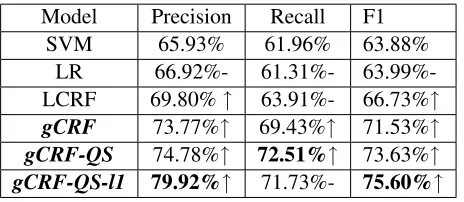
regular-ization (gCRF); (b) we add the reply question based factorscf1andcf2to the model (gCRF-QS); and (c) we replace default L2 regularization with our pro-posed groupL1 regularization term (gCRF-QS-l1). For linear CRF system, we use all our textual and non-textual features as well as the local (exact pre-vious and next) neighborhood contextual factors in-stead of the features of (Shen et al., 2007) for fair-ness. For the thresholds used in the contextual fac-tors, we enforceτlqto be equal toτlsandτuq equal toτusfor the purpose of simplifying the parameters setting (τlq =τls = 0.4,τuq =τus = 0.8in our ex-periments). We randomly divide the dataset into ten subsets (every subset with 40 questions and the as-sociated answers), and conduct a ten-fold cross val-idation and for each round where the nine subsets are used to train the model and the remaining one for testing. The precision, recall and F1 measures of these models are presented in Table 2.
Table 2 shows that our general CRF model based on question segmentation with groupL1
Model R1 P R1 R R1 F1 R2 P R2 R R2 F1 RL P RL R RL F1
SVM 79.2% 52.5% 63.1% 71.9% 41.3% 52.4% 67.1% 36.7% 47.4%
LR 75.2%↓ 57.4%↑ 65.1%↑ 66.1%↓ 48.5%↑ 56.0%↑ 61.6%↓ 43.2%↑ 50.8%↑
LCRF 78.7%- 61.8%↑ 69.3%- 71.4%- 54.1%↑ 61.6%↑ 67.1%- 49.6%↑ 57.0%↑
gCRF 81.9%↑ 65.2%↑ 72.6%↑ 76.8%↑ 57.3%↑ 65.7%↑ 73.9%↑ 53.5%↑ 62.1%↑
gCRF-QS 81.4%- 70.0%↑ 75.3%↑ 76.2%- 62.4%↑ 68.6%↑ 73.3%- 58.6%↑ 65.1%↑
[image:8.612.74.306.223.324.2]gCRF-QS-l1 86.6%↑ 68.3%- 76.4%↑ 82.6%↑ 61.5%- 70.5%↑ 80.4%↑ 58.2%- 67.5%↑
Table 3: The Precision, Recall and F1 of ROUGE-1, ROUGE-2, ROUGE-L in the baselines SVM,LR, LCRF and our general CRF based models (gCRF, gCRF-QS, gCRF-QS-l1). The down-arrow means performance degradation with statistical significance.
Model Precision Recall F1
SVM 65.93% 61.96% 63.88%
LR 66.92%- 61.31%-
63.99%-LCRF 69.80%↑ 63.91%- 66.73%↑
gCRF 73.77%↑ 69.43%↑ 71.53%↑
gCRF-QS 74.78%↑ 72.51%↑ 73.63%↑
gCRF-QS-l1 79.92%↑ 71.73%- 75.60%↑
Table 2: The Precision, Recall and F1 measures of the baselines SVM,LR, LCRF and our general CRF based models (gCRF, gCRF-QS, gCRF-QS-l1). The up-arrow denotes the performance improvement compared to the precious method (above) with statistical significance un-der p value of 0.05, the short line ’-’ denotes there is no difference in statistical significance.
which just utilize the independent sentence-level features, behave not vary well here, and there is no statistically significant performance difference be-tween them. We also find that LCRF which utilizes the local context information between sentences per-form better than the LR method in precision and F1 with statistical significance. While we consider the general local and non-local contextual factorcf3and
cf4for novelty and non-redundancy constraints, the
gCRF performs much better than LCRF in all three measures; and we obtain further performance im-provement by adding the contextual factors based on QS, especially in the recall measurement. This is mainly because we have divided the question into several sub questions, and the system is able to se-lect more novel sentences than just treating the origi-nal multi-sentence as a whole. In addition, when we replace the default L2 regularization by the group
L1 regularization for more efficient feature weight
learning, we obtain a much better performance in
precision while not sacrificing the recall measure-ment statistically.
We also compute the Precision, Recall and F1 in ROUGE-1, ROUGE-2 and ROUGE-L measure-ments, which are widely used to measure the quality of automatic text summarization. The experimental results are listed in Table 3. All results in the Ta-ble are the average of the ten-fold cross validation experiments on our dataset.
It is observed that our gCRF-QS-l1 model im-proves the performance in terms of precision, recall and F1 score on all three measurements of ROUGE-1, ROUGE-2 and ROUGE-L by a significant mar-gin compared to other baselines due to the use of local and non-local contextual factors and factors based on QS with group L1 regularization. Since
the ROUGE measures care more about the recall and precision of N-grams as well as common substrings to the reference summary rather than the whole sen-tence, they offer a better measurement in modeling the user’s information needs. Therefore, the im-provements in these measures are more encouraging than those of the average classification accuracy for answer summarization.
From the viewpoint of ROUGE measures we ob-serve that our question segmentation method can en-hance the recall of the summaries significantly due to the more fine-grained modeling of sub questions. We also find that the precision of the groupL1 reg-ularization is much better than that of the default L2regularization while not hurting the recall
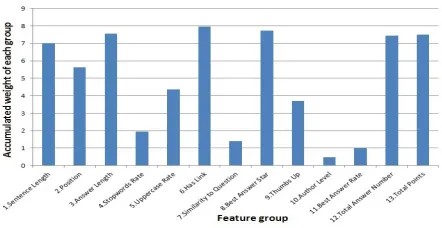
Figure 2: The accumulated weight of each site feature group in the groupL1-regularization to our Yahoo!
An-swer dataset. The horizonal axis corresponds to the name of each feature group.
5.2 Evaluation of Feature Learning
For group L1 regularization term, we set the ε = 10−4 in Equation 6. To see how much the dif-ferent textual and non-textual features contribute to community answer summarization, the accumulated weight of each group of sentence-level features5 is presented in Figure 2. It shows that the textual fea-tures such as 1 (Sentence Length), 2 (Position) 3 ( An-swer Length), 6 (Has Link) and non-textual features such as 8 (Best Answer Star) , 12 (Total Answer Number) as well as 13 (Total Points) have larger weights, which play a significant role in the sum-marization task as we intuitively considered; fea-tures 4 (Stopwords Rate), 5 (Uppercase Rate) and 9 (Thumbs Up) have medium weights relatively; and the other features like 7 (Similarity to Question), 10 (Author Level) and 11 (Best Answer Rate) have the smallest accumulated weights. The main reasons that the feature 7 (Similarity to Question) has low contribution is that we have utilized the similarity to question in the contextual factors, and this simi-larity feature in the single site becomes redundant. Similarly, the features Author Level and Best An-swer Numberare likely to be redundant when other non-textual features(Total Answer Number and To-tal Points) are presented together. The experimental results demonstrate that with the use of group L1 -regularization we have learnt better combination of these features.
5
Note that we have already evaluated the contribution of the contextual factors in Section 5.1.
5.3 An Example of Summarized Answer
To demonstrate the effectiveness of our proposed method, Table 4 shows the generated summary of the example question which is previously illustrated in Table 1 in the introduction section. The best swer available in the system and the summarized an-swer generated by our model are compared in Table 4. It is found that the summarized answer contains more valuable information about the original multi-sentence question, as it better answers the reason of teeth blooding and offers some solution for it. Stor-ing and indexStor-ing this summarized answer in ques-tion archives should provide a better choice for an-swer reuse in question retrieval of cQAs.
Question
Why do teeth bleed at night and how do you prevent/stop it? This morning I woke up with blood caked between my two front teeth.[...]
Best Answer - Chosen by Asker
Periodontal disease is a possibility, gingivitis, or some gum infec-tion. Teeth don’t bleed; gums bleed.
Summarized Answer Generated by Our Method
Periodontal disease is a possibility, gingivitis, or some gum infec-tion. Teeth don’t bleed; gums bleed. Gums that bleed could be a sign of a more serious issue like leukemia, an infection, gum dis-ease, a blood disorder, or a vitamin deficiency. wash your mouth with warm water and salt, it will help to strengthen your gum and teeth, also salt avoid infection.
Table 4:Summarized answer by our general CRF based model for the question in Table 1.
6 Conclusions
re-sources.
Acknowledgements
This work was supported by the NSFC under Grant No.61073002 and No.60773077.
References
L. A. Adamic, J. Zhang, E. Bakshy, and M. S. Ackerman. 2008. Knowledge sharing and yahoo answers: every-one knows something. Proceedings of WWW 2008. Shilin Ding, Gao Cong, Chin-Yew Lin and Xiaoyan Zhu.
2008. Rouge: Using Conditional Random Fields to Extract Contexts and Answers of Questions from On-line Forums. Proceedings of ACL-08: HLT, pages 710–718.
Michel Galley. 2006. A Skip-Chain Conditional Ran-dom Field for Ranking Meeting Utterances by Impor-tance. Proceedings of EMNLP 2006.
Z. Gyongyi, G. Koutrika, J. Pedersen, and H. Garcia-Molina. 2007. Questioning yahoo! answers. Tech-nical report. Stanford InfoLab.
F. Maxwell Harper, Daphne Raban, Sheizaf Rafaeli, and Joseph A. Konstan. 2008. Predictors of Answer Qual-ity in Online Q&A Sites.Proceedings of CHI 2008. Liangjie Hong and Brian D. Davison. 2009. A
Classification-based Approach to Question Answering in Discussion Boards. Proceedings of the 32th ACM SIGIR Conference, pages 171–178.
Eduard Hovy, Chin Y. Lin, and Liang Zhou. 2005. A BE-based Multi-document Summarization with Sen-tence Compression. Proceedings of Multilingual Sum-marization Evaluation (ACL 2005 workshop). Jiwoon Jeon, W. Bruce Croft, Joon Ho Lee and Soyeon
Park 2006. A Framework to Predict the Quality of Answers with NonTextual Features. Proceedings of the 29th ACM SIGIR Conference, pages 228–235. V. Jijkoun and M. de Rijke. 2005. Retrieving answers
from frequently asked questions pages on the web. In CIKM.
Daniel Jurafsky and James H. Martin. 2009. Speech and Language Processing: An introduction to natural language processing, computational linguistics, and speech recognition. Published by Pearson Education. John D. Lafferty, Andrew McCallum, and Fernando C.
N. Pereira. 2001. Conditional random fields: Proba-bilistic models for segmenting and labeling sequence data. Proceedings of the 18th ICML, pages 282–289. S. Lee, H. Lee, P. Abbeel, and A. Ng. 2006. Efficient L1
Regularized Logistic Regression. In AAAI.
Chin-Yew Lin. 2004. Rouge: A package for automatic evaluation of summaries. Proceedings of ACL Work-shop, pages 74–81.
Yandong Liu, Jiang Bian, and Eugene Agichtein. 2008. Predicting Information Seeker Satisfaction in Commu-nity Question Answering. Proceedings of the 31th ACM SIGIR Conference.
Yuanjie Liu, Shasha Li, Yunbo Cao, Chin-Yew Lin, Dingyi Han, and Yong Yu. 2008. Understanding and summarizing answers in community-based question answering services. Proceedings of the 22nd ICCL, pages 497–504.
S. Riezler, A. Vasserman, I. Tsochantaridis, V. Mittal, and Y. Liu. 2007. Statistical machine translation for query expansion in answer retrieval.Proceedings of the 45th Annual Meeting of ACL.
Mark Schmidt. 2010. Graphical Model Structure Learn-ing with L1-Regularization.Doctoral Thesis.
Chirag Shah and Jefferey Pomerantz. 2010. Evaluat-ing and PredictEvaluat-ing Answer Quality in Community QA. Proceedings of the 33th ACM SIGIR Conference. Dou Shen, Jian-Tao Sun, Hua Li, Qiang Yang and Zheng
Chen. 2007. Document Summarization using Condi-tional Random Fields.Proceedings of the 20th IJCAI. Troy Simpson and Malcolm Crowe 2005. WordNet.Net
http://opensource.ebswift.com/WordNet.Net
Mineki Takechi, Takenobu Tokunaga, and Yuji Mat-sumoto. 2007. Chunking-based Question Type Iden-tification for Multi-Sentence Queries. Proceedings of SIGIR 2007 Workshop.
Mattia Tomasoni and Minlie Huang. 2010. Metadata-Aware Measures for Answer Summarization in Com-munity Question Answering. Proceedings of the 48th Annual Meeting of ACL, pages 760–769.
Hongning Wang, Chi Wang, ChengXiang Zhai, Jiawei Han 2011. Learning Online Discussion Structures by Conditional Random Fields. Proceedings of the 34th ACM SIGIR Conference.
Kai Wang, Zhao-Yan Ming and Tat-Seng Chua. 2009. A Syntactic Tree Matching Approach to Finding Simi-lar Questions in Community-based QA Services. Pro-ceedings of the 32th ACM SIGIR Conference.
Kai Wang, Zhao-Yan Ming, Xia Hu and Tat-Seng Chua. 2010. Segmentation of Multi-Sentence Questions: Towards Effective Question Retrieval in cQA Ser-vices. Proceedings of the 33th ACM SIGIR Confer-ence, pages 387–394.
X. Xue, J.Jeon, and W.B.Croft. 2008. Retrieval models for question and answers archives. Proceedings of the 31th ACM SIGIR Conference.
Zi Yang, Keke Cai, Jie Tang, Li Zhang, Zhou Su, and Juanzi Li. 2011. Social Context Summarization. Pro-ceedings of the 34th ACM SIGIR Conference.