Enhancing Language Models in Statistical Machine Translation
with Backward N-grams and Mutual Information Triggers
Deyi Xiong, Min Zhang, Haizhou Li Human Language Technology Institute for Infocomm Research
1 Fusionopolis Way, #21-01 Connexis, Singapore 138632
{dyxiong, mzhang, hli}@i2r.a-star.edu.sg
Abstract
In this paper, with a belief that a language model that embraces a larger context provides better prediction ability, we present two ex-tensions to standard n-gram language mod-els in statistical machine translation: a back-ward language model that augments the con-ventional forward language model, and a mu-tual information trigger model which captures long-distance dependencies that go beyond the scope of standardn-gram language mod-els. We integrate the two proposed models into phrase-based statistical machine transla-tion and conduct experiments on large-scale training data to investigate their effectiveness. Our experimental results show that both mod-els are able to significantly improve transla-tion quality and collectively achieve up to 1 BLEU point over a competitive baseline.
1 Introduction
Language model is one of the most important knowledge sources for statistical machine transla-tion (SMT) (Brown et al., 1993). The standard
n-gram language model (Goodman, 2001) assigns probabilities to hypotheses in the target language conditioning on a context history of the preceding
n−1 words. Along with the efforts that advance translation models from word-based paradigm to syntax-based philosophy, in recent years we have also witnessed increasing efforts dedicated to ex-tend standardn-gram language models for SMT. We roughly categorize these efforts into two directions: data-volume-oriented and data-depth-oriented.
In the first direction, more data is better. In or-der to benefit from monolingual corpora (LDC news data or news data collected from web pages) that consist of billions or even trillions of English words, huge language models are built in a distributed man-ner (Zhang et al., 2006; Brants et al., 2007). Such language models yield better translation results but at the cost of huge storage and high computation.
The second direction digs deeply into monolin-gual data to build linguistically-informed language models. For example, Charniak et al. (2003) present a syntax-based language model for machine transla-tion which is trained on syntactic parse trees. Again, Shen et al. (2008) explore a dependency language model to improve translation quality. To some ex-tent, these syntactically-informed language models are consistent with syntax-based translation models in capturing long-distance dependencies.
In this paper, we pursue the second direction with-out resorting to any linguistic resources such as a syntactic parser. With a belief that a language model that embraces a larger context provides better pre-diction ability, we learn additional information from training data to enhance conventional n-gram lan-guage models and extend their ability to capture richer contexts and long-distance dependencies. In particular, we integrate backwardn-grams and mu-tual information (MI) triggers into language models in SMT.
In conventionaln-gram language models, we look at the precedingn−1words when calculating the probability of the current word. We henceforth call the previous n − 1 words plus the current word as forward n-grams and a language model built
on forward n-grams as forward n-gram language model. Similarly, backward n-grams refer to the succeedingn−1words plus the current word. We train a backwardn-gram language model on back-wardn-grams and integrate the forward and back-ward language models together into the decoder. In doing so, we attempt to capture both the preceding and succeeding contexts of the current word.
Different from the backward n-gram language model, the MI trigger model still looks at previous contexts, which however go beyond the scope of for-wardn-grams. If the current word is indexed aswi,
the farthest word that the forwardn-gram includes iswi−n+1. However, the MI triggers are capable of
detecting dependencies betweenwiand words from w1 to wi−n. By these triggers ({wk → wi},1 ≤ k≤i−n), we can capture long-distance dependen-cies that are outside the scope of forwardn-grams.
We integrate the proposed backward language model and the MI trigger model into a state-of-the-art phrase-based SMT system. We evaluate the effectiveness of both models on Chinese-to-English translation tasks with large-scale training data. Compared with the baseline which only uses the forward language model, our experimental re-sults show that the additional backward language model is able to gain about 0.5 BLEU points, while the MI trigger model gains about 0.4 BLEU points. When both models are integrated into the decoder, they collectively improve the performance by up to 1 BLEU point.
The paper is structured as follows. In Section 2, we will briefly introduce related work and show how our models differ from previous work. Section 3 and 4 will elaborate the backward language model and the MI trigger model respectively in more detail, de-scribe the training procedures and explain how the models are integrated into the phrase-based decoder. Section 5 will empirically evaluate the effectiveness of these two models. Section 6 will conduct an in-depth analysis. In the end, we conclude in Section 7.
2 Related Work
Previous work devoted to improving language mod-els in SMT mostly focus on two categories as we
mentioned before1: large language models (Zhang et al., 2006; Emami et al., 2007; Brants et al., 2007; Talbot and Osborne, 2007) and syntax-based lan-guage models (Charniak et al., 2003; Shen et al., 2008; Post and Gildea, 2008). Since our philoso-phy is fundamentally different from them in that we build contextually-informed language models by us-ing backwardn-grams and MI triggers, we discuss previous work that explore these two techniques (backwardn-grams and MI triggers) in this section. Since the context “history” in the backward lan-guage model (BLM) is actually the future words to be generated, BLM is normally used in a post-processing where all words have already been gener-ated or in a scenario where sentences are proceeded from the ending to the beginning. Duchateau et al. (2002) use the BLM score as a confidence measure to detect wrongly recognized words in speech recog-nition. Finch and Sumita (2009) use the BLM in their reverse translation decoder where source sen-tences are proceeded from the ending to the begin-ning. Our BLM is different from theirs in that we ac-cess the BLM during decoding (rather than after de-coding) where source sentences are still proceeded from the beginning to the ending.
Rosenfeld et al. (1994) introduce trigger pairs into a maximum entropy based language model as features. The trigger pairs are selected accord-ing to their mutual information. Zhou (2004) also propose an enhanced language model (MI-Ngram) which consists of a standard forward n-gram lan-guage model and an MI trigger model. The latter model measures the mutual information of distance-dependent trigger pairs. Our MI trigger model is mostly inspired by the work of these two papers, es-pecially by Zhou’s MI-Ngram model (2004). The difference is that our model is distance-independent and, of course, we are interested in an SMT problem rather than a speech recognition one.
Raybaud et al. (2009) use MI triggers in their con-fidence measures to assess the quality of translation results after decoding. Our method is different from theirs in the MI calculation and trigger pair selec-tion. Mauser et al. (2009) propose bilingual triggers where two source words trigger one target word to
1
improve lexical choice of target words. Our analysis (Section 6) show that our monolingual triggers can also help in the selection of target words.
3 Backward Language Model
Given a sequence of words wm1 = (w1...wm), a
standard forwardn-gram language model assigns a probabilityPf(wm1 )tow1mas follows.
Pf(w1m) = m ∏
i=1
P(wi|wi1−1)≈ m ∏
i=1
P(wi|wii−−n1+1) (1)
where the approximation is based on thenth order Markov assumption. In other words, when we pre-dict the current wordwi, we only consider the
pre-ceding n−1 words wi−n+1...wi−1 instead of the
whole context historyw1...wi−1.
Different from the forward n-gram language model, the backward n-gram language model as-signs a probabilityPb(w1m)tow1mby looking at the
succeeding context according to
Pb(w1m) = m ∏
i=1
P(wi|wmi+1)≈ m ∏
i=1
P(wi|wii++1n−1) (2)
3.1 Training
For the convenience of training, we invert the or-der in each sentence in the training data, i.e., from the original order (w1...wm) to the reverse order
(wm...w1). In this way, we can use the same toolkit
that we use to train a forward n-gram language model to train a backward n-gram language model without any other changes. To be consistent with training, we also need to reverse the order of trans-lation hypotheses when we access the trained back-ward language model2. Note that the Markov con-text history of Eq. (2) iswi+n−1...wi+1 instead of
wi+1...wi+n−1 after we invert the order. The words
are the same but the order is completely reversed.
3.2 Decoding
In this section, we will present two algorithms to integrate the backward n-gram language model into two kinds of phrase-based decoders respec-tively: 1) a CKY-style decoder that adopts bracket-ing transduction grammar (BTG) (Wu, 1997; Xiong
2
This is different from the reverse decoding in (Finch and Sumita, 2009) where source sentences are reversed in the order.
et al., 2006) and 2) a standard phrase-based decoder (Koehn et al., 2003). Both decoders translate source sentences from the beginning of a sentence to the ending. Wu (1996) introduce a dynamic program-ming algorithm to integrate a forward bigram lan-guage model with inversion transduction grammar. His algorithm is then adapted and extended for inte-grating forwardn-gram language models into syn-chronous CFGs by Chiang (2007). Our algorithms are different from theirs in two major aspects
1. The string input to the algorithms is in a reverse order.
2. We adopt a different way to calculate language model probabilities for partial hypotheses so that we can utilize incompleten-grams.
Before we introduce the integration algorithms, we define three functionsP,L, andRon strings (in a reverse order) over the English terminal alphabet
T. The functionP is defined as follows.
P(wk...w1) =P(wk)...P(wk−n+2|wk...wk−n+3)
| {z }
a
× ∏
1≤i≤k−n+1
P(wi|wi+n−1...wi+1)
| {z }
b
(3)
This function consists of two parts:
• The first part(a)calculates incompleten-gram language model probabilities for word wk to wk−n+2. That means, we calculate the
uni-gram probability forwk(P(wk)), bigram
prob-ability forwk−1 (P(wk−1|wk)) and so on
un-til we taken−1-gram probability forwk−n+2
(P(wk−n+2|wk...wk−n+3)). This resembles
the way in which the forward language model probability in the future cost is computed in the standard phrase-based SMT (Koehn et al., 2003).
• The second part (b) calculates complete n -gram backward language model probabilities for wordwk−n+1 tow1.
we calculate backward language model probabilities during a beginning-to-ending (left-to-right) decod-ing process, the succeeddecod-ing context for the current word is either yet to be generated or incomplete in terms of n-grams. The P function enables us to utilize incomplete succeeding contexts to approxi-mately predict words. Once the succeeding con-texts are complete, we can quickly update language model probabilities in an efficient way in our algo-rithms.
The other two functionsL andR are defined as follows
L(wk...w1) = {
wk...wk−n+2, ifk≥n wk...w1, otherwise
(4)
R(wk...w1) = {
wn−1...w1, ifk≥n wk...w1, otherwise
(5)
TheLandRfunction return the leftmost and right-mostn−1words from a string in a reverse order respectively.
Following Chiang (2007), we describe our algo-rithms in a deductive system. We firstly show the algorithm3 that integrates the backward language model into a BTG-style decoder (Xiong et al., 2006) in Figure 1. The item [A, i, j;l|r] indicates that a BTG nodeAhas been constructed spanning from i
toj on the source side with the leftmost|rightmost
n−1wordsl|ron the target side. As mentioned be-fore, all target strings assessed by the defined func-tions (P, L, and R) are in an inverted order (de-noted by e). We only display the backward lan-guage model probability for each item, ignoring all other scores such as phrase translation probabilities. The Eq. (8) in Figure 1 shows how we calculate the backward language model probability for the ax-iom which applies a BTG lexicon rule to translate a source phrase c into a target phrase e. The Eq. (9) and (10) show how we update the backward lan-guage model probabilities for two inference rules which combine two neighboring blocks in a straight and inverted order respectively. The fundamental theories behind this update are
P(e1e2) =P(e1)P(e2) P(R(e2)L(e1))
P(R(e2))P(L(e1)) (6)
3
It can also be easily adapted to integrate the forward n-gram language model.
Function Value
e1 a1a2a3
e2 b1b2b3
R(e2) b2b1
L(e1) a3a2
P(R(e2)) P(b2)P(b1|b2)
P(L(e1)) P(a3)P(a2|a3)
P(e1) P(a3)P(a2|a3)P(a1|a3a2)
P(e2) P(b3)P(b2|b3)P(b1|b3b2)
P(R(e2)L(e1)) P(b2)P(b1|b2)
P(a3|b2b1)P(a2|b1a3)
P(e1e2)
P(b3)P(b2|b3)P(b1|b3b2)
P(a3|b2b1)P(a2|b1a3)P(a1|a3a2)
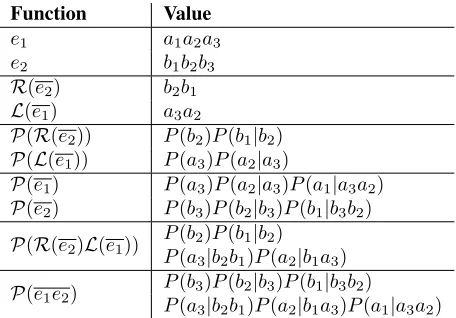
Table 1: Values ofP,L, andRin a 3-gram example .
P(e2e1) =P(e1)P(e2) P(R(e1)L(e2))
P(R(e1))P(L(e2)) (7)
Whenever two stringse1ande2are concatenated
in a straight or inverted order, we can reuse their P values (P(e1) and P(e2)) in terms of dynamic
programming. Only the probabilities of boundary words (e.g., R(e2)L(e1) in Eq. (6)) need to be
re-calculated since they have complete n-grams after the concatenation. Table 1 shows values of P, L, andR in a 3-gram example which helps to verify Eq. (6). These two equations guarantee that our algorithm can correctly compute the backward lan-guage model probability of a sentence stepwise in a dynamic programming framework.4
[image:4.612.314.542.62.221.2]The theoretical time complexity of this algorithm is O(m3|T|4(n−1)) because in the update parts in Eq. (6) and (7) both the numerator and denomina-tor have up to2(n−1)terminal symbols. This is the same as the time complexity of Chiang’s language model integration (Chiang, 2007).
Figure 2 shows the algorithm that integrates the backward language model into a standard phrase-based SMT (Koehn et al., 2003).V denotes a cover-age vector which records source words translated so far. The Eq. (11) shows how we update the back-ward language model probability for a partial hy-pothesis when it is extended into a longer hyhy-pothesis by a target phrase translating an uncovered source
4
A→c/e
[A, i, j;L(e)|R(e)] :P(e) (8)
A→[A1, A2] [A1, i, k;L(e1)|R(e1)] :P(e1) [A2, k+ 1, j;L(e2)|R(e2)] :P(e2)
[A, i, j;L(e1e2)|R(e1e2)] :P(e1)P(e2)PP(R(R(e(e2)L(e1)) 2))P(L(e1))
(9)
A→ ⟨A1, A2⟩ [A1, i, k;L(e1)|R(e1)] :P(e1) [A2, k+ 1, j;L(e2)|R(e2)] :P(e2)
[A, i, j;L(e2e1)|R(e2e1)] :P(e1)P(e2)PP(R(R(e(1e))1P)L((Le(2e))2))
(10)
Figure 1: Integrating the backward language model into a BTG-style decoder.
[V;L(e1)] :P(e1) c/e2:P(e2)
[V′;L(e1e2)] :P(e1)P(e2)PP(R(R(e(2e))2P)L((Le(1e))1))
(11)
Figure 2: Integrating the backward language model into a standard phrase-based decoder.
segment. This extension on the target side is simi-lar to the monotone combination of Eq. (9) in that a newly translated phrase is concatenated to an early translated sequence.
4 MI Trigger Model
It is well-known that long-distance dependencies be-tween words are very important for statistical lan-guage modeling. However,n-gram language models can only capture short-distance dependencies within ann-word window. In order to model long-distance dependencies, previous work such as (Rosenfeld et al., 1994) and (Zhou, 2004) exploit trigger pairs. A trigger pair is defined as an ordered 2-tuple (x, y) where word x occurs in the preceding context of wordy. It can also be denoted in a more visual man-ner as x → y with x being the trigger and y the triggered word5.
We use pointwise mutual information (PMI) (Church and Hanks, 1990) to measure the strength of the association betweenxandy, which is defined as follows
P M I(x, y) =log( P(x, y)
P(x)P(y)) (12)
5
In this paper, we require that wordxandy occur in the same sentence.
Zhou (2004) proposes a new language model en-hanced with MI trigger pairs. In his model, the prob-ability of a given sentencewm1 is approximated as
P(wm1)≈(
m ∏
i=1
P(wi|wii−−n1+1))
×
m ∏
i=n+1 i∏−n
k=1
exp(P M I(wk, wi, i−k−1))
(13)
There are two components in his model. The first component is still the standard n-gram language model. The second one is the MI trigger model which multiples all exponential PMI values for trig-ger pairs where the current word is the trigtrig-gered word and all preceding words outside the n-gram window of the current word are triggers. Note that his MI trigger model is distance-dependent since trigger pairs (wk, wi) are sensitive to their distance i−k−1(zero distance for adjacent words). There-fore the distance between wordxand wordyshould be taken into account when calculating their PMI.
In this paper, for simplicity, we adopt a distance-independent MI trigger model as follows
M I(w1m) =
m ∏
i=n+1 i∏−n
k=1
exp(P M I(wk, wi)) (14)
We integrate the MI trigger model into the log-linear model of machine translation as an additional knowledge source which complements the standard
4.1 Training
We can use the maximum likelihood estimation method to calculate PMI for each trigger pair by tak-ing counts from traintak-ing data. Let C(x, y) be the co-occurrence count of the trigger pair(x, y)in the training data. The joint probability of(x, y) is cal-culated as
P(x, y) =∑C(x, y)
x,yC(x, y)
(15)
The marginal probabilities of x andy can be de-duced from the joint probability as follows
P(x) =∑
yP(x, y) (16)
P(y) =∑
xP(x, y) (17)
Since the number of distinct trigger pairs is O(|T|2), the question is how to select valuable trig-ger pairs. We select trigtrig-ger pairs according to the following three steps
1. The distance betweenxandymust not be less thann−1. Suppose we use a 5-gram language model andy =wi, thenx∈ {w1...wi−5}.
2. C(x, y)> c. In all our experiments we setc= 10.
3. Finally, we only keep trigger pairs whose PMI value is larger than 0. Trigger pairs whose PMI value is less than 0 often contain stop words, such as “the”, “a”. These stop words have very large marginal probabilities due to their high frequencies.
4.2 Decoding
The MI trigger model of Eq. (14) can be directly integrated into the decoder. For the standard phrase-based decoder (Koehn et al., 2003), whenever a par-tial hypothesis is extended by a new target phrase, we can quickly retrieve the pre-computed PMI value for each trigger pair where the triggered word lo-cates in the newly translated target phrase and the trigger is outside the n-word window of the trig-gered word. It’s a little more complicated to in-tegrate the MI trigger model into the CKY-style
phrase-based decoder. But we still can handle it by dynamic programming as follows
M I(e1e2) =M I(e1)M I(e2)M I(e1→e2) (18)
whereM I(e1 → e2)represents the PMI values in
which a word ine1triggers a word ine2. It is defined
as follows
M I(e1→e2) = ∏
wi∈e2 ∏
wk∈e1
i−k≥n
exp(P M I(wk, wi))
(19)
5 Experiments
In this section, we conduct large-scale experiments on NIST Chinese-to-English translation tasks to evaluate the effectiveness of the proposed backward language model and MI trigger model in SMT. Our experiments focus on the following two issues:
1. How much improvements can we achieve by separately integrating the backward language model and the MI trigger model into our phrase-based SMT system?
2. Can we obtain a further improvement if we jointly apply both models?
5.1 System Overview
Without loss of generality6, we evaluate our models in a phrase-based SMT system which adapts brack-eting transduction grammars to phrasal translation (Xiong et al., 2006). The log-linear model of this system can be formulated as
w(D) =MT(r1l..nl)·MR(r
m 1..nm)
λR
·Pf L(e)λf L·exp(|e|)λw
(20)
where D denotes a derivation, r1l..n
l are the BTG
lexicon rules which translate source phrases to tar-get phrases, andr1m..nm are the merging rules which combine two neighboring blocks into a larger block in a straight or inverted order. The translation modelMT consists of widely used phrase and
lex-ical translation probabilities (Koehn et al., 2003).
6
The reordering modelMR predicts the merging
or-der (straight or inverted) by using discriminative contextual features (Xiong et al., 2006). Pf Lis the
standard forwardn-gram language model.
If we simultaneously integrate both the backward language modelPbL and the MI trigger modelM I
into the system, the new log-linear model will be formulated as
w(D) =MT(r1l..nl)·MR(r
m 1..nm)
λR·P
f L(e)λf L
·PbL(e)λbL·M I(e)λM I ·exp(|e|)λw
(21)
5.2 Experimental Setup
Our training corpora7 consist of 96.9M Chinese words and 109.5M English words in 3.8M sentence pairs. We used all corpora to train our translation model and smaller corpora without the United Na-tions corpus to build a maximum entropy based re-ordering model (Xiong et al., 2006).
To train our language models and MI trigger model, we used the Xinhua section of the En-glish Gigaword corpus (306 million words). Firstly, we built a forward 5-gram language model using the SRILM toolkit (Stolcke, 2002) with modified Kneser-Ney smoothing. Then we trained a back-ward 5-gram language model on the same monolin-gual corpus in the way described in Section 3.1. Fi-nally, we trained our MI trigger model still on this corpus according to the method in Section 4.1. The trained MI trigger model consists of 2.88M trigger pairs.
We used the NIST MT03 evaluation test data as the development set, and the NIST MT04, MT05 as the test sets. We adopted the case-insensitive BLEU-4 (Papineni et al., 2002) as the evaluation metric, which uses the shortest reference sentence length for the brevity penalty. Statistical significance in BLEU differences is tested by paired bootstrap re-sampling (Koehn, 2004).
5.3 Experimental Results
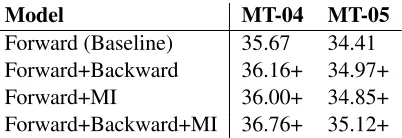
The experimental results on the two NIST test sets are shown in Table 2. When we combine the back-ward language model with the forback-ward language
7LDC2004E12, LDC2004T08, LDC2005T10,
LDC2003E14, LDC2002E18, LDC2005T06, LDC2003E07 and LDC2004T07.
Model MT-04 MT-05
Forward (Baseline) 35.67 34.41 Forward+Backward 36.16+ 34.97+
Forward+MI 36.00+ 34.85+
[image:7.612.328.529.62.131.2]Forward+Backward+MI 36.76+ 35.12+
Table 2: BLEU-4 scores (%) on the two test sets for dif-ferent language models and their combinations. +: better than the baseline (p <0.01).
model, we obtain 0.49 and 0.56 BLEU points over the baseline on the MT-04 and MT-05 test set respec-tively. Both improvements are statistically signifi-cant (p <0.01). The MI trigger model also achieves statistically significant improvements of 0.33 and 0.44 BLEU points over the baseline on the MT-04 and MT-05 respectively.
When we integrate both the backward language model and the MI trigger model into our system, we obtain improvements of 1.09 and 0.71 BLEU points over the single forward language model on the MT-04 and MT-05 respectively. These improve-ments are larger than those achieved by using only one model (the backward language model or the MI trigger model).
6 Analysis
In this section, we will study more details of the two models by looking at the differences that they make on translation hypotheses. These differences will help us gain some insights into how the presented models improve translation quality.
Source 北京 青年报 报导,北京 农业局 最 近 发出 一连串 的 防治 及 监督 法 令
Baseline Beijing Youth Daily reported that Beijing Agricultural decree recently issued a series ofcontrol and super-vision
F+B Beijing Youth Daily reported that Beijing Bureau of Agriculture re-cently issued a series of prevention and control laws
[image:8.612.310.540.60.227.2]Reference Beijing Youth Daily reported that Beijing Bureau of Agriculture re-cently issued a series of preventative and monitoring ordinances
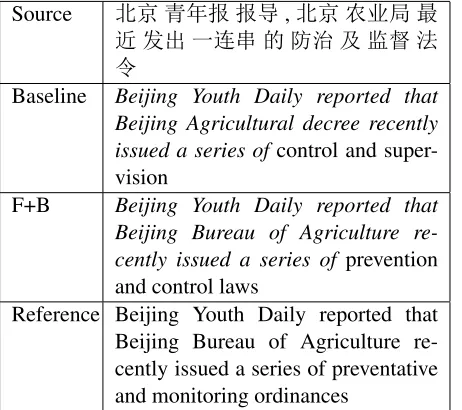
Table 3: Translation example from the MT-04 test set, comparing the baseline with the backward language model. F+B: forward+backward language model .
is better enough to be selected as the best hypothe-sis by the decoder. This suggests that the backward language model is able to provide useful and dis-criminative information which is complementary to that given by the forward language model.
In Table 4, we present another example to show how the MI trigger model improves translation qual-ity. The major difference in hypotheses of this ex-ample is the word choice between “is” and “was”. The new system enhanced with the MI trigger model (F+M) selects the former while the baseline selects the latter. The forward language model score for the baseline hypothesis is -26.41, which is higher than the score of the F+M hypothesis -26.67. This could be the reason why the baseline selects the word “was” instead of “is”. As can be seen, there is an-other “is” in the preceding context of the word “was” in the baseline hypothesis. Unfortunately, this word “is” is located just outside the scope of the preceding 5-gram context of “was”. The forward 5-gram lan-guage model is hence not able to take it into account when calculating the probability of “was”. However, this is not a problem for the MI trigger model. Since “is” and “was” rarely co-occur in the same sentence, the PMI value of the trigger pair (is, was)8 is -1.03
8Since we remove all trigger pairs whose PMI value is
neg-ative, the PMI value of this pair (is, was) is set 0 in practice in the decoder.
Source 自卫队 此行 之所以 引人瞩目,是
因为 它 并非 是 一个 孤立 的 事件 。
Baseline Self-Defense Force ’s trip is remark-able , because it was not an isolated incident .
F+M Self-Defense Force ’s trip is remark-able , because it is not an isolated in-cident .
[image:8.612.73.304.63.268.2]Reference The Self-Defense Forces’ trip arouses attention because it is not an isolated incident.
Table 4: Translation example from the MT-04 test set, comparing the baseline with the MI trigger model. Both system outputs are not detokenized so that we can see how language model scores are calculated. The un-derlined words highlight the difference between the en-hanced models and the baseline. F+M: forward language model + MI trigger model.
while the PMI value of the trigger pair (is, is) is as high as 0.32. Therefore our MI trigger model selects “is” rather than “was”.9This example illustrates that the MI trigger model is capable of selecting correct words by using long-distance trigger pairs.
7 Conclusion
We have presented two models to enhance the abil-ity of standardn-gram language models in captur-ing richer contexts and long-distance dependencies that go beyond the scope of forward n-gram win-dows. The two models have been integrated into the decoder and have shown to improve a state-of-the-art phrase-based SMT system. The first model is the backward language model which uses back-wardn-grams to predict the current word. We in-troduced algorithms that directly integrate the back-ward language model into a CKY-style and a stan-dard phrase-based decoder respectively. The sec-ond model is the MI trigger model that incorporates long-distance trigger pairs into language modeling.
Overall improvements are up to 1 BLEU point on the NIST Chinese-to-English translation tasks with large-scale training data. Further study of the two
9The overall MI trigger model scores (the logarithm of Eq.
models indicates that backward n-grams and long-distance triggers provide useful information to im-prove translation quality.
In future work, we would like to integrate the backward language model into a syntax-based sys-tem in a way that is similar to the proposed algo-rithm shown in Figure 1. We are also interested in exploring more morphologically- or syntactically-informed triggers. For example, a verb in the past tense triggers another verb also in the past tense rather than the present tense.
References
Thorsten Brants, Ashok C. Popat, Peng Xu, Franz J. Och, and Jeffrey Dean. 2007. Large language mod-els in machine translation. In Proceedings of the 2007 Joint Conference on Empirical Methods in Nat-ural Language Processing and Computational Natu-ral Language Learning (EMNLP-CoNLL), pages 858– 867, Prague, Czech Republic, June. Association for Computational Linguistics.
P. F. Brown, S. A. Della Pietra, V. J. Della Pietra, and R. L. Mercer. 1993. The mathematics of statistical machine translation: Parameter estimation. Computa-tional Linguistics, 19(2):263–311.
Eugene Charniak, Kevin Knight, and Kenji Yamada. 2003. Syntax-based language models for statistical machine translation. InProceedings of MT Summit IX. Intl. Assoc. for Machine Translation.
David Chiang. 2007. Hierarchical phrase-based transla-tion. Computational Linguistics, 33(2):201–228. Kenneth Ward Church and Patrick Hanks. 1990. Word
association norms, mutual information, and lexicogra-phy. Computational Linguistics, 16(1):22–29. Jacques Duchateau, Kris Demuynck, and Patrick
Wambacq. 2002. Confidence scoring based on back-ward language models. In Proceedings of ICASSP, pages 221–224, Orlando, FL, April.
Ahmad Emami, Kishore Papineni, and Jeffrey Sorensen. 2007. Large-scale distributed language modeling. In
Proceedings of ICASSP, pages 37–40, Honolulu, HI, April.
Andrew Finch and Eiichiro Sumita. 2009. Bidirectional phrase-based statistical machine translation. In Pro-ceedings of the 2009 Conference on Empirical Meth-ods in Natural Language Processing, pages 1124– 1132, Singapore, August. Association for Computa-tional Linguistics.
Joshua T. Goodman. 2001. A bit of progress in lan-guage modeling extended version. Technical report, Microsoft Research.
Philipp Koehn, Franz Joseph Och, and Daniel Marcu. 2003. Statistical phrase-based translation. In Proceed-ings of the 2003 Human Language Technology Confer-ence of the North American Chapter of the Association for Computational Linguistics, pages 58–54, Edmon-ton, Canada, May-June.
Philipp Koehn. 2004. Statistical significance tests for machine translation evaluation. In Proceedings of EMNLP 2004, pages 388–395, Barcelona, Spain, July. Arne Mauser, Saˇsa Hasan, and Hermann Ney. 2009. Ex-tending statistical machine translation with discrimi-native and trigger-based lexicon models. In Proceed-ings of the 2009 Conference on Empirical Methods in Natural Language Processing, pages 210–218, Singa-pore, August. Association for Computational Linguis-tics.
Franz Josef Och. 2003. Minimum error rate training in statistical machine translation. InProceedings of the 41st Annual Meeting of the Association for Compu-tational Linguistics, pages 160–167, Sapporo, Japan, July.
Kishore Papineni, Salim Roukos, Todd Ward, and Wei-Jing Zhu. 2002. Bleu: a method for automatic eval-uation of machine translation. InProceedings of 40th Annual Meeting of the Association for Computational Linguistics, pages 311–318, Philadelphia, Pennsylva-nia, USA, July.
Matt Post and Daniel Gildea. 2008. Parsers as language models for statistical machine translation. In Proceed-ings of AMTA.
Sylvain Raybaud, Caroline Lavecchia, David Langlois, and Kamel Sma¨ıli. 2009. New confidence measures for statistical machine translation. InProceedings of the International Conference on Agents and Artificial Intelligence, pages 61–68, Porto, Portugal, January. Roni Rosenfeld, Jaime Carbonell, and Alexander
Rud-nicky. 1994. Adaptive statistical language model-ing: A maximum entropy approach. Technical report, Carnegie Mellon University.
Libin Shen, Jinxi Xu, and Ralph Weischedel. 2008. A new string-to-dependency machine translation algo-rithm with a target dependency language model. In
Proceedings of ACL-08: HLT, pages 577–585, Colum-bus, Ohio, June. Association for Computational Lin-guistics.
Andreas Stolcke. 2002. Srilm–an extensible language modeling toolkit. In Proceedings of the 7th Inter-national Conference on Spoken Language Processing, pages 901–904, Denver, Colorado, USA, September. David Talbot and Miles Osborne. 2007. Randomised
Prague, Czech Republic, June. Association for Com-putational Linguistics.
Dekai Wu. 1996. A polynomial-time algorithm for sta-tistical machine translation. InProceedings of the 34th Annual Meeting of the Association for Computational Linguistics, pages 152–158, Santa Cruz, California, USA, June.
Dekai Wu. 1997. Stochastic inversion transduction grammars and bilingual parsing of parallel corpora.
Computational Linguistics, 23(3):377–403.
Deyi Xiong, Qun Liu, and Shouxun Lin. 2006. Maxi-mum entropy based phrase reordering model for sta-tistical machine translation. InProceedings of the 21st International Conference on Computational Linguis-tics and 44th Annual Meeting of the Association for Computational Linguistics, pages 521–528, Sydney, Australia, July. Association for Computational Lin-guistics.
Ying Zhang, Almut Silja Hildebrand, and Stephan Vogel. 2006. Distributed language modeling for n-best list re-ranking. InProceedings of the 2006 Conference on Empirical Methods in Natural Language Processing, pages 216–223, Sydney, Australia, July. Association for Computational Linguistics.