Punctuation Processing for Projective Dependency Parsing
∗Ji Ma†, Yue Zhang‡and Jingbo Zhu†?
†Northeastern University, Shenyang, China
‡Singapore University of Technology and Design, Singapore
?Hangzhou YaTuo Company, 358 Wener Rd., Hangzhou, China, 310012
[email protected] yue [email protected] [email protected]
Abstract
Modern statistical dependency parsers as-sign lexical heads to punctuations as well as words. Punctuation parsing errors lead to low parsing accuracy on words. In this work, we propose an alternative approach to addressing punctuation in dependency parsing. Rather than assigning lexical heads to punctuations, we treat punctu-ations as properties of their neighbour-ing words, used as features to guide the parser to build the dependency graph. In-tegrating our method with an arc-standard parser yields a93.06%unlabelled attach-ment score, which is the best accuracy by a single-model transition-based parser re-ported so far.
1 Introduction
The task of dependency parsing is to identify the lexical head of each of the tokens in a string. Modern statistical parsers (McDonald et al., 2005; Nivre et al., 2007; Huang and Sagae, 2010; Zhang and Nivre, 2011) treat all the tokens equally, as-signing lexical heads to punctuations as well as words. Punctuations arguably play an important role in syntactic analysis. However, there are a number of reasons that it is not necessary to parse punctuations:
First, the lexical heads of punctuations are not as well defined as those of words. Consequently, punctuations are not as consistently annotated in treebanks as words, making it harder to parse punctuations. For example, modern statistical parsers achieve above90%unlabelled attachment score (UAS) on words. However, the UAS on punctuations are generally below85%.
∗
This work was done while the first author was visiting SUTD
Moreover, experimental results showed that parsing accuracy of content words drops on sen-tences which contain higher ratios of punctuations. One reason for this result is that projective de-pendency parsers satisfy the “no crossing links” constraint, and errors in punctuations may pre-vent correct word-word dependencies from being created (see section 2). In addition, punctuations cause certain type of features inaccurate. Take va-lency features for example, previous work (Zhang and Nivre, 2011) has shown that such features are important to parsing accuracy, e.g., it may inform the parser that a verb already has two objects at-tached to it. However, such information might be inaccurate when the verb’s modifiers contain punctuations.
Ultimately, it is the dependencies between words that provide useful information for real world applications. Take machine translation or information extraction for example, most systems take advantage of the head-modifier relationships between word pairs rather than word-punctuation pairs to make better predictions. The fact that most previous work evaluates parsing accuracies with-out taking punctuations into account is also largely due to this reason.
Given the above reasons, we propose an alterna-tive approach to punctuation processing for depen-dency parsing. In this method, punctuations are not associated with lexical heads, but are treated as properties of their neighbouring words.
Our method is simple and can be easily incor-porated into state-of-the-art parsers. In this work, we report results on an arc-standard transition-based parser. Experiments show that our method achieves about0.90%UAS improvement over the greedy baseline parser on the standard Penn Tree-bank test set. Although the improvement becomes smaller as the beam width grows larger, we still achieved93.06%UAS with a beam of width 64, which is the best result for transition-based parsers
Length 1∼20 21−40 41−60 Punc% 0∼15 15∼30 >30 0∼15 15∼30 >30 0∼15 15∼30 >30
[image:2.595.109.487.62.125.2]E-F 94.56 92.88 87.67 91.84 91.82 83.87 89.83 88.01 − A-S 93.87 92.00 90.05 90.81 90.15 75.00 88.06 88.89 − A-S-64 95.28 94.43 88.15 92.96 92.63 76.61 90.78 88.76 − MST 94.90 93.55 88.15 92.45 93.11 77.42 90.89 89.77 −
Table 2: Parsing accuracies vs punctuation ratios, on the development set
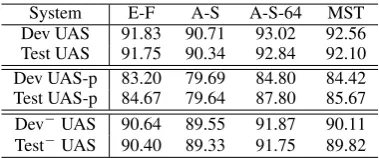
System E-F A-S A-S-64 MST Dev UAS 91.83 90.71 93.02 92.56 Test UAS 91.75 90.34 92.84 92.10 Dev UAS-p 83.20 79.69 84.80 84.42 Test UAS-p 84.67 79.64 87.80 85.67 Dev−UAS 90.64 89.55 91.87 90.11 Test−UAS 90.40 89.33 91.75 89.82
Table 1: Parsing accuracies. “E-F” and “MST” de-note easy-first parser and MSTparser, respectively. “A-S” and “A-S 64” denote our arc-standard parser with beam width 1 and 64, respectively. “UAS” and “UAS-p” denote word and punctuation unla-belled attachment score, respectively. “−” denotes
the data set with punctuations removed.
reported so far. Our code will be available at https://github.com/majineu/Parser/Punc/A-STD.
2 Influence of Punctuations on Parsing
In this section, we conduct a set of experiments to show the influence of punctuations on dependency parsing accuracies.
2.1 Setup
We use the Wall Street Journal portion of the Penn Treebank with the standard splits: sections 02-21 are used as the training set; section 22 and sec-tion 23 are used as the development and test set, respectively. Penn2Malt is used to convert brack-eted structures into dependencies. We use our own implementation of the Part-Of-Speech (POS) tag-ger proposed by Collins (2002) to tag the devel-opment and test sets. Training set POS tags are generated using 10-fold jack-knifing. Parsing ac-curacy is evaluated using unlabelled attachment score (UAS), which is the percentage of words that are assigned the correct lexical heads.
To show that the influence of punctuations on parsing is independent of specific pars-ing algorithms, we conduct experiments us-ing three parsers, each representus-ing a different parsing methodology: the open source
MST-Parser1(McDonald and Pereira, 2006), our own
re-implementation of an arc-standard transition-based parser (Nivre, 2008), which is trained us-ing global learnus-ing and beam-search (Zhang and Clark, 2008) with a rich feature set (Zhang and Nivre, 2011)2, and our own re-implementation of
the easy-first parser (Goldberg and Elhadad, 2010) with an extended feature set (Ma et al., 2013).
2.2 Punctuations and Parsing Accuracy
Our first experiment is to show that, compared with words, punctuations are more difficult to parse and to learn. To see this, we evaluate the parsing accuracies of the selected parsers on words and punctuations, separately. Results are listed in Table 1, where row 2 and row 3 list the UAS of words (all excluding punctuations) on the de-velopment and test set, respectively. Row 4 and row 5 list accuracies of punctuations (all excluding words) on the development and test set, respec-tively. We can see that although all the parsers achieve above 90% UAS on words, the UAS on punctuations are mostly below85%.
As for learning, we calculate the percentage of parameter updates that are caused by associating punctuations with incorrect heads during training of the easy-first parser3. The result is that more
than31%of the parameter updates are caused due to punctuations, though punctuations account for only11.6%of the total tokens in the training set.
The fact that parsers achieve low accuracies on punctuations is to some degree expected, because the head of a punctuation mark is linguistically less well-defined. However, a related problem is
1We trained a second order labelled parser with all the
configurations set to the default value. The code is publicly available at http://sourceforge.net/projects/mstparser/
2Some feature templates in Zhang and Nivre (2011)
in-volve head word and head POS tags which are not avail-able for an arc-standard parser. Interestingly, without those features our arc-standard parser still achieves92.84%UAS which is comparable to the92.90%UAS obtained by the arc-eager parser of Zhang and Nivre (2011)
3For the greedy easy-first parser, whether a parameter
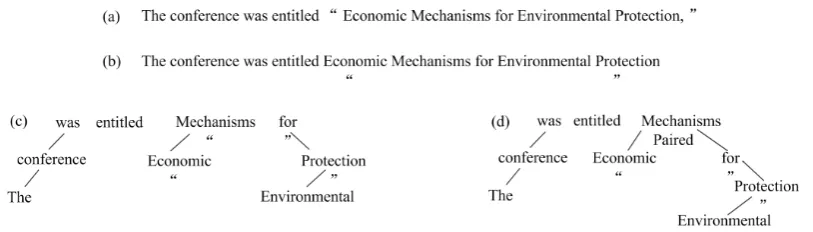
[image:2.595.86.276.168.247.2]Figure 1: Illustration of processing paired punctuation. The property of a word is denoted by the punc-tuation below that word.
that parsing accuracy on words tends to drop on the sentences which contain high ratio of punc-tuations. To see this, we divide the sentences in the development set into sub-sets according the punctuation ratio (percentage of punctuations that a sentence contains), and then evaluate parsing ac-curacies on the sub-sets separately.
The results are listed in Table 2. Since long sentences are inherently more difficult to parse, to make a fair comparison, we further divide the development set according to sentence lengths as shown in the first row4. We can see that most of the
cases, parsing accuracies drop on sentences with higher punctuation ratios. Note that this negative effect on parsing accuracy might be overlooked since most previous work evaluates parsing accu-racywithouttaking punctuations into account.
By inspecting the parser outputs, we found that error propagation caused by assigning incorrect head to punctuations is one of the main reason that leads to this result. Take the sentence shown in Figure 1 (a) for example, the word Mechanisms
is a modifier ofentitledaccording to the gold ref-erence. However, if the quotation mark, “, is in-correctly recognized as a modifier ofwas, due to the “no crossing links” constraint, the arc between
Mechanismsandentitledcan never be created. A natural question is whether it is possible to reduce such error propagation by simply remov-ing all punctuations from parsremov-ing. Our next ex-periment aims at answering this question. In this experiment, we first remove all punctuations from the original data and then modify the dependency arcs accordingly in order to maintain word-word dependencies in the original data. We re-train the parsers on the modified training set and evaluate
41694 out of 1700 sentences on the development set with
length no larger than 60 tokens
parsing accuracies on the modified data.
Results are listed in row 6 and row 7 of Table 1. We can see that parsing accuracies on the modified data drop significantly compared with that on the original data. The result indicates that by remov-ing punctuations, we lose some information that is important for dependency parsing.
3 Punctuation as Properties
In our method, punctuations are treated as prop-erties of its neighbouring words. Such propprop-erties are used as additional features to guide the parser to construct the dependency graph.
3.1 Paired Punctuation
Our method distinguishes paired punctuations from other punctuations. Here paired punctuations include brackets and quotations marks, whose Penn Treebank POS tags are the following four:
-LRB- -RRB- “ ”
The characteristics of paired punctuations include: (1) they typically exist in pairs; (2) they serve as
boundariesthat there is only one dependency arc between the words inside the boundaries and the words outside. Take the sentence in Figure 1 (a) for example, the only arc cross the boundary is (Mechanisms, entitled) where entitled is the head. To utilize such boundary information, we fur-ther classify paired punctuations into two cate-gories: those that serve as the beginning of the boundary, whose POS tags are either -LRB- or “, denoted by BPUNC; and those that serve as the end
of the boundary, denoted by EPUNC.
unigram forpinβ0, β1, β2, β3, σ0, σ1, σ2 ppunc
forpinβ0, β1, β2, σ0, σ1 ppuncpw, ppuncpt
bigram forp, qin(σ0, β0),(σ0, β1),(σ0, β2),(σ0, σ1),(σ0, σ2) ppuncqpunc, ppuncqt, ppuncqw
forp, qin(σ2, σ0),(σ1, σ0),(σ2, σ0) ppuncqt, ppuncptqt
forp, qin(σ2, σ0),(σ1, σ0),(σ0, β0) dpqppuncptqt
Table 3: Feature templates. For an elementpeither on σorβ of an arc-standard parser, we useppunc,
pw andptto denote the punctuation property, head word and head tag ofp, respectively.dpqdenotes the distance between the two elementspandq.
we attach BPUNCs to their right neighbours and
EPUNCs to their left neighbours, as shown in
Fig-ure 1 (b). Note that in FigFig-ure 1 (a), the left neigh-bour of ” is also a punctuation. In such cases, we simply remove these punctuations since the exis-tence of paired punctuations already indicates that there should be a boundary.
During parsing, when a dependency arc with lexical head wh is created, the property of wh is updated by the property of its left (or right) most child to keep track whether there is a BPUNC (or
EPUNC) to the left (or right) side of the sub-tree
rooted at wh, as shown in Figure 1 (c). When BPUNCs and EPUNCs meet each other at wh, a
PAIREDproperty is assigned towhto capture that
the words within the paired punctuations form a sub-tree, rooted atwh. See Figure 1 (d).
3.2 Practical Issues
It is not uncommon that two BPUNCS appear
ad-jacent to each other. For example,
(“Congress’s Environmental Buccaneers,” Sept. 18).
In our implementation, BPUNCor EPUNC
prop-erties are implemented using flags. In the exam-ple, we set two flags “ and ( on the word Con-grees’s. When BPUNC and EPUNC meet each
other, the corresponding flags are turned off. In the example, when Congrees’s is identified as a modifier of Buccaneers, the” flag of Buccaneers is turned off. However, we do not assign a PAIRED
property to Buccaneers since its ( flag is still on. The PAIRED property is assigned only when all
the flags are turned off.
3.3 Non-Paired Punctuations
Though some types of non-paired punctuations may capture certain syntactic patterns, we do not make further distinctions between them, and treat these punctuations uniformly for simplicity.
Before parsing starts and after the preprocessing step for paired punctuations, our method employs
a second preprocessing step to attach non-paired punctuations to their left neighbouring words. It is guaranteed that the property of the left neigh-bouring words of non-paired punctuations must be empty. Otherwise, it means the non-paired punc-tuation is adjacent to a paired puncpunc-tuation. In such cases, the non-paired punctuation would be removed in the first processing step.
During parsing, non-paired punctuations are also passed bottom-up: the property of wh is up-dated by its right-most dependent to keep track whether there is a punctuation to the right side of the tree rooted atwh. The only special case is that ifwhalready contains a BPUNCproperty, then our method simply ignores the non-paired prop-erty since we maintain the boundary information with the highest priority.
3.4 Features
We incorporate our method into the arc-standard transition-based parser, which uses a stack σ to maintain partially constructed trees and a bufferβ
for the incoming words (Nivre, 2008). We design a set of features to exploit the potential of using punctuation properties for the arc-standard parser. The feature templates are listed in Table 3. In addition to the features designed for paired punctuations, such as bigram punctuation features listed in line 3 of Table 3, we also design features for non-paired punctuations. For example, the dis-tance features in line 5 of Table 3 is used to capture the pattern that if a wordwwith comma property is the left modifier of a noun or a verb, the distance betweenwand its lexical head is often larger than 1. In other words, they are not adjacent.
4 Results
un-s Baseline Paired All 1 90.76 91.25 91.47 2 91.88 92.06 92.34 4 92.50 92.61 92.70 8 92.73 92.76 92.82 16 92.90 92.94 92.99 64 92.99 93.04 93.10
Table 4: Parsing accuracies on the development set.sdenotes the beam width.
touched. Feature templates used in this experi-ment are those listed in the top three rows of Ta-ble 3 together with those used for the baseline arc-standard parser.
Results on the development set are shown in the second column of Table 4. We can see that when the beam width is set to 1, our method achieves an
0.49 UAS improvement. By comparing the out-puts of the two parsers, two types of errors made by the baseline parser are effectively corrected.
The first is that our method is able to cap-ture the pattern that there is only one depen-dency arc between the words within the paired-punctuations and the words outside, while the baseline parser sometimes creates more depen-dency arcs that cross the boundary.
The second is more interesting. Our method is able to capture that the root, wh, of the sub-tree within the paired-punctuation, such as “Mecha-nisms” in Figure 1, generally serves as a modifier of the words outside, while the baseline parser oc-casionally makewhas the head of the sentence.
As we increase the beam width, the improve-ment of our method over the baseline becomes smaller. This is as expected, since beam search also has the effect of reducing error propagation (Zhang and Nivre, 2012), thereby alleviating the errors caused by punctuations.
In the last experiment, we examine the effect of incorporating all punctuations using the method introduced in Section 2. In this experiment, we use all the feature templates in Table 3 and those in the baseline parser. Results are listed in the fourth column of Table 4, which shows that pars-ing accuracies can be further improved by also processing non-paired punctuations. The overall accuracy improvement when the beam width is 1 reaches 0.91%. The extra improvements mainly come from better accuracies on the sentences with comma. However, the exact type of errors that are corrected by using non-paired punctuations is more difficult to summarize.
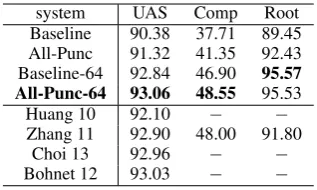
system UAS Comp Root Baseline 90.38 37.71 89.45 All-Punc 91.32 41.35 92.43 Baseline-64 92.84 46.90 95.57 All-Punc-64 93.06 48.55 95.53
Huang 10 92.10 − −
Zhang 11 92.90 48.00 91.80
Choi 13 92.96 − −
[image:5.595.116.249.61.135.2]Bohnet 12 93.03 − −
Table 5: Final result on the test set.
The final results on the test set are listed in Ta-ble 55. Table 5 also lists the accuracies of
state-of-the-art transition-based parsers. In particular, “Huang 10” and “Zhang 11” denote Huang and Sagae (2010) and Zhang and Nivre (2011), re-spectively. “Bohnet 12” and “Choi 13” denote Bohnet and Nivre (2012) and Choi and Mccal-lum (2013), respectively. We can see that our method achieves the best accuracy for single-model transition-based parsers.
5 Conclusion and Related Work
In this work, we proposed to treat punctuations as properties of context words for dependency parsing. Experiments with an arc-standard parser showed that our method effectively improves pars-ing performance and we achieved the best accu-racy for single-model transition-based parser.
Regarding punctuation processing for depen-dency parsing, Li et al. (2010) proposed to uti-lize punctuations to segment sentences into small fragments and then parse the fragments separately. A similar approach is proposed by Spitkovsky et al. (2011) which also designed a set of constraints on the fragments to improve unsupervised depen-dency parsing.
Acknowledgements
We highly appreciate the anonymous reviewers for their insightful suggestions. This research was supported by the National Science Founda-tion of China (61272376; 61300097; 61100089), the Fundamental Research Funds for the Cen-tral Universities (N110404012), the research grant T2MOE1301 from Singapore Ministry of Ed-ucation (MOE) and the start-up grant SRG ISTD2012038 from SUTD.
5The number of training iteration is determined using the
References
Bernd Bohnet and Joakim Nivre. 2012. A transition-based system for joint part-of-speech tagging and la-beled non-projective dependency parsing. In Pro-ceedings of the 2012 Joint Conference on Empirical Methods in Natural Language Processing and Com-putational Natural Language Learning, EMNLP-CoNLL ’12, pages 1455–1465, Stroudsburg, PA, USA. Association for Computational Linguistics. Jinho D. Choi and Andrew Mccallum. 2013.
Transition-based dependency parsing with selec-tional branching. InIn Proceedings of the 51st An-nual Meeting of the Association for Computational Linguistics.
Michael Collins. 2002. Discriminative training meth-ods for hidden markov models: theory and experi-ments with perceptron algorithms. InProceedings of the ACL-02 conference on Empirical methods in natural language processing - Volume 10, EMNLP ’02, pages 1–8, Stroudsburg, PA, USA. Association for Computational Linguistics.
Yoav Goldberg and Michael Elhadad. 2010. An effi-cient algorithm for easy-first non-directional depen-dency parsing. InHuman Language Technologies: The 2010 Annual Conference of the North American Chapter of the Association for Computational Lin-guistics, HLT ’10, pages 742–750, Stroudsburg, PA, USA. Association for Computational Linguistics. Liang Huang and Kenji Sagae. 2010. Dynamic
pro-gramming for linear-time incremental parsing. In Jan Hajic, Sandra Carberry, and Stephen Clark, ed-itors, ACL, pages 1077–1086. The Association for Computer Linguistics.
Zhenghua Li, Wanxiang Che, and Ting Liu. 2010. Im-proving dependency parsing using punctuation. In Minghui Dong, Guodong Zhou, Haoliang Qi, and Min Zhang, editors,IALP, pages 53–56. IEEE Com-puter Society.
Ji Ma, Jingbo Zhu, Tong Xiao, and Nan Yang. 2013. Easy-first pos tagging and dependency parsing with beam search. In Proceedings of the 51st Annual Meeting of the Association for Computational Lin-guistics (Volume 2: Short Papers), pages 110–114, Sofia, Bulgaria, August. Association for Computa-tional Linguistics.
Ryan McDonald and Fernando Pereira. 2006. Online learning of approximate dependency parsing algo-rithms. In Proceedings of 11th Conference of the European Chapter of the Association for Computa-tional Linguistics (EACL-2006)), volume 6, pages 81–88.
Ryan McDonald, Koby Crammer, and Fernando Pereira. 2005. Online large-margin training of de-pendency parsers. In Proceedings of the 43rd An-nual Meeting on Association for Computational Lin-guistics, ACL ’05, pages 91–98, Stroudsburg, PA, USA. Association for Computational Linguistics.
Joakim Nivre, Johan Hall, Jens Nilsson, Atanas Chanev, G¨ulsen Eryigit, Sandra K¨ubler, Svetoslav Marinov, and Erwin Marsi. 2007. Maltparser: A language-independent system for data-driven de-pendency parsing. Natural Language Engineering, 13(2):95–135.
Joakim Nivre. 2008. Algorithms for deterministic in-cremental dependency parsing. Computational Lin-guistics, 34(4):513–553.
Valentin I. Spitkovsky, Hiyan Alshawi, and Daniel Ju-rafsky. 2011. Punctuation: Making a point in un-supervised dependency parsing. In Proceedings of the Fifteenth Conference on Computational Natural Language Learning (CoNLL-2011).
Yue Zhang and Stephen Clark. 2008. A tale of two parsers: Investigating and combining graph-based and transition-based dependency parsing. In Pro-ceedings of the 2008 Conference on Empirical Meth-ods in Natural Language Processing, pages 562– 571, Honolulu, Hawaii, October. Association for Computational Linguistics.
Yue Zhang and Joakim Nivre. 2011. Transition-based dependency parsing with rich non-local features. In
Proceedings of the 49th Annual Meeting of the Asso-ciation for Computational Linguistics: Human Lan-guage Technologies, pages 188–193, Portland, Ore-gon, USA, June. Association for Computational Lin-guistics.