A Subcategorization Acquisition System for French Verbs
C´edric Messiant
Laboratoire d’Informatique de Paris-Nord CNRS UMR 7030 and Universit´e Paris 13
99, avenue Jean-Baptiste Cl´ement, F-93430 Villetaneuse France
Abstract
This paper presents a system capable of auto-matically acquiring subcategorization frames (SCFs) for French verbs from the analysis of large corpora. We applied the system to a large newspaper corpus (consisting of 10 years of the French newspaper ’Le Monde’) and ac-quired subcategorization information for 3267 verbs. The system learned 286 SCF types for these verbs. From the analysis of 25 represen-tative verbs, we obtained 0.82 precision, 0.59 recall and 0.69 F-measure. These results are comparable with those reported in recent re-lated work.
1 Introduction
Many Natural Language Processing (NLP) tasks require comprehensive lexical resources. Hand-crafting large lexicons is labour-intensive and error-prone. A growing body of research focuses therefore on automatic acquisition of lexical resources from text corpora.
One useful type of lexical information for NLP is the number and type of the arguments of predicates. These are typically expressed in simple syntac-tic frames called subcategorization frames (SCFs). SCFs can be useful for many NLP applications, such as parsing (John Carroll and Briscoe, 1998) or in-formation extraction (Surdeanu et al., 2003). Au-tomatic acquisition of SCFs has therfore been an active research area since the mid-90s (Manning, 1993; Brent, 1993; Briscoe and Carroll, 1997).
Comprehensive subcategorization information is currently not available for most languages. French
is one of these languages: although manually built syntax dictionaries do exist (Gross, 1975; van den Eynde and Mertens, 2006; Sagot et al., 2006) none of them are ideal for computational use and none also provide frequency information important for statistical NLP.
We developed ASSCI, a system capable of ex-tracting large subcategorization lexicons for French verbs from raw corpus data. Our system is based on a approach similar to that of the well-known Cam-bridge subcategorization acquisition system for En-glish (Briscoe and Carroll, 1997; Preiss et al., 2007). The main difference is that unlike the Cambridge system, our system does not employ a set of pre-defined SCF types, but learns the latter dynamically from corpus data.
We have recently used ASSCI to acquire LexSchem – a large subcategorization lexicon for French verbs – from a raw journalistic corpus. and have made the resulting resource freely available to the community on the web (Messiant et al., 2008).
We describe our SCF acquisition system in sec-tion 2 and explain the acquisisec-tion of a large subcat-egorization lexicon for French and its evaluation in section 3. We finally compare our study with work previously achieved for English and French in sec-tion 4.
2 ASSCI: The Acquisition System
Our SCF acquisition system takes as input corpus data and produces a list of frames for each verb that occurred more than 200 times in the corpus. It the first system that automatically induces a large-scale SCF information from raw corpus data for French.
Previous experiments focussed on a limited set of verbs (Chesley and Salmon-Alt, 2006), or were based on treebanks or on substantial manual work (Gross, 1975; Kup´s´c, 2007).
The system works in three steps:
1. verbs and surrounding phrases are extracted from parsed corpus data;
2. tentative SCFs are built dynamically, based on morpho-syntactic information and relations be-tween the verb and its arguments;
3. a statistical filter is used to filter out incorrect frames.
2.1 Preprocessing
When aiming to build a large lexicon for general language, the input data should be large, balanced and representative enough. Our system tags and lemmatizes input data using TreeTagger (Schmid, 1994) and then syntactically analyses it using Syn-tex (Bourigault et al., 2005). TheTreeTagger is a statistical, language independent tool for the auto-matic annotation of part-of-speech and lemma in-formation. Syntex is a shallow parser for extract-ing lexical dependencies (such as adjective/noun or verb/noun dependencies). Syntex obtained the best precision and F-measure for written French text in the recent EASY evaluation campaign1.
The dependencies extracted by the parser include both arguments and adjuncts (such as location or time phrases). The parsing strategy is based on heuristics and statistics only. This is ideal for us since no lexical information should be used when the task is to acquire it.Syntexworks on the general assumption that the word on the left side of the verb is the subject, where as the word on the right is the object. Exceptions to this assumption are dealt with a set of rules.
(2) Ces propri´etaires exploitants
ach`etent ferme le carburant la
1http://www.limsi.fr/Recherche/CORVAL/
easy
The scores and ranks ofSyntex at this evaluation campaign are available at http://w3.univ-tlse2.fr/erss/ textes/pagespersos/bourigault/syntex.html# easy
compagnie .
(These owners buy fast the fuel to
the company.)
(3)is the preprocessedASSCIinput for sentence (2) (after the TreeTagger annotation and Syntex’s analysis).
(3) DetMP|ce|Ces|1|DET;3|
AdjMP|propri´etaire|propri´etaires|2|ADJ;3| NomMP|exploitant|exploitants|3||DET;1,ADJ;2 VCONJP|acheter|ach`etent|4||ADV;5,OBJ;7,PREP;8 Adv|ferme|ferme|5|ADV;11|
DetMS|le|le|6|DET;7|
NomMS|carburant|carburant|7|OBJ;4|DET;6 Prep|`a|`a|8|PREP;4|NOMPREP;10
DetFS|le|la|9|DET;10|
NomFS|compagnie|compagnie|10|NOMPREP;8|DET;9 Typo|.|.|11||
2.2 Pattern Extractor
The pattern extraction module takes as input the syntactic analysis of Syntex and extracts each verb which is sufficiently frequent (the minimum of 200 corpus occurrences) in the syntactically analysed corpus data, along with surrounding phrases. In some cases, this module makes deeper use of the dependency relations in the analysis. For example, when a preposition is part of the dependencies, the pattern extractor examines whether this preposition is followed by a noun phrase or an infinitive clause.
(4)is the output of the pattern extractor for(3).
(4) VCONJP|acheter
NomMS|carburant|OBJ Prep|`a+SN|PREP
Note that +SNmarks that the“`a” preposition is followed by a noun phrase.
2.3 SCF Builder
SCF and the total number of occurrences with each verb are recorded.
This dynamic approach to SCF learning was adopted because no sufficiently comprehensive list of SCFs was available for French (most previous work on English (e.g., (Preiss et al., 2007)) employs a set of predefined SCFs because a relatively com-prehensive lists are available for English).
The SCF candidate built for sentence (2) is shown in(5)2.
(5) SN SP[`a+SN]
2.4 SCF Filter
The final module filters the SCF candidates. A fil-ter is necessary since the output of the second mod-ule is noisy, mainly because of tagging and parsing errors but also because of the inherent difficulty of argument-adjunct distinction which ideally requires access to the lexical information we aim to acquire, along with other information and criteria which cur-rent NLP systems (and even humans) find it difficult to identify. Several previous works (e.g., (Briscoe and Carroll, 1997; Chesley and Salmon-Alt, 2006)) have used binomial hypothesis testing for filtering. Korhonen et al. (2000) proposes to use the maxi-mum likelihood estimate and shows that this method gives better results than the filter based on binomial hypothesis testing. This method employs on a sim-ple threshold over the relative frequencies of SCFs candidates. (The maximum likehood estimate is still an option in the current Cambridge system but an improved version calculates it specific to different SCFs - a method which we left for future work).
The relative frequency of the SCFiwith the verb jis calculated as follows:
rel f req(scfi, verbj) =|scfi, verbj|
|verbj|
|scfi, verbj|is the number of occurrences of the
SCFiwith the verbjand|verbj|is the total number of occurrences of the verbjin the corpus.
These estimates are compared with the threshold value to filter out low probability frames for each verb. The effect of the choice of the threshold on the results is discussed in section 3.
2
SN stands for a noun phrase and SP for a prepositional phrase
3 Experimental Evaluation
3.1 Corpus
In order to evaluate our system on a large corpus, we gathered ten years of the French newspaperLe Monde (two hundred millions words). It is one of the largest corpus for French and “clean” enough to be easily and efficiently parsed. Because our aim was to acquire a large general lexicon, we require the minimum of 200 occurrences per each verb we analysed using this system.
3.2 LexSchem: The Acquired Lexicon
3267 verbs were found with more than 200 oc-currences in the corpus. From the data for these verbs, we induced 286 distinct SCF types. We have made the extracted lexicon freely available on the web (http://www-lipn.univ-paris13. fr/˜messiant/lexschem.html) under the LGPL-LR (Lesser General Public License For Linguistic Resources) license. An interface which enables viewing the SCFs acquired for each verb and the verbs taking different SCFs is also available at the same address. For more details of the lexicon and its format, see (Messiant et al., 2008).
3.3 Gold Standard
Direct evaluation of subcategorization acquisition performance against a gold standard based on a manmade dictionary is not ideal (see e.g. (Poibeau and Messiant, 2008)). However, this method is still the easiest and fastest way to get an idea of the per-formance of the system. We built agold standard using the SCFs found in the Tr´esor de la Langue Franc¸aise Informatis´e (TFLI), a large French dictio-nary available on the web3. We evaluated 25 verbs listed in Appendix to evaluate our system. These verbs were chosen for their heterogeneity in terms of semantic and syntactic features, but also because of their varied frequency in the corpus (from 200 to 100.000 occurences).
3.4 Evaluation Measures
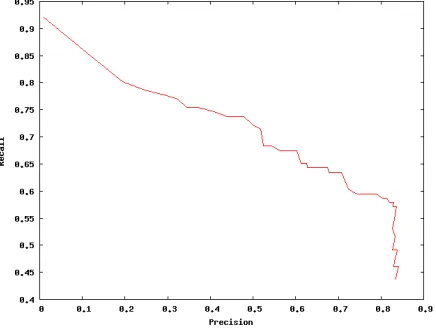
We calculated type precision, type recall and F-measure for these 25 verbs. We obtain the best results (0.822 precision, 0.587 recall and 0.685 f-measure) with the MLE threshold of 0.032 (see
Figure 1: The relation of the threshold on the F-Measure
Figure 2: The relation between precision and recall
ure 1). Figure 2 shows that even by substantially lowering recall we cannot raise precision over 0.85.
Table 1 shows a comparison of three versions of ASSCIfor our 25 verbs:
• Unfiltered: the unfiltered output ofASSCI;
• ASSCI-1: one single threshold fixed to 0.0325;
• ASSCI-2: one INTRANS-specific threshold (0.08) and the 0.0325-threshold for all other cases.
These results reveal that the unfiltered version of the lexicon is very noisy indeed (0.01 precision).
System Precision Recall F-Measure Unfiltered 0.010 0.921 0.020
[image:4.612.77.296.59.228.2]ASSCI-1 0.789 0.595 0.679 ASSCI-2 0.822 0.587 0.685
Table 1: Comparison of different versions ofASSCI
A simple threshold on the relative frequencies im-proves the results dramatically (ASSCI-1).
Each step of the acquisition process generates er-rors. For example, some nouns are tagged as averb by TreeTagger (e.g., in the phrase“Le programme d’armement (weapons program)”, “programme” is taggedverb). Syntexgenerates errors when identi-fying dependencies: in some cases, it fails to iden-tify relevant dependencies; in other cases incorrect dependencies are generated. The SCF builder is an-other source of error because of the ambiguity or the lack of sufficient information to build some frames (e.g. those involving pronouns). Finally, the filtering module rejects some correct SCFs and accept some incorrect ones. We could reduce these errors by im-proving the filtering method or refining the thresh-olds.
Many of the errors involve intransitive SCFs. We tried to address this problem with an INTRANS-specific threshold which is higher than others (see the results forASSCI-2). This improves the preci-sion of the system slightly but does not substantially reduce the number of false negatives. The intran-sitive form of verbs is very frequent in corpus data but it doesn’t appear in thegold standard. A better evaluation (e.g., a gold standard based on manual analysis of the corpus data and annotation for SCFs) should not yield these errors. In other cases (e.g. interpolated clauses), the parser is incapable of find-ing the dependencies. In subsequent work we plan to use an improved version ofSyntexwhich deals with this problem.
[image:4.612.77.295.268.433.2]use-ful for NLP tasks and applications. For example, John Carroll& al. shows that a parser can be signif-icantly improved by using a SCF lexicon despite a high error rate (John Carroll and Briscoe, 1998).
4 Related Work
4.1 Manual or Semi-Automatic Work
Most previous subcategorization lexicons for French were built manually. For example, Maurice Gross built a large French dictionnary called “Les Tables du LADL” (Gross, 1975). This dictionary is not easy to employ for NLP use but work in progress is aimed at addressing this problem (Gardent et al., 2005). The Lefff is a morphological and syntactic lexicon that contains partial subcategorization information (Sagot et al., 2006), whileDicovalenceis a manually built valency dictionnary based on the pronominal approach (van den Eynde and Blanche-Benveniste, 1978; van den Eynde and Mertens, 2006). There are also lexicons built using semi-automatic approaches e.g., the acquisition of subcategorization informa-tion from treebanks (Kup´s´c, 2007).
4.2 Automatic Work
Experiments have been made on the automatic acquisition of subcategorization frames since mid 1990s (Brent, 1993; Briscoe and Carroll, 1997). The first experiments were performed on English but since the beginning of 2000s the approach has been successfully applied to various other languages. For example, (Schulte im Walde, 2002) has induced a subcategorization lexicon for German verbs from a lexicalized PCFG. Our approach is quite similar to the work done in Cambridge. The Cambridge sys-tem has been regularly improved and evaluated; and it represents the state-of-the-art perfomance on the task (Briscoe and Carroll, 1997; Korhonen et al., 2000; Preiss et al., 2007). In the latest paper, the au-thors show that the method can be successfully ap-plied to acquire SCFs not only for verbs but also for nouns and adjectives (Preiss et al., 2007). A major difference between these related works and ours is the fact that we do not use a predefined set of SCFs. Of course, the number of frames depends on the language, the corpus, the domain and the informa-tion taken into account (for example, (Preiss et al., 2007) used a list of 168 predefined frames for
En-glish which abstract over lexically-governed prepo-sitions).
As far as we know, the only directly compara-ble work on subcategorization acquisition for French is (Chesley and Salmon-Alt, 2006) who propose a method for acquiring SCFs from a multi-genre corpus in French. Their work relies on the VISL parser which have an “unevaluated (and potentially high) error rate” while our system relies onSyntex which is, according to the EASY evaluation cam-paign, the best parser for French (as evaluated on general newspaper corpora). Additionally, we ac-quired a large subcategorization lexicon (available on the web) (286 distinct SCFs for 3267 verbs) whereas (Chesley and Salmon-Alt, 2006) produced only 27 SCFs for 104 verbs and didn’t produce any lexicon for public release.
5 Conclusion
We have introduced a system which we have devel-oped for acquiring large subcategorization lexicons for French verbs. When the system was applied to a large French newspaper corpus, it produced a lex-icon of 286 SCFs corresponding to 3267 verbs. We evaluated this lexicon by comparing the SCFs it pro-duced for 25 test verbs to those included in a manu-ally built dictionary and obtained promising results. We made the automatically acquired lexicon freely available on the web under the LGPL-LR license (and through a web interface).
Future work will include improvements of the fil-tering module (using e.g. SCF-specific thresholds or statistical hypothesis testing) and exploration of task-based evaluation in the context of practical NLP applications and tasks such as the acquisition of se-mantic classes from the SCFs (Levin, 1993).
Acknowledgements
C´edric Messiant’s PhD is funded by a DGA/CNRS Grant. The research presented in this paper was also supported by the ANR MDCO ’CroTal’ project and the British Council and the French Ministry of For-eign Affairs -funded ’Alliance’ grant.
References
analyseur syntaxique de corpus. InActes des 12`emes journ´ees sur le Traitement Automatique des Langues Naturelles, Dourdan.
Michael R. Brent. 1993. From Grammar to Lexicon: Unsupervised Learning of Lexical Syntax. Computa-tional Linguistics, 19:203–222.
Ted Briscoe and John Carroll. 1997. Automatic Ex-traction of Subcategorization from Corpora. In Pro-ceedings of the 5th ACL Conference on Applied Nat-ural Language Processing, pages 356–363, Washing-ton, DC.
Paula Chesley and Susanne Salmon-Alt. 2006. Au-tomatic extraction of subcategorization frames for French. In Proceedings of the Language Resources and Evaluation Conference (LREC), Genua (Italy). Claire Gardent, Bruno Guillaume, Guy Perrier, and
In-grid Falk. 2005. Maurice Gross’ Grammar Lexicon and Natural Language Processing. In 2nd Language and Technology Conference, Poznan.
Maurice Gross. 1975. M´ethodes en syntaxe. Hermann, Paris.
Guido Minnen John Carroll and Ted Briscoe. 1998. Can subcategorisation probabilities help a statistical parser? InProceedings of the 6th ACL/SIGDAT Work-shop on Very Large Corpora, Montreal (Canada). Anna Korhonen, Genevieve Gorrell, and Diana
Mc-Carthy. 2000. Statistical filtering and subcategoriza-tion frame acquisisubcategoriza-tion. InProceedings of the Confer-ence on Empirical Methods in Natural Language Pro-cessing and Very Large Corpora, Hong Kong. Anna Kup´s´c. 2007. Extraction automatique de cadres
de sous-cat´egorisation verbale pour le franc¸ais `a par-tir d’un corpus arbor´e. InActes des 14`emes journ´ees sur le Traitement Automatique des Langues Naturelles, Toulouse, June.
Beth Levin. 1993. English Verb Classes and Alter-nations: a preliminary investigation. University of Chicago Press, Chicago and London.
Christopher D. Manning. 1993. Automatic Acquisition of a Large Subcategorization Dictionary from Cor-pora. InProceedings of the Meeting of the Association for Computational Linguistics, pages 235–242. C´edric Messiant, Anna Korhonen, and Thierry Poibeau.
2008. LexSchem : A Large Subcategorization Lex-icon for French Verbs. In Language Resources and Evaluation Conference (LREC), Marrakech.
Thierry Poibeau and C´edric Messiant. 2008. Do We Still Need Gold Standard For Evaluation ? InProceedings of the Language Resources and Evaluation Conference (LREC), Marrakech.
Judita Preiss, Ted Briscoe, and Anna Korhonen. 2007. A System for Large-Scale Acquisition of Verbal, Nom-inal and Adjectival Subcategorization Frames from
Corpora. InProceedings of the Meeting of the Associ-ation for ComputAssoci-ational Linguistics, pages 912–918, Prague.
Benoˆıt Sagot, Lionel Cl´ement, Eric de La Clergerie, and Pierre Boullier. 2006. The Lefff 2 syntactic lexicon for French: architecture, acquisition, use. In Proceed-ings of the Language Resources and Evaluation Con-ference (LREC), Genua (Italy).
Helmut Schmid. 1994. Probabilistic Part-of-Speech Tag-ging Using Decision Trees. In International Con-ference on New Methods in Language Processing, Manchester, UK. unknown.
Sabine Schulte im Walde. 2002. A Subcategorisation Lexicon for German Verbs induced from a Lexicalised PCFG. InProceedings of the 3rd Conference on Lan-guage Resources and Evaluation, volume IV, pages 1351–1357, Las Palmas de Gran Canaria, Spain. Mihai Surdeanu, Sanda M. Harabagiu, John Williams,
and Paul Aarseth. 2003. Using Predicate-Argument Structures for Information Extraction. In Proceed-ings of the Association of Computational Linguistics (ACL), pages 8–15.
Karel van den Eynde and Claire Blanche-Benveniste. 1978. Syntaxe et m´ecanismes descriptifs : pr´esentation de l’approche pronominale. Cahiers de Lexicologie, 32:3–27.
Karel van den Eynde and Piet Mertens. 2006. Le dictio-nnaire de valence Dicovalence : manuel d’utilisation. Manuscript, Leuven.
Appendix — List of test verbs