Munich Personal RePEc Archive
Rent-focused behavior and rent-seeking
in the context of rent relations theory
development
Latkov, Andrey
21 May 2015
Online at https://mpra.ub.uni-muenchen.de/64512/
Andrey V. Latkov, Sc. D., professor, Stolypin Volga Region Institute of Administration RANEPA, Russia, Saratov
Rent-focused behavior and rent-seeking in the context
of rent relations theory development
Abstract. The perspective directions of rent-seeking phenomenon research are allocated in the article. The algorithm of seeking system research is offered. rent-focused behavior and rent-seeking strategies are differenced in the text. The special attention is paid to definition of medium-term and long-term rent-seeking effects directed to assignment of natural-resources rent on example of national economic systems of the UAE and Nauru.
Keywords: rent-seeking, rent-focused behavior, rent relations theory, natural and resource rent, rent-seeking effects.
Studies of the rent-seeking phenomenon are interesting to many authors in the world almost 50 years, and it is over the past two decades for national science representatives. In my opinion, it can be explained by the following reasons:
1) Studies of rent-seeking are integral part of comprehensive rent relations system analysis;
2) Prevalence of rent-seeking behavior in the so-called “rent economies”, which is accepted to the national economies of many countries, including Russia;
3) Continuing validity to develop more accurate methods of estimating losses as the results of rent-seeking (the term “rent-seeking” had negative connotation for the results of economic activity at the macro level originally);
4) Necessity to define such interrelated areas, methods, tools of economic policies, which are essential to be rent-seeking behavior of economic and political agents and its negative impact to national economies development processes.
These reasons indicate that a detailed studies of the rent-seeking nature, forms, consequences have practical importance also, not only theoretical importance. And the problems associated with rent-seeking behavior have long been acquired economical, political, environmental, and general social sound. In this regard, there can be no doubt that the study of the rent-seeking behavior phenomenon should be interdisciplinary, gathering together economists, psychologists, sociologists and political scientists initially.
direction takes place. Solid theoretical and methodological foundation has been established for the rent-seeking phenomenon study: “political economy of rent-seeking society” was established [9]; “theory of rent-seeking society” is forming [3, 10]; the theory of rent-seeking and the property rights theory are integrated [24]; the basic models of rent-seeking behavior are built [11, 22]; the models of political agents rent-seeking behavior in the political business cycles context are constructed [1, 2, 4, 7, 8, 12-15, 20, 23]. Also many local aspects of rent-seeking in different countries including Russia are considered [16-19, 21, 25].
On the other side, there are some questions, the lack of answers to which limits the further development not only the theory of rent-seeking behavior, but also the rent relations theory in general. In my opinion, these questions can be summarized as follows:
1. As far as the estimate of rent-seeking behavior as clearly negative phenomenon at the national economies is correct? If this estimation isn’t correct, the rents must be differentiated as “effective” and “ineffective”, “productive” and “ non-productive”.
2. The need for differentiation of the above necessarily entails the question: as far as the current classification of rents is correct for the current stage of economic systems development at the different levels?
3. If we try to divide “effective” and “ineffective” rents, we should to identify clearly criterion of effectiveness / ineffectiveness of rents and rent-seeking.
4. Does the period term influence to level of rent and rent-seeking effectiveness / ineffectiveness? If that’s right, we should distinguish the rent-seeking behavior influence to the economic system at the short-, medium- and long-term periods.
5. In this case, what is the criterion for short-, medium- and long-term periods distinguishing for rent-seeking behavior? Will this criterion be the same for any kind of rent?
6. What are definitions for “effective/ineffective” and “ productive/non-productive” rent-seeking?
7. Is it possible to construct comprehensive methodology for assessing the losses for society (or the growth of social welfare) determined by rent-seeking behavior?
8. How can we calculate the summa of rental incomes and their share in the national income?
9. What possibilities do we have for further analysis of rent-seeking behavior at different levels of socio-economic system?
This isn’t exhaustive list of questions which shows promising directions of
development of rent relations theory in general, and theory of rent-seeking behavior in particular, on the one hand. Currently we can not answer this complex question reasonably. But we have opportunity to nominate some hypotheses that need to confirm (or to refute) during further research.
synthesis of classical, neoclassical and institutional approaches to the rent relations theory. Excess profits can be identified as part of economic agents’ profits, and some neoclassical economists called excess profits as rental incomes which should be called “innovative and technological quasi-rents”. Seeking of such quasi-rents is positive because it contributes to the economic system development. Therefore, assessment of rent-seeking behavior as clearly negative phenomenon isn’t correct.
That’s why we should differentiate “effective” and “ineffective” rents and
“productive” and “non-productive” rents also.
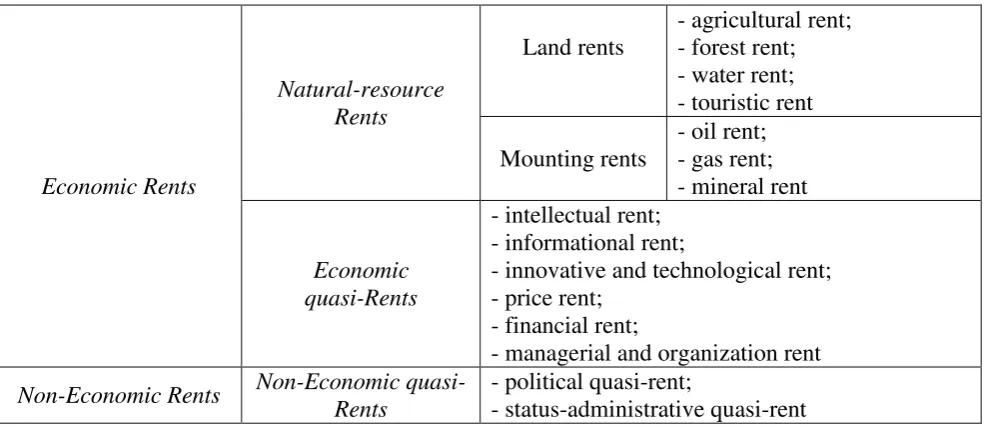
[image:4.595.53.546.289.502.2]Second, I venture to suggest that current rents classification isn’t quite perfect for modern economic systems development. Actually, single universally accepted rents classification is out. Some years ago the author proposed the following typology of rental incomes (see Table 1).
Table 1. Rents typology based on the rental resource criterion
Economic Rents
Natural-resource Rents
Land rents
- agricultural rent; - forest rent; - water rent; - touristic rent
Mounting rents
- oil rent; - gas rent; - mineral rent
Economic quasi-Rents
- intellectual rent; - informational rent;
- innovative and technological rent; - price rent;
- financial rent;
- managerial and organization rent
Non-Economic Rents Non-Economic quasi-Rents
- political quasi-rent;
- status-administrative quasi-rent
There is diversity of opinions about species “non-economic rents” distinction in modern literature. Furthermore, I see controversial character of proposed typology of land rents. Therefore, “effective” and “ineffective” rents differentiation such as
“productive” and “non-productive” rents differentiation require prior improving of rents classification.
Third, I should tell that clear criteria for rents (and rent-seeking) effectiveness/ineffectiveness has not been developed yet. Existing criterion (rent-seeking leads to increase vs decrease of social welfare / GDP / national income, etc.) is very “fuzzy”, and vague and therefore imperfect. That’s why clear criteria (may be criteria system) evaluation of rent-seeking effectiveness / ineffectiveness defining is one of the most important problems in modern economic science.
Fourth, it is possible to assume that level of rent (rent-seeking) effectiveness / ineffectiveness depends from the length of period under review. So-called “Dutch
due to global market conditions changes. Therefore, it’s necessary to distinguish short-, medium- and long-term influences of rent-seeking behavior to the economic systems.
Fifth, criteria system for differentiation of short-, medium- and long-term periods in relation to rent-seeking behavior isn’t developed yet. Political business cycle and legislature durations are source parameters for political quasi-rent seeking, but this criterion isn’t so clear for other rent types. It can be assumed that demarcation periods criterion is closely linked to relevant rental resources characteristics. However, it is unlikely that it will be universal criterion.
Sixth, we assume that “productive” rent-seeking can be as “effective” as
“ineffective” depending from review period term. However, this hypothesis needs to be elaborated argumentation.
Seventh, it seems likely that comprehensive methodology construction for social welfare losses assessing (or for social welfare growth) from rent-seeking behavior is possible in principle if the total amount of rental incomes and their share in the national income are determined more or less accurately. We shouldn’t forget that A. Krueger in the 1970s held theoretical analysis and assessment of rent that arose in connection with the practice of state power limit for economic activity in India and in Turkey [9].
Eighth, there are various methods for rental incomes value and their share of national income determining already. However, techniques proposed by D.S. Lvov, S.Y. Glazyev and other Russian scientists are not perfect. D.S. Lvov believed that
“problem of distinguishing the rental component of income is unlikely to have a standard solution suitable for all cases of industrial activity which involves natural resources” [18].
Ninth, Center for Psychological and Economic Researches at Saratov Scientific Center RAS formulated hypothesis to separate two categories: rent-focused behavior and rent-seeking. Original “rent seeking” term was formulated to describe economic agents’ behavior in institutional transformation context when individual efforts to maximize value generate society losses, rather benefits. We assume that actual rent-focused behavior is characterized by agents’ actions aimed to rental incomes assignment based on economic using of existing rental resources. In contrast, rent-seeking is characterized primarily by agents’ actions to create rental resources in the socio-economic system to use for rent incomes extraction in the future. Obviously, rent-focused behavior and rent-seeking involve each other in the same socio-economic system.
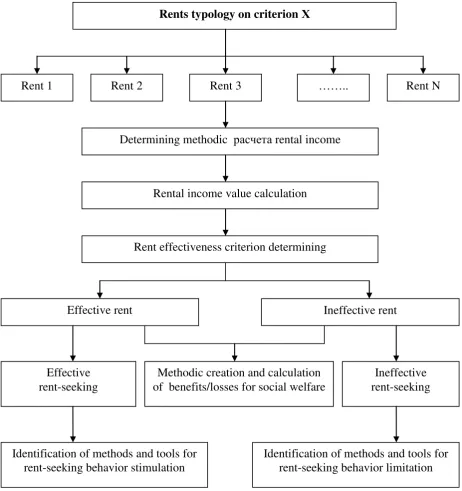
Based on the above, following outline for study of rent-seeking behavior (see Fig. 1).
Let’s dwell on parameters for rent-seeking and rent-seeking behavior differentiation and on influence to national economies development by these two behavioral strategies. As initial object natural resource rents have particular importance for national socio-economic system functioning and development.
Fig. 1. Rent-seeking behavior study design
On the other side, these states are very different. The UAE belongs to the small states category (the total population is 8.45 million people in 2013); and Nauru is microstate, its population is about 10 thousands people on small territory (just 21.3 km²). United Arab Emirates is the landlocked country bordering Persian Gulf; Nauru is remote Pacific Ocean island nation near equator. Primary rental resources of the UAE are crude oil originally and natural gas also. The main rental resource of Nauru is phosphates. The list of differences can be expanded significantly.
On the other side, selected states have much in common.
1. The financial basis for development of these state entities had been the natural resource rent (oil and gas rents for the UAE, and phosphate rent for Nauru).
Rents typology on criterion Х
Rent 1 Rent 2 Rent 3 …….. Rent N
Determining methodic расчета rental income
Effective rent-seeking
Methodic creation and calculation of benefits/losses for social welfare Effective rent
Identification of methods and tools for rent-seeking behavior stimulation
Rental income value calculation
Ineffective rent Rent effectiveness criterion determining
Ineffective rent-seeking
2. The states put under strict control creation, distribution and use of natural resource rents both in order to ensure the financial basis of development: Abu Dhabi National Oil Company was established in 1971, and Nauru Phosphate Corporation established also.
3. Both countries had a long history of development as colonial possessions. They were unable to determine the socio-economic development strategy before political independence gaining. Therefore, the positive effects of rent-seeking behavior could not be high in these countries during the colonial period (see Table 2).
Table 2. Rental economies parameters in Nauru and in the UAE before political independence gaining.
Terri-tory
Traditional industries
The opening of the rental resource
Start of the rental resource intensive exploitation Subjects assignment of rental income
The effects of rent-seeking behavior
Nauru
Fishing, gathering, agriculture
1900 1906
Non-residents (Australian and British companies)
Full employment achieving; some growth in living standards
UAE
Oasis farming, fishing,
pearling, nomadic herding
1954 1959
Non-residents (British companies)
Full employment achieving; some growth in living standards
4. The countries received the political independence at the same time.
5. Labor shortage has led to significant influx of foreign labor force (from Pakistan, India, Bangladesh, Sri Lanka, Nepal, and Philippines to the UAE; from Kiribati and Tuvalu to Nauru), which affected strongly to the population composition in both countries. Indigenous population is about 11% in the UAE, and it doesn’t exceed 58% of the total population in Nauru.
[image:7.595.52.550.642.774.2]Political and economic independence achievement of political and economic independence allowed to fix the natural resource rents as base of national development. The political leaderships of the states demonstrated pronounced rent-oriented behavior (see Table 3).
Table 3. Baseline characteristics of Nauru and the UAE rental economies.
The state
Independen ce founding
The base of national economy
The dominant rental resource
The source of rental incomes
The subject of assignment of
rents
UAE 1971 natural resource rent (crude oil rent)
crude oil and natural gas
Labor of hired
workers-immigrants
The state
Nauru 1968
natural resource rent (phosphate rent)
phosphates (“nauruits”)
Labor of hired
workers-immigrants
During the first decades of the state sovereignty Nauru and the UAE have shown the effects natural resource rent-seeking behavior, which can be reduced to the following parameters: a) significant increase in the standard of living of the population (mostly it affected indigenous people); b) high values of GDP, GNP, national income, including per capita (in Nauru in 1986, per capita GDP reached $ 20,000, it was close to the rate in the United Arab Emirates); c) the increase in the positive balance of foreign trade (the ratio of export and import in Nauru in the mid-1980s. 4: 1); d) the rapid growth of value of the assets; e) the rapid development of social infrastructure, including education and health systems; f) positive trends of the population (at the time of independence in 1968, the population of Nauru was about 3 000 residents, after 30 years of independence it was about 10 000 residents, that in the UAE this indicator increased from 180 000 in 1971 to nearly 3 million in 1999).
Thus, for at least two decades after gaining political independence and the nationalization of the main rental resource indicators of the economies of both countries (“rental economies”) have the same motion vector. An analysis of longer period of national economic systems functioning opens up a completely different picture (see Tab. 4).
Table 4. Long-term economical-ecological effects of natural-resource rent-seeking behavior in Nauru and in the UAE
The state Nominal GDP per capita Ecological system Rental resource Rental incomes dynamics
The economic result of natural resource
rent-seeking behavior
Nauru
5000 $ in 2005; 2500 $ in 2006
Practically destroyed
Practically
exhausted Steadily declining
The collapse of economic system
UAE 64840 $ in 2012
Artificiall y created
While maintaining the same found new
Reducing the share of oil and gas rents, increase in the share of new types of rental incomes
Diversification of the economy and its sustainable
development
Economic shifts determined relevant socio-political events in the two countries (see Table 5).
Table 5. Long-term socio-political effects of natural-resource rent-seeking behavior in Nauru and in the UAE
The state The population dynamics Unemployment rate Political system
Nauru The population decline during 10 years
almost 10% (to 9 300 in 2012) 90% in 2004 Unstable
UAE
The population decline during 10 years almost three times (to 8 264 thousands in 2010)
4,6% in 2012 Stable
the other hand, it is even more important to consider the institutional features of the political elite rent-seeking behavior in Nauru and in United Arab Emirates. Adequate institutional options for creating, appropriation and distribution of natural resource rents are necessary conditions for output of the national economy on the path of sustainable development. Sufficient conditions for such development are adequate institutions for rental incomes using. In Nauru natural resource rent has been used to improve living standards in the medium term (it directed at expanding the intertemporal budget constraint of the rental economy), as well as for the foreign assets acquisition (real estate mainly). In the UAE natural resource rents became the strong financial foundation for the national economy diversification and for the new rental resources search and for subsequent assignment of rental income types (financial, tourist, and technological innovation rents).
It seems that the most important factor of national economic systems vectors divergence in two states was the specifics of the implementation of the rent-focused behavior and rent-seeking strategies, as well as their combination.
Initially, the rent-focused behavior strategy in the UAE included maximizing the volume of production and export of energy sources such as oil and natural gas (reduction of oil production in the early 1980s was due to external institutional constraints like entry into OPEC), as evidenced by the data of Table 6.
Table 6. Natural-material parameters of the rent-focused behavior strategy implementation in the UAE
Rent-focused activities Years
1977 1985 2006 2010
Oil extraction, million tons 96,6 60,1 145,4 > 141,0
Gas extraction, billion m³ not available 9,3 47,0 (in 2005) 48,8 (in 2009)
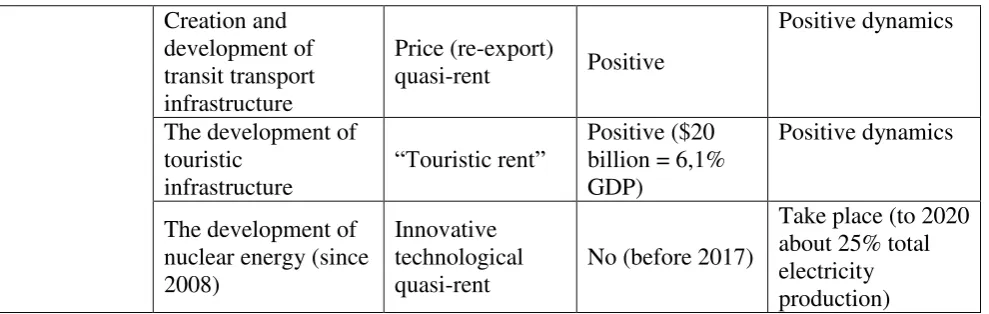
[image:9.595.52.544.587.785.2]Promising prospects for the rent-focused behavior strategy continuation have not prevented the country's leaders to start rent-seeking strategy implementing in the 1980s (see Table 7).
Table 7. Rent-focused behavior and rent-seeking strategies synthesis in the UAE
Strategies Forms of strategies implementation
Rental incomes type
Socio-economic effects at the beginning of the
XXI century
Economic prospects in the
XXI century
Rent-focused behavior
Oil and gas extraction and exports
Natural resource
rent Positive Negative dynamics
Rent-seeking
Free economic zones creation (since 1985)
Innovative technological quasi-rent
Positive Positive dynamics
Creation of an international financial center
Financial quasi-rent
Positive (up to $10 billion, and to 40 tons of gold per year)
Creation and development of transit transport infrastructure
Price (re-export)
quasi-rent Positive
Positive dynamics
The development of touristic
infrastructure
“Touristic rent”
Positive ($20 billion = 6,1% GDP)
Positive dynamics
The development of nuclear energy (since 2008)
Innovative technological quasi-rent
No (before 2017)
Take place (to 2020 about 25% total electricity production)
[image:10.595.52.547.54.211.2]The skillful combination of two strategies led to significant shifts in the national economy structure (see Table 8).
Table 8. Structure-economic effect of the rent-seeking strategy in the UAE
Years 1982 1991 2010
The share of the oil and gas industry in the UAE GDP, %
50 43 25
[image:10.595.58.511.419.567.2]Statistical and empirical evidences indicate that the positive effect of the rent-focused behavior and rent-seeking strategies synthetic implementation in the UAE socio-economic system (see Fig. 2).
Fig. 2. Effect of the rent-focused behavior and rent-seeking strategies synthetic implementation in the UAE socio-economic system
Table 9. Natural-material parameters of the rent-focused behavior strategy implementation in Nauru
Rent-focused activity Years
1985 1995 2001 2003
Phosphates extraction and exports, million tons
1,67 2 0,162 0
Consistent implementation of the rent-seeking behavior strategy in Nauru to the twentieth century beginning led to the main rental resource depletion (see Table
Rent-focused behavior
Rent-focused behavior + Rent-seeking
Life quality improving
The growth of absolute indicators of consumption and
savings
Life quality improving
?
9). Mining phosphate resumption in 2006 coincided with change in the subject of natural resource rents appropriation (from the state to Australian company “Incitex Pivot”).
[image:11.595.51.535.244.485.2]In contrast to the UAE, natural resource rent in Nauru didn’t become the financial basis of the rent-seeking strategy. Another negative factor was the almost complete destruction of the unique island nature, which rule out the possibility of the tourism cluster development. Consequently, the rent-seeking strategy implementation faced serious constraints that influenced the choice of rent-seeking directions (see Table 10).
Table 10. Features of the rent-focused behavior and rent-seeking strategies in Nauru
Strategies Forms of strategies implementation
Rental incomes type
Socio-economic effects at the beginning of the
XXI century
Economic prospects in the
XXI century
Rent-focused behavior
Phosphates extraction and exports
Natural
resource rent Negative No
Rent-seeking
Creating an offshore zone (before 2003)
Financial
quasi-rent Negative No Sale of passports to
foreigners (“investor passports”)
Status
quasi-rent No No
Licenses issuance for fishing
Natural
resource rent Ambivalent Negligible
Placement of immigrants on their way to Australia
Geopolitical quasi-rent by location
Ambivalent Negligible
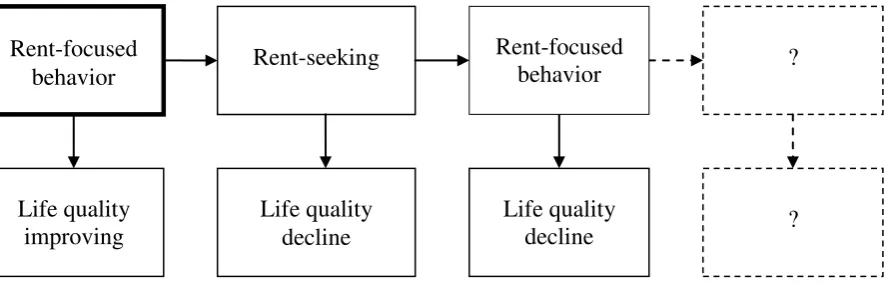
The above predetermined points other than in the UAE effect of the rent-focused behavior and rent-seeking strategies implementation (see Fig. 3). In this regard, the prospects for Nauru national economic system development remain uncertain.
Fig. 3. The effect of phased implementation of rent-focused behavior and rent-seeking strategies in Nauru socio-economic system.
Rent-focused
behavior Rent-seeking
Life quality improving
Life quality decline
Life quality decline
?
? Rent-focused
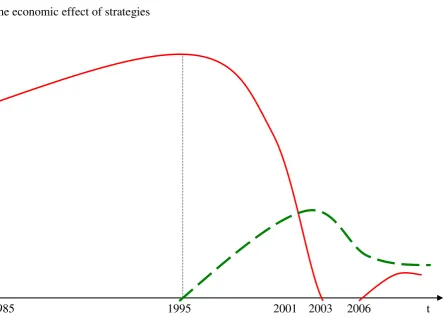
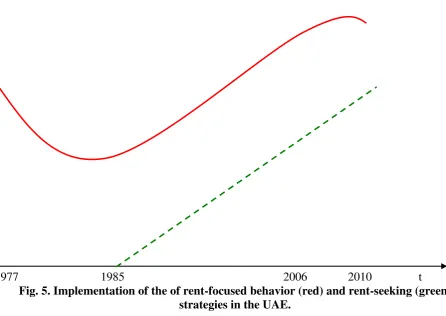
[image:11.595.54.534.244.486.2] [image:11.595.66.511.578.720.2]Comparison of the parameters times and economic effects of rent-seeking and rent-focused behavior shows for us the lateness of the rent-seeking strategy in Nauru. The time limit of natural resource rent-focused behavior strategy implementation was detected no later than mid-1980s, and implementation of the rent-seeking strategy started (even in its inefficient version) more than after 10 years (see Fig. 4). In the UAE, in addition to the objective of favorable factors, the positive role played by early country’s leaders decision to start the multidirectional rent-seeking strategy implementing (see Fig. 5).
The economic effect of strategies
[image:12.595.66.510.197.515.2]1985 1995 2001 2003 2006 t
1977 1985 2006 2010 t Fig. 5. Implementation of the of rent-focused behavior (red) and rent-seeking (green)
strategies in the UAE.
Summary:
1. Differentiation of rent-focused behavior and rent-seeking defines one of the directions of comprehensive rent relations theory further development at the intersection of economics, psychology, sociology, political science and international relations.
2. The practical importance is determined by productivity of the rent-focused behavior and rent-seeking strategies comparing in terms of the influence of their implementation parameters to the socio-economic systems development trajectory.
References:
1. Alesina A., Roubini N., Cohen G. Political Cycles and the Macroeconomy, Cambridge, MA: MIT Press. 1997;
2. Alt J., Chrystal А. Political Economy, Berkeley CA: Berkeley University Press. 1983;
3. Buchanan J. Rent Seeking and Profit Seeking. In: J. Buchanan et al. (eds.). Toward a Theory of the Rent Seeking Society. Texas A & M University Press, 1980, p. 4;
4. Downs A. An Economic Theory of Democracy. New York: Harper and Row. 1957;
5. Faust J., Irons J. Money, Politics, and the Post-War Business Cycle. Board of Governors of Federal Reserve System, International Finance Discussion Paper 572. 1996;
7. Kramer G. A Dynamical Model of Political Equilibrium, Journal of Economic Theory 1977, Vol. 16;
8. Kramer G. Short-Term Fluctuations in U.S. Voting Behavior // American Political Science Review. 1971. Vol. 65. Р. 131-143;
9. Krueger A.O. The Political Economy of the Rent-Seeking Society // American Economic Review. 1974. 64 (№3, June);
10. Moller L. Rent Seeking. Kobenhavn Universitet, 1994, Series No 31;
11. Nitzan S. Modelling Rent-Seeking Contests. – European Journal of Political Economy, 1994,
vol. 10, No 1;
12. Nordhaus W. The Political Business Cycle // Review of Economic Studies. 1975. Vol. 42. Р.
169-189;
13. Paldam M. Is There an Electoral Cycle? A Comparative Study of National Accounts // Scandinavian Journal of Economics. 1979. Vol. 81. Р. 323-42;
14. Tufte E. Determinants of the Outcomes of Midterm Congressional Elections // American Political Science Review. 1975. Vol. 69. Р. 812-26;
15. Tufte E. The Political Control of the Economy. Princeton: Princeton University Press. 1978.
16. Заостровцев А.Рентоориентированное поведение: потери для общества // Вопросы экономики. 2000. № 5;
17. КимельманС. Горнаяиценовая рента в современной российской экономике // Вопросы
экономики. 2010. № 7;
18. Львов Д.С. Вернуть народу ренту. М., 2004. С. 82;
19. Олейник А. О природе и причинах административной ренты: особенности ведения бизнеса в российском регионе N // Вопросы экономики. 2010. № 5;
20. Олсон М.Логика коллективных действий. Общественные блага и теория групп. М.: Фонд экономической инициативы, 1995;
21.Ослунд А.«Рентоориентированное поведение» в российской переходной экономике // Вопросы экономики. 1996. № 8;
22. Познер Р.Экономический анализ права. –СПб.: Экономическая школа, 2003;
23. Шульгин С.Г. Влияние рентоориентированного поведения на политические деловые циклы / дисс. канд.эк.н....08.00.01. –М., 2006.
24. Эггертссон Т. Экономическое поведение и институты. М: Дело, 2001;