A global model for joint lemmatization and part-of-speech prediction
Kristina Toutanova
Microsoft Research Redmond, WA 98052 [email protected]
Colin Cherry
Microsoft Research Redmond, WA 98052 [email protected]
Abstract
We present a global joint model for lemmatization and part-of-speech predic-tion. Using only morphological lexicons and unlabeled data, we learn a partially-supervised part-of-speech tagger and a lemmatizer which are combined using fea-tures on a dynamically linked dependency structure of words. We evaluate our model on English, Bulgarian, Czech, and Slovene, and demonstrate substantial im-provements over both a direct transduction approach to lemmatization and a pipelined approach, which predicts part-of-speech tags before lemmatization.
1 Introduction
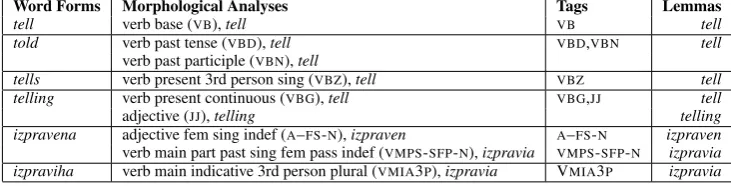
The traditional problem of morphological analysis is, given a word form, to predict the set of all of its possible morphological analyses. A morpho-logical analysis consists of a part-of-speech tag (POS), possibly other morphological features, and a lemma (basic form) corresponding to this tag and features combination (see Table 1 for examples). We address this problem in the setting where we are given a morphological dictionary for training, and can additionally make use of un-annotated text in the language. We present a new machine learn-ing model for this task settlearn-ing.
In addition to the morphological analysis task we are interested in performance on two subtasks: tag-set prediction (predicting the set of possible tags of words) and lemmatization(predicting the set of possible lemmas). The result of these sub-tasks is directly useful for some applications.1 If
we are interested in the results of each of these two
1Tag sets are useful, for example, as a basis of
sparsity-reducing features for text labeling tasks; lemmatization is useful for information retrieval and machine translation from a morphologically rich to a morphologically poor language, where full analysis may not be important.
subtasks in isolation, we might build independent solutions which ignore the other subtask.
In this paper, we show that there are strong de-pendencies between the two subtasks and we can improve performance on both by sharing infor-mation between them. We present a joint model for these two subtasks: it is joint not only in that it performs both tasks simultaneously, sharing in-formation, but also in that it reasons about multi-ple words jointly. It uses component tag-set and lemmatization models and combines their predic-tions while incorporating joint features in a log-linear model, defined on a dynamically linked de-pendency structure of words.
The model is formalized in Section 5 and eval-uated in Section 6. We report results on English, Bulgarian, Slovene, and Czech and show that joint modeling reduces the lemmatization error by up to 19%, the tag-prediction error by up to 26% and the error on the complete morphological analysis task by up to 22.6%.
2 Task formalization
The main task that we would like to solve is as follows: given a lexicon L which contains all morphological analyses for a set of words
{w1, . . . , wn}, learn to predict all morphological
analyses for other words which are outside ofL. In addition to the lexicon, we are allowed to make use of unannotated textTin the language. We will predict morphological analyses for words which occur in T. Note that the task is defined on word types and not on words in context.
A morphological analysis of a wordwconsists of a (possibly structured) POS tagt, together with one or several lemmas, which are the possible ba-sic forms of w when it has tag t. As an exam-ple, Table 1 illustrates the morphological analy-ses of several words taken from the CELEX lexi-cal database of English (Baayen et al., 1995) and the Multext-East lexicon of Bulgarian (Erjavec, 2004). The Bulgarian words are transcribed in
Word Forms Morphological Analyses Tags Lemmas
tell verb base (VB),tell VB tell
told verb past tense (VBD),tell VBD,VBN tell
verb past participle (VBN),tell
tells verb present 3rd person sing (VBZ),tell VBZ tell
telling verb present continuous (VBG),tell VBG,JJ tell
adjective (JJ),telling telling
izpravena adjective fem sing indef (A–FS-N),izpraven A–FS-N izpraven
[image:2.595.115.481.64.157.2]verb main part past sing fem pass indef (VMPS-SFP-N),izpravia VMPS-SFP-N izpravia izpraviha verb main indicative 3rd person plural (VMIA3P),izpravia VMIA3P izpravia
Table 1: Examples of morphological analyses of words in English and Bulgarian.
Latin characters. Here by “POS tags” we mean both simple main pos-tags such as nounorverb, and detailed tags which include grammatical fea-tures, such as VBZ for English indicating present
tense third person singular verb and A–FS-N for
Bulgarian indicating a feminine singular adjective in indefinite form. In this work we predict only main POS tags for the Multext-East languages, as detailed tags were less useful for lemmatization.
Since the predicted elements are sets, we use precision, recall, and F-measure (F1) to evaluate performance. The two subtasks, tag-set prediction and lemmatization are also evaluated in this way. Table 1 shows the correct tag-sets and lemmas for each of the example words in separate columns. Our task setting differs from most work on lemma-tization which uses either no or a complete rootlist (Wicentowski, 2002; Dreyer et al., 2008).2 We can
use all forms occurring in the unlabeled textTbut there are no guarantees about the coverage of the target lemmas or the number of noise words which may occur in T (see Table 2 for data statistics). Our setting is thus more realistic since it is what one would have in a real application scenario.
3 Related work
In work on morphological analysis using machine learning, the task is rarely addressed in the form described above. Some exceptions are the work (Bosch and Daelemans, 1999) which presents a model for segmenting, stemming, and tagging words in Dutch, and requires the prediction of all possible analyses, and (Antal van den Bosch and Soudi, 2007) which similarly requires the pre-diction of all morpho-syntactically annotated seg-mentations of words for Arabic. As opposed to
2These settings refer to the availability of a set of word
forms which are possible lemmas; in the no rootlist setting, no other word forms in the language are given in addition to the forms in the training set; in the complete rootlist setting, a set of word forms which consists of exactly all correct lem-mas for the words in the test set is given.
our work, these approaches do not make use of un-labeled data and make predictions for each word type in isolation.
In machine learning work on lemmatization for highly inflective languages, it is most often as-sumed that a word form and a POS tag are given, and the task is to predict the set of corresponding lemma(s) (Mooney and Califf, 1995; Clark, 2002; Wicentowski, 2002; Erjavec and Dˇzeroski, 2004; Dreyer et al., 2008). In our task setting, we do not assume the availability of gold-standard POS tags. As a component model, we use a lemmatiz-ing strlemmatiz-ing transducer which is related to these ap-proaches and draws on previous work in this and related string transduction areas. Our transducer is described in detail in Section 4.1.
Another related line of work approaches the dis-ambiguation problem directly, where the task is to predict the correct analysis of word-forms in context (in sentences), and not all possible anal-yses. In such work it is often assumed that the cor-rect POS tags can be predicted with high accuracy using labeled POS-disambiguated sentences (Er-javec and Dˇzeroski, 2004; Habash and Rambow, 2005). A notable exception is the work of (Adler et al., 2008), which uses unlabeled data and a morphological analyzer to learn a semi-supervised HMM model for disambiguation in context, and also guesses analyses for unknown words using a guesser of likely POS-tags. It is most closely re-lated to our work, but does not attempt to predict all possible analyses, and does not have to tackle a complex string transduction problem for lemma-tization since segmentation is mostly sufficient for the focus language of that study (Hebrew).
4 Component models
We use two component models as the basis of addressing the task: one is a partially-supervised POS tagger which is trained usingLand the unla-beled textT; the other is a lemmatizing transducer which is trained fromLand can useT. The trans-ducer can optionally be given input POS tags in training and testing, which can inform the lemma-tization. The tagger is described in Section 4.2 and the transducer is described in Section 4.1.
In a pipeline approach to combining the tagging and lemmatization components, we first predict a set of tags for each word using the tagger, and then ask the lemmatizer to predict one lemma for each of the possible tags. In a direct transduction ap-proach to the lemmatization subtask, we train the lemmatizer without access to tags and ask it to predict a single lemma for each word in testing. Our joint model, described in Section 5, is defined in a re-ranking framework, and can choose from amongk-best predictions of tag-sets and lemmas generated from the component tagger and lemma-tizer models.
4.1 Morphological analyser
We employ a discriminative character transducer as a component morphological analyzer. The input to the transducer is an inflected word (the source) and possibly an estimated part-of-speech; the out-put is the lemma of the word (the target). The transducer is similar to the one described by Ji-ampojamarn et al. (2008) for letter-to-phoneme conversion, but extended to allow for whole-word features on both the input and the output. The core of our engine is the dynamic programming algo-rithm for monotone phrasal decoding (Zens and Ney, 2004). The main feature of this algorithm is its capability to transduce many consecutive char-acters with a single operation; the same algorithm is employed to tag subsequences in semi-Markov CRFs (Sarawagi and Cohen, 2004).
We employ three main categories of features: context, transition, and vocabulary (rootlist) fea-tures. The first two are described in detail by Ji-ampojamarn et al. (2008), while the final is novel to this work. Context features are centered around a transduction operation such as es → e, as em-ployed ingives →give. Context features include an indicator for the operation itself, conjoined with indicators for alln-grams of source context within a fixed window of the operation. We also employ a
copy feature that indicates if the operation simply copies the source character, such ase →e. Tran-sition features are our Markov, orn-gram features on transduction operations. Vocabulary features are defined on complete target words, according to the frequency of said word in a provided unla-beled text T. We have chosen to bin frequencies; experiments on a development set suggested that two indicators are sufficient: the first fires for any word that occurred fewer than five times, while a second also fires for those words that did not oc-cur at all. By encoding our vocabulary in a trie and adding the trie index to the target context tracked by our dynamic programming chart, we can ef-ficiently track these frequencies during transduc-tion.
We incorporate the source part-of-speech tag by appending it to each feature, thus the context fea-ture es → e may become es → e,VBZ. To
en-able communication between the various parts-of-speech, a universal set of unannotated features also fires, regardless of the part-of-speech, acting as a back-off model of how words in general behave during stemming.
Linear weights are assigned to each of the trans-ducer’s features using an averaged perceptron for structure prediction (Collins, 2002). Note that our features are defined in terms of the operations employed during transduction, therefore to cre-ate gold-standard feature vectors, we require not only target outputs, but also derivations to pro-duce those outputs. We employ a deterministic heuristic to create these derivations; given a gold-standard source-target pair, we construct a deriva-tion that uses only trivial copy operaderiva-tions until the first character mismatch. The remainder of the transduction is performed with a single multi-character replacement. For example, the deriva-tion for living → live would be l → l, i → i, v → v,ing → e. For languages with morpholo-gies affecting more than just the suffix, one can either develop a more complex heuristic, or deter-mine the derivations using a separate aligner such as that of Ristad and Yianilos (1998).
4.2 Tag-set prediction model
or a tag-set model, which can assign probabili-ties for possible sets of tags of wordsPT SM(ts|w) and the other is a word context model, which can assign probabilitiesPCM(contextsw|w, ts)to all
contexts of occurrence of wordwin an unlabeled text T. The word-context model is Bayesian and utilizes a sparse Dirichlet prior on the distributions of tags given words. In addition, it uses informa-tion on a four word context of occurrences ofwin the unlabeled text.
Note that the (Toutanova and Johnson, 2008) model is a tagger that assigns tags to occurrences of words in the text, whereas we only need to pre-dict sets of possible tags for word types, such as the set{VBD,VBN}for the wordtold. Their
com-ponent sub-modelPT SM predicts sets of tags and
it is possible to use it on its own, but by also us-ing the context model we can take into account information from the context of occurrence of words and compute probabilities of tag-sets given the observed occurrences inT. The two are com-bined to make a prediction for a tag-set of a test wordw, given unlabeled textT, using Bayes rule:
p(ts|w)∝PT SM(ts|w)PCM(contextsw|w, ts).
We use a direct re-implementation of the word-context model, using variational inference follow-ing (Toutanova and Johnson, 2008). For the tag-set sub-model, we employ a more sophisticated approach. First, we learn a log-linear classifier in-stead of a Naive Bayes model, and second, we use features derived from related words appearing in T. The possible classes predicted by the classifier are as many as the observed tag-sets in L. The sparsity is relieved by adding features for individ-ual tagstwhich get shared across tag-sets contain-ingt.
There are two types of features in the model: (i) word-internal features: word suffixes, capital-ization, existence of hyphen, and word prefixes (such features were also used in (Toutanova and Johnson, 2008)), and (ii) features based on re-lated words. These latter features are inspired by (Cucerzan and Yarowsky, 2000) and are defined as follows: for a wordwsuch astelling, there is an indicator feature for every combination of two suf-fixesα andβ, such that there is a prefixp where telling=pαandpβexists inT. For example, if the wordtellsis found inT, there would be a feature for the suffixesα=ing,β=sthat fires. The suffixes are defined as all character suffixes up to length three which occur with at least 100 words.
b o u n ce d
VBD VBN JJ VBD VBN
b o u n ce r
JJR NN
bounce
bouncer bounce
…
bounc
bouncer
boucer
f
bounce bounce
bounced bounced b o u n ce
VB NN VB
bounce bounce
… …
…
[image:4.595.326.511.62.218.2]f
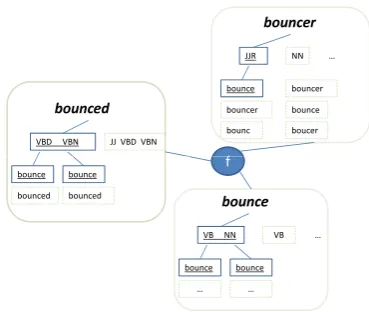
Figure 1: A small subset of the graphical model. The tag-sets and lemmas active in the illustrated assignment are shown in bold. The extent of joint features firing for the lemmabounceis shown as a factor indicated by the blue cir-cle and connected to the assignments of the three words.
5 A global joint model for morphological analysis
The idea of this model is to jointly predict the set of possible tags and lemmas of words. In addi-tion to modeling dependencies between the tags and lemmas of a single word, we incorporate de-pendencies between the predictions for multiple words. The dependencies among words are deter-mined dynamically. Intuitively, if two words have the same lemma, their tag-sets are dependent. For example, imagine that we need to determine the tag-set and lemmas of the wordbouncer. The tag-set model may guess that the word is an adjective in comparative form, because of its suffix, and be-cause its occurrences in Tmight not strongly in-dicate that it is a noun. The lemmatizer can then lemmatize the word like an adjective and come up with bounce as a lemma. If the tag-set model is fairly certain thatbounce is not an adjective, but is a verb or a noun, a joint model which looks si-multaneously at the tags and lemmas of bouncer andbouncewill detect a problem with this assign-ments and will be able to correct the tagging and lemmatization error forbouncer.
as-signments of words are determined dynamically by the currently chosen set of lemmas.
As an example, Figure 1 shows three sample English words and their possible tag-sets and lem-mas determined by the component models. It also illustrates the dependencies between the variables induced by the features of our model active for the current (incorrect) assignment.
5.1 Formal model description
Given a set of test wordsw1, . . . wnand additional
word forms occurring in unlabeled dataT, we de-rive an extended set of wordsw1, . . . , wm which
contains the original test words and additional re-lated words, which can provide useful information about the test words. For example, ifbounceris a test word andbounceandbouncedoccur inTthese two words can be added to the set of test words because they can contribute to the classification of bouncer. The algorithm for selecting related words is simple: we add any word for which the pipelined model predicts a lemma which is also predicted as one of the top klemmas for a word from the test set.
We define a joint model over tag-sets and lem-mas for all words in the extended set, using fea-tures defined on a dynamically linked structure of words and their assigned analyses. It is a re-ranking model because the tag-sets and possible lemmas are limited to the topkoptions provided by the pipelined model.3 Our model is defined
on a very large set of variables, each of which can take a large set of values. For example, for a test set of size about 4,000 words for Slovene an additional about 9,000 words fromT were added to the extended set. Each of these words has a corresponding variable which indicates its tag-set and lemma assignment. The possible assignments range over all combinations available from the tag-ging and lemmatizer component models; using the top three tag-sets per word and top three lemmas per tag gives an average of around 11.2 possible assignments per word. This is because the tag-sets have about 1.2 tags on average and we need to choose a lemma for each. While it is not the case that all variables are connected to each other by features, the connectivity structure can be com-plex.
More formally, lettsji denote possible tag-sets
3We used top three tag-sets and top three lemmas for each
tag for training.
for wordwi, forj = 1. . . k. Also, letli(t)j
de-note the top lemmas for wordwi given tagt. An
assignment of a tag-set and lemmas to a wordwi
consists of a choice of a tag-set, tsi (one of the
possiblektag-sets for the word) and, for each tag
t in the chosen tag-set, a choice of a lemma out of the possible lemmas for that tag and word. For brevity, we denote such joint assignment by tli.
As a concrete example, in Figure 1, we can see the current assignments for three words: the assigned tag-sets are shown underlined and in bolded boxes (e.g., forbounced, the tag-set{VBD,VBN}is
cho-sen; for both tags, the lemmabounceis assigned). Other possible tag-sets and other possible lemmas for each chosen tag are shown in greyed boxes.
Our joint model defines a distribution over as-signments to all wordsw1, . . . , wm. The form of
the model is as follows:
P(tl1, . . . , tlm) = e
F(tl1,...,tlm)0θ
P
tl01,...,tl0me
F(tl01,...,tl0m)0θ
Here F denotes the vector of features defined over an assignment for all words in the set andθ
is a vector of parameters for the features. Next we detail the types of features used.
Word-local features. The aim of such features is to look at the set of all tags assigned to a word to-gether with all lemmas and capture coarse-grained dependencies at this level. These features intro-duce joint dependencies between the tags and lem-mas of a word, but they are still local to the as-signment of single words. One such feature is the number of distinct lemmas assigned across the dif-ferent tags in the assigned tag-set. Another such feature is the above joined with the identity of the tag-set. For example, if a word’s tag-set is
{VBD,VBN}, it will likely have the same lemma
for both tags and the number of distinct lemmas will be one (e.g., the wordbounced), whereas if it has the tagsVBG,JJthe lemmas will be distinct for
the two tags (e.g. telling). In this class of features are also the log-probabilities from the tag-set and lemmatizer models.
Non-local features. Our non-local features look, for every lemma l, at all words which have that lemma as the lemma for at least one of their as-signed tags, and derive several predicates on the joint assignment to these words. For example, using our word graph in the figure, the lemma bounce is assigned to bounced for tags VBD and VBN, to bounce for tags VB and NN, and to
bouncer for tag JJR. One feature looks at the
differ-ent forms of the lemma. In this case this would be [JJR,NN+VB-lem,VBD+VBN]. The feature also
indicates any word which is exactly equal to the lemma withlemas shown for theNNandVBtags
corresponding tobounce. Our model learns a neg-ative weight for this feature, because the lemma of a word with tag JJRis most often a word with
at least one tag equal to JJ. A variant of this
feature also appends the final character of each word, like this: [JJR+r,NN+VB+e-lem,VBD+VBN
-d]. This variant was helpful for the Slavic lan-guages because when using only main POS tags, the granularity of the feature is too coarse. An-other feature simply counts the number of distinct words having the same lemma, encouraging re-using the same lemma for different words. An ad-ditional feature fires for every distinct lemma, in effect counting the number of assigned lemmas.
5.2 Training and inference
Since the model is defined to re-rank candidates from other component models, we need two differ-ent training sets: one for training the compondiffer-ent models, and another for training the joint model features. This is because otherwise the accuracy of the component models would be overestimated by the joint model. Therefore, we train the com-ponent models on the training lexiconsLTrainand select their hyperparameters on theLDevlexicons. We then train the joint model on theLDevlexicons and evaluate it on theLTestlexicons. When apply-ing models to theLTestset, the component mod-els are first retrained on the union of LTrain and LDevso that all models can use the same amount of training data, without giving unfair advantage to the joint model. Such set-up is also used for other re-ranking models (Collins, 2000).
For training the joint model, we maximize the log-likelihood of the correct assignment to the words in LDev, marginalizing over the assign-ments of other related words added to the graph-ical model. We compute the gradient approx-imately by computing expectations of features given the observed assignments and marginal pectations of features. For computing these ex-pectations we use Gibbs sampling to sample com-plete assignments to all words in the graph.4 We
4We start the Gibbs sampler by the assignments found by
the pipeline method and then use an annealing schedule to find a neighborhood of high-likelihood assignments, before taking about 10 complete samples from the graph to compute expectations.
use gradient descent with a small learning rate, se-lected to optimize the accuracy on the LDevset. For finding a most likely assignment at test time, we use the sampling procedure, this time using a slower annealing schedule before taking a single sample to output as a guessed answer.
For the Gibbs sampler, we need to sample an assignment for each word in turn, given the current assignments of all other words. Let us denote the current assignment to all words exceptwiastl−i.
The conditional probability of an assignment tli
for wordwiis given by:
P(tli|tl−i) = e
F(tli,tl−i)0θ
P
tl0 ie
F(tl0i,tl−i)0θ
The summation in the denominator is over all possible assignments for word wi. To compute
these quantities we need to consider only the fea-tures involving the current word. Because of the nature of the features in our model, it is possible to isolate separate connected components which do not share features for any assignment. If two words do not share lemmas for any of their possi-ble assignments, they will be in separate compo-nents. Block sampling within a component could be used if the component is relatively small; how-ever, for the common case where there are five or more words in a fully connected component ap-proximate inference is necessary.
6 Experiments
6.1 Data
We use datasets for four languages: English, Bul-garian, Slovene, and Czech. For each of the lan-guages, we need a lexicon with morphological analysesLand unlabeled text.
For English we derive the lexicon from CELEX (Baayen et al., 1995), and for the other lan-guages we use the Multext-East resources (Er-javec, 2004). For English we use only open-class words (nouns, verbs, adjectives, and adverbs), and for the other languages we use words of all classes. The unlabeled data for English we use is the union of the Penn Treebank tagged WSJ data (Marcus et al., 1993) and the BLLIP corpus.5 For the rest of
the languages we use only the text of George Or-well’s novel 1984, which is provided in morpho-logically disambiguated form as part of Multext-East (but we don’t use the annotations). Table 2
5The BLLIP corpus contains approximately 30 million
Lang LTrain LDev LTest Text ws tl nf ws tl nf ws tl nf Eng 5.2 1.5 0.3 7.4 1.4 0.8 7.4 1.4 0.8 320 Bgr 6.9 1.2 40.8 3.8 1.1 53.6 3.8 1.1 52.8 16.3 Slv 7.5 1.2 38.3 4.2 1.2 49.1 4.2 1.2 49.8 17.8 Cz 7.9 1.1 32.8 4.5 1.1 43.2 4.5 1.1 43.0 19.1
Table 2: Data sets used in experiments. The number of word types (ws) is shown approximately in thousands. Also shown are average number of complete analyses (tl) and per-cent target lemmas not found in the unlabeled text (nf).
details statistics about the data set sizes for differ-ent languages.
We use three different lexicons for each lan-guage: one for training (LTrain), one for devel-opment (LDev), and one for testing (LTest). The global model weights are trained on the develop-ment set as described in section 5.2. The lex-icons are derived such that very frequent words are likely to be in the training lexicon and less frequent words in the dev and test lexicons, to simulate a natural process of lexicon construction. The English lexicons were constructed as follows: starting with the full CELEX dictionary and the text of the Penn Treebank corpus, take all word forms appearing in the first 2000 sentences (and are found in CELEX) to form the training lexi-con, and then take all other words occurring in the corpus and split them equally between the de-velopment and test lexicons (every second word is placed in the test set, in the order of first oc-currence in the corpus). For the rest of the lan-guages, the same procedure is applied, starting with the full Multext-East lexicons and the text of the novel 1984. Note that while it is not possi-ble for training words to be included in the other lexicons, it is possible for different forms of the same lemma to be in different lexicons. The size of the training lexicons is relatively small and we believe this is a realistic scenario for application of such models. In Table 2 we can see the number of words in each lexicon and the unlabeled corpora (by type), the average number of tag-lemma com-binations per word,6 as well as the percentage of
word lemmas which do not occur in the unlabeled text. For English, the large majority of target lem-mas are available inT (with only 0.8% missing), whereas for the Multext-East languages around 40 to 50% of the target lemmas are not found in T; this partly explains the lower performance on these languages.
6The tags are main tags for the Multext-East languages
and detailed tags for English.
Language Tag Model Tag Lem T+L
English none – 94.0 –
full 89.9 95.3 88.9 no unlab data 80.0 94.1 78.3 Bulgarian none – 73.2 –
[image:7.595.328.508.62.127.2]full 87.9 79.9 75.3 no unlab data 80.2 76.3 70.4
Table 3: Development set results using different tag-set models and pipelined prediction.
6.2 Evaluation of direct and pipelined models for lemmatization
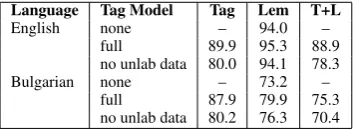
As a first experiment which motivates our joint modeling approach, we present a comparison on lemmatization performance in two settings: (i) when no tags are used in training or testing by the transducer, and (ii) when correct tags are used in training and tags predicted by the tagging model are used in testing. In this section, we report per-formance on English and Bulgarian only. Compa-rable performance on the other Multext-East lan-guages is shown in Section 6.
Results are presented in Table 3. The experi-ments are performed usingLTrainfor training and LDevfor testing. We evaluate the models on tag-set F-measure (Tag), lemma-tag-set F-measure(Lem) and complete analysis F-measure (T+L). We show the performance on lemmatization when tags are not predicted (Tag Model is none), and when tags are predicted by the tag-set model. We can see that on both languages lemmatization is significantly improved when a latent tag-set variable is used as a basis for prediction: the relative error reduction in Lem F-measure is 21.7% for English and 25% for Bulgarian. For Bulgarian and the other Slavic languages we predicted only main POS tags, be-cause this resulted in better lemmatization perfor-mance.
It is also interesting to evaluate the contribution of the unlabeled dataTto the performance of the tag-set model. This can be achieved by remov-ing the word-context sub-model of the tagger and also removing related word features. The results achieved in this setting for English and Bulgarian are shown in the rows labeled “no unlab data”. We can see that the tag-set F-measure of such models is reduced by 8 to 9 points and the lemmatization F-measure is similarly reduced. Thus a large por-tion of the positive impact tagging has on lemma-tization is due to the ability of tagging models to exploit unlabeled data.
lemmatization subtasks, which a joint model could exploit.
6.3 Evaluation of joint models
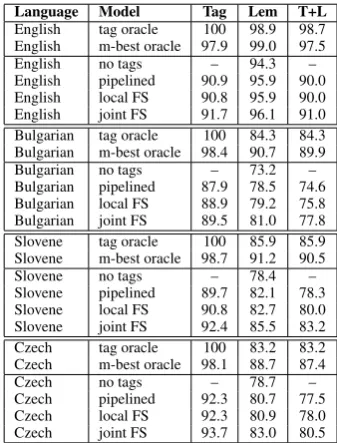
Since our joint model re-ranks candidates pro-duced by the component tagger and lemmatizer, there is an upper bound on the achievable perfor-mance. We report these upper bounds for the four languages in Table 4, at the rows which listm-best oracle underModel. The oracle is computed using five-best tag-set predictions and three-best lemma predictions per tag. We can see that the oracle per-formance on tag F-measure is quite high for all languages, but the performance on lemmatization and the complete task is close to only 90 percent for the Slavic languages. As a second oracle we also report the perfect tag oracle, which selects the lemmas determined by the transducer using the correct part-of-speech tags. This shows how well we could do if we made the tagging model perfect without changing the lemmatizer. For the Slavic languages this is quite a bit lower than them-best oracles, showing that the majority of errors of the pipelined approach cannot be fixed by simply im-proving the tagging model. Our global model has the potential to improve lemma assignments even given correct tags, by sharing information among multiple words.
The actual achieved performance for three dif-ferent models is also shown. For comparison, the lemmatization performance of the direct trans-duction approach which makes no use of tags is also shown. The pipelined models select one-best tag-set predictions from the tagging model, and the 1-best lemmas for each tag, like the mod-els used in Section 6.2. The model name lo-cal FS denotes a joint log-linear model which has only word-internal features. Even with only word-internal features, performance is improved for most languages. The the highest improvement is for Slovene and represents a 7.8% relative re-duction in F-measure error on the complete task.
When features looking at the joint assignments of multiple words are added, the model achieves much larger improvements (modelsjoint FSin the Table) across all languages.7 The highest overall improvement compared to the pipelined approach is again for Slovene and represents 22.6% reduc-tion in error for the full task; the reducreduc-tion is 40%
7Since the optimization is stochastic, the results are
av-eraged over four runs. The standard deviations are between 0.02 and 0.11.
Language Model Tag Lem T+L
English tag oracle 100 98.9 98.7
English m-best oracle 97.9 99.0 97.5
English no tags – 94.3 –
English pipelined 90.9 95.9 90.0
English local FS 90.8 95.9 90.0
English joint FS 91.7 96.1 91.0
Bulgarian tag oracle 100 84.3 84.3 Bulgarian m-best oracle 98.4 90.7 89.9
Bulgarian no tags – 73.2 –
Bulgarian pipelined 87.9 78.5 74.6
Bulgarian local FS 88.9 79.2 75.8
Bulgarian joint FS 89.5 81.0 77.8
Slovene tag oracle 100 85.9 85.9
Slovene m-best oracle 98.7 91.2 90.5
Slovene no tags – 78.4 –
Slovene pipelined 89.7 82.1 78.3
Slovene local FS 90.8 82.7 80.0
Slovene joint FS 92.4 85.5 83.2
Czech tag oracle 100 83.2 83.2
Czech m-best oracle 98.1 88.7 87.4
Czech no tags – 78.7 –
Czech pipelined 92.3 80.7 77.5
Czech local FS 92.3 80.9 78.0
[image:8.595.331.500.61.283.2]Czech joint FS 93.7 83.0 80.5
Table 4: Results on the test set achieved by joint and pipelined models and oracles. The numbers represent tag-set prediction F-measure (Tag), lemma-set prediction F-measure (Lem) and F-measure on predicting complete tag, lemma analysis sets (T+L).
relative to the upper bound achieved by them-best oracle. The smallest overall improvement is for English, representing a 10% error reduction over-all, which is still respectable. The larger improve-ment for Slavic languages might be due to the fact that there are many more forms of a single lemma and joint reasoning allows us to pool information across the forms.
7 Conclusion
In this paper we concentrated on the task of mor-phological analysis, given a lexicon and unanno-tated data. We showed that the tasks of tag pre-diction and lemmatization are strongly dependent and that by building state-of-the art models for the two subtasks and performing joint inference we can improve performance on both tasks. The main contribution of our work was that we intro-duced a joint model for the two subtasks which in-corporates dependencies between predictions for multiple word types. We described a set of fea-tures and an approximate inference procedure for a global log-linear model capturing such dependen-cies, and demonstrated its effectiveness on English and three Slavic languages.
Acknowledgements
References
Meni Adler, Yoav Goldberg, and Michael Elhadad. 2008. Unsupervised lexicon-based resolution of unknown words for full morpholological analysis. InProceedings of ACL-08: HLT.
Galen Andrew, Trond Grenager, and Christopher Manning. 2004. Verb sense and subcategorization: Using joint in-ference to improve performance on complementary tasks. InEMNLP.
Erwin Marsi Antal van den Bosch and Abdelhadi Soudi. 2007. Memory-based morphological analysis and part-of-speech tagging of arabic. In Abdelhadi Soudi, An-tal van den Bosch, and Gunter Neumann, editors,Arabic Computational Morphology Knowledge-based and Em-pirical Methods. Springer.
R. H. Baayen, R. Piepenbrock, and L. Gulikers. 1995. The CELEX lexical database.
Antal Van Den Bosch and Walter Daelemans. 1999. Memory-based morphological analysis. InProceedings of the 37th Annual Meeting of the Association for Compu-tational Linguistics.
Alexander Clark. 2002. Memory-based learning of mor-phology with stochastic transducers. InProceedings of the 40th Annual Meeting of the Association for Computa-tional Linguistics (ACL), pages 513–520.
Shay B. Cohen and Noah A. Smith. 2007. Joint morpholog-ical and syntactic disambiguation. InEMNLP.
Michael Collins. 2000. Discriminative reranking for natural language parsing. InICML.
M. Collins. 2002. Discriminative training methods for hid-den markov models: Theory and experiments with percep-tron algorithms. InEMNLP.
S. Cucerzan and D. Yarowsky. 2000. Language independent minimally supervised induction of lexical probabilities. In
Proceedings of ACL 2000.
Markus Dreyer, Jason R. Smith, and Jason Eisner. 2008. Latent-variable modeling of string transductions with finite-state methods. InProceedings of the Conference on Empirical Methods in Natural Language Processing (EMNLP), pages 1080–1089, Honolulu, October. Tomaˇz Erjavec and Saˇao Dˇzeroski. 2004. Machine
learn-ing of morphosyntactic structure: lemmatizlearn-ing unknown Slovene words. Applied Artificial Intelligence, 18:17— 41.
Tomaˇz Erjavec. 2004. Multext-east version 3: Multilingual morphosyntactic specifications, lexicons and corpora. In
Proceedings of LREC-04.
Jenny Rose Finkel, Christopher D. Manning, and Andrew Y. Ng. 2006. Solving the problem of cascading errors: Approximate bayesian inference for linguistic annotation pipelines. InEMNLP.
Nizar Habash and Owen Rambow. 2005. Arabic tokeniza-tion, part-of-speech tagging and morphological disam-biguation in one fell swoop. InProceedings of the 43rd Annual Meeting of the Association for Computational Lin-guistics.
Sittichai Jiampojamarn, Colin Cherry, and Grzegorz Kon-drak. 2008. Joint processing and discriminative training for letter-to-phoneme conversion. InProceedings of ACL-08: HLT, pages 905–913, Columbus, Ohio, June. M. Marcus, B. Santorini, and Marcinkiewicz. 1993.
Build-ing a large annotated coprus of english: the penn treebank.
Computational Linguistics, 19.
Raymond J. Mooney and Mary Elaine Califf. 1995. Induc-tion of first-order decision lists: Results on learning the past tense of english verbs. Journal of Artificial Intelli-gence Research, 3:1—24.
Eric Sven Ristad and Peter N. Yianilos. 1998. Learning string-edit distance.IEEE Transactions on Pattern Analy-sis and Machine Intelligence, 20(5):522–532.
Sunita Sarawagi and William Cohen. 2004. Semimarkov conditional random fields for information extraction. In
ICML.
Kristina Toutanova and Mark Johnson. 2008. A bayesian LDA-based model for semi-supervised part-of-speech tag-ging. Innips08.
Richard Wicentowski. 2002. Modeling and Learning Mul-tilingual Inflectional Morphology in a Minimally Super-vised Framework. Ph.D. thesis, Johns-Hopkins Univer-sity.