Separation of Sn, Sb, Bi, As, Cu, Pb and Zn from Hydrochloric Acid Solution
by Solvent Extraction Process Using TBP (tri-n-Butylphosphate)
as an Extractant
Jae Woo Ahn
1;*and Jae Chun Lee
21Department of Advanced Materials Science & Engineering, Daejin University, Pocheon, 487-711, Korea
2Mineral Resources Research Division, Korea Institute of Geoscience & Mineral Resources (KIGAM), Daejeon 305-350, Korea
A basic study for the recovery of tin(Sn) from the scraps or plating sludges by a hydrometallurgical process was carried out. Tin was leached out by hydrochloric acid solutions and then separated from the mixed solution of co-leached miner metals such as, As, Sb, Bi, Cu, Zn and Pb for making high purity metal. A solvent extraction process was followed for the separation of tin and other minor metals from hydrochloric acid solution using TBP (tri-n-Butylphosphate) as the extracting reagent. Optimum conditions for the separation process were obtained using separation factors of tin versus each metal impurities derived at various concentrations of hydrochloric acid and sodium chloride in aqueous solution, and TBP in the organic solution. Scrubbing for metal impurities from the loaded organic solution was studied with different HCl concentrations. The study showed that Pb, Bi, Cu, Zn and Sb were quantitatively removed by scrubbing with 8.0 mol/L HCl from the organic phase after extracted in 6.0–7.0 mol/L HCl solution; As with 4.0 mol/L HCl solution from the organic phase after extracted in 3.0 mol/L HCl solution. From the integrated separation experiment by the simulate solution at 25C, 1.0 of O/A, and one stage contact at each extraction
and purification step, the purity of finial Sn strip solution was 98.9% and the recovery of Sn was 67.9%. [doi:10.2320/matertrans.M2011142]
(Received May 9, 2011; Accepted September 5, 2011; Published November 25, 2011)
Keywords: tin separation, solvent extraction, tri-n-butylphosphate (TBP), hydrochloric acid
1. Introduction
Recovery of tin was preferentially conducted by a pyrometallurgical route; however, a few recoveries through hydrometallurgical treatment had been studied from low
grade ore and waste scrap.1)Recent increases in consumption
of tin in electronics industries has led to a demand to recover such metals from electronic scraps or process waste mate-rials. The past few years in Korea, precious metals like gold have been recovered in a small scale using hydrometallur-gical or high temperature separation methods from electronic scraps. Yet, little research on recovery of tin has been reported. Several investigations have cited recovery of tin from waste resources through pyrometallurgical treatment in
smelter plants.2,3)However, this pyrometallurgical method is
associated with several drawbacks such as the high energy-intensiveness in cost to recover metals from a large content of impurities, costly processes, as well as gaining highly purified metals is questionable. Therefore, major research on hydrometallurgical method has been focused on its relative flexibility in controlling process treatment scales and ease of separating the metal impurities. A hydrometallurgical route can be considered as the convenient and appropriate way to recover tin by electrowinning method after separating the metal ions from leach liquor. Considering several metal separation processes such as solvent extraction, ion exchange and precipitation, the solvent extraction method is the most effective one in removing impurities from leach liquor. Therefore, in the present study the solvent extraction treat-ment was applied to recover tin from the leach solution of electronic waste. Previously, basic research on solvent extraction of tin by TBP and Alamine336 has already been carried out.4,5)
Since most of the waste solder or process waste materials contain various metal impurities such as, Pb, As, Sb, Bi, etc., therefore to recover high pure tin from such impurities, an effective separation process has been considered in present study. There are several reports regarding separation of tin from complex solution containing different kinds of
impurities. Sunitaet al.reported on solvent extraction of tin
from HCl media with PC-88A in that more than 99% of tin was extracted from 0.1–0.3 mol/L HCl, stripping of tin from the organic phase was easily performed with 4.0 M HCl. Also tin was selectively separated from metal ions such as Sb,
Bi, Pb, Cu, Ni, etc.6) In another study, Sato and Kikuchi
reported extraction of tin by D2EHPA from the HCl solution
where they found that the distribution coefficient decreased with the increasing of acidity up to 6.0 mol/L and there was possible separation of lead and bismuth at 1.0 mol/L HCl solution.7)
Sargar et al. found quantitative extraction of tin in the
range of 7.0–10.0 mol/L HCl solution using N-n-octylaniline as the extractant and it resulted in the effective separation of tin from the mixture of Se(IV), Bi(III), Pb(II), Cu(II) and
Zn(II).8)Maurice et al.investigated the extraction behavior
of tin from 10 g/L HCl solution that containing 0.3 g/L Sn, 32.5 g/L Fe and 6.2 g/L Pb using TBP and reported four
stages of extraction for tin from the leach solution.9)
Harlamovset al.conducted a basic research on the separation
recovery of tin from the leach solution containing Cu, Sn, Zn, Fe, etc. using different extractants TBP, Alamine 336, and Aliquat 336. They showed that tin was effectively
extracted by TBP and stripped in 1.0 mol/L HCl.10)Shuihog
et al.also suggested the optimum extraction conditions for the separation of Sn(IV) from hydrochloric acid solution
containing several impurities by TBP.11)
As seen from prior research, above reports, most of the investigations have been focused on the use of analytical
*Corresponding author, E-mail: [email protected]
chemistry. A few systematic studies have been directed on the separation of tin and various metal impurities from waste materials such as, waste solder etc. Hence, in this study the separation recovery of tin from a mixture of complex metal ion solution containing As, Sb, Bi, Pb, Cu, Zn as well as Sn using TBP as extractant was investigated in order to obtain the optimum conditions for Sn(IV) separation.
2. Materials and Experimental Method
Solvent extraction of tin from various impurities was initially studied using a synthetic model solution that was prepared by taking appropriate amounts of either metal chlorides or oxides in HCl solution and the composition of the solution was as follows: 5.0 g/L Sn(IV), 0.5 g/L, As(III), 0.5 g/L Bi(III), 0.5 g/L Sb(III), 0.5 g/L Pb(II), 0.5 g/L Zn(II), 0.5 g/L and Cu(II). The organic extractant TBP
(Tri-n-Butyl Phosphate: C12H27O4P) (Yakuri pure Chemical
Co.) was used for the extraction process without further purification and Exxol D80 as the diluents in the organic phase.
All solvent extraction experiments were carried out at
25C and phase ratio (O/A) of 1.0. Solutions were mixed and
stirred for 30 minutes in a separatory funnel, and sample was taken after the two phases were allowed to settle down and separate. All the metal species were analysed using ICP-AES (Perkin Elmer, Optima-4300 DV) and the extraction
percentage (E), distribution ratio (D), separation factor ()
for each species were determined.
The distribution ratio (D) was defined as follows:
D¼CMO=CMA
where, CMOand CMAare the concentrations of organic phase
and aqueous phase in equilibrium condition respectively. The extraction percentage (E) is defined in relation to the distribution ratio (D) as follows:
Eð%Þ ¼ ð100CMOÞ=ðCMOþCMAÞ ¼ ð100DÞ=ðDþ1Þ
Separation factor () is as follows:
¼D1=D2
where, D1, D2are the distribution ratios between metal 1 and
metal 2 respectively. Also, the stripping percentage (S) was determined using the same method as was the extraction percentage experiment conducted by using HCl solution as the stripping agent from the metal loaded organic phase.
3. Results and Discussion
3.1 Effect of hydrochloric acid concentration
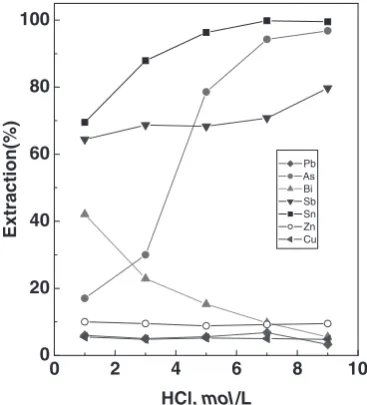
Extraction behavior of various metal species with different concentrations of hydrochloric acid were investigated by 0.365 mol/L TBP in simulated leach solutions. The result showed (Fig. 1) Sn(IV) extraction of 68% at 1.0 mol/L HCl increased with an increase of HCl concentration and reached 93.6% at 8.0 mol/L HCl. Extraction of As was less than 10% at HCl range of 1.0–3.0 mol/L, but it increased rapidly to 91.0% when HCl concentration increased to 9.0 mol/L. Extraction of Sb was about 50% with 1.0–4.0 mol/L HCl and then increased slightly at 6.0 mol/L of HCl. The extraction
behavior of metals like Bi, Zn, Cu and Pb was less than 20% throughout all the HCl concentrations examined. Therefore, from the above observations, tin was readily extracted in mixed solutions selectively except for antimony and the extraction order of the metals above 5.0 mol/L HCl was
observed as Sn>As>Sb>Zn>Bi>CuPb, while Sb
was higher than As at less than 5.0 mol/L HCl concentration.
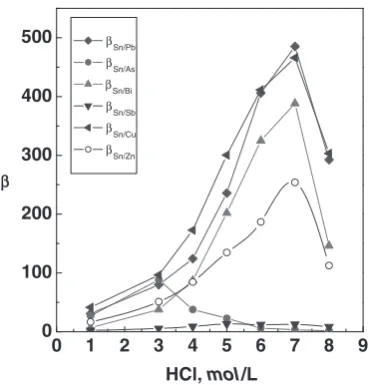
The separation factors () were derived (Fig. 2) from the
extraction % of Sn and other impurity metals. At 7.0 mol/L HCl, the separation factors of Sn/Cu, Sn/Pb, Sn/Bi and Sn/ Zn were 466, 485, 388 and 254 respectively. This means that Sn can be easily separated from Cu, Bi, Pb, Zn mixed solution. On the other hand, antimony showed a low separation factors, yet arsenic showed the maximum sepa-ration factors of 88.2 at 3.0 mol/L HCl, but decreased with increasing HCl concentration. Therefore, the degree of separation of minor metal impurities from the tin solution
was in the order of Pb>Cu>Bi>Zn>Sb>As above
5.5 mol/L HCl.
0 0 20 40 60 80 100
Extraction(%)
HCl, mol/L
Pb As Bi Sb Sn Cu Zn
10 8 6 4 2
Fig. 1 Effect of HCl concentration on extraction of metals.
0 0 100 200 300 400 500
β
HCl, mol/L βSn/Pb
βSn/As βSn/Bi βSn/Sb βSn/Cu βSn/Zn
9 8 7 6 5 4 3 2 1
[image:2.595.333.518.73.275.2] [image:2.595.334.519.317.510.2]3.2 Effect of chloride concentration
To investigate the influence of chloride concentration on extraction of metal ions, sodium chloride of 0.1–2.0 mol/L was added in the aqueous phase and tested with 0.365 mol/L TBP. As observed from the result (Fig. 3), 82% of tin was extracted with 0.1 mol/L sodium chloride, and rose with increasing sodium chloride concentration and then reached 95% at 1.5 mol/L of sodium chloride. Extraction of antimony reached 61% at 0.1 mol/L, and thereafter a slight increment was observed with increasing sodium chloride concentration. Meanwhile, a marginal extraction value was observed in the case of As, Bi, Pb, Zn, and Cu which was less than 30%, although the extraction % rose with an increase of sodium chloride concentration. The increase in the extraction of metal species with addition of sodium chloride is attributed to the formation of extractable metal chloro-complexes in
the aqueous phase.4)
3.3 Effect of TBP concentration
To evaluate the effect of the TBP concentration on the extraction of metal, it was varied from 0.183 mol/L to 0.548 mol/L and the result is shown in Fig. 4. As shown in the figure, about 30% of Sn and Sb were extracted at 0.183 mol/L TBP, and gradually the extraction rose with increasing TBP concentrations and 88% of Sn and 72% of Sb were obtained at 0.548 mol/L TBP. Meanwhile, Pb, As, Bi, Cu and Zn were not extracted as well and there was no significant changes while increasing the TBP concentration.
3.4 Effect of Sn concentration
Tin concentration was varied to find out its effect upon extraction of a simulated leached solution prepared at different concentrations of HCl solution. As was observed from the figure (Fig. 5), the overall extraction behavior of metal is similar to Fig. 1. Extraction of tin was the highest among all the other metal ions present in the solution. The result showed at 5.0 mol/L of HCl solution, the tin extraction was of 97.2%. Among the impurity metals, Bi showed a somewhat increase in extraction of 40% at very low HCl
solution levels. It decreased with an increase of HCl concentration in solution. This is due to the formation of non extractable chloro-complex in solution with an increase of HCl concentration.
3.5 Scrubbing behavior of metals with HCl
concentra-tion
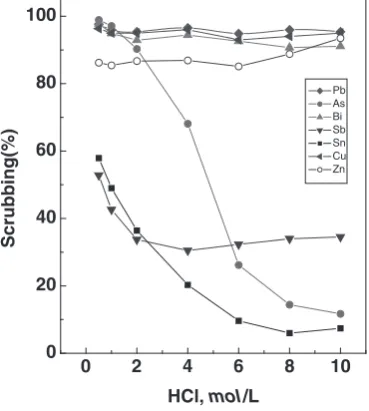
During the extraction stage of Sn by TBP in hydrochloric acid solution, minor metal constituents were also co-extracted. Thus, in order to remove these minor impurities effectively, a scrubbing process was followed. Hydrochloric acid was used as a scrubbing agent and the scrubbing behavior of minor constituents at various HCl concentrations was investigated. At first, an initial content of 5 g/L Sn and 0.5 g/L of each Sn, Sb, As, Bi, Pb, Cu and Zn were dissolved with 6.0 mol/L HCl and extracted by 0.365 mol/L TBP. Then, the metal loaded organic phase was used to scrub the minor metals. Figure 6 shows the scrubbing result of various
0.0 0 20 40 60 80 100
Extraction(%)
NaCl, mol/L Pb
As Bi Sb Sn Cu Zn
2.0 1.5
1.0 0.5
Fig. 3 Effect of NaCl concentration on extraction of metals.
0.2 0 20 40 60 80 100
Extraction(%)
TBP, mol/L
Pb As Bi Sb Sn Cu Zn
0.6 0.5 0.4 0.3
Fig. 4 Effect of TBP concentration on extraction of Sn and other impurity metals.
0 0 20 40 60 80 100
Extraction(%)
HCl, mol/L
Pb As Bi Sb Sn Zn Cu
10 8 6 4 2
[image:3.595.75.263.69.285.2] [image:3.595.334.517.70.277.2] [image:3.595.334.518.323.526.2]metals. Lead and copper were readily scrubbed from the TBP and a scrubbed value of 95% was obtained over the whole range of HCl concentrations. Bismuth also showed a higher scrubbing value of 90% and similarly 85–94% of Zn was scrubbed while increasing the HCl concentrations. On the contrary, As was scrubbed well at 2.0 mol/L HCl, but with a increas of HCl concentration to 10.0 mol/L the scrubbing value rapidly decreased to 11.7%. About 55% of antimony was scrubbed at 0.5 mol/L HCl, and with increasing HCl value to 2.0 mol/L, the scrubbing also decreased gradually to 33% and finally there was hardly any difference in the scrubbing value with a further increase of HCl concentration from 5.0 to 10.0 mol/L. Similarly, Sn showed 65% of scrubbing at 0.5 mol/L HCl; but with a further increase in HCl concentration, it also decreased gradually to 6% at 8.0 mol/L, which was the lowest value. Hence, from the above observations, it was concluded that the scrubbing of Pb, Bi, Zn, Cu and Sb from the loaded organic phase were comparatively effective at the 8.0 mol/L HCl concentration, whereas arsenic was more effectively scrubbed at 4.0 mol/L HCl.
3.6 Stripping of Sn
After extraction and scrubbing stages, the stripping process was followed to recover tin as a pure solution. Table 1 shows the result of the stripping of tin from the tin loaded TBP at various stripping agents. Tin was readily stripped by sodium hydroxide and reached 99.3% at 2.0 mol/L sodium hydroxide and without phase disengagement problems. In the case of the use of hydrochloric acid as a stripping agent, 82.4% of tin was stripped at 0.5 mol/L hydrochloric acid and decreased with increasing hydrochloric acid concentration. From the comparative study, it was conferred that sodium hydroxide was a more effective tin stripping agent than hydrochloric acid.
3.7 Separation process for each metal
To remove the minor metal constituents (As, Sb, Bi and Zn) from the leach solution of Sn, it is desired to be a high
extraction percentage of Sn with a low extraction percentage of other metal impurities during the extraction process. In this case, some of the metals are selectively removed during the extraction stage, but some of the metals are co-extracted with Sn. Therefore, for an effective separation of tin from the other metal species a proper selection of conditions for both extraction and scrubbing were conducted. The analyzed results for each minor impurity are listed in Table 2. Among the metals, Bi, Pb, Cu and Zn, can be separated from the Sn solution because of a low extraction percentage with TBP and high scrubbing percentage at high HCl concentration. The present analysis, thus may suggest that the most effective condition for removal of Pb, Bi, Cu and Zn is to be extracted within 6.0–7.0 mol/L HCl, followed by scrubbing with 8.0 mol/L HCl from the loaded organic phase. In case of As, since extraction and scrubbing are both largely dependent on HCl concentrations, a selection of specific HCl concen-tration range becomes very important. Thus, 3.0 mol/L HCl may be used for extraction and 4.0 mol/L HCl for the scrubbing purpose of As from the loaded organic phase. As the results showed, Sb was not easily separated from Sn solution compared with other metal species, but it can be removed with a proper selection of HCl concentrations. At first, the extraction was properly conducted around 7.0 mol/L HCl, then scrubbing from the organic phase was appropri-ately followed with 8.0 mol/L HCl. After the removal of minor impurities in the organic phase, tin may be easily stripped with 0.1 mol/L HCl solution or 0.5 mol/L NaOH solution and also recovered as a pure aqueous solution.
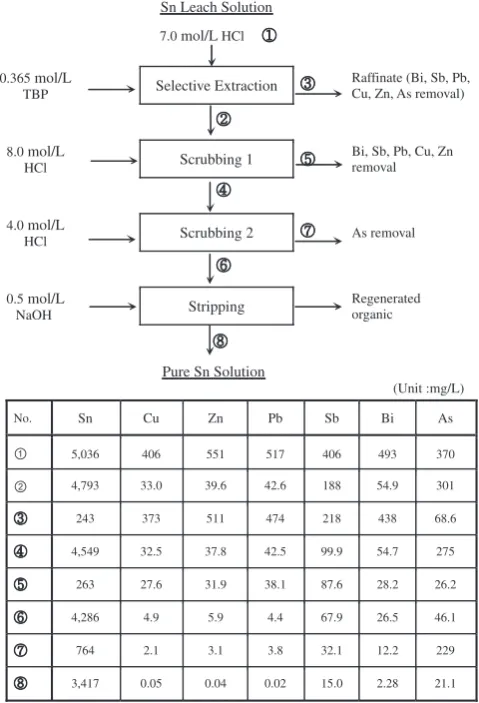
Finially, in order to verify the above mentioned proposed process, a series lab test has been carried out with the
simulate solution at 25C, 1.0 of O/A and one stage contact
at each purification step. Figure 7 shows the flowsheet of the tin separation process in mixed solution by TBP and the chemical compositions of metal ions in solution before and after each purification process. The test results indicated that
0 0 20 40 60 80 100
Scrubbing(%)
HCl, mol/L
Pb As Bi Sb Sn Cu Zn
10 8 6 4 2
[image:4.595.77.262.74.280.2]Fig. 6 Scrubbing percentage of metal ions at various HCl concentration.
Table 1 Stripping percentages of Sn loaded with TBP at various stripping agents (Loaded organic Sn 850 mg/L, O/A¼1:0, 25C).
Stripping agent Stripping percentage 0.5 mol/L NaOH 97.2% 1.0 mol/L NaOH 98.3% 2.0 mol/L NaOH 99.3% 0.5 mol/L HCl 82.4% 1.0 mol/L HCl 56.1% 2.0 mol/L HCl 38.6%
Table 2 Extraction and scrubbing of various ions for separation of Sn. Metal ions [HCl] for extraction, mol/L [HCl] for stripping, mol/L
Bi 6.0–7.0 8.0
As 3.0 4.0
Sb 7.0 8.0
Pb 6.0–7.0 8.0
Cu 6.0–7.0 8.0
[image:4.595.306.549.94.193.2] [image:4.595.303.548.231.327.2]even though there were some differences of the extraction and scrubbing behavior of metals, the separation behavior of each metals were similar to the proposed process. The purity of finial Sn strip solution was about 98.9% Sn and 15.0 mg/L of Sb and 21.1 mg/L of As were remained in the solution as a major impurities. The recovery of Sn was only 67.9% through the process, but in this experiment, only one stage was adapted in extraction step. So if we adapted two or three stages in extraction step, the recovery percentage of Sn will be increased.
4. Conclusion
The present investigation is related to separation of impurity metals (Bi, Pb, As, Sb, Cu, Zn) using TBP from Sn leach solution. The following conclusions were drawn:
(1) Above 5.0 mol/L HCl, the order of extraction by TBP
was Sn>As>Sb>Zn>Bi>CuPb, whereas, below
5.0 mol/L HCl, the extraction of Sb was higher than that
of As. Meanwhile, the order of separation from Sn leach
solution was Pb>Cu>Bi>Zn>Sb>As in which a
reverse order compared to extraction was observed.
(2) An increase of NaCl concentration in the aqueous solution did not effectively increase the separation factor of Sn from the other metal species.
(3) An increase of TBP concentration in the organic solution increased the separation factor of Sn from As, Bi, Pb, Cu and Zn so that the separation process became easier at higher TBP concentrations.
(4) From the result of scrubbing with HCl solution, it concluded that Bi, Pb, Cu, and Zn were easily stripped, while As and Sn were stripped well at low concentrations, but decreased rapidly with increasing concentrations and reached the lowest scrubbing percentage at 8.0 mol/L HCl.
(5) For the effective separation and removal of individual metal species, it was concluded that Pb, Bi, Cu and Zn can be extracted with 6.0–7.0 mol/L HCl and scrubbed with 8.0 mol/L HCl from the organic solution, whereas, As and Sn were extracted with 3.0 mol/L HCl and scrubbed with 4.0 mol/L HCl from the organic solution, and Sb was extracted with 7.0 mol/L HCl and scrubbed with 8.0 mol/L HCl.
(6) From the integrated separation experiment by the
simulate solution at 25C, 1.0 of O/A, and one stage contact
at each purification step, the purity of finial Sn strip solution was 98.9% and 15.0 mg/L of Sb and 21.1 mg/L of As were remained in the solution as a major impurities. And the recovery of Sn was 67.9% through the process by one stage extraction contact.
Acknowledgement
This work was supported by the Daejin University Research Grants in 2011.
REFERENCES
1) G. Holt and D. Pearson: Trans. Inst. Min. Metall. (Section C: Mineral Process. Extr. Metall.)86(1977) C77–C81.
2) E. Y. L. Sum: J. Metals43(1991) 53–61. 3) J. E. Hoffman: J. Metals44(1992) 43–48.
4) J. S. Seo, J. W. Ahn and M. S. Lee: J. Korean Inst. Resources Resources Recycling19(2010) 45–51.
5) J. W. Ahn, J. S. Seo and M. S. Lee: J. Korean Inst. Met. Mater48(2010) 929–935.
6) S. V. Bandekar and P. M. Dhadke: Talanta46(1998) 1181–1186. 7) T. Sato and S. Kikuchi: Hydrometallurgy20(1998) 97–108. 8) B. M. Sargar, T. N. Lokhande and M. A. Anuse: Proc. Int. Symp. on
Solvent Extraction (ISSE), (2002) pp. 207–221.
9) M. C. Fuerstenau and G. Wang: Hydrometallurgy46(1997) 229–234. 10) J. R. Harlamovs, G. Harrison and G. J. Lawson: Proc. Int. Solvent
extraction Conf. ISEC’80, Liege Belgium3(1980) 1–9.
11) C. Shuihog and S. Yuanfu: J. East China Inst. Chem. Technol. 14
(1988) 523–529.
Sn Leach Solution
7.0 mol/L HCl
0.365 mol/L
TBP Selective Extraction
Raffinate (Bi, Sb, Pb, Cu, Zn, As removal)
8.0 mol/L
HCl Scrubbing 1
Bi, Sb, Pb, Cu, Zn removal
4.0 mol/L
HCl Scrubbing 2 As removal
0.5 mol/L
NaOH Stripping
Regenerated organic
Pure Sn Solution
(Unit :mg/L)
No. Sn
5,036
4,793
243
4,549
263
4,286
764
3,417
As Bi Sb Pb Zn Cu
370 493 406 517 551 406
301 54.9 188 42.6 39.6 33.0
68.6 438 218 474 511 373
275 54.7 99.9 42.5 37.8 32.5
26.2 28.2 87.6 38.1 31.9 27.6
46.1 26.5 67.9 4.4 5.9 4.9
229 12.2 32.1 3.8 3.1 2.1
21.1 2.28 15.0 0.02 0.04 0.05
[image:5.595.49.289.74.426.2]