In
fl
uence of Processing Regimes on Fine-Grained Microstructure Development
in an Al
Mg
Sc Alloy by Hot Equal-Channel Angular Pressing
Oleg Sitdikov
1, Elena Avtokratova
1, Rita Babicheva
1, Taku Sakai
2,
Kaneaki Tsuzaki
3and Yoshimi Watanabe
41Institute for Metals Superplasticity Problems, Khalturina 39, Ufa 450001, Russia 2UEC Tokyo (The University of Electro-Communications), Tokyo 182-8585, Japan 3National Institute for Materials Science, Tsukuba 305-0047, Japan
4Nagoya Institute of Technology, Nagoya 466-8555, Japan
Grain refinement during equal-channel angular pressing (ECAP) was studied in a commercial Al5.8%Mg0.3%Sc alloy at temperatures from 473 to 723 K (³0.50.8Tm). The samples were quenched in water in every ECAP pass, which is a conventional cyclic process. ECAP to
¾=12 resulted in ultrafine-grained structures developed uniformly at high strains at 473 and 723 K, while processing at 573 K led to the evolution of a duplex grain structure containing partially much coarser grains. In contrast, ECAP process continuously carried out to¾=12 without interruption at 573 K, resulted in development of a uniform ultrafine-grained structure. Effects of processing regimes on microstructural evolution in the AlMgSc alloy are discussed. [doi:10.2320/matertrans.MD201108]
(Received June 1, 2011; Accepted September 8, 2011; Published October 19, 2011)
Keywords: aluminum alloy, equal-channel angular pressing, grain refinement, temperature effect, static recrystallization
1. Introduction
There have been several works to date showing that equal-channel angular pressing (ECAP) is an effective method for grain refining of metallic materials at low-to-high temper-atures.1) Microstructural changes in aluminum (Al) alloys have been studied at various temperatures.114)The formation of new grains during ECAP has been proposed as a result of the transformation of deformation-induced low angle boundaries (LABs) formed at earlier stages of deformation into high angle boundaries (HABs) at high strains. This mechanism is similar to in situ or continuous dynamic recrystallization (cDRX).15)It is suggested13,6,7,10,1215) that the transition of LABs into HABs can be controlled by dynamic recovery, and so accelerated with increasing temperature. On the other hand, it was found that the final grain size and the fraction of LABs evolved at high strains generally increase with increasing temperature in dilute and low-to-moderately alloyed aluminum alloys.3,6,10,13) Such opposite effects of processing temperature on new grain formation are currently a matter of intense debate. The above picture becomes much more complicated in some highly-alloyed Al alloys, in which dynamic recovery is additionally inhibited by the presence of a large number of dispersoid particles and substitutional atoms in solid solution.14,68)It has been shown that new grain formation can be delayed in such alloys, and relativelyfiner crystallites with more diffused dislocation subboundaries are evolved at much higher strains at low-to-moderate temperatures.3,8) Besides, duplex micro-structures containing unexpectedly coarse grains have been sometimes reported in some Alhigh Mg alloys during ECAP at high temperature.4,6,7) All the above mentioned points emphasize that deformation temperature is one of the most complicated and the least understood parameters of ECAP. The major factors controlling microstructural development during warm-to-hot ECAP are, unfortunately, still unclear due to the lack of related experimental data.
The aim of the present work is to study the effect of processing regimes on new grain development in an Al 5.8%Mg0.3%Sc alloy during warm-to-hot ECAP. The addition of Mg and Sc to Al alloy can significantly inhibit dynamic recovery operating during ECAP.13,8) It has been previously shown in9,11,14) that the microstructural formation in the present alloy is significantly changed by ECAP at various temperatures; then this effect will be examined in a wide range of temperatures in the current work. The main factors promoting grain refinement are analyzed at various temperatures and the mechanisms of strain-induced grain formation are discussed.
2. Experimental Procedure
The alloy used had the following chemical composition Al5.8%Mg0.3%Sc0.4%Mn0.2%Si0.1%Fe (in mass%). It was fabricated by casting into a steel mold at the Kamensk-Uralsk Metallurgical Works (Russia) and then homogenized at 793 K for 48 h. First the as-cast alloy was extruded at 663 K to a strain of 0.7, followed by annealing at 673 K for 1 h. This treatment resulted in a non-uniform and partially recrystallized microstructure with a bimodal distribution of grain size, in which coarse elongated grains lied parallel to the extrusion axis, andfine equiaxed grains were evolved in their mantle regions.9,11) The average size of coarse grains was about 170 and 70 µm in longitudinal and transverse directions, respectively. The fine grains had an average size of 4.5 µm with a volume fraction of 0.35. The precipitates of the binary Al3Mg2 (¢)-phase were revealed in such as-supplied material state to be rather coarse (³0.51 µm) and distributed mainly along original grain boundaries. Also coherent Al3Sc dispersoids were identified in this structure and had a size of about 1020 nm.9,11,16)
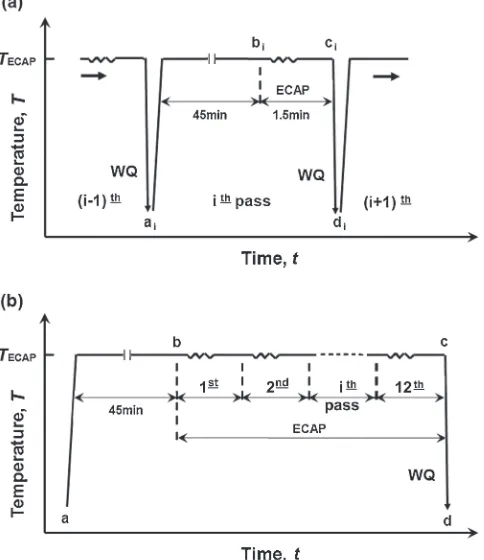
from 473 to 723 K to the total strain of ¾=12, using a circular die in cross-section with a diameter of 20 mm. The die had a channel in L-shaped configuration with an angle of 90° between the two channels and an angle of 0° at the outer arc curvature at the point of intersection. These angles lead to a strain of about 1 in each passage through the die. A heating jacket was put on the die and the pressing temperature was controlled within«5 K of 473723 K. Samples were pressed repeatedly using route A, i.e. the orientation of billet was not changed at each pass. The route A was selected because it has been previously shown that it could be the most effective one for formation of fine-grained structure with HABs.5) More-over, this is the simplest method of ECAP and, hence, can be most suitable for grain refinement under industrial conditions. The ECAP was performed in a press operating at a pressing speed of ³6 mm/s. The samples were quenched into water after each pressing and then reheated and kept at the pressing temperature for 45 min to attain much equilibrium material state before the next ECAP pass,17) as shown in Fig. 1(a). The mean time interval between the starting ECAP in each pass and immersion of the sample after pressing into water was about 1.5 min. The latter included the waiting time in the die caused by ECAP procedure, since the pressed sample was pushed out of the channel after pressing by the next rod introduced into the die.
Also, for comparison, a number of samples were ECAPed continuously to ¾=12 without interruption between passes, as shown in Fig. 1(b); that is, some of the samples, removed from the exit channel of the ECAP matrix after each deformation, were“immediately”put to the entrance channel
microstructural observations, such as optical microscopy, electron back scattering diffraction (EBSD) and X-ray analyses. The Vickers hardness was measured at room temperature with a load of 0.51 N. For each sample, twenty five to thirty indents were made to obtain the average value of microhardness. Metallographic observations were carried out using a Nikon L-150 optical microscope and scanning electron microscope (SEM) JSM-840 after etching with a standard Keller’s reagent. (Sub)grain boundary distributions were obtained from EBSD using LEO1530 SEM and JSM-6500 SEM equipped with field-emission guns. The X-ray structural analysis was performed at the specimen surface areas with a diameter of³1 mm by a photo method using the X-ray device URS-2.0. Specimens for SEM-EBSD and X-ray examinations were mechanically polished and then electro-polished at 20 V in a solution of 30%HNO3and 70%CH3OH at a temperature of 243 K. The mean (sub)grain size was measured by the line-intercept method.
3. Results and Discussion
3.1 Microstructures developed by warm-to-hot ECAP
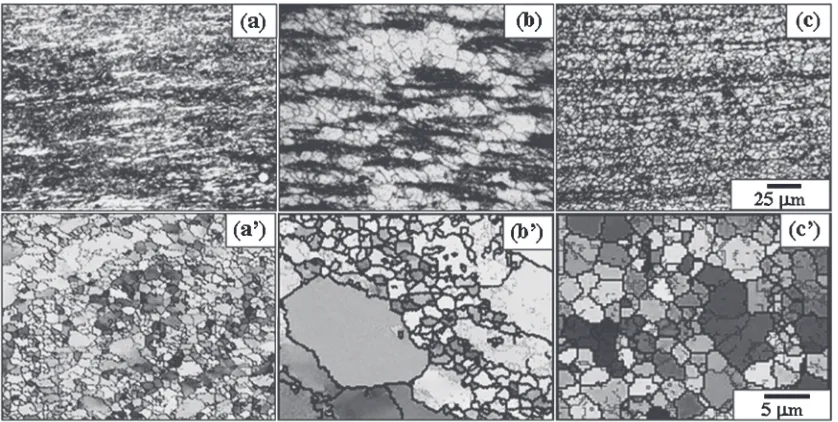
Figure 2 represents typical (a)(c) optical micrographs and (aA)(cA) EBSD maps for the microstructures developed by cyclic ECAP to ¾=12 [Fig. 1(a)] at temperatures (a)(aAA) 473, (b)(bAA) 573 and (c)(cAA) 723 K. The different grayscale levels in EBSD maps [Fig. 2(aA)(cA)] indicate the different crystallographic orientations and the differences between neighboring grid points 2°¯ª<5°, 5°¯ª<15° and 15°¯ª are marked by narrow white, gray and black lines, respectively. It is evident that grain refinement takes place almost uniformly during ECAP at 473 K and 723 K. The average crystallite sizes and their volume fractions were as high as³0.4 µm and 0.60.7 at 473 K and³2.5 µm and 0.85 at 723 K.
In contrast, a bimodal grain structure containing partially coarse grains is evolved after 12 passes of ECAP at 573 K. One component of this structure comprises fine-grained bands aligned parallel to the pressing direction. The size of the crystallites evolved in these bands is about 1 µm; their volume fraction is about 0.3. The other grain component is composed of relatively coarser grains of about 8 µm and the volume fraction of about 0.6. The size of these grains is unexpectedly large and most of them have essentially equiaxed shape. It is also interesting to see in Fig. 2(bA) that there are very low misorientation gradients developed in their
Fig. 1 (a) Schematic representation for (a) the cyclic ECAP procedure and (b) the uninterrupted one:aibi: (re)heating and exposure of samples at
ECAP temperature (TECAP) during 45 min before deformation; bici:
[image:2.595.50.292.74.354.2]interiors. Note that such grains are classified by orientation imaging microscopy (OIM) software as “recrystallized”, because their internal lattice distortion angles do not exceed 0.25° µm¹1. In addition, their pattern quality is relatively high; i.e. their coincidental index (CI) and image quality (IQ) can be measured to be always more than³0.50.6 and³100, respectively. This may be good evidence of their low defect density.11) The represented data suggest that these coarser grains have not suffered any remarkable strain after their formation and, hence, may be formed by static, rather than dynamic, processes.
The X-ray diffraction patterns obtained after ECAP to¾= 12 are represented in Fig. 3. These show some continuous diffraction rings at 473, 523, 573 and 723 K. This can be an additional independent evidence that some misoriented deformation/(sub)grain structures are almost fully evolved during ECAP in a wide range of temperatures. The diffraction patterns at 473, 523 and 723 K exhibit rather broad and
diffused rings; that may be related to some high strain gradients and/or lattice distortions introduced by ECAP, while the picture taken at 573 K displays very sharp diffraction spots along the rings, as arrowed in Fig. 3(c). This suggests that some coarse recrystallized grains are partially evolved in the examined material at this temper-ature.
It is concluded in Figs. 2 to 3 that the present AlMgSc alloy exhibits rather complicated structural behavior during warm-to-hot ECAP. There is a “processing window” at around 573 K (³0.6Tm), in which the structural development during ECAP is characterized by partial appearance of coarser grains with much larger size than that developed even at 723 K. Note that these coarse grains may be related to a
“sudden discontinuous grain coarsening”, which was re-ported earlier for some AlMg alloys ECAPed at elevated temperatures.4,6,7) These features of the microstructural development during ECAP will be discussed latter in detail.
Fig. 2 Typical as-deformed microstructures developed in Al5.8%Mg0.3%Sc alloy after 12 passes of ECAP at (a)(aAA) 473 K, (b)(bAA) 573 K and (c)(cAA) 723 K. The pressing direction is horizontal.
[image:3.595.90.509.70.281.2] [image:3.595.87.511.330.525.2]after its transition through the deformation zone, as described below. Since shear plastic deformation is only applied in the narrow region of the L-shaped corner, the material remains under static annealing conditions inside the heated die both before arrival at and after leaving the deformation zone. Moreover, since the pressed sample is pushed out of the channel by the next rod, additional waiting time in the die is also caused by the necessity to up the plunger after pressing, put this rod into the entrance channel and press it. Then in the real cyclic ECAP process used, a period of delay time from severe plastic deformation at the die-corner to water quenching may be evaluated to be roughly 9095% of the total period of time for ECAP working, e.g. 80 to 85 s in the present experiment. Thus, there may be enough time to operate some static recovery and static recrystallization events, leading to formation of a duplex structure.
Second, a spontaneous static annealing may also occur between ECAP passes [segments aibi in Fig. 1(a)], since the deformation temperature should be maintained and/or periodically restored before each pass during the whole ECAP procedure; this is inherent to the repeated deformation mode of ECAP. It has been shown11)that both the size and the volume fraction of “coarse”grains developed by ECAP at 573 K are remarkably increased during such interpass exposures.
Thus SRX may occur as an alternative restoration process under warm-to-hot ECAP conditions through annealing of as-deformed material by its exposure in the ECAP channel and reheating between passes, when dynamic recovery is strongly inhibited by some structural factors in Al alloys.11) In the present alloy, an enhanced driving force for recrystallization can be produced even under warm-to-hot deformation conditions, because of
(i) strongly localized plastic deformation introduced at around the corner of ECAP die and
(ii) inhibition of recovery by the presence of coherent dispersion particles as well as Mg atoms in solid solution.
Both (i) and (ii) may provide locally a high dislocation density, which gives rise to a large stored strain energy.7,11,15) Here, it is interesting to understand the reason for the development of a duplex structure in a very narrow
“processing window” at around 573 K, while no SRX accompanied by grain growth was noticed at the lower or higher temperatures, i.e. at 473, 523 and 723 K. It is also rather surprising that the formation of “coarse” statically
recrystallized grains takes place even in the present AlMg Sc alloy containing a respectable amount of fine coherent Al3Sc particles. The latter are reported to serve as very effective pinning agents and thus prevent recrystallization.
3.2 Temperature effect on occurrence conditions for
SRX
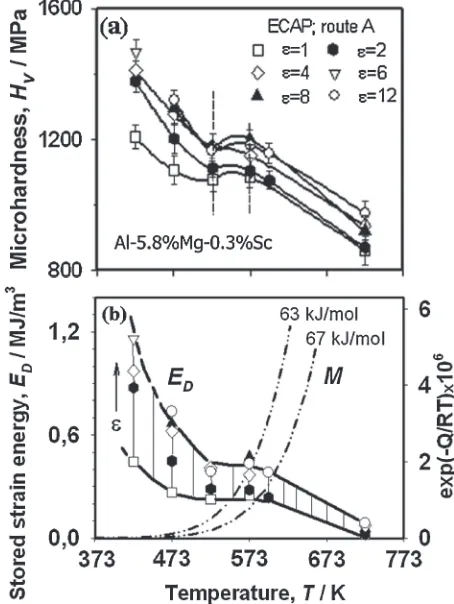
The room temperature microhardness was measured on the samples ECAPed to ¾=112 and the results are plotted against temperature in Fig. 4(a). The data at 423 K16) are represented here for reference. Note in Fig. 4 that the hardness at 573 K was examined only in the fine-grained regions because of providing compatible data with those obtained at the other deformation temperatures. It is seen in Fig. 4(a) that the microhardness investigated at all ECAP strains monotonically drops in the temperature intervals from 423 to 523 K and from 573 to 723 K; this may be normally related to acceleration of the rate of restoration processes taking place in deformation structures, which is controlled mainly by dynamic recovery.15) On the other hand, the microhardness is nearly unchanged at the temperatures from 523 to 573 K, at which SRX takes place (Fig. 2). This may suggest an inability of the material to recover rapidly in dislocation substructures developed. Now this will be discussed below in detail.
An overall strain energy, ED, stored during ECAP at various temperatures is evaluated using eq. (1)19)
ED¼ ðHv=3Þ2=ðm2¡2GÞ; ð1Þ
Fig. 4 (a) Microhardness changes in Al5.8%Mg0.3%Sc alloy after ECAP. Hardness at 573 K was evaluated in the regions offine-grains evolved. (b) Evaluated stored strain energy (ED) and grain boundary
[image:4.595.312.539.72.374.2]and depictured in Fig. 4(b), where m (μ3) is the Taylor factor,¡(μ0.5) is the constant and Gis the shear modulus of the aluminum.19,20) Here approximate changes in flow stresses are assumed to be taken as¦Hv/3=(Hv¹Hv0)/3. TheHv0(μ790«10 MPa) was obtained from extrapolation of the strain dependencies of microhardness to¾=0.9,16)It is seen that the ED decreases non-monotonically at all strains with increasing temperature. It should be noted that such non-monotonic temperature dependence provides relatively high strain energy in the temperature interval from 523 to 573 K, which is about 0.30.5 MJ m¹3. This, in turn, can provide a rather high driving force for grain boundary migration in SRX, which is comparable with a restrained force of Al3Sc particles in the present alloy.11)In contrast, the EDvalues at 723 K are negligibly small at all strains and so can result in a quite limited migration of grain boundaries.
It is also interesting to note that the temperature interval from 523 to 573 K coincides with the vicinity of the solvus point of about 553 K in the Al5.8%Mg alloy.21) It is well known that dynamic recovery is more effectively suppressed by high Mg solute content in the matrix of non-heat treatable AlMg-based alloys, while the effect of Al3Mg2 (¢-phase) precipitates on recovery and recrystallization processes can be very weak.2,21) Temperature dependence of the equi-librium Mg content in solid solution derived from Thermo-Calc software22) is represented in Fig. 5(a) for the Al 5.8%Mg0.3%Sc0.4%Mn0.2%Si0.1%Fe alloy. The dis-tribution of the ¢-phase particles developed during ECAP at 473 K is shown in Fig. 5(b), as it was observed by optical microscopy on the polished sample surface. It is remarkable to note in Fig. 5(a) that the amount of Mg in solid solution increases rapidly from about 3 to about 5.8% when the temperature increases from 473 to 573 K, i.e. up to ³3 mass%of Mg can additionally dissolve in the¡-phase at these temperatures. Such an increase in solute Mg content in the matrix can additionally inhibit dynamic recovery with increasing temperature and, thus, increase the value of stored strain energy and so driving force for SRX.
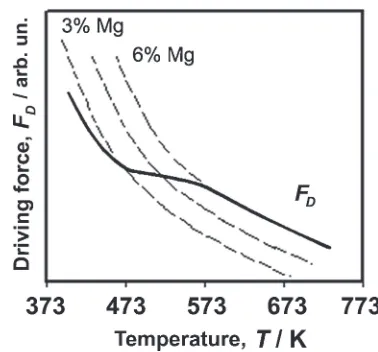
It is expected in an AlMg solid solution alloy with afixed Mg content that the driving force for recrystallization, FD, will be reduced with increasing temperature and, hence, recrystallization will occur less readily after deformation at higher temperatures.15) However, the absolute value of FD will be always larger in Al alloy containing higher solute content. Such dependencies of FD on temperature and Mg concentration are represented schematically by a series of dashed lines in Fig. 6. A solid line in this figure shows, in turn, a change in the driving force for recrystallization of AlMg alloy, in which Mg content in ¡-phase matrix would be increased by increasing temperature. It can be seen in this case that there is an additional increment of FD by increasing temperature through the solvus point (Fig. 5). This schematic representation forFDis consistent with the present experimental results for temperature dependencies of micro-hardness and so estimated stored strain energy in Fig. 4.
On the other hand, recrystallization can start to occur under large stored strain energy/driving force conditions, when increasing deformation temperature provides a high value of grain-boundary mobility, M.15) It is known that M is approximated by an Arrhenius type relationship, as eq. (2), i.e.
MexpðQ=RTÞ; ð2Þ
where Q is the activation energy for the grain boundary migration and R is the universal gas constant.15) The dependencies of the exp(¹Q/RT) vs. T are represented in Fig. 4(b) by dash-dot-dotted lines. The activation energy for grain boundary migration in aluminum,15) ³6367 kJ mol¹1, was taken into account to evaluate M at deformation temperatures. It can be seen, that M is negligibly small at temperatures less than 473 K, but starts to rapidly grow at
T²523 K. Thus, there is an overlap of accelerated grain boundary mobility and enhanced strain energy in the vicinity of T³573 K. Hence, a high potential for grain boundary migration may be evolved during the process of ECAP at around 573 K. At T¹573 K or Tº573 K, in contrast, either the M or ED values are not large enough to trigger SRX, respectively, and thus, the microstructural development in the present alloy occurs in accordance with cDRX
Fig. 5 (a) Temperature dependence of the equilibrium Mg content in the solid solution of the Al5.8%Mg0.3%Sc0.4%Mn0.2%Si0.1% Fe-based alloy derived from Thermo-Calc software.22)(b) Polished sample of
Al5.8%Mg0.3%Sc alloy quenched from 473 K.
[image:5.595.62.276.65.259.2] [image:5.595.329.518.67.243.2]mechanism, leading to uniform formation of ultrafine-grained structures.
Additionally, there is some possibility for grain coarsening accompanying with dissolution of the precipitation particles of ¢-phase. A rather unstable condition may exist at around the solvus point. Namely, dissolution of¢-phase should take place locally in a short period of annealing time at 573 K and thus result in grain coarsening due to the unpinning effect. On the other hand, increasing in Mg content in solid solution may retard grain boundary migration.15)
3.3 Influence of interpass exposure time
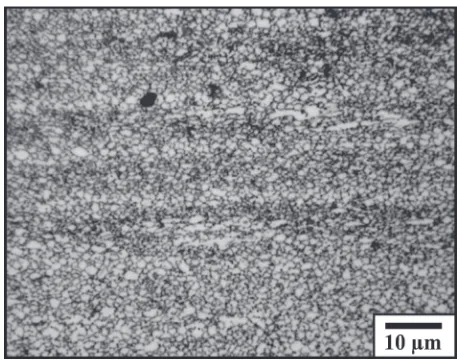
To avoid a partial development of coarse recrystallized grains in the present aluminum alloy, some samples were continuously ECAPed up to¾=12 without any interruption at 573 K [see Fig. 1(b)]. The typical microstructure devel-oped after 12 ECAP passes is represented in Fig. 7. It is seen that an uniformfine-grained structure is almost fully evolved in the whole regions even though the ECAP is carried out at the “processing window”temperature. The mean grain size developed was about 0.9 µm and the microhardness of the as-pressed material was as high as 1260 MPa, i.e. this micro-structure evolved was essentially similar to that developed within the bands offine grains in Fig. 2(b). The present data suggest that interpass cooling and reheating can play an important role in the formation of fine-grained structure during hot ECAP. Namely, even if a high potential for SRX appears during hot ECAP, its occurrence can be suppressed by a decrease in the time of exposure for ECAPed samples at high temperature. In this case, the development of new grains may take place only in accordance with cDRX mechanism operating during ECAP. It should be noted that severe plastic deformation at high temperature can remarkably accelerate recovery processes23,24) and promote strain-induced grain formation.
4. Conclusions
Microstructural development in a commercial Al 5.8%Mg0.3%Sc alloy subjected to ECAP by route A to a
grain evolved is larger than that developed even at 723 K. (3) The microstructural development in (2) may be caused by a large potential for the grain boundary migration that appears at 573 K due to an overlapping effect of accelerated grain boundary mobility and enhanced stored strain energy, which results from a strong inhibition of dynamic recovery in the highly-alloyed aluminum alloy. The static recrystalliza-tion occurs as an alternative restorarecrystalliza-tion process during reheating/exposure of the samples between pressings.
(4) An ECAP process continuously carried out without any interruption at 573 K results in suppression of static recrystallization, followed by full development of a uniform ultrafine grained structure with the mean size of ³0.9 µm at high strains.
Acknowledgments
This work was supported by the Ministry of Education and Science of Russian Federation under grant no. P1065.
REFERENCES
1) R. Z. Valiev and T. G. Langdon: Prog. Mater. Sci.51(2006) 881981. 2) Y. Iwahashi, Z. Horita, M. Nemoto and T. G. Langdon: Metall. Mater.
Trans. A29(1998) 25032510.
3) A. Yamashita, D. Yamaguchi, Z. Horita and T. G. Langdon: Mater. Sci. Eng. A287(2000) 100106.
4) C. Pithan, T. Hashimoto, M. Kawazoe, J. Nagahora and K. Higashi: Mater. Sci. Eng. A280(2000) 6268.
5) A. Gholinia, P. B. Prangnell and M. V. Markushev: Acta Mater.48
(2000) 11151130.
6) Y. C. Chen, Y. Y. Huang, C. P. Chang and P. W. Kao: Acta Mater.51
(2003) 20052015.
7) M. Popovic and B. Verlinden: Mater. Sci. Technol.21(2005) 606612. 8) P. J. Apps, M. Berta and P. B. Prangnell: Acta Mater.53(2005) 449
511.
9) O. Sitdikov, T. Sakai, E. Avtokratova, R. Kaibyshev, Y. Kimura and K. Tsuzaki: Mater. Sci. Eng. A444(2007) 1830.
10) I. Mazurina, T. Sakai, H. Miura, O. Sitdikov and R. Kaibyshev: Mater. Sci. Eng. A486(2008) 662671.
11) O. Sitdikov, T. Sakai, E. Avtokratova, R. Kaibyshev, K. Tsuzaki and Y. Watanabe: Acta Mater.56(2008) 821834.
12) R. R. Mulyukov, A. A. Nazarov and R. M. Imayev: Mater. Sci. Forum
29(2008) 584586.
13) I. Mazurina, T. Sakai, H. Miura, O. Sitdikov and R. Kaibyshev: Mater. Trans.50(2009) 101110.
14) O. S. Sitdikov and E. V. Avtokratova: Proc. XVII Int. Conf. on Physics of strength and plasticity of materials, ed. V. P. Radchenko, A. P. Amosov, A. F. Zausaev et al., Vol. 2, (2009, Samara, Samara State Technical University) (in Russian) pp. 7580.
[image:6.595.54.284.68.248.2]15) F. J. Humphreys and M. Hatherly: Recrystallization and Related Annealing Phenomena, second ed., (Elsevier, 2004).
16) R. Babicheva: Diploma Thesis, USATU (Ufa State Aviation Technical University, 2008).
17) At that the particles of the¢-phase present in original material should normally coagulate and/or dissolve in accordance with equilibrium phase diagram to achieve the most equilibrium condition even in early ECAP stage.
18) D. Yamaguchi, Z. Horita, M. Nemoto and T. G. Langdon: Scr. Mater.
41(1999) 791796.
19) M. Taheri, H. Weiland and A. Rollett: Metall. Mater. Trans. A 37
(2006) 1925.
20) H. J. Frost and M. F. Ashby: Deformation-Mechanism Maps: The Plasticity and Creep of Metals and Ceramics, (Pergamon Press, 1982). 21) L. F. Mondolfo: Aluminum Alloys: Structure and Properties, (Butter
Worths, London, 1976).
22) Thermo-Calc for Windows: Users Guide, Thermo-Calc Software AB, Stockholm, (2008).
23) J. K. Kim, H. G. Jeong, S. I. Hong, Y. S. Kim and W. J. Kim: Scr. Mater.45(2001) 901907.
24) C. Kobayashi, T. Sakai, A. Belyakov and H. Miura: Philos. Mag. Lett.