Maximal Incrementality in Linear Categorial Deduction
M a r k H e p p l e
Dept. of Computer Science
University of Sheffield
Regent Court, Portobello Street
Sheffield S1 4DP, UK
hepple©dcs, s h e f . ac. uk
A b s t r a c t
Recent work has seen the emergence of a common framework for parsing categorial grammar (CG) formalisms that fall within the 'type-logical' tradition (such as the Lambek calculus and related systems), whereby some method of linear logic the- orem proving is used in combination with a system of labelling that ensures only de- ductions appropriate to the relevant gram- matical logic are allowed. The approaches realising this framework, however, have not so far addressed the task of incremental parsing - - a key issue in earlier work with 'flexible' categorial grammars. In this pa- per, the approach of (Hepple, 1996) is mod- ified to yield a linear deduction system that does allow flexible deduction and hence in- cremental processing, but that hence also suffers the problem of 'spurious ambiguity'. This problem is avoided via normalisation.
1 I n t r o d u c t i o n
A key attraction of the class of formalisms known as 'flexible' categorial grammars is their compatibility with an incremental style of processing, in allow- ing sentences to be assigned analyses that are fully or primarily left-branching. Such analyses designate many initial substrings of a sentence as interpretable constituents, allowing its interpretation to be gener- ated 'on-line' as it is presented. Incremental inter- pretation has been argued to provide for efficient language processing, by allowing early filtering of implausible readings. 1
This paper is concerned with the parsing of cat- egorial formalisms that fall within the 'type-logical'
1Within the categorial field, the significance of incre- mentality has been emphasised most notably in the work of Steedman, e.g. (Steedman, 1989).
tradition, whose most familiar representative is the associative Lambek calculus (Lambek, 1958). Re- cent work has seen proposals for a range of such systems, differing in their resource sensitivity (and hence, implicitly, their underlying notion of 'lin- guistic structure'), in some cases combining differ- ing resource sensitivities in one system. 2 Many of these proposals employ a 'labelled deductive sys- tem' methodology (Gabbay, 1996), whereby types in proofs are associated with labels which record proof information for use in ensuring correct inferencing.
A common framework is emerging for parsing type-logical formalisms, which exploits the labelled deduction idea. Approaches within this framework employ a theorem proving method that is appropri- ate for use with linear logic, and combine it with a labelling system that restricts admitted deductions to be those of a weaker system. Crucially, linear logic stands above all of the type-logical formalisms pro- posed in the hierarchy of substructural logics, and hence linear logic deduction methods can provide a common basis for parsing all of these systems. For example, Moortgat (1992) combines a linear proof net method with labelling to provide deduction for several categorial systems. Morrill (1995) shows how types of the associative Lambek calculus may be translated to labelled implicational linear types, with deduction implemented via a version of SLD resolution. Hepple (1996) introduces a linear deduc- tion method, involving compilation to first order for- mulae, which can be combined with various labelling disciplines. These approaches, however, are not dir- ected toward incremental processing.
In what follows, we show how the method of (Hepple, 1996) can be modified to allow processing which has a high degree of incrementality. These modifications, however, give a system which suffers
the problem of 'derivational equivalence', also called 'spurious ambiguity', i.e. allowing multiple proofs which assign the same reading for some combina- tion, a fact which threatens processing efficiency. We show how this problem is solved via normalisation.
2
I m p l i c a t i o n a l
L i n e a r L o g i c
Linear logic is an example of a "resource-sensitive" logic, requiring that each assumption ('resource') is used precisely once in any deduction. For the implic- ational fragment, the set of formulae ~ are defined by 5 r ::= A [ ~ ' o - ~ - (with A a nonempty set of atomic types). A natural deduction formulation re- quires the elimination and introduction rules in (1), which correspond semantically to steps of functional application and abstraction, respectively.
(1) Ao-B : a B: b IS: v]
o-E A : a
A: (ab) o - I
Ao-B : Av.a
The proof (2) (which omits lambda terms) illustrates that 'hypothetical reasoning' in proofs (i.e. the use of additional assumptions that are later discharged or cancelled, such as Z here) is driven by the presence of higher-order formulae (such as X o - ( y c - z ) here).
(2) Xo-(Yo--Z) Yo-W Wo--Z [Z]
W
Y
Yo-Z
X
Various type-logical categorial formalisms (or strictly their implicational fragments) differ from the above system only in imposing further restric- tions on resource usage. For example, the associ- ative Lambek calculus imposes a linear order over formulae, in which context, implication divides into two cases, (usually written \ and /) depending on whether the argument type appears to the left or right of the functor. Then, formulae may combine only if they are adjacent and in the appropriate left-right order. The non-associative Lambek cal- culus (Lambek, 1961) sets the further requirement that types combine under some fixed initial brack- etting. Such weaker systems can be implemented by combining implicational linear logic with a la- belling system whose labels are structured objects that record relevant resource information, i.e. of se- quencing a n d / o r bracketting, and then using this in- formation in restricting permitted inferences to only those that satisfy the resource requirements of the weaker logic.
3
F i r s t - o r d e r C o m p i l a t i o n
The first-order formulae are those with only atomic argument types (i.e. ~" ::= A I .~o-A). Hepple (1996) shows how deductions in implica- tional linear logic can be recast as deductions in- volving only first-order formulae. 3 The method in- volves compiling the original formulae to indexed
first-order formulae, where a higher-order initial for- mula yields multiple compiled formulae, e.g. (omit- ting indices) X o - ( y o - - Z ) would yield X o - Y a n d Z,
i.e. with the subformula relevant to hypothetical reasoning (Z) effectively excised from the initial for- mulae, to be treated as a separate assumption, leav- ing a first-order residue. Indexing is used in ensuring general linear use of resources, but also notably to ensure proper use of excised subformulae, i.e. so that Z, in our example, must be used in deriving the argu- ment of X o - Y , and not elsewhere (otherwise invalid deductions would be derivable).
The approach is best explained by example. In proving Xo-(Yo--Z), Y o - W , Wo--Z =~ X, compila- tion of the premise formulae yields the indexed for- mulae t h a t form the assumptions of (3), where for- mulae (i) and (iv) both derive from Xo--(Yo-Z). (Note in (3) t h a t the lambda terms of assumptions are written below their indexed types, simply to help the proof fit in the column.) Combination is allowed by the single inference rule (4).
(3)
(i)
(ii)
(iii)
(iv)
{i}:Xo-(Y:{j}) {k}:Yo-(W:0) {l}:Wo--(Z:0) {j}:Z
)~t.x( )tz.t ) )~u.yu Av.wv z
{j,l} : W : w z
{j, k, l}: Y: y ( w z )
{i, j, k, l}: X: x()tz.y(wz))
(4) ¢: Ao--(B:~) : Av.a ¢ : B : b lr = ¢t~¢
r : A: a[b//vl
Each assumption in (3) is associated with a set con- taining a single index, which serves as the unique
3The point of this manoeuvre (i.e. compiling to first- order formulae) is to create a deduction method which, like chart parsing for phrase-structure grammar, avoids the need to recompute intermediate results when search- ing exhaustively for all possible analyses, i.e. where any combination of types contributes to more than one over- all analysis, it need only be computed once. The incre- mental system to be developed in this paper is similarly compatible with a 'chart-like' processing approach, al- though this issue will not be further addressed within this paper. For earlier work on chart-parsing type-logical formalisms, specifically the associative Lambek calculus,
identifier for that assumption. The index sets of a derived formula identify precisely those assumptions from which it is derived. The rule (4) ensures appro- priate indexation, i.e. via the condition rr = ¢ ~ ¢ , where t~ stands for disjoint union (ensuring linear usage). The common origin of assumptions (i) and (iv) (i.e. from Xo--(Yo-Z)) is recorded by the fact that (i)'s argument is marked with (iv)'s index (j). The condition a C ~b of (4) ensures that (iv) must contribute to the derivation of (i)'s argument (which is needed to ensure correct inferencing). Finally, ob- serve that the semantics of (4) is handled not by simple application, but rather by direct substitution for the variable of a lambda expression, employing a special variant of substitution, notated _[_//_] (e.g. t[s//v] to indicate substitution of s for v in t), which specifically does not act to avoid accidental binding. In the final inference of (3), this method allows the variable z to fall within the scope of an abstraction over z, and so become bound. Recall that introduc- tion inferences of the original formulation are associ- ated with abstraction steps. In this approach, these inferences are no longer required, their effects hav- ing been compiled into the semantics. See (Hepple, 1996) for more details, including a precise statement of the compilation procedure.
4 F l e x i b l e D e d u c t i o n
The approach just outlined is unsuited to incre- mental processing. Its single inference rule allows only a rigid style of combining formulae, where or- der of combination is completely determined by the argument order of functors. The formulae of (3), for example, must combine precisely as shown. It is not possible, say, to combine assumptions (i) and (if) to- gether first as part of a derivation. To overcome this limitation, we might generalise the combination rule to allow composition of functions, i.e. combinations akin to e.g. Xo-Y, Yo--W ==> X o - W . However, the treatment of indexation in the above system is one that does not readily adapt to flexible combination. We will transform these indexed formulae to an- other form which better suits our needs, using the compilation procedure (5). This procedure returns a modified formula plus a set of equations that spe- cify constraints on its indexation. For example, the assumptions (i-iv) of (3) yield the results (6) (ignor- ing semantic terms, which remain unchanged). Each atomic formula is partnered with an index set (or typically a variable over such), which corresponds t o the full set of indices to be associated with the complete object of that category, e.g. in (i) we have (X+¢), plus the equation ¢ = {i}Wrr which tells us that X's index set ¢ includes the argument formula
Y's index set rr plus its own index i. The further constraint equation ¢ = {i}t~rr indicates that the argument's index set should include j (c.f. the con- ditions for using the original indexed formula).
(5) 0.(¢: x : t) = ( ( x + ¢ ) : t,0) where X atomic
0.(¢: X o - Y : t) = ( Z : t,C) where 0.1(¢, Xo--Y) = (Z, C) 0.1(¢,x) = ( ( x + 7 ) , {7 = ¢})
where X atomic, 7 a fresh variable
0.1 (¢, X l ° - ( Y : 7r)) = (X2o--(Y+7), C') where 6, 7 fresh variables, 6 := ¢~7
0"1(6, X 1) = (X2, C) C' = C u {~r c 7}
(unless ~r = 0, when C = C')
(6) i. old formula: {i}: Xo--(Y:{j})
new formula: (X+C)o-(Y+Tr) constraints: {¢ = {i}~rr, {j} C 7r}
if. old formula: {k}:Yo-(W:O)
new formula: ( V + a ) o - ( W % 3 ) constraints: {a = {k}~/~}
iii. old formula: {l} :Wo-(Z:O)
new formula: ( W + 7 ) o - ( Z + ~ ) constraints: {7 = {l}t~}
iv. old formula: {j} :Z
new formula: (Z+{j})
constraints: 0
(7) Ac--B : Av.a B : b
A: a[bllv]
We can now state a generalised composition rule as in (8). The inference is marked as [m, n], where m is the argument position of the 'functor' (always
the
lefthand premise) that is involved in the com- bination, and n indicates the number of arguments inherited from the 'argument' (righthand premise). The notation "o--Zn...o--Zl" indicates a sequence of n arguments, where n may be zero, e.g. the case [1,0] corresponds precisely to the rule (7). Rule (8) allows the non-applicative derivation (9) over the formulae from (6) (c.f. the earlier derivation (3)).(8) Xo-Y . . . . o--Y1 Ymo-Z . . . . o'-Zl
Ayl ...y,, .a Azl ...z~ .b
[m, n]
Xo- Z .... o- Zl o-Y,,_ 1-.o-Y1 Ayl ...ym- 1 Zl ...z,.a[b // ym ]
(9)
(i)
(ii)
(iii)
(iv)
X c - Y Y o - W W o - Z Z
At.x(Az.t) Au.yu Av.wv z
Xo-W: Au.x(kz.yu) [1,11
[1,1]
xo-z: ~v.x(~z.y(wv))
x : x(,~z.y(wz) ) [1 21
5
I n c r e m e n t a l D e r i v a t i o n
As noted earlier, the relevance of flexible CGs to incremental processing relates to their ability to assign highly left-branching analyses to sentences, so that many initial substrings are treated as in- terpretable constituents. Although we have adap- ted the (Hepple, 1996) approach to allow flexibility in deduction, the applicability of the notion 'left- branching' is not clear since it describes the form of structures built in proof systems where formu- lae are placed in a linear order, with combination dependent on adjacency. Linear deduction meth- ods, on the other hand, work with unordered collec- tions of formulae. Of course, the system of labelling that is in use - - where the constraints of the 'real' grammatical logic reside - - may well import word order information that limits combination possibil- ities, but in designing a general parsing method for linear categorial formalisms, these constraints must remain with the labelling system.
This is not to say that there is no order informa- tion available to be considered in distinguishing in- cremental and non-incremental analyses. In an in- cremental processing context, the words of a sen- tence are delivered to the parser one-by-one, in 'left- to-right' order. Given lexical look-up, there will then be an 'order of delivery' of lexical formulae to the parser. Consequently, we can characterise an incre-
mental analysis as being one that at any stage in- cludes the maximal amount of 'contentful' combin- ation of the formulae (and hence also lexical mean- ings) so far delivered, within the limits of possible combination that the proof system allows. Note that we have not in these comments reintroduced an ordered proof system of the familiar kind by the back door. In particular, we do not require formu- lae to combine under any notion of 'adjacency', but simply 'as soon as possible'.
For example, if the order of arrival of the formulae in (9) were (i,iv)-<(ii)-<(iii) (recall that (i,iv) origin- ate from the same initial formula, and so must ar- rive together), then the proof (9) would be an incre- mental analysis. However, if the order instead was (ii)-<(iii)-<(i,iv), then (9) would not be incremental, since at the stage when only (ii) and (iii) had ar- rived, they could combine (as part of an equivalent alternative analysis), but are not so combined in (9).
6
D e r i v a t i o n a l E q u i v a l e n c e ,
D e p e n d e n c y &: N o r m a l i s a t i o n
It seems we have achieved our aim of a linear deduc- tion method that allows incremental analysis quite easily, i.e. simply by generalising the combina- tion rule as in (8), having modified indexed formu- lae using (5). However, without further work, this 'achievement' is of little value, because the result- ing system will be very computationally expensive due to the problem of 'derivational equivalence' or 'spurious ambiguity', i.e. the existence of multiple distinct proofs which assign the same reading. For example, in addition to the proof (9), we have also the equivalent proof (10).
(10)
(i)
(ii)
(iii)
(iv)
Xo--Y Yo-W Wo-Z Z
At.x(Az.t) Au.yu Av.wv z
Yo--Z : )~v.y(wv) [1,1]
Y: y(wz) x : z( az y( wz ) )
[1,0]
[1,0]
The solution to this problem involves specifying a normal f o r m for deductions, and allowing that only normal form proofs are c o n s t r u c t e d ) Our route to specifying a normal form for proofs exploits a corres- pondence between proofs and dependency structures. Dependency g r a m m a r (DG) takes as fundamental
the notions of head and dependent. An analogy is often drawn between CG and DG based on equating categorial functors with heads, whereby the argu- ments sought by a functor are seen as its dependents. The two approaches have some obvious differences. Firstly, the argument requirements of a categorial functor are ordered. Secondly, arguments in CG are phrasal, whereas in DG dependencies are between words. However, to identify the dependency rela- tions entailed by a proof, we may simply ignore argu- ment ordering, and we can trace through the proof to identify those initial assumptions ('words') that are related as head and dependent by each combination of the proof. This simple idea unfortunately runs into complications, due to the presence of higher or- der functions. For example, in the proof (2), since the higher order functor's argument category (i.e. Yo--Z) has subformuiae corresponding to compon- ents of both of the other two assumptions, Y o - W and Wo--Z, it is not clear whether we should view the higher order functor as having a dependency re- lation only to the 'functionally dominant' assump- tion Y o - W , i.e. with dependencies as in ( l l a ) , or to both the assumptions Y o - W and W o - Z , i.e. with dependencies as perhaps in either ( l l b ) or (llc). The compilation approach, however, lacks this prob- lem, since we have only first order formulae, amongst which the dependencies are clear, e.g. as in (12).
(11) (a)
~
f ~
Xo-(Yo-Z) Yo-W Wo-Z
• Xo- (Yo-Z) Yo-W Wo-Z
Xo-(Yo-Z) Yo-W Wo-Z
(12)
# - 5
Xo--Y Y o - W Wo-Z Z
Some preliminaries. We assume t h a t proof as- sumptions explicitly record 'order of delivery' in- formation, marked by a natural number, and so take the form: n
x N
Further, we require the ordering to go beyond simple 'order of delivery' in relatively ordering first order as- sumptions that derive from the same original higher- order formula. (This move simply introduces some extra arbitrary bias as a basis for distinguishing proofs.) It is convenient to have a 'linear' nota-
tion for writing proofs. We will write ( n / X [a]) for an assumption (such as t h a t just shown), and (X Y / Z [m, n]) for a combination of subproofs X and Y to give result formula Z by inference [m, n].
(13) dep((X Y / Z [m,n])) = { ( i , j , k ) } where gov(m, X) = (i, k), fun(Y) = j
(14) d e p * ( ( n / X [a])) -- 0 dep*((X Y / Z [re, n]))
= {~} U dep*(X) U dep*(Y) where 5 = dep((X Y / Z [m, n]))
The procedure dep, defined in (13), identifies the dependency relation established by any combina- tion, i.e. for any subproof P = (X Y / Z [m,n]), dep(P) returns a triple ( i , j , k ) , where i , j identify the head and dependent assumptions for the com- bination, and k indicates the argument position of the head assumption that is involved (which has now been inherited to be argument m of the functor of the combination). The procedure dep*, defined in (14), returns the set of dependencies established within a subproof. Note that dep employs the pro- cedures gov (which traces the relevant argument back to its source assumption - - the head) and fun (which finds the functionally dominant assumption within the argument s u b p r o o f - - the dependent).
(15) gov(i,
(n/x
[a])) = (n, i)gov(i, ( x Y / z [m, n])) = gov((i - m + 1), Y) w h e r e t o < i < ( m + n )
gov(i, (X Y / Z [m, n])) = gov(i, X) where i < m
gov(i, (X Y / Z [m, n])) = gov((i - n + 1), X) where (m + n) < i
(16) f u n ( ( n / X [a])) = n
fun((X Y / Z [re, n])) = fun(X)
(17) 5 < < 7 ( w h e r e h = ( i , j , k ) , 7 = ( x , y , z ) ) if] (max(/,j) < max(x,y) V
(max(/,j) = max(x, y) A min(i, ]1 > rain(x, y)))
We can use << to define an incremental normal form for proofs, i.e. an incremental proof is one that is well-ordered with respect to << in the sense that every combination (X Y / Z [m, n]) within it establishes a dependency 5 which follows under << every dependency 5' established within the sub- proofs X and Y it combines, i.e. 5' << 5 for each 5' 6 dep*(X) tJ dep*(Y). This normal form is useful only if we can show that every proof has an equi- valent normal form. For present purposes, we can take two proofs to be equivalent if] they establish identical sets of dependency relations. 5
(18) trace(/,j, ( i / X [a])) = j
trace(/,j, (X Y / Z [m,n])) = (m + k - 1) where i 6 assure(Y)
trace(i, j, Y) = k
trace(i,j, (X Y / Z [m,n])) = k where i 6 assure(X)
t r a c e ( i , j , X ) = k, k < m trace(i, j, (X Y / Z [m, hi)) = (k + n - 1)
where i 6 assure(X)
trace(i, j, X) = k, k > m
(19) assum((i/x [a])) = {i}
assum((X Y / Z fro, n]))
= assum(X) U assum(Y)
We can specify a method such t h a t given a set of dependency relations :D we can construct a cor- responding proof. The process works with a set of subproofs 7 ), which are initially just the set of as- sumptions (i.e. each of the form ( n / F [a])), and proceeds by combining pairs of subproofs together, until finally just a single proof remains. Each step involves selecting a dependency 5 (5 = (i, j, k)) from /) (setting D := D - {5} for subsequent purposes), removing the subproofs P, Q from 7) which contain the assumptions i , j (respectively), combining P, Q (with P as functor) to give a new subproof R which
5This criterion turns out to be equivalent to one stated in terms of the lambda terms that proofs generate, i.e. two proofs will yield identical sets of dependency re- lations iff they yield proof terms that are fly-equivalent. This observation should not be surprising, since the set of 'dependency relations' returned for a proof is in es- sence just a rather unstructured summary of its func- tional relations.
is added to 7) (i.e. P := (7) - {P, Q}) u {R}). It is important to get the right value for m in the combin- ation fro, n] used to combine P, Q, so that the correct argument of the assumption i (as now inherited to the end-type of P ) is involved. This value is given by m = trace(i, k, P ) (with trace as defined in (18)). The process of proof construction is nondetermin- istic, in the order of selection of dependencies for in- corporation, and so a single set of dependences can yield multiple distinct, but equivalent, proofs (as we would expect).
To build normal form proofs, we only need to limit the order of selection of dependencies using <<, i.e. requiring t h a t the minimal element under << is se- lected at each stage. Note t h a t this ordering restric- tion makes the selection process deterministic, from which it follows t h a t normal forms are unique. Put- ting the above methods together, we have a complete normal form method for proofs of the first-order lin- ear deduction system, i.e. for any proof P, we can extract its dependency relations and use these to construct a unique, maximally incremental, altern- ative proof - - the normal form of P.
7 P r o o f R e d u c t i o n
a n d
N o r m a l i s a t i o n
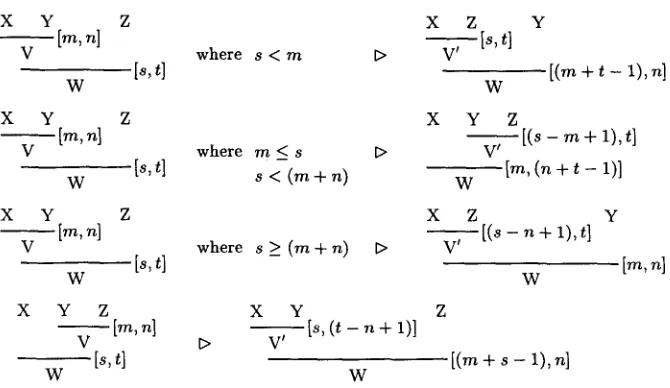
The above normalisation approach is somewhat non- standard. We shall next briefly sketch how normal- isation could instead be handled via the standard method of proof reduction. This method involves defining a contraction relation (t>l) between proofs, which is typically stated as a number of contraction rules of the form X t>l Y, where X is termed a redex and Y its contractum. Each rule allows that a proof containing a redex be transformed into one where that occurrence is replaced by its contractum. A proof is in normal form if] it contains no redexes. T h e contraction relation generates a reduction rela- tion (t>) such that X reduces to Y (X [> Y) if] Y is obtained from X by a finite series (possibly zero) of contractions. A term Y is a normal form of X iff ¥ is a normal form and X [> Y.
x
X
Y Z X Z Y
[m, n] ~ is, t]
V where s < m 1:> V'
[8, t] [ ( m + t - 1), n]
W W
Y z X Y Z
Ira, n] - - [(s - m + 1), t]
V where m _< s I> V'
[s, t] - - Ira, (n + t - 1)]
W s < ( m + n) W
x
X Y Z X Z Y
~ [ m , n ] ~ [ ( s -- n + 1),t]
V where s_> ( r e + n ) D V'
[~,
t] Ira,~]
W w
Y Z X Y Z
Ira, n] - - [ 8 , (t - n +
:)]
V t> V'
- - [s, t] [(m + s - 1), n]
W W
F i g u r e 1: Local R e o r d e r i n g of C o m b i n a t i o n Steps: t h e four cases
d u c t i o n s y s t e m can be shown to e x h i b i t t h e p r o p e r t y
(called strong normalisation) t h a t every r e d u c t i o n is
finite, from which it follows t h a t every p r o o f has a n o r m a l form. 6
8 N o r m a l f o r m p a r s i n g
T h e t e c h n i q u e of n o r m a l form p a r s i n g involves en- suring t h a t only n o r m a l form proofs are c o n s t r u c - t e d b y t h e p a r s e r , avoiding t h e u n n e c e s s a r y w o r k of b u i l d i n g all t h e n o n - n o r m a l form proofs. A t any stage, all s u b p r o o f s so far c o n s t r u c t e d a r e in n o r m a l form, a n d t h e r e s u l t of any c o m b i n a t i o n is a d m i t t e d only p r o v i d e d it is in n o r m a l form, o t h e r w i s e it is d i s c a r d e d . T h e r e s u l t of a c o m b i n a t i o n is recognised as n o n - n o r m a l form if it e s t a b l i s h e s a d e p e n d e n c y t h a t is o u t of o r d e r w i t h r e s p e c t to t h a t of t h e fi- nal c o m b i n a t i o n of a t least one of t h e two s u b p r o o f s c o m b i n e d (which is an a d e q u a t e c r i t e r i o n since t h e s u b p r o o f s are well-ordered). T h e p r o c e d u r e s defined a b o v e can b e used to identify t h e s e d e p e n d e n c i e s .
9 T h e D e g r e e o f I n c r e m e n t a l i t y
Let us n e x t consider t h e degree of i n c r e m e n t a l i t y t h a t t h e a b o v e s y s t e m allows, a n d t h e sense in which
6To prove strong normalisation, it is sufficient to give a metric which assigns to each proof a finite non-negative integer score, and under which every contraction reduces a proof's score by a non-zero amount. The following
metric tt can be shown to suffice: (a) for P = (nIX [a]),
# ( P ) = 0, (b) for P = ( X Y / Z [m,n]), whose final
step establishes a dependency a, # ( P ) = it(X) + ~u(Y) + D, where D is the number of dependencies 5' such t h a t << a', which are established in X and Y, i.e. D = [A] w h e r e A = { 5 ' ] 5 ' e d e p , ( X ) U d e p , ( Y ) A 5 < < 5 ' } .
it m i g h t b e c o n s i d e r e d m a x i m a l . Clearly, t h e s y s t e m does n o t allow full ' w o r d - b y - w o r d ' i n c r e m e n t a l i t y , i.e. where t h e words t h a t have b e e n d e l i v e r e d a t any s t a g e in i n c r e m e n t a l p r o c e s s i n g a r e c o m b i n e d to give a single r e s u l t formula, w i t h c o m b i n a t i o n s t o incor- p o r a t e each new lexical f o r m u l a as it a r r i v e s / For e x a m p l e , in i n c r e m e n t a l p r o c e s s i n g of Today John sang, t h e first two words m i g h t yield (after compil- a t i o n ) t h e f i r s t - o r d e r f o r m u l a e s o - s a n d np, which will n o t c o m b i n e u n d e r t h e rule (8). s
I n s t e a d , t h e a b o v e s y s t e m will allow precisely t h o s e c o m b i n a t i o n s t h a t e s t a b l i s h f u n c t i o n a l rela- tions t h a t are m a r k e d o u t in lexical t y p e s t r u c t u r e (i.e. s u b c a t e g o r i s a t i o n ) , which, given t h e parMlel- ism of s y n t a x a n d s e m a n t i c s , c o r r e s p o n d s to allow- ing t h o s e c o m b i n a t i o n s t h a t e s t a b l i s h s e m a n t i c a l l y relevant f u n c t i o n a l r e l a t i o n s a m o n g s t lexical m e a n - ings. T h u s , we believe t h e a b o v e s y s t e m t o e x h i b i t m a x i m a l i n c r e m e n t a l i t y in r e l a t i o n to allowing 'se- m a n t i c a l l y c o n t e n t f u l ' c o m b i n a t i o n s . I n d e p e n d e n c y t e r m s , t h e s y s t e m allows a n y set of i n i t i a l f o r m u l a e
to c o m b i n e t o a single r e s u l t iff t h e y form a con-
n e c t e d g r a p h u n d e r t h e d e p e n d e n c y r e l a t i o n s t h a t o b t a i n a m o n g s t t h e m .
N o t e t h a t t h e e x t e n t of i n c r e m e n t a l i t y allowed b y using ' g e n e r a l i s e d c o m p o s i t i o n ' in t h e c o m p i l e d first- o r d e r s y s t e m s h o u l d n o t be e q u a t e d w i t h t h a t which
7For an example of a system allowing word-by-word incrementality, see (Milward, 1995).
SNote t h a t this is not to say t h a t the system is un-
able to combine these two types, e.g. a combination
so--s, np =~ s o - ( s o - n p ) is derivable, with appropriate
compilation. The point rather is that such a combina-
tion will typically not happen as a component in a proof
[image:7.612.148.483.46.240.2]would be allowed by such a rule in the original (non- compiled) system. We can illustrate this point using the following type combination, which is not an in- stance of even 'generalised' composition.
X o - ( Y o - Z ) , Yo--W =~ X o - ( W o - Z )
Compilation of the higher-order assumption would yield Xo--Y plus Z, of which the first formula can compose with the second assumption Y o - W to give X o - W , thereby achieving some semantically con- tentful combination of their associated meanings, which would not be allowed by composition over the original formulae. 9
1 0 C o n c l u s i o n
We have shown how the linear categorial deduction method of (Hepple, 1996) can be modified to allow incremental derivation, and specified an incremental normal form for proofs of the system. These results provide for an efficient incremental linear deduction method that can be used with various labelling dis- ciplines as a basis for parsing a range of type-logical formalisms.
R e f e r e n c e s
Jason Eisner 1996. 'Efficient Normal-Form Parsing for Combinatory Categorial Grammar.' Proc. o/ ACL-3~.
Dov M. Gabbay. 1996. Labelled deductive systems. Volume 1. Oxford University Press.
Herman Hendriks. 1992. 'Lambek Semantics: nor- malisation, spurious ambiguity, partial deduction and proof nets', Proc. of Eighth Amsterdam Col-
loquium, ILLI, University of Amsterdam.
Mark Hepple. 1990. 'Normal form theorem proving for the Lambek calculus'. Proc. of COLING-90.
Mark Hepple. 1992. ' Chart Parsing Lambek Gram- mars: Modal Extensions and Incrementality',
Proc. of COLING-92.
Mark Hepple. 1995. 'Mixing Modes of Linguistic Description in Categorial Grammar'. Proceedings
EA CL-7, Dublin.
Mark Hepple. 1996. 'A Compilation-Chart Method for Linear Categorial Deduction'. Proc. of
COLING-96, Copenhagen.
9This combination corresponds to what in a direc- tional system Wittenburg (1987) has termed a 'predict- ive combinator', e.g. such as X/(Y/Z), Y/W =v W/Z. Indeed, the semantic result for the combination in the first-order system corresponds closely to that which would be produced under Wittenburg's rule.
Mark Hepple & Glyn Morrill. 1989. 'Parsing and derivational equivalence.' Proc. of EA CL-4.
Esther KSnig. 1989. 'Parsing as natural deduction'.
Proc. of ACL-2Z
Esther KSnig. 1990. 'The complexity of pars- ing with extended categorial grammars' Proc. of
COLING-90.
Esther KSnig. 1994. 'A Hypothetical Reasoning Al- gorithm for Linguistic Analysis.' Journal of Logic
and Computation, Vol. 4, No 1, ppl-19.
Joachim Lambek. 1958. 'The mathematics of
sentence structure.' American Mathematical
Monthly, 65, pp154-170.
Joachim Lambek. 1961. 'On the calculus of syn- tactic types.' R. Jakobson (Ed), Structure of
Language and its Mathematical Aspects, Proceed-
ings of the Symposia in Applied Mathematics XII, American Mathematical Society.
David Milward. 1995. 'Incremental Interpretation of Categorial Grammar.' Proceedings EACL-7,
Dublin.
Michael Moortgat. 1992. 'Labelled deductive sys- tems for categorial theorem proving'. Proc. of
Eighth Amsterdam Colloquium, ILLI, University
of Amsterdam.
Michael Moortgat & Richard T. Oehrle. 1994. 'Ad- jacency, dependency and order'. Proc. of Ninth
Amsterdam Colloquium.
Michael Moortgat & Glyn Morrill. 1991. 'Heads and Phrases: Type Calculus for Dependency and Constituency.' To appear: Journal of Language, Logic and Information.
Glyn Morrill. 1994. Type Logical Grammar: Cat-
egorial Logic of Signs. Kluwer Academic Publish-
ers, Dordrecht.
Glyn Morrill. 1995. 'Higher-order Linear Logic Programming of Categorial Deduction'. Proc. of
EA CL- 7, Dublin.
Mark J. Steedman. 1989. 'Grammar, interpreta- tion and processing from the lexicon.' In Marslen- Wilson, W. (Ed), Lexical Representation and Pro-
cess, MIT Press, Cambridge, MA.