Name-aware Machine Translation
Haibo Li† Jing Zheng‡ Heng Ji† Qi Li† Wen Wang‡
†Computer Science Department and Linguistics Department Queens College and Graduate Center, City University of New York
New York, NY, USA 10016
{lihaibo.c, hengjicuny, liqiearth}@gmail.com
‡Speech Technology & Research Laboratory SRI International
Menlo Park, CA, USA 94025
{zj, wwang}@speech.sri.com
Abstract
We propose a Name-aware Machine Translation (MT) approach which can tightly integrate name processing into MT model, by jointly annotating parallel cor-pora, extracting name-aware translation grammar and rules, adding name phrase table and name translation driven decod-ing. Additionally, we also propose a new MT metric to appropriately evaluate the translation quality of informative words, by assigning different weights to differ-ent words according to their importance values in a document. Experiments on Chinese-English translation demonstrated the effectiveness of our approach on en-hancing the quality of overall translation, name translation and word alignment over a high-quality MT baseline1.
1 Introduction
A shrinking fraction of the world’s Web pages are written in English, therefore the ability to access pages across a range of languages is becoming in-creasingly important. This need can be addressed in part by cross-lingual information access tasks such as entity linking (McNamee et al., 2011; Cas-sidy et al., 2012), event extraction (Hakkani-Tur et al., 2007), slot filling (Snover et al., 2011) and question answering (Parton et al., 2009; Parton and McKeown, 2010). A key bottleneck of high-quality cross-lingual information access lies in the performance of Machine Translation (MT). Tradi-tional MT approaches focus on the fluency and accuracy of the overall translation but fall short in their ability to translate certain content word-s including critical information, eword-specially nameword-s. 1Some of the resources and open source programs devel-oped in this work are made freely available for research pur-pose at http://nlp.cs.qc.cuny.edu/NAMT.tgz
A typical statistical MT system can only trans-late 60% person names correctly (Ji et al., 2009). Incorrect segmentation and translation of names which often carry central meanings of a sentence can also yield incorrect translation of long con-texts. Names have been largely neglected in the prior MT research due to the following reasons:
• The current dominant automatic MT scoring
metrics (such as Bilingual Evaluation Under-study (BLEU) (Papineni et al., 2002)) treat all words equally, but names have relative low frequency in text (about 6% in newswire and only 3% in web documents) and thus are vast-ly outnumbered by function words and com-mon nouns, etc..
• Name translations pose a greater complexity
because the set of names is open and highly dynamic. It is also important to acknowledge that there are many fundamental differences between the translation of names and other tokens, depending on whether a name is ren-dered phonetically, semantically, or a mixture of both (Ji et al., 2009).
• The artificial settings of assigning low weights to information translation (compared to overall word translation) in some large-scale government evaluations have discour-aged MT developers to spend time and ex-plore resources to tackle this problem. We propose a novel Name-aware MT (NAMT) approach which can tightly integrate name pro-cessing into the training and decoding processes of an end-to-end MT pipeline, and a new name-aware metric to evaluate MT which can assign different weights to different tokens according to their im-portance values in a document. Compared to pre-vious methods, the novel contributions of our ap-proach are:
1. Tightly integrate joint bilingual name tag-ging into MT training by coordinating tagged
names in parallel corpora, updating word seg-mentation, word alignment and grammar ex-traction (Section 3.1).
2. Tightly integrate name tagging and transla-tion into MT decoding via name-aware gram-mar (Section 3.2).
3. Optimize name translation and context trans-lation simultaneously and conduct name translation driven decoding with language model (LM) based selection (Section 3.2). 4. Propose a new MT evaluation metric which
can discriminate names and non-informative words (Section 4).
2 Baseline MT
As our baseline, we apply a high-performing Chinese-English MT system (Zheng, 2008; Zheng et al., 2009) based on hierarchical phrase-based translation framework (Chiang, 2005). It is based on a weighted synchronous context-free grammar (SCFG). All SCFG rules are associated with a set of features that are used to compute derivation probabilities. The features include:
• Relative frequency in two directionsP(γ|α)
andP(α|γ), estimating the likelihoods of one side of the ruler:X →< γ, α >translating
into the other side, whereγ andαare strings
of terminals and non-terminals in the source side and target side. Non-terminals inγ and αare in one-to-one correspondence.
• Lexical weights in two directions: Pw(γ|α) andPw(α|γ), estimating likelihoods of word-s in one word-side of the rule r: X →< γ, α >
translating into the other side (Koehn et al., 2003).
• Phrase penalty: a penalty exp(1) for a rule with no non-terminal being used in deriva-tion.
• Rule penalty: a penalty exp(1) for a rule
with at least one non-terminal being used in derivation.
• Glue rule penalty: a penalty exp(1) if a glue rule used in derivation.
• Translation length: number of words in
trans-lation output.
Our previous work showed that combining mul-tiple LMs trained from different sources can lead to significant improvement. The LM used for de-coding is a log-linear combination of four word n-gram LMs which are built on different English
corpora (details described in section 5.1), with the LM weights optimized on a development set and determined by minimum error rate training (MERT), to estimate the probability of a word giv-en the preceding words. All four LMs were trained using modified Kneser-Ney smoothing algorithm (Chen and Goodman, 1996) and converted into Bloom filter LMs (Talbot and Brants, 2008) sup-porting memory map.
The scaling factors for all features are optimized by minimum error rate training algorithm to max-imize BLEU score (Och, 2003). Given an input sentence in the source language, translation into the target language is cast as a search problem, where the goal is to find the highest-probability derivation that generates the source-side sentence, using the rules in our SCFG. The source-side derivation corresponds to a synchronous side derivation and the terminal yield of this target-side derivation is the output of the system. We em-ploy our CKY-style chart decoder, named SRInter-p, to solve the search problem.
3 Name-aware MT
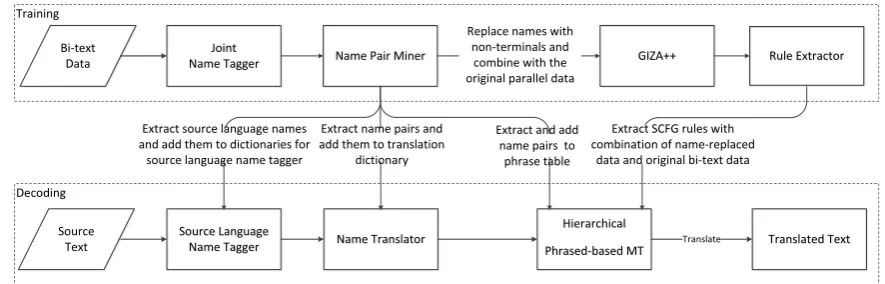
We tightly integrate name processing into the above baseline to construct a NAMT model. Fig-ure 1 depicts the general procedFig-ure.
3.1 Training
join-Decoding
Hierarchical
Phrased-based MT Translate Translated Text Bi-text
Data
Source Text
Joint Name Tagger
Source Language
Name Tagger Name Translator
Training
Name Pair Miner
Extract source language names and add them to dictionaries for
source language name tagger
Extract name pairs and add them to translation
dictionary
Extract and add name pairs to
phrase table
GIZA++ Rule Extractor
Extract SCFG rules with combination of name-replaced
data and original bi-text data Replace names with
[image:3.595.75.518.67.209.2]non-terminals and combine with the original parallel data
Figure 1:Architecture of Name-aware Machine Translation System.
t bilingual name tagger to extract three types of names: (Person (PER), Organization (ORG) and Geo-political entities (GPE)) from both the source side and the target side. We pair two entities from two languages, if they have the same entity type and are mapped together by word alignment. We ignore two kinds of names: multi-word names with conflicting boundaries in two languages and names only identified in one side of a parallel sen-tence.
We built a NAMT system from such name-tagged parallel corpora. First, we replace name-tagged name pairs with their entity types, and then use Giza++ and symmetrization heuristics to re-generate word alignment. Since the name tags ap-pear very frequently, the existence of such tags yields improvement in word alignment quality. The re-aligned parallel corpora are used to train our NAMT system based on SCFG. Since the joint name tagger ensures that each tagged source name has a corresponding translation on the target side (and vice versa), we can extract SCFG rules by treating the tagged names as non-terminals.
However, the original parallel corpora contain many high-frequency names, which can already be handled well by the baseline MT. Some of these names carry special meanings that may influence translations of the neighboring words, and thus re-placing them with non-terminals can lead to infor-mation loss and weaken the translation model. To address this issue, we merged the name-replaced parallel data with the original parallel data and tract grammars from the combined corpus. For ex-ample, given the following sentence pair:
• -ýÍù e¿›Ëe‰åɲ• .
• China appeals to world for non involvement in Angola conflict .
after name tagging it becomes
• GPEÍù e¿›ËeGPE²•.
• GPE appeals to world for non involvement in GPE conflict .
Both sentence pairs are kept in the combined data to build the translation model.
3.2 Decoding
During decoding phase, we extract names with the baseline monolingual name tagger described in (Li et al., 2012) from a source document. It-s performance iIt-s comparable to the beIt-st report-ed results on Chinese name tagging on Automat-ic Content Extraction (ACE) data (Ji and Grish-man, 2006; Florian et al., 2006; Zitouni and Flo-rian, 2008; Nguyen et al., 2010). Then we ap-ply a state-of-the-art name translation system (Ji et al., 2009) to translate names into the target lan-guage. The name translation system is composed of the following steps: (1) Dictionary matching based on 150,041 name translation pairs; (2) Sta-tistical name transliteration based on a structured perceptron model and a character based MT mod-el (Dayne and Shahram, 2007); (3) Context infor-mation extraction based re-ranking.
In our NAMT framework, we add the following extensions to name translation.
name, such as “1‰” which can be translated
ei-ther as “Jolie” or “Zhu Li”.
For those names with fewer than five instances in the training data, we use the name translation system to provide translations; for the rest of the names, we leave them to the baseline MT mod-el to handle. The joint bilingual name tagger was also exploited to mine bilingual name translation pairs from parallel training corpora. The mapping score between a Chinese name and an English name was computed by the number of aligned to-kens. A name pair is extracted if the mapping score is the highest among all combinations and the name types on both sides are identical. It is necessary to incorporate word alignment as addi-tional constraints because the order of names is of-ten changed after translation. Finally, the extract-ed 9,963 unique name translation pairs were also used to create an additional name phrase table for NAMT. Manual evaluation on 2,000 name pairs showed the accuracy is 86%.
The non-terminals in SCFG rules are rewritten to the extracted names during decoding, therefore allow unseen names in the test data to be trans-lated. Finally, based on LMs, our decoder ex-ploits the dynamically created phrase table from name translation, competing with originally ex-tracted rules, to find the best translation for the input sentence.
4 Name-aware MT Evaluation
Traditional MT evaluation metrics such as BLEU (Papineni et al., 2002) and Translation Ed-it Rate (TER) (Snover et al., 2006) assign the same weights to all tokens equally. For exam-ple, incorrect translations of “the” and “Bush” will receive the same penalty. However, for cross-lingual information processing applications, we should acknowledge that certain informationally critical words are more important than other com-mon words. In order to properly evaluate the trans-lation quality of NAMT methods, we propose to modify the BLEU metric so that they can dynam-ically assign more weights to names during evalu-ation.
BLEU considers the correspondence between a system translation and a human translation:
BLEU=BP ·exp
XN
n=1
wnlogpn
(1)
whereBP is brevity penalty defined as follows:
BP=
(
1 ifc > r,
e(1−r/c) ifc≤r. (2)
wherewnis a set of positive weights summing to one and usually uniformly set aswn = 1/N, cis the length of the system translation and r is the
length of reference translation, andpnis modified n-gram precision defined as:
pn=
P C∈Candidates
P
n-gram∈C
Countclip(n-gram) P
C0∈Candidates
P
n-gram0∈C0
Countclip(n-gram0) (3) whereC andC0 are translation candidates in the
candidate sentence set, if a source sentence is translated to many candidate sentences.
As in BLEU metric, we first count the maxi-mum number of times an n-gram occurs in any s-ingle reference translation. The total count of each candidate n-gram is clipped at sentence level by it-s maximum reference count. Then we add up the weights of clipped n-grams and divide them by the total weight of all n-grams.
Based on BLEU score, we design a name-aware BLEU metric as follows. Depending on whether a tokentis contained in a name in reference
trans-lation, we assign a weightweightttotas follows:
weightt= (
1−e−tf(t,d)·idf(t,D), iftnever appears in names
1 +P E
Z , iftoccurs in name(s)
(4)
whereP Eis the sum of penalties of non-name
tokens and Z is the number of tokens within all
names:
P E= X
tnever appears in names
e−tf(t,d)·idf(t,D) (5)
In this paper, thetf·idf score is computed at
sen-tence level, therefore, D is the sentence set and
eachd∈Dis a sentence.
The weight of an n-gram in reference translation is the sum of weights of all tokens it contains.
weightngram= X
t∈ngram
weightt (6)
Next, we compute the weighted modified n-gram precisionCountweight−clip(n-gram) as fol-lows:
Countweight−clip(n-gram) = X
if thengramiis correctly translated
The Countclip(n-gram) in the equation 3 is substituted with aboveCountweight−clip(n-gram). When we sum up the total weight of all n-grams of a candidate translation, some n-grams may contain tokens which do not exist in reference translation. We assign the lowest weight of tokens in reference translation to these rare tokens.
We also add an item, name penalty N P, to
penalize the output sentences which contain too many or too few names:
NP=e−(uv−1)
2
/2σ (8)
whereu is the number of name tokens in system
translation andvis the number of name tokens in
reference translation.
Finally the name-aware BLEU score is defined as:
BLEUNA=BP·N P·exp
XN
n=1
wnlogwpn
(9)
This new metric can also be applied to evalu-ate MT approaches which emphasize other types of facts such as events, by simply replacing name tokens by other fact tokens.
5 Experiments
In this section we present the experimental results of NAMT compared to the baseline MT.
5.1 Data Set
We used a large Chinese-English MT training cor-pus from various sources and genres (including newswire, web text, broadcast news and broadcast conversations) for our experiments. We also used some translation lexicon data and Wikipedia trans-lations. The majority of the data sets were col-lected or made available by LDC for U.S. DARPA Translingual Information Detection, Extraction and Summarization (TIDES) program, Global Au-tonomous Language Exploitation (GALE) pro-gram, Broad Operational Language Translation (BOLT) program and National Institute of Stan-dards and Technology (NIST) MT evaluations. The training corpus includes 1,686,458 sentence pairs. The joint name tagger extracted 1,890,335 name pairs (295,087 Persons, 1,269,056 Geo-political entities and 326,192 Organizations).
Four LMs, denoted LM1, LM2, LM3, and LM4, were trained from different English cor-pora. LM1 is a 7-gram LM trained on the
tar-get side of Chinese-English and Egyptian Arabic-English parallel text, Arabic-English monolingual discus-sion forums data R1-R4 released in BOLT Phase 1 (LDC2012E04, LDC2012E16, LDC2012E21, LDC2012E54), and English Gigaword Fifth Edi-tion (LDC2011T07). LM2 is a 7-gram LM trained only on the English monolingual discussion fo-rums data listed above. LM3 is a 4-gram LM trained on the web genre among the target side of all parallel text (i.e., web text from pre-BOLT parallel text and BOLT released discussion fo-rum parallel text). LM4 is a 4-gram LM trained on the English broadcast news and conversation transcripts released under the DARPA GALE pro-gram. Note that for LM4 training data, some scripts were quick transcripts and quick rich tran-scripts released by LDC, and some were generated by running flexible alignment of closed captions or speech recognition output from LDC on the audio data (Venkataraman et al., 2004).
In order to demonstrate the effectiveness and generality of our approach, we evaluated our ap-proach on seven test sets from multiple genres and domains. We asked four annotators to annotate names in four reference translations of each sen-tence and an expert annotator to adjudicate result-s. The detailed statistics and name distribution of each test data set is shown in Table 1. The per-centage of names occurred fewer than 5 times in training data are listed in the brackets in the last column of the table.
5.2 Overall Performance
Besides the new name-aware MT metric, we also adopt two traditional metrics, TER to evaluate the overall translation performance and Named Entity Weak Accuracy (NEWA) (Hermjakob et al., 2008) to evaluate the name translation performance.
TER measures the amount of edits required to change a system output into one of the reference translations. Specifically:
TER= # of edits
average # of reference words (10) Possible edits include insertion, substitution dele-tion and shifts of words.
The NEWA metric is defined as follows. Us-ing a manually assembled name variant table, we also support the matching of name variants (e.g., “World Health Organization” and “WHO”).
NEWA=Count # of correctly translated names
Corpus Genre Sentence # in sourceWord # in referenceToken # GPE(%) PER(%) ORG(%) (% occurredAll names
[image:6.595.90.508.60.145.2]<5) BOLT 1 forum 1,200 20,968 24,193 875(82.9) 90(8.5) 91(8.6) 1,056 (51.4) BOLT 2 forum 1,283 23,707 25,759 815(73.7) 141(12.8) 149(13.5) 1,105 (65.9) BOLT 3 forum 2,000 38,595 42,519 1,664(80.4) 204(9.8) 204(9.8) 2,072 (47.4) BOLT 4 forum 1,918 41,759 47,755 1,852(80.0) 348(25.0) 113(5.0) 2,313 (53.3) BOLT 5 blog 950 23,930 26,875 352(42.5) 235(28.3) 242(29.2) 829 (55.3) NIST2006 news&blog 1,664 38,442 45,914 1,660(58.2) 568(19.9) 625(21.9) 2,853 (73.1) NIST2008 news&blog 1,357 32,646 37,315 700(47.9) 367(25.1) 395(27.0) 1,462 (72.0)
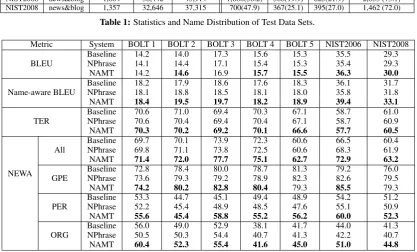
Table 1:Statistics and Name Distribution of Test Data Sets.
Metric System BOLT 1 BOLT 2 BOLT 3 BOLT 4 BOLT 5 NIST2006 NIST2008
BLEU BaselineNPhrase 14.214.1 14.014.4 17.317.1 15.615.4 15.315.3 35.435.5 29.329.3 NAMT 14.2 14.6 16.9 15.7 15.5 36.3 30.0
Name-aware BLEU BaselineNPhrase 18.218.1 17.918.8 18.618.5 17.618.1 18.318.0 35.836.1 31.731.8 NAMT 18.4 19.5 19.7 18.2 18.9 39.4 33.1
TER BaselineNPhrase 70.670.6 71.070.4 69.469.4 70.370.4 67.167.1 58.758.7 61.060.9 NAMT 70.3 70.2 69.2 70.1 66.6 57.7 60.5
NEWA
All BaselineNPhrase 69.769.8 70.171.1 73.973.8 72.372.5 60.660.6 68.366.5 60.461.9 NAMT 71.4 72.0 77.7 75.1 62.7 72.9 63.2
GPE BaselineNPhrase 72.873.6 78.479.3 80.079.2 78.778.9 81.382.3 82.679.2 76.079.5 NAMT 74.2 80.2 82.8 80.4 79.3 85.5 79.3
PER BaselineNPhrase 53.352.2 44.745.4 45.148.9 49.448.5 48.947.6 55.154.2 51.250.9 NAMT 55.6 45.4 58.8 55.2 56.2 60.0 52.3
[image:6.595.91.509.130.382.2]ORG BaselineNPhrase 56.050.5 49.050.3 52.954.4 38.140.7 41.741.3 42.244.0 41.340.7 NAMT 60.4 52.3 55.4 41.6 45.0 51.0 44.8
Table 2:Translation Performance (%).
For better comparison with NAMT, besides the original baseline, we develop the other baseline system by adding name translation table into the phrase table (NPhrase).
Table 2 presents the performance of overal-l transoveral-lation and name transoveral-lation. We can see that except for the BOLT3 data set with BLEU metric, our NAMT approach consistently outper-formed the baseline system for all data sets with all metrics, and provided up to 23.6% relative er-ror reduction on name translation. According to Wilcoxon Matched-Pairs Signed-Ranks Test, the improvement is not significant with BLEU metric, but is significant at 98% confidence level with all of the other metrics. The gains are more signifi-cant for formal genres than informal genres main-ly because most of the training data for name tag-ging and name translation were from newswire. Furthermore, using external name translation table only did not improve translation quality in most test sets except for BOLT2. Therefore, it is im-portant to use name-replaced corpora for rule ex-traction to fully take advantage of improved word alignment.
Many errors from the baseline MT approach
oc-curred because some parts of out-of-vocabulary names were mistakenly segmented into common words. For example, the baseline MT system mis-takenly translated a person name “Y¢÷ (Sun
Honglei)” into “Sun red thunder”. In informal genres such as discussion forums and web blogs, even common names often appear in rare form-s due to miform-sform-spelling or morphing. For example, “e8l(Obama)” was mistakenly translated into
“Ma Olympic”. Such errors can be compounded when word re-ordering was applied. For example, the following sentence: “펎„›ÏØ /:
'J /i y(Guo Meimei’s strength real-ly is formidable, I realreal-ly admire her)” was mis-takenly translated into “Guo the strength of the America and the America also really strong , ah , really admire her” by the baseline MT system because the person name “펎 (Guomeimei)”
was mistakenly segmented into three words “í
(Guo)”, “Ž (the America)” and “Ž (the
B L E U N a m e - a w a r e B L E U
0
2
4
6
8
1 0 1 2 1 4 1 6 1 8 2 0
S
c
o
re
A u t o m a t i c M e t r i c s
H u m . 1 H u m . 2 H u m . 3
0 . 0 0 . 5 1 . 0 1 . 5 2 . 0 2 . 5 3 . 0 3 . 5 4 . 0
b a s e l i n e N A M T
S
c
o
re
[image:7.595.314.520.62.167.2]H u m a n E v a l u a t i o n
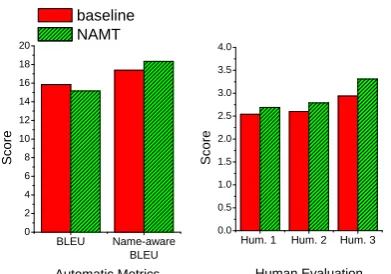
Figure 2: Scores based on Automatic Metrics and Human
Evaluation.
5.3 Name-aware BLEU vs The Human Evaluation
In order to investigate the correlation between name-aware BLEU scores and human judgment results, we asked three bi-lingual speakers to judge our translation output from the baseline system and the NAMT system, on a Chinese subset of 250 sentences (each sentence has two corresponding translations from baseline and NAMT) extracted randomly from 7 test corpora. The annotators rat-ed each translation from 1 (very bad) to 5 (very good) and made their judgments based on whether the translation is understandable and conveys the same meaning.
We computed the name-aware BLEU scores on the subset and also the aggregated average scores from human judgments. Figure 2 shows that NAMT consistently achieved higher scores with both name-aware BLEU metric and human judge-ment. Furthermore, we calculated three Pearson product-moment correlation coefficients between human judgment scores and name-aware BLEU s-cores of these two MT systems. Give the sample size and the correlation coefficient value, the high significance value of 0.99 indicates that name-aware BLEU tracks human judgment well.
5.4 Word Alignment
It is also important to investigate the impact of our NAMT approach on improving word alignmen-t. We conducted the experiment on the Chinese-English Parallel Treebank (Li et al., 2010) with ground-truth word alignment. The detailed pro-cedure following NAMT framework is as follows: (1) Ran the joint bilingual name tagger; (2) Re-placed each name string with its name type (PER, ORG or GPE), and ran Giza++ on the replaced sentences; (3) Ran Giza++ on the words within
Words Method P R F Baseline Giza++ 69.8 47.8 56.7 Joint Name
Tagging
70.4 48.1 57.1 Overall
Words
Ground-truth Name Tagging (Upper-bound)
71.3 48.9 58.0
Baseline Giza++ 86.0 31.4 46.0 Words
Within Names
Joint Name Tagging
[image:7.595.83.279.65.202.2]77.6 37.2 50.3
Table 3: Impact of Joint Bilingual Name Tagging on Word
Alignment (%).
each name pair. (4) Merged (2) and (3) to pro-duce the final word alignment results. In order to compare with the upper-bound gains, we also mea-sured the performance of applying ground-truth name tagging with the above procedures.
The experiment results are shown in Table 3. For the words within names, our approach provid-ed significant gains by enhancing F-measure from 46.0% to 50.3%. Only 10.6% words are within names, therefore the upper-bound gains on over-all word alignment is only 1.3%. Our joint name tagging approach achieved 0.4% (statistically sig-nificant) improvement over the baseline. In Fig-ure 3 we categorized the sentences according to the percentage of name words in each sentence and measured the improvement for each category. We can clearly see that as the sentences include more names, the gains achieved by our approach tend to be greater.
5.5 Remaining Error Analysis
Although the proposed model has significantly en-hanced translation quality, some challenges main. We analyze some major sources of the re-maining errors as follows.
1. Name Structure Parsing.
We found that the gains of our NAMT approach were mainly achieved for names with one or two components. When the name structure becomes too complicated to parse, name tagging and name translation are likely to produce errors, especially for long nested organizations. For example, “ä0
¿ÀßbÍ @” (Anti-malfeasance Bureau of
Gutian County Procuratorate) consists of a nested organization name with a GPE as modifier: “ä
0¿Àßb” (Gutian County Procuratorate) and
an ORG name: “Í @” (Anti-malfeasance
Bu-reau).
0~10 10~20 20~30 30~40 >40 -0.5
0.0 0.5 1.0 1.5 2.0 2.5 3.0 3.5 4.0 4.5 5.0 5.5
F-Measure Gains in Overall Word Alignment (%)
#name tokens/#all tokens(%) Baseline Giza++
Joint Name Tagging
[image:8.595.77.284.62.217.2]Ground-truth Name Tagging (Upper-bound)
Figure 3:Word alignment gains according to the percentage
of name words in each sentence.
not incorporated any coreference resolution tech-niques. For example, without knowing that “FAW” refers to “First Automotive Works” in “FAW has also utilized the capital market to directly fi-nance, and now owns three domestic listed compa-nies”, our system mistakenly labeled it as a GPE. The same challenge exists in name alignment and translation (for example, “ i(Min Ge)”
refer-s to “-ýý Zi}ÔX ” (Revolutionary
Committee of the Chinese Kuomintang). 3. Cross-lingual information transfer
English monolingual features normally gener-ate higher confidence than Chinese features for ORG names. On the other hand, some good prop-agated Chinese features were not able to correct English results. For example, in the following sen-tence pair: “9n-ý ŒT ý¾ r ¹¾ „... (in accordance with the tripartite
a-greement reached by China, Laos and the UNHCR on)...”, even though the tagger can successfully la-bel “T ý¾ r/UNHCR” as an organization
because it is a common Chinese name, English features based on previous GPE contexts still in-correctly predicted “UNHCR” as a GPE name.
6 Related Work
Two types of humble strategies were previously attempted to build name translation components which operate in tandem and loosely integrate into conventional statistical MT systems:
1. Pre-processing: identify names in the source texts and propose name translations to the MT system; the name translation results can be simply but aggressively transferred from the source to the target side using word align-ment, or added into phrase table in order to
enable the LM to decide which translations to choose when encountering the names in the texts (Ji et al., 2009). Heuristic rules or su-pervised models can be developed to create “do-not-translate” list (Babych and Hartley, 2003) or learn “when-to-transliterate” (Her-mjakob et al., 2008).
2. Post-processing: in a cross-lingual informa-tion retrieval or quesinforma-tion answering frame-work, online query names can be utilized to obtain translation and post-edit MT out-put (Parton et al., 2009; Ma and McKeown, 2009; Parton and McKeown, 2010; Parton et al., 2012).
It is challenging to decide when to use name translation results. The simple transfer method en-sures all name translations appear in the MT out-put, but it heavily relies on word alignment and does not take into account word re-ordering or the words found in a name’s context; therefore it could mistakenly break some context phrase struc-tures due to name translation or alignment errors. The LM selection method often assigns an inap-propriate weight to the additional name transla-tion table because it is constructed independent-ly from translation of context words; therefore af-ter weighted voting most correct name translations are not used in the final translation output. Our experimental results 2 confirmed this weakness. More importantly, in these approaches the MT model was still mostly treated as a “black-box” because neither the translation model nor the LM was updated or adapted specifically for names.
Recently the wider idea of incorporating seman-tics into MT has received increased interests. Most of them designed some certain semantic represen-tations, such as predicate-argument structure or semantic role labeling (Wu and Fung, 2009; Liu and Gildea, 2009; Meyer et al., 2011; Bojar and Wu, 2012), word sense disambiguation (Carpu-at and Wu, 2007b; Carpu(Carpu-at and Wu, 2007a) and graph-structured grammar representation (Jones et al., 2012). Lo et al. (2012) proposed a semantic role driven MT metric. However, none of these work declaratively exploited results from informa-tion extracinforma-tion for MT.
name tagging on overall word alignment.
Most of the previous name translation work combined supervised transliteration approaches with LM based re-scoring (Knight and Graehl, 1998; Al-Onaizan and Knight, 2002; Huang et al., 2004). Some recent research used compara-ble corpora to mine name translation pairs (Feng et al., 2004; Kutsumi et al., 2004; Udupa et al., 2009; Ji, 2009; Fung and Yee, 1998; Rapp, 1999; Shao and Ng, 2004; Lu and Zhao, 2006; Hassan et al., 2007). However, most of these approaches required large amount of seeds, suffered from In-formation Extraction errors, and relied on phonet-ic similarity, context co-occurrence and documen-t similaridocumen-ty for re-scoring. In condocumen-trasdocumen-t, our name pair mining approach described in this paper does not require any machine translation or translitera-tion features.
7 Conclusions and Future Work
We developed a name-aware MT framework which tightly integrates name tagging and name translation into training and decoding of MT. Ex-periments on Chinese-English translation demon-strated the effectiveness of our approach over a high-quality MT baseline in both overall transla-tion and name translatransla-tion, especially for formal genres. We also proposed a new name-aware eval-uation metric. In the future we intend to improve the framework by training a discriminative model to automatically assign weights to combine name translation and baseline translation with additional features including name confidence values, name types and global validation evidence, as well as conducting LM adaptation through bilingual top-ic modeling and clustering based on name anno-tations. We also plan to jointly optimize MT and name tagging by propagating multiple word seg-mentation and name annotation hypotheses in lat-tice structure to statistical MT and conduct latlat-tice- lattice-based decoding (Dyer et al., 2008). Furthermore, we are interested in extending this framework to translate other out-of-vocabulary terms.
Acknowledgement
This work was supported by the U.S. Army Re-search Laboratory under Cooperative Agreement No. W911NF- 09-2-0053 (CTA), the U.S. NS-F CAREER Award under Grant IIS-0953149, the U.S. NSF EAGER Award under Grant No. IIS1144111, the U.S. DARPA FA87501320041
-Deep Exploration and Filtering of Text (DEFT) Program and CUNY Junior Faculty Award. The views and conclusions contained in this documen-t are documen-those of documen-the audocumen-thors and should nodocumen-t be in-terpreted as representing the official policies, ei-ther expressed or implied, of the U.S. Govern-ment. The U.S. Government is authorized to re-produce and distribute reprints for Governmen-t purposes noGovernmen-twiGovernmen-thsGovernmen-tanding any copyrighGovernmen-t noGovernmen-taGovernmen-tion here on. We express our gratitude to Bing Zhao who provided the test sets and references that were used for Broad Operational Language Translation (BOLT) evaluation and thanks to Taylor Cassidy for constructive comments.
References
Y. Al-Onaizan and K. Knight. 2002. Translating Named Entities Using Monolingual and Bilingual Resources. InProceeding ACL’02, pages 400–408.
N. Aswani and R. Gaizauskas. 2005. A Hybrid Ap-proach to Align Sentences and Words in English-Hindi Parallel Corpora. In Proceeding ACL’05 Workshop on Building and Using Parallel Texts, pages 57–64.
Bogdan Babych and Anthony Hartley. 2003. Im-proving Machine Translation Quality with Automat-ic Named Entity Recognition. InProceeding EAMT ’03 workshop on MT and other Language Technol-ogy Tools, Improving MT through other Language Technology Tools: Resources and Tools for Building MT, pages 1–8.
O. Bojar and D. Wu. 2012. Towards a Predicate-Argument evaluation for MT. InProceeding of the Sixth Workshop on Syntax, Semantics and Structure in Statistical Translation, pages 30–38, July.
Marine Carpuat and Dekai Wu. 2007a. How Phrase Sense Disambiguation outperforms Word Sense Dis-ambiguation for Statistical Machine Translation. In Proceeding TMI’07, pages 43–52.
Marine Carpuat and Dekai Wu. 2007b. Improving Sta-tistical Machine Translation using Word Sense Dis-ambiguation. In Proceeding EMNLP-CoNLL’07, pages 61–72.
Taylor Cassidy, Heng Ji, Hongbo Deng, Jing Zheng, and Jiawei Han. 2012. Analysis and Refinement of Cross-lingual Entity Linking. In Proceeding CLE-F’12, pages 1–12.
David Chiang. 2005. A Hierarchical Phrase-based Model for Statistical Machine Translation. In Pro-ceeding ACL’05, pages 263–270.
F. Dayne and K. Shahram. 2007. A Sequence Align-ment Model Based on the Averaged Perceptron. In Proceeding EMNLP-CoNLL’07, pages 238–247.
C. Dyer, S. Muresan, and P. Resnik. 2008. Generaliz-ing Word Lattice Translation. InProceeding ACL-HLT’08, pages 1012–1020.
D. Feng, Y. Lv, and M. Zhou. 2004. A New Approach for English-Chinese Named Entity Alignment. In Proceeding PACLIC’04, pages 372–379.
R. Florian, H. Jing, N. Kambhatla, and I. Zitouni. 2006. Factorizing Complex Models: A Case S-tudy in Mention Detection. InProceeding COLING-ACL’06, pages 473–480.
P. Fung and L. Y. Yee. 1998. An IR Approach for Translating New Words from Nonparallel and Com-parable Texts. In Proceeding COLING-ACL’98, pages 414–420.
D. Hakkani-Tur, H. Ji, and R. Grishman. 2007. Us-ing Information Extraction to Improve Cross-lUs-ingual Document Retrieval. In Proceeding RANLP Work-shop on Multi-source, Multilingual Information Ex-traction and Summarization, pages 17–23.
A. Hassan, H. Fahmy, and H. Hassan. 2007. Im-proving Named Entity Translation by Exploiting Comparable and Parallel Corpora. In Proceeding RANLP’07, pages 1–6.
U. Hermjakob, K. Knight, and H. Daume III. 2008. Name Translation in Statistical Machine Transla-tion: Learning When to Transliterate. InProceeding ACL’08, pages 389–397.
F. Huang, S. Vogel, and A. Waibel. 2004. Im-proving Named Entity Translation Combining Pho-netic and Semantic Similarities. In Proceeding HLT/NAACL’04, pages 281–288.
H. Ji and R. Grishman. 2006. Analysis and Repair of Name Tagger Errors. In Proceeding COLING-ACL’06, pages 420–427.
H. Ji, R. Grishman, D. Freitag, M. Blume, J. Wang, S. Khadivi, R. Zens, and H. Ney. 2009. Name Extraction and Translation for Distillation. Hand-book of Natural Language Processing and Machine Translation: DARPA Global Autonomous Language Exploitation.
H. Ji. 2009. Mining Name Translations from Com-parable Corpora by Creating Bilingual Information Networks. In Proceeding ACL-IJCNLP’09 work-shop on Building and Using Comparable Corpora, pages 34–37.
B. Jones, J. Andreas, D. Bauer, K. M. Hermann, and K. Knight. 2012. Semantics-Based Machine Trans-lation with Hyperedge Replacement Grammars. In Proceeding COLING’12, pages 1359–1376.
K. Knight and J. Graehl. 1998. Machine Translit-eration. InComputational Linguistics, volume 24, pages 599–612, Cambridge, MA, USA, December. MIT Press.
P. Koehn, F. Josef Och, and D. Marcu. 2003. Statis-tical Phrase-Based Translation. InProceeding HLT-NAACL’03, pages 127–133.
T. Kutsumi, T. Yoshimi, K. Kotani, and I. Sata. 2004. Integrated Use of Internal and External Evidence in The Alignment of Multi-Word Named Entities. In Proceeding PACLIC’04, pages 187–196.
X. Li, S. Strassel, S. Grimes, S. Ismael, X. Ma, N. Ge, A. Bies, N. Xue, and M. Maamouri. 2010. Parallel Aligned Treebank Corpora at LDC: Methodology, Annotation and Integration. InWorkshop on Anno-tation and ExploiAnno-tation of Parallel Corpora (AEPC).
Q. Li, H. Li, H. Ji, W. Wang, J. Zheng, and F. Huang. 2012. Joint Bilingual Name Tagging for Parallel Corpora. In Proceeding CIKM’12, pages 1727– 1731.
D. Liu and D. Gildea. 2009. Semantic Role Fea-tures for Machine Translation. InProceeding COL-ING’09, pages 716–724.
C. Lo, A. K. Tumuluru, and D. Wu. 2012. Fully Au-tomatic Semantic MT Evaluation. InProceeding of the Seventh Workshop on Statistical Machine Trans-lation, pages 243–252.
M. Lu and J. Zhao. 2006. Multi-feature based Chinese-English Named Entity Extraction from Comparable Corpora. In Proceeding PACLIC’06, pages 134–141.
W. Ma and K. McKeown. 2009. Where’s the Ver-b Correcting Machine Translation During Question Answering. InProceeding ACL-IJCNLP’09, pages 333–336.
P. McNamee, J. Mayfield, D. Lawrie, D. W. Oard, and D. Doermann. 2011. Cross-Language Entity Link-ing. InProceeding IJCNLP’11.
A. Meyer, M. Kosaka, S. Liao, and N. Xue. 2011. Im-proving MT Word Alignment Using Aligned Multi-Stage Parses. InProceeding ACL-HLT 2011 Work-shop on Syntax, Semantics and Structure in Statisti-cal Translation, pages 88–97.
T. T. Nguyen, A. Moschitti, and G. Riccardi. 2010. Kernel-based Reranking for Named-Entity Extrac-tion. InProceeding COLING’10, pages 901–909.
F. J. Och. 2003. Minimum Error Rate Training in Statistical Machine Translation. InProceeding A-CL’03, pages 160–167.
K. Papineni, S. Roukos, T. Ward, and W. Zhu. 2002. BLEU: a Method for Automatic Evaluation of Ma-chine Translation. In Proceeding ACL’02, pages 311–318.
K. Parton and K. McKeown. 2010. MT Error Detec-tion for Cross-Lingual QuesDetec-tion Answering. Pro-ceeding COLING’10, pages 946–954.
K. Parton, K. R. McKeown, R. Coyne, M. T. Dia-b, R. Grishman, D. Hakkani-Tur, M. Harper, H. Ji, W. Y. Ma, A. Meyers, S. Stolbach, A. Sun, G. Tur, W. Xu, and S. Yaman. 2009. Who, What, When, Where, Why? Comparing Multiple Approaches to the Cross-Lingual 5W Task. In Proceeding ACL-IJCNLP’09, pages 423–431.
K. Parton, N. Habash, K. McKeown, G. Iglesias, and A. de Gispert. 2012. Can Automatic Post-Editing Make MT More Meaningful? InProceeding EAMT’12, pages 111–118.
R. Rapp. 1999. Automatic Identification of Word Translations from Unrelated English and German Corpora. InProceeding ACL’99, pages 519–526.
L. Shao and H. T. Ng. 2004. Mining New Word Trans-lations from Comparable Corpora. In Proceeding COLING’04.
M. Snover, B. Dorr, R. Schwartz, L. Micciulla, and J. Makhoul. 2006. A Study of Translation Edit Rate with Targeted Human Annotation. InProceeding of Association for Machine Translation in the Americ-as, pages 223–231.
M. Snover, X. Li, W. Lin, Z. Chen, S. Tamang, M. Ge, A. Lee, Q. Li, H. Li, S. Anzaroot, and H. Ji. 2011. Cross-lingual Slot Filling from Comparable Corpo-ra. InProceeding ACL’11 Worshop on Building and Using Comparable Corpora, pages 110–119.
D. Talbot and T. Brants. 2008. Randomized Language Models via Perfect Hash Functions. InProceeding of ACL/HLT’08, pages 505–513.
R. Udupa, K. Saravanan, A. Kumaran, and J. Jagarla-mudi. 2009. MINT: A Method for Effective and Scalable Mining of Named Entity Transliterations from Large Comparable Corpora. In Proceeding EACL’09, pages 799–807.
A. Venkataraman, A. Stolcke, W. Wang, D. Vergyri, V. R. R. Gadde, and J. Zheng. 2004. An Efficient Repair Procedure For Quick Transcriptions. In Pro-ceeding INTERSPEECH’04, pages 1961–1964.
D. Wu and P. Fung. 2009. Semantic Roles for SMT: A Hybrid Two-Pass Model. InNAACL HLT’09, pages 13–16.
R. Zens, O. Bender, S. Hasan, S. Khadivi, E. Matusov, J. Xu, Y. Zhang, and H. Ney. 2005. The RWTH Phrase-based Statistical Machine Translation Sys-tem. InProceeding IWSLT’05, pages 155–162.
J. Zheng, N. F. Ayan, W. Wang, and D. Burkett. 2009. Using Syntax in Large-Scale Audio Doc-ument Translation. In Proceeding Interspeech’09, pages 440–443.
J. Zheng. 2008. SRInterp: SRI’s Scalable Multipur-pose SMT Engine. InTechnical Report.