Sentiment Relevance
Christian Scheible
Institute for Natural Language Processing University of Stuttgart, Germany
Hinrich Sch¨utze
Center for Information and Language Processing University of Munich, Germany
Abstract
A number of different notions, including subjectivity, have been proposed for dis-tinguishing parts of documents that con-vey sentiment from those that do not. We propose a new concept, sentiment rele-vance, to make this distinction and argue that it better reflects the requirements of sentiment analysis systems. We demon-strate experimentally that sentiment rele-vance and subjectivity are related, but dif-ferent. Since no large amount of labeled training data for our new notion of sen-timent relevance is available, we investi-gate two semi-supervised methods for cre-ating sentiment relevance classifiers: a dis-tant supervision approach that leverages structured information about the domain of the reviews; and transfer learning on feature representations based on lexical taxonomies that enables knowledge trans-fer. We show that both methods learn sen-timent relevance classifiers that perform well.
1 Introduction
It is generally recognized in sentiment analy-sis that only a subset of the content of a doc-ument contributes to the sentiment it conveys. For this reason, some authors distinguish the categories subjective and objective (Wilson and Wiebe, 2003). Subjective statements refer to the internal state of mind of a person, which cannot be observed. In contrast, objective statements can be verified by observing and checking reality. Some sentiment analysis systems filter out objective lan-guage and predict sentiment based on subjective language only because objective statements do not directly reveal sentiment.
Even though the categories subjective/objective are well-established in philosophy, we argue that
they are not optimal for sentiment analysis. We in-stead introduce the notion ofsentiment relevance (S-relevance orSR for short). A sentence or lin-guistic expression is S-relevant if it contains infor-mation about the sentiment the document conveys; it isS-nonrelevant(SNR) otherwise.
Ideally, we would like to have at our disposal a large annotated training set for our new con-cept of sentiment relevance. However, such a resource does not yet exist. For this reason, we investigate two semi-supervised approaches to relevance classification that do not require S-relevance-labeled data. The first approach is dis-tant supervision (DS). We create an initial label-ing based on domain-specific metadata that we ex-tract from a public database and show that this improves performance by 5.8%F1 compared to a baseline. The second approach is transfer learning (TL) (Thrun, 1996). We show that TL improves
F1by 12.6% for sentiment relevance classification when we use a feature representation based on lex-ical taxonomies that supports knowledge transfer.
In our approach, we classify sentences as S-(non)relevant because this is the most fine-grained level at which S-relevance manifests itself; at the word or phrase level, S-relevance classification is not possible because of scope and context ef-fects. However, S-relevance is also a discourse phenomenon: authors tend to structure documents into S-relevant passages and S-nonrelevant pas-sages. To impose this discourse constraint, we em-ploy a sequence model. We represent each docu-ment as a graph of sentences and apply a minimum cut method.
The rest of the paper is structured as follows. Section 2 introduces the concept of sentiment rel-evance and relates it to subjectivity. In Section 3, we review previous work related to sentiment rel-evance. Next, we describe the methods applied in this paper (Section 4) and the features we extract (Section 5). Finally, we turn to the description and
results of our experiments on distant supervision (Section 6) and transfer learning (Section 7). We end with a conclusion in Section 8.
2 Sentiment Relevance
Sentiment Relevance is a concept to distinguish content informative for determining the sentiment of a document from uninformative content. This is in contrast to the usual distinction between sub-jective and obsub-jective content. Although there is overlap between the two notions, they are differ-ent. Consider the following examples for subjec-tive and objecsubjec-tive sentences:
(1) Subjective example: Bruce Banner, a genet-ics researcher with a tragic past, suffers a horrible accident.
(2) Objective example: The movie won a Golden Globe for best foreign film and an Oscar.
Sentence (1) is subjective because assessments like tragic pastandhorrible accident are subjec-tive to the reader and writer. Sentence (2) is objec-tive since we can check the truth of the statement. However, even though sentence (1) has negative subjective content, it is not S-relevant because it is about the plot of the movie and can appear in a glowingly positive review. Conversely, sentence (2) contributes to the positive opinion expressed by the author. Subjectivity and S-relevance are two distinct concepts that do not imply each other: Generally neutral and objective sentences can be relevant while certain subjective content is S-nonrelevant. Below, we first describe the annota-tion procedure for the sentiment relevance corpus and then demonstrate empirically that subjectivity and S-relevance differ.
2.1 Sentiment Relevance Corpus
For our initial experiments, we focus on senti-ment relevance classification in the movie domain. To create a sentiment-relevance-annotated corpus, the SR corpus, we randomly selected 125 docu-ments from the movie review data set (Pang et al., 2002).1 Two annotators annotated the sentences
for S-relevance, using the labelsSRandSNR. If no decision can be made because a sentence contains both S-relevant and S-nonrelevant linguistic ma-terial, it is marked asuncertain. We excluded 360 sentences that were labeled uncertain from the
1We used the texts from the raw HTML files since the
processed version does not have capitalization.
evaluation. In total, the SR corpus contains 2759 S-relevant and 728 S-nonrelevant sentences. Fig-ure 1 shows an excerpt from the corpus. The full corpus is available online.2
First, we study agreement between human an-notators. We had 762 sentences annotated for S-relevance by both annotators with an agreement (Fleiss’ κ) of .69. In addition, we obtained
sub-jectivity annotations for the same data on Amazon Mechanical Turk, obtaining each label through a vote of three, with an agreement ofκ=.61.
How-ever, the agreement of the subjectivity and rele-vance labelings after voting, assuming that sub-jectivity equals relevance, is only at κ = .48.
This suggests that there is indeed a measurable difference between subjectivity and relevance. An annotator who we asked to examine the 225 ex-amples where the annotations disagree found that 83.5% of these cases are true differences.
2.2 Contrastive Classification Experiment
We will now examine the similarities of S-relevance and an existing subjectivity dataset. Pang and Lee (2004) introduced subjectivity data (henceforth P&L corpus) that consists of 5000 highly subjective (quote) review snippets from rot-tentomatoes.com and 5000 objective (plot) sen-tences from IMDb plot descriptions.
We now show that although the P&L selection criteria (quotes, plot) bear resemblance to the def-inition of S-relevance, the two concepts are differ-ent.
We use quote as S-relevant and plot as S-nonrelevant data in TL. We divide both the SR and P&L corpora into training (50%) and test sets (50%) and train a Maximum Entropy (MaxEnt) classifier (Manning and Klein, 2003) with bag-of-word features. Macro-averaged F1 for the four possible training-test combinations is shown in Ta-ble 1. The results clearly show that the classes defined by the two labeled sets are different. A classifier trained on P&L performs worse by about 8% on SR than a classifier trained on SR (68.5 vs. 76.4). A classifier trained on SR performs worse by more than 20% on P&L than a classifier trained on P&L (67.4 vs. 89.7).
Note that the classes are not balanced in the S-relevance data while they are balanced in the subjectivity data. This can cause a misestimation
2http://www.ims.uni-stuttgart.
O SNR Braxton is a gambling addict in deep to Mook (Ellen Burstyn), a local bookie.
S SNR Kennesaw is bitter about his marriage to a socialite (Rosanna Arquette), believing his wife to be unfaithful.
S SR The plot is twisty and complex, with lots of lengthy flashbacks, and plenty of surprises.
S SR However, there are times when it is needlessly complex, and at least one instance the storytelling turns so muddled that the answers to important plot points actually get lost.
[image:3.595.123.243.233.284.2]S SR Take a look at L. A. Confidential, or the film’s more likely inspiration, The Usual Suspects for how a complex plot can properly be handled.
Figure 1: Example data from the SR corpus with subjectivity (S/O) and S-relevance (SR/SNR) annota-tions
test P&L SR
tr
ain P&L 89.7 68.5 SR 67.4 76.4
Table 1: TL/in-taskF1 for P&L and SR corpora
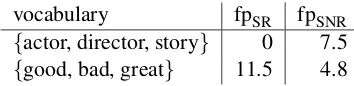
vocabulary fpSR fpSNR
{actor, director, story} 0 7.5 {good, bad, great} 11.5 4.8 Table 2: % incorrect sentences containing specific words
of class probabilities and lead to the experienced performance drops. Indeed, if we either balance the S-relevance data or unbalance the subjectivity data, we can significantly increase F1 to 74.8% and 77.9%, respectively, in the noisy label trans-fer setting. Note however that this step is difficult in practical applications if the actual label distri-bution is unknown. Also, in a real practical ap-plication the distribution of the data is what it is – it cannot be adjusted to the training set. We will show in Section 7 that using an unsupervised se-quence model is superior to artificial manipulation of class-imbalances.
An error analysis for the classifier trained on P&L shows that many sentences misclassified as S-relevant (fpSR) contain polar words; for
exam-ple,Then, the situation turns bad. In contrast, sen-tences misclassified as S-nonrelevant (fpSNR)
con-tain named entities or plot and movie business vo-cabulary; for example,Tim Roth delivers the most impressive acting job by getting the body language right.
The word count statistics in Table 2 show this for three polar words and for three plot/movie business words. The P&L-trained classifier seems to have a strong bias to classify sentences with
po-lar words as S-relevant even if they are not, per-haps because most training instances for the cat-egory quote are highly subjective, so that there is insufficient representation of less emphatic S-relevant sentences. These snippets rarely con-tain plot/movie-business words, so that the P&L-trained classifier assigns almost all sentences with such words to the category S-nonrelevant.
3 Related Work
Many publications have addressed subjectivity in sentiment analysis. Two important papers that are based on the original philosophical definition of the term (internal state of mind vs. external real-ity) are (Wilson and Wiebe, 2003) and (Riloff and Wiebe, 2003). As we argue above, if the goal is to identify parts of a document that are useful/non-useful for sentiment analysis, then S-relevance is a better notion to use.
Researchers have implicitly deviated from the philosophical definition because they were primar-ily interested in satisfying the needs of a particular task. For example, Pang and Lee (2004) use a min-imum cut graph model for review summarization. Because they do not directly evaluate the results of subjectivity classification, it is not clear to what extent their method is able to identify subjectivity correctly.
In general, it is not possible to know what the underlying concepts of a statistical classification are if no detailed annotation guidelines exist and no direct evaluation of manually labeled data is performed.
[image:3.595.91.268.316.359.2]to show that this scheme is different. In addi-tion, they work on the paragraph level. How-ever, paragraphs often contain a mix of S-relevant and S-nonrelevant sentences. We use the mini-mum cut method and are therefore able to incorpo-rate discourse-level constraints in a more flexible fashion, giving preference to “relevance-uniform” paragraphs without mandating them.
T¨ackstr¨om and McDonald (2011) develop a fine-grained annotation scheme that includes S-nonrelevance as one of five categories. However, they do not use the category S-nonrelevance di-rectly in their experiments and do not evaluate classification accuracy for it. We do not use their data set as it would cause domain mismatch be-tween the product reviews they use and the avail-able movie review subjectivity data (Pang and Lee, 2004) in the TL approach. Changing both the do-main (movies to products) and the task (subjectiv-ity to S-relevance) would give rise to interactions that we would like to avoid in our study.
The notion of annotator rationales (Zaidan et al., 2007) has some overlap with our notion of sentiment relevance. Yessenalina et al. (2010) use rationales in a multi-level model to integrate sentence-level information into a document classi-fier. Neither paper presents a direct gold standard evaluation of the accuracy of rationale detection.
In summary, no direct evaluation of sentiment relevance has been performed previously. One contribution in this paper is that we provide a single-domain gold standard for sentiment rele-vance, created based on clear annotation guide-lines, and use it for direct evaluation.
Sentiment relevance is also related to review mining (e.g., (Ding et al., 2008)) and sentiment retrieval techniques (e.g., (Eguchi and Lavrenko, 2006)) in that they aim to find phrases, sentences or snippets that are relevant for sentiment, either with respect to certain features or with a focus on high-precision retrieval (cf. (Liu, 2010)). How-ever, finding a few S-relevant items with high pre-cision is much easier than the task we address: ex-haustive classification of all sentences.
Another contribution is that we show that gen-eralization based on semantic classes improves S-relevance classification. While previous work has shown the utility of other types of feature gen-eralization for sentiment and subjectivity analysis (e.g., syntax and part-of-speech (Riloff and Wiebe, 2003)), semantic classes have so far not been
ex-ploited.
Named-entity features in movie reviews were first used by Zhuang et al. (2006), in the form of feature-opinion pairs (e.g., a positive opinion about the acting). They show that recognizing plot elements (e.g., script) and classes of people (e.g., actor) benefits review summarization. We follow their approach by using IMDb to define named entity features. We extend their work by intro-ducing methods for labeling partial uses of names and pronominal references. We address a different problem (S-relevance vs. opinions) and use differ-ent methods (graph-based and statistical vs. rule-based).
T¨ackstr¨om and McDonald (2011) also solve a similar sequence problem by applying a distantly supervised classifier with an unsupervised hidden sequence component. Their setup differs from ours as our focus lies on pattern-based distant su-pervision instead of distant susu-pervision using doc-uments for sentence classification.
Transfer learning has been applied previously in sentiment analysis (Tan and Cheng, 2009), target-ing polarity detection.
4 Methods
Due to the sequential properties of S-relevance (cf. Taboada et al. (2009)), we impose the discourse constraint that an S-relevant (resp. S-nonrelevant) sentence tends to follow an relevant (resp. S-nonrelevant) sentence. Following Pang and Lee (2004), we use minimum cut (MinCut) to formal-ize this discourse constraint.
For a document with n sentences, we create a
graph with n+ 2 nodes: n sentence nodes and
source and sink nodes. We define source and sink to represent the classes relevance and S-nonrelevance, respectively, and refer to them as SR and SNR.
The individual weight ind(s, x)between a sen-tencesand the source/sink nodex ∈ {SR,SNR}
is weighted according to some confidence mea-sure for assigning it to the corresponding class. The weight on the edge from the document’s
ith sentence si to its jth sentence sj is set to
assoc(si, sj) = c/(j −i)2 where cis a
se-quence. As a result, outliers with low confidence are eliminated and we get a “smoother” label se-quence.
To compute minimum cuts, we use the push-relabel maximum flow method (Cherkassky and Goldberg, 1995).3
We need to find values for multiple free param-eters related to the sequence model. Supervised optimization is impossible as we do not have any labeled data. We therefore resort to a proxy mea-sure, the run count. A run is a sequence of sen-tences with the same label. We set each param-eter p to the value that produces a median run
count that is closest to the true median run count (or, in case of a tie, closest to the true mean run count). We assume that the optimal median/mean run count is known. In practice, it can be estimated from a small number of documents. We find the optimal value ofpby grid search.
5 Features
Choosing features is crucial in situations where no high-quality training data is available. We are interested in features that are robust and support generalization. We propose two linguistic feature types for S-relevance classification that meet these requirements.
5.1 Generalization through Semantic Features
Distant supervision and transfer learning are set-tings where exact training data is unavailable. We therefore introduce generalization features which are more likely to support knowledge transfer. To generalize over concepts, we use knowledge from taxonomies. A set of generalizations can be in-duced by making a cut in the taxonomy and defin-ing the concepts there as base classes. For nouns, the taxonomy is WordNet (Miller, 1995) for which CoreLex (Buitelaar, 1998) gives a set of basic types. For verbs, VerbNet (Kipper et al., 2008) already contains base classes.
We add for each verb in VerbNet and for each noun in CoreLex its base class or basic type as an additional feature where words tagged by the mate tagger (Bohnet, 2010) asNN.*are treated as nouns and words tagged asVB.*as verbs. For ex-ample, the verbsuggestoccurs in the VerbNet base classsay, so we add a featureVN:sayto the
fea-3using the HIPR tool (www.avglab.com/andrew/
soft.html)
ture representation. We refer to these feature sets asCoreLex(CX) andVerbNet(VN) features and to their combination assemantic features(SEM).
5.2 Named Entities
As standard named entity recognition (NER) sys-tems do not capture categories that are relevant to the movie domain, we opt for a lexicon-based ap-proach similar to (Zhuang et al., 2006). We use the IMDb movie metadata database4 from which
we extract names for the categories <ACTOR>,
<PERSONNEL> (directors, screenwriters, and composers), and<CHARACTER> (movie charac-ters). Many entries are unsuitable for NER, e.g., dog is frequently listed as a character. We filter out all words that also appear in lower case in a list of English words extracted from the dict.cc dictio-nary.5
A name ncan be ambiguous between the
cat-egories (e.g., John Williams). We disambiguate by calculating the maximum likelihood estimate of p(c|n) = Pf(n,c)
c0f(n,c0) where c is one of the
three categories andf(n, c)is the number of times
n occurs in the database as a member of cat-egory c. We also calculate these probabilities
for all tokens that make up a name. While this can cause false positives, it can help in many cases where the name obviously belongs to a cat-egory (e.g.,Skywalker inLuke Skywalker is very likely a character reference). We always inter-pret a name preceding an actor in parentheses as a character mention, e.g., Reese Witherspoon in Tracy Flick (Reese Witherspoon) is an over-achiever [. . . ]This way, we can recognize charac-ter mentions for which IMDb provides insufficient information.
In addition, we use a set of simple rules to prop-agate annotations to related terms. If a capitalized word occurs, we check whether it is part of an al-ready recognized named entity. For example, if we encounter Robin and we previously encoun-tered Robin Hood, we assume that the two enti-ties match. Personal pronouns will match the most recently encountered named entity. This rule has precedence over NER, so if a name matches a la-beled entity, we do not attempt to label it through NER.
The aforementioned features are encoded as bi-nary presence indicators for each sentence. This
4www.imdb.com/interfaces/
feature set is referred to asnamed entities(NE).
5.3 Sequential Features
Following previous sequence classification work with Maximum Entropy models (e.g., (Ratna-parkhi, 1996)), we use selected features of adja-cent sentences. If a sentence contains a featureF, we add the featureF+1to the following sentence. For example, if a <CHARACTER>feature occurs in a sentence,<CHARACTER+1>is added to the following sentence. For S-relevance classification, we perform this operation only for NE features as they are restricted to a few classes and thus will not enlarge the feature space notably. We refer to this feature set assequential features(SQ).
6 Distant Supervision
Since a large labeled resource for sentiment rele-vance classification is not yet available, we inves-tigate semi-supervised methods for creating sen-timent relevance classifiers. In this section, we show how to bootstrap a sentiment relevance clas-sifier by distant supervision (DS) .
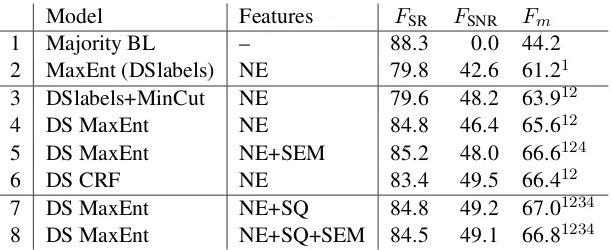
Even though we do not have sentiment rele-vance annotations, there are sources of metadata about the movie domain that we can leverage for distant supervision. Specifically, movie databases like IMDb contain both metadata about the plot, in particular the characters of a movie, and meta-data about the “creators” who were involved in the production of the movie: actors, writers, direc-tors, and composers. On the one hand, statements about characters usually describe the plot and are not sentiment relevant and on the other hand, state-ments about the creators tend to be evaluations of their contributions – positive or negative – to the movie. We formulate a classification rule based on this observation: Count occurrences of NE fea-tures and label sentences that contain a majority of creators (and tied cases) as SR and sentences that contain a majority of characters as SNR. This simple labeling rule covers 1583 sentences with an F1 score of 67.2% on the SR corpus. We call these labels inferred from NE metadatadistant su-pervision (DS) labels. This is a form of distant supervision in that we use the IMDb database as described in Section 5 to automatically label sen-tences based on which metadata from the database they contain.
To increase coverage, we train a Maximum En-tropy (MaxEnt) classifier (Manning and Klein,
2003) on the labels. The MaxEnt model achieves anF1of 61.2% on the SR corpus (Table 3, line 2). As this classifier uses training data that is biased towards a specialized case (sentences containing the named entity types creators and characters), it does not generalize well to other S-relevance problems and thus yields lower performance on the full dataset. This distant supervision setup suf-fers from two issues. First, the classifier only sees a subset of examples that contain named entities, making generalization to other types of expres-sions difficult. Second, there is no way to control the quality of the input to the classifier, as we have no confidence measure for our distant supervision labeling rule. We will address these two issues by introducing an intermediate step, the unsupervised sequence model introduced in Section 4.
As described in Section 4, each document is represented as a graph of sentences and weights between sentences and source/sink nodes repre-senting SR/SNR are set to the confidence values obtained from the distantly trained MaxEnt clas-sifier. We then apply MinCut as described in the following paragraphs and select the most confident examples as training material for a new classifier.
6.1 MinCut Setup
We follow the general MinCut setup described in Section 4. As explained above, we assume that creators and directors indicate relevance and char-acters indicate nonrelevance. Accordingly, we define nSR to be the number of <ACTOR> and <PERSONNEL>features occurring in a sentence, andnSNRthe number of<CHARACTER>features.
We then set the individual weight between a sen-tence and the source/sink nodes to ind(s, x) =nx
wherex ∈ {SR,SNR}. The MinCut parameterc
is set to 1; we wish to give the association scores high weights as there might be long spans that have individual weights with zero values.
6.2 Confidence-based Data Selection
We use the output of the base classifier to train su-pervised models. Since the MinCut model is based on a weak assumption, it will make many false de-cisions. To eliminate incorrect decisions, we only use documents as training data that were labeled with high confidence. As the confidence measure for a document, we use the maximum flow valuef
Model Features FSR FSNR Fm
1 Majority BL – 88.3 0.0 44.2
2 MaxEnt (DSlabels) NE 79.8 42.6 61.21 3 DSlabels+MinCut NE 79.6 48.2 63.912
4 DS MaxEnt NE 84.8 46.4 65.612
5 DS MaxEnt NE+SEM 85.2 48.0 66.6124
6 DS CRF NE 83.4 49.5 66.412
7 DS MaxEnt NE+SQ 84.8 49.2 67.01234
[image:7.595.147.453.61.186.2]8 DS MaxEnt NE+SQ+SEM 84.5 49.1 66.81234
Table 3: Classification results:FSR(S-relevantF1),FSNR (S-nonrelevantF1), andFm(macro-averaged
F1). Superscript numbers indicate a significant improvement over the corresponding line.
is low, then the cut was found more quickly and thus can be easier to calculate; this means that the sentence is more likely to have been assigned to the correct segment. Following this assumption, we train MaxEnt and Conditional Random Field (CRF, (McCallum, 2002)) classifiers on the k% of documents that have the lowest maximum flow values f, where k is a parameter which we
op-timize using the run count method introduced in Section 4.
6.3 Experiments and Results
Table 3 shows S-relevant (FSR), S-nonrelevant
(FSNR) and macro average (Fm)F1values for dif-ferent setups with this parameter. We compare the following setups: (1) The majority baseline (BL) i.e., choosing the most frequent label (SR). (2) a MaxEnt baseline trained on DS labels without ap-plication of MinCut; (3) the base classifier using MinCut (DSlabels+MinCut) as described above.
Conditions 4-8 train supervised classifiers based on the labels from DSlabels+MinCut: (4) MaxEnt with named entities (NE); (5) MaxEnt with NE and semantic (SEM) features; (6) CRF with NE; (7) MaxEnt with NE and sequential (SQ) features; (8) MaxEnt with NE, SQ, and SEM.
We test statistical significance using the approx-imate randomization test (Noreen, 1989) on doc-uments with 10,000 iterations at p < .05. We
achieve classification results above baseline using the MinCut base classifier (line 3) and a consider-able improvement through distant supervision. We found that all classifiers using DS labels and Min-cut are significantly better than MaxEnt trained on purely rule-based DS labels (line 2). Also, the MaxEnt models using SQ features (lines 7,8) are significantly better than the MinCut base classi-fier (line 3). For comparison to a chain-based
se-quence model, we train a CRF (line 6); however, the improvement over MaxEnt (line 4) is not sig-nificant.
We found that both semantic (lines 5,8) and se-quential (lines 7,8) features help to improve the classifier. The best model (line 7) performs bet-ter than MinCut (3) by 3.1% and betbet-ter than train-ing on purely rule-generated DS labels (line 2) by 5.8%. However, we did not find a cumulative ef-fect (line 8) of the two feature sets.
Generally, the quality of NER is crucial in this task. While IMDb is in general a thoroughly com-piled database, it is not perfect. For example, all main characters inGroundhog Dayare listed with their first name only even though the full names are given in the movie. Also, some entries are in-tentionally incomplete to avoid spoiling the plot. The data also contains ambiguities between char-acters and titles (e.g.,Forrest Gump) that are im-possible to resolve with our maximum likelihood method. In some types of movies, e.g., documen-taries, the distinction between characters and ac-tors makes little sense. Furthermore, ambiguities like occurrences of common names such asJohn are impossible to resolve if there is no earlier full referring expression (e.g.,John Williams).
Feature analysis for the best model using DS labels (7) shows that NE features are dominant. This correlation is not surprising as the seed la-bels were induced based on NE features. Interest-ingly, some subjective features, e.g.,horriblehave high weights for S-nonrelevance, as they are asso-ciated with non-relevant content such as plot de-scriptions.
MinCut-based input significantly outperforming the baseline. Named entity recognition, accom-plished with data extracted from a domain-specific database, plays a significant rule in creating an ini-tial labeling.
7 Transfer Learning
To address the problem that we do not have enough labeled SR data we now investigate a sec-ond semi-supervised method for SR classification, transfer learning (TL). We will use the P&L data (introduced in Section 2.2) for training. This data set has labels that are intended to be subjectivity labels. However, they were automatically created using heuristics and the resulting labels can be ei-ther viewed as noisy SR labels or noisy subjectiv-ity labels. Compared to distant supervision, the key advantage of training on P&L is that the train-ing set is much larger, containtrain-ing around 7 times as much data.
In TL, the key to success is to find a general-ized feature representation that supports knowl-edge transfer. We use a semantic feature gener-alization method that relies on taxonomies to in-troduce such features.
We again use MinCut to impose discourse con-straints. This time, we first classify the data us-ing a supervised classifier and then use MinCut to smooth the sequences. The baseline (BL) uses a simple bag-of-words representation of sentences for classification which we then extend with se-mantic features.
7.1 MinCut Setup
We again implement the basic MinCut setup from Section 4. We set the individual weight ind(s, x) on the edge between sentencesand classxto the
estimatep(x|s)returned by the supervised classi-fier. The parametercof the MinCut model is tuned using the run count method described in Section 4.
7.2 Experiments and Results
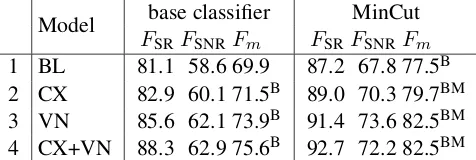
As we would expect, the baseline performance of the supervised classifier on SR is low: 69.9% (Ta-ble 4, line 1). MinCut significantly boosts the per-formance by 7.9% to 77.5% (line 1), a result sim-ilar to (Pang and Lee, 2004). Adding semantic features improves supervised classification signif-icantly by 5.7% (75.6% on line 4). When MinCut and both types of semantic features are used to-gether, these improvements are partially
cumula-0.2 0.4 0.6 0.8 1.0
2
4
6
8
10
c
run length
77
78
79
80
81
82
F1
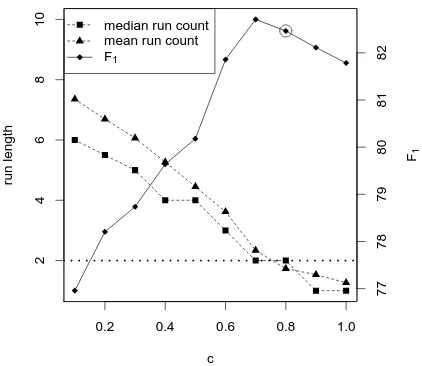
[image:8.595.311.522.63.246.2]median run count mean run count F1
Figure 2: F1 measure for different values of c. Horizontal line: optimal median run count. Cir-cle: selected point.
tive: an improvement over the baseline by 12.6% to 82.5% (line 4).
We also experiment with a training set where an artificial class imbalance is introduced, matching the 80:20 imbalance of SR:SNR in the S-relevance corpus. After applying MinCut, we find that while the results for BL with and without imbalances does not differ significantly. However, models us-ing CX and VN features and imbalances are ac-tually significantly inferior to the respective bal-anced versions. This result suggests that MinCut is more effective at coping with class imbalances than artificial balancing.
MinCut and semantic features are successful for TL because both impose constraints that are more useful in a setup where noise is a major problem. MinCut can exploit test set information without supervision as the MinCut graph is built directly on each test set review. If high-confidence infor-mation is “seeded” within a document and then spread to neighbors, mistakes with low confidence are corrected. This way, MinCut also leads to a compensation of different class imbalances.
The results are evidence that semantic features are robust to the differences between subjectivity and S-relevance (cf. Section 2). In the CX+VN model, meaningful feature classes receive high weights, e.g., the human class from CoreLex which contains professions that are frequently as-sociated with non-relevant plot descriptions.
Model base classifier MinCut
FSRFSNRFm FSRFSNRFm
1 BL 81.1 58.6 69.9 87.2 67.8 77.5B
2 CX 82.9 60.1 71.5B 89.0 70.3 79.7BM
3 VN 85.6 62.1 73.9B 91.4 73.6 82.5BM
[image:9.595.180.418.63.143.2]4 CX+VN 88.3 62.9 75.6B 92.7 72.2 82.5BM
Table 4: Classification results:FSR(S-relevantF1),FSNR (S-nonrelevantF1), andFm(macro-averaged
F1).Bindicates a significant improvement over the BL base classifier (69.9),Mover BL MinCut (77.5).
setting (line 4) in Figure 2. Due to differences in the base classifier, the optimum ofcmay vary
be-tween the experiments. A weaker base classifier may yield a higher weight on the sequence model, resulting in a largerc. The circled point shows the
data point selected through optimization. The op-timization criterion does not always correlate per-fectly withF1. However, we find no statistically
significant difference between the selected result and the highestF1value.
These experiments demonstrate that S-relevance classification improves considerably through TL if semantic feature generalization and unsupervised sequence classification through MinCut are applied.
8 Conclusion
A number of different notions, including subjec-tivity, have been proposed for distinguishing parts of documents that convey sentiment from those that do not. We introducedsentiment relevanceto make this distinction and argued that it better re-flects the requirements of sentiment analysis sys-tems. Our experiments demonstrated that senti-ment relevance and subjectivity are related, but different. To enable other researchers to use this new notion of S-relevance, we have published the annotated S-relevance corpus used in this paper.
Since a large labeled sentiment relevance re-source does not yet exist, we investigated semi-supervised approaches to S-relevance classifica-tion that do not require S-relevance-labeled data. We showed that a combination of different tech-niques gives us the best results: semantic gener-alization features, imposing discourse constraints implemented as the minimum cut graph-theoretic method, automatic “distant” labeling based on a domain-specific metadata database and transfer learning to exploit existing labels for a related classification problem.
In future work, we plan to use sentiment
rele-vance in a downstream task such as review sum-marization.
Acknowledgments
This work was funded by the DFG through the Sonderforschungsbereich 732. We thank Charles Jochim, Wiltrud Kessler, and Khalid Al Khatib for many helpful comments and discussions.
References
Bernd Bohnet. 2010. Top accuracy and fast depen-dency parsing is not a contradiction. InProceedings of the 23rd International Conference on Computa-tional Linguistics (Coling 2010), pages 89–97, Bei-jing, China, August. Coling 2010 Organizing Com-mittee.
P. Buitelaar. 1998. CoreLex: systematic polysemy and
underspecification. Ph.D. thesis, Brandeis Univer-sity.
B. Cherkassky and A. Goldberg. 1995. On imple-menting push-relabel method for the maximum flow
problem. Integer Programming and Combinatorial
Optimization, pages 157–171.
X. Ding, B. Liu, and P. S. Yu. 2008. A holistic
lexicon-based approach to opinion mining. InWSDM 2008,
pages 231–240.
K. Eguchi and V. Lavrenko. 2006. Sentiment retrieval
using generative models. In EMNLP 2006, pages
345–354.
L.R. Ford and D.R. Fulkerson. 1956. Maximal flow
through a network.Canadian Journal of
Mathemat-ics, 8(3):399–404.
K. Kipper, A. Korhonen, N. Ryant, and M. Palmer. 2008. A large-scale classification of English verbs.
Language Resources and Evaluation, 42(1):21–40.
B. Liu. 2010. Sentiment analysis and subjectivity.
Handbook of Natural Language Processing, pages 978–1420085921.
A.K. McCallum. 2002. Mallet: A machine learning for language toolkit.
G.A. Miller. 1995. Wordnet: a lexical database for
english. Communications of the ACM, 38(11):39–
41.
E.W. Noreen. 1989. Computer Intensive Methods for
Hypothesis Testing: An Introduction. Wiley.
B. Pang and L. Lee. 2004. A sentimental education: Sentiment analysis using subjectivity summarization
based on minimum cuts. InACL 2004, pages 271–
278.
B. Pang, L. Lee, and S. Vaithyanathan. 2002. Thumbs up?: sentiment classification using machine learning
techniques. InACL-EMNLP 2002, pages 79–86.
A.M. Popescu and O. Etzioni. 2005. Extracting prod-uct features and opinions from reviews. In Proceed-ings of the conference on Human Language Tech-nology and Empirical Methods in Natural Language Processing, pages 339–346. Association for Compu-tational Linguistics.
A. Ratnaparkhi. 1996. A maximum entropy model for
part-of-speech tagging. InProceedings of the
con-ference on empirical methods in natural language processing, volume 1, pages 133–142.
E. Riloff and J. Wiebe. 2003. Learning extraction
pat-terns for subjective expressions. In EMNLP 2003,
pages 105–112.
M. Taboada, J. Brooke, and M. Stede. 2009. Genre-based paragraph classification for sentiment analy-sis. InSIGdial 2009, pages 62–70.
O. T¨ackstr¨om and R. McDonald. 2011. Discover-ing fine-grained sentiment with latent variable
struc-tured prediction models. InECIR 2011, pages 368–
374.
S. Tan and X. Cheng. 2009. Improving SCL model for sentiment-transfer learning. InACL 2009, pages 181–184.
S. Thrun. 1996. Is learning then-th thing any easier
than learning the first? InNIPS 1996, pages 640–
646.
T. Wilson and J. Wiebe. 2003. Annotating opinions in
the world press. In4th SIGdial Workshop on
Dis-course and Dialogue, pages 13–22.
A. Yessenalina, Y. Yue, and C. Cardie. 2010. Multi-level structured models for document-Multi-level
senti-ment classification. InEMNLP 2010, pages 1046–
1056.
O. Zaidan, J. Eisner, and C. Piatko. 2007. Using anno-tator rationales to improve machine learning for text
categorization. In NAACL-HLT 2007, pages 260–
267.
L. Zhuang, F. Jing, and X. Zhu. 2006. Movie review
mining and summarization. InCIKM 2006, pages