Discriminative Learning with Natural Annotations:
Word Segmentation as a Case Study
Wenbin Jiang1 Meng Sun1 Yajuan L ¨u1 Yating Yang2 Qun Liu3,1 1Key Laboratory of Intelligent Information Processing
Institute of Computing Technology, Chinese Academy of Sciences
{jiangwenbin, sunmeng, lvyajuan}@ict.ac.cn
2Multilingual Information Technology Research Center
The Xinjiang Technical Institute of Physics & Chemistry, Chinese Academy of Sciences
3Centre for Next Generation Localisation
Faculty of Engineering and Computing, Dublin City University
Abstract
Structural information in web text pro-vides natural annotations for NLP prob-lems such as word segmentation and pars-ing. In this paper we propose a discrim-inative learning algorithm to take advan-tage of the linguistic knowledge in large amounts of natural annotations on the In-ternet. It utilizes the Internet as an external corpus with massive (although slight and sparse) natural annotations, and enables a classifier to evolve on the large-scaled and real-time updated web text. With Chinese word segmentation as a case study, exper-iments show that the segmenter enhanced with the Chinese wikipedia achieves sig-nificant improvement on a series of testing sets from different domains, even with a single classifier and local features.
1 Introduction
Problems related to information retrieval, machine translation and social computing need fast and ac-curate text processing, for example, word segmen-tation and parsing. Taking Chinese word seg-mentation for example, the state-of-the-art mod-els (Xue and Shen, 2003; Ng and Low, 2004; Gao et al., 2005; Nakagawa and Uchimoto, 2007; Zhao and Kit, 2008; Jiang et al., 2009; Zhang and Clark, 2010; Sun, 2011b; Li, 2011) are usually trained on human-annotated corpora such as the Penn Chinese Treebank (CTB) (Xue et al., 2005), and perform quite well on corresponding test sets. Since the text used for corpus annotating are usu-ally drawn from specific fields (e.g. newswire or finance), and the annotated corpora are limited in
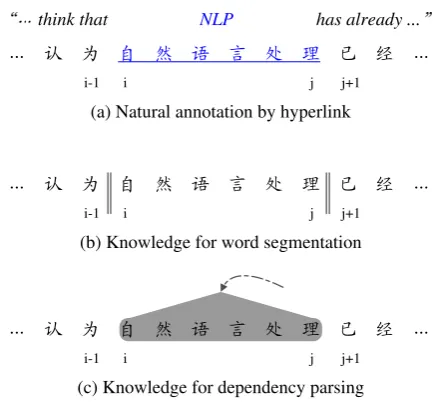
think that NLP has already ...
n ఊ น ᆑ ௶ ဴ ཝ ҉ स ྸ ࠼ n
i-1 i j j+1
(a) Natural annotation by hyperlink
n ఊ น ᆑ ௶ ဴ ཝ ҉ स ྸ ࠼ n
i-1 i j j+1
n ఊ น ᆑ ௶ ဴ ཝ ҉ स ྸ ࠼ n
i-1 i j j+1
(b) Knowledge for word segmentation
[image:1.595.306.526.262.464.2](c) Knowledge for dependency parsing
Figure 1: Natural annotations for word segmenta-tion and dependency parsing.
size (e.g. tens of thousands), the performance of word segmentation tends to degrade sharply when applied to new domains.
Internet provides large amounts of raw text, and statistics collected from it have been used to im-prove parsing performance (Nakov and Hearst, 2005; Pitler et al., 2010; Bansal and Klein, 2011; Zhou et al., 2011). The Internet also gives mas-sive (although slight and sparse) natural annota-tions in the forms of structural information includ-ing hyperlinks, fonts, colors and layouts (Sun, 2011a). These annotations usually imply valuable knowledge for problems such as word segmen-tation and parsing, based on the hypothesis that the subsequences marked by structural informa-tion are meaningful fragments in sentences. Fig-ure 1 shows an example. The hyperlink indicates
a Chinese phrase (meaning NLP), and it probably corresponds to a connected sub-graph for depen-dency parsing. Creators of web text give valuable annotations during editing, the whole Internet can be treated as a wide-coveraged and real-time up-dated corpus.
Different from the dense and accurate tions in human-annotated corpora, natural annota-tions in web text are sparse and slight, it makes direct training of NLP models impracticable. In this work we take for example a most important problem, word segmentation, and propose a novel discriminative learning algorithm to leverage the knowledge in massive natural annotations of web text. Character classification models for word seg-mentation usually factorize the whole prediction into atomic predictions on characters (Xue and Shen, 2003; Ng and Low, 2004). Natural anno-tations in web text can be used to get rid of im-plausible predication candidates for related char-acters, knowledge in the natural annotations is therefore introduced in the manner of searching space pruning. Since constraint decoding in the pruned searching space integrates the knowledge of the baseline model and natural annotations, it gives predictions not worse than the normal decod-ing does. Annotation differences between the out-puts of constraint decoding and normal decoding are used to train the enhanced classifier. This strat-egy makes the usage of natural annotations simple and universal, which facilitates the utilization of massive web text and the extension to other NLP problems.
Although there are lots of choices, we choose the Chinese wikipedia as the knowledge source due to its high quality. Structural information, in-cluding hyperlinks, fonts and colors are used to de-termine the boundaries of meaningful fragments. Experimental results show that, the knowledge im-plied in the natural annotations can significantly improve the performance of a baseline segmenter trained on CTB 5.0, an F-measure increment of 0.93points on CTB test set, and an average incre-ment of1.53points on7other domains. It is an ef-fective and inexpensive strategy to build word seg-menters adaptive to different domains. We hope to extend this strategy to other NLP problems such as named entity recognition and parsing.
In the rest of the paper, we first briefly intro-duce the problems of Chinese word segmentation and the character classification model in section
Type Templates Instances
n-gram C−2 C−2=@
C−1 C−1=
C0 C0=g
C1 C1=,
C2 C2=
C−2C−1 C−2C−1=@
C−1C0 C−1C0=g
C0C1 C0C1=g,
C1C2 C1C2=,
C−1C1 C−1C1=,
function P u(C0) P u(C0)=false
[image:2.595.315.518.61.241.2]T(C−2:2) T(C−2:2)= 44444
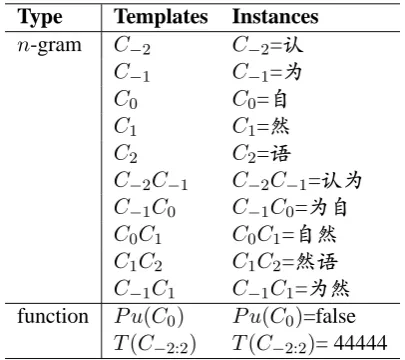
Table 1: Feature templates and instances for character classification-based word segmentation model. Suppose we are considering thei-th char-acter “g” in “...@g ,ó?n®²...”.
2, then describe the representation of the knowl-edge in natural annotations of web text in section 3, and finally detail the strategy of discriminative learning on natural annotations in section 4. Af-ter giving the experimental results and analysis in section5, we briefly introduce the previous related work and then give the conclusion and the expec-tation of future research.
2 Character Classification Model
Character classification models for word segmen-tation factorize the whole prediction into atomic predictions on single characters (Xue and Shen, 2003; Ng and Low, 2004). Although natural anno-tations in web text do not directly support the dis-criminative training of segmentation models, they do get rid of the implausible candidates for predic-tions of related characters.
func-Algorithm 1 Perceptron training algorithm. 1: Input: Training corpusC
2: ~α←0
3: fort←1..T do ⊲T iterations 4: for (x,y˜)∈ Cdo
5: y←arg maxyΦ(x, y)·~α 6: ify6= ˜ythen
7: ~α←~α+Φ(x,y˜)−Φ(x, y) 8: Output: Parameters~α
tion:
f(x) = arg max
y
S(y|~α,Φ, x)
= arg max
y Φ(x, y)·~α
= arg max
y
X
(i,t)∈y
Φ(i, t, x, y)·α~ (1)
The score of the whole sequenceyis accumulated across all its character-label pairs, (i, t) ∈ y (s.t. 1 ≤ i ≤ n and t ∈ {b, m, e, s}). The feature functionΦmaps a labeled sequence or a character-label pair into a feature vector, ~α is the parame-ter vector and Φ(x, y)·~α is the inner product of Φ(x, y)and~α.
Analogous to other sequence labeling prob-lems, word segmentation can be solved through a viterbi-style decoding procedure. We omit the de-coding algorithm in this paper due to its simplicity and popularity.
The feature templates for the classifier is shown in Table 1.C0denotes the current character, while
C−k/Ck denote the kth character to the left/right
ofC0. The functionP u(·)returns true for a
punc-tuation character and false for others, the function T(·) classifies a character into four types, 1, 2,3 and 4, representing number, date, English letter and others, respectively.
The classifier can be trained with online ing algorithms such as perceptron, or offline learn-ing models such as support vector machines. We choose the perceptron algorithm (Collins, 2002) to train the classifier for the character classification-based word segmentation model. It learns a discriminative model mapping from the inputsx∈Xto the outputsy˜∈Y, whereXis the set of sentences in the training corpus andY is the set of corresponding labeled results. Algorithm 1 shows the perceptron algorithm for tuning the pa-rameter~α. The “averaged parameters” technology (Collins, 2002) is used for better performance.
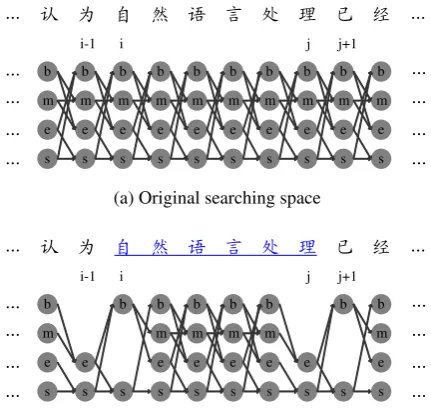
n ఊ น ᆑ ௶ ဴ ཝ ҉ स ྸ ࠼ n
i-1 i j j+1
(a) Original searching space
n n n n n n n n b m e s b m e s b m e s b m e s b m e s b m e s b m e s b m e s b m e s b m e s
n ఊ น ᆑ ௶ ဴ ཝ ҉ स ྸ ࠼ n
i-1 i j j+1
(b) Shrinked searching space
[image:3.595.309.525.63.272.2]n n n n n n n n b m e s e s b s b m e s b m e s b m e s b m e s e s b s b m e s
Figure 2: Shrink of searching space for the charac-ter classification-based word segmentation model.
3 Knowledge in Natural Annotations
Web text gives massive natural annotations in the form of structural informations, including hyper-links, fonts, colors and layouts (Sun, 2011a). Al-though slight and sparse, these annotations imply valuable knowledge for problems such as word segmentation and parsing.
Algorithm 2 Perceptron learning with natural an-notations.
1: ~α←TRAIN(C) 2: forx∈ F do
3: y←DECODE(x, ~α)
4: y˜←CONSTRAINTDECODE(x, ~α,Ψ) 5: ify6= ˜ythen
6: C′← C′∪ {y˜}
7: ~α←TRAIN(C ∪ C′)
wordware the words inP exceptwitself, that is, Ψ(w) ={x|x∈P− {w}}.
Creators of web text give valuable structural annotations during editing, these annotations re-duce the predication uncertainty for atomic char-acters or words, although not exactly defining which predication is. Figure 2 shows an exam-ple for word segmentation, depicting the shrink of searching space for the character classification-based model. Since the decrement of uncertainty indicates the increment of knowledge, the whole Internet can be treated as a wide-coveraged and real-time updated corpus. We choose the Chinese wikipedia as the external knowledge source, and structural information including hyperlinks, fonts and colors are used in the current work due to their explicitness of representation.
4 Learning with Natural Annotations
Different from the dense and accurate annotations in human-annotated corpora, natural annotations are sparse and slight, which makes direct training of NLP models impracticable. Annotations im-plied by structural information do not give an ex-act predication to a charex-acter, however, they help to get rid of the implausible predication candidates for related characters, as described in the previous section.
Previous work on constituency parsing or ma-chine translation usually resort to some kinds of heuristic tricks, such as punctuation restrictions, to eliminate some implausible candidates during decoding. Here the natural annotations also bring knowledge in the manner of searching space prun-ing. Conditioned on the completeness of the de-coding algorithm, a model trained on an exist-ing corpus probably gives better or at least not worse predications, by constraint decoding in the pruned searching space. The constraint decoding procedure integrates the knowledge of the baseline
Algorithm 3 Online version of perceptron learn-ing with natural annotations.
1: ~α←TRAIN(C)
2: forxwith natural annotations do
3: y←DECODE(x, ~α)
4: y˜←CONSTRAINTDECODE(x, ~α,Ψ) 5: ify6= ˜ythen
6: ~α←~α+Φ(x,y˜)−Φ(x, y) 7: outputα~ at regular time
model and natural annotations, the predication dif-ferences between the outputs of constraint decod-ing and normal decoddecod-ing can be used to train the enhanced classifier.
Restrictions of the searching space according to natural annotations can be easily incorporated into the decoder. If the completeness of the searching algorithm can be guaranteed, the constraint decod-ing in the pruned searchdecod-ing space will give predi-cations not worse than those given by the normal decoding. If a predication of constraint decoding differs from that of normal decoding, it indicates that the annotation precision is higher than the lat-ter. Furthermore, the degree of difference between the two predications represents the amount of new knowledge introduced by the natural annotations over the baseline.
The baseline model ~α is trained on an exist-ing human-annotated corpus. A set of sentences F with natural annotations are extracted from the Chinese wikipedia, and we reserve the ones for which constraint decoding and normal decoding give different predications. The predictions of re-served sentences by constraint decoding are used as additional training data for the enhanced classi-fier. The overall training pipeline is analogous to self-training (McClosky et al., 2006), Algorithm 2 shows the pseudo-codes. Considering the online characteristic of the perceptron algorithm, if we are able to leverage much more (than the Chinese wikipedia) data with natural annotations, an online version of learning procedure shown in Algorithm 3 would be a better choice. The technology of “av-eraged parameters” (Collins, 2002) is easily to be adapted here for better performance.
Partition Sections # of word CTB
Training 1−270 0.47M
400−931 1001−1151
Developing 301−325 6.66K
[image:5.595.85.277.60.161.2]Testing 271−300 7.82K
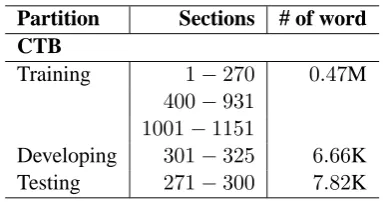
Table 2: Data partitioning for CTB 5.0.
two predications, we can approximate how much new knowledge that a naturally annotated sentence brings. For a sentencex, given the predications of constraint decoding and normal decoding, y˜and y, the difference of their scoresδ =S(y)−S(˜y) indicates the degree to which the current model mistakes. This indicator helps us to select more valuable training examples.
The strategy of learning with natural annota-tions can be adapted to other situaannota-tions. For ex-ample, if we have a list of words or phrases (espe-cially in a specific domain such as medicine and chemical), we can generate annotated sentences automatically by string matching in a large amount of raw text. It probably provides a simple and effective domain adaptation strategy for already trained models.
5 Experiments
We use the Penn Chinese Treebank 5.0 (CTB) (Xue et al., 2005) as the existing annotated cor-pus for Chinese word segmentation. For conve-nient of comparison with other work in word seg-mentation, the whole corpus is split into three par-titions as follows: chapters 271-300 for testing, chapters 301-325 for developing, and others for training. We choose the Chinese wikipedia1 (ver-sion 20120812) as the external knowledge source, because it has high quality in contents and it is much better than usual web text. Structural infor-mations, including hyperlinks, fonts and colors are used to derive the annotation information.
To further evaluate the improvement brought by the fuzzy knowledge in Chinese wikipedia, a series of testing sets from different domains are adopted. The four testing sets from SIGHAN Bakeoff 2010 (Zhao and Liu, 2010) are used, they are drawn from the domains of literature, finance, computer science and medicine. Although the ref-erence sets are annotated according to a different
1
http://download.wikimedia.org/backup-index.html.
95.6 95.8 96 96.2 96.4 96.6 96.8 97 97.2 97.4
1 2 3 4 5 6 7 8 9 10
Accuracy (F1%)
Training iterations
Figure 3: Learning curve of the averaged percep-tron classifier on the CTB developing set.
word segmentation standard (Yu et al., 2001), the quantity of accuracy improvement is still illustra-tive since there are no vast diversities between the two segmentation standards. We also annotated another three testing sets 2, their texts are drawn from the domains of chemistry, physics and ma-chinery, and each contains500sentences.
5.1 Baseline Classifier for Word
Segmentation
We train the baseline perceptron classifier for word segmentation on the training set of CTB 5.0, using the developing set to determine the best training iterations. The performance mea-surement for word segmentation is balanced F-measure,F = 2P R/(P+R), a function of preci-sionP and recallR, whereP is the percentage of words in segmentation results that are segmented correctly, andRis the percentage of correctly seg-mented words in the gold standard words.
Figure 3 shows the learning curve of the aver-aged perceptron on the developing set. The sec-ond column of Table 3 lists the performance of the baseline classifier on eight testing sets, where newswire denotes the testing set of the CTB it-self. The classifier performs much worse on the domains of chemistry, physics and machinery, it indicates the importance of domain adaptation for word segmentation (Gao et al., 2004; Ma and Way, 2009; Gao et al., 2010). The accuracy on the testing sets from SIGHAN Bakeoff 2010 is even lower due to the difference in both domains and word segmentation standards.
2
[image:5.595.318.520.66.213.2]Dataset Baseline (F%) Enhanced (F%) Newswire 97.35 98.28 +0.93 Out-of-Domain
Chemistry 93.61 95.68 +2.07
Physics 95.10 97.24 +2.14
Machinery 96.08 97.66 +1.58 Literature 92.42 93.53 +1.11
Finance 92.50 93.16 +0.66
Computer 89.46 91.19 +1.73 Medicine 91.88 93.34 +1.46
Average 93.01 94.54 +1.53
Table 3: Performance of the baseline classifier and the classifier enhanced with natural annotations in Chinese wikipedia.
5.2 Classifier Enhanced with Natural
Annotations
The Chinese wikipedia contains about0.5million items. From their description text, about 3.9 mil-lions of sentences with natural annotations are ex-tracted. With the CTB training set as the exist-ing corpus C, about 0.8 million sentences are re-served according to Algorithm 2, the segmenta-tions given by constraint decoding are used as ad-ditional training data for the enhanced classifier.
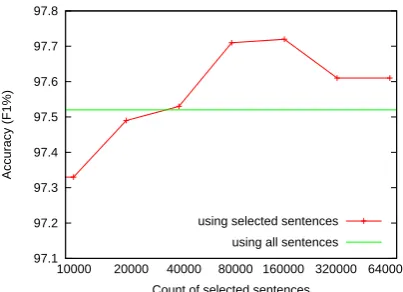
According to the previous description, the dif-ference of the scores of constraint decoding and normal decoding, δ = S(y) − S(˜y), indicates the importance of a constraint segmentation to the improvement of the baseline classifier. The con-straint segmentations of the reserved sentences are sorted in descending order according to the dif-ference of the scores of constraint decoding and normal decoding, as described previously. From the beginning of the sorted list, different amounts of segmented sentences are used as the additional training data for the enhanced character classifier. Figure 4 shows the performance curve of the en-hanced classifiers on the developing set of CTB. We found that the highest accuracy was achieved when 160,000 sentences were used, while more additional training data did not give continuous improvement. A recent related work about self-training for segmentation (Liu and Zhang, 2012) also reported a very similar trend, that only a mod-erate amount of raw data gave the most obvious improvements.
The performance of the enhanced classifier is listed in the third column of Table 3. On the CTB testing set, training data from the Chinese
97.1 97.2 97.3 97.4 97.5 97.6 97.7 97.8
Accuracy (F1%)
Count of selected sentences
10000 20000 40000 80000 160000 320000 640000 using selected sentences
[image:6.595.319.521.64.210.2]using all sentences
Figure 4: Performance curve of the classifier en-hanced with selected sentences of different scales.
Model Accuracy (F%)
(Jiang et al., 2008) 97.85 (Kruengkrai et al., 2009) 97.87 (Zhang and Clark, 2010) 97.79 (Wang et al., 2011) 98.11
(Sun, 2011b) 98.17
Our Work 98.28
Table 4: Comparison with state-of-the-art work in Chinese word segmentation.
wikipedia brings an F-measure increment of0.93 points. On out-of-domain testing sets, the im-provements are much larger, an average increment of 1.53 points is achieved on seven domains. It is probably because the distribution of the knowl-edge in the CTB training data is concentrated in the domain of newswire, while the contents of the Chinese wikipedia cover a broad range of do-mains, it provides knowledge complementary to that of CTB.
resorting to complicated features, system com-bination and other semi-supervised technologies. What is more, since the text on Internet is wide-coveraged and real-time updated, our strategy also helps a word segmenter be more domain adaptive and up to date.
6 Related Work
Li and Sun (2009) extracted character classifi-cation instances from raw text for Chinese word segmentation, resorting to the indication of punc-tuation marks between characters. Sun and Xu (Sun and Xu, 2011) utilized the features derived from large-scaled unlabeled text to improve Chi-nese word segmentation. Although the two work also made use of large-scaled raw text, our method is essentially different from theirs in the aspects of both the source of knowledge and the learning strategy.
Lots of efforts have been devoted to semi-supervised methods in sequence labeling and word segmentation (Xu et al., 2008; Suzuki and Isozaki, 2008; Haffari and Sarkar, 2008; Tomanek and Hahn, 2009; Wang et al., 2011). A semi-supervised method tries to find an optimal hyper-plane of both annotated data and raw data, thus to result in a model with better coverage and higher accuracy. Researchers have also investigated un-supervised methods in word segmentation (Zhao and Kit, 2008; Johnson and Goldwater, 2009; Mochihashi et al., 2009; Hewlett and Cohen, 2011). An unsupervised method mines the latent distribution regularity in the raw text, and auto-matically induces word segmentation knowledge from it. Our method also needs large amounts of external data, but it aims to leverage the knowl-edge in the fuzzy and sparse annotations. It is fundamentally different from semi-supervised and unsupervised methods in that we aimed to exca-vate a totally different kind of knowledge, the nat-ural annotations implied by the structnat-ural informa-tion in web text.
In recent years, much work has been devoted to the improvement of word segmentation in a vari-ety of ways. Typical approaches include the in-troduction of global training or complicated fea-tures (Zhang and Clark, 2007; Zhang and Clark, 2010), the investigation of word internal structures (Zhao, 2009; Li, 2011), the adjustment or adapta-tion of word segmentaadapta-tion standards (Wu, 2003; Gao et al., 2004; Jiang et al., 2009), the integrated
solution of segmentation and related tasks such as part-of-speech tagging and parsing (Zhou and Su, 2003; Zhang et al., 2003; Fung et al., 2004; Gold-berg and Tsarfaty, 2008), and the strategies of hy-brid or stacked modeling (Nakagawa and Uchi-moto, 2007; Kruengkrai et al., 2009; Wang et al., 2010; Sun, 2011b).
In parsing, Pereira and Schabes (1992) pro-posed an extended inside-outside algorithm that infers the parameters of a stochastic CFG from a partially parsed treebank. It uses partial bracket-ing information to improve parsbracket-ing performance, but it is specific to constituency parsing, and its computational complexity makes it impractical for massive natural annotations in web text. There are also work making use of word co-occurrence statistics collected in raw text or Internet n-grams to improve parsing performance (Nakov and Hearst, 2005; Pitler et al., 2010; Zhou et al., 2011; Bansal and Klein, 2011). When enriching the re-lated work during writing, we found a work on de-pendency parsing (Spitkovsky et al., 2010) who utilized parsing constraints derived from hypertext annotations to improve the unsupervised depen-dency grammar induction. Compared with their method, the strategy we proposed is formal and universal, the discriminative learning strategy and the quantitative measurement of fuzzy knowledge enable more effective utilization of the natural an-notation on the Internet when adapted to parsing.
7 Conclusion and Future Work
This work presents a novel discriminative learning algorithm to utilize the knowledge in the massive natural annotations on the Internet. Natural anno-tations implied by structural information are used to decrease the searching space of the classifier, then the constraint decoding in the pruned search-ing space gives predictions not worse than the nor-mal decoding does. Annotation differences be-tween the outputs of constraint decoding and nor-mal decoding are used to train the enhanced classi-fier, linguistic knowledge in the human-annotated corpus and the natural annotations of web text are thus integrated together. Experiments on Chi-nese word segmentation show that, the enhanced word segmenter achieves significant improvement on testing sets of different domains, although us-ing a sus-ingle classifier with only local features.
comple-mentary to that of human-annotated corpora with concentrated distribution of domains. The content on the Internet is large-scaled and real-time up-dated, it compensates for the drawback of expen-sive building and updating of corpora. Our strat-egy, therefore, enables us to build a classifier more domain adaptive and up to date. In the future, we will compare this method with self-training to bet-ter illustrate the importance of boundary informa-tion, and give error analysis on what types of er-rors are reduced by the method to make this inves-tigation more complete. We will also investigate more efficient algorithms to leverage more mas-sive web text with natural annotations, and further extend the strategy to other NLP problems such as named entity recognition and parsing.
Acknowledgments
The authors were supported by National Natural Science Foundation of China (Con-tracts 61202216), 863 State Key Project (No. 2011AA01A207), and National Key Technology R&D Program (No. 2012BAH39B03). Qun Liu’s work was partially supported by Science Foun-dation Ireland (Grant No.07/CE/I1142) as part of the CNGL at Dublin City University. Sincere thanks to the three anonymous reviewers for their thorough reviewing and valuable suggestions!
References
Mohit Bansal and Dan Klein. 2011. Web-scale fea-tures for full-scale parsing. In Proceedings of ACL.
Michael Collins. 2002. Discriminative training meth-ods for hidden markov models: Theory and exper-iments with perceptron algorithms. In Proceedings of EMNLP, pages 1–8, Philadelphia, USA.
Pascale Fung, Grace Ngai, Yongsheng Yang, and Ben-feng Chen. 2004. A maximum-entropy chinese parser augmented by transformation-based learning. In Proceedings of TALIP.
Jianfeng Gao, Andi Wu, Mu Li, Chang-Ning Huang, Hongqiao Li, Xinsong Xia, and Haowei Qin. 2004. Adaptive chinese word segmentation. In Proceed-ings of ACL.
Jianfeng Gao, Mu Li, Andi Wu, and Chang-Ning Huang. 2005. Chinese word segmentation and named entity recognition: A pragmatic approach. Computational Linguistics.
Wenjun Gao, Xipeng Qiu, and Xuanjing Huang. 2010. Adaptive chinese word segmentation with online passive-aggressive algorithm. In Proceedings of CIPS-SIGHAN Workshop.
Yoav Goldberg and Reut Tsarfaty. 2008. A single gen-erative model for joint morphological segmentation and syntactic parsing. In Proceedings of ACL-HLT.
Gholamreza Haffari and Anoop Sarkar. 2008. Homotopy-based semi-supervised hidden markov models for sequence labeling. In Proceedings of COLING.
Daniel Hewlett and Paul Cohen. 2011. Fully unsu-pervised word segmentation with bve and mdl. In Proceedings of ACL.
Wenbin Jiang, Liang Huang, Yajuan Lv, and Qun Liu. 2008. A cascaded linear model for joint chinese word segmentation and part-of-speech tagging. In Proceedings of ACL.
Wenbin Jiang, Liang Huang, and Qun Liu. 2009. Au-tomatic adaptation of annotation standards: Chinese word segmentation and pos tagging–a case study. In Proceedings of the 47th ACL.
Mark Johnson and Sharon Goldwater. 2009. Improv-ing nonparameteric bayesian inference: experiments on unsupervised word segmentation with adaptor grammars. In Proceedings of NAACL.
Canasai Kruengkrai, Kiyotaka Uchimoto, Jun.ichi Kazama, Yiou Wang, Kentaro Torisawa, and Hitoshi Isahara. 2009. An error-driven word-character hy-brid model for joint chinese word segmentation and pos tagging. In Proceedings of ACL-IJCNLP.
Zhongguo Li and Maosong Sun. 2009. Punctuation as implicit annotations for chinese word segmentation. Computational Linguistics.
Zhongguo Li. 2011. Parsing the internal structure of words: A new paradigm for chinese word segmenta-tion. In Proceedings of ACL.
Yang Liu and Yue Zhang. 2012. Unsupervised domain adaptation for joint segmentation and pos-tagging. In Proceedings of COLING.
Yanjun Ma and Andy Way. 2009. Bilingually moti-vated domain-adapted word segmentation for statis-tical machine translation. In Proceedings of EACL.
David McClosky, Eugene Charniak, and Mark John-son. 2006. Effective self-training for parsing. In Proceedings of the HLT-NAACL.
Daichi Mochihashi, Takeshi Yamada, and Naonori Ueda. 2009. Bayesian unsupervised word segmen-tation with nested pitman-yor language modeling. In Proceedings of ACL-IJCNLP.
Tetsuji Nakagawa and Kiyotaka Uchimoto. 2007. A hybrid approach to word segmentation and pos tag-ging. In Proceedings of ACL.
Hwee Tou Ng and Jin Kiat Low. 2004. Chinese part-of-speech tagging: One-at-a-time or all-at-once? word-based or character-based? In Proceedings of EMNLP.
Fernando Pereira and Yves Schabes. 1992. Inside-outside reestimation from partially bracketed cor-pora. In Proceedings of ACL.
Emily Pitler, Shane Bergsma, Dekang Lin, and Ken-neth Church. 2010. Using web-scale n-grams to improve base np parsing performance. In Proceed-ings of COLING.
Valentin I. Spitkovsky, Daniel Jurafsky, and Hiyan Al-shawi. 2010. Profiting from mark-up: Hyper-text annotations for guided parsing. In Proceedings of ACL.
Weiwei Sun and Jia Xu. 2011. Enhancing chinese word segmentation using unlabeled data. In Pro-ceedings of EMNLP.
Maosong Sun. 2011a. Natural language processing based on naturally annotated web resources. CHI-NESE INFORMATION PROCESSING.
Weiwei Sun. 2011b. A stacked sub-word model for joint chinese word segmentation and part-of-speech tagging. In Proceedings of ACL.
Jun Suzuki and Hideki Isozaki. 2008. Semi-supervised sequential labeling and segmentation using giga-word scale unlabeled data. In Proceedings of ACL.
Katrin Tomanek and Udo Hahn. 2009. Semi-supervised active learning for sequence labeling. In Proceedings of ACL.
Kun Wang, Chengqing Zong, and Keh-Yih Su. 2010. A character-based joint model for chinese word seg-mentation. In Proceedings of COLING.
Yiou Wang, Jun’ichi Kazama, Yoshimasa Tsuruoka, Wenliang Chen, Yujie Zhang, and Kentaro Tori-sawa. 2011. Improving chinese word segmentation and pos tagging with semi-supervised methods us-ing large auto-analyzed data. In Proceedus-ings of IJC-NLP.
Andi Wu. 2003. Customizable segmentation of mor-phologically derived words in chinese. Computa-tional Linguistics and Chinese Language Process-ing.
Jia Xu, Jianfeng Gao, Kristina Toutanova, and Her-mann Ney. 2008. Bayesian semi-supervised chinese word segmentation for statistical machine transla-tion. In Proceedings of COLING.
Nianwen Xue and Libin Shen. 2003. Chinese word segmentation as lmr tagging. In Proceedings of SIGHAN Workshop.
Nianwen Xue, Fei Xia, Fu-Dong Chiou, and Martha Palmer. 2005. The penn chinese treebank: Phrase structure annotation of a large corpus. In Natural Language Engineering.
Shiwen Yu, Jianming Lu, Xuefeng Zhu, Huiming Duan, Shiyong Kang, Honglin Sun, Hui Wang, Qiang Zhao, and Weidong Zhan. 2001. Processing norms of modern chinese corpus. Technical report.
Yue Zhang and Stephen Clark. 2007. Chinese seg-mentation with a word-based perceptron algorithm. In Proceedings of ACL 2007.
Yue Zhang and Stephen Clark. 2010. A fast decoder for joint word segmentation and pos-tagging using a single discriminative model. In Proceedings of EMNLP.
Huaping Zhang, Hongkui Yu, Deyi Xiong, and Qun Liu. 2003. Hhmm-based chinese lexical analyzer ictclas. In Proceedings of SIGHAN Workshop.
Hai Zhao and Chunyu Kit. 2008. Unsupervised segmentation helps supervised learning of charac-ter tagging for word segmentation and named entity recognition. In Proceedings of SIGHAN Workshop.
Hongmei Zhao and Qun Liu. 2010. The cips-sighan clp 2010 chinese word segmentation bakeoff. In Proceedings of CIPS-SIGHAN Workshop.
Hai Zhao. 2009. Character-level dependencies in chi-nese: Usefulness and learning. In Proceedings of EACL.
Guodong Zhou and Jian Su. 2003. A chinese effi-cient analyser integrating word segmentation, part-ofspeech tagging, partial parsing and full parsing. In Proceedings of SIGHAN Workshop.