A Framework for R o b u s t Semantic I n t e r p r e t a t i o n
C a r o l y n P . R o s @
L e a r n i n g R e s e a r c h a n d D e v e l o p m e n t C e n t e r U n i v e r s i t y o f P i t t s b u r g h
P i t t s b u r g h , P A 15260
rosecp @pitt. edu
A b s t r a c t
This paper describes AUTOSEM, a robust semantic interpretation framework that can operate both at parse time and repair time. The evaluation demon- strates that AUTOSEM achieves a high level of ro- bustness efficiently and without requiring any hand coded knowledge dedicated to repair.
1 I n t r o d u c t i o n
In order for an approach to robust interpretation to be practical it must be efficient, address the ma- jor types of disfluencies that plague spontaneously produced language input, and be domain indepen- dent so t h a t a c h i e v i n g robustness in a particular do- main does not require an additional knowledge en- gineering effort. This paper describes AUTOSEM, a semantic interpretation framework that possesses these three qualities. While previous approaches to robust interpretation have offered robust parsers paired with separate repair modules~ with separate knowledge sources for each, AUTOSEM is a single unified framework that can operate both at parse time and repair time. AUTOSEM is integrated with the LCFLEx robust parser (Ros@ and Lavie, to ap- pear; Lavie and Ros@, 2000). Together AUTOSEM and LCFLEx constitute the robust understanding engine within the CARMEL natural language un- derstanding component developed in the context of the Atlas intelligent tutoring project (Freedman at al., to appear). The evaluation reported here demon- strates that AUTOSEM's repair approach operates 200 times faster than the most similar competing ap- proach while producing hypotheses of better quality. AUTOSEM provides an interface to allow seman- tic interpretation to operate in parallel with syntac- tic interpretation at parse time in a lexicon driven fashion. Domain specific semantic knowledge is en- coded declaratively within a meaning representation specification. Semantic constructor functions are compiled automatically from this specification and then linked into lexical entries as in the Glue Lan- guage Semantics approach to interpretation (Dal- rymple, 1999). Based on syntactic h e a d / a r g u m e n t relationships assigned at parse time, the construc-
tot functions enforce semantic selectiona] restric- tions and assemble meaning representation struc- tures by composing the meaning representation asso- ciated with the constructor function with the mean- ing representation of each of its arguments.
AUTOSEM first a t t e m p t s to construct analy- ses that satisfy both syntactic and semantic well- formedness conditions. The L C F L E x parser has the ability to efficiently relax syntactic constraints as needed and as allowed by its parameterized flexi- bility settings. For sentences remaining beyond the parser's coverage, AUTOSEM's repair algorithm re- lies entirely on semantic knowledge to compose the partial analyses produced by the parser. Each se- mantic representation built by AUTOSEM's inter- pretation framework contains a pointer to the con- structor function that built it. Thus, each partial analysis can be treated as a constructor function with built in knowledge about how the associated partial analysis can be combined with other par- tial analyses in a semantically meaningful way. Ge- netic programming search (Koza, 1992; Koza, 1994) is used to efficiently compose the fragments pro- duced by the parser. T h e function definitions com- piled from the meaning representation specification allow the genetic search to use semantic constraints to make effective use of its search space. Thus, AU- T O S E M operates efficiently, free of any hand coded repair rules or any knowledge specifically dedicated to repair unlike other approaches to recovery from parser failure (Danieli and Gerbino, 1995; Van No- ord, 1997; Kasper et al., 1999).
2 T h e M e a n i n g R e p r e s e n t a t i o n S p e c i f i c a t i o n
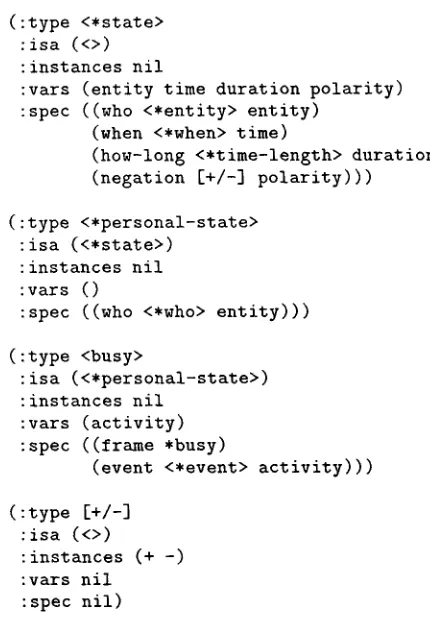
(:type <*state> :isa (<>) :instances nil
:vars (entity time duration polarity) :spec ((who <*entity> entity)
(when <*when> time)
(how-long <*time-length> duration) (negation [+/-] polarity)))
(:type <*personal-state> :isa (<*state>)
:instances nil :vars ()
:spec ((who <*who> entity)))
(:type <busy>
:isa (<*personal-state>) :instances nil
:vars (activity) :spec ((frame *busy)
(event <*event> activity)))
( : t y p e [+/-]
: i s a (<>)
:instances (+ -) :vars nil
:spec nil)
Figure 1: S a m p l e m e a n i n g r e p r e s e n t a t i o n s p e c i f i c a t i o n e n t r i e s
t r a g r a m m a t i c a l input sentence.
T h e meaning representation specification pro- vides a venue for expressing d o m a i n specific se- mantic information declaratively. A U T O S E M pro- duces frame-based meaning representation struc- tures. Thus, each domain specific meaning repre- sentation specification m u s t define a set of semantic types t h a t together specify the set of frames and atomic feature values t h a t m a k e up the domain spe- cific frame-based language, which slots are associ- ated with each frame, and what range of frames and atomic feature values m a y fill each of those slots.
A U T O S E M provides a simple f o r m a l i s m for defin- ing meaning representations. Each entry corre- sponds to a semantic type and contains five fields: : t y p e , : i s a , : i n s t a n c e s , : v a r s , and : s p e c . Some sample entries for the a p p o i n t m e n t scheduling do- main are displayed in Figure 1. Some details are o m i t t e d for simplicity. T h e : t y p e field simply con- talus the n a m e of the type. T h e : v a r s field contains a list of variables, each corresponding to a semantic role. T h e : s p e c field associates a f r a m e and set of slots with a type. For each slot, the : s p e c field con- rains the n a m e of the slot, the most general type re- striction on the slot, and a specification of where the
slot filler comes from. This third piece of information can be either a variable name, indicating t h a t what- ever is bound to t h a t variable is what should fill t h a t slot, or a function call to another semantic construc- tor function, allowing types to specify constraints at more than one level of embedding. Similar to the : s p e c field, the : i n s t a n c e s field associates a list of atomic values with a type. Inheritance relations are defined via the : i s a field. T y p e s inherit the values of each subsuming t y p e ' s : i n s t a n c e s , : v a r s , and
: s p e c fields.
3 S e m a n t i c I n t e r p r e t a t i o n a t P a r s e T i m e
(:type <cancel> :isa (<*event>)
: instances nil
:vats (agent activity time polarity) :spec ((frame *cancel)
(engagement <*event> activity)))
Figure 2: M e a n i n g r e p r e s e n t a t i o n d e f i n i t i o n o f < c a n c e l >
(:morph cancel
:syntax ((cat vlex) (root cancel) (vform bare) (irreg-past +) (irreg-pastpart +)
(irreg-prespart +)
(subcat (*or* intrans np)) (semtag cancel1))
:semantics (cancel1 <cancel> ((subject agent)
(object activity) (tempadjunct time) (negation polarity))))
Figure 3: L e x i c a l e n t r y f o r t h e v e r b " c a n c e l "
As an extension to L C F L E x ' s LFG-like pseudo- unification g r a m m a r formalism, A U T O S E M pro- vides the i n s e r t - r o l e function as an interface to allow semantic interpretation to operate in parallel with syntactic interpretation at parse time. When
the insert-role function is used to insert a child
[image:2.612.104.319.80.399.2]m a p p i n g s between syntactic functional roles such as s u b j e c t , d i r e c t o b j e c t , and i n d i r e c t
object
and semantic roles such as a g e n t , a c t i v i t y , or t i m e . See Figures 2 and 3 discussed further be- low. Note t h a t the syntactic features t h a t a p p e a r in this example are taken from the C O M L E X lex- icon (Grishman et al., 1994). In order to provide consistent input to the semantic constructor func- tious, A U T O S E M assumes a syntactic approach in which deep syntactic functional roles are assigned as in C A R M E L ' s syntactic parsing g r a m m a r evaluated in (Freedman et al., to appear). In this way, for ex- ample, the roles assigned within an active sentence and its corresponding passive sentence remain the same.Since the same constructor function is called with different arguments a n u m b e r of times in order to construct an analysis incrementally, an a r g u m e n t is included in every constructor function that allows a "result so far" to be passed in and augmented. Its default value, which is used the first time the constructor function is executed, is the representa- tion associated with the corresponding type in the absence of any arguments being instantiated. Each time the constructor function is executed, each of its arguments t h a t are instantiated are first checked to be certain that the structures they are instantiated with m a t c h all of the type restrictions on all of the slots t h a t are bound to t h a t argument. If they are, the instantiated a r g u m e n t s ' structures are inserted into the corresponding slots in the "result so far". Otherwise the constructor function fails.
Take as an example the sentence "The meeting I had scheduled was canceled by you." as it is pro- cessed by A U T O S E M using the C A R M E L g r a m m a r and lexicon, which is built on top of the C O M L E X lexicon (Grishman et al., 1994). T h e g r a m m a r as- signs deep syntactic functional roles to constituents. Thus, "you" is the deep subject of "cancel", and "the meeting" is the direct object b o t h of "cancel" and of "schedule". T h e detailed subcategorization classes associated with verbs, nouns, and adjectives in C O M L E X make it possible to determine what these relationships should be. T h e meaning repre- sentation entry for < c a n c e l > as well as the lexical entry for the verb "cancel" are found in Figures 2 and 3 respectively. Some details are left out for sim- plicity. When "the meeting I had scheduled" is ana- lyzed as the surface subject of "was canceled", it is assigned the deep syntactic role of object since "was canceled" is passive. The verb "cancel" has c a n c e l l as its semtag value in the lexicon, c a n c e l 1 is defined there as being associated with the type < c a n c e l > , and the o b j e c t syntactic role is associated with the a c t i v i t y argument. Thus, the < c a n c e l > function is called with its a c t i v i t y argument instantiated with the meaning of "the meeting I had scheduled".
Next, when "by you" is attached, "you" is assigned the deep syntactic role of subject of "cancel". T h e s u b j e c t role is associated with the a g e n t a r g u m e n t in the definition of c a n c e l l . Thus, < c a n c e l > is called a again, this time with "you" instantiating the
agent
a r g u m e n t and the result from the last call to < c a n c e l > passed in through the "result so far" argument.4
Semantic Interpretation for Repair
While the LCFLEX parser has been d e m o n s t r a t e d to robustly parse a variety of disfluencies found in spontaneously generated language (Ros~ and Lavie, to appear), sentences still remain t h a t are beyond its coverage. Previous research involving the ear- lier G L R * parser (Lavie, 1995) and an earlier repair module (Rosd, 1997) has d e m o n s t r a t e d t h a t divid- ing the task of robust interpretation into two stages, namely parsing and repair, provides a better trade off between run time and coverage than a t t e m p t - ing to place the entire burden of robustness on the parser alone (Ros$, 1997). Thus, when the flexibility allowed at parse time is not sufficient to construct an analysis of an entire sentence for any reason, a frag- m e n t a r y analysis is passed into the repair module. For each pair of vertices in the chart the best single clause level and noun phrase level analysis accord- ing to L C F L E x ' s statistical disambiguation scores is included in the set of f r a g m e n t a r y analyses passed on to the repair stage. An example 1 is displayed in Figure 4. Here the sentence "Why d o n ' t we make it from like eleven to one?" failed to parse. In this case, the problem is t h a t the insertion of "like" causes the sentence to be u n g r a m m a t i c a l . When the parser's flexibility settings are such t h a t it is constrained to build analyses only for contiguous portions of text, such an insertion would prevent the parser from con- structing an analysis covering the entire sentence. Nevertheless, it is able to construct analyses for a n u m b e r of g r a m m a t i c a l subsets of it.
Genetic p r o g r a m m i n g search (Koza, 1992; Koza, 1994) is used to search for different ways to combine the fragments. Genetic p r o g r a m m i n g is an oppor- tunistic search algorithm used for constructing com- puter p r o g r a m s to solve particular problems. Among its desirable properties is its ability to search a large space efficiently by first sampling widely and shal- lowly, and then narrowing in on the regions sur- rounding tile m o s t promising looking points.
Sentence: Why don't we make it from like eleven to one?
Functions:
(<SCHEDULE> NIL T NIL NIL NIL NIL NIL NIL T NIL NIL
:STR ((FRAME *SCHEDULE) (ATTITUDE *LET-S) (WHAT ((FRAME *IT))))
:COV (6 5 4 3 2 1)
:SCORE 1.4012985e-45)
(<SCHEDULE> NIL T NIL NIL NIL T T NIL NIL NIL NIL
:STR ((FRAME *SCHEDULE)
(WHAT ((FRAME *IT))) (NEGATIVE +) (WHO ((FRAME *WE))))
:COV (6 5 4 3 2) :SCORE 3.05483e-43)
(<SCHEDULE> NIL NIL NIL NIL NIL NIL NIL NIL T NIL NIL
:STR ((FRAME *SCHEDULE) (ATTITUDE *LET-S))
:COV (5 4 3 2 1) :SCORE 1.4012985e-45)
(<INTERVAL> NIL T T T
:STR ((END ((FRAME *SIMPLE-TIME)
(HOUR 1 ) ) )
(START ((FRAME *SIMPLE-TIME)
(HOUR 1 1 ) ) )
(INCL-EXCL INCLUSIVE) (FRAME *INTERVAL))
:COV (11 10 9) :SCORE 1.2102125e-38)
(<SCHEDULE> NIL NIL NIL NIL NIL T T NIL NIL NIL NIL
:STR ((FRAME *SCHEDULE) (NEGATIVE +) (WHO ((FRAME *WE))))
:COV (5 4 3 2) :SCORE 2.2584231e-37)
(<SCHEDULE> NIL T NIL NIL NIL T NIL NIL NIL NIL NIL
:STR ((FRAME *SCHEDULE) (WHAT ((FRAME *IT))) (WHO ((FRAME *WE))))
:COV (6 5 4)
:SCORE 1.861576e-27)
(<PRO> NIL NIL NIL :STR ((FRAME *PRO)) :COV (II)
:SCORE 2.2223547e-18)
(<SIMPLE-TIME> NIL NIL NIL NIL NIL NIL T NIL :STR ((FRAME *SIMPLE-TIME) (HOUR 1))
:C0V (11)
:SCORE 2.2223547e-18)
(<SIMPLE-TIME> NIL NIL NIL NIL NIL NIL
T NIL
:STR ((FRAME *SIMPLE-TIME) (HOUR II))
:COV (9)
:SCORE 1.0090891e-22)
(<IT>
:STR ((FRAME *IT))
:COV (6)
:SCORE 2.593466e-13)
Ideal Program:
(<SCHEDULE> NIL NIL NIL NIL NIL NIL NIL (<INTERVAL> NIL NIL NIL NIL
:STR ((END ((FRAME *SIMPLE-TIME) (HOUR I))) (START
((FRAME *SIMPLE-TIME) (HOUR Ii))) (INCL-EXCL INCLUSIVE)
(FRAME *INTERVAL)) :COV (II I0 9)
:SCORE 1.2102125e-38) NIL NIL NIL
:STR ((FRAME *SCHEDULE) (ATTITUDE *LET-S) (WHAT ((FRAME *IT))))
:COV (6 5 4 3 2 I) :SCORE 1.4012985e-45)
Interpretation: Let's schedule it for from eleven o'clock till one o'clock
It first takes a list of functions and terminal sym- bols and randomly generates a population of pro- grams. It then evaluates each p r o g r a m for its "fit- hess" according to some predetermined set of crite- ria. T h e most fit programs are then paired up and used to produce the next generation by means of a crossover operation whereby a pair of subprograms, one from each parent program, are swapped. T h e new generation is evaluated for its fitness, and the process continues for a preset n u m b e r of generations. As mentioned earlier, because each semantic rep- resentation built by A U T O S E M contains a pointer to the constructor function t h a t built it, each partial analysis can itself be treated as a constructor func- tion. Thus, the function set m a d e available to the genetic p r o g r a m m i n g search for each sentence need- ing repair is derived from the set of partial anal- yses extracted from the parser's chart. A n u m b e r of the functions produced for the example are dis- played in Figure 4. Some functions have been omit- ted for brevity. T h e functions are displayed as func- tion calls, with the n a m e of the function followed by its arguments. T h e n a m e of each function corre- sponds to the semantic type from the meaning rep- resentation t h a t corresponds to the associated par- tial analysis. Following this is a list of place holders corresponding to each a r g u m e n t position associated with the semantic type, as described in Section 2. Each place holder is either n i l if it is an open place holder, or 1: if the position has already been filled in the corresponding partial analysis. T h e STR field contains the corresponding partial analysis. This is the "result so far" p a r a m e t e r discussed in Section 3. T h e C0V field lists the positions in the sentence covered by the partial analysis. Note t h a t in the example sentence, the word
"don't"
covers b o t h po- sitions 2 and 3 since the parser expands the con- traction before parsing. The SCORE field contains the statistical score assigned by the parser's statis- tical disambiguation procedure described in (Ros~ and Lavie, to appear).The repair process begins as the genetic p r o g r a m - ming algorithm composes the function definitions into p r o g r a m s t h a t assemble the fragments produced by the parser. T h e genetic p r o g r a m m i n g algorithm has access to a list of type restrictions t h a t are placed on each argument position by the meaning repre- sentation specification. Thus, the algorithm ensures that the p r o g r a m s t h a t are generated do not vio- late any of the meaning representation's type restric- tions.
Once a population of programs is generated ran- domly, each p r o g r a m is evaluated for its fitness. A simple function implements a preference for pro- grams t h a t cover more of the sentence with fewer steps while using the analyses the parser assigned the best statistical scores to. A score between 0 and
1 is first assigned to each p r o g r a m corresponding to the percentage of the input sentence it covers. A second score between 0 and 1 estimates how com- plicated the p r o g r a m is by dividing the n u m b e r of function calls by the length of the sentence and sub- tracting this n u m b e r from 1. A third score is as- signed the average of the statistical scores assigned by the parser to the fragments used in the program. Using coefficients based on an intuitive assignment of relative i m p o r t a n c e to the three scores, the final fit- ness value of each p r o g r a m is 1 - [(.55 *
coverageS) +
(.25 •
complexityS) +
(.2 •statisticalS)].
A typed version of the original crossover algorithm described in (Koza, 1992; Koza, 1994) was used to ensure t h a t new p r o g r a m s would not violate any type restrictions or include more than one partial analysis covering the same span of text. This was accomplished by first m a k i n g for each s u b p r o g r a m a list of the s u b p r o g r a m s from the alternate p r o g r a m it could be inserted into without violating any seman- tic constraints. From these two lists it is possible to generate a list of all quadruples t h a t specify a sub- p r o g r a m from each parent p r o g r a m to be removed and which s u b p r o g r a m from the alternate parent p r o g r a m they could be inserted into. From t h i s list, all quadruples were removed t h a t would either cause a span of text to be covered more t h a n once in a resulting p r o g r a m or would require a s u b p r o g r a m to be inserted into a s u b p r o g r a m t h a t would have been removed. From the remaining list, a quadruple was selected randomly. T h e corresponding crossover operation was then executed and the resulting two new p r o g r a m s were returned. While this typed vet- sion of crossover is more complex than the original crossover operation, it can be executed very rapidly in practice because the p r o g r a m s are relatively small and the semantic type restrictions ensure than the initial lists generated are correspondingly small.
5
R e l a t e d W o r k
able level of coverage at an acceptable computational expense.
Some partial parsing approaches have been cou- pled with a post-parsing repair stage (Danieli and Gerbino, 1995; Ros6 and Waibel, 1994; Ros6, 1997; Van Noord, 1997; Kasper et al., 1999) The goal behind these two stage approaches is to increase the coverage over partial parsing alone at a rea- sonable computational cost. Until the introduction of AUTOSEM, the ROSE approach, introduced in (Ros6, 1997), was unique in that it achieved this goal without either requiring hand coded knowledge specifically dedicated to repair or excessive amounts of interaction with the user. However, although (Ros6, 1997) demonstrates that the two stage ROSE approach is significantly faster than a t t e m p t i n g to achieve the same quality of results in a single stage parsing approach, our evaluation demonstrates that it remains computationally intractable, requiring on average 67 seconds to repair a single parse on a 330 MHz Gateway 2000. In contrast, we demonstrate that AUTOSEM is on average 200 times faster, tak- ing only .33 seconds on average to repair a single parse while achieving results of superior quality.
6
E v a l u a t i o n
An experiment was conducted to evaluate AU- T O S E M ' s robustness by comparing the effectiveness and efficiency of AUTOSEM's repair approach with that of the alternative ROSE approach. T h e test set used for this evaluation contains 750 sentences extracted from a corpus of spontaneous scheduling dialogues collected in English. For both repair ap- proaches we used the meaning representation devel- oped for the appointment scheduling domain that was used in previous evaluations of the ROSE ap- proach (Ros6, 1997). It consists of 260 semantic types, each expressing domain specific concepts for the appointment scheduling domain such as busy, c a n c e l , and out-of-~;own. The ROSE meaning rep- resentation specification was easily converted to the format used in AUTOSEM. Because a pre-existing semantic g r a m m a r was available t h a t parsed directly onto this meaning representation, that g r a m m a r was used in the parsing stage to construct analyses. The final meaning representation structures for the first 300 sentences were then passed to a generation com- ponent, and the resulting texts were graded by a human judge not involved in developing the research reported here. Each result was graded as either Bad, Okay, or Perfect, where Perfect indicates that the re- sult was fluent and communicated the idea from the original sentence. A grade of Okay indicates that the result communicated the correct information, but not fluently. Those graded Bad either communi- cated incorrect information or were missing part or all of the information communicated in the original
sentence.
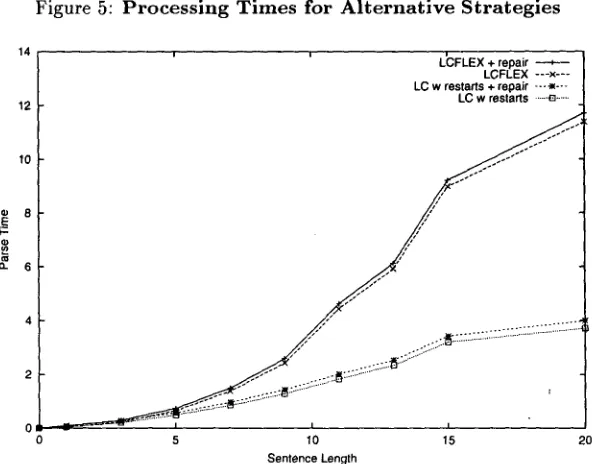
Each sentence was parsed in two different modes. In LC w / r e s t a r t s mode, the parser was allowed to construct analyses for contiguous portions of input starting at any point in the sentence. In L C F L E x mode, the parser was allowed to start an analysis at any point and skip up to three words within the anal- ysis. Because the AUTOSEM repair algorithm runs significantly faster than the ROSE repair algorithm, repair was a t t e m p t e d after every parse rather than only when a parse quality heuristic indicated a need as in the ROSE approach (Ros6, 1997). We com- pared the results of b o t h A U T O S E M and ROSE in conjunction with the LC w / r e s t a r t s parsing mode. The results are displayed in Figures 5 and 7. Be- cause the ROSE approach only runs the full repair algorithm when its parse quality heuristic indicates a need and the parser returns more than one par- tial analysis, it only a t t e m p t e d repair for 14% of the sentences in the corpus. Nevertheless, although the A U T O S E M repair algorithm ran for each sentence, Figure 5 demonstrates t h a t processing time for pars- ing plus repair in the A U T O S E M condition was dra- matically faster on average than with ROSE. Aver- age processing time for the ROSE algorithm was 200 times slower than t h a t for A U T O S E M on sentences where both repair algorithms were used. In addition to the advantage in terms of speed, the A U T O S E M repair approach achieved an acceptable grade (Okay or Perfect) on approximately 4% more sentences.
Parsing in LC w / r e s t a r t s mode plus repair was also compared with parsing in L C F L E x mode with skipping up to three words. Again, LC w / r e s t a r t s + AUTOSEM repair achieved a slightly higher number of acceptable grades, although L C F L E x achieved a slightly higher number of Perfect grades. On long sentences (between 15 and 20 words), L C F L E x mode required almost three times as much time as LC w / r e s t a r t s mode plus A U T O S E M re- pair. This evaluation confirms our previous results that two stage approaches offer a better processing time versus robustness trade-off.
45
40
35
3O
.~ 25
p-
20
15
10
5
i i ,
ROSE ~ "
C A R M E L - - - x - - -
)e-. . . "~ . . . "~ . . . k,- .. . . x . . .
5 10 15 20
Sentence Length
Figure 5: Processing Times for Alternative Strategies
14
12
10
8
E
o. 6
0 ; 0
' ' L C F L E X + repair
LCFLEX LC w restarts + repair --.-m---
LC w restarts .---.~ ...
/ / / " ..- : . ~ 2 2. L-.:.:2 2 2.:.:.:2.:2 2 2 2 2 2:.2-" 2;:2
5 '10 15 20
Sentence Length
Figure 6: Processing Times for Alternative Strategies
ated by ROSE m u s t therefore be much larger than in A U T O S E M in order to obtain the same results. Fur- thermore, the fitness of each repair hypothesis can only be c o m p u t e d by executing the p r o g r a m to ob- tain a result. The combination of all of these things makes the process of fitness evaluation in ROSE far more costly than in A U T O S E M . In contrast, AU- T O S E M ' s constructor function definitions make it possible for the genetic search to m a k e use of seman- tic restrictions to speed up the process of converging on a high quality repair hypothesis. T h e tremendous speed-up offered by the A U T O S E M approach makes
it practical to apply repair more often and to use a larger generation size (50 individuals as opposed to 32) and a larger n u m b e r of generations (5 as opposed to 4) for the genetic search.
7
C u r r e n t D i r e c t i o n s
In this paper we described A U T O S E M , a new robust semantic interpretation framework. Our evaluation demonstrates t h a t A U T O S E M achieves a greater level of robustness 200 times more efficiently than the most similar c o m p e t i n g approach.
[image:7.612.162.460.88.301.2] [image:7.612.164.461.314.546.2]Bad Okay Perfect LC w/restarts 92 (30.7%) 61 (20.3%) i47 (49.0%)
LCFL~x 72 (24.0%) 67 (22.3%) 161 (53.7%)
LC w/restarts + ROSE 75 (25.0%) 68 (22.7%) 157 (52.3%) LC w/restarts + AUTOSEM 64 (21.3%) 84 (28.0%) 152 (50.7%) LCFLEx + AUTOSEM 64 (21.3%) 78 (26.0%) i58 (52.7%)
Total Acceptable
209 (69.3%) 228 (76.0%)
225 (75.0%)
236 (78.7%) 236 (78.7%)
Figure 7: I n t e r p r e t a t i o n q u a l i t y w i t h a n d w i t h o u t r e p a i r
functional roles and semantic arguments is com- pletely determined in the current version. In some cases, such as with copular constructions and with adjunct prepositional phrases, it would be useful to introduce some non-determinism so that, for exam- ple, semantic selectional restrictions between the ob- ject. of the preposition and the semantic structure that the prepositional phrase is attaching to can more easily play a role in selecting the appropri- ate semantic relationship. Exploring approaches for achieving this non-determinism efficiently is one of our current objectives.
8
Acknowledgements
Special thanks are due to the JANUS multi- lingual speech-to-speech translation project for mak- ing their interlingua specification and semantic pars- ing and generation grammars available for the eval- uation reported here. This research was supported by NSF Grant IRI-94-57637 and Grant 9720359 to CIRCLE, a center for research on intelligent tutor- ing.
References
S. Abney. 1996. Partial parsing via finite-state cascades. In Proceedings of the Eighth European Summer School In Logic, Language and Informa- tion, Prague, Czech Republic.
S. Ait-Mokhtar and J. Chanod. 1997. Incremental finite-state parsing. In Proceedings of the Fifth Conference on Applied Natural Language Process- ing.
M. Dalrymple. 1999. Semantics and Syntax in Lex- ical Functional Grammar. The MIT Press. M. Danieli and E. Gerbino. 1995. Metrics for evalu-
ating dialogue strategies in a spoken language sys- tem. In Working Notes of the A A A I Spring Sym- posium on Empirical Methods in Discourse Inter- pretation and Generation.
R. Freedman, C. P. Ros6, M. A. Ringenberg, and K. VanLehn. to appear. Its tools for natural language dialogue: A domain-independent parser and planner. In Proceedings of the Intelligent Tu- toring Systems Conference.
R. Grishman, C. Macleod, and A. Meyers. 1994. COMLEX syntax: Building a computational lexi- con. In Proceedings of the 15th International Con- ference on Computational Linguistics (COLING-
94).
D. R. Hipp. 1992. Design and Development of Spoken Natural-Language Dialog Parsing Systems. Ph.D. thesis, Dept. of Computer Science, Duke University.
W. Kasper, B. Kiefer, H. Krieger, C. Rupp, and K. Worm. 1999. Charting the depths of robust speech parsing. In Proceedings of the 37th An- nual Meeting of the Association for Computa- tional Linguistics.
J. Koza. 1992. Genetic Programming: On the Pro- gramming of Computers by Means of Natural Se- lection. MIT Press.
J. Koza. 1994. Genetic Programming H. MIT Press. A. Lavie and C. P. Ros~. 2000. Optimal ambi- guity packing in unification-augmented context- free grammars. In Proceedings of the International
Workshop on Parsing Technologies.
A. Lavie. 1995. A Grammar Based Robust Parser For Spontaneous Speech. Ph.D. thesis, School of Computer Science, Carnegie Mellon University. J. F. Lehman. 1989. Adaptive Parsing: Self-
Extending Natural Language Interfaces. Ph.D. thesis, School of Computer Science, Carnegie Mel- lon University.
C. P. Ros~ and A. Lavie. to appear. BMancing ro- bustness and efficiency in unification augmented context-free parsers for large practical applica- tions. In J. C. Junqua and G. Van Noord, editors, Robustness in Language and Speech Technologies. Kluwer Academic Press.
C. P. Ros~ and A. Waibel. 1994. Recovering from parser failures: A hybrid statistical/symbolic ap- proach. In Proceedings of The Balancing Act: Combining Symbolic and Statistical Approaches to Language workshop at the 32nd Annual Meeting of the A CL.
C. P. Ros& 1997. Robust Interactive Dialogue Inter- pretation. Ph.D. thesis, School of Computer Sci- ence, Carnegie Mellon University.
G. Van Noord. 1997. An efficient implementation of the head-corner parser. Computational Linguis- tics, 23(3).
[image:8.612.154.518.83.145.2]