A c q u i r i n g K n o w l e d g e F r o m E n c y c l o p e d i c T e x t s *
Fernando Gomez
Dept. of Computer Science
Univ. of Central Florida
Orlando, FL 32816, USA
g o m e z ~ c s , u c f .
edu
Richard Hull
Dept. of Computer Science
Univ. of Central Florida
Orlando, FL 32816, USA
hull@as, ucf.
eduCarlos Segami
Math. and Comp. Sci. Dept.
Barry University
Miami Shores, FL 33161, USA
segami~buvax, barry,
eduAbstract
A c o m p u t a t i o n a l model for the acquisition of knowledge from encyclopedic texts is de- scribed. T h e model has been implemented in a program, called SNOWY, t h a t reads unedited texts from The World Book En- cyclopedia, and acquires new concepts and conceptual relations about topics dealing with the dietary habits of animals, their classifications and habitats. T h e program is also able to answer an ample set of ques- tions a b o u t the knowledge t h a t it has ac- quired. This paper describes the essential components of this model, namely seman- tic interpretation, inferences and represen- tation, and ends with an evaluation of the performance of the program, a sample of the questions t h a t it is able to answer, and its relation to other programs of similar na- ture.
1
Introduction
We present an approach to the acquisition of knowl- edge from encyclopedic texts. T h e goal of this re- search is to build a knowledge base about a given topic by reading an encyclopedic article. Expert sys- tems could use this database to tap in for pieces of knowledge, or a user could directly query the database for specific answers. Then, two possible applications could be derived from our research: (a) the a u t o m a t i c construction of databases from ency- clopedic texts for problem-solvers and (b) querying an encyclopedia in natural language. The idea is to build a database from an encyclopedic text on the fly. Then, if a user asks the question, say, Which bears eat seals? the system would reply by saying something like "I d o n ' t know. But, wait a minute, I am going to read this article and let you know." In the process of reading the article, the system builds a small knowledge base about bears and calls the
*This research is being funded by NASA-KSC Con- tract NAG-10-0120
question-answering system to answer any question
posed
by an expert system or a human. T h e long-term goal of our research is to read an entire ar- ticle on, say bears, and to build a knowledge base about bears. Since this goal requires dealing with an extraordinary number of research issues, we have concentrated on a series of topics a b o u t animals, in- cluding diet, habitat, and classification. A skimmer scans the article for sentences relevant to a given topic and passes these sentences to the understand- ing system, called SNOWY, for complete parsing, in- terpretation, concept formation, concept recognition and integration in long-term m e m o r y (LTM). But, if, in the process of learning a b o u t the dietary habits of, say beetles, the p r o g r a m is told t h a t they culti- vate fungi, and the program is able to interpret t h a t sentence, t h a t knowledge will also be integrated in LTM. Consequently, our approach to understanding expository texts is a b o t t o m - u p approach in which final knowledge representation structures are built from the logical form of the sentences, without inter- vening scriptal or frame knowledge about the topic. Hence, our system does not start with a frame con- taining the main slots to be filled for a topic, say "diet," as in recent MUC projects (Sundheim, 1992), but rather it will build everything relevant to diet from the o u t p u t of the interpretation phase. Then, when we are talking a b o u t the topic, it will not make any difference if the sentences refer to what the an- imals eat, or what eats them. Every aspect dealing with the general idea of ingest can be analyzed and properly integrated into memory. Our corpora for testing our ideas has been The World Book Ency- clopedia (World Book, 1987), which is one or two levels less complex than the Collier's Encyclopedia, which, in turn, is less complex t h a n the Encyclopae-
dia Britannica.
2 Interpretation
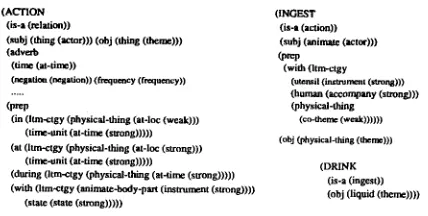
(ACTION (INGEST (is-a (relathm)) (is-a (action)) (subj (thing (actor))) (obj (thing (theme))) (subj (animate (acte0))
(adverb (prep
(time (at-time)) (with (Itm-ctgy (nesati~ (negation)) ( frequef:cy (frequeocy)) (uteri[ (ingt~mem (s~ron~))) ... (human (accompany (strong))) (prep (physical-thing
(in (Itm-ctgy (physical-thlng (at-loc (weak))) (c~ther~ (weak)))))) (time-unit (at-time (strong)))))
(obj (J~ysical -thing (theme))} (at (ltm~gy (physical-thing (at-loc (strong)))
(time-unit (at-time (strong))))) (DRINK (during (Itm-ctgy (physical-thing (at-time (strong))))) (is-a (inge.~t)) (with (ltm-ctgy (animate.body-part (instrument (strong)))) (obj (liquid (theme))))
(state (state (strong)))))
Figure 1: Organization of the Verbal Concepts
(REPS ((VRS (G233)))
SUBJ ((PARSER ((DFART THE) (VERB CROWNED) (NOUN EAGLE))) (REE (DEFINITE)) (PLURAL NIL)
(INTERP (CROWNED-EAGLE (Q (ALL)))) (SEMANTIC-ROLE (ACTOR))) PREP ((PARSE (OF ((PN AFRICA)))) (INTERP (AFRICA (Q (CONSTANT))))
(ATTACH-TO (CROWNED-EAGLE (LOCATION-R (AFRICA)))))
VERB ((MAIN-VERB EAT EATS) (TENSE PRES)(NUM SING) (PRIM (IY4GEST))) OBJ ((PARSE ((NOUN MONKEYS))) (PLURAL T)) (INTERP (MONKEY (Q (?))))
(SEMANTIC-ROLE (THEME))))
output for Structure G233:
(SUBJ ((PARSE ((DFART THE) (VERB CROWNED) (NOUN EAGLE))) (REP (DEFINITE)) (PLURAL NIL)
(INTERP (CROWNED-EAGLE (Q (ALL)))) (SEMANTIC-ROLE (ACTOR))) VERB ((MAIN-VERB LIVE LIVES) (TEMSE PRES) (NUM SING) (PRIM (I]*4HABIT))) PREP ((PARSE (IN ((DFART THE) (NOUN RAIN) (NOUN FOREST))))
(REF (DEFI~TITE)) (PLURAL NIL)
(INTERP (RAIN-FOREST)) (SEMANTIC-ROLE (AT-LOC)) (ATtACH-TO (VERB (STRONGLY))))
tation phase is built by a top-down, lexical-driven parser(Gomez, 1989), which parses the sentences di- rectly into syntactic cases. Prepositional phrases are left unattached inside the structure built by the parser. It is up to the interpreter to attach them, identify their meaning and the thematic roles that they m a y stand for. T h e parser is a deterministic machine, containing mechanisms for minimizing the need for backing up. The average a m o u n t of time in parsing a sentence from the encyclopedia is about one second. T h e parser has presently a lexicon of about 35,000 words. The rate of success of produc- ing a full and correct parse of a sentence is, as of this writing, 76.8% for this Encyclopedia (see below for a detailed discussion of test results and machine used). The parser begins the parsing of a sentence on a syntactic basis until the meaning of the verb is recognized. T h e rules that determine the mean- ing of the verbs, called VM rules, are classified as subj-rules, verb-rules, obj-rules, io-rules, pred-rules, prep-rules, and end-of-clause-rules. These rules are activated when the verb, a syntactic case or a prepo- sitional phrase has been parsed, or when the end of the clause has been reached, respectively. In most cases, the antecedents of these rules contain selec- tional restrictions which determine whether the in- terpretation of the syntactic constituent is a sub- class of some concept in SNOWY's LTM ontology. If during an examination of LTM the selectional re- striction is passed, the consequent(s) of the VM rule establish the proper meaning or verbal concept for the verb. If no rules fire, the parser inserts the syn- tactic case or prepositional phrase in the structure being built and continues parsing. These rules, of which there are just over 300, incorporate a con- siderable degree of ambiguity procrastination (Rich, 1987). For instance, rather than writing an obj-rule for determining the meaning of "take" saying: If LTM(obj) is-a medicament then meaning-of take is ingest, which will immediately j u m p to determine the meaning of "take" in Peter took an aspirin when the obj is parsed, it is better to write that rule as an end-of-clause rule. This will avoid making the wrong assumption about the meaning of the verb in Peter took an aspirin to Mary.
Figure 2: O u t p u t of the parser and interpreter for the sentence The crowned eagle of Africa lives in the rain forests and eats monkeys.
[image:2.612.78.292.82.190.2]action root node.
Figure 2 depicts the output of the interpreter. The slot subject contains the output of the parser marked by the slot PARSE, the interpretation of the noun phrase marked by INTERP, and the the- matic role marked by SEMANTIC-ROLE. The entry Q within the I N T E R P slot indicates the quantifier for that case. The entries for the slot PREP, contain, in addition to the PARSE slot, the slot ATTACH- TO indicating which concept in the parse structure to attach t h a t constituent to, and the meaning of the preposition indicated, in this case, by the sub- slot LOCATION-R. The quantifier for "monkey" is a question mark, because its value is not indicated in the text. In (Gomez et al., 1992), the reader may find a detailed discussion of the interpretation issues presented in this session.
3
I n f e r e n c e s
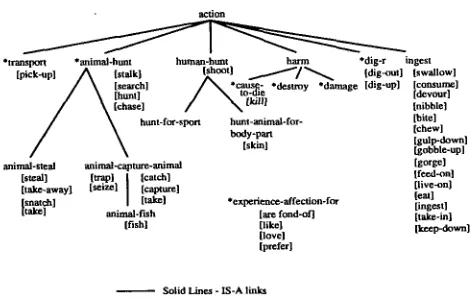
If the knowledge about dietary habits of animals were indicated in the texts by using "eat" and its cognates, the task of acquiring this knowledge would be rather simple. But, the fact is that an encyclo- pedia article may refer to the dietary habits in a variety of manners. Figure 3 contains a hierarchy about the diet topic. The verbs that trigger these verbal concepts are indicated by writing [verb]. The verb "dig out" triggers the action dig-r. Those ver- bal concepts from which an ingest relation is inferred are indicated by writing an asterisk by its side. The representation of dig-r is:
(dlg-r ( i s - a ( a c t i o n ) )
(subj ( a n i m a l (actor)) ( m a c h i n e (actor))) ( o b j ( p h y s i c a l - t h i n g ( t h e m e ) ) ) ( a d d i t i o n - r o l e s ( f i r e - o n e
((and (if% i s - a actor a n i m a l ) (ife'/o i s - a t h e m e a n i n ~ a t ¢ ) ) ( a d d (((actor (actot)) (pr ( i n g e s t ) )
( t h e m e ( t h e m e ) ) ) ) ) ) ) ) )
The representation of dig-r is similar to the previ- ous verbal concepts, except for the entry that says addition-rule. This is an inference rule saying that if the actor of this action is an animal and the theme is an animate, then add to LTM the relation say- ing that the actor ingests the theme. This rule per- mits the acquisition of the fact that bears eat squir- rels and mice from the sentence A grizzly has long, curved claws that it uses chiefly to dig out ground squirrels and mice. Similar inference rules are stored in the other actions marked with an asterisk. Then, if the system reads the sentence Bears are fond of honey, it will infer that they eat honey. The infer- ence rules are also inherited from the nodes repre- senting the actions in the hierarchy. Hence, if the verbal concept animal-fish, shown in Figure 3, was suggested for the sentence Owls have been known to fish in shallow creeks, we would inherit an addi- tion rule from the verbal concept animal-hunt which would then infer an ingest relation.
- action
*transport *animal-hum huraan-htmt harm *dig-r ingest
[~k~p] A [,l~k] ~oot] ~ / ~ ] ~ g ~ ] [,wallow[
/ \ [search / ~ . *cause- *destroy *damage ]dig-up[ [consume]
to-ule [devour]
/ \ !",~']. tenasel / / \'D~lll x, [nibble]
[image:3.612.342.577.79.229.2]body-part ]chew] ]gulp-down] [skin] {gobble-up] animal-steal animal-captm'e-aulmal {gotgc]
[steal] [trap] I [catch] [feed-on]
I
]live-on[]take.away] [seize] ]capture] ]em]
[take] [ingest]
l ~ h ] *expedence-af fection- for
animal-fish ]ate fond-of[ [take-in]
[fish] ]like] ]keep-down[
]love[ [prefer]
- - Solid Lines - 1S-A links
Figure 3: Conceptual Verbs Organizing the Topic
The hierarchy is also helpful in avoiding incorrect inferences. Sentences discussing humans hunting an- imals do not automatically imply ingest relations, especiMly when an explicit purpose is given which is not ingest-related. For example in People hunt some kinds of seals for their soft fur, it is unlikely that the people mentioned will eat those seals. There- fore, we have separate verbal concepts for hunt re- lations where humans are the actors, whose infer- ence rules do not suggest ingest relations, except in cases like Eskimos hunt polar bears for food. Fur- thermore, addition rules typically have constraints within their antecedents to prevent inappropriate in- ferences, i.e., we would not want to infer an ingest relation when processing the sentence Tigers search for warm places to sleep during the day, and a con- straint on the theme of "search for" to be at least
animate rejects the inference.
4
I n t e r p r e t i n g N o u n P h r a s e s and
R e s t r i c t i v e Modifiers
Detecting classification relations in the text becomes a must, not only if questions of the type Which owls eat fish?, or Which eagles eat hyraxes? are to be answered, but also for the acquisition of the knowl- edge in sentences like The prey of polar bears con- sists of seals, or The diet of bears consists of nuts, berries and small rodents. In order to achieve this, complex noun groups and restrictive modifiers are represented by the noun group interpreter as clas- sification hierarchies. One of the senses of "diet" is represented as: X l (cf (is-a (food) R1)), where R1 is the relation ingest with actor = animal, and theme = food. Then, "the diet of bears" is represented as the concept X2 (cf (is-a (food) R2)), where R2 is the relation ingest with actor = bear, and theme = food. The slot cf contains the necessary and suffi- cient conditions that define the concept X2. Then, the meaning of X2 is:
T h e same interpretation is given to restrictive rel- ative clauses. T h e phrase "eagles t h a t live in the rain forests" is represented as
X3 (cf (is-a (eagle) R3)),
where R3 is the relation "live in the rain forests." Once these structures are built by the interpreter, a classifier that is a component of the integration al- gorithm integrates these concepts in the proper po- sition in LTM. The interpretation of complex nouns proceeds by a t t e m p t i n g to determine the meaning of pairs of items in the complex noun, utilizing a scheme t h a t combines the items in the complex noun from left to right. For example, in the interpretation of "big red wine bottle" an a t t e m p t is made to find a meaning for the terms "big red,....
big wine," "big bottle," "red wine," "red bottle" and "wine bottle." If one item in the complex noun can be paired (i.e., a meaning can be found) with more than one other item in the complex noun, then the algorithm re- turns more than one interpretation for the complex noun, and disambiguation routines are activated. In our example, a meaning is found for "big bottle," "red wine," "red bottle," and "wine bottle," from which the algorithm returns the two possible inter- pretations:(bottle (size ( b i g ) ) (color (red)) (pertain-to (wine))) (bottle (size ( b i g ) ) (pertain-to ( w i n e (color (red)))))
Finding the meaning of terms of the form " i t e m l item2" reduces to finding a relation that connects the concepts corresponding to " i t e m l " and "item2" in LTM. Consequently, this algorithm as well as the algorithm that finds the meaning of PPs and syn- tactic cases depends on a a priori set of concepts that constitutes the basic ontology of SNOWY. As S N O W Y reads, it adds new concepts to this ontol- ogy as explained below. Its initial ontology consists of 1243 concepts.
In order to find a semantic relation between two pair of items in a NP, the items or any of their su- perconcepts must belong to the
a priori
ontology. If the noun group interpreter does not find a seman- tic relation between two items, the algorithm will hyphenate them. This has been the case for "rain forest," and "crowned eagle" (see Figure 2). "Rain- forest" is constructed in LTM as a subconcept of "forest." But, no semantic relation will be built between "rain" and "forest." However, if the pair of items is "sea mammal," the algorithm buildsX3
(cf(is-a(mammal) live-in(sea))),
because "mammal" and "sea" are categorized in LTM as subconcepts of "animate" and "habitat," respectively. The algo- rithm will produce the same representation for "sea m a m m a l " and "mammals that live in the sea," ex- cept for the names of the concepts, which are d u m m y names with no meaning. Therecognizer
algorithm is able to tell that the two concepts are the same concept by examining the content of the cfslot, and activating aclassifier
t h a t analyzes the subsumption relations between a pair of concepts. In (Gomez andSegami, 1989), the reader m a y find a detailed dis- cussion of the
recognizer
algorithm. Note t h a t the algorithm will produce the conceptX4 (cf(is-a(lion)
live-in(sea)))
if the noun group "sea lion" is not in quotation marks or capitalized.5
Final K n o w l e d g e R e p r e s e n t a t i o n
S t r u c t u r e s
The input of the interpreter is passed to the for- mation phase that builds the final knowledge rep- resentation structures. These are in turn integrated into LTM upon activating a
recognizer
algorithm and anintegration
algorithm both of which make exten- sive use of aclassifier
similar to the one reported in (Schmolze and Lipkis, 1983). T h e construction of the final knowledge representation structures is done as follows. T h e interpretation phase, if successful, has built a relation, and a set of t h e m a t i c roles for each sentence. Let us call the thematic roles of the relation the entities for that relation. All the n en- tities of an-ary
relation are represented as objects in our language, and links are created pointing to the representation of the relation, which is repre- sented as a separate structure, called ana-structure.
Figure 4 depicts the representation produced from the interpretation of the sentenceThe crowned ea-
gle of Africa lives in the rain forests and eats mon-
keys.
Five objects have been created; C R O W N E D - EAGLE, AFRICA, R A I N - F O R E S T , M O N K E Y and @X235, which stands for the concept "crowned ea- gle of Africa." The relation @A237 represents theingest
relation between the object @X235 and the object MONKEY. The object M O N K E Y points to this structure by the entry under M O N K E Y t h a t saysingest~oby (@x235 (Smote (@a237)))),
and the object @X235 also points to this structure by the slot(ingest (monkey ($more (@a237)))).
T h e scope of the quantifiers is from left to right. Then, the meaning of structure @A239 (assuming t h a t the question mark in the quantifier slot of M O N K E Y stands for "some" as the question-answering as- sumes) isV(x)(@X235(x) ~
3 y ( M O N K E Y ( y ) A
I N G E S T ( x , y ) ) ) .
Ana-structure
can be linked to othera-structures
by slots expressingcausality, time,
etc., as becomes necessary in the representation ofBirds migrate south when it freezes.
6
R e s u l t s
C R O W N E D * E A G L E
(is-a (eagle))
R A I N - F O R E S T (is-a (feces0)
(related-to (@a239))
@X235
(cf (is-a (crowned-caBle)) (@a235)) (location-r (afi'ie a ($rncte (@a237))))
(ingest (monkey ($mofe (@a237)))) (inhabit ($null ($mcfe (@a239))))
@A235
(instance-of (description))
(args (@x235) (africa))
(pr (location-r)) (descr-subj (@r,235 (q (all)))) (descr-obj (africa (q (constant))))
AFRICA
(location-of (@x235 (Smote (@a236))))
M O N K E Y
(ingest%by (@x235 (Smote (@a237))))
@A237
(args (@x235) (monkey))
(pr (ingest)) (actor (@x235 (q (zll))))
(theme (monkey (q (?))D
(instance-of (action))
@A239
(args (@x235) (raln-fc~est)) (1~ (inhabit))
(actor (@x235 (q (all))))
(at-lot (rain-forest (q (7)))) (instance-of (action))
Figure 4: Formation Structures
umes of the encyclopedia. T h e letter "B" and the letter "M" were chosen. T h e texts were then se- lected from those volumes. In December of 1993, an article a b o u t birds was chosen. No component of the system (lexicon, parser, interpreter, etc.) was pre- prepared with information about this article. T h e lexicon of the parser consisted of 10,000 words. This text was the largest article t h a t the system had ana- lyzed, contMning approximately 1330 sentences and 16,000 words. None of the designers of the system read this article prior to the test. And even if they had read it, it would have been of very little use be- cause the system has reached such complexity that it is not easy to assess how it is going to perform in an article of 1330 sentences.
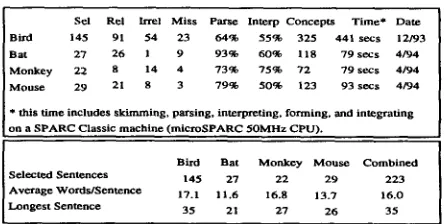
T h e first row of Table 1 indicates that 145 sentences were selected from the bird text by a k e y w o r d / p a t t e r n - b a s e d skimmer. Of these 145 sen- tences, 91 were relevant to the dietary habits do- main. A t o t a l of 23 relevant sentences were missed, primarily due to keywords or patterns not contem- plated. An example of sentence that is relevant but was not selected is Robins and sparrows, for example, are highly effective against cabbageworms, tomato worms, and leaf beetles. T h e parser was able to produce a correct parse for 58 of the 91 relevant sentences (64%), even in cases where the sentence contained unknown words. Among the sentences successfully parsed, the parser encountered some 40 unknown words of which approximately 70% were names of birds, such as "grosbeaks", "flycatchers", "titmice", "thrashers," etc., and 30% were common words. Of those 58 parsed sentences, 32 (55%) were interpreted correctly. T h e o u t p u t for these 32 sen- tences was then passed to the formation, recogni- tion, and integration phases to be inserted into LTM. Interpretation failures can be a t t r i b u t e d to missing VM rules, comparatives, and problems of anaphoric reference.
Later, in April of 1994, three more texts were ran- domly chosen for testing. A s u m m a r y of the results for those three tests is also given in Table 1. In
Table 1: Statistics for the Sentences of the Bird, Bat, Monkey, and Mouse Texts
S e l R e l I r r e l M i s s Parse Interp Concepts T i m e * Date
B i r d 1 4 5 91 5 4 2 3 6 4 % 5 5 % 3 2 5 4 4 1 s e e s 1 2 / 9 3
Bat 2 7 2 6 1 9 9 3 % 6 0 % 1 1 8 7 9 s e e s 4 / 9 4
M o n k e y 2 2 8 1 4 4 7 3 % V5q~ 7 2 7 9 s e e s 4 / 9 4 M o u s e 2 9 21 8 3 7 9 % 5 0 % 1 2 3 9 3 s e e s 4 / 9 4
* t h i s t i m e i n c l u d e s s k i m m i n g , p a r s i n g , i n t e r p r e t i n g , forming, and integrating o n a S P A R C Classic m a c h i n e ( m i c r o S P A R C 5 0 M H z C P U ) .
B i r d B a t M o n k e y M o u s e C o m b i n e d
S e l e c t e d S e n t e n c e s 1 4 5 2 7 2 2 2 9 2 2 3
A v e r a g e Words/Sentence 17.1 1 1 . 6 16.8 1 3 , 7 1 6 . 0
Longest Sentence 3 5 21 2 7 2 6 3 5
this test, the parser ran with a lexicon consisting of about 35,000 words. T h e improvement of the inter- preter was mainly due to new interpretation rules, additions to the hierarchy of verbal concepts, and to the hierarchy of concepts t h a t organize the infer- ences about the topic.
All of the tests were run on a SPAP~C Classic Ma- chine executing Allegro C o m m o n Lisp. T h e average time to completely process a selected sentence on this platform was 3.1 seconds. This is a conserva- tive figure because it includes the processing time of the skimmer, i.e., some a m o u n t of overhead is nec- essary for file handling and for determining when a sentence is irrelevant. Therefore, the average time for processing a sentence is actually less than -3.'1 seconds.
T h e following is a list of natural language ques- tions posed to the system after reading the bird, bat, and monkey articles and the contents of the system-generated answers. Note t h a t the system o u t p u t has been Mtered and condensed for the sake of brevity. In answering the questions, the sys- tem uses classification-based reasoning, not theorem proving. Many complex chains of inferences can be obtained by keeping m e m o r y organized in a princi- pled manner. In those cases in which a question asks about a concept that does not exist in LTM, the clas- sifier is activated to place t h a t concept in LTM and obtain an answer. See (Gomez and Segami, 1991) for a detailed discussion of all these issues and the theorems proving the soundness of the inference al- gorithms.
What do birds eat? sapsucker ingest tree-sap; hum- mingbird ingest nectar; duck ingest p l a n t - m a t t e r , grass, seaweed; louisiana-water-thrush ingest water- insect; young-bird ingest earthworm, insect, small animal; ...
Which birds eat nectar? h u m m i n g b i r d ingest nectar What kinds of insect eaters are there? chickadee, creeper, flycatcher, kinglet, swallow, swift, thrasher, titmice, vireo, warbler, woodpecker, owl
[image:5.612.98.301.80.231.2] [image:5.612.344.568.126.238.2]process
Do most cactus dwellers eat insects? yes
What kills birds? eagle is-a bird, and hunters and trappers kill eagles; osprey is-a bird, and hunters and trappers kill osprey
When do most birds search for food? at-time day Do birds help people? yes, bird help farmer
How do birds help farmers? bird ingest <insect which ingest crop>; bird ingest weed-seed
Do bats eat blood? yes, some bat eat blood because vampire-bat is-a bat and vampire-bat ingest blood How much blood do vampire bats eat? vampire-bat ingest blood quantity 1 tablespoon *frequency* day Do vampire bats attack human beings? yes, vampire bat h a r m h u m a n *frequency* sometimes
Do monkeys have enemies? yes, some monkey has- enemy cheetah hyena jackal leopard lion because <monkeys inhabit at-loc g r o u n d > has-enemy chee- tah hyena jackal leopard lion
7 R e l a t e d W o r k
In (Sondheimer et al., 1984), frame-like structures, KL-ONE structures in fact, are also used to guide semantic interpretation in an application domain. However, the overall approach to the interpreta- tion task presented here differs from that work. In approaching the problem of unrestricted texts, we agree with those researchers (Hobbs, 1991; Grish- m a n et al., 1991) who think that it is possible to build correct parses and interpretations for real- world texts. In fact, it is hard for us to see how statistical methods (de Marcken, 1990; Church et al., 1991) could be used for building knowledge-bases with sufficient expressive power to correctly answer questions posed by expert systems or h u m a n users. We think that the same critique applies to skim- mers (Lehnert et al., 1991), but for very different reasons. In order to guarantee the correctness of the knowledge-base built, every element in the sen- tence needs to be interpreted. For instance, if the adverb "mostly" is not interpreted in the sentence These owls eat mostly rodents, the integrity of the knowledge-base built is not going to suffer greatly. But, if we are talking about the adverb "rarely" in the sentence These owls rarely eat rodents, the situ- ation becomes much more serious, as we found out. This work has advanced a new approach to se- mantic interpretation that occupies a middle ground between those approaches that rely heavily on the parser for building structures and attaching PPs, subordinate clauses, etc. (Grishman et al., 1991; Hobbs, 1978; Tomita, 1985) and semantic-centered approaches (Riesbeck and Martin, 1986; Cardie and Lehnert, 1991; Slator and Wilks, 1991). Our parser delegates all the burden of dealing with structural ambiguity ( a t t a c h m e n t of PPs, relative clauses, sub- ordinate clauses, etc.) to the interpreter. T h a t is one of the reasons why it is so fast. T h e interpreter has a
very sophisticated algorithm t h a t uses the informa- tion built in the verbal concepts in order to attach PPs. Yet, if the parser does not build a parse, albeit a shallow one, the interpreter will not know what to do. Moreover, the interpreter does not question the parser when it says this constituent is an obj, or subj, or a time-np, etc. This is a situation that we are not happy about, because the parser identifies some constituents incorrectly, especially the time- np. We are studying mechanisms under which the interpreter will override the parser and will get it out of trouble in processing very complex sentences (Krupka et al., 1991; Jacobs et al., 1991).
8 C o n c l u s i o n s
We have presented a m e t h o d for the acquisition of knowledge from encyclopedic texts. T h e m e t h o d de- pends on understanding what is being read, which in turn depends on: (1) providing a successful parse and interpretation for a sentence, (2) building final knowledge representation structures from the log- ical form of the sentence, which involves creating new concepts and relations as the system is reading, and (3) integrating in LTM those concepts and rela- tions that the recognizer algorithm fails to recognize, which in m a n y cases involves the reorganization of concepts in LTM.
ingest, and consequently, the skimmer is not going to select this sentence. Then, if the author later on says Makos feed on other fish, including herring, mackerel, and swordfish, the system has no way to relate "Mako" to sharks, missing the fact that sharks feed on herring, mackerel, and swordfish. In June, we tested the parser on 2900 sentences from 25 ar- ticles, including non-animal articles such as black- holes, cancer, computer chips, napoleon, greenhouse effect, etc., and the rate of success was 76.8%. How- ever, some sentences are still not parsed because some subcategorizations of verbs are wrong or in- complete, or the phrasal lexicon is incomplete. We are confident that the parser may reach a plateau at 85% or 90% for this Encyclopedia. The remaining 10% or 15% may require considerable help from the interpreter to be parsed.
R e f e r e n c e s
Cardie, C. and Lehnert, W. (1991). A cognitively plausible approach to understanding complex syn-
tax. In Proc. AAAI-91, pp. 117-124, Anaheim,
CA, July 1991.
Church, K., Gale, W., Hanks, P., and Hindle, D. (1991). Parsing, Word Associations, and Typi-
cal Predicate-Argument Relations. In Current Is-
sues in Parsing Technology, Tomita, Masaru, ed., Kluwer Academic Publishers, Boston, MA, pp. 103-112.
Gomez, F. (1989). WUP: A parser Based on Word Usage. UCF-Tech-89-2, Dept. of Computer Sci- ence, University of Central Florida, Orlando, F1 32816, (Under Revision).
Gomez, F., and Segami, C. (1989). The Recogni- tion and Integration of Concepts in Understand- ing Scientific Texts. Journal of Experimental and
Theoretical Artificial Intelligence. 1, pp. 51-77. Gomez, F., Segami, C., and Hull, R. (1993). Prepo-
sitional Attachment, Prepositional Meaning and Determination of Primitives and Thematic Roles. UCF Technical Report.
Gomez, F., and Segami, C. (1991) Classification-
Based Reasoning. IEEE Trans. on Systems, Man
and Cybernetics, 21, no. 3, pp. 644-659.
Grishman, R., Sterling, J., and Macleod, C. (1991). New York University: Description of the PRO-
TEUS System as Used for MUC-3. Proc. 3rd Mes-
sage Understanding Conference (MUC-3), May, 1991, Morgan Kaufmann, pp. 3-16.
Grosz, B. J., Providing a Unified Account of Definite Noun Phrase in Discourse, Proc. ACL, 1983, pp. 44-5O.
Hobbs, a. R. (1991). SRI International: Descrip- tion of the TACITUS System as Used for MUC-3.
Proc. 3rd Message Understanding Conf. (MUC-
3), May, 1991, Morgan Kaufmann, pp. 3-16.
Hobbs, J. R. (1978). Resolving pronoun refer- ences. In Readings in Natural Language Process- ing, Grosz, B., Jones, K. S., Webber, B., eds., pp 339-352, Morgan Kaufmann Publishers, Los Al- tos, CA.
Jacobs, P. S., Krupka, G. R., Rau, L. F. (1991). Lexico-semantic pattern matching as a companion
to parsing in text understanding. In Proc. DARPA
Speech and Natural Language Workshop, pp. 337- 341, Asilomar, CA.
Krupka, G., Jacobs, P., Rau, L., and Iwanska, L. (1991). GE: Description of the NLToolset Sys-
tem as Used for MUC-3. Proc. 3rd Message Un-
derstanding Conf. (MUC-3), May, 1991, Morgan Kaufmann, pp. 3-16.
Lehnert, W., Cardie, C., Fisher, D., Riloff, E., and Williams, R. (1991). University of Massachusetts: Description of the CIRCUS System as Used for
MUC-3. Proc. 3rd Message Understanding Conf.
(MUC-3), May, 1991, Morgan Kaufmann, pp. 3- 16.
de Marcken, C. G. (1990). Parsing the LOB cor- pus. In Proc. ACL, pp. 243-251, Helsinki, Finland, Aug. 1990.
Rich, E., Barnett, J., Wittenburg, K., and Wrob- lewski, D. (1987). Ambiguity Procrastination. AAAI-87, pp. 571-574.
Riesbeck, C. K., and Martin, C. E. (1986). Direct
Memory Access Parsing. Experience, Memory and
Reasoning, ed. Kolodner, J. and Riesbeck, C. K., Lawrence Erlbaum Associates, Hillsdale, N.J. Slator, Brian M., and Wilks, Yorick. (1991).
PREMO: Parsing by conspicuous lexical con- sumption. In Current Issues in Parsing Technol- ogy, Tomita, Masaru, ed., Kluwer Academic Pub- lishers, Boston, MA, pp. 85-102.
Schmolze, J., and Lipkis, T. (1983). Classification in the KL-ONE Knowledge Representation System, in Proc. IJCAI-83, Karlsruhe: IJCAI, pp. 330- 332, 1983.
Sondheimer, N. K., Weischedel, R. M., and Bobrow, R. J. (1984). Semantic Interpretation Using KL-
ONE. COLING-84, pp. 101-107.
Sundheim, Beth M. (1992). Overview of the Fourth Message Understanding Evaluation and Confer-
ence. Proc. 4th Message Understanding Conf.
(MUC-4), June, 1992, Morgan Kaufmann, pp. 3- 21.
Tomita, M. (1985). Efficient parsing for natural lan- guage. Kluwer Academic Publishers, Boston, MA. The World Book Encyclopedia. (1987). World Book,
Inc., Chicago.