P. O. Box 314, Northeastern University, Shenyang 110004, P. R. China
Grain refinement of a magnesium alloy, AZ80, was studied in multi-directional forging (MDF) with decreasing temperatures from 683 to 573 K. The MDF was carried out up to accumulative true strains of around 7 with changing the loading direction from pass to pass. The structural changes are characterized by the alternate appearance offine dynamic recrystallized (DRXed) grains (with many dynamic granular Mg17Al12phases) and coarse DRXed grains (without Mg17Al12phases) in the sample, the expansion of thefine grains area, and the refinement of (DRXed) grains in thefine grains area during the MDF process. The non-uniform dynamic precipitation of the Mg17Al12phase may attribute to the inhomogenous Al content distribution in the Mg matrix. These Mg17Al12phase retards the growth of the DRX grains, which in turn results in the formation and the expansion of thefine grains area during the MDF process with decreasing temperature.
[doi:10.2320/matertrans.M2013251]
(Received July 3, 2013; Accepted November 5, 2013; Published January 25, 2014)
Keywords: AZ80 magnesium alloy, multi-directional forging, severe plastic deformation, dynamic recrystallization, precipitation
1. Introduction
Ultra-fine grain (UFG) structure materials are assumed to possess high strength and good ductility. To obtain such materials, severe plastic deformation (SPD) is the most effective method. As a widely used material in modern industry, Mg alloys have also been inevitably involved in the SPD process. So far, the SPD-induced fine grained micro-structure and the corresponding properties of Mg alloys have been extensively reported.110) It has been discussed that during cold or warm working the fine grains result from the continuous dynamic reactions. However, the grain size depends on the deforming temperature, strain rate, and original structure, etc.
Although a low deforming temperature is desirable for obtaining fine grains, the poor ductility of Mg alloys will induce fracture. Hence, taking into account both the grain refinement and the formability, the SPD of Mg alloy is usually carried out in a temperatures decreasing process with low strain rate.912) In the AZ-series Mg alloys, the decreasing temperatures during the SPD process will lead to the reduction of aluminum solid solubility, and then result in the “dynamic precipitation”of the Mg17Al12 phase. This phase can reduce the final dynamic recrystallized (DRXed) grain size by pinning the grain boundaries.10)
In addition, it is known that original structure also has an important influence on thefinal deformed structure. Usually the original grains can be completely replaced by the DRXed grains by a continual increment of the strains during SPD. However, the original inhomogenous solute distribution (unavoidable even with a normal homogenized heat treat-ment13)) cannot be eliminated by this increment. As mentioned above, the Mg17Al12 phase in the AZ-series Mg alloys can affect the DRXed grains. Thus, the inhomoge-nously distributed Al and then the precipitated Mg17Al12 phase will certainly result in inhomogenously deformed structure.
AZ80 is an important deformation Mg alloy. The structure evolution of this alloy in the SPD process has been widely investigated.10,14) However, the correlation among the Al solute distribution, the precipitation of Mg17Al12 and the DRXed grain size was rarely mentioned. Based on this, AZ80 Mg alloy was chosen and multi-directionally forged during decreasing temperatures from pass to pass and the above-mentioned correlation was carefully studied.
2. Experimental
Three same-sized rectangular samples (61 mm (xaxis)© 52 mm (y axis)©45 mm (z axis)) were cut from a commercial direct chill (DC) casting AZ80 magnesium alloy (annealed at 683 K for 16 h) with compositions of Al (7.85 mass%), Zn (0.43 mass%), Mn (0.21 mass%) and the balance Mg. The samples were heated at 683 K for 1.5 h, and then forged by a 300-t hydraulic press. The MDF process was carried out with changing the loading axes (i.e.,
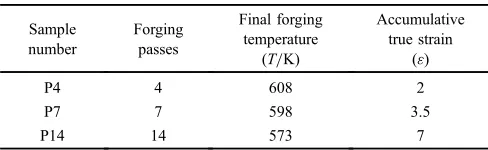
[image:1.595.305.549.711.786.2]x¼y¼z¼x+) from pass to pass. The strain rate and the true strain of each pass were 0.13 s¹1 and 0.5 (with 0.5 true strain the sample could almost change back to the original shape in each pass, indicating that the MDF process could be carried out infinitely), respectively. The detailed experimental parameters are shown in Table 1. The deformed samples were cut along the middle plane parallel to the last compression axis, then mechanically polished and etched by the mixed liquid picric acid and nitric acid for macro- and microstructural observation. Afterwards, small specimens
Table 1 Experimental parameters.
Sample number Forging passes Final forging temperature
(T/K)
Accumulative true strain
(¾)
P4 4 608 2
P7 7 598 3.5
P14 14 573 7
were cut from these samples. With a further grounding, polishing and oxidizing, these specimens were observed by a SHIMADZU SS-550 scanning electron microscope. The Al and Zn compositions in the primary Mg matrix were manually detected by the EPMA-1600/1610 Electron Probe Microanalysis (EPMA).
3. Results and Discussion
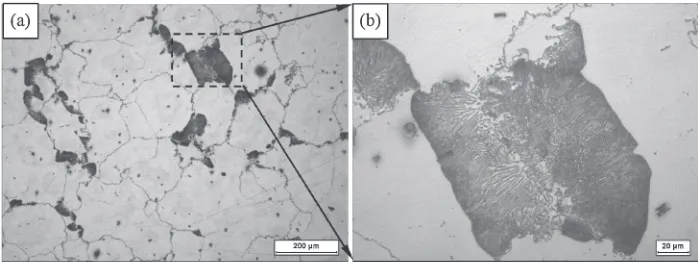
Figure 1(a) shows the optical micrograph of the initial DC casting AZ80 alloy after homogenization heat treatment. It can be found that the matrix is composed of some equiaxed grains (about 210 µm). And some black contamination like substances are distributed along the grains boundaries. A further observation shows that these substances are composed of laminar second phase, as shown in the magnified figure in Fig. 1(b). EDX analysis indicates that the phase is laminar ¢-Mg17Al12. A statistical measurement suggests that the mean area fraction of Mg17Al12 in the specimen is about 13.6%.
Figures 2(a)2(c) show the macrostructures of the speci-mens with different forging passes. As can be seen, the metal flow lines become more obvious with increasing the passes. To reveal the details, the microstructures corresponding to the zones enclosed by the rectangular frames in Figs. 2(a)2(c) are displayed in Figs. 2(d)2(f ), respectively. It can be found that the metal flow lines are actually composed of some mutual-mixed black and white structures. Furthermore, the areas of the black structures increase with increasing the accumulative strains and decreasing temperature. The mean fractions of the black areas measured in Figs. 2(d)2(f ) are about 19.4, 25.4 and 52.2%, respectively.
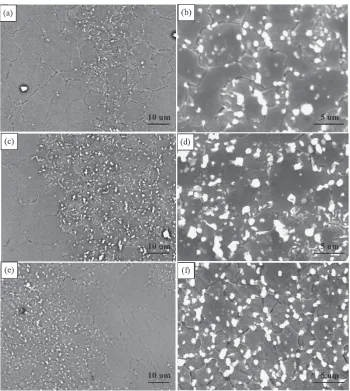
Figures 3(a)3(c) show the further magnified micrographs of the P4-sample, P7-sample and P14-sample respectively. It can be seen that in all the samples the white and black structures consist of coarse (about 20 µm) and fine (several micrometers) grains, respectively. Moreover, the areas of the fine grains obviously increase with increasing the accumu-lative strains and decreasing temperature. A further observa-tion indicates that some second-phase ¢-Mg17Al12 is dis-tributed along the boundaries in the fine grain structure, as shown in the SEM images in Figs. 4(a)4(c). And different from the laminar second-phase in the initial alloy, the ¢-Mg17Al12 reveals granular form. Moreover, the size of the
fine grains decreases with increasing the accumulative strains and decreasing temperature, but that of the coarse grains seems less affected. In addition, it is also found that the Al compositions in the primary Mg matrix in thefine and coarse grains are also different. Figure 5(b) shows a typical zone with mixed fine and coarse grains. EPMA analysis on the points enclosed by the circles (see the magnified images in Figs. 5(a) and 5(c)) indicates that the mean Al compositions in the Mg matrix of fine and coarse grains are 8.1 and 6.1 mass%, respectively.
The results have clearly shown that the existence of the granular ¢-Mg17Al12 phase on the grains boundaries retards the growth of the DRXed grains, and results in the formation offine grains in the AZ80 alloy. B. Q. Shi10)and Xu12)have found a similar structure in the deformed AZ80 and AZ91 alloy respectively, and evidenced the function of¢-Mg17Al12 Fig. 1 Optical microscope images of as-homogenized AZ80 alloy specimen, and (b) magnified micrographs signed by the rectangular
frame in (a).
[image:2.595.123.472.70.201.2]Fig. 3 Magnified micrograph of different deformed sample, (a) P4-sample, (b) P7-sample, (c) P14-sample.
Fig. 4 SEM images of the samples, (a) P4-sample, (c) P7-sample, (e) P14-sample, (b) (d) and (f ) are the partial magnified micrographs of
[image:3.595.125.473.65.318.2] [image:3.595.124.474.370.761.2]phase in retarding grains growth. Nevertheless, different viewpoints are proposed in the formation of the ¢-Mg17Al12 phase by them. Xu considered that the granular phase results from the crush of the originally formed Mg17Al12phase in the alloy, whereas B. Q. Shi believed that it origins from the precipitation of Mg17Al12phase during the MDF process. In the present work, the Mg17Al12phase shows such a tendency that its area fractions increase in the fine grains area with increasing the accumulative strains and decreasing temper-ature. This may indirectly prove that the precipitation of Mg17Al12 phase is the main origin of the granular phases, which agrees with B. Q. Shi.
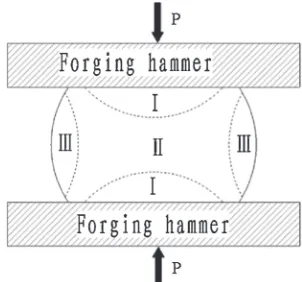
During the MDF process, the precipitation of Mg17Al12 phase should be affected by the deforming temperature, accumulative strains and Al content in the Mg matrix, etc. However, in a local micro area with and without Mg17Al12 phase, the deforming temperature and the accumulative strains should be approximately the same. Thus, the precipitation of Mg17Al12phase should be mainly controlled by the Al content in the Mg matrix. As aforementioned, the solute distribution in the initial alloy is inhomogenous, which will naturally result in an ununiform precipitation of the Mg17Al12 phase. This has also been proved by the above-mentioned EPMA measurement that the mean Al composition in the Mg matrix of fine is higher than that in the coarse grains. As a consequence, fine and coarse grains coexist in the microstructures. It has been mentioned that the precipitation of the Mg17Al12 should be related to the accumulative strains and temperatures. However, in this work, it has been found that there is no clear difference in the precipitation amounts of the Mg17Al12between the stagnant zone (near the hammerhead) and the easy deformation zone (the sample center) (see Fig. 6), where accumulative strains are obviously different in one sample. This may indirectly prove that the precipitation of the Mg17Al12should be mainly determined by temperature changes, i.e., the precipitation amount of the phase is increased with decreasing the temperatures.
In summary, during the MDF process, the modification of the structures can be attributed to the interaction between the DRX and the dynamic precipitation of the Mg17Al12 phase. On one hand, the pinning effect of the Mg17Al12 phase can greatly retard the growth of the DRXed grains. On the other hand, the newly formed grain boundaries provide an ideal position for the precipitation of Mg17Al12 phase. Yet the interaction between these two aspects is complicated. A further study is needed to confirm the dominant factor in modifying the structures.
4. Conclusion
The AZ80 Mg alloy has been MDFed to the maximum accumulative true strains of 7 with decreasing temperature from 683 to 573 K. Main conclusions obtained are shown as follows:
(1) In the present MDF process, the coexistence of thefine grains (with many granular Mg17Al12 phases) and coarse grains (without Mg17Al12 phases) is the main character of the structure.
(2) The fine grains area and the fraction of granular Mg17Al12 phases expand with the increasing accumu-lative strains and decreasing temperature.
(3) The size of thefine grains decreases with increasing the accumulative strains and decreasing temperature, but that of the coarse grains seems less affected.
(4) The inhomogenous Al content distribution in the Mg matrix leads to the non-uniform dynamic precipitation of the Mg17Al12 phase during the MDF process with temperature decreasing. These non-uniform distributed Mg17Al12 phases retard the growth of the DRX grains, which in turns results in the formation and the expansion of thefine grains area.
Acknowledgement
The project is supported by National Natural Science Foundation of China (No. 51204053 & 51204048 & 51074048), China Postdoctoral Science Foundation (No. 20110491518), National Program on Key Basic Research Project (973 Program) (No. 2012CB619506).
Fig. 5 Micro area of P14-sample measured by EPMA, (a) and (c) are the enlarged images as signed by the circles.
[image:4.595.99.500.69.174.2] [image:4.595.350.501.216.357.2]5) H. K. Lin, J. C. Huang and T. G. Langdon:Mater. Sci. Eng. A402
(2005) 250257.
6) Y. Yoshida, L. Cisar, S. Kamado and Y. Kojima: Mater. Trans.44
(2003) 468475.
7) R. Z. Valiev, P. K. Islamgaliev and I. V. Alexandrov:Prog. Mater. Sci.
Mater.61(2009) 249252.
13) S. W. Xu, S. Kamado and T. Honma:Mater. Sci. Eng. A528(2011) 23852393.
14) Q. Guo, H. G. Yan, Z. H. Chen and H. Zhang:Mater. Charact. 58