Proceedings of the ACL-IJCNLP 2009 Student Research Workshop, pages 27–35, Suntec, Singapore, 4 August 2009. c2009 ACL and AFNLP
Paraphrase Recognition Using Machine Learning to Combine Similarity
Measures
Prodromos Malakasiotis Department of Informatics
Athens University of Economics and Business Patission 76, GR-104 34 Athens, Greece
Abstract
This paper presents three methods that can be used to recognize paraphrases. They all employ string similarity measures ap-plied to shallow abstractions of the input sentences, and a Maximum Entropy clas-sifier to learn how to combine the result-ing features. Two of the methods also ex-ploit WordNet to detect synonyms and one of them also exploits a dependency parser. We experiment on two datasets, theMSR paraphrasing corpus and a dataset that we automatically created from the MTC cor-pus. Our system achieves state of the art or better results.
1 Introduction
Recognizing or generating semantically equiva-lent phrases is of significant importance in many natural language applications. In question answer-ing, for example, a question may be phrased dif-ferently than in a document collection (e.g., “Who is the author of War and Peace?” vs. “Leo Tol-stoyis the writer of War and Peace.”), and taking such variations into account can improve system performance significantly (Harabagiu et al., 2003; Harabagiu and Hickl, 2006). A paraphrase gener-ator, meaning a module that produces new phrases or patterns that are semantically equivalent (or al-most equivalant) to a given input phrase or pattern (e.g., “X is the writer ofY” ⇔“X wrote Y”⇔ “Y was written byX”⇔“Xis the author ofY”, or “X produces Y” ⇔ “X manufactures Y” ⇔ “Xis the manufacturer ofY”) can be used to pro-duce alternative phrasings of the question, before matching it against a document collection.
Unlike paraphrase generators, paraphrase rec-ognizers decide whether or not twogivenphrases (or patterns) are paraphrases, possibly by general-izing over many different training pairs of phrases.
Paraphrase recognizers can be embedded in para-phrase generators to filter out erroneous generated paraphrases; but they are also useful on their own. In question answering, for example, they can be used to check if a pattern extracted from the ques-tion (possibly by replacing named entities by their semantic categories and turning the question into a statement) matches any patterns extracted from candidate answers. As a further example, in text summarization, especially multi-document sum-marization, a paraphrase recognizer can be used to check if a sentence is a paraphrase of any other sentence already present in a partially constructed summary.
Note that, although “paraphrasing” and “textual entailment” are sometimes used as synonyms, we use the former to refer to methods that generate or recognize semantically equivalent (or almost equivalent) phrases or patterns, whereas in textual entailment (Dagan et al., 2006; Bar-Haim et al., 2006; Giampiccolo et al., 2007) the expressions or patterns are not necessarily semantically equiva-lent; it suffices if one entails the other, even if the reverse direction does not hold. For example, “Y
was written byX” textually entails “Y is the work of X”, but the reverse direction does not neces-sarily hold (e.g., ifY is a statue); hence, the two sentences are not paraphrases.
In this paper, we focus on paraphrase recogni-tion. We propose three methods that employ string similarity measures, which are applied to several abstractions of a pair of input phrases (e.g., the phrases themselves, their stems, POS tags). The scores returned by the similarity measures are used as features in a Maximum Entropy (ME) classifier (Jaynes, 1957; Good, 1963), which learns to sepa-rate true paraphrase pairs from false ones. Two of our methods also exploit WordNet to detect syn-onyms, and one of them uses additional features to measure similarities of grammatical relations
obtained by a dependency parser.1 Our
experi-ments were conducted on two datasets: the pub-licly available Microsoft Research Paraphrasing corpus (Dolan et al., 2004) and a dataset that we constructed from the MTC corpus.2 The experi-mental results show that our methods perform very well. Even the simplest one manages to achieve state of the art results, even though it uses fewer linguistic resources than other reported systems. The other two, more elaborate methods perform even better.
Section 2 presents the three methods, and sec-tion 3 our experiments. Secsec-tion 4 covers related work. Section 5 concludes and proposes further work.
2 The three methods
The main idea underlying our methods is that by capturing similarities at various shallow abstrac-tions of the input (e.g., the original sentences, the stems of their words, theirPOStags), we can rec-ognize paraphrases and textual entailment reason-ably well, provided that we learn to assign ap-propriate weights to the resulting features. Fur-ther improvements are possible by recognizing synonyms and by employing similarity measures that operate on the output of dependency grammar parsers.
2.1 Method 1 (INIT)
During training, the first method, called INIT, is given a set{hS1,1, S1,2, y1i, . . . ,hSn,1, Sn,2, yni}, where Si,1 and Si,2 are sentences (more gener-ally, phrases), yi = 1 (positive class) if the two sentences are paraphrases, and yi = −1 (negative class) otherwise. Each pair of sen-tences hSi,1, Si,2i is converted to a feature vec-tor ~vi, whose values are scores returned by sim-ilarity measures that indicate how similar Si,1 and Si,2 are at various levels of abstraction. The vectors and the corresponding categories {h~v1, yii, . . . ,hv~n, yni}are given as input to the
ME classifier, which learns how to classify new vectors~v, corresponding to unseen pairs of sen-tenceshS1, S2i.
We use nine string similarity measures: Leven-shtein distance (edit distance), Jaro-Winkler dis-tance, Manhattan disdis-tance, Euclidean disdis-tance,
co-1We use Stanford University’s MEclassifier and parser;
seehttp://nlp.stanford.edu/.
2The corpus is available by theLDC, Catalogue Number
LDC2002T01, ISBN 1-58563-217-1.
sine similarity, n-gram distance (with n = 3), matching coefficient, Dice coefficient, and Jac-card coefficient. To save space, we do not repeat the definitions of the similarity measures here, since they are readily available in the literature and they are also summarized in our previous work (Malakasiotis and Androutsopoulos, 2007).
For each pair of input stringshS1, S2i, we form ten new pairs of strings s1
1, s12, . . . ,s101 , s102 corresponding to ten different levels of abstraction of S1 and S2, and we apply the nine similarity measures to the ten new pairs, resulting in a to-tal of 90 measurements. These measurements are then included as features in the vector~vthat cor-responds tohS1, S2i. Thesi1, si2pairs are:
s1 1, s12
: two strings consisting of theoriginal tokensofS1 andS2, respectively, with the original order of the to-kens maintained;3
s2
1, s22
: as in the previous case, but now the tokens are replaced by theirstems;
s3
1, s32
: as in the previous case, but now the tokens are replaced by theirpart-of-speech(POS) tags;
s4
1, s42
: as in the previous case, but now the tokens are replaced by theirsoundex codes;4
s5
1, s52
: two strings consisting of only thenounsofS1and
S2, as identified by aPOS-tagger, with the original or-der of the nouns maintained;
s6
1, s62
: as in the previous case, but now withnouns re-placed by their stems;
s7
1, s72: as in the previous case, but now withnouns re-placed by their soundex codes;
s8
1, s82
: two strings consisting of only theverbsofS1and
S2, as identified by aPOS-tagger, with the original or-der of the verbs maintained;
s9
1, s92
: as in the previous case, but now withverbs re-placed by their stems;
s10
1 , s102
: as in the previous case, but now withverbs re-placed by their soundex codes.
Note that the similarities are measured in terms of tokens, not characters. For instance, the edit distance ofS1 andS2 is the minimum number of operations needed to transformS1toS2, where an operation is an insertion, deletion or substitution of a single token. Moreover, we use high-level
3We use Stanford University’s tokenizer andPOS-tagger,
and Porter’s stemmer.
4Soundex is an algorithm intended to map English names
POS tags only, i.e., we do not consider the num-ber of nouns, the voice of verbs etc.; this increases the similarity of positives3
1, s32pairs.
A common problem is that the string similar-ity measures may be misled by differences in the lengths ofS1 andS2. This is illustrated in the fol-lowing examples, where the underlined part ofS1 is much more similar toS2than the entireS1.
S1: While Bolton apparently fell and was immobilized, Selenski used the mattress to scale a 10-foot, razor-wire fence, Fischi said.
S2: After the other inmate fell, Selenski used the mattress to scale a 10-foot, razor-wire fence, Fischi said. To address this problem, when we consider a pair of stringshs1, s2i, ifs1 is longer thans2, we obtain all of the substringss0
1 ofs1 that have the same length ass2. Then, for eachs01, we compute the nine valuesfj(s01, s2), wherefj (1 ≤ j ≤ 9) are the string similarity measures. Finally, we lo-cate thes0
1 with the best average similarity (over all similarity measures) tos2, namelys0∗1:
s0∗1 = arg max
s0 1
10 X
j=1
fj(s01, s2)
and we keep the nine fj(s0∗1, s2) values and their average as ten additional measurements. Simi-larly, if s2 is longer than s1, we keep the nine
fj(s1, s0∗2) values and their average. This process is applied to pairs s1
1, s12, . . . , s41, s42, where large length differences are more likely to appear, adding 40 more measurements (features) to the vector~vof eachhS1, S2ipair of input strings.
The measurements discussed above provide 130 numeric features.5 To those, we add two Boolean
features indicating the existence or absence of negation inS1orS2, respectively; negation is de-tected by looking for words like “not”, “won’t” etc. Finally, we add a length ratio feature, de-fined as min(LS1,LS2)
max(LS1,LS2), whereLS1 andLS2 are the
lengths, in tokens, ofS1andS2. Hence, there is a total of 133 available features inINIT.
2.2 Method 2 (INIT+WN)
Paraphrasing may involve using synonyms which cannot be detected by the features we have con-sidered so far. In the following pair of sentences, for example, “dispatched” is used as a synonym
5All feature values are normalized in[−1,1]. We use our
own implementation of the string similarity measures.
of “sent”; treating the two verbs as the same to-ken during the calculation of the string similarity measures would yield a higher similarity. The sec-ond method, called INIT+WN, treats words from S1 andS2 that are synonyms as identical; other-wise the method is the same asINIT.
S1: Fewer than a dozen FBI agents were dispatched to se-cure and analyze evidence.
S2: Fewer than a dozen FBI agents will be sent to Iraq to secure and analyze evidence of the bombing.
2.3 Method 3 (INIT+WN+DEP)
The features of the previous two methods op-erate at the lexical level. The third method, called INIT+WN+DEP, adds features that operate on the grammatical relations (dependencies) a de-pendency grammar parser returns forS1 andS2. We use three measures to calculate similarity at the level of grammatical relations, namelyS1 de-pendency recall (R1), S2 dependency recall (R2) and theirF-measure (FR1,R2), defined below:
R1 = |common dependencies|S1dependencies| |
R2 = |common dependencies|S2dependencies| |
FR1,R2 = 2R·R1+R1·R22
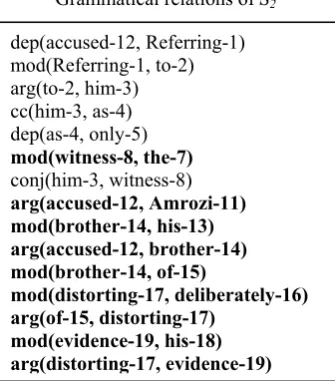
The following two examples illustrate the use-fulness of dependency similarity measures in de-tecting paraphrases. In the first exampleS1andS2 are not paraphrases and the scores are low, while in the second example whereS1andS2have almost identical meanings, the scores are much higher. Figures 1 and 2 lists the grammatical relations (de-pendencies) of the two sentences with the common ones shown in bold.
Example 1:
S1: Gyorgy Heizler, head of the local disaster unit, said the coach was carrying 38 passengers.
S2: The head of the local disaster unit, Gyorgy Heizler, said the coach driver had failed to heed red stop lights. R1= 0.43,R2= 0.32,FR1,R2= 0.36
Example 2:
S1: Amrozi accused his brother, whom he called “the wit-ness”, of deliberately distorting his evidence.
S2: Referring to him as only “the witness”, Amrozi accused his brother of deliberately distorting his evidence. R1= 0.69,R2= 0.6,FR1,R2 = 0.64
Grammatical relations of S1 Grammatical relations of S2
mod(Heizler-2, Gyorgy-1) mod(head-2, The-1) arg(said-11, Heizler-2) arg(said-12, head-2)
mod(head-2, of-3)
mod(Heizler-2, head-4)
mod(head-4, of-5) mod(unit-7, the-4) mod(unit-9, the-6) mod(unit-7, local-5) mod(unit-9, local-7) mod(unit-7, disaster-6) mod(unit-9, disaster-8) arg(of-3, unit-7)
arg(of-5, unit-9) mod(Heizler-10, Gyorgy-9)
mod(coach-13, the-12) mod(unit-7, Heizler-10) arg(carrying-15, coach-13) mod(driver-15, the-13) aux(carrying-15, was-14) mod(driver-15, coach-14) arg(said-11, carrying-15) arg(failed-17, driver-15) mod(passengers-17, 38-16) aux(failed-17, had-16)
arg(said-12, failed-17) arg(carrying-15, passengers-17)
aux(heed-19, to-18) arg(failed-17, heed-19) mod(lights-22, red-20) mod(lights-22, stop-21) arg(heed-19, lights-22)
Figure 1: Grammatical relations of example 1.
Grammatical relations of S1 Grammatical relations of S2
arg(accused-2, Amrozi-1) dep(accused-12, Referring-1) mod(brother-4, his-3) mod(Referring-1, to-2) arg(accused-2, brother-4) arg(to-2, him-3) arg(called-8, whom-6) cc(him-3, as-4) arg(called-8, he-7) dep(as-4, only-5)
mod(witness-8, the-7) mod(brother-4, called-8)
mod(witness-11, the-10) conj(him-3, witness-8) arg(accused-12, Amrozi-11) dep(called-8, witness-11)
mod(brother-4, of-14) mod(brother-14, his-13) mod(distorting-16, deliberately-15) arg(accused-12, brother-14) arg(of-14, distorting-16) mod(brother-14, of-15)
mod(evidence-18, his-17) mod(distorting-17, deliberately-16) arg(distorting-16, evidence-18) arg(of-15, distorting-17)
[image:4.595.324.492.496.687.2]mod(evidence-19, his-18) arg(distorting-17, evidence-19)
As withPOS-tags, we use only the highest level of the tags of the grammatical relations, which in-creases the similarity of positive pairs of S1 and
S2. For the same reason, we ignore the direction-ality of the dependency arcs which we have found to improve the results. INIT+WN+DEPemploys a total of 136 features.
2.4 Feature selection
Larger feature sets do not necessarily lead to im-proved classification performance. Despite seem-ing useful, some features may in fact be too noisy or irrelevant, increasing the risk of overfitting the training data. Some features may also be redun-dant, given other features; thus, feature selection methods that consider the value of each feature on its own (e.g., information gain) may lead to sub-optimal feature sets.
Finding the best subset of a set of available fea-tures is a search space problem for which several methods have been proposed (Guyon et al., 2006). We have experimented with a wrapper approach, whereby each feature subset is evaluated accord-ing to the predictive power of a classifier (treated as a black box) that uses the subset; in our exper-iments, the predictive power was measured asF -measure (defined below, not to be confused with
FR1,R2). More precisely, during feature selection,
for each feature subset we performed 10-fold cross validation on the training data to evaluate its pre-dictive power. After feature selection, the classi-fier was trained on all the training data, and it was evaluated on separate test data.
With large feature sets, an exhaustive search over all subsets is intractable. Instead, we ex-perimented with forward hill-climbing and beam search (Guyon et al., 2006). Forward hill-climbing starts with an empty feature set, to which it adds features, one at a time, by preferring to add at each step the feature that leads to the highest predic-tive power. Forward beam search is similar, except that the search frontier contains thekbest exam-ined states (feature subsets) at each time; we used
k = 10. Fork = 1, beam search reduces to hill-climbing.
3 Experiments
We now present our experiments, starting from a description of the datasets used.
3.1 Datasets
We mainly used the Microsoft Research (MSR) Paraphrasing Corpus (Dolan et al., 2004), which consists of 5,801 pairs of sentences. Each pair is manually annotated by two human judges as a true or false paraphrase; a third judge resolved dis-agreements. The data are split into 4,076 training pairs and 1,725 testing pairs.
We have experimented with a dataset we created from theMTCcorpus. MTCis a corpus containing news articles in Mandarin Chinese; for each article 11 English translations (by different translators) are also provided. We considered the translations of the same Chinese sentence as paraphrases. We obtained all the possible paraphrase pairs and we added an equal number of randomly selected non paraphrase pairs, which contained sentences that were not translations of the same sentence. In this way, we constructed a dataset containing 82,260 pairs of sentences. The dataset was then split in training (70%) and test (30%) parts, with an equal number of positive and negative pairs in each part.
3.2 Evaluation measures and baseline
We used four evaluation measures, namely accu-racy (correctly classified pairs over all pairs), pre-cision (P, pairs correctly classified in the positive class over all pairs classified in the positive class), recall (R, pairs correctly classified in the positive class over all true positive pairs), and F-measure (with equal weight on precision and recall, defined as 2·P·R
P+R). These measures are not to be confused with theR1,R2, andFR1,R2 of section 2.3 which
are used as features.
A reasonable baseline method (BASE) is to use just the edit distance similarity measure and a threshold in order to decide whether two phrases are paraphrases or not. The threshold is chosen using a grid search utility and 10-fold cross vali-dation on the training data. More precisely, in a first step we search the range [-1, 1] with a step of 0.1.6 In each step, we perform 10-fold cross
validation and the value that achieves the bestF -measure is our initial threshold,th, for the second step. In the second step, we perform the same pro-cedure in the range [th- 0.1,th+ 0.1] and with a step of 0.001.
6Recall that we normalize similarity in [-1, 1].
3.3 Experimental results
With both datasets, we experimented with a Max-imum Entropy (ME) classifier. However, prelim-inary results (see table 1) showed that our MTC dataset is very easy.BASEachieves approximately 95% in accuracy andF-measure, and an approx-imate performance of 99.5% in all measures (ac-curacy, precision, recall, F-measure) is achieved by using ME and only some of the features of INIT (we use 36 features corresponding to pairs
s1
1, s12, s21, s22, s31, s32, s41, s42 plus the two negation features). Therefore, we did not experi-ment with theMTCdataset any further.
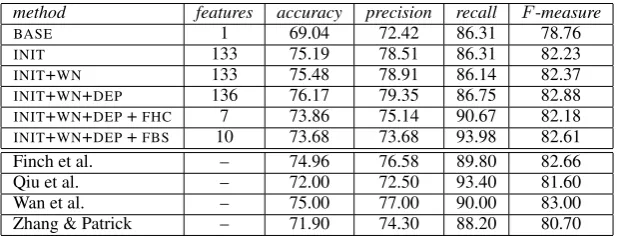
Table 2 (upper part) lists the results of our ex-periments on theMSR corpus. We optionally per-formed feature selection with both forward hill-climbing (FHC) and forward beam search (FBS). All of our methods clearly perform better than BASE. As one might expect, there is a lot of re-dundancy in the complete feature set. Hence, the two feature selection methods (FHCandFBS) lead to competitive results with much fewer features (7 and 10, respectively, instead of 136). However, feature selection deteriorates performance, espe-cially accuracy, i.e., the full feature set is better, despite its redundancy. Table 2 also includes all other reported results for theMSR corpus that we are aware of; we are not aware of the exact number of features used by the other researchers.
It is noteworthy that INITachieves state of the art performance, even though the other approaches use many more linguistic resources. For example, Wan et al.’s approach (Wan et al., 2006), which achieved the best previously reported results, is similar to ours, in that it also trains a classifier with similarity measures; but some of Wan et al.’s mea-sures require a dependency grammar parser, unlike INIT. More precisely, for each pair of sentences, Wan et al. construct a feature vector with values that measure lexical and dependency similarities. The measures are: word overlap, length difference (in words), BLEU (Papineni et al., 2002), depen-dency relation overlap (i.e., R1 and R2 but not
FR1,R2), and dependency tree edit distance. The
measures are also applied on sequences containing the lemmatized words of the original sentences, similarly to one of our levels of abstraction. Inter-estingly,INITachieves the same (and slightly bet-ter) accuracy as Wan et al.’s system, without em-ploying any parsing. Our more enhanced methods, INIT+WNandINIT+WN+DEP, achieve even better
results.
Zhang and Patrick (2005) use a dependency grammar parser to convert passive voice phrases to active voice ones. They also use a preprocess-ing stage to generalize the pairs of sentences. The preprocessing replaces dates, times, percentages, etc. with generic tags, something that we have also done in theMSRcorpus, but it also replaces words and phrases indicating future actions (e.g., “plans to”, “be expected to”) with the word “will”; the latter is an example of further preprocessing that could be added to our system. After the prepro-cessing, Zhang and Patrick create for each sen-tence pair a feature vector whose values measure the lexical similarity between the two sentences; they appear to be using the maximum number of consecutive common words, the number of com-mon words, edit distance (in words), and modi-fiedn-gram precision, a measure similar toBLEU. The produced vectors are then used to train a de-cision tree classifier. Hence, Zhang and Patrick’s approach is similar to ours, but we use more and different similarity measures and several levels of abstraction of the two sentences. We also useME, along with a wrapper approach to feature selec-tion, rather than decision tree induction and its em-bedded information gain-based feature selection. Furthermore, all of our methods, evenINITwhich employs no parsing at all, achieve better results compared to Zhang and Patrick’s.
Qiu et al. (2006) first convert the sentences into tuples using parsing and semantic role labeling. They then match similar tuples across the two sen-tences, and use anSVM(Vapnik, 1998) classifier to decide whether or not the tuples that have not been matched are important or not. If not, the sentences are paraphrases. Despite using a parser and a se-mantic role identifier, Qiu et al.’s system performs worse than our methods.
method features accuracy precision recall F-measure
BASE – 95.30 98.16 92.32 95.15
[image:7.595.177.425.61.96.2]INIT’ 38 99.62 99.50 99.75 99.62
Table 1: Results (%) of our methods on ourMTCdataset.
method features accuracy precision recall F-measure
BASE 1 69.04 72.42 86.31 78.76
INIT 133 75.19 78.51 86.31 82.23
INIT+WN 133 75.48 78.91 86.14 82.37
INIT+WN+DEP 136 76.17 79.35 86.75 82.88
INIT+WN+DEP+FHC 7 73.86 75.14 90.67 82.18 INIT+WN+DEP+FBS 10 73.68 73.68 93.98 82.61
Finch et al. – 74.96 76.58 89.80 82.66
Qiu et al. – 72.00 72.50 93.40 81.60
Wan et al. – 75.00 77.00 90.00 83.00
Zhang & Patrick – 71.90 74.30 88.20 80.70
Table 2: Results (%) of our methods (upper part) and other methods (lower part) on theMSRcorpus.
we achieve similar or better accuracy results.
4 Related work
We have already made the distinction between paraphrase (and textual entailment)generatorsvs. recognizers, and we have pointed out that rec-ognizers can be embedded in generators as fil-ters. The latter is particularly useful in bootstrap-ping paraphrase generation approaches (Riloff and Jones, 1999; Barzilay and McKeown, 2001; Ravichandran and Hovy, 2001; Ravichandran et al., 2003; Duclaye et al., 2003; Szpektor et al., 2004), which are typically given seed pairs of named entities for which a particular relation holds; the system locates in a document collec-tion (or the entire Web) contexts were the seeds cooccur, and uses the contexts as patterns that can express the relation; the patterns are then used to locate new named entities that satisfy the relation, and a new iteration begins. A paraphrase recog-nizer could be used to filter out erroneous gener-ated paraphrases between iterations.
Another well known paraphrase generator is Lin and Pantel’s (2001) DIRT, which produces slotted semantically equivalent patterns (e.g., “X is the writer of Y” ⇔ “X wrote Y” ⇔ “Y was writ-ten by X” ⇔ “X is the author of Y”), based on the assumption that different paths of depen-dency trees (obtained from a corpus) that occur frequently with the same words (slot fillers) at their ends are often paraphrases. An extension of DIRT, namedLEDIR, has also been proposed (Bha-gat et al., 2007) to recognize directional textual entailment rules (e.g., “Y was written byX” ⇒
“Y is the work of X”). Ibrahim et al.’s (2003) method is similar to DIRT, but it uses only de-pendency grammar paths from aligned sentences (from a parallel corpus) that share compatible an-chors (e.g., identical strings, or entity names of the same semantic category). Shinyama and Sekine (2003) adopt a very similar approach.
In another generation approach, Barzilay and Lee (2002; 2003) look for pairs of slotted word lattices that share many common slot fillers; the lattices are generated by applying a multiple-sequence alignment algorithm to a corpus of mul-tiple news articles about the same events. Finally, Pang et al. (2003) create finite state automata by merging parse trees of aligned sentences from a parallel corpus; in each automaton, different paths represent paraphrases. Again, a paraphrase recog-nizer could be embedded in all of these methods, to filter out erroneous generated patterns.
5 Conclusions and further work
We have presented three methods (INIT,INIT+WN, INIT+WN+DEP) that recognize paraphrases given pairs of sentences. These methods employ nine string similarity measures applied to ten shallow abstractions of the input sentences. Moreover, INIT+WNandINIT+WN+DEPexploit WordNet for synonymy resolution, andINIT+WN+DEPuses ad-ditional features that measure grammatical rela-tion similarity. Supervised machine learning is used to learn how to combine the resulting fea-tures. We experimented with a Maximum Entropy classifier on two datasets; the publicly available MSRcorpus and one that we constructed from the
[image:7.595.145.454.130.249.2]MTC corpus. However, the latter was found to be very easy, and consequently we mainly focused on theMSRcorpus.
On theMSRcorpus, all of our methods achieved similar or better performance than the sate of the art, even INIT, despite the fact that it uses fewer linguistic resources. Hence,INITmay have prac-tical advantages in less spoken languages, which have limited resources. The most elaborate of our methods,INIT+WN+DEP, achieved the best re-sults, but it requires WordNet and a reliable depen-dency grammar parser. Feature selection experi-ments indicate that there is significant redundancy in our feature set, though the full feature set leads to better performance than the subsets produced by feature selection. Further improvements may be possible by including in our system additional features, such asBLEUscores or features for word alignment.
Our long-term goal is to embed our recognizer in a bootstrapping paraphrase generator, to filter out erroneous paraphrases between bootstrapping iterations. We hope that our recognizer will be ad-equate for this purpose, possibly in combination with a human in the loop, who will inspect para-phrases the recognizer is uncertain of.
Acknowledgements
This work was funded by the GreekPENED 2003 programme, which is co-funded by the European Union (80%), and the Greek General Secretariat for Research and Technology (20%).
References
R. Bar-Haim, I. Dagan, B. Dolan, L. Ferro, D. Gi-ampiccolo, B. Magnini, and I. Szpektor. 2006. The 2nd PASCAL recognising textual entailment chal-lenge. In Proceedings of the 2nd PASCAL
Chal-lenges Workshop on Recognising Textual Entail-ment, Venice, Italy.
R. Barzilay and L. Lee. 2002. Bootstrapping lexi-cal choice via multiple-sequence alignment. In
Pro-ceedings of EMNLP, pages 164–171, Philadelphia,
PA.
R. Barzilay and L. Lee. 2003. Learning to paraphrase: an unsupervised approach using multiple-sequence alignment. In Proceedings of HLT-NAACL, pages 16–23, Edmonton, Canada.
R. Barzilay and K. McKeown. 2001. Extracting para-phrases from a parallel corpus. In Proceedings of
ACL/EACL, pages 50–57, Toulouse, France.
R. Bhagat, P. Pantel, and E. Hovy. 2007. LEDIR: An unsupervised algorithm for learning directional-ity of inference rules. InProceedings of theEMNLP -CONLL, pages 161–170.
I. Dagan, O. Glickman, and B. Magnini. 2006. The PASCAL recognising textual entailment challenge. In Qui˜nonero-Candela et al., editor, LNAI, volume 3904, pages 177–190. Springer-Verlag.
B. Dolan, C. Quirk, and C. Brockett. 2004. Unsu-pervised construction of large paraphrase corpora: exploiting massively parallel news sources. In
Pro-ceedings of COLING, page 350, Morristown,NJ.
F. Duclaye, F. Yvon, and O. Collin. 2003. Learning paraphrases to improve a question-answering sys-tem. InProceedings of theEACLWorkshop on Nat-ural Language Processing for Question Answering
Systems, pages 35–41, Budapest, Hungary.
A. Finch, Y. S. Hwang, and E. Sumita. 2005. Using machine translation evaluation techniques to deter-mine sentence-level semantic equivalence. In Pro-ceedings of the 3rd International Workshop on
Para-phrasing, Jeju Island, Korea.
D. Giampiccolo, B. Magnini, I. Dagan, and B. Dolan. 2007. The third Pascal recognizing textual entail-ment challenge. In Proceedings of theACL-Pascal
Workshop on Textual Entailment and Paraphrasing,
pages 1–9, Prague, Czech Republic.
I. J. Good. 1963. Maximum entropy for hypothesis formulation, especially for multidimentional conti-gency tables. Annals of Mathematical Statistics, 34:911–934.
I.M. Guyon, S.R. Gunn, M. Nikravesh, and L. Zadeh, editors. 2006. Feature Extraction, Foundations and
Applications. Springer.
S. Harabagiu and A. Hickl. 2006. Methods for using textual entailment in open-domain question answer-ing. In Proceedings of COLING-ACL, pages 905– 912, Sydney, Australia.
S.M. Harabagiu, S.J. Maiorano, and M.A. Pasca. 2003. Open-domain textual question answer-ing techniques. Natural Language Engineering, 9(3):231–267.
A. Ibrahim, B. Katz, and J. Lin. 2003. Extract-ing structural paraphrases from aligned monolExtract-ingual corpora. In Proceedings of the ACLWorkshop on
Paraphrasing, pages 57–64, Sapporo, Japan.
E. T. Jaynes. 1957. Information theory and statistical mechanics.Physical Review, 106:620–630.
D. Lin and P. Pantel. 2001. Discovery of inference rules for question answering. Natural Language
P. Malakasiotis and I. Androutsopoulos. 2007. Learn-ing textual entailment usLearn-ing svms and strLearn-ing similar-ity measures. InProceedings of the ACL-PASCAL
Workshop on Textual Entailment and Paraphrasing,
pages 42–47, Prague, June. Association for Compu-tational Linguistics.
B. Pang, K. Knight, and D. Marcu. 2003. Syntax-based alignment of multiple translations: extracting paraphrases and generating new sentences. In
Pro-ceedings of HLT-NAACL, pages 102–109,
Edmon-ton, Canada.
K. Papineni, S. Roukos, T. Ward, and W.J. Zhu. 2002. Bleu: a method for automatic evaluation of machine translation. InProceedings of ACL, pages 311–318, Philadelphia, Pennsylvania.
L. Qiu, M. Y. Kan, and T.S. Chua. 2006. Paraphrase recognition via dissimilarity significance classifica-tion. InProceedings of EMNLP, pages 18–26, Syd-ney, Australia.
D. Ravichandran and E. Hovy. 2001. Learning surface text patterns for a question answering system. In
Proceedings of ACL, pages 41–47, Philadelphia,PA.
D. Ravichandran, A. Ittycheriah, and S. Roukos. 2003. Automatic derivation of surface text patterns for a maximum entropy based question answering sys-tem. InProceedings of HLT-NAACL, pages 85–87, Edmonton, Canada.
E. Riloff and R. Jones. 1999. Learning dictionaries for information extraction by multi-level bootstrapping.
In Proceedings of AAAI, pages 474–479, Orlando,
FL.
Y. Shinyama and S. Sekine. 2003. Paraphrase ac-quisition for information extraction. In
Proceed-ings of the ACL Workshop on Paraphrasing,
Sap-poro, Japan.
I. Szpektor, H. Tanev, I. Dagan, and B. Coppola. 2004. Scaling Web-based acquisition of entailment rela-tions. InProceedings of EMNLP, Barcelona, Spain. V. Vapnik. 1998. Statistical learning theory. John
Wiley.
S. Wan, M. Dras, R. Dale, and C. Paris. 2006. Us-ing dependency-based features to take the “para-farce” out of paraphrase. InProceedings of the
Aus-tralasian Language Technology Workshop, pages
131–138, Sydney, Australia.
Y. Zhang and J. Patrick. 2005. Paraphrase identifi-cation by text canonicalization. InProceedings of
the Australasian Language Technology Workshop,
pages 160–166, Sydney, Australia.