Correcting errors in speech recognition with articulatory dynamics
Frank Rudzicz
University of Toronto, Department of Computer Science Toronto, Ontario, Canada
Abstract
We introduce a novel mechanism for incorporating articulatory dynamics into speech recognition with the theory of task dynamics. This system reranks sentence-level hypotheses by the likelihoods of their hypothetical articulatory realizations which are derived from relationships learned with aligned acoustic/articulatory data. Experiments compare this with two baseline systems, namely an acoustic hid-den Markov model and a dynamic Bayes network augmented with discretized rep-resentations of the vocal tract. Our sys-tem based on task dynamics reduces
word-error rates significantly by 10.2% relative
to the best baseline models.
1 Introduction
Although modern automatic speech recognition (ASR) takes several cues from the biological per-ception of speech, it rarely models its biological production. The result is that speech is treated as a surface acoustic phenomenon with lexical or phonetic hidden dynamics but without any phys-ical constraints in between. This omission leads
to some untenable assumptions. For example,
speech is often treated out of convenience as a se-quence of discrete, non-overlapping packets, such as phonemes, despite the fact that some major dif-ficulties in ASR, such as co-articulation, are by definition the result of concurrent physiological phenomena (Hardcastle and Hewlett, 1999).
Many acoustic ambiguities can be resolved with knowledge of the vocal tract’s configuration (O’Shaughnessy, 2000). For example, the three
nasal sonorants, /m/, /n/, and /ng/, are
acousti-cally similar (i.e., they have large concentrations of energy at the same frequencies) but uniquely and reliably involve bilabial closure, tongue-tip
elevation, and tongue-dorsum elevation, respec-tively. Having access to the articulatory goals of the speaker would, in theory, make the identifica-tion of linguistic intent almost trivial. Although we don’t typically have access to the vocal tract
during speech recognition, its configuration can
be estimated reasonably well from acoustics alone within adequate models or measurements of the vocal tract (Richmond et al., 2003; Toda et al., 2008). Evidence that such inversion takes place naturally in humans during speech perception sug-gests that the discriminability of speech sounds de-pends powerfully on their production (Liberman and Mattingly, 1985; D’Ausilio et al., 2009).
This paper describes the use of explicit models of physical speech production within recognition systems. Initially, we augment traditional models of ASR with probabilistic relationships between acoustics and articulation learned from appropri-ate data. This leads to the incorporation of a high-level, goal-oriented, and control-based theory of speech production within a novel ASR system.
2 Background and related work
The use of theoretical (phonological) features of the vocal tract has provided some improvement over traditional acoustic ASR systems in phoneme recognition with neural networks (Kirchhoff, 1999; Roweis, 1999), but there has been very little work in ASR informed by direct
measure-ments of the vocal tract. Recently, Markov et
al. (2006) have augmented hidden Markov models with Bayes networks trained to describe articula-tory constraints from a small amount of Japanese vocal tract data, resulting in a small
phoneme-error reduction. This work has since been
ex-panded upon to inform ASR systems sensitive to physiological speech disorders (Rudzicz, 2009). Common among previous efforts is an interpre-tation of speech as a sequence of short, instanta-neous observations devoid of long-term dynamics.
2.1 Articulatory phonology
Articulatory phonology bridges the divide be-tween the physical manifestation of speech and its underlying lexical intentions. Within this
disci-pline, the theory of task dynamicsis a combined
model of physical articulator motion and the plan-ning of abstract vocal tract configurations (Saltz-man, 1986). This theory introduces the notion that all observed patterns of speech are the result of
overlapping gestures, which are abstracted
goal-oriented reconfigurations of the vocal tract, such as bilabial closure or velar opening (Saltzman and Munhall, 1989). Each gesture occurs within one
of the followingtract variables(TVs): velar
open-ing (VEL), lip aperture (LA) and protrusion (LP),
tongue tip constriction location (TTCL) and
de-gree (TTCD)1, tongue body constriction location
(TBCL) and degree (TBCD), lower tooth height
(LTH), and glottal vibration (GLO). For example,
the syllable pub consists of an onset (/p/), a
nu-cleus (/ah/), and a coda (/b/). Four gestural goals
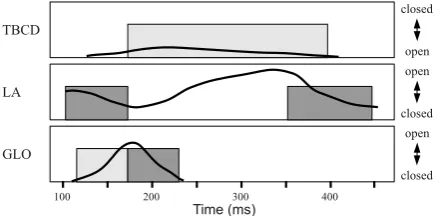
are associated with the onset, namely the shutting of GLO and of VEL, and the closure and release of LA. Similarly, the nucleus of the syllable consists of three goals, namely the relocation of TBCD and TBCL, and the opening of GLO. The presence and extent of these gestural goals are represented by filled rectangles in figure 1. Inter-gestural timings between these goals are specified relative to one another according to human data as described by Nam and Saltzman (2003).
TBCD
closed
open
GLO
open
closed
LA
open
closed
100 200 300 400
[image:2.595.72.290.497.605.2]Time (ms)
Figure 1: Canonical examplepubfrom Saltzman
and Munhall (1989).
The presence of these discrete goals influences the vocal tract dynamically and continuously as modelled by the following non-homogeneous second-order linear differential equation:
Mz00+Bz0+K(z−z∗) =0. (1)
1Constrictionlocationsgenerally refer to the front-back
dimension of the vocal tract and constrictiondegrees gener-ally refer to the top-down dimension.
Here,zis a continuous vector representing the
in-stantaneous positions of the nine tract variables,
z∗ is the target (equilibrium) positions of those
variables, and vectorsz0 andz00 represent the first
and second derivatives of z with respect to time
(i.e., velocity and acceleration), respectively. The
matrices M, B, and K are syllable-specific
coef-ficients describing the inertia, damping, and stiff-ness, respectively, of the virtual gestures. Gener-ally, this theory assumes that the tract variables are mutually independent, and that the system is criti-cally damped (i.e., the tract variables do not oscil-late around their equilibrium positions) (Nam and
Saltzman, 2003). The continuous state,z, of
equa-tion (1) is exemplified by black curves in figure 1.
2.2 Articulatory data
Tract variables provide the dimensions of an ab-stract gestural space independent of the physical characteristics of the speaker. In order to com-plete our articulatory model, however, we require physical data from which to infer these high-level articulatory goals.
Electromagnetic articulography (EMA) is a method to measure the motion of the vocal tract
during speech. In EMA, the speaker is placed
within a low-amplitude electromagnetic field pro-duced within a cube of a known geometry. Tiny sensors within this field induce small electric cur-rents whose energy allows the inference of artic-ulator positions and velocities to within 1 mm of error (Yunusova et al., 2009). We derive data for the following study from two EMA sources:
• The University of Edinburgh’s MOCHA
database, which provides
phonetically-balanced sentences repeated from TIMIT (Zue et al., 1989) uttered by a male and a female speaker (Wrench, 1999), and
• The University of Toronto’s TORGO
database, from which we select sentences repeated from TIMIT from two females and three males (Rudzicz et al., 2008). (Cerebrally palsied speech, which is the focus of this database, is not included here).
these onto the midsagittal plane. (Additionally, the MOCHA database provides velum (V) data on this plane, and TORGO provides the left and right lip corners (LL and RL) but these are excluded from study except where noted).
All articulatory data is aligned with its associ-ated acoustic data, which is transformed to Mel-frequency cepstral coefficients (MFCCs). Since the 2D EMA system in MOCHA and the 3D EMA system in TORGO differ in their recording rates, the length of each MFCC frame in each database must differ in order to properly align acoustics with articulation in time. Therefore, each MFCC frame covers 16 ms in the TORGO database, and 32 ms in MOCHA. Phoneme boundaries are de-termined automatically in the MOCHA database by forced alignment, and by a speech-language pathologist in the TORGO database.
We approximate the tract variable space from the physical space of the articulators, in general, through principal component analysis (PCA) on the latter, and subsequent sigmoid normalization
on[0,1]. For example, the LTH tract variable is
in-ferred by calculating the first principal component of the two-dimensional lower incisor (LI) motion in the midsagittal plane, and by normalizing the resulting univariate data through a scaled sigmoid. The VEL variable is inferred similarly from velum (V) EMA data. Tongue tip constriction location and degree (TTCL and TTCD, respectively) are
inferred from the 1stand 2ndprincipal components
of tongue tip (TT) EMA data, with TBCL and TBCD inferred similarly from tongue body (TB) data. Finally, the glottis (GLO) is inferred by voic-ing detection on acoustic energy below 150 Hz (O’Shaughnessy, 2000), lip aperture (LA) is the normalized Euclidean distance between the lips,
and lip protrusion (LP) is the normalized 2nd
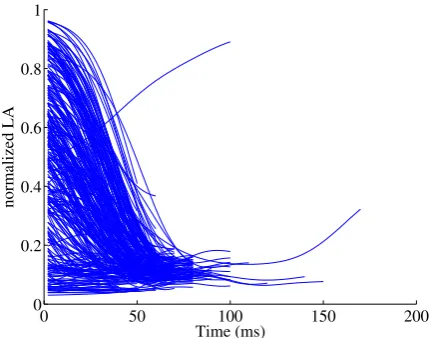
prin-cipal component of the midpoint between the lips. All PCA is performed without segmentation of the data. The result is a low-dimensional set of contin-uous curves describing goal-relevant articulatory variables. Figure 2, for example, shows the degree of the lip aperture (LA) over time for all instances
of the/b/phoneme in the MOCHA database. The
relevant articulatory goal of lip closure is evident.
3 Baseline systems
We now turn to the task of speech recognition. Traditional Bayesian learning is restricted to uni-versal or immutable relationships, and is
agnos-0 50 100 150 200
0 0.2 0.4 0.6 0.8 1
Time (ms)
[image:3.595.309.525.64.233.2]normalized LA
Figure 2: Lip aperture (LA) over time during all
MOCHA instances of/b/.
tic towards dynamic systems or time-varying rela-tionships. Dynamic Bayes networks (DBNs) are directed acyclic graphs that generalize the power-ful stochastic mechanisms of Bayesian represen-tation to temporal sequences. We are free to ex-plicitly provide topological (i.e., dependency) re-lationships between relevant variables in our mod-els, which can include measurements of tract data.
We examine two baseline systems. The
first is the standard acoustic hidden Markov model (HMM) augmented with a bigram language
model, as shown in figure 3(a). Here,Wt →Wt+1
represents word transition probabilities, learned
by maximum likelihood estimation, and Pht →
Pht+1 represents phoneme transition probabilities
whose order is explicitly specified by the
relation-shipWt →Pht. Likewise, each phonemePh
con-ditions the sub-phoneme state, Qt, whose
transi-tion probabilitiesQt →Qt+1describe the
dynam-ics within phonemes. The variable Mt refers to
hidden Gaussian indices so that the likelihoods
of acoustic observations,Ot, are represented by a
mixture of 4, 8, 16, or 32 Gaussians for each state and each phoneme. See Murphy (2002) for a fur-ther description of this representation.
The second baseline model is the articulatory dynamic Bayes network (DBN-A). This augments the standard acoustic HMM by replacing hidden
indices, Mt, with discrete observations of the
vo-cal tract,Kt, as shown in figure 3(b). The pattern
of acoustics within each phoneme is dependent on a relatively restricted set of possible articulatory configurations (Roweis, 1999). To find these
de-scribe the articulatory data according to k-means clustering with the sum-of-squares error function.
During training, the DBN variable Kt is set
ex-plicitly to theindexof the mean vector nearest to
the current frame of EMA data at timet. In this
way, the relationship Kt →Ot allows us to learn
how discretized articulatory configurations affect acoustics. The training of DBNs involves a spe-cialized version of expectation-maximization, as described in the literature (Murphy, 2002;
Ghahra-mani, 1998). During inference, variablesWt,Pht,
and Kt become hidden and we marginalize over
their possible values when computing their likeli-hoods. Bigrams are computed by maximum like-lihood on lexical annotations in the training data.
Mt
Ot
Mt+1
Ot+1
Qt
Pht
Qt+1
Pht+1
Wt Wt+1
(a) HMM
Kt
Ot Kt+1
Ot+1 Qt
Pht
Qt+1 Pht+1 Wt Wt+1
[image:4.595.87.274.276.423.2](b) DBN-A
Figure 3: Baseline systems: (a) acoustic hidden Markov model and (b) articulatory dynamic Bayes
network. NodeWtrepresents the current word,Pht
is the current phoneme,Qt is that phoneme’s
dy-namic state, Ot is the acoustic observation,Mt is
the Gaussian mixture component, andKtis the
dis-cretized articulatory configuration. Filled nodes represent observed variables during training,
al-though only Ot is observed during recognition.
Square nodes are discrete variables while circular nodes are continuous variables.
4 Switching Kalman filter
Our first experimental system attempts speech recognition given only articulatory data. The true
state of the tract variables at timet−1 constitutes
a 9-dimensional vector, xt−1, of continuous
val-ues. Under the task dynamics model of section 2.1, the motions of these tract variables obey crit-ically damped second-order oscillatory relation-ships. We start with the simplifying assumption of linear dynamics here with allowances for random
Gaussianprocess noise, vt, since articulatory
be-haviour is non-deterministic. Moreover, we know that EMA recordings are subject to some error (usually less than 1 mm (Yunusova et al., 2009)),
so the actual observation at timet, yt, will not in
general be the true position of the articulators.
As-suming that the relationship betweenyt andxt is
also linear, and that the measurement noise, wt,
is also Gaussian, then the dynamical articulatory system can be described by
xt=Dtxt−1+vt
yt=Ctxt+wt.
(2)
Eqs. 2 form the basis of the Kalman filter which allows us to use EMA measurements di-rectly, rather than quantized abstractions thereof as in the DBN-A model. Obviously, since artic-ulatory dynamics vary significantly for different goals, we replicate eq. (2) for each phoneme and connect these continuous Kalman filters together with discrete conditioning variables for phoneme and word, resulting in the switching Kalman
fil-ter (SKF) model. Here, paramefil-tersDt andvt are
implicit in the relationshipxt →xt+1, and
param-eters Ct and wt are implicit in xt →yt. In this
model, observation yt is the instantaneous
mea-surements derived from EMA, andxt is their true
hidden states. These parameters are trained using expectation-maximization, as described in the lit-erature (Murphy, 1998; Deng et al., 2005).
5 Recognition with task dynamics
Our goal is to integrate task dynamics within an ASR system for continuous sentences called
TD-ASR. Our approach is to re-rank anN-best list of
sentence hypotheses according to a weighted like-lihood of their articulatory realizations. For
ex-ample, if a word sequenceWi :wi,1 wi,2 ... wi,m
has likelihoods LX(Wi) and LΛ(Wi) according to
purely acoustic and articulatory interpretations of an utterance, respectively, then its overall score would be
L(Wi) =αLX(Wi) + (1−α)LΛ(Wi) (3)
given a weighting parameterαset manually, as in
section 6.2. Acoustic likelihoodsLX(Wi) are
ob-tained from Viterbi paths through relevant HMMs in the standard fashion.
5.1 TheTADAcomponent
In order to obtain articulatory likelihoods,LΛ(Wi),
to task dynamics. To this end, we use
compo-nents from the open-source TADA system (Nam
and Goldstein, 2006), which is a complete imple-mentation of task dynamics. From this toolbox, we use the following components:
• A syllabic dictionary supplemented with
the International Speech Lexicon Dictionary (Hasegawa-Johnson and Fleck, 2007). This
breaks word sequences Wi into syllable
se-quencesSi consisting of onsets, nuclei, and
coda and covers all of MOCHA and TORGO.
• A syllable-to-gesture lookup table. Given
a syllabic sequence, Si, this table provides
the gestural goals necessary to produce those
syllables. For example, given the syllable
pub in figure 1, this table provides the
tar-gets for the GLO, VEL, TBCL, and TBCD tract variables, and the parameters for the
second-order differential equation, eq. 1,
that achieves those goals. These parameters have been empirically tuned by the authors
of TADA according to a generic,
speaker-independent representation of the vocal tract (Saltzman and Munhall, 1989).
• A component that produces the continuous
tract variable paths that produce an utter-ance. This component takes into account var-ious physiological aspects of human speech production, including intergestural and in-terarticulator co-ordination and timing (Nam and Saltzman, 2003; Goldstein and Fowler, 2003), and the neutral (“schwa”) forces of the vocal tract (Saltzman and Munhall, 1989). This component takes a sequence of gestu-ral goals predicted by the segment-to-gesture lookup table, and produces appropriate paths for each tract variable.
The result of the TADA component is a set of
N 9-dimensional articulatory paths, TVi,
neces-sary to produce the associated word sequences,Wi
for i=1..N. Since task dynamics is a
prescrip-tive model and fully deterministic,TVisequences
are the canonical or default articulatory
realiza-tions of the associated sentences. These canonical realizations are independent of our training data, so we transform them in order to more closely re-semble the observed articulatory behaviour in our EMA data. Towards this end, we train a switch-ing Kalman filter identical to that in section 4,
ex-cept the hidden state variablext is replaced by the
observed instantaneous canonical TVs predicted
by TADA. In this way we are explicitly learning
a relationship betweenTADA’s task dynamics and
human data. Since the lengths of these sequences are generally unequal, we align the articulatory
be-haviour predicted byTADAwith training data from
MOCHA and TORGO using standard dynamic time warping (Sakoe and Chiba, 1978). During
run-time, the articulatory sequenceyt most likely
to have been produced by the human data given the
canonical sequenceTVi is inferred by the Viterbi
algorithm through the SKF model with all other variables hidden. The result is a set of articulatory
sequences, TV∗i, for i=1..N, that represent the
predictions of task dynamics that better resemble our data.
5.2 Acoustic-articulatory inversion
In order to estimate the articulatory likelihood of an utterance, we need to evaluate each
trans-formed articulatory sequence,TV∗i, within
proba-bility distributions ranging over all tract variables. These distributions can be inferred using acoustic-articulatory inversion. There are a number of ap-proaches to this task, including vector quantiza-tion, and expectation-maximization with Gaussian mixtures (Hogden and Valdez, 2001; Toda et al., 2008). These approaches accurately inferred the
xyposition of articulators to within 0.41 mm and
2.73 mm. Here, we modify the approach taken
by Richmond et al. (2003), who estimate proba-bility functions over the 2D midsagittal positions of 7 articulators, given acoustics, with a mixture-density network (MDN). An MDN is essentially a typical discriminative multi-layer neural network whose output consists of the parameters to Gaus-sian mixtures. Here, each GausGaus-sian mixture de-scribes a probability function over TV positions
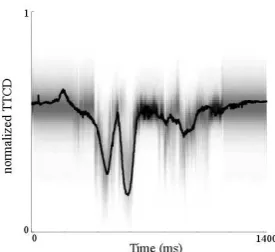
given the acoustic frame at time t. For
exam-ple, figure 4 shows an intensity map of the likely values for tongue-tip constriction degree (TTCD) for each frame of acoustics, superimposed with the ‘true’ trajectory of that TV. Our networks are trained with acoustic and EMA-derived data as de-scribed in section 2.2.
5.3 Recognition by reranking
During recognition of a test utterance, a standard acoustic HMM produces word sequence
hypothe-ses,Wi, and associated likelihoods,L(Wi), fori=
1..N. The expected canonical motion of the tract
Figure 4: Example probability density of tongue tip constriction degree over time, inferred from acoustics. The true trajectory is superimposed as a black curve.
for each of these word sequences and transformed by an SKF to better match speaker data, giving
TV∗i. The likelihoods of these paths are then
eval-uated within probability distributions produced by an MDN. The mechanism for producing the artic-ulatory likelihood is shown in figure 5. The overall likelihood, L(Wi) =αLX(Wi) + (1−α)LΛ(Wi), is
then used to produce a final hypothesis list for the given acoustic input.
6 Experiments
Experimental data is obtained from two sources,
as described in section 2.2. We procure 1200
sentences from Toronto’s TORGO database, and 896 from Edinburgh’s MOCHA. In total, there are 460 total unique sentence forms, 1092 total unique word forms, and 11065 total words uttered. Ex-cept where noted, all experiments randomly split the data into 90% training and 10% testing sets for 5-cross validation. MOCHA and TORGO data are never combined in a single training set due to dif-fering EMA recording rates. In all cases, models are database-dependent (i.e., all TORGO data is conflated, as is all of MOCHA).
For each of our baseline systems, we calcu-late the phoneme-error-rate (PER) and word-error-rate (WER) after training. The phoneme-error-rate is calculated according to the proportion of frames of speech incorrectly assigned to the proper
phoneme. The word-error-rate is calculated as
the sum of insertion, deletion, and substitution er-rors in the highest-ranked hypothesis divided by the total number of words in the correct orthogra-phy. The traditional HMM is compared by vary-ing the number of Gaussians used in the modellvary-ing
System Parameters PER (%) WER (%)
HMM
|M|=4 29.3 14.5
|M|=8 27.0 13.9
|M|=16 26.1 10.2
|M|=32 25.6 9.7
DBN-A
|K|=4 26.1 13.0
|K|=8 25.2 11.3
|K|=16 24.9 9.8
|K|=32 24.8 9.4
Table 1: Phoneme- and Word-Error-Rate (PER and WER) for different parameterizations of the baseline systems.
No. of Gaussians
1 2 3 4
LTH −0.28 −0.18 −0.15 −0.11
LA −0.36 −0.32 −0.30 −0.29
LP −0.46 −0.44 −0.43 −0.43
GLO −1.48 −1.30 −1.29 −1.25
TTCD −1.79 −1.60 −1.51 −1.47
TTCL −1.81 −1.62 −1.53 −1.49
TBCD −0.88 −0.79 −0.75 −0.72
[image:6.595.109.247.67.193.2]TDCL −0.22 −0.20 −0.18 −0.17
Table 2: Average log likelihood of true tract vari-able positions in test data, under distributions pro-duced by mixture density networks with varying numbers of Gaussians.
of acoustic observations. Similarly, the DBN-A model is compared by varying the number of dis-crete quantizations of articulatory configurations, as described in section 3. Results are obtained by direct decoding. The average results across both databases, between which there are no significant
differences, are shown in table 1. In all cases
the DBN-A model outperforms the HMM, which highlights the benefit of explicitly conditioning acoustic observations on articulatory causes.
6.1 Efficacy of TD-ASR components
In order to evaluate the whole system, we start by evaluating its parts. First, we test how accurately the mixture-density network (MDN) estimates the position of the articulators given only information from the acoustics available during recognition. Table 2 shows the average log likelihood over each
tract variable across both databases. These
[image:6.595.315.518.246.384.2]Acoustics
ASR
ASR
MDN
MDN W1
W2 ... WN N-best hypotheses
TADA
TADA
TV1 TV2 ... TVN Canonical
Tract Variables
TRANS
TRANS
TV*1 TV*2 ... TV*N Modified
Tract Variables
P(TVi*) W* 1 W*2 ... W*N
[image:7.595.74.531.66.200.2]Reranked list
Figure 5: The TD-ASR mechanism for deriving articulatory likelihoods,LΛ(Wi), for each word sequence
Wiproduced by standard acoustic techniques.
Manner Canonical Transformed
approximant 0.19 0.16
fricative 0.37 0.29
nasal* 0.24 0.18
retroflex 0.23 0.19
plosive 0.10 0.08
[image:7.595.85.278.259.356.2]vowel 0.27 0.25
Table 3: Average difference between predicted
tract variables and observed data, on [0,1] scale.
(*) Nasals are evaluated only with MOCHA data, since TORGO data lacks velum measurements.
We evaluate how closely transformations to the
canonical tract variables predicted byTADAmatch
the data. Namely, we input the known orthography
for each test utterance intoTADA, obtain the
pre-dicted canonical tract variablesTV, and transform
these according to our trained SKF. The resulting predicted and transformed sequences are aligned with our measurements derived from EMA with dynamic time warping. Finally, we measure the average difference between the observed data and the predicted (canonical and transformed) tract variables. Table 3 shows these differences accord-ing to the phonological manner of articulation. In all cases the transformed tract variable motion is more accurate, and significantly so at the 95% con-fidence level for nasal and retroflex phonemes, and at 99% for fricatives. The practical utility of the transformation component is evaluated in its effect on recognition rates, as described below.
6.2 Recognition with TD-ASR
With the performance of the components of TD-ASR better understood, we combine these and study the resulting composite TD-ASR system.
0 0.2 0.4 0.6 0.8 1
8 8.5 9 9.5 10
α
WER (%)
TORGO MOCHA
Figure 6: Word-error-rate according to varyingα,
for both TORGO and MOCHA data.
Figure 6 shows the WER as a function ofαwith
TD-ASR andN=4 hypotheses per utterance. The
effect ofαis clearly non-monotonic, with
articula-tory information clearly proving useful. Although systems whose rankings are weighted solely by the articulatory component perform better than the ex-clusively acoustic systems, the lists available to the former are procured from standard acoustic ASR. Interestingly, the gap between systems trained to
the two databases increases as αapproaches 1.0.
Although this gap is not significant, it may be the result of increased inter-speaker articulatory varia-tion in the TORGO database, which includes more than twice as many speakers as MOCHA.
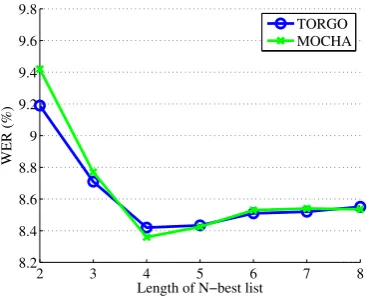
Figure 7 shows the WER obtained with
TD-ASR given varying-length N-best lists and α =
0.7. TD-ASR accuracy at N=4 is significantly
better than both TD-ASR atN=2 and the
base-line approaches of table 1 at the 95% confidence
level. However, for N >4 there is a noticeable
[image:7.595.309.515.265.414.2]2 3 4 5 6 7 8 8.2
8.4 8.6 8.8 9 9.2 9.4 9.6 9.8
Length of N−best list
WER (%)
[image:8.595.79.263.70.218.2]TORGO MOCHA
Figure 7: Word-error-rate according to
vary-ing lengths of N-best hypotheses used, for both
TORGO and MOCHA data.
The optimal parameterization of the TD-ASR model results in an average word-error-rate of
8.43%, which represents a 10.3% relative error
re-duction over the best parameterization of our base-line models. The SKF model of section 4 differs from the HMM and DBN-A baseline models only in its use of continuous (rather than discrete) hid-den dynamics and in its articulatory observations. However, its performance is far more variable, and
less conclusive. On the MOCHA database the
SKF model had an average of 9.54% WER with
a standard deviation of 0.73 over 5 trials, and an
average of 9.04% WER with a standard deviation
of 0.64 over 5 trials on the TORGO database.
De-spite the presupposed utility of direct articulatory observations, the SKF system does not perform significantly better than the best DBN-A model.
Finally, the experiments of tables 6 and 7 are repeated with the canonical tract variables passed untransformed to the probability maps generated by the MDNs. Predictably, resulting articulatory
likelihoodsLΛare less representative and
increas-ing their contributionα to the hypothesis
rerank-ing does not improve TD-ASR performance sig-nificantly, and in some instances worsens it.
Al-though TADA is a useful prescriptive model of
generic articulation, its use must be tempered with knowledge of inter-speaker variability.
7 Discussion and conclusions
The articulatory medium of speech rarely informs
modern speech recognition. We have
demon-strated that the use of direct articulatory knowl-edge can substantially reduce phoneme and word
errors in speech recognition, especially if that knowledge is motivated by high-level abstrac-tions of vocal tract behaviour. Task dynamic the-ory provides a coherent and biologically plausible model of speech production with consequences for phonology (Browman and Goldstein, 1986), neu-rolinguistics (Guenther and Perkell, 2004), and the evolution of speech and language (Goldstein et al., 2006). We have shown that it is also useful within speech recognition.
We have overcome a conceptual impediment in integrating task dynamics and ASR, which is the former’s deterministic nature. This integration is accomplished by stochastically transforming pre-dicted articulatory dynamics and by calculating the likelihoods of these dynamics according to speaker data. However, there are several new av-enues for exploration. For example, task dynamics lends itself to more general applications of con-trol theory, including automated self-correction, rhythm, co-ordination, and segmentation (Fried-land, 2005). Other high-level questions also re-main, such as whether discrete gestures are the correct biological and practical paradigm, whether a purely continuous representation would be more appropriate, and whether this approach general-izes to other languages.
In general, our experiments have revealed very little difference between the use of MOCHA and
TORGO EMA data. Anad hocanalysis of some
of the errors produced by the TD-ASR system found no particular difference between how sys-tems trained to each of these databases recognized nasal phonemes, although only those trained with MOCHA considered velum motion. Other errors common to both sources of data include phoneme insertion errors, normally vowels, which appear to co-occur with some spurious motion of the tongue
between segments, especially for longer N-best
lists. Despite the relative slow motion of the ar-ticulators relative to acoustics, there remains some intermittent noise.
As more articulatory data becomes available and as theories of speech production become more refined, we expect that their combined value to speech recognition will become indispensable.
Acknowledgments
References
Catherine P. Browman and Louis M. Goldstein. 1986. To-wards an articulatory phonology. Phonology Yearbook, 3:219–252.
Alessandro D’Ausilio, Friedemann Pulvermuller, Paola Salmas, Ilaria Bufalari, Chiara Begliomini, and Luciano Fadiga. 2009. The motor somatotopy of speech percep-tion.Current Biology, 19(5):381–385, February. Jianping Deng, M. Bouchard, and Tet Yeap. 2005. Speech
Enhancement Using a Switching Kalman Filter with a Per-ceptual Post-Filter. InAcoustics, Speech, and Signal Pro-cessing, 2005. Proceedings. (ICASSP ’05). IEEE Interna-tional Conference on, volume 1, pages 1121–1124, 18-23,. Bernard Friedland. 2005. Control System Design: An
Intro-duction to State-Space Methods. Dover.
Zoubin Ghahramani. 1998. Learning dynamic Bayesian net-works. In Adaptive Processing of Sequences and Data Structures, pages 168–197. Springer-Verlag.
Louis M. Goldstein and Carol Fowler. 2003. Articulatory phonology: a phonology for public language use. Phonet-ics and Phonology in Language Comprehension and Pro-duction: Differences and Similarities.
Louis Goldstein, Dani Byrd, and Elliot Saltzman. 2006. The role of vocal tract gestural action units in understanding the evolution of phonology. In M.A. Arib, editor,Action to Language via the Mirror Neuron System, pages 215– 249. Cambridge University Press, Cambridge, UK. Frank H. Guenther and Joseph S. Perkell. 2004. A
neu-ral model of speech production and its application to studies of the role of auditory feedback in speech. In Ben Maassen, Raymond Kent, Herman Peters, Pascal Van Lieshout, and Wouter Hulstijn, editors, Speech Motor Control in Normal and Disordered Speech, chapter 4, pages 29–49. Oxford University Press, Oxford.
William J. Hardcastle and Nigel Hewlett, editors. 1999.
Coarticulation – Theory, Data, and Techniques. Cam-bridge University Press.
Mark Hasegawa-Johnson and Margaret Fleck. 2007. Inter-national Speech Lexicon Project.
John Hogden and Patrick Valdez. 2001. A stochastic articulatory-to-acoustic mapping as a basis for speech recognition. InProceedings of the 18th IEEE Instrumen-tation and Measurement Technology Conference, 2001. IMTC 2001, volume 2, pages 1105–1110 vol.2.
Katrin Kirchhoff. 1999. Robust Speech Recognition Us-ing Articulatory Information. Ph.D. thesis, University of Bielefeld, Germany, July.
Alvin M. Liberman and Ignatius G. Mattingly. 1985. The motor theory of speech perception revised. Cognition, 21:1–36.
Konstantin Markov, Jianwu Dang, and Satoshi Nakamura. 2006. Integration of articulatory and spectrum features based on the hybrid HMM/BN modeling framework.
Speech Communication, 48(2):161–175, February. Kevin Patrick Murphy. 1998. Switching Kalman Filters.
Technical report.
Kevin Patrick Murphy. 2002. Dynamic Bayesian Networks: Representation, Inference and Learning. Ph.D. thesis, University of California at Berkeley.
Hosung Nam and Louis Goldstein. 2006. TADA (TAsk Dy-namics Application) manual.
Hosung Nam and Elliot Saltzman. 2003. A competitive, cou-pled oscillator model of syllable structure. InProceedings of the 15th International Congress of Phonetic Sciences (ICPhS 2003), pages 2253–2256, Barcelona, Spain. Douglas O’Shaughnessy. 2000. Speech Communications –
Human and Machine. IEEE Press, New York, NY, USA. Korin Richmond, Simon King, and Paul Taylor. 2003.
Modelling the uncertainty in recovering articulation from acoustics.Computer Speech and Language, 17:153–172. Sam T. Roweis. 1999. Data Driven Production Models for
Speech Processing. Ph.D. thesis, California Institute of Technology, Pasadena, California.
Frank Rudzicz, Pascal van Lieshout, Graeme Hirst, Gerald Penn, Fraser Shein, and Talya Wolff. 2008. Towards a comparative database of dysarthric articulation. In Pro-ceedings of the eighth International Seminar on Speech Production (ISSP’08), Strasbourg France, December. Frank Rudzicz. 2009. Applying discretized articulatory
knowledge to dysarthric speech. In Proceedings of the 2009 IEEE International Conference on Acoustics, Speech, and Signal Processing (ICASSP09), Taipei, Tai-wan, April.
Hiroaki Sakoe and Seibi Chiba. 1978. Dynamic program-ming algorithm optimization for spoken word recognition.
IEEE Transactions on Acoustics, Speech, and Signal Pro-cessing, ASSP-26, February.
Elliot L. Saltzman and Kevin G. Munhall. 1989. A dynam-ical approach to gestural patterning in speech production.
Ecological Psychology, 1(4):333–382.
Elliot M. Saltzman, 1986.Task dynamic co-ordination of the speech articulators: a preliminary model, pages 129–144. Springer-Verlag.
Tomoki Toda, Alan W. Black, and Keiichi Tokuda. 2008. Statistical mapping between articulatory movements and acoustic spectrum using a Gaussian mixture model.
Speech Communication, 50(3):215–227, March.
Alan Wrench. 1999. The MOCHA-TIMIT articulatory database, November.
Yana Yunusova, Jordan R. Green, and Antje Mefferd. 2009. Accuracy Assessment for AG500, Electromagnetic Artic-ulograph. Journal of Speech, Language, and Hearing Re-search, 52:547–555, April.
Victor Zue, Stephanie Seneff, and James Glass. 1989. Speech Database Development: TIMIT and Beyond. In

![Table 3: Average difference between predictedtract variables and observed data, on(*) Nasals are evaluated only with MOCHA data, [, 0] 1 scale.since TORGO data lacks velum measurements.](https://thumb-us.123doks.com/thumbv2/123dok_us/227691.522156/7.595.309.515.265.414/average-difference-predictedtract-variables-observed-nasals-evaluated-measurements.webp)