N Semantic Classes are Harder than Two
Ben Carterette∗
CIIR
University of Massachusetts Amherst, MA 01003 [email protected]
Rosie Jones
Yahoo! Research 3333 Empire Ave. Burbank, CA 91504 [email protected]
Wiley Greiner∗
Los Angeles Software Inc. 1329 Pine Street Santa Monica, CA 90405
Cory Barr
Yahoo! Research 3333 Empire Ave. Burbank, CA 91504 [email protected]
Abstract
We show that we can automatically clas-sify semantically related phrases into 10 classes. Classification robustness is im-proved by training with multiple sources of evidence, including within-document cooccurrence, HTML markup, syntactic relationships in sentences, substitutability in query logs, and string similarity. Our work provides a benchmark for automatic n-way classification into WordNet’s se-mantic classes, both on a TREC news cor-pus and on a corcor-pus of substitutable search query phrases.
1 Introduction
Identifying semantically related phrases has been demonstrated to be useful in information retrieval (Anick, 2003; Terra and Clarke, 2004) and spon-sored search (Jones et al., 2006). Work on seman-tic entailment often includes lexical entailment as a subtask (Dagan et al., 2005).
We draw a distinction between the task of tifying terms which are topically related and iden-tifying the specific semantic class. For example, the terms “dog”, “puppy”, “canine”, “schnauzer”, “cat” and “pet” are highly related terms, which can be identified using techniques that include distributional similarity (Lee, 1999) and within-document cooccurrence measures such as point-wise mutual information (Turney et al., 2003). These techniques, however, do not allow us to dis-tinguish the more specific relationships:
• hypernym(dog,puppy)
∗This work was carried out while these authors were at
Yahoo! Research.
• hyponym(dog,canine) • coordinate(dog,cat)
Lexical resources such as WordNet (Miller, 1995) are extremely useful, but are limited by be-ing manually constructed. They do not contain se-mantic class relationships for the many new terms we encounter in text such as web documents, for example “mp3 player” or “ipod”. We can use WordNet as training data for such classification to the extent that the training on pairs found in Word-Net and testing on pairs found outside WordWord-Net provides accurate generalization.
We describe a set of features used to train n -way supervised machine-learned classification of semantic classes for arbitrary pairs of phrases. Re-dundancy in the sources of our feature informa-tion means that we are able to provide coverage over an extremely large vocabulary of phrases. We contrast this with techniques that require parsing of natural language sentences (Snow et al., 2005) which, while providing reasonable performance, can only be applied to a restricted vocabulary of phrases cooccuring in sentences.
Our contributions are:
• Demonstration that binary classification re-moves the difficult cases of classification into closely related semantic classes
• Demonstration that dependency parser paths are inadequate for semantic classification into 7 WordNet classes on TREC news corpora • A benchmark of 10-class semantic
classifica-tion over highly substitutable query phrases • Demonstration that training a classifier
us-ing WordNet for labelus-ing does not generalize well to query pairs
• Demonstration that much of the performance in classification can be attained using only
syntactic features
• A learning curve for classification of query phrase pairs that suggests the primary bottle-neck is manually labeled training instances: we expect our benchmark to be surpassed.
2 Relation to Previous Work
Snow et al. (2005) demonstrated binary classi-fication of hypernyms and non-hypernyms using WordNet (Miller, 1995) as a source of training la-bels. Using dependency parse tree paths as fea-tures, they were able to generalize from WordNet labelings to human labelings.
Turney et al. (2003) combined features to an-swer multiple-choice synonym questions from the TOEFL test and verbal analogy questions from the SAT college entrance exam. The multiple-choice questions typically do not consist of mul-tiple closely related terms. A typical example is given by Turney:
• hidden:: (a) laughable (c) ancient (b) veiled (d) revealed
Note that only (b) and (d) are at all related to the term, so the algorithm only needs to distinguish antonyms from synonyms, not synonyms from say hypernyms.
We use as input phrase pairs recorded in query logs that web searchers substitute during search sessions. We find much more closely related phrases:
• hidden::
(a) secret (e) hiden (b) hidden camera (f) voyeur (c) hidden cam (g) hide (d) spy
This set contains a context-dependent synonym, topically related verbs and nouns, and a spelling correction. All of these could cooccur on web pages, so simple cooccurrence statistics may not be sufficient to classify each according to the se-mantic type.
We show that the techniques used to perform binary semantic classification do not work as well when extended to a full n-way semantic classifi-cation. We show that using a variety of features performs better than any feature alone.
3 Identifying Candidate Phrases for Classification
In this section we introduce the two data sources we use to extract sets of candidate related phrases
for classification: a TREC-WordNet intersection and query logs.
3.1 Noun-Phrase Pairs Cooccuring in TREC News Sentences
The first is a data-set derived from TREC news corpora and WordNet used in previous work for binary semantic class classification (Snow et al., 2005). We extract two sets of candidate-related pairs from these corpora, one restricted and one more complete set.
Snow et al. obtained training data from the inter-section of noun-phrases cooccuring in sentences in a TREC news corpus and those that can be labeled unambiguously as hypernyms or non-hypernyms using WordNet. We use a restricted set since in-stances selected in the previous work are a subset of the instances one is likely to encounter in text. The pairs are generally either related in one type of relationship, or completely unrelated.
In general we may be able to identify related phrases (for example with distributional similarity (Lee, 1999)), but would like to be able to automat-ically classify the related phrases by the type of the relationship. For this task we identify a larger set of candidate-related phrases.
3.2 Query Log Data
To find phrases that are similar or substitutable for web searchers, we turn to logs of user search ses-sions. We look at query reformulations: a pair of successive queries issued by a single user on a single day. We collapse repeated searches for the same terms, as well as query pair sequences repeated by the same user on the same day.
3.2.1 Substitutable Query Segments
Whole queries tend to consist of several con-cepts together, for example “new york|maps” or “britney spears|mp3s”. We identify segments or phrases using a measure over adjacent terms sim-ilar to mutual information. Substitutions occur at the level of segments. For example, a user may initially search for “britney spears |mp3s”, then search for “britney spears |music”. By aligning query pairs with a single substituted segment, we generate pairs of phrases which a user has substi-tuted. In this example, the phrase “mp3s” was sub-stituted by the phrase “music”.
test each pair for statistical significance to elim-inate phrase rewrites which occurred in a small number of sessions, perhaps by chance. To test for statistical significance we use the pair inde-pendence likelihood ratio, or log-likelihood ratio, test. This metric tests the hypothesis that the prob-ability of phrase β is the same whether phrase α
has been seen or not by calculating the likelihood of the observed data under a binomial distribution using probabilities derived using each hypothesis (Dunning, 1993).
logλ=logL(P(β|α) =P(β|¬α)) L(P(β|α)6=P(β|¬α))
A high negative value forλ suggests a strong dependence between queryαand queryβ.
4 Labeling Phrase Pairs for Supervised Learning
We took a random sample of query segment sub-stitutions from our query logs to be labeled. The sampling was limited to pairs that were frequent substitutions for each other to ensure a high prob-ability of the segments having some relationship.
4.1 WordNet Labeling
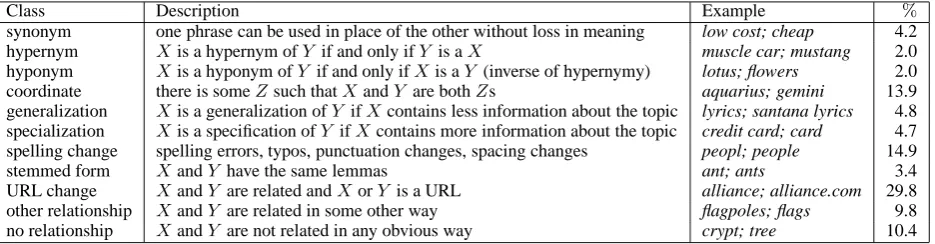
WordNet is a large lexical database of English words. In addition to defining several hun-dred thousand words, it defines synonym sets, or synsets, of words that represent some underly-ing lexical concept, plus relationships between synsets. The most frequent relationships between noun-phrases are synonym, hyponym, hypernym, and coordinate, defined in Table 1. We also may use meronym and holonym, defined as thePART-OF
relationship.
We used WordNet to automatically label the subset of our sample for which both phrases occur in WordNet. Any sense of the first segment having a relationship to any sense of the second would re-sult in the pair being labeled. Since WordNet con-tains many other relationships in addition to those listed above, we group the rest into the other cate-gory. If the segments had no relationship in Word-Net, they were labeled no relationship.
4.2 Segment Pair Labels
Phrase pairs passing a statistical test are com-mon reformulations, but can be of many seman-tic types. Rieh and Xie (2001) categorized types of query reformulations, defining 10 general cat-egories: specification, generalization, synonym,
parallel movement, term variations, operator us-age, error correction, general resource, special re-source, and site URLs. We redefine these slightly to apply to query segments. The summary of the definitions is shown in Table 1, along with the dis-tribution in the data of pairs passing the statistical test.
4.2.1 Hand Labeling
More than90%of phrases in query logs do not appear in WordNet due to being spelling errors, web site URLs, proper nouns of a temporal nature, etc. Six annotators labeled 2,463 segment pairs selected randomly from our sample. Annotators agreed on the label of78%of pairs, with a Kappa statistic of.74.
5 Automatic Classification
We wish to perform supervised classification of pairs of phrases into semantic classes. To do this, we will assign features to each pair of phrases, which may be predictive of their semantic rela-tionship, then use a machine-learned classifier to assign weights to these features. In Section 7 we will look at the learned weights and discuss which features are most significant for identifying which semantic classes.
5.1 Features
Features for query substitution pairs are extracted from query logs and web pages.
5.1.1 Web Page / Document Features
We submit the two segments to a web search engine as a conjunctive query and download the top 50 results. Each result is converted into an HTML Document Object Model (DOM) tree and segmented into sentences.
Dependency Tree Paths The path from the first
segment to the second in a dependency parse tree generated by MINIPAR (Lin, 1998) from sentences in which both segments ap-pear. These were previously used by Snow et al. (2005). These features were extracted from web pages in all experiments, except where we identify that we used TREC news stories (the same data as used by Snow et al.).
HTML Paths The paths from DOM tree nodes
Class Description Example %
synonym one phrase can be used in place of the other without loss in meaning low cost; cheap 4.2
hypernym Xis a hypernym ofY if and only ifY is aX muscle car; mustang 2.0
hyponym Xis a hyponym ofY if and only ifXis aY (inverse of hypernymy) lotus; flowers 2.0 coordinate there is someZsuch thatXandY are bothZs aquarius; gemini 13.9 generalization Xis a generalization ofY ifXcontains less information about the topic lyrics; santana lyrics 4.8 specialization Xis a specification ofY ifXcontains more information about the topic credit card; card 4.7 spelling change spelling errors, typos, punctuation changes, spacing changes peopl; people 14.9
stemmed form XandY have the same lemmas ant; ants 3.4
URL change XandY are related andXorY is a URL alliance; alliance.com 29.8
other relationship XandY are related in some other way flagpoles; flags 9.8
[image:4.595.75.543.62.184.2]no relationship XandY are not related in any obvious way crypt; tree 10.4
Table 1: Semantic relationships between phrases rewritten in query reformulation sessions, along with their prevalence in our data.
Lexico-syntactic Patterns (Hearst, 1992) A
sub-string occurring between the two segments extracted from text in nodes in which both segments appear. In the example fragment “authors such as Shakespeare”, the feature is “such as” and the value is the number of times the substring appears between “author” and “Shakespeare”.
5.1.2 Query Pair Features
Table 2 summarizes features that are induced from the query strings themselves or calculated from query log data.
5.2 Additional Training Pairs
We can double our training set by adding for each pairu1, u2a new pairu2, u1. The class of the new pair is the same as the old in all cases but hyper-nym, hypohyper-nym, specification, and generalization, which are inverted. Features are reversed from
f(u1, u2)tof(u2, u1).
A pair and its inverse have different sets of fea-tures, so splitting the set randomly into training and testing sets should not result in resubstitution error. Nonetheless, we ensure that a pair and its inverse are not separated for training and testing.
5.3 Classifier
For each class we train a binary one-vs.-all linear-kernel support vector machine (SVM) using the optimization algorithm of Keerthi and DeCoste (2005).
5.3.1 Meta-Classifier
For n-class classification, we calibrate SVM scores to probabilities using the method described by Platt (2000). This gives us P(class|pair) for each pair. The final classification for a pair is
argmaxclassP(class|pair).
Source Snow (NIPS 2005) Experiment Task binary hypernym binary hypernym
Data WordNet-TREC WordNet-TREC
Instance Count 752,311 752,311 Features minipar paths minipar paths
Feature Count 69,592 69,592
Classifier logistic Regression linear SVM
[image:4.595.307.530.229.313.2]maxF 0.348 0.453
Table 3: Snow et al’s (2005) reported performance using lin-ear regression, and our reproduction of the same experiment, using a support vector machine (SVM).
5.3.2 Evaluation
Binary classifiers are evaluated by ranking in-stances by classification score and finding the Max F1 (the harmonic mean of precision and recall; ranges from 0 to 1) and area under the ROC curve (AUC; ranges from 0.5 to 1 with at least 0.8 being “good”). The meta-classifier is evaluated by pre-cision and recall of each class and classification accuracy of all instances.
6 Experiments
6.1 Baseline Comparison to Snow et al.’s Previous Hypernym Classification on WordNet-TREC data
Snow et al. (2005) evaluated binary classifi-cation of noun-phrase pairs as hypernyms or non-hypernyms. When training and testing on WordNet-labeled pairs from TREC sentences, they report classifier Max F of 0.348, using de-pendency path features and logistic regression. To justify our choice of an SVM for classification, we replicated their work. Snow et al. provided us with their data. With our SVM we achieved a Max F of 0.453, 30% higher than they reported.
6.2 Extending Snow et al.’s WordNet-TREC Binary Classification to N Classes
hy-Feature Description
Levenshtein Distance # character insertions/deletions/substitutions to change queryαto queryβ(Levenshtein, 1966). Word Overlap Percent # words the two queries have in common, divided by num. words in the longer query.
Possible Stem 1 if the two segments stem to the same root using the Porter stemmer. Substring Containment 1 if the first segment is a substring of the second.
Is URL 1 if either segment matches a handmade URL regexp.
[image:5.595.73.547.63.157.2]Query Pair Frequency # times the pair was seen in the entire unlabeled corpus of query pairs. Log Likelihood Ratio The Log Likelihood Ratio described in Section 3.2.1 Formula 3.2.1 Dice and Jaccard Coefficients Measures of the similarity of substitutes for and by the two phrases.
Table 2: Syntactic and statistical features over pairs of phrases.
ponym of the first sense of the second and both have no more than one tagged sense in the Brown corpus) and “Known Non-Hypernyms” (no sense of the first word is a hyponym of any sense of the second). We wished to test whether making the classes less cleanly separable would affect the re-sults, and also whether we could use these features forn-way classification.
From the same TREC corpus we extracted known synonym, known hyponym, known coordi-nate, known meronym, and known holonym pairs. Each of these classes is defined analogously to the known hypernym class; we selected these six rela-tionships because they are the six most common. A pair is labeled known no-relationship if no sense of the first word has any relationship to any sense of the second word. The class distribution was se-lected to match as closely as possible that observed in query logs. We labeled 50,000 pairs total.
Results are shown in Table 4(a). Although AUC is fairly high for all classes, MaxF is low for all but two. MaxF has degraded quite a bit for hyper-nyms from Table 3. Removing all instances except hypernym and no relationship brings MaxF up to 0.45, suggesting that the additional classes make it harder to separate hypernyms.
Metaclassifier accuracy is very good, but this is due to high recall of no relationship and coordi-nate pairs: more than 80% of instances with some relationship are predicted to be coordinates, and most of the rest are predicted no relationship. It seems that we are only distinguishing between no vs. some relationship.
The size of the no relationship class may be bi-asing the results. We removed those instances, but performance of the n-class classifier did not im-prove (Table 4(b)). MaxF of binary classifiers did improve, even though AUC is much worse.
6.3 N-Class Classification of Query Pairs
We now use query pairs rather than TREC pairs.
6.3.1 Classification Using Only Dependency Paths
We first limit features to dependency paths in order to compare to the prior results. Dependency paths cannot be obtained for all query phrase pairs, since the two phrases must appear in the same sen-tence together. We used only the pairs for which we could get path features, about 32% of the total. Table 5(a) shows results of binary classification and metaclassification on those instances using pendency path features only. We can see that de-pendency paths do not perform very well on their own: most instances are assigned to the “coordi-nate” class that comprises a plurality of instances. A comparison of Tables 5(a) and 4(a) suggests that classifying query substitution pairs is harder than classifying TREC phrases.
Table 5(b) shows the results of binary clas-sification and metaclasclas-sification on the same in-stances using all features. Using all features im-proves performance dramatically on each individ-ual binary classifier as well as the metaclassifier.
6.3.2 Classification on All Query Pairs Using All Features
We now expand to all of our hand-labeled pairs. Table 6(a) shows results of binary and meta classi-fication; Figure 1 shows precision-recall curves for 10 binary classifiers (excluding URLs). Our clas-sifier does quite well on every class but hypernym and hyponym. These two make up a very small percentage of the data, so it is not surprising that performance would be so poor.
The metaclassifier achieved 71% accuracy. This is significantly better than random or majority-class baselines, and close to our 78% interanno-tator agreement. Thresholding the metaclassifier to pairs with greater than .5 max class probability (68% of instances) gives 85% accuracy.
com-binary n-way data
class maxF AUC prec rec %
no rel .980 .986 .979 .985 80.0
synonym .028 .856 0 0 0.3
hypernym .185 .888 .512 .019 2.1
hyponym .193 .890 .462 .016 2.1
coordinate .808 .971 .714 .931 14.8
meronym .158 .905 .615 .050 0.3
holonym .120 .883 .909 .062 0.3
metaclassifier accuracy .927
(a) All seven WordNet classes. The high accuracy is mostly due to high recall of no rel and coordinate classes.
binary n-way data
maxF AUC prec rec %
– – – – 0
.086 .683 0 0 1.7 .337 .708 .563 .077 10.6 .341 .720 .527 .080 10.6 .857 .737 .757 .986 74.1 .251 .777 .500 .068 1.5 .277 .767 .522 .075 1.5
– .749
[image:6.595.116.484.60.192.2](b) Removing no relationship instances improves MaxF and recall of all classes, but performance is generally worse.
Table 4: Performance of 7 binary classifier and metaclassifiers on phrase-pairs cooccuring in TREC data labeled with WordNet classes, using minipar dependency features. These features do not seem to be adequate for distinguishing classes other than
coordinate and no-relationship.
binary n-way
class maxf auc prec rec
no rel .281 .611 .067 .006
synonym .269 .656 .293 .167
hypernym .140 .626 0 0
hyponym .121 .610 0 0
coordinate .506 .760 .303 .888 spelling .288 .677 .121 .022
stemmed .571 .834 .769 .260
URL .742 .919 .767 .691
generalization .082 .547 0 0
specification .085 .528 0 0
other .393 .681 .384 .364
metaclassifier accuracy .385 (a) Dependency tree paths only.
binary n-way data
maxf auc prec rec % % full
.602 .883 .639 .497 10.6 3.5 .477 .851 .571 .278 4.5 1.5 .167 .686 .125 .017 3.7 1.2 .136 .660 0 0 3.7 1.2 .747 .935 .624 .862 21.0 6.9 .814 .970 .703 .916 11.0 3.6 .781 .972 .788 .675 4.8 1.6 1 1 1 1 16.2 5.3 .490 .883 .489 .393 3.5 1.1 .584 .854 .600 .589 3.5 1.1 .641 .895 .603 .661 17.5 5.7
– .692 —
[image:6.595.116.482.253.414.2](b) All features.
Table 5: Binary and metaclassifier performance on the 32% of hand-labeled instances with dependency path features. Adding all our features significantly improves performance over just using dependency paths.
putationally expensive syntactic parsing of depen-dency paths. To estimate the marginal gain of the other features over the dependency paths, we ex-cluded the latter features and retrained our clas-sifiers. Results are shown in Table 6(b). Even though binary and meta-classifier performance de-creases on all classes but generalizations and spec-ifications, much of the performance is maintained. Because URL changes are easily identifiable by the IsURL feature, we removed those instances and retrained the classifiers. Results are shown in Table 6(c). Although overall accuracy is worse, individual class performance is still high, allow-ing us to conclude our results are not only due to the ease of classifying URLs.
We generated a learning curve by randomly sampling instances, training the binary classifiers on that subset, and training the metaclassifier on the results of the binary classifiers. The curve is shown in Figure 2. With 10% of the instances, we have a metaclassifier accuracy of 59%; with 100% of the data, accuracy is 71%. Accuracy shows no
sign of falling off with more instances.
6.4 Training on WordNet-Labeled Pairs Only
Figure 2 implies that more labeled instances will lead to greater accuracy. However, manually la-beled instances are generally expensive to obtain. Here we look to other sources of labeled instances for additional training pairs.
6.4.1 Training and Testing on WordNet
We trained and tested five classifiers using 10-fold cross validation on our set of WordNet-labeled query segment pairs. Results for each class are shown in Table 7. We seem to have regressed to predicting no vs. some relationship.
binary n-way
class maxf auc prec rec
no rel .531 .878 .616 .643
synonym .355 .820 .506 .212
hypernym .173 .821 .100 .020
hyponym .173 .797 .059 .010
coordinate .635 .921 .590 .703 spelling .778 .960 .625 .904
stemmed .703 .973 .786 .589
URL 1 1 1 1
generalization .565 .916 .575 .483 specification .661 .926 .652 .506
other .539 .898 .575 .483
metaclassifier accuracy .714 (a) All features.
binary n-way data
maxf auc prec rec %
.466 .764 .549 .482 10.4 .351 .745 .493 .178 4.2
.133 .728 0 0 2.0
.163 .733 0 0 2.0
.539 .832 .565 .732 13.9 .723 .917 .628 .902 14.9 .656 .964 .797 .583 3.4
1 1 1 1 29.8
.492 .852 .604 .604 4.8 .578 .869 .670 .644 4.7 .436 .790 .550 .444 9.8
– .714
(b) Dependency path features removed.
binary n-way
maxf auc prec rec
.512 .808 .502 .486 .350 .759 .478 .212 .156 .710 .250 .020 .187 .739 .125 .020 .634 .885 .587 .706 .774 .939 .617 .906 .717 .967 .802 .601
– – – –
.581 .885 .598 .634 .665 .906 .657 .468 .529 .847 .559 .469
– .587
[image:7.595.76.521.60.222.2](c) URL class removed. Table 6: Binary and metaclassifier performance on all classes and all hand-labeled instances. Table (a) provides a benchmark for 10-class classification over highly substitutable query phrases. Table (b) shows that a lot of our performance can be achieved without computationally-expensive parsing.
binary meta data
class maxf auc prec rec %
no rel .758 .719 .660 .882 57.8
synonym .431 .901 .617 .199 2.4
hypernym .284 .803 .367 .061 1.8
hyponym .212 .804 .415 .056 1.6
coordinate .588 .713 .615 .369 35.5
other .206 .739 .375 .019 0.8
[image:7.595.82.283.277.372.2]metaclassifier accuracy .648
Table 7: Binary and metaclassifier performance on WordNet-labeled instances with all features.
binary meta data
class maxf auc prec rec %
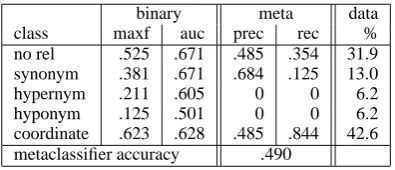
no rel .525 .671 .485 .354 31.9
synonym .381 .671 .684 .125 13.0
hypernym .211 .605 0 0 6.2
hyponym .125 .501 0 0 6.2
coordinate .623 .628 .485 .844 42.6 metaclassifier accuracy .490
Table 8: Training on WordNet-labeled pairs and testing on hand-labeled pairs. Classifiers trained on WordNet do not generalize well.
6.4.2 Training on WordNet, Testing on WordNet and Hand-Labeled Pairs
We took the five classes for which human and WordNet definitions agreed (synonyms, coordi-nates, hypernyms, hyponyms, and no relationship) and trained classifiers on all WordNet-labeled in-stances. We tested the classifiers on human-labeled instances from just those five classes. Re-sults are shown in Table 8. Performance was not very good, reinforcing the idea that while our features can distinguish between query segments, they cannot distinguish between common words.
0.56 0.58 0.6 0.62 0.64 0.66 0.68 0.7 0.72
0 500 1000 1500 2000 2500 3000 3500 4000 4500 5000
Metaclassifier accuracy
[image:7.595.326.502.281.406.2]Number of query pairs
Figure 2: Meta-classifier accuracy as a function of number of labeled instances for training.
7 Discussion
Almost all high-weighted features are either HTML paths or query log features; these are the ones that are easiest to obtain. Many of the highest-weight HTML tree features are symmet-ric, e.g. both words appear in cells of the same ta-ble, or as items in the same list. Here we note a selection of the more interesting predictors.
synonym —“X or Y” expressed as a dependency
path was a high-weight feature.
hyper/hyponym —“Y and other X” as a
depen-dency path has highest weight. An interesting feature is X in a table cell and Y appearing in text outside but nearby the table.
sibling —many symmetric HTML features. “X to
the Y” as in “80s to the 90s”. “X and Y”, “X, Y, and Z” highly-weighted minipar paths.
general/specialization —the top three features
are substring containment, word subset dif-ference count, and prefix overlap.
[image:7.595.83.281.426.511.2]0 0.2 0.4 0.6 0.8 1
0 0.2 0.4 0.6 0.8 1
Precision
Recall
F=0.531 F=0.634
F=0.354
F=0.172 F=0.173
no relationship sibling synonym hyponym hypernym
0 0.2 0.4 0.6 0.8 1
0 0.2 0.4 0.6 0.8 1
Precision
Recall
F=0.777
F=0.538 F=0.702
F=0.565 F=0.661
[image:8.595.106.490.65.188.2]spelling change related in some other way stemmed form generalization specification
Figure 1: Precision-recall curves for 10 binary classifiers on all hand-labeled instances with all features.
cating that two words that cooccur in a web page are not likely to be spelling differences.
other —many symmetric HTML features. Two
words emphasized in the same way (e.g. both bolded) may indicate some relationship.
none —many asymmetric HTML features, e.g.
one word in a blockquote, the other bolded in a different paragraph. Dice coefficient is a good negative features.
8 Conclusion
We have provided the first benchmark for n -class semantic -classification of highly substi-tutable query phrases. There is much room for im-provement, and we expect that this baseline will be surpassed.
Acknowledgments
Thanks to Chris Manning and Omid Madani for helpful comments, to Omid Madani for providing the classification code, to Rion Snow for providing the hypernym data, and to our labelers.
This work was supported in part by the CIIR and in part by the Defense Advanced Research Projects Agency (DARPA) under contract number HR001-06-C-0023. Any opinions, findings, and conclusions or recommendations expressed in this material are those of the authors and do not neces-sarily reflect those of the sponsor.
References
Peter G. Anick. 2003. Using terminological feedback for web search refinement: a log-based study. In SIGIR 2003, pages 88–95.
Ido Dagan, Oren Glickman, and Bernardo Magnini. 2005. The pascal recognising textual entailment challenge. In
PASCAL Challenges Workshop on Recognising Textual Entailment.
Ted E. Dunning. 1993. Accurate methods for the statistics of surprise and coincidence. Computational Linguistics, 19(1):61–74.
Marti A. Hearst. 1992. Automatic acquisition of hyponyms from large text corpora. In Proceedings of Coling 1992, pages 539–545.
Rosie Jones, Benjamin Rey, Omid Madani, and Wiley Greiner. 2006. Generating query substitutions. In 15th
International World Wide Web Conference (WWW-2006),
Edinburgh.
Sathiya Keerthi and Dennis DeCoste. 2005. A modified fi-nite newton method for fast solution of large scale linear svms. Journal of Machine Learning Research, 6:341–361, March.
Lillian Lee. 1999. Measures of distributional similarity. In
37th Annual Meeting of the Association for Computational Linguistics, pages 25–32.
V. I. Levenshtein. 1966. Binary codes capable of cor-recting deletions, insertions, and reversals. Cybernetics
and Control Theory, 10(8):707–710. Original in Doklady Akademii Nauk SSSR 163(4): 845–848 (1965).
Dekang Lin. 1998. Dependency-based evaluation of mini-par. In Workshop on the Evaluation of Parsing Systems. George A. Miller. 1995. Wordnet: A lexical database for
english. Communications of the ACM, 38(11):39–41. J. Platt. 2000. Probabilistic outputs for support vector
ma-chines and comparison to regularized likelihood methods. pages 61–74.
Soo Young Rieh and Hong Iris Xie. 2001. Patterns and se-quences of multiple query reformulations in web search-ing: A preliminary study. In Proceedings of the 64th
An-nual Meeting of the American Society for Information Sci-ence and Technology Vol. 38, pages 246–255.
Rion Snow, Dan Jurafsky, and Andrew Y. Ng. 2005. Learn-ing syntactic patterns for automatic hypernym discovery. In Proceedings of the Nineteenth Annual Conference on
Neural Information Processing Systems (NIPS 2005).
Egidio Terra and Charles L. A. Clarke. 2004. Scoring miss-ing terms in information retrieval tasks. In CIKM 2004, pages 50–58.
P.D Turney, M.L. Littman, J. Bigham, and V. Shnayder, 2003.
Recent Advances in Natural Language Processing III: Se-lected Papers from RANLP 2003, chapter Combining