Proceedings of the Thirteenth Workshop on Innovative Use of NLP for Building Educational Applications, pages 200–205
The Whole is Greater than the Sum of its Parts: Towards the Effectiveness
of Voting Ensemble Classifiers for Complex Word Identification
Nikhil Wani†,?, Sandeep Mathias?, Jayashree Aanand Gajjam♣, Pushpak Bhattacharyya? Center for Indian Language Technology
?Department of Computer Science and Engineering
♣Department of Humanities and Social Sciences
Indian Institute of Technology Bombay, India,
?sam,pb{@cse.iitb.ac.in},♣jayashree [email protected]
Abstract
In this paper, we present an effective sys-tem using voting ensemble classifiers to detect contextually complex words for non-native English speakers. To make the final decision, we channel a set of eight calibrated classifiers based on lexical, size and vocabulary features and train our model with annotated datasets collected from a mixture of native and non-native speakers. Thereafter, we test our system on three datasets namely NEWS, WIKINEWS,
and WIKIPEDIA and report competitive
re-sults with an F1-Score ranging between 0.777 to 0.855 for each of the datasets. Our sys-tem outperforms multiple other models and falls within 0.042 to 0.026 percent of the best-performing model’s score in the shared task.
1 Introduction
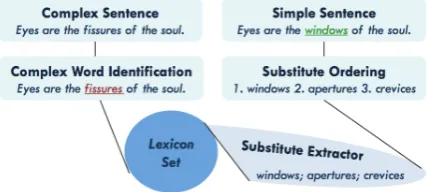
Complex Word Identification (CWI) is an essen-tial sub-task for Lexical Simplification. Lexical Simplification involves substituting a complicated word in the text with a more straightforward syn-onym. Figure 1 shows the pipeline for Lexical Simplification systems. It is geared for target pop-ulation like non-native speakers, second-language learners, young learners, and people with language disabilities (like Aphasia and Alexia), with the aim of allowing them to comprehend the presented text completely.
The goal of the shared task is as follows: Given a target word (or phrase) and its context, we are to computationally determine if the target word is complex or not. Unlike the SemEval 2016 shared task, the target words herecould have more than one word(e.g.,teenage girl), and the context could stretch over multiple sentences.
[image:1.595.310.524.226.322.2]The rest of the paper is organized as follows. In Section 2, we mention related work in the area of Complex Word Identification - in partic-ular, the previous shared task at SemEval 2016
Figure 1: Lexical Simplification Pipeline
(Paetzold and Specia,2016a). Section3describes the dataset of NLP BEA’S CWI shared task at NAACL 2018. In Section 4, we describe our system, the features used, and our classification methodology. Moving along we then report our competitive results in Section5and discuss them in Section6. We conclude by recapitulating our paper in Section 7 and identify future work that will be done.
2 Related Work
In SemEval 2016, 21 teams participated in a shared task on complex word identification (Paet-zold and Specia, 2016a). The competition in-volved finding out whether a given word in a sen-tence was complex or not for a non-native speaker. The dataset used was completely in English.
In this task, the winning team used a soft voting-based approach from the outputs of 21 predic-tors (either classifiers, threshold-based, or lexical) (Paetzold and Specia,2016b). This system was the best system according to the G-Score - an eval-uation metric designed specifically for this task at SemEval 2016 (Paetzold and Specia, 2016a). The system with the best F1-Score made use of a threshold-based approach that marked a word as complex if its frequency in Simple Wikipedia is above a threshold (Wr´obel,2016).
Other systems at the SemEval 2016 shared
Dataset Total Sents. Unique Sents.
NEWS-TRAIN 14002 1016
NEWS-TEST 2095 175
WIKINEWS-TRAIN 7746 652
WIKINEWS-TEST 1287 105
WIKIPEDIA-TRAIN 5551 387
[image:2.595.75.288.65.169.2]WIKIPEDIA-TEST 870 61
Table 1: Description of the Dataset. The first column gives the dataset. The next column gives the total num-ber of sentences. The last column gives the numnum-ber of unique sentences.
task used SVM (Kuru, 2016; Choubey and Pa-teria, 2016; S P et al., 2016; Zampieri et al., 2016), Random Forest (Davoodi and Kosseim, 2016; Mukherjee et al., 2016; Zampieri et al., 2016;Brooke et al.,2016;Ronzano et al.,2016), Neural Networks (Bingel et al.,2016;Nat,2016), Decision Trees (Quijada and Medero, 2016; Malmasi et al., 2016; Malmasi and Zampieri, 2016), Nearest Centroid classifier (Palakurthi and Mamidi, 2016), Naive Bayes (Mukherjee et al., 2016), threshold bagged classifiers (Kauchak, 2016) and Entropy classifiers (Konkol, 2016; Mart´ınez Mart´ınez and Tan,2016).
The features used in most of the systems were common, such as length-based features (like target word length), presence in a corpus (like presence of the target word in Simple English Wikipedia), PoS features of the target word, position features (position of the target word in the sentence),etc. However, a few of the systems used some in-novative features. One of them was the MRC Psycholinguistic database (Wilson,1988) used by Davoodi and Kosseim(2016). Another system by Konkol(2016) useda single featurenamely docu-ment frequency of the word in Wikipedia, for clas-sifying using a maximum entropy classifier.
3 Datasets
For this shared task (Yimam et al., 2018), we used only the English monolingual dataset, which made use of data from a number of sources, such as News articles, WikiNews and Wikipedia arti-cles. Table3shows details such as total sentences and the number of unique sentences that we com-puted across all the three datasets. The Wikipedia dataset consisted of sentences from Wikipedia ar-ticles. Likewise, the WIKINEWS dataset and the
NEWS dataset contained sentences from news ar-ticles. However, the difference between the two is that the articles in the NEWS dataset were writ-ten by professional journalists, while lesser ex-perienced writers wrote those in the WIKINEWS dataset.
In a majority of instances, the target words were just a single word. However, there were a few tar-get words that were over a word long. Similarly, in most cases, the context was only one sentence, ex-cept for a few instances in which the context was as long as 3 - 4 sentences. The training datasets were annotated by 10 native and 10 non-native En-glish speakers. Even if one amongst them found the word to be difficult, it was annotated as com-plex.
4 Methodology
In this section, we describe the experiment setup, such as the features used and provide analysis for their selection. This is followed by a detailed sys-tem overview which explains the syssys-tem’s archi-tecture.
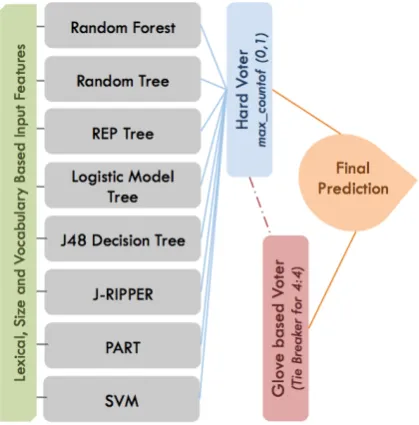
Figure 2: CWI System Architecture
4.1 Feature Sets
[image:2.595.312.522.413.626.2]4.1.1 Lexical Features
The following features were extracted using WordNet (Fellbaum,1998) for the target word:
• Degree of Polysemy (DP):Number of senses of the target word in WordNet (Fellbaum, 1998). This is operationalized by counting the number of Synsets of the target word in WordNet. Words with larger WordNet Synset sizes have several senses and were found to be more unclear.
• Hyponym (Ho) and Hypernym (He) Tree
Depth (TD): These help in finding lexical relations. To find the position of the word in WordNet’s hierarchical tree, we consider capturing its depth. General and simple words tend to be at the top of the tree. By computing the average depth among all the target-word Synsets, we count the number of Hyponyms and Hypernyms as a feature.
• Holonym Count (HC) and Meronym
Count (MC):An alternative way to traverse Wordnet’s hierarchical tree is by consider-ing the relationship of the target word to its components (Meronyms) or to the things it is contained in (Holonyms). Holonyms tend to be more simple than meronyms because meronyms are usually more specific, com-pared to holonyms, as holonyms are a gen-eralized word for a group of entities, while meronyms refer to specific entities in that group.
• Verb Entailments (VE):Verbs being action words often contain entailment relationships. For example, the act of roosting involves the act of sitting, so roosting entails sitting. Tar-get words on average with multiple entail-ments were found to be relatively complex since they tend to be visually more vivid when trying to comprehend. Hence, the num-ber of verb entailments of the target word was also part of our feature set.
4.1.2 Other Features
In addition to the lexical features, we also make use of size-based features and vocabulary-based features. These features are defined in Table3.
4.2 System Overview
These input features are converged to the follow-ing eight calibrated classifiers, namely Random
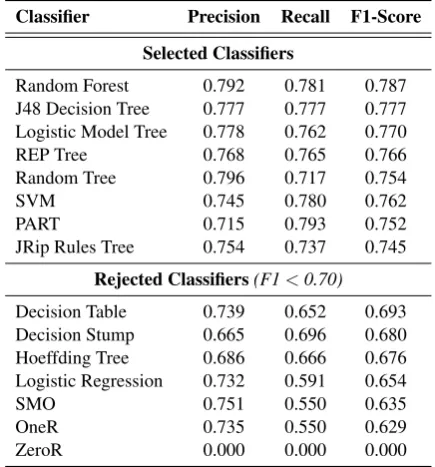
Classifier Precision Recall F1-Score Selected Classifiers
Random Forest 0.792 0.781 0.787 J48 Decision Tree 0.777 0.777 0.777 Logistic Model Tree 0.778 0.762 0.770
REP Tree 0.768 0.765 0.766
Random Tree 0.796 0.717 0.754
SVM 0.745 0.780 0.762
PART 0.715 0.793 0.752
JRip Rules Tree 0.754 0.737 0.745 Rejected Classifiers(F1<0.70) Decision Table 0.739 0.652 0.693 Decision Stump 0.665 0.696 0.680 Hoeffding Tree 0.686 0.666 0.676 Logistic Regression 0.732 0.591 0.654
SMO 0.751 0.550 0.635
OneR 0.735 0.550 0.629
[image:3.595.307.525.63.297.2]ZeroR 0.000 0.000 0.000
Table 2: Results of ten-fold cross-validation on the training for each of the classifiers on thecomplex class only. This was used to choose our top classifiers.
Forest, Random Tree, REP Tree, Logistic Model Tree, J48 Decision Tree, JRip Rules Tree, PART, and SVM, from a set of 16 classifiers (7 tree-based classifiers, 5 rule-based classifiers, 1 Bayesian classifier, 1 regression-based classifier, and 2 non-linear classifiers).
SIZE-BASED FEATURES
Feature Definition(Number of)
Word Count (WC) Words in the target word Word Length (WL) Letters in the target word Vowels Count (VC) Vowels in the target word Syllable Count (SC) Syllables in the target word
VOCABULARY-BASED FEATURES
Feature Definition(Word is in)
[image:3.595.307.525.67.297.2]Ogden’s Basic Lexicons (OB) Ogden’s Basic Word List Ogden’s Freq. Lexicons (OF) Ogden’s Frequent Word List Barron’s Lexicons (BW) Barron’s GRE Word List
Table 3: Size-based and Vocabulary-based features that we use.
non-TEAM DATASET
WIKINEWS WIKIPEDIA NEWS
camb 0.8430 0.8115 0.8792
ajason08 0.8368 0.7736 0.8625
nathansh 0.8329 0.7996 0.8706
nikhilwani 0.8213 0.7770 0.8554
dirkdh 0.8151 0.7816 0.8721
daalft 0.8050 0.7839 0.8391
TMU 0.7910 0.7621 0.8706
pom 0.7723 0.7460 0.8277
[image:4.595.69.292.65.229.2]natgillin 0.7498 0.6690 0.8363
Table 4: F1-Score for each of the datasets for the top 10 teams on the corresponding test dataset. The high-lighted row corresponds to our submission.
complex class, the ZeroR classifier has a Preci-sion, Recall, and F1-Score of 0.
We use a hard voting approach to predict the class of the target word. If more than 4 classi-fiersclassify the target word as either complex or simple, we assign the majority label to that word. In case of a 4-4 tie, (where 4 classifiers say the tar-get word is complex and 4 say that it is simple), we use a word-embedding based classifier to act as a tie-breaker.
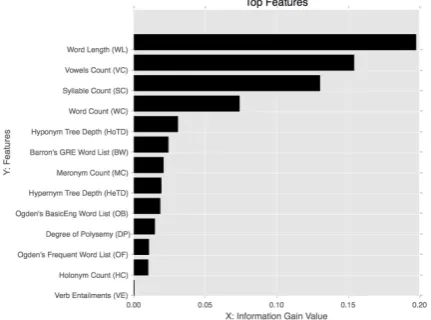
Figure 3: Feature significance observed by ranking them from highest to lowest using Attribute Evaluation based on Information Gain. The length of the bar cor-responds to the actual Information Gain value.
For the word-embedding based classifier, we use the GloVe pre-trained word embeddings (Pen-nington et al.,2014). We first split the target into its constituent words (in most cases, it is a single word, but in a few cases, it is a phrase). We find the most similar word to each of the constituent
words in the training set. If any of the given con-stituent words were tagged as complex, we target the target word as complex as well.
Out of 4252 test points to be classified, 173 times a tie occurred and the ensembled classiferes were unable to make a call. This is almost 4.06% of the predictions, which is significant in the larger scheme of things and further refines the hard vot-ing.
5 Results and Analysis
In this section we discuss the results as well as re-flect on the significance of each of the features for this task.
Table 4 gives the results of our experiments on the test set. From the results, our system is placed 4th in the WIKINEWS dataset, 5th in the WIKIPEDIAdataset, and 6th in the NEWSdataset. Figure3delineates important features and ranks them according to their significance. Size based features namely - Word Length, Vowels Count, Syllable Count, Word Count were seen to consti-tute the first four topmost features. Another useful indicator of a complex word is its presence in Bar-ron’s GRE Word List, a list filled with the vocabu-lary level equivalent to a graduate college student.
6 Discussion
As it is evident from Tables2and4, we see that individual classifiers do not work as well as en-sembling them together, which agrees with the ex-pression“The whole is greater than the sum of its parts”. Classifier Ensembling would further prove to be an efficacy for contextual documents similarity-based binary classification tasks (Kano-jia et al.,2017) which rely heavily on lexical fea-tures, as well as it should also potentially cross-pollinate to benefit probabilistic touch classifica-tion problems (Wani et al.,2017) where spatial and contextual information has been proven to be piv-otal.
7 Conclusion and Future Work
[image:4.595.74.290.446.606.2]As part of our future work, we plan to incor-porate Parts of Speech (POS) tags, Named Entity Recognition (NER) tag and word position features to improve our existing effective system.
References
Joachim Bingel, Natalie Schluter, and H´ector Mart´ınez Alonso. 2016. Coastalcph at semeval-2016 task 11: The importance of designing your neural networks right. In Proceedings of the 10th International Workshop on Semantic Eval-uation (SemEval-2016), pages 1028–1033, San Diego, California. Association for Computational Linguistics.
Julian Brooke, Alexandra Uitdenbogerd, and Timothy Baldwin. 2016. Melbourne at semeval 2016 task 11: Classifying type-level word complexity using ran-dom forests with corpus and word list features. In
Proceedings of the 10th International Workshop on Semantic Evaluation (SemEval-2016), pages 975– 981, San Diego, California. Association for Com-putational Linguistics.
Prafulla Choubey and Shubham Pateria. 2016. Garuda & bhasha at semeval-2016 task 11: Complex word identification using aggregated learning models. In
Proceedings of the 10th International Workshop on Semantic Evaluation (SemEval-2016), pages 1006– 1010, San Diego, California. Association for Com-putational Linguistics.
Elnaz Davoodi and Leila Kosseim. 2016. Clac at semeval-2016 task 11: Exploring linguistic and psycho-linguistic features for complex word identi-fication. In Proceedings of the 10th International Workshop on Semantic Evaluation (SemEval-2016), pages 982–985, San Diego, California. Association for Computational Linguistics.
Christiane Fellbaum. 1998. WordNet. Wiley Online Library.
Diptesh Kanojia, Nikhil Wani, and Pushpak Bhat-tacharyya. 2017. Is your statement purposeless? predicting computer science graduation admission acceptance based on statement of purpose. In Pro-ceedings of the 14th International Conference on Natural Language Processing (ICON-2017), pages 141–145, Kolkata, India. NLP Association of India.
David Kauchak. 2016. Pomona at semeval-2016 task 11: Predicting word complexity based on corpus fre-quency. In Proceedings of the 10th International Workshop on Semantic Evaluation (SemEval-2016), pages 1047–1051, San Diego, California. Associa-tion for ComputaAssocia-tional Linguistics.
Michal Konkol. 2016. Uwb at semeval-2016 task 11: Exploring features for complex word identifi-cation. In Proceedings of the 10th International Workshop on Semantic Evaluation (SemEval-2016),
pages 1038–1041, San Diego, California. Associa-tion for ComputaAssocia-tional Linguistics.
Onur Kuru. 2016. Ai-ku at semeval-2016 task 11: Word embeddings and substring features for com-plex word identification. In Proceedings of the 10th International Workshop on Semantic Evalua-tion (SemEval-2016), pages 1042–1046, San Diego, California. Association for Computational Linguis-tics.
Shervin Malmasi, Mark Dras, and Marcos Zampieri. 2016. Ltg at semeval-2016 task 11: Complex word identification with classifier ensembles. In Proceed-ings of the 10th International Workshop on Semantic Evaluation (SemEval-2016), pages 996–1000, San Diego, California. Association for Computational Linguistics.
Shervin Malmasi and Marcos Zampieri. 2016. Maza at semeval-2016 task 11: Detecting lexical com-plexity using a decision stump meta-classifier. In
Proceedings of the 10th International Workshop on Semantic Evaluation (SemEval-2016), pages 991– 995, San Diego, California. Association for Com-putational Linguistics.
Jos´e Manuel Mart´ınez Mart´ınez and Liling Tan. 2016. Usaar at semeval-2016 task 11: Complex word identification with sense entropy and sentence per-plexity. In Proceedings of the 10th International Workshop on Semantic Evaluation (SemEval-2016), pages 958–962, San Diego, California. Association for Computational Linguistics.
Niloy Mukherjee, Braja Gopal Patra, Dipankar Das, and Sivaji Bandyopadhyay. 2016. Ju nlp at semeval-2016 task 11: Identifying complex words in a sen-tence. In Proceedings of the 10th International Workshop on Semantic Evaluation (SemEval-2016), pages 986–990, San Diego, California. Association for Computational Linguistics.
Gillin Nat. 2016. Sensible at semeval-2016 task 11: Neural nonsense mangled in ensemble mess. In
Proceedings of the 10th International Workshop on Semantic Evaluation (SemEval-2016), pages 963– 968, San Diego, California. Association for Com-putational Linguistics.
Gustavo Paetzold and Lucia Specia. 2016a. SemEval 2016 Task 11: Complex Word Identification. In
Proceedings of the 10th International Workshop on Semantic Evaluation (SemEval-2016), pages 560– 569, San Diego, California. Association for Com-putational Linguistics.
Ashish Palakurthi and Radhika Mamidi. 2016. Iiit at semeval-2016 task 11: Complex word identification using nearest centroid classification. In Proceed-ings of the 10th International Workshop on Semantic Evaluation (SemEval-2016), pages 1017–1021, San Diego, California. Association for Computational Linguistics.
Jeffrey Pennington, Richard Socher, and Christopher Manning. 2014. Glove: Global vectors for word representation. In Proceedings of the 2014 Con-ference on Empirical Methods in Natural Language Processing (EMNLP), pages 1532–1543, Doha, Qatar. Association for Computational Linguistics.
Maury Quijada and Julie Medero. 2016. Hmc at semeval-2016 task 11: Identifying complex words using depth-limited decision trees. InProceedings of the 10th International Workshop on Semantic Evaluation (SemEval-2016), pages 1034–1037, San Diego, California. Association for Computational Linguistics.
Francesco Ronzano, Ahmed Abura’ed, Luis Es-pinosa Anke, and Horacio Saggion. 2016. Taln at semeval-2016 task 11: Modelling complex words by contextual, lexical and semantic features. In
Proceedings of the 10th International Workshop on Semantic Evaluation (SemEval-2016), pages 1011– 1016, San Diego, California. Association for Com-putational Linguistics.
Sanjay S P, Anand Kumar, and Soman K P. 2016. Amritacen at semeval-2016 task 11: Complex word identification using word embedding. In Proceed-ings of the 10th International Workshop on Seman-tic Evaluation (SemEval-2016), pages 1022–1027, San Diego, California. Association for Computa-tional Linguistics.
Nikhil Wani, Adarsh Patodi, and Sumit Singh Yadav. 2017. Probabilistic modeling of swarachakra key-board for improved touch accuracy. In Adjunct Proceedings of 16th IFIP TC.13 International Con-ference on Human Computer Interaction (INTER-ACT 2017 MUMBAI), pages 22–27, Industrial De-sign Centre, IIT Bombay, Mumbai, India.
Michael Wilson. 1988. Mrc psycholinguistic database: Machine-usable dictionary, version 2.00. Behav-ior research methods, instruments, & computers, 20(1):6–10.
Krzysztof Wr´obel. 2016. Plujagh at semeval-2016 task 11: Simple system for complex word identi-fication. In Proceedings of the 10th International Workshop on Semantic Evaluation (SemEval-2016), pages 953–957, San Diego, California. Association for Computational Linguistics.
Seid Muhie Yimam, Chris Biemann, Shervin Mal-masi, Gustavo Paetzold, Lucia Specia, Sanja ˇStajner, Ana¨ıs Tack, and Marcos Zampieri. 2018. A Report on the Complex Word Identification Shared Task
2018. InProceedings of the 13th Workshop on In-novative Use of NLP for Building Educational Ap-plications, New Orleans, United States. Association for Computational Linguistics.