PLUJAGH at SemEval-2016 Task 11:
Simple System for Complex Word Identification
Krzysztof Wróbel Jagiellonian University
ul. Golebia 24 31-007 Krakow, Poland
AGH University of Science and Technology al. Mickiewicza 30
30-059 Krakow, Poland
Abstract
This paper presents the description of a sys-tem which detects complex words. It solely uses information regarding the presence of a word in a prepared vocabulary list. The tem outperforms multiple more advanced sys-tems and is ranked fourth for the shared task, with minimal loss to the best system. F-score optimization guaranteed the first place in this measurement. Different features are consid-ered and evaluated. Maximal bounds are pre-dicted. The rule “the simplest methods give the best results” is confirmed.
1 Introduction
The goal of Complex Word Identification (CWI) is to detect words in a text that are complex (not easy to understand) for some group of people. CWI is one of the tasks of SemEval-2016 (Paetzold and Specia, 2016).
CWI can be treated as the first step of Lexical Simplification (LS). LS was a task of SemEval-2012 (Specia et al., 2012). Complex words were identi-fied using n-grams, the length of the word, and the number of syllables (Ligozat et al., 2012; De Belder et al., 2010; Biran et al., 2011). The resources exploited in this task include Wikipedia, WordNet, Google Web 1T corpus (Sinha, 2012; Paetzold and Specia, 2015). Additional annotation of input sen-tences was performed by: a part-of-speech tagger, and word sense disambiguation (Amoia and Ro-manelli, 2012; Jauhar and Specia, 2012).
A similar task is the prediction of the readability of a whole text. In comparison, in CWI, each word
has to be scored. The applied methods are summa-rized in (D˛ebowski et al., 2015).
This paper presents findings regarding the neces-sary data and the performed experiments. For the fi-nal submission, a simple system was chosen, which scored at fourth place.
2 Task Data Analysis
It is important to notice the difference between train-ing and test data. Each sentence in the traintrain-ing set was annotated by 20 annotators. If at least one of them classified a word in a sentence as complex, it was marked as complex. The training data consists of 2237 classified words. On the other hand, each sentence in the test data (88221 classified words) was annotated by only one annotator.
Complex words represent 31.56% of the words in the training data. Fortunately, organizers pub-lished the unaggregated annotations – every word in a sentence has 20 annotations. In this scenario, only 4.55% instances are classified as complex.
A priori probability of the word being complex is important knowledge for the classification task.
What is more, the organizers shared the baseline results for test data (Table 1). It shows that complex words represent 4.7% of instances in the test data – similar to training.
3 Resources and Methods
Knowledge bases are essential to this task. Wikipedia is one of the most popular sources of text used in NLP. Using the cycloped.io (Smywi´nski-Pohl and Wróbel, 2014) framework the English and Simple English Wikipedia were preprocessed. The
Table 1: Scores for baseline systems on the test data. 1) All complex – all words are classified as complex, 2) All simple: all words are classified as simple, 3) Ogden’s lexicon: words present in Ogden’s Basic English vocabulary are classified as simple, others as complex. G-score is defined as a harmonic mean of accuracy and recall.
System Accuracy Recall G-score All complex 0.047 1.000 0.089 All simple 0.953 0.000 0.000 Ogden’s lexicon 0.248 0.947 0.393
text extracted from articles allowed the calculation of term frequency (TF) and document frequency (DF). TF represents the total number of times a word appears in the corpora; DF is the number of docu-ments in which the word occurred at least once.
It was required to apply the same tokenization of corpora as in the data from the organizers.
For every word which needed classification, many features were created:
• TF and DF for the word and its lemma use, – English Wikipedia,
– Simple English Wikipedia,
– corpora created from training and test sen-tences,
• length of sentence (number of words), • length of word (number of characters), • position of word in sentence,
• GloVe word embedding (Pennington et al., 2014).
For quick development, sklearn (Pedregosa et al., 2011) was used. Many supervised machine-learning algorithms were tested using cross-validation:
• decision trees with maximum depth from 1 to 6,
• linear classifier with stochastic gradient descent (SGD) training,
• k-nearest neighbors classifiers for k=3,5,10,20, • random forest,
• extremely randomized trees,
• AdaBoost,
[image:2.612.319.530.78.275.2]• GradientBoostingClassifier, • LinearSVC.
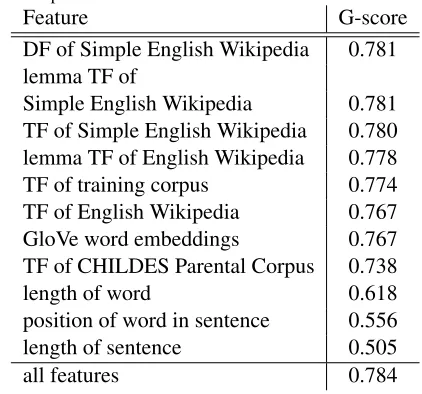
Table 2: Ranking of features in terms of G-score. The last position presents the score for all features used in one model.
Feature G-score
DF of Simple English Wikipedia 0.781 lemma TF of
Simple English Wikipedia 0.781 TF of Simple English Wikipedia 0.780 lemma TF of English Wikipedia 0.778 TF of training corpus 0.774 TF of English Wikipedia 0.767 GloVe word embeddings 0.767 TF of CHILDES Parental Corpus 0.738
length of word 0.618
position of word in sentence 0.556 length of sentence 0.505
all features 0.784
4 Evaluation
All experiments were conducted by employing cross-validation on raw vote data. Training data were aggregated – a word is labeled as complex if at least two annotators marked it accordingly.
4.1 Metrics
The results are scored using a harmonic mean of ac-curacy and recall (marked as G-score). In compar-ison to F-score (a harmonic mean of precision and recall), it is higher if more instances are predicted as complex.
4.2 Experiments
Tree-based classifiers achieved the best results (ex-cept for word embeddings). Table 2 presents the G-scores obtained by training a classifier with each of the features. Combining features gives only a slightly better score.
4.2.1 Upper Bounds
0 0.1 0.2 0.3 0.4 0.5 0.6 0.7 0.8 0.9 1
0 0.2 0.4 0.6 0.8 1
Score
Minimal percentage of annotators describing word as complex when system predicts 'complex'
G-score Accuracy Recall
[image:3.612.76.287.58.249.2]Precision F-score
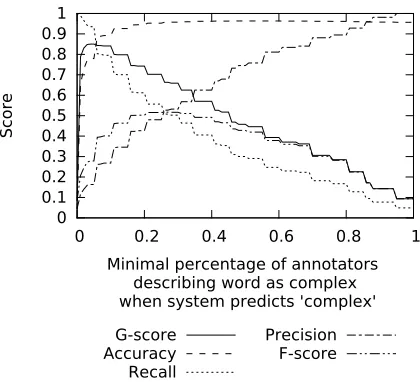
Figure 1:Results for the first theoretical system using classifi-cation with information about context.
sentences. The first one has information regarding the context (whole sentence) – for each sentence, it knows how many annotators recognized each word as complex. The second one knows how many times each word was assessed as complex (without con-text).
1. The problem can be treated as simple classi-fication and not sequence labeling. For every word in every sentence, the system predicts words as com-plex if at least X people annotated it as comcom-plex. The maximum G-score is 84.54% for X=10% and the F-score is 51.66% for X=25%. This system has infor-mation regarding the word and the sentence. How-ever, it is still not sequence classification – it has no information regarding the predictions of the other words in the sentence. Figure 1 presents results in a function of X.
2. Going further input data can be solely words, without the sentence, so that we can aggregate an-notations for the same words, but in different sen-tences. The system describes a word as complex if at least X people annotated it as complex (this sys-tem has no information regarding the context of the sentence). The maximum G-score is 85.04% for X from 4% to 5%, and the F-score is 51.71% for X from 26% to 27%. This system has information only about the word. Figure 2 presents results in a func-tion of X.
The results above show that a G-score of 86% can
0 0.1 0.2 0.3 0.4 0.5 0.6 0.7 0.8 0.9 1
0 0.2 0.4 0.6 0.8 1
Score
Minimal percentage of annotators describing word as complex when system predicts 'complex'
G-score Accuracy Recall
[image:3.612.318.528.59.250.2]Precision F-score
Figure 2:Results for the second theoretical system using clas-sification without information about context.
not be exceeded on this data.
4.2.2 Final Submission
The experiments showed a minimally increased score for more advanced classifiers using more fea-tures in comparison to the simple one-rule algorithm with one feature. Simple models are usually more difficult to overfit. The complexity of this algorithm isO(1)for every word using hashing.
The final submission uses DF of Simple English Wikipedia. The scores, as a function of threshold, are presented in Figure 3.
The main submission is optimized for G-score, and its threshold is 147. Words with a DF exceed-ing this threshold are considered simple, and others are considered complex. A set of simple words con-tains almost 11 thousand tokens (without sanitiza-tion). The size of the model is 78 kilobytes.
The second submission was optimized for F-score and the threshold was 18.
5 Results and Discussion
Table 3 shows the top 10 results of the systems on the test data in terms of G-score. The system placed fourth with two other systems.
0 0.1 0.2 0.3 0.4 0.5 0.6 0.7 0.8 0.9 1
0 50 100 150 200 250 300 350 400
Score
DF threshold
G-score Accuracy Recall
[image:4.612.74.293.81.257.2]Precision F-score
Figure 3:
Table 3:Top 10 systems in terms of G-score. Additionally, the average scores of all systems and their standard deviations are provided.
System Accuracy Recall G-score
SV000gg-Soft 0.779 0.769 0.774
SV000gg-Hard 0.761 0.787 0.773
TALN-WEI 0.812 0.736 0.772
UWB-All 0.803 0.734 0.767
PLUJAGH-SEWDF 0.795 0.741 0.767
JUNLP-NaiveBayes 0.767 0.767 0.767
HMC-RegressionTree 0.838 0.705 0.766
HMC-DecisionTree 0.846 0.698 0.765
JUNLP-RandomForest 0.795 0.730 0.761
MACSAAR-RFC 0.825 0.694 0.754
TALN-SIM 0.847 0.673 0.750
MACSAAR-NNC 0.804 0.660 0.725
Average 0.737 0.591 0.620
Standard deviation 0.130 0.202 0.123
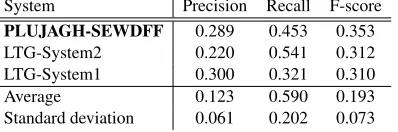
Table 4: Top 3 systems in terms of F-score. Additionally, the average scores of all systems and their standard deviations are provided.
System Precision Recall F-score
PLUJAGH-SEWDFF 0.289 0.453 0.353 LTG-System2 0.220 0.541 0.312 LTG-System1 0.300 0.321 0.310
Average 0.123 0.590 0.193
Standard deviation 0.061 0.202 0.073
paper. Its result is higher by almost one percentage point.
The next system in the ranking, TALN-WEI, uses external resources, i.e. WordNet, simple/complex word lists, tools, i.e. part-of-speech tagger, and a de-pendency parser. A random forest classifier is then trained.
JUNLP-NaiveBayes employs word sense disam-biguation and features extracted from an ontology. Also, a random forest classifier is used. Additional word lists are developed, i.e. scientific, geographi-cal, and non-English.
Surprisingly, UWB-ALL is almost the same as the one presented in this article (the English version of Wikipedia is used, not Simple English).
The presented system took first place in terms of F-score. The higher score is probably due to this submission being optimized for F-score with no other teams doing this.
Beating 85% G-score is not possible without more information. It is possible that having the possibility to model every person’s knowledge would improve the results. However, this approach needs historic data annotated by a specified user and the predic-tions would be only relevant for this user.
References
Marilisa Amoia and Massimo Romanelli. 2012. Sb: mmsystem-using decompositional semantics for lex-ical simplification. InProceedings of the First Joint Conference on Lexical and Computational Semantics-Volume 1: Proceedings of the main conference and the shared task, and Volume 2: Proceedings of the Sixth International Workshop on Semantic Evaluation, pages 482–486. Association for Computational Lin-guistics.
Or Biran, Samuel Brody, and Noémie Elhadad. 2011. Putting it simply: a context-aware approach to lexi-cal simplification. InProceedings of the 49th Annual Meeting of the Association for Computational Linguis-tics: Human Language Technologies: short papers-Volume 2, pages 496–501. Association for Computa-tional Linguistics.
[image:4.612.89.288.617.683.2]Łukasz D˛ebowski, Bartosz Broda, Bartłomiej Nito´n, and Edyta Charzy´nska. 2015. Jasnopis – a program to compute readability of texts in Polish based on psy-cholinguistic research. InNatural Language Process-ing and Cognitive Science. ProceedProcess-ings 2015, pages 51–61.
Sujay Kumar Jauhar and Lucia Specia. 2012. Uow-shef: Simplex–lexical simplicity ranking based on contex-tual and psycholinguistic features. InProceedings of the First Joint Conference on Lexical and Computa-tional Semantics-Volume 1: Proceedings of the main conference and the shared task, and Volume 2: Pro-ceedings of the Sixth International Workshop on Se-mantic Evaluation, pages 477–481. Association for Computational Linguistics.
Anne-Laure Ligozat, Anne Garcia-Fernandez, Cyril Grouin, and Delphine Bernhard. 2012. Annlor: a naïve notation-system for lexical outputs ranking. In Proceedings of the First Joint Conference on Lexical and Computational Semantics-Volume 1: Proceedings of the main conference and the shared task, and Vol-ume 2: Proceedings of the Sixth International Work-shop on Semantic Evaluation, pages 487–492. Associ-ation for ComputAssoci-ational Linguistics.
Gustavo Henrique Paetzold and Lucia Specia. 2015. Lexenstein: A framework for lexical simplification. ACL-IJCNLP 2015, 1(1):85–90.
Gustavo H. Paetzold and Lucia Specia. 2016. Semeval 2016 task 11: Complex word identification. In Pro-ceedings of the 10th International Workshop on Se-mantic Evaluation (SemEval 2016).
F. Pedregosa, G. Varoquaux, A. Gramfort, V. Michel, B. Thirion, O. Grisel, M. Blondel, P. Prettenhofer, R. Weiss, V. Dubourg, J. Vanderplas, A. Passos, D. Cournapeau, M. Brucher, M. Perrot, and E. Duches-nay. 2011. Scikit-learn: Machine learning in Python. Journal of Machine Learning Research, 12:2825– 2830.
Jeffrey Pennington, Richard Socher, and Christopher D. Manning. 2014. Glove: Global vectors for word rep-resentation. In Empirical Methods in Natural Lan-guage Processing (EMNLP), pages 1532–1543. Ravi Sinha. 2012. Unt-simprank: Systems for
lex-ical simplification ranking. In Proceedings of the First Joint Conference on Lexical and Computational Semantics-Volume 1: Proceedings of the main confer-ence and the shared task, and Volume 2: Proceedings of the Sixth International Workshop on Semantic Eval-uation, pages 493–496. Association for Computational Linguistics.
Aleksander Smywi´nski-Pohl and Krzysztof Wróbel. 2014. The importance of cross-lingual information for matching Wikipedia with the Cyc ontology. In9th
International Workshop on Ontology Matching, pages 176–177.